CBSE Class 10 English Poem Dust of Snow Summary, Line by Line Explanation along with Difficult Word Meanings and Literary Devices from First Flight Book
In the class 10 poem 1 “Dust of Snow” from the First Flight book, Robert Frost highlights the transformative power of nature. He highlights that even inauspicious things like a crow and a hemlock tree can bring a positive change in life. The poem aims at giving us a neutral outlook towards the nature around us.
Question: What are the key points of the poem Dust of Snow?
Ans. The key points of the poem “Dust of Snow” are as follows:
- Simple moments: The poem illustrates how a single simple moment in life can bring about great change. In the poem, the poet’s mood goes from gloomy to hopeful simply because a dust of snow falls upon him.
- Symbolism and nature: The poem shows two elements of nature: crow and hemlock tree. Robert Frost displays how two elements, which usually symbolise illness and grief, can still bring about a positive change in the world.
- Transformation: the simple action of the snow falling on the poet transforms his mood and makes him happy.
Dust of Snow Quick Overview
| Detail | Information |
| Poem Title | Dust of Snow |
| Author | Robert Frost |
| Book | First Flight (CBSE Class 10 English) |
| Poem No. | 1 |
| Narrator | Poet |
| Setting | Snow-covered open area around a hemlock tree |
| Theme | nature’s capacity for transformation, inauspicious things can bring happiness |
- Dust of Snow Summary
- Theme-based Questions of the Poem Dust of Snow
- Dust of Snow Previous Year Questions with Model Answers PDF
- Dust of Snow Poem Explanation
- Dust of Snow Video Explanation
- Dust of Snow Literary Devices
- Dust of Snow Summary in Hindi
Related:
- Dust of Snow Question Answers (Important)
- Dust of Snow Character Sketches
- Dust of Snow MCQs
- Dust of Snow Previous Years Question with Answers
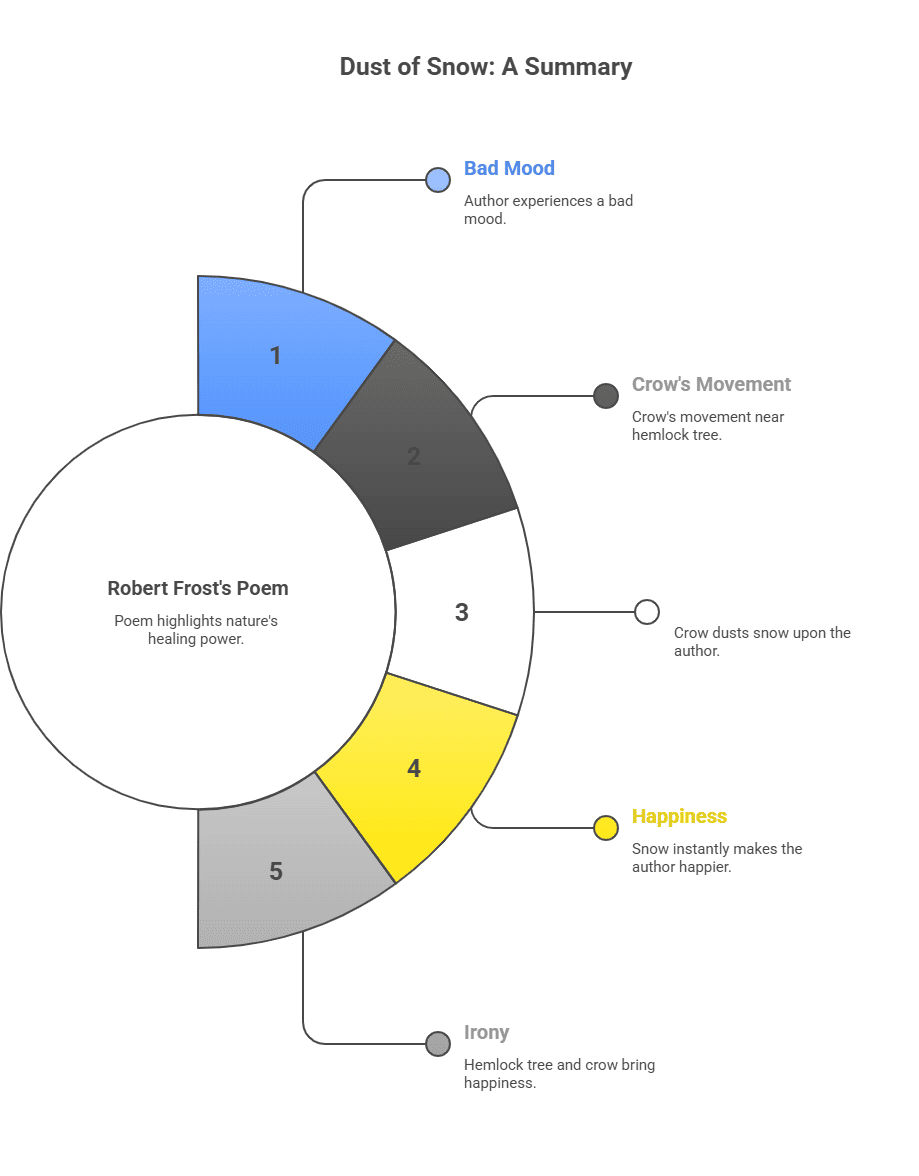
Dust of Snow Summary Mind Map
Finish your entire English prep in 24 hrs & shine in Boards 2026! – Concise chapter summaries (key events & ideas), lesson themes, Visual character sketches using mind maps Click here

Question: Give a summary of the class 10 poem Dust of Snow.
Ans. The short poem by Robert Frost throws light upon the unimaginable healing power of nature and tiny things. From a bad mood to ill-health, there is nothing that can’t be cured by nature. The author was experiencing one such bad day when a crow’s movement near a hemlock tree dusted snow upon him. The snow instantly makes him happier. His day gets a lot better. Thus, the supremacy of nature as a whole made him realise how petty his problem was. The fact that hemlock tree is poisonous combined with crow being the indicator of doom and fear are used in the poem as the carriers of happiness in the life of narrator is ironical. The poet, through these objects has tried to highlight that sometimes creatures linked with negative aspects of life can be the bringer of change and happiness. Being outdoors in nature, with all it’s unpredictability can benefit anyone, anywhere at any time.
Theme-based Questions of the Poem Dust of Snow
Question: How can a simple moment in life pose great significance and change the mood of the day? Illustrate with reference to the poem Dust of Snow.
Ans. A simple moment in life can be significant. Our mood can be lifted through a single moment. “It is the little things that matter in life.” This popular saying conveys the importance of simple moments and how we can find happiness and positivity in small gestures. This is illustrated in the poem “Dust of Snow” written by Robert Frost. It talks about a simple moment of a dust of snow falling on the poet from the hemlock tree because of the crow’s actions. The poet had been regretting that day due to prior unpleasant events. But the feeling of snow falling on him changed his mood. It distracted him from the events of the day and made him focus on something else, making him more cheerful and optimistic. The simple moment of snow falling on him gave him a change of heart, and he focused on more positive and light-hearted matters. Therefore, it doesn’t have to be grand gestures that uplift us. We can find motivation and hope even in the smallest of occurrences, like the gentle feeling of powder-like snow falling on top of us.
Question: How does Frost present nature in this poem?
Ans. Nature, as we all know, is very powerful and impactful. In the poem “Dust of Snow”, Robert Frost illustrates the power of nature and how it can change our mood in one simple moment. Frost is in a terrible mood due to the prior events that made him rue the day. However, when he felt snow fall on him because of the crow shaking the hemlock tree, he experienced a change of heart and felt more optimistic. The poem displays three elements of nature that are often associated with gloominess and negativity. These are winter, crow, and hemlock tree. However, because of the crow’s actions, the snow the hemlock tree carried, and the snow itself, invoked a feeling of happiness in the poet. This shows that while some things in nature are seen to be bad or ‘bad luck’, these things are also uplifting. This shows that everything in nature has the power to motivate and enlighten us, even those things which are associated with negativity and darkness.
Question: What is the central idea of the poem “Dust of Snow”?
Ans. The poem “Dust of Snow”, written by Robert Frost, shows the significance of simple moments in nature that are small but life-changing and uplifting. The poet is in a sad and dark mood due to his terrible day. He stands underneath the hemlock tree, regretting the events of that day. Suddenly, a crow shakes a branch of the hemlock tree. Because of the winter season, the tree is covered with snow. Due to the crow’s movement, a dust of snow falls on the poet. The poet is surprised by the feeling of the small snowflakes falling on him. The surprise snaps him out of his rueful thoughts, and therefore, nature distracts him from his terrible mood. Due to the dust of snow, the poet focuses on his surroundings rather than the past events, shifting his mood from gloomy to optimistic and light-hearted. What happened before to make the poet unhappy and how the crow moved are irrelevant. The key point is how a single simple moment in nature changed the poet’s mood and that it was brought about by a crow and a hemlock tree. A crow is a creature that symbolises darkness, death, bad omen, and grief. A hemlock tree is poisonous. Yet, it is because of the crow and hemlock tree that the poet was able to feel happier, despite them being symbols of sadness and illness.
Dust of Snow Previous Year Questions with Model Answers PDF
Download the previous year questions of the Poem Dust of Snow of class 10 for free. With the help of this, you can prepare for the exam.
To Download Dust of Snow Previous Year Questions with Model Answers- Click Here
Dust of Snow Poem Explanation
Poem
The way a crow
Shook down on me
The dust of snow
From a hemlock tree
Word Meanings
Shook– shake
Hemlock– a poisonous tree with small white flowers
Explanation: The poem is set in a scene where the poet is in a bad mood and is walking by a tree, a hemlock tree. Hemlock tree is a poisonous tree. As he passes by, a crow happens to throw some snow dust on him. Whether it falls on his head or shoulders is unknown as there is no specific mention in the poem. Also, the readers are left in doubt about the bird’s specific action. Whether the crow was landing, shivering with cold, re adjusting itself on the branch or taking off, it happened to send some particles of snow upon the author. Here, the two agents of nature, the hemlock tree and the crow are signifiers of sadness and gloom just like the poet’s mood was in the opening scene.
Questions based on the stanza above
Question: What did the crow do to the tree?
Ans. The crow moves the branch of the hemlock tree and causes snow to fall on the poet.
Question: What is a hemlock tree?
Ans. A hemlock tree is a poisonous tree with small white flowers.
Question: What is a dust of snow?
Ans. A dust of snow refers to the small particulars of snow that fall on the poet when the crow shook a branch of the hemlock tree.
Question: Why doesn’t the poet write about a more ‘beautiful’ tree such as a maple, or an oak, or a pine?
Ans. The poet Robert Frost writes about a hemlock tree in his poem “Dust of Snow” than a maple, or oak, or pine tree. This is because he wants to show that the things that are usually considered to be inauspicious or bad can generate a positive response or change of mood in us.
Question: What does the crow symbolise in the poem “Dust of Snow”?
Ans. The crow symbolises sadness and gloom in nature. In the poem “Dust of Snow”, the crow symbolises the sadness and regret that surrounded the poet in the beginning. However, despite the dark symbolism, the crow’s actions bring a positive change in the poet.
Poem
Has given my heart
A change of mood
And saved some part
Of a day I had rued.
Word Meanings
Rued– held in regret
Explanation: For reasons unknown, the author was having a terrible day. But the falling of the snow on his head lifted his mood instantly. He had already spent his day in a bad mood but the rest of it was saved by the crow and the hemlock tree. Generally, hemlock tree and crow are used for negative references but the poet used them beautifully to portray that inauspicious things can bring joy and happiness too. One must not take things for granted and should be open and accept whichever way the nature chooses to bless us.
Questions based on the stanza above
Question: What gives the poet a change of mood?
Ans. The action of the crow shaking a branch of a hemlock tree and the feeling of a dust of snow falling on him give the poet Robert Frost a change of mood.
Question: Why had the poet rued the day?
Ans. ‘Rued’ means that he regretted the day. For some reason, the poet was unhappy with how his day had passed. Perhaps he had done something, or something had happened, that put him in a terrible mood.
Dust of Snow Video Explanation
Dust of Snow Literary Devices / Poetic Devices
1. Rhyme Scheme- abab cdcd
2. Alliteration- the occurrence of the same letter or sound at the beginning of adjacent or closely connected words.
The instances of alliteration are as follows-
- Has given my heart
- And saved some part
3. inversion – when the structure of a sentence is changed by the poet to create rhyme, this poetic license is called inversion. In stanza 1, inversion can be seen.
4. assonance – the prominence of a vowel sound throughout a line is called assonance. In stanza 1, line 2 – “Shook down on me” – ‘o’ sound is prominent.
5. enjambment – when the same sentence continues to the next line without the use of any punctuation marks, it is called enjambment. It has been used throughout the poem.
Dust of Snow FAQs
Question: Who is the poet of Dust of Snow?
Ans. The poem Dust of Snow is composed by Robert Frost.
Question: What is the theme of the class 10 poem Dust of Snow?
Ans. The central message of the poem Dust of Snow is nature’s capacity for transformation, including how it can alter one’s attitude and viewpoint. The crow and the Hemlock tree, both considered inauspicious, alter his mood from that of regret to joyous.
Question: What does the crow denote in the poem Dust of Snow?
Ans. In the poem Dust of Snow, the crow is a symbol of bad luck and is considered inauspicious. However, the poet says that the crow brings him happiness and turns his mood from sad to happy. Thus, he conveys that we should not consider nature are symbolical of good or bad.
Question: What happens with the Poet in the poem Dust of Snow?
Ans. The poet was going through a bad day. A crow flew from the branch of a snow-covered hemlock tree which threw some snow on the poet. This brought him joy and made him happy.
Question: What is the poem Dust of Snow about?
Ans. The poem Dust of Snow is about the transformative power of nature. The poet conveys that we must not classify natural creations as good or bad. Even inauspicious things like a crow and a hemlock tree can bring happiness and thus, prove to be good for us.
Summary of the Poem Dust of Snow in Hindi
Here is the Summary of the poem Dust of Snow in Hindi:
रॉबर्ट फ्रॉस्ट की यह छोटी कविता प्रकृति और छोटी घटनाओं की अकल्पनीय उपचार शक्ति पर प्रकाश डालती है।
खराब मूड से लेकर अस्वस्थता तक, ऐसा कुछ भी नहीं है जिसे प्रकृति द्वारा ठीक नहीं किया जा सकता है। लेखक ऐसे ही एक बुरे दिन का अनुभव कर रहा था जब एक हेमलॉक पेड़ के पास एक कौवे की हरकत ने उस पर बर्फ गिरा दी ।
बर्फ का उस पर गिरना तुरंत उसे खुश कर देता है। उसका दिन बहुत अच्छा हो जाता है। इस प्रकार, समग्र रूप से प्रकृति की सर्वोच्चता ने उन्हें यह एहसास कराया कि उनकी समस्या कितनी क्षुद्र थी।
तथ्य यह है कि हेमलॉक का पेड़ जहरीला होता है, जिसमें कौआ कयामत का सूचक होता है और भय का उपयोग कविता में कथाकार के जीवन में खुशी के वाहक के रूप में किया गया है, यह विडंबना है।
कवि ने इन वस्तुओं के माध्यम से यह उजागर करने की कोशिश की है कि कभी-कभी जीवन के नकारात्मक पहलुओं से जुड़े जीव परिवर्तन और खुशी के कारक हो सकते हैं।
प्रकृति में बाहर होने के कारण, इसकी अप्रत्याशितता के साथ, किसी को भी, कहीं भी, किसी भी समय लाभ हो सकता है।
Explanation and Summary of Class 10 Poems from First Flight book
Also see:
- Class 10 English Syllabus
- CBSE Class 10 English Lesson Explanation, Summary
- CBSE Class 10 English Important Questions (Chapter wise)
- Character Sketches of Class 10 English
- CBSE Class 10 English MCQs
- Class 10 English First Flight word meanings
- Class 10 English First Flight Poems word meanings
- Class 10 English Footprints without Feet word meanings
- Poetic Devices in Poems of First Flight book
- Class 10 English Complete Study Guide