CBSE Class 10 English Chapter 2 Mrs. Packletide’s Tiger Summary, Explanation along with Difficult Word Meanings from Literature Reader (Communicative) Book
“Mrs Packletide’s Tiger” is a brilliantly witty and deeply humorous short story written by Saki whose real name was Hector Hugh Munro. It appears in the CBSE Class 10 English textbook as Chapter 2. Saki was a British writer renowned for his sharp satirical wit and his extraordinary ability to expose the shallow vanity and social pretensions of Edwardian upper class society through brilliantly crafted and deeply entertaining short stories. The story revolves around Mrs Packletide who decides to go on a tiger hunt not out of any genuine courage or love of adventure but purely out of jealousy toward her neighbour Loona Bimberton. The story teaches us that jealousy, vanity and the desperate desire to outshine others always lead to dishonesty, humiliation and consequences far more costly and embarrassing than the original envy that started everything.
Question: What are the Important Keywords / Value Points of ‘Mrs Packletide’s Tiger’?
- Jealousy, The Root of All Problems: Mrs Packletide’s jealousy of Loona Bimberton is the root cause of every single problem and complication that follows in the story. She does not want to shoot a tiger because she loves adventure or values courage, she wants to do so purely because Loona has done it and she cannot bear being seen as less impressive. This petty and consuming jealousy drives her into a web of dishonesty deception and ultimately humiliation showing that jealousy never leads to genuine satisfaction or real achievement in life.
- Vanity and Social Pretension, Caring Only for Appearances: Mrs Packletide is a deeply vain woman who cares far more about how she appears to society than about who she genuinely is. She stages a fake hunt poses confidently for photographs and hosts a party supposedly in Loona’s honour all in the service of her public image and social reputation. This obsession with appearances over reality is the central target of Saki’s brilliant and merciless satire showing that vanity and social pretension always lead to a hollow and ultimately unsatisfying life.
- Miss Mebbin, The Shrewd Opportunist: Miss Louisa Mebbin is Mrs Packletide’s paid companion and one of the most brilliantly drawn characters in the story. She is sharp, calculating and completely unsentimental. She notices immediately that it was the goat and not the tiger that was killed by Mrs Packletide’s bullet. Rather than keeping this information to herself out of loyalty she uses it as a tool for blackmail securing herself a weekend cottage in Dorset. Miss Mebbin represents the shrewd and opportunistic side of human nature that is always watching carefully for an advantage.
- The Staged Hunt, Dishonesty and Its Consequences: The entire tiger hunt is a carefully staged and completely dishonest performance from beginning to end. Mrs Packletide pays for a weak old tiger arranges everything to minimize any real risk and then poses as a brave and skilled hunter for the newspapers. This fundamental dishonesty is what makes her vulnerable to Miss Mebbin’s blackmail showing that dishonesty always creates vulnerabilities that others can and will exploit at the most inconvenient possible moment.
- Loona Bimberton, The Foil Character: Loona Bimberton never appears directly in the story but her presence drives the entire narrative. She is just as vain and status-obsessed as Mrs Packletide showing that the two women are essentially mirror images of each other. Her refusal to attend the luncheon party and her deeply repressed letter of thanks perfectly capture the petty and vindictive nature of their ongoing and completely pointless social rivalry.
- Saki’s Satire, Exposing Social Pretensions: The greatest strength of the story is Saki’s brilliant and merciless satirical wit. Through humor irony and perfectly timed comic observation he exposes the shallow vanity petty jealousy and complete absurdity of upper class Edwardian social life. Every character in the story is a perfectly drawn satirical target and every situation is designed to expose the gap between appearance and reality that lies at the heart of a society obsessed with status reputation and social one-upmanship.
Mrs Packletide’s Tiger Quick Overview
| Detail | Information |
| Story Title | Mrs Packletide’s Tiger |
| Author | Saki (Hector Hugh Munro) |
| Book | CBSE Class 10 English Textbook |
| Chapter No. | Chapter 2 |
| Narrator | Third Person Narrator |
| Setting | An Indian Village, London, Edwardian Era |
| Theme | Jealousy, Vanity, Social Pretension and Consequences of Dishonesty |
- Mrs. Packletide’s Tiger Summary
- Mrs. Packletide’s Tiger Theme based Questions
- Mrs. Packletide’s Tiger Previous Year Questions with Model Answers PDF
- Mrs. Packletide’s Tiger Explanation
- Mrs. Packletide’s Tiger Summary in Hindi
Related:
- Class 10 Mrs. Packletide’s Tiger (Important) Questions and Answers
- Character Sketch of Mrs Packletide, Loona Bimberton and Miss Mebbin | Mrs Packletide’s Tiger
- Mrs. Packletide’s Tiger Previous Years Question with Answers
Mrs. Packletide’s Tiger PDF Download here
Mrs. Packletide’s Tiger Summary Mind Map
Don’t wait—master English Communicative fast & ace your CBSE Boards 2026! – Concise chapter summaries (key events & ideas), lesson themes, Visual character sketches using mind maps Click here

Question: Give a Summary of the Class 9 English Chapter Mrs Packletide’s Tiger
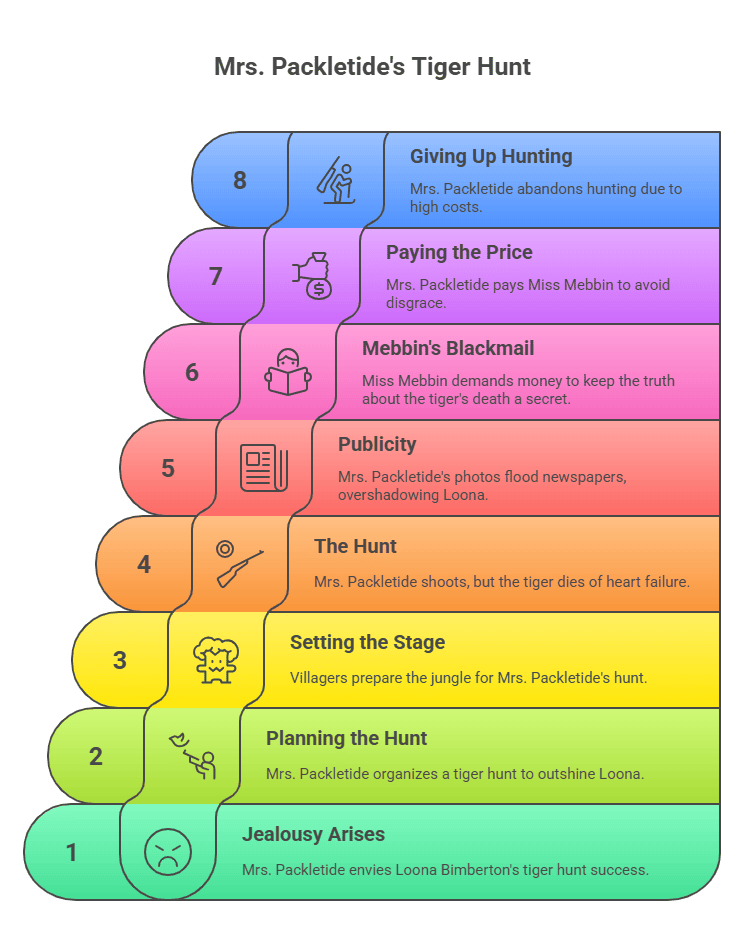
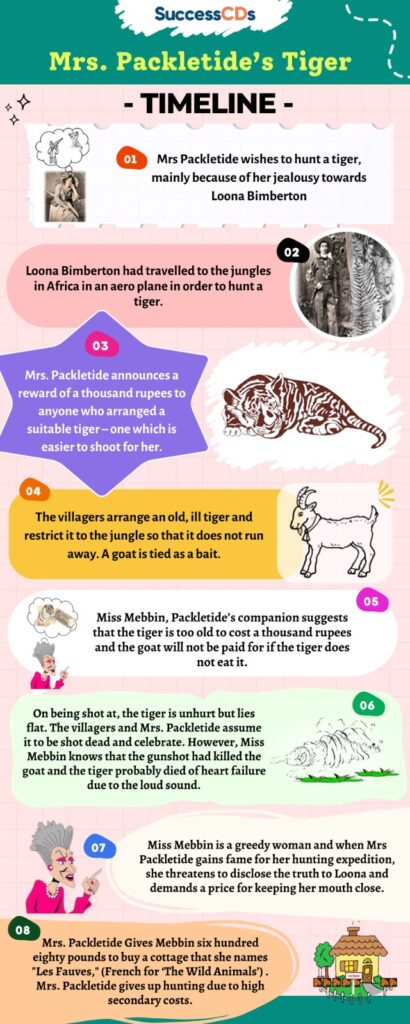
Ans. Mrs. Packletide is jealous of Loona Bimberton’s achievement and in order to show her down, she wants to shoot a tiger. Loona Bimberton had travelled to the jungles in Africa in an aero plane in order to hunt a tiger. Her achievement was the talk of the town and so Mrs. Packletide herself wanted to get a tiger skin and a lot of photographs with the hunt. She felt that by getting the photographs published in the newspapers, she could attract all the attention and show Loona down.
She planned to organize a lunch party in honour of Loona but her actual motive was to display the tiger skin that she procured and show Loona down.
Mrs. Packletide announced a reward of a thousand rupees to anyone who arranged a suitable tiger – one which was easier to shoot for her. The villagers were eager to earn the reward money and so they made suitable arrangements for her to shoot with ease. They arranged an old, ill tiger and restricted it to the jungle so that it did not run away.

Children were positioned to guard the jungle area, goats were left in the jungle to act as food for it. A platform was raised from where the tiger could be shot at easily. The village women also scolded their children to not to disturb the tiger from its sleep. A goat, as a bait, was tied at the perfect spot.
On the night fixed for the shooting, Mrs. Packletide and her paid companion
Miss. Mebbin sat hidden on the raised platform. The goat’s persistent sound attracted the beast but it rested rather than attacking it. Miss Mebbin suggested that as the tiger was too old, the amount of money paid for it was very huge. Also, that they need not pay for the goat if the tiger did not eat it.
Mrs. Packletide aimed at her prey and fired the gun shot. The tiger lay flat on the ground. The villagers and Mrs. Packetide were joyous and celebrated her achievement of killing the tiger.
It was Miss. Mebbin who noticed that the tiger did not die of the gun shot and that the gun shot had killed the goat. The beast died of heart failure due to the loud sound of gunshot.
Mrs. Packletide did not bother about it as she had got what she wanted – the tiger skin. Even the villagers did not object to it as they wanted the reward money. The newspapers were loaded with Mrs. Packletide’s photographs and Loona Bimberton was shown down upon.
Miss. Mebbin was a greedy woman. When Mrs. Packletide gained a lot of publicity, she threatened to disclose her secret to the world. She assured Mrs. Packletide that Loona would surely believe that the bullet had killed the goat and not the tiger. The tiger died due to heart failure as it was old and ill.
She demanded a price for keeping her secret saying that she wanted to buy a weekend cottage but had no money for it.
Mrs. Packletide was forced to give her six hundred and eighty pounds to buy the cottage. She had to pay the hush money in order to prevent being disgraced.
However, she gave up hunting as the added secondary expenses were too high.
Questions Based on the Themes of ‘Mrs Packletide’s Tiger’
Question: How does Saki use satire effectively in the story?
Ans. Saki uses satire brilliantly throughout the story to expose the shallow vanity and petty jealousy of upper class Edwardian society. He uses humor irony and perfectly timed comic observation to show the complete absurdity of Mrs Packletide’s tiger hunt, a supposedly brave and adventurous enterprise that is in reality nothing more than a carefully staged and completely dishonest performance designed purely to impress society and outshine a rival. Every detail in the story from the old and weak tiger to the goat that gets shot instead is designed to expose the gap between the glamorous image Mrs Packletide wishes to project and the embarrassing reality of what actually happens.
Question: How does the story show the consequences of jealousy and dishonesty?
Ans. The story powerfully shows that jealousy and dishonesty always have very real and very costly consequences. Mrs Packletide’s jealousy drives her to arrange a completely fake tiger hunt at great expense. Her dishonesty in pretending to have shot the tiger makes her vulnerable to Miss Mebbin’s blackmail. She ends up paying for Miss Mebbin’s cottage and giving up big game hunting entirely confiding that the incidental expenses are simply too heavy. The story brilliantly shows that the price of jealousy and dishonesty is always far greater than the price of simply accepting one’s limitations honestly and gracefully.
Question: How does the story justify its title “Mrs Packletide’s Tiger”?
Ans. The title is brilliantly ironic and works on multiple levels simultaneously. Literally it refers to the tiger that Mrs Packletide supposedly shoots during her hunt in India. But the irony lies in the fact that the tiger was never really “Mrs Packletide’s” in any meaningful sense — she did not shoot it, she did not hunt it bravely and she did not earn it through any genuine skill or courage. The tiger was old weak and ultimately died of heart failure. The title perfectly captures the central irony and satirical message of the entire story.
Question: Describe the writing style of Saki in this story.
Ans. Saki writes in a brilliantly witty sharp and deeply ironic style that is perfectly suited to his satirical subject matter. His sentences are precise and elegantly crafted with every word carefully chosen for maximum comic and satirical effect. He uses understatement, irony and perfectly timed humor to expose his characters’ shallow vanities and social pretensions without ever becoming heavy-handed or preachy. His description of the old tiger resting before its “grand attack” and Miss Mebbin’s “elder-sister attitude towards money” are perfect examples of his extraordinary ability to achieve devastating satirical effect through perfectly chosen comic details.
Mrs. Packletide’s Tiger Previous Year Questions with Model Answers PDF
Download the previous year questions of the Lesson Mrs. Packletide’s Tiger of class 10 (Communicative) for free. With the help of this, you can prepare for the exam.
To Download Mrs. Packletide’s Tiger Previous Year Questions with Model Answers- Click Here
Explanation of Chapter 2 Mrs. Packletide’s Tiger
Question. What is Mrs. Packletide’s main intention as introduced by the author?
Passage – It was Mrs. Packletide’s pleasure and intention that she should shoot a tiger. Not that the lust to kill had suddenly descended on her, or that she felt that she would leave India safer and more wholesome than she had found it, with one fraction less of wild beast per million of inhabitants.
Word meaning
Descended: Develop suddenly.
Wholesome: “Better than before”, in general
Inhabitants: A person or animal that lives in a particular place.
Explanation/Answer: The author introduces the main character, Mrs. Packletide. She wanted to shoot a tiger. He discusses the reason for her new interest. She was neither a hunter nor did she feel that by killing one tiger, she would make the huge population of India feel safer.
One fraction less of wild beast per million of inhabitants means one tiger less in ratio to the huge population of the country.
Question. What rivalry motivates Mrs. Packletide’s sudden desire to hunt a tiger?
Passage – The compelling motive for her sudden deviation towards the footsteps of Nimrod was the fact that Loona Bimberton had recently been carried eleven miles in an aeroplane by an Algerian aviator, and talked of nothing else; only a personally procured tiger-skin and a heavy harvest of press photographs could successfully counter that sort of thing.
Word meaning
Compelling motive: Aim backed by force and power.
Deviation: An action, behavior, or condition that is different from what is usual or expected.
Nimrod : Biblical character (great grandson of Noah); a mighty hunter
Algerian: A native or inhabitant of Algeria.
Aviator: A pilot.
Procured: To get something by some effort.
Harvest: Collect or obtain for future use.
Explanation/Answer: The reason to shoot a tiger was her jealousy of Loona Bimberton,due to which she followed the footsteps of Nimrod, a biblical figure known for his hunting skills. Loona Bimberton had travelled to the jungles in Africa in an aero plane, covering a distance of eleven miles, with a pilot from Algeria in order to hunt a tiger. All this was rare and unheard of in those times and so, her achievement was the talk of the town. Mrs. Packletide herself wanted to get a tiger skin and a lot of photographs with the hunt. She felt that by getting the photographs published in the newspapers, she could attract all the attention and show Loona down. She wanted to outshine Loona.
Question. What are Mrs. Packletide’s planned uses for her tiger-skin to humiliate Loona Bimberton?
Passage – Mrs. Packletide had already arranged in her mind the lunch she would give at her house in Curzon Street, ostensibly in Loona Bimberton’s honour, with a tiger-skin rug occupying most of the foreground and all of the conversation. She had also already designed in her mind the tiger-claw brooch that she was going to give Loona Bimberton on her next birthday.
Word meaning
Ostensibly: Supposedly
Foreground: The part of a scene or picture that is nearest to and in front of the viewer.
Explanation/Answer: Mrs. Packletide was a wishful thinker, she planned to organize a lunch party in honour of Loona but her actual motive was to display the tiger skin that she procured and show Loona down.She had also planned to gift her a brooch in the shape of a tiger’s claw. The design of the brooch was intended in such a manner so as to make fun of Loona and to mock at her.
Question. How does Mrs. Packletide differ from the world’s typical motivations of hunger and love?
Passage – In a world that is supposed to be chiefly swayed by hunger and by love Mrs. Packletide was an exception; her movements and motives were largely governed by dislike of Loona Bimberton.
Word meaning
Swayed: Influence
Explanation/Answer: Unlike the world which gets motivated by the want to fulfill their hunger and desire to love, Mrs. Packletide’s actions on the other hand reflected the dislikes off Loona Bimberton. The push factor for her was her jealousy.
Question. How did favourable circumstances enable Mrs. Packletide’s tiger hunt with minimal risk?
Passage – Circumstances proved propitious Mrs. Packletide had offered a thousand rupees for the opportunity of shooting a tiger without over-much risk or exertion, and it so happened that a neighbouring village could boast of being the favoured rendezvous of an animal of respectable antecedents, which had been driven by the increasing infirmities of age to abandon game-killing and confine its appetite to the smaller domestic animals.
Word meaning
Propitious: Likely to have or produce good results.
Boast: Possess.
Rendezvous: A place or point where a group meets.
Antecedents: Predecessor.
Infirmities: The state of being weak or ill because of age.
Explanation/Answer: The circumstances were favourable for Mrs. Packletide. She had announced a reward of a thousand rupees to anyone who arranged a suitable tiger – one which was easier to shoot for her, without putting her life in danger. The neighbouring village was a famous point where a lot of tigers were found. The villagers were eager to earn the reward money and so they made suitable arrangements for her to shoot with ease. They arranged a tiger of good lineage (humour intended). Also, the tiger was old and ill due to old age, hence, it was not as ferocious. It had given up big time hunting and now satisfied its hunger by hunting smaller animals. Such a tiger was easier to shoot at and was not dangerous for Mrs. Packletide.
Question. How did the villagers ensure the tiger remained available for Mrs. Packletide’s shoot to secure the thousand rupees?
Passage – The prospect of earning the thousand rupees had stimulated the sporting and commercial instinct of the villagers; children were posted night and day on the outskirts of the local jungle to head the tiger back in the unlikely event of his attempting to roam away to fresh hunting-grounds, and the cheaper kinds of goats were left about with elaborate carelessness to keep him satisfied with his present quarters. The one great anxiety was lest he should die of old age before the date appointed for the memsahib’s shoot. Mothers carrying their babies home through the jungle after the day’s work in the fields hushed their singing lest they might curtail the restful sleep of the venerable herd-robber.
Word meaning
Prospect: Hope or likelihood.
Stimulated: Encourage or arouse interest.
Herd-robber: refers to a tiger that hunts and preys on other animals.
Explanation/Answer: The reward money lured the villagers. They wanted the shooting expedition to be a success in order to win the reward. They made many efforts in order to make it easier for Mrs. Packletide. The children were asked to guard the outskirts of the jungle, in case the tiger tried to escape (humour intended). Cheap goats were left in the jungle to act as food for it, lest it should die due to starvation before being shot down by Mrs. Packletide (humour intended). A platform was raised from where the tiger could be shot at easily. The village women hushed their children to not to disturb the tiger from it’s sleep. A cheap goat, as a bait, was tied at the spot which had a clear view from the raised platform so that Mrs, Packletide could shoot the tiger when it pounced upon it.
Question. What ideal conditions and setup awaited Mrs. Packletide for her tiger hunt?
Passage – The great night duly arrived, moonlit and cloudless. A platform had been constructed in a comfortable and conveniently placed tree, and thereon crouched Mrs. Packletide and her paid companion, Miss Mebbin.
Word meaning
Crouched: Adopt a position where the knees are bent and the upper body is brought forward and down, typically in order to avoid detection or to defend oneself.
Explanation/Answer:The night chosen for the shooting was also a perfect one. The sky was moonlit so that Mrs. Packletide could spot the tiger with ease. Mrs. Packletide had got along a paid companion, Miss. Mebbin who would publicize her achievement back home in London. They sat hidden on the raised platform constructed for their comfort, between the trees.
Question. What made the tethered goat an effective lure even for an impaired tiger?
Passage – A goat, gifted with a particularly persistent bleat, such as even a partially deaf tiger might be reasonably expected to hear on a still night, was tethered at the correct distance.
Word meaning
Persistent: Continuing beyond the usual or expected time.
Bleat: The loud cry of sheep or goat.
tethered: fastened
Explanation/Answer:The goat tied was so loud that even a partially deaf tiger might hear its sound. (humour intended). The goat bleated so loudly that no one, not even a partially deaf tiger could miss it’s sound. The scene was all set for the tiger to attack it’s prey.
Question. What equipment and demeanor did Mrs. Packletide maintain while awaiting the tiger?
Passage – With an accurately sighted rifle and a thumb- nail pack of patience cards the sportswoman awaited the coming of the quarry.
Word meaning
thumb- nail pack of patience cards : small sized playing cards to play solitaire
Quarry: Prey, victim
Explanation/Answer: Mrs. Packletide has been referred to as a sportswoman. She had a rifle in one hand to shoot the tiger. In the other hand she had a pack of cards (called ‘patience cards’ as they helped her keep patience, she played cards with Louisa Mebbin while waiting for the tiger to arrive).
Question. How does Miss Mebbin’s response to the tiger’s age reveal her greedy nature in “Mrs. Packletide’s Tiger”?
Passage – “I suppose we are in some danger?” said Miss Mebbin.
She was not actually nervous about the wild beast, but she had a morbid dread of performing an atom more service than she had been paid for.
“Nonsense,” said Mrs. Packletide; “it’s a very old tiger. It couldn’t spring up here even if it wanted to.”
“If it’s an old tiger I think you ought to get it cheaper. A thousand rupees is a lot of money.”
Word meaning
Morbid: Unpleasant.
Explanation/Answer: Miss Mebbin enquired if she is in danger. She was not nervous that the beast could attack them, but didn’t want to do even a slightest of extra service for which she was not paid.
She was getting impatient due to the wait time. This shows her greedy and money – minded nature. With the rifle and ammunition Mrs. Packletide was ready to hunt, to Miss Mebbin’s question she replied that the tiger was too old, it won’t be able to jump at this height. Miss Mebbin’s reply again shows her money minded attitude as she said that if the tiger was too old then the amount of money paid for it was very huge. Also, that they need not pay for the goat if the tiger did not eat it.
Question. How does Louisa Mebbin’s attitude toward money contrast with Mrs. Packletide’s spending habits?
Passage – Louisa Mebbin adopted a protective elder-sister attitude towards money in general, irrespective of nationality or denomination. Her energetic intervention had saved many a rouble from dissipating itself in tips in some Moscow hotel, and francs and centimes clung to her instinctively under circumstances which would have driven them headlong from less sympathetic hands.
Word meaning
Intervention: To become involved in something in order to have an influence.
Instinctively: Feelings based on instincts.
Explanation/Answer: Louisa Mebbin had a protective attitude towards money. Just right she was protective about Mrs. Packletide’s money like an old sister is. It was not for her welfare though! But Miss Mebbin herself wanted to extract the maximum amount of money. And she didn’t allow her to just spend her rubbles, francs and centimes (Russian currency) on tips and things she deemed as less important. relates to Mrs Packletide who was wasteful and spendthrift. It was Miss Mebbin’s intervention which saved the money as she stopped her from spending it mindlessly. She used them wisely or else others would spend it sympathetically without even thinking.
Question. What humorous contrast does the tiger’s action create with Miss Mebbin’s speculations in “Mrs. Packletide’s Tiger”?
Passage – Her speculations as to the market depreciation of tiger remnants were cut short by the appearance on the scene of the animal itself.
Word meaning
Speculations: Ideas or guesses about something that is not known.
Depreciation: Decrease in value.
Explanation/Answer: While Miss Mebbin was calculating the price of the kind of tiger that was arranged for shooting, her thoughts were cut short by the appearance of the tiger on the scene.
Question. How does the tiger’s resting instead of attacking the goat add humor in “Mrs. Packletide’s Tiger”?
Passage – As soon as it caught sight of the tethered goat it lay flat on the earth, seemingly less from a desire to take advantage of all available cover than for the purpose of snatching a short rest before commencing the grand attack.
Explanation/Answer: It seemed that rather than taking advantage of the night time and the dense forest surrounding them, the tiger was taking some rest before making the ‘grand attack’ (humour intended).
Question. Why does Louisa Mebbin loudly claim the tiger is ill in Hindustani in “Mrs. Packletide’s Tiger”?
Passage – “I believe it’s ill,” said Louisa Mebbin, loudly in Hindustani, for the benefit of the village headman, who was in ambush in a neighbouring tree.
Explanation/Answer: Seeing the tiger’s reaction, Louisa spoke up loudly that it seemed that the tiger was ill. She wanted to be heard by the village headman, spoke in their native language of ‘hindustani’.
The headman was busy in another hunting expedition. She was complaining for the poor quality of the tiger arranged for shooting as this could help them save some money.
Question. What does Miss Mebbin’s excitement about not paying for the goat reveal in “Mrs. Packletide’s Tiger”?
Passage – “Hush!” said Mrs. Packletide, and at that moment the tiger commenced ambling towards his victim.
“Now, now!” urged Miss Mebbin with some excitement; “if he doesn’t touch the goat we needn’t pay for it.” (The bait was an extra.)
Word meaning
Commenced: To begin.
Ambling: To walk slowly in a free and relaxed way.
Explanation/Answer: As soon as the tiger started to approach the prey, Miss Mebbin got excited and said “if the goat remained unharmed you need not to pay for it” and asked Mrs. Packletide to go for the aim.
Question. How do the villagers react immediately after Mrs. Packletide fires at the tiger?
Passage – The rifle flashed out with a loud report, and the great tawny beast sprang to one side and then rolled over in the stillness of death. In a moment a crowd of excited natives had swarmed on to the scene, and their shouting speedily carried the glad news to the village, where a thumping of tom-toms took up the chorus of triumph.
Explanation/Answer: Mrs. Packletide aimed at her prey and fired the gun shot. The tiger lay flat on the ground. The villagers and Mrs. Packletide were joyous and celebrated her achievement of killing the tiger. Villagers started shouting, dancing and even started playing drums.
Question. What future social event excites Mrs. Packletide after the villagers’ celebration of her tiger hunt?
Passage – And their triumph and rejoicing found a ready echo in the heart of Mrs. Packletide; already that luncheon-party in Curzon Street seemed immeasurably nearer.
Explanation/Answer: Everyone was so happy, Mrs. Packletide could foresee the party she was long waiting for.
Question. What does Miss Mebbin discover about the cause of the tiger’s death and the goat’s injury?
Passage – It was Louisa Mebbin who drew attention to the fact that the goat was in death-throes from a mortal bullet-wound, while no trace of the rifle’s deadly work could be found on the tiger. Evidently the wrong animal had been hit, and the beast of prey had succumbed to heart-failure, caused by the sudden report of the rifle, accelerated by senile decay.
Word meaning
Senile: Showing a loss of mental ability in old age.
Succumbed: To die.
Explanation/Answer: It was Miss. Mebbin who noticed that the tiger did not die of the gunshot and that the gunshot had killed the goat. The beast died of heart failure due to the loud sound of gunshot.
Question. Why do the villagers and Miss Mebbin support Mrs. Packletide’s claim of shooting the tiger despite the truth?
Passage – Mrs. Packletide was pardonably annoyed at the discovery; but, at any rate, she was the possessor of a dead tiger, and the villagers, anxious for their thousand rupees, gladly connived at the fiction that she had shot the beast. And Miss Mebbin was a paid companion.
Explanation/Answer: Mrs. Packletide initially got annoyed to find the truth but did not bother about it as she had got what she wanted – the tiger skin, she was the owner of it. Even the villagers did not object to it as they wanted the reward money.
Question. What internal conflict does Mrs. Packletide experience while posing for photographs after shooting the tiger?
Passage – Therefore did Mrs. Packletide face the cameras with a light heart, and her pictured fame reached from the pages of the Texas Weekly Snapshot to the illustrated Monday supplement of the Novoe Vremya.
Explanation/Answer: Miss Packletide was getting photographs clicked with a smile but at the back of her mind, the truth of her expedition was lurking. Stll as long as she had the tiger skin and the photographs published in the newspapers, she could fulfil her aim of outshining Loona.
Question. What does the phrase “a model of repressed emotions” suggest about Loona Bimberton’s letter in “Mrs. Packletide’s Tiger”?
Passage – As for Loona Bimberton, she refused to look at an illustrated paper for weeks, and her letter of thanks for the gift of a tiger-claw brooch was a model of repressed emotions. The luncheon-party she declined; there are limits beyond which repressed emotions become dangerous.
Word meaning
Tiger-claw brooch: A small piece of jewellery in the shape of a tiger’s claw with a pin at the back that is fastened to a woman’s clothes.
Explanation/Answer: When Mrs. Packletide gained a lot of publicity Loona Bimberton couldn’t see it, she was so depressed and angry. She in-fact declined the invitation for the luncheon-party.
was a model of repressed emotions means that the letter of thanks reflected her jealousy.
there are limits beyond which repressed emotions become dangerous The author wants to say that Loona’s jealousy was about to cross the limit and subsequently, she could go to any extent which would become dangerous.
Question. What secret does Miss Mebbin threaten to reveal about the tiger hunt in “Mrs. Packletide’s Tiger”?
Passage – “How amused everyone would be if they knew what really happened,” said Louisa Mebbin a few days after the ball.
“What do you mean?” asked Mrs. Packletide quickly.
“How you shot the goat and frightened the tiger to death,” said Miss Mebbin, with her disagreeably pleasant laugh.
Explanation/Answer: Miss Mebbin started showing her true colours. She threatened to disclose her secret to the world and tried to extort money to keep her secret.. She assured Mrs. Packletide that Loona would surely believe that the bullet had killed the goat and not the tiger. The tiger died due to heart failure as it was old and ill.
Question. How does Miss Mebbin exploit Mrs. Packletide’s rivalry with Loona Bimberton in “Mrs. Packletide’s Tiger”?
Passage – “No one would believe it,” said Mrs. Packletide, her face changing colour as rapidly as though it were going through a book of patterns before post-time.
“Loona Bimberton would,” said Miss Mebbin. Mrs. Packletide’s face settled on an unbecoming shade of greenish white.
“You surely wouldn’t give me away?” she asked.
Word meaning
Book of patterns : Book showing the colour patterns of racing, stables, with colours worn by jockeys.
Post-time: The start of horse race and deadline for placing a bet
Explanation/Answer: Mrs. Packletide couldn’t believe those words coming out of Miss Mebbin’s mouth, she got pale, and hesitatingly said no one would believe her word. Taking advantage of their rivalry Miss Mebbin said Loona Bimbeton would surely believe her.
Question. How does Miss Mebbin use the tiger incident to blackmail Mrs. Packletide in “Mrs. Packletide’s Tiger”?
Passage – “I’ve seen a week-end cottage near Darking that I should rather like to buy,” said Miss Mebbin with seeming irrelevance. “Six hundred and eighty, freehold. Quite a bargain, only I don’t happen to have the money.”
Explanation/Answer: Louisa Mebbin, being a greedy woman and taking advantage of the situation, demanded a price for keeping this secret. She said she had seen a weekend cottage that she would love to buy but had no money for it. Hence, Mrs Packletide is forced to give her the money (the six hundred and eighty pounds) so that Louis can buy the cottage and keep her image as it is.
Question. What is the ironic significance of Louisa Mebbin’s cottage name “Les Fauves” and tiger-lilies in “Mrs. Packletide’s Tiger”?
Passage – Louisa Mebbin’s pretty week-end cottage, christened by her “Les Fauves,” and gay in summer-time with its garden borders of tiger-lilies, is the wonder and admiration of her friends.
Word meaning
Les Fauves: French for ‘The Wild Animals’
Explanation/Answer: She named it “Les Fauves” which is a French word meaning ‘For the wild beasts’ and planted Tiger lilies in the garden as a note of thanks to the tiger due to which she had got it.
Question. How does the story’s ending satirize both Mrs. Packletide and Louisa Mebbin in “Mrs. Packletide’s Tiger”?
Passage – “It is a marvel how Louisa manages to do it,” is the general verdict.
Mrs. Packletide indulges in no more big-game shooting.
“The incidental expenses are so heavy,” she confides to inquiring friends.
Word meaning
Incidental : secondary.
Explanation/Answer: Louis Mebbin’s weekend cottage is a wonder and an admiration among her friends.
Meanwhile, Mrs Packletide has given up hunting ; confiding to her friends who keep asking her why, that the added expenses that comes with it is too much.
Top
Mrs Packletide’s Tiger FAQs
Question: Who was Mrs. Packletide?
Ans. Mrs Packletide was a high-society woman in England. She was jealous and competitive in nature. She makes the decision to go hunting in an effort to undermine Loona Bimberton’s successes.
Question: Out of the three women in the story ‘Mrs Packletide’s Tiger’ who do you think got the most benefit?
Ans. Out of Mrs Packletide, Loona Bimberton and Miss Mebbin, I think that Miss Mebbin got the most benefit. She got a cottage worth six hundred and eighty pounds as a bribe for zipping her mouth.
Question: What gift had Mrs Packletide decided for Loona Bimberton?
Ans. Mrs Packletide had planned to gift Loona a brooch in the shape of a tiger’s claw. She would organize a lunch party in Loona’s honour and gift her the brooch.
Question: Name the important characters in Mrs Packletide’s Tiger.
Ans. The important characters in the story, Mrs Packletide’s Tiger are Mrs Packletide, Loona Bimberton and Miss Mebbin.
Question: Who wrote the class 10 English lesson, Mrs Packletide’s Tiger?
Ans. Mrs Packletide’s Tiger was written by Saki whose real name was Hector Hugh Munro. He was a British writer known for his witty satirical short stories. It appears in the CBSE Class 10 English textbook as Chapter 2. He is considered one of the greatest masters of the English short story form.
Question: What is the theme of the class 10 English story, Mrs Packletide’s Tiger?
Ans. The central theme is that jealousy vanity and the desperate desire to outshine others always lead to dishonesty deception and ultimately to consequences far more costly and embarrassing than the original envy. The story also satirizes the shallow social pretensions and petty rivalries of upper class Edwardian society with brilliant and merciless wit.
Question: Why did Mrs Packletide want to shoot a tiger?
Ans. Mrs Packletide wanted to shoot a tiger purely out of jealousy toward her neighbour Loona Bimberton who had been carried eleven miles in an aeroplane by an Algerian aviator and had shot a tiger. Mrs Packletide wanted to outshine Loona in the eyes of their shared social circle and could not bear being seen as less impressive or adventurous.
Question: What really happened during the tiger hunt in the class 10 English lesson, Mrs. Packletide’s Tiger?
Ans. During the tiger hunt Mrs Packletide’s bullet actually killed the goat that was tied as bait and not the tiger. The tiger died of heart failure caused by the sudden loud sound of the rifle accelerated by its advanced age and poor health. Miss Mebbin noticed this truth and later used it to blackmail Mrs Packletide into buying her a weekend cottage.
Question: What is the moral of the class 10 story, Mrs Packletide’s Tiger?
Ans. The moral is that jealousy vanity and dishonesty always lead to very real and very costly consequences. The story teaches us that measuring our worth through comparison with others and living purely for social appearances rather than genuine achievement always leads to a hollow embarrassing and ultimately unsatisfying life. Honesty and genuine achievement are always worth far more than any carefully constructed and maintained social facade.
Top
Summary of the Lesson Mrs Packletide’s Tiger in Hindi
श्रीमती पैकलेटाइड को लूना बिम्बर्टन की उपलब्धि से ईर्ष्या होती है और उसे नीचा दिखाने के लिए वह एक बाघ को गोली मारना चाहती है। लूना बिम्बर्टन एक बाघ का शिकार करने के लिए हवाई जहाज से अफ्रीका के जंगलों में गई थीं। उनकी उपलब्धि शहर में चर्चा का विषय थी और इसलिए श्रीमती पैकलेटाइड स्वयं एक बाघ की खाल और शिकार के साथ ढेर सारी तस्वीरें लेना चाहती थीं। उसे लगा कि अखबारों में तस्वीरें छपवाकर वह सबका ध्यान अपनी ओर खींच सकती है और लूना को नीचा दिखा सकती है।
उसने लूना के सम्मान में एक लंच पार्टी आयोजित करने की योजना बनाई थी लेकिन उसका असली मकसद अपने द्वारा खरीदी गई बाघ की खाल को प्रदर्शित करना और लूना को नीचा दिखाना था।
श्रीमती पैकलेटाइड ने एक उपयुक्त बाघ की व्यवस्था करने वाले को एक हजार रुपये का इनाम देने की घोषणा की – ऐसा बाघ जिसे उनके लिए शूट करना आसान हो। ग्रामीण इनाम की रकम कमाने के लिए उत्सुक थे और इसलिए उन्होंने उसके लिए आसानी से शूटिंग करने के लिए उपयुक्त व्यवस्था की। उन्होंने एक बूढ़े, बीमार बाघ की व्यवस्था की और उसे जंगल तक सीमित कर दिया ताकि वह भाग न जाए।
बच्चों को जंगल क्षेत्र की रखवाली के लिए तैनात किया गया था, बकरियों को भोजन के रूप में जंगल में छोड़ दिया गया था। एक ऐसा मंच बनाया गया जहां से बाघ पर आसानी से गोली चलाई जा सके। गाँव की महिलाओं ने अपने बच्चों को भी डांटा कि वे बाघ की नींद में खलल न डालें। एक बकरी, चारे के रूप में, उत्तम स्थान पर बाँधी गई थी।
शूटिंग के लिए तय की गई रात को, श्रीमती पैकलेटाइड और उनके वेतनभोगी साथी मिस मेबिन ऊंचे मंच पर छुपकर बैठी थी। बकरी की लगातार आवाज ने जानवर को आकर्षित किया लेकिन उसने उस पर हमला करने के बजाय आराम किया। मिस मेबिन ने सुझाव दिया कि चूंकि बाघ बहुत बूढ़ा था, इसलिए इसके लिए भुगतान की गई राशि बहुत बड़ी थी। साथ ही, यदि बाघ ने बकरी को नहीं खाया तो उन्हें उसके लिए भुगतान करने की आवश्यकता नहीं है।
श्रीमती पैकलेटाइड ने अपने शिकार पर निशाना साधा और बंदूक से गोली चला दी। बाघ ज़मीन पर सीधा लेट गया। ग्रामीण और श्रीमती पैकेटाइड खुश थे और उन्होंने बाघ को मारने की अपनी उपलब्धि का जश्न मनाया।
यह मिस मेबिन ही थीं जिन्होंने देखा कि बाघ बंदूक की गोली से नहीं मरा था और बंदूक की गोली से बकरी की मौत हुई थी। गोली की तेज आवाज से वह जानवर हृदय गति रुकने से मर गया।
श्रीमती पैकलेटाइड ने इसके बारे में चिंता नहीं की क्योंकि उन्हें वह मिल गया था जो वह चाहती थीं – बाघ की खाल। यहां तक कि गांव वालों ने भी इस पर कोई आपत्ति नहीं जताई क्योंकि उन्हें इनाम की रकम चाहिए थी. अखबार श्रीमती पैकलेटाइड की तस्वीरों से भरे हुए थे और लूना बिम्बर्टन को नीचा दिखाया गया था।
मिस मेबिन एक लालची महिला थी। जब श्रीमती पैकलेटाइड को बहुत प्रचार मिला, तो उन्होंने अपना रहस्य दुनिया के सामने उजागर करने की धमकी दी। उन्होंने श्रीमती पैकलेटाइड को आश्वासन दिया कि लूना निश्चित रूप से विश्वास करेगी कि गोली से बकरी की मौत हुई है, बाघ की नहीं। बाघ की मृत्यु हृदय गति रुकने से हुई क्योंकि वह बूढ़ा और बीमार था।
उसने अपनी बात गुप्त रखने के लिए कीमत की मांग करते हुए कहा कि वह एक सप्ताहांत कॉटेज खरीदना चाहती थी लेकिन उसके पास इसके लिए पैसे नहीं थे।
श्रीमती पैकलेटाइड को कॉटेज खरीदने के लिए छह सौ अस्सी पाउंड देने के लिए मजबूर किया गया था। बदनामी से बचने के लिए उसे गुप्त धनराशि चुकानी पड़ी।
हालाँकि, अतिरिक्त अतिरिक्त खर्चे बहुत अधिक होने के कारण उसने शिकार करना छोड़ दिया।
Top
Important Videos Links
Also See:
- Julius Caesar Class 10 English Summary, Explanation, Difficult Words and Question Answers
- Snake Class 10 English Summary, Explanation, Difficult Words and Question Answers
- The Rime of the Ancient Mariner Class 10 English Summary, Explanation, Difficult Words and Question Answers
- Ozymandias Class 10 English Summary, Explanation, Difficult Words and Question Answers
- Not Marble, nor the Gilded Monuments Class 10 English Summary, Explanation, Difficult Words and Question Answers
- Poem Mirror Class 10 English Summary, Explanation, Difficult Words and Question Answers
- The Frog and the Nightingale Class 10 English Summary, Explanation, Difficult Words and Question Answers
- VIRTUALLY TRUE Class 10 English Summary, Explanation, Difficult Words and Question Answers
- Two Gentlemen of Verona Class 10 English Summary, Explanation, Difficult Words and Question Answers
- The Letter Class 10 English Summary, Explanation, Difficult Words and Question Answers
- Patol Babu, Filmstar Class 10 English Summary, Explanation, Difficult Words and Question Answers
- Shady Plot Class 10 English Summary, Explanation, Difficult Words and Question Answers
- The Dear Departed Class 10 English Summary, Explanation, Difficult Words and Question Answers
- CBSE Class 10 English Communicative Study Guide
- CBSE Class 10 Communicative English Syllabus 2024-25
- Class 10 Communicative English Important Character Sketches