
Character Sketch of Nelson Mandela from Class 10 English Chapter 2 Nelson Mandela – long walk to freedom
In this post, we explain the character sketch of Nelson Mandela from Class 10 English Chapter 2 Nelson Mandela- long walk to freedom! This post covers everything you need to know about Nelson Mandela from the lesson. We provide answers to questions related to the character sketch of Nelson Mandela, including his traits, personalities, and motivations. Our explanations are easy to understand, and we offer examples from the lesson to support our points. Whether you’re a student looking to study for your exams or a teacher seeking to explain the lesson to your students, our post can be very helpful. So, read on and learn all about the character sketch of Nelson Mandela.
Related:
- Class 10 Nelson Mandela: Long Walk to Freedom Summary, Explanation
- Class 10 Nelson Mandela: Long Walk to Freedom (Important) Question Answers
- Class 10 Nelson Mandela: Long Walk to Freedom MCQs
- Nelson Mandela Long Walk to Freedom Previous Years Question with Answers
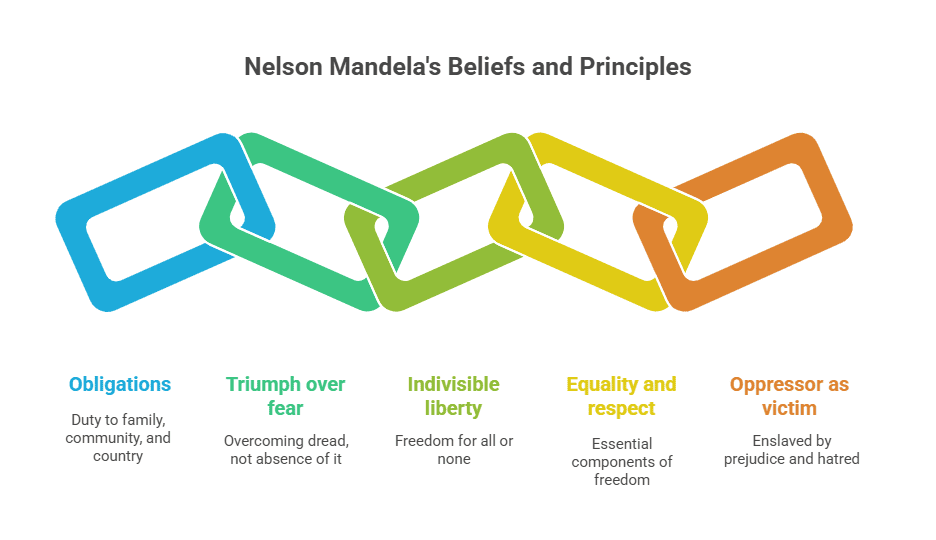
Nelson Mandela Character Attributes
Finish your entire English prep in 24 hrs & shine in Boards 2026! – Concise chapter summaries (key events & ideas), lesson themes, Visual character sketches using mind maps Click here

Questions related to the Character of Nelson Mandela
Question: How did Nelson Mandela’s childhood view of freedom change as he grew older?
Ans. As a young boy, Mandela believed he was born free, focusing on simple joys like running in fields and swimming in streams. However, as he matured, he realized these were merely illusions of liberty. He began to understand that his personal freedom was inseparable from the freedom of his entire community. This realization transformed him from a law-abiding attorney into a bold revolutionary. His hunger for his own freedom eventually grew into a much greater hunger for the liberation of all his people
Question: What does Mandela mean by the twin obligations of a man?
Ans. Mandela explains that every individual has two sets of duties. The first is to his family, parents, wife, and children. The second is to his people, his community, and his country. In a civil society, a person should be able to fulfill both. However, in a system of racial segregation, a person of color who attempted to fulfill his duty to his people was inevitably ripped from his family and forced to live a life of secrecy and rebellion, making the balance impossible.
Question: Why does Mandela describe the inauguration as a rainbow gathering?
Ans. The inauguration of the first democratic government represented a unique assembly of different nations and races. Mandela uses the metaphor of a rainbow to symbolize the unity of people who were previously divided by skin color and systemic prejudice. After years of being treated as outcasts by the world, South Africans were finally hosting a diverse international community. This gathering marked the end of a dark era of white supremacy and the birth of a vibrant, multi-colored society based on equality.
Question: How does Mandela define the relationship between the oppressor and the oppressed?
Ans. Mandela argues that both the victim and the victimizer are essentially prisoners. While the oppressed is physically shackled, the oppressor is a prisoner of hatred, locked behind the bars of prejudice and narrow-mindedness. He believes that someone who takes away another person’s freedom is not truly free themselves because they have lost their own humanity. Therefore, the task of the liberation movement was not just to free the victims, but also to liberate the oppressors from the darkness of their own hearts.
Also See :
First Flight book
- Character Sketch of Lencho and PostMaster | A Letter to God
- Character Sketch of Nelson Mandela | Nelson Mandela Long Walk to Freedom
- Character Sketch of Young Seagull | Two Stories About Flying Part 1 His First Flight
- Character Sketch of the Pilot | Two Stories About Flying Part 2 The Black Aeroplane
- Character Sketch of Mr Keesing and Anne Frank | From The Diary Of Anne Frank
- Character Sketch of Wanda, Maddie and Peggy | The Hundred Dresses – I
- Character Sketch of Miss Mason | The Hundred Dresses – II
- Character Sketch of Lucio Rodrigues, Rajvir and Pranjol | Glimpses of India
- Character Sketch of Gavin Maxwell and Mijbil | Mijbil The Otter
- Character Sketch of Valli and Bus Conductor | Madam Rides the Bus
- Character Sketch of Kisa Gotami and Gautama Buddha | Sermon at Benares
- Character Sketch of Natalya, Chubukov and Lomov | The Proposal
Footprints without Feet book
- Character Sketch of Tricki, Mrs Pumphrey, Dr Herriot | Triumph of Surgery
- Character Sketch of Anil and Hari | The Thief’s Story
- Character Sketch of Max, Ausable, Fowler | The Midnight Visitor
- Character Sketch of Horace Danby | A Question of Trust
- Character Sketch of Griffins, Mr Hall, Mrs Hall, Officer Bobby Jaffers | Footprints without Feet
- Character Sketch of Richard Ebright, mother | The Making of a Scientist
- Character Sketch of M Loisel, Matilda, Jeanne | The Necklace
- Character Sketch of Oliver Lutkins, Sinclair Lewis | The Hackdriver
- Character Sketch of Bholi, Ramlal, Bishamber, Bholi’s mother, teacher | Bholi
- Character Sketch of Think Tank, Oops, Noodle, Omega and Iota | The Book that Saved the Earth
Related Links
Class 10 English Syllabus
Character Sketches of Class 10 English
CBSE Class 10 English Lesson Explanation, Summary
CBSE Class 10 English Question Answers (Important)
CBSE Class 10 English MCQs
Class 10 English Complete Study Guide
Class 10 English First Flight book Prose word meanings
Class 10 English First Flight Poems word meanings
Class 10 English Footprints without Feet word meanings
List of Poetic Devices in Class 10 Poems (Poem-wise)
10 Important Poetic Devices for Class 10

Very amazing 🤩 got 80/80 on my class test