Character Sketch of Lencho and the Postmaster from Class 10 English First Flight Book Chapter 1 A Letter to God
In this post, we explain the character sketch of Lencho and character sketch of the Postmaster from Class 10 English Chapter 1 A Letter to God. This post covers everything you need to know about Lencho and Postmaster from the lesson. We provide answers to questions related to the character sketch of Lencho and the Postmaster, including their traits, personalities, and motivations. Our explanations are easy to understand, and we offer examples from the lesson to support our points. Whether you’re a student looking to study for your exams or a teacher seeking to explain the lesson to your students, our post can be very helpful. So, read on and learn all about the character sketch of Lencho and the Postmaster.
Lencho
Postmaster
Related:

- A Letter to God Class 10 Summary, Explanation
- A Letter to God (Important) Question Answers
- A Letter to God MCQs
- A Letter to God Previous Years Question with Answers
Character Sketch of Lencho Mind Map

Finish your entire English prep in 24 hrs & shine in Boards 2026! – Concise chapter summaries (key events & ideas), lesson themes, Visual character sketches using mind maps Click here
Questions related to the Character of Lencho
Question: What does the comparison of Lencho to an ox tell us about his character?
Ans. Describing Lencho as an ox of a man highlights his immense physical strength and his disciplined work ethic. He spent his entire life working in the fields, showing that he was not a lazy dreamer but a person who understood the value of hard labor. This background makes his eventual loss even more tragic, as his entire year of manual toil was wiped out in a single hour by the hailstorm.
Question: How does Lencho’s literacy contrast with his simple nature?
Ans. Although Lencho was a simple farmer who worked like an animal in the fields, he possessed the basic ability to read and write. This literacy allowed him to bridge the gap between his rural life and his spiritual beliefs. However, his writing was not used for complex intellectual thought but for a very straightforward, childlike request. This shows that despite having some education, his worldview remained incredibly innocent and literal.
Question: What does the comparison of Lencho to an ox tell us about his character?
Ans. Describing Lencho as an ox of a man highlights his immense physical strength and his disciplined work ethic. He spent his entire life working in the fields, showing that he was not a lazy dreamer but a person who understood the value of hard labor. This background makes his eventual loss even more tragic, as his entire year of manual toil was wiped out in a single hour by the hailstorm.
Question: How does Lencho’s literacy contrast with his simple nature?
Ans. Although Lencho was a simple farmer who worked like an animal in the fields, he possessed the basic ability to read and write. This literacy allowed him to bridge the gap between his rural life and his spiritual beliefs. However, his writing was not used for complex intellectual thought but for a very straightforward, childlike request. This shows that despite having some education, his worldview remained incredibly innocent and literal.
Question: How does Lencho’s reaction to the post office employees reveal his flaws?
Ans. While Lencho is a hero of faith, his character also shows a lack of worldly wisdom and a suspicious nature toward humanity. By calling the employees a bunch of crooks, he demonstrates that his focus is so entirely fixed on the divine that he fails to see the goodness in the people right in front of him. This reveals a stubborn perspective where he assumes humans are dishonest, even when they are being his greatest benefactors.
Question: Why did Lencho feel no surprise when he found the money in the envelope?
Ans. Lencho’s lack of surprise is the ultimate testament to his confidence in a higher power. To him, receiving a reply was the natural consequence of his request. He did not view the money as a miracle or a coincidence but as a direct fulfillment of a debt. His anger at the missing amount further proves this, as he felt he was being cheated of what was rightfully his, showing a character that is firm and demanding in its faith.
Question: What is Lencho’s background?
Ans. Lencho is a poor farmer who lives in a small village in rural Mexico. He has a wife and two children, and he relies on his crops for his livelihood.
Question: What are Lencho’s personality traits?
Ans. Lencho is a determined and hardworking individual who is committed to providing for his family. He is also deeply religious, and he believes in the power of God to help him overcome his problems.
Question: How does Lencho react to the hailstorm that destroys his crops?
Ans. Lencho is devastated by the hailstorm and fears that his family will starve because of the loss of his crops. However, he is determined to find a solution to his problem and decides to write a letter to God asking for help.
Question: What does Lencho write in his letter to God?
Ans. Lencho writes a simple and heartfelt letter to God, asking for 100 pesos to help him and his family get through the difficult times ahead.
Question: How does Lencho react when he receives a response to his letter?
Ans. Lencho is initially overjoyed when he receives a letter from God, but his happiness turns to anger when he discovers that the postmaster has kept some of the money for himself.
Question: What does Lencho’s reaction to the response letter reveal about his character?
Ans. Lencho’s reaction reveals his strong faith in God, his sense of justice, and his determination to provide for his family. Despite the setback, he refuses to give up and remains committed to finding a solution to his problems.
Character Sketch of the Postmaster Mind Map
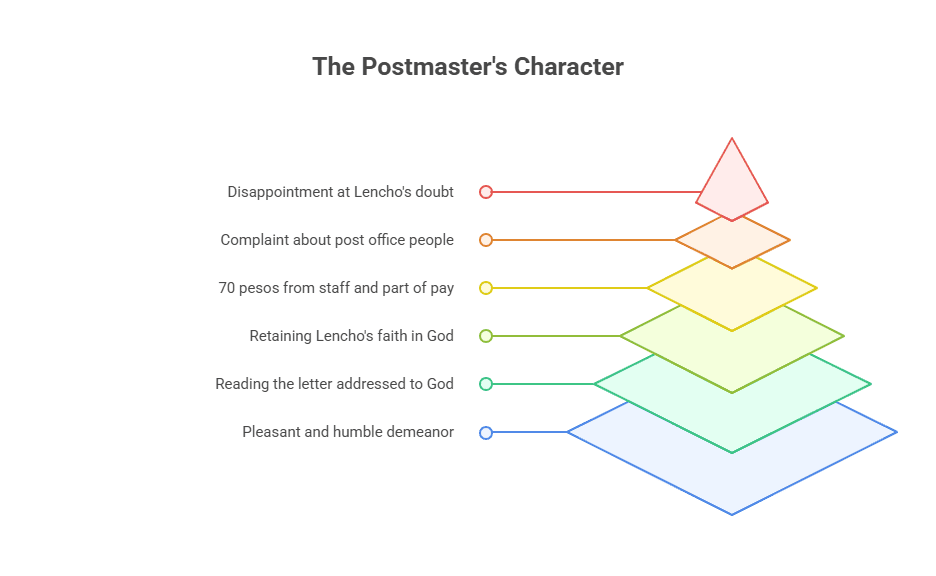
Questions related to Character of the Postmaster
Question 1: How does the Postmaster’s initial reaction to Lencho’s letter differ from his final actions?
Ans. Initially, the Postmaster breaks into laughter because the idea of addressing a letter to a divine entity seems absurd and naive. However, his amusement quickly turns into serious admiration. He is moved by the depth of Lencho’s faith and decides that such a pure belief should not be shaken. This shift from mockery to profound respect drives him to organize a collection, showing that he values the spirit of hope over the logic of the world.
Question 2: What traits make the Postmaster a magnanimous person?
Ans. The Postmaster displays magnanimity through his selfless leadership and personal sacrifice. He contributes a significant portion of his own salary and persuades his colleagues and friends to give acts of charity. He does not seek any credit or recognition for his help; instead, he signs the letter simply as God to ensure Lencho’s faith remains intact. His primary motivation is the well-being and spiritual peace of a stranger, which defines his noble character.
Question 3: Describe the emotional state of the Postmaster after he delivers the money.
Ans. After sending the money, the Postmaster experiences a sense of deep contentment. He watches from his office with the satisfaction of a man who has performed a virtuous deed. He expects to see a look of joy or surprise on Lencho’s face. Although the outcome is ironic when Lencho reacts with anger, the Postmaster’s internal reward remains his knowledge that he acted with genuine kindness and compassion during someone’s darkest hour.
Question: What is the postmaster’s background?
Ans. The postmaster is a government employee who works in a small village in rural Mexico. He is responsible for delivering the mail and collecting postage fees.
Question: What are the postmaster’s personality traits?
Ans. The postmaster is portrayed as a friendly man. He is sensitive and is moved to see Lencho’s immense faith in God. He wants to retain it and so, de ides to collect the money that the poor farmer needs
Question: How does the Postmaster’s initial reaction to Lencho’s letter differ from his final actions?
Ans. Initially, the Postmaster breaks into laughter because the idea of addressing a letter to a divine entity seems absurd and naive. However, his amusement quickly turns into serious admiration. He is moved by the depth of Lencho’s faith and decides that such a pure belief should not be shaken. This shift from mockery to profound respect drives him to organize a collection, showing that he values the spirit of hope over the logic of the world.
Question: What traits make the Postmaster a magnanimous person?
Ans. The Postmaster displays magnanimity through his selfless leadership and personal sacrifice. He contributes a significant portion of his own salary and persuades his colleagues and friends to give acts of charity. He does not seek any credit or recognition for his help; instead, he signs the letter simply as God to ensure Lencho’s faith remains intact. His primary motivation is the well-being and spiritual peace of a stranger, which defines his noble character.
Question: Describe the emotional state of the Postmaster after he delivers the money.
Ans. After sending the money, the Postmaster experiences a sense of deep contentment. He watches from his office with the satisfaction of a man who has performed a virtuous deed. He expects to see a look of joy or surprise on Lencho’s face. Although the outcome is ironic when Lencho reacts with anger, the Postmaster’s internal reward remains his knowledge that he acted with genuine kindness and compassion during someone’s darkest hour.
Also See :
First Flight book
- Character Sketch of Lencho and PostMaster | A Letter to God
- Character Sketch of Nelson Mandela | Nelson Mandela Long Walk to Freedom
- Character Sketch of Young Seagull | Two Stories About Flying Part 1 His First Flight
- Character Sketch of the Pilot | Two Stories About Flying Part 2 The Black Aeroplane
- Character Sketch of Mr Keesing and Anne Frank | From The Diary Of Anne Frank
- Character Sketch of Wanda, Maddie and Peggy | The Hundred Dresses – I
- Character Sketch of Miss Mason | The Hundred Dresses – II
- Character Sketch of Lucio Rodrigues, Rajvir and Pranjol | Glimpses of India
- Character Sketch of Gavin Maxwell and Mijbil | Mijbil The Otter
- Character Sketch of Valli and Bus Conductor | Madam Rides the Bus
- Character Sketch of Kisa Gotami and Gautama Buddha | Sermon at Benares
- Character Sketch of Natalya, Chubukov and Lomov | The Proposal
Footprints without Feet book
- Character Sketch of Tricki, Mrs Pumphrey, Dr Herriot | Triumph of Surgery
- Character Sketch of Anil and Hari | The Thief’s Story
- Character Sketch of Max, Ausable, Fowler | The Midnight Visitor
- Character Sketch of Horace Danby | A Question of Trust
- Character Sketch of Griffins, Mr Hall, Mrs Hall, Officer Bobby Jaffers | Footprints without Feet
- Character Sketch of Richard Ebright, mother | The Making of a Scientist
- Character Sketch of M Loisel, Matilda, Jeanne | The Necklace
- Character Sketch of Oliver Lutkins, Sinclair Lewis | The Hackdriver
- Character Sketch of Bholi, Ramlal, Bishamber, Bholi’s mother, teacher | Bholi
- Character Sketch of Think Tank, Oops, Noodle, Omega and Iota | The Book that Saved the Earth
Also See:
Class 10 English Syllabus
Character Sketches of Class 10 English
CBSE Class 10 English Lesson Explanation, Summary
CBSE Class 10 English Question Answers (Important)
CBSE Class 10 English MCQs
Class 10 English Complete Study Guide
Class 10 English First Flight book Prose word meanings
Class 10 English First Flight Poems word meanings
Class 10 English Footprints without Feet word meanings
List of Poetic Devices in Class 10 Poems (Poem-wise)
10 Important Poetic Devices for Class 10