CBSE Class 10 English Chapter 7 The Frog and the Nightingale Summary, Explanation along with Difficult Word Meanings from Literature Reader (Communicative) Book
Updated for the CBSE 2026-27 session as per the rationalised syllabus.
In the poem ‘The Frog and the Nightingale’ by Vikram Seth, we are introduced to a conceited frog who rules over Bingle Bog with his harsh and unpleasant croaking. His dominance is challenged when a nightingale arrives and enchants the other creatures with her melodious voice. Consumed by jealousy and greed, the frog poses as a music critic and a great singer to take the nightingale under his wing. The story follows the tragic exploitation of the nightingale, who is too innocent and lacks self-confidence to see through the frog’s manipulation. The frog forces her to practice in extreme weather and perform constantly to earn him money, eventually leading to her physical exhaustion and death. The poem serves as a powerful allegory about the dangers of blind trust, the cruelty of exploitation, and how the lack of self-belief can lead to one’s downfall.
Question: What are the important keywords / value points of The Frog and The Nightingale?
Ans. The keywords of the poem The Frog and the Nightingale are-
- Bingle Bog: This is the muddy, swampy setting of the poem where the frog reigns as the undisputed, albeit unpleasant, musical authority.
- Unrivalled: This term describes the frog’s status before the nightingale arrives, highlighting his supreme ego and his lack of competition.
- Cacophony: This refers to the harsh, discordant, and unpleasant sound of the frog’s croaking that irritates the other creatures of the bog.
- Minstrel: The nightingale is described as a talented singer or minstrel whose divine voice temporarily transforms the atmosphere of the swamp.
- Mozart in Disguise: This is the ironic title the nightingale bestows upon the frog, showing her extreme naivety and her misplaced respect for his supposed expertise.
The Frog and the Nightingale Quick Overview
| Detail | Information |
| Poem Title | The Frog and the Nightingale |
| Poet | Vikram Seth |
| Book | Literature Reader (Communicative) Book
(CBSE Class 10 English) |
| Poem No. | 1 |
| Protagonists | The Frog and The Nightingale |
| Setting | Bingle Bog |
| Themes | Exploitation, jealousy, lack of self-confidence, manipulation |
- The Frog and The Nightingale Summary
- Theme-based Questions The Frog and the Nightingale
- The Frog and The Nightingale Previous Year Questions with Model Answers PDF
- The Frog and The Nightingale Poem Explanation
- The Frog and The Nightingale Summary in Hindi
Related:

- Character Sketch of Frog and Nightingale | The frog and the nightingale
- The Frog and the Nightingale (Important) Questions and Answers
- The Frog and the Nightingale MCQs
- The Frog and the Nightingale Previous Years Question with Answers
The Frog and the Nightingale PDF Download here
The Frog and The Nightingale Summary Mind Map
Don’t wait—master English Communicative fast & ace your CBSE Boards 2026! – Concise chapter summaries (key events & ideas), lesson themes, Visual character sketches using mind maps Click here
Question: What is the summary of The Frog and the Nightingale?
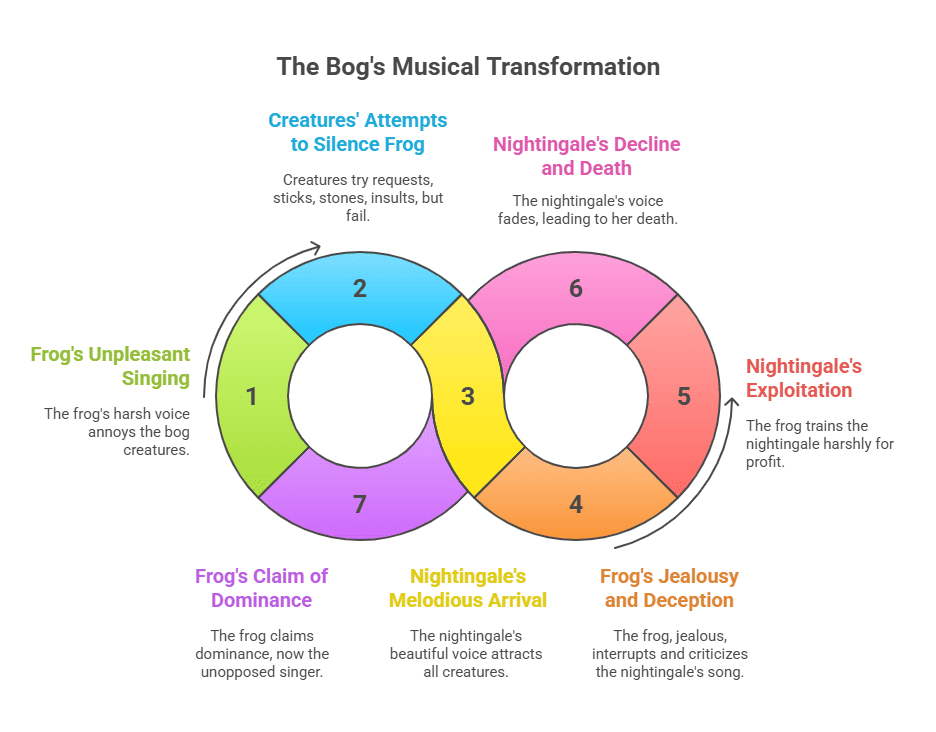
Ans. In the Bingle bog, under a sumac tree a frog sang in its unpleasant voice. All the creatures in the bog hated its harsh sound. They tried using different ways – requests, sticks, stones, insults and complaints but the frog could not be stopped. It was proud of its voice and sang with confidence.
One night when the sky was lit with the moonlight, a melodious nightingale sat on the sumac tree and sang beautifully. All the creatures were attracted towards the melodious voice. The frog was amazed as it had never heard such a beautiful voice. All the creatures praised and cheered the bird and asked it to sing more.
The nightingale had never received such praise and so, it got flattered. It sang continuously throughout the night. The next night, as the bird prepared to sing the frog who was jealous of it interrupted it. It introduced itself as the owner of the tree on which the bird was sitting. It said that it was famous for its deep manly voice and also wrote occasionally for the bog trumpet magazine. The frog told the nightingale that her song was not bad, but pointed out that it was too long and lacked force. The innocent bird felt that such a great musician had evaluated her singing talent. The frog scolded her for being proud that her song was her own original composition. He said that she had to get formal training to become a perfect singer. Agreed hesitantly but would charge a fee. The frog forced the little delicate bird to sing in bad weather, for long hours which made her weak. Her voice lost its melody.
After some rest, the nightingale’s throat felt better, and it again started singing. As a huge crowd would gather to hear the melodious voice, the greedy frog started charging admission fee for the ‘concert’. It attracted a royal crowd of birds and animals from distant places who attended the concert in their fine dresses.
The frog was happy that he was earning so much money but at the same time, was jealous of the nightingale’s popularity. As the frog became greedy for more money, it would scold the poor bird, force it to practise more and pointed out mistakes in its singing technique. All this took a toll on the little bird.
As it became sad, overworked and weak, it’s song lost its melody and became boring. The crowd started decreasing which infuriated the frog. One day as the bird tried to draw a deep breath to sing loud and strong, a vein in it burst and it died.
Now the frog calls the nightingale stupid, nervous and prone to be influenced by others. It says that it should have had confidence rather than being influenced by what the frog said.
The frog says that it believes and so now, once again it is the unopposed singer in the bog.
The Frog and the Nightingale Theme-based Questions
Question: How does the poem explore the theme of ‘Exploitation’?
Ans. The frog represents the predatory nature of individuals who use the talent of others for personal gain. He recognizes the nightingale’s gift not as something to be admired, but as a ‘gold mine.’ By charging admission fees for her concerts and forcing her to sing until she is exhausted, he treats her as a commodity rather than a living being. The theme suggests that in a competitive world, the innocent are often used by the manipulative.
Question: What role does ‘Lack of Self-Confidence’ play in the nightingale’s tragedy?
Ans. Despite having a voice that ‘shook the stars,’ the nightingale suffers from a fatal lack of self-worth. She constantly seeks validation from the frog, whom she considers a ‘Mozart in disguise.’ Her inability to trust her own talent allows the frog to dominate her mind. The theme illustrates that talent alone is not enough; one must have the strength of character to protect that talent from negative influences.
Question: Discuss ‘Professional Jealousy’ as a driving force in the poem.
Ans. The frog is the ‘unrivalled’ singer of Bingle Bog until the nightingale arrives. His ego is bruised when the audience shifts their attention to her. His primary motivation is not to help her improve, but to ensure she fails so that he can remain the only voice in the bog. This theme highlights how jealousy can lead to destructive behavior, where one person’s success is seen as another’s failure.
The Frog and The Nightingale Previous Year Questions with Model Answers PDF
Download the previous year questions of the Lesson The Frog and The Nightingale of class 10 (Communicative) for free. With the help of this, you can prepare for the exam.
To Download The Frog and The Nightingale Previous Year Questions with Model Answers- Click Here
The Frog and The Nightingale Poem Explanation
After going through the summary of the Poem The Frog and the Nightingale, let us go through the line by line explanation of the lesson
Poem
Once upon a time a frog
Croaked away in Bingle Bog
Every night from dusk to dawn
He croaked awn and awn and awn.
Word meanings
Bingle: name of the bog
bog: an area of land that is very wet and muddy
awn: ‘on’ misspelt and mispronounced as ‘awn’ so that it rhymes with ‘dawn’
Literary Devices
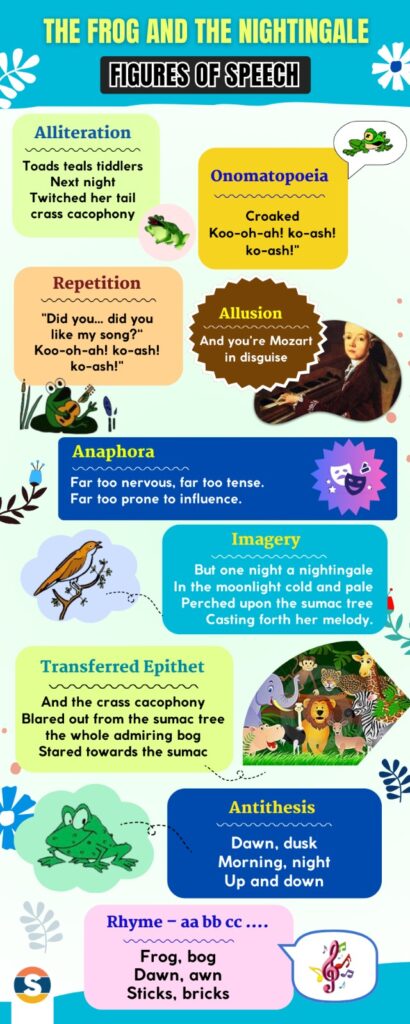
1. Rhyme scheme- aa bb
2. Onomatopoeia- ‘croaked’
3. Repetition – awn and awn and awn
4. Alliteration – ‘Bingle bog’ – ‘b’ sound repeated
5. Antithesis – ‘dusk’ ‘dawn’
Explanation of the above poem – The poet is telling the story of a frog and a nightingale who lived in a marshy land called ‘Bingle Bog’. The frog croaked all through the night from sunset till sunrise. It croaked non – stop and to emphasize the continuity of his sound, the poet repeats the word ‘awn’ thrice.
Questions based on the stanza above-
Question: Who is the protagonist described in these lines, and what is his attitude?
Ans. The protagonist described in the opening lines is the Frog. His attitude is one of extreme arrogance, conceit, and self-importance. He considers himself a master musician and believes he has the sole right to sing in the bog, showing a complete lack of concern for the discomfort his harsh voice causes to others.
Question: What did the frog do every night at Bingle Bog?
Ans. Every night at Bingle Bog, the frog would sit under a sumac tree and croak loudly from evening until the next morning. He sang without any break or rhythm, determined to assert his dominance over the area with his unpleasant and jarring voice.
Question: Where did the frog live and what did he do there every night?
Ans. The frog lived in a place called Bingle Bog. Every night, he would park himself at the foot of a sumac tree and sing his ‘monstrous’ song. He was ‘unrivalled’ in the bog and used his loud croaking to drown out any other sounds, making sure he was the only one heard.
Question: What is the significance of the rhyme ‘dawn’ and ‘awn and awn and awn’ in this context?
Ans. The rhyme is significant because it mimics the repetitive and monotonous nature of the frog’s croaking. The use of ‘awn and awn’ creates an onomatopoeic effect that suggests the sound is never-ending, boring, and highly irritating to the listener. It emphasizes that the frog has no musical variety and simply continues his noise without stopping.
Poem
Other creatures loathed his voice,
But, alas, they had no choice.
And the crass cacophony
Blared out from the
At whose foot the frog each night
Minstrelled on till morning night
Word meanings
loathed: hated
crass: Rude and insensitive
cacophony: a very loud and unpleasant noise
minstrelled: sang
Literary Devices
1. Rhyme scheme – aa bb cc
2. Alliteration – ‘crass cacophony’ – ‘c’ sound is repeated
3. Transferred epithet – ‘And the crass cacophony Blared out from the sumac tree’
4. Antithesis- ‘morning’ ‘night’
Explanation of the above poem – The other creatures in the Bingle bog like rabbits, elephants, monkeys, birds, etc disliked the harsh and unpleasant sound made by the frog. They could do nothing about it and the rude and loud sound made by the frog could be heard as it croaked sitting at the foot of a tree called sumac. (Just like there are various trees – mango, sheesham, mahogany, acacia, bamboo, etc. this tree was of sumac). It croaked continuously throughout the night.
Questions based on the stanza above-
Question: Whose voice was loathed?
Ans. The voice of the frog was loathed by all the other creatures living in Bingle Bog. His croaking was described as a ‘monstrous’ and unpleasant sound that lacked any melody or rhythm, causing great irritation to everyone who was forced to listen to it.
Question: Why did the other creatures have no choice?
Ans. The other creatures had no choice because the frog was ‘unrivalled’ and extremely persistent in his singing. Despite their ‘stones and prayers’ and their clear dislike for his noise, the frog refused to stop. He used his loud and powerful voice to dominate the bog, effectively drowning out any other sounds.
Question: Who are the ‘other creatures’ mentioned in the first line?
Ans. The ‘other creatures’ refer to the various animals and birds that inhabited Bingle Bog alongside the frog. This includes a variety of ducks, herons, and other marshland inhabitants who were disturbed by the frog’s constant and jarring nightly performances.
Question: Where was the frog singing from, and when did he sing?
Ans. The frog was singing from the foot of a sumac tree located within Bingle Bog. He followed a strict and relentless schedule, starting his croaking at ‘dusk’ or evening and continuing it ‘on and on’ until the ‘morning light’ or dawn.
Question: What does the phrase ‘minstrelled on till morning light’ mean in this context?
Ans. The phrase is used ironically by the poet to describe the frog’s singing. A ‘minstrel’ is usually a talented musician who sings beautiful songs, but here it refers to the frog’s loud and ugly croaking. It means that he continued his noise throughout the entire night without any consideration for the sleep or peace of others.
Poem
Neither stones nor prayers nor sticks,
Insults or complaints or bricks
Stilled the frog’s determination
To display his heart’s elation
Word Meanings
elation: great pride and joy
Literary Devices
1. Rhyme scheme – aa bb
2. Alliteration – ‘his heart’s’ – ‘h’ sound is repeated
Explanation of the above poem – The creatures of the bog tried different ways to stop the frog. They hit it with stones, bricks and sticks, insulted it, complained against it and even prayed before it to stop making the unpleasant sound. They were unsuccessful as the frog was determined to ‘sing’ as it was proud of its unique voice.
Questions based on the stanza above-
Question: What was the frog determined to do, according to the extract?
Ans. The frog was determined to be the sole and unrivalled singer of Bingle Bog. He was committed to croaking from the foot of the sumac tree every single night, from dusk until dawn, without any regard for the negative reactions or the discomfort of the other inhabitants of the marsh.
Question: What did the creatures of the bog use in their attempt to silence the frog?
Ans. The creatures of the bog used both physical actions and emotional appeals to try and silence the frog. They threw stones at him to physically stop the noise and offered up prayers in the hope that he would finally cease his ‘monstrous’ and jarring croaking.
Question: What does the phrase ‘heart’s elation’ imply about the frog’s feelings regarding his own voice?
Ans. The phrase ‘heart’s elation’ implies that the frog was extremely proud of his own voice and derived great joy and satisfaction from his singing. While others found his voice loathsome and harsh, he himself felt a sense of triumph and happiness every time he croaked, showing a total lack of self-awareness.
Question: Why did the bog creatures want to stop the frog from singing?
Ans. The bog creatures wanted to stop the frog because his voice was extremely unpleasant, loud, and lacked any musical quality. It disturbed their peace, prevented them from sleeping, and turned their living environment into a place of constant, irritating noise that they found impossible to enjoy.
Question: What personality trait of the frog is highlighted by his refusal to be quiet despite the insults?
Ans. The frog’s refusal to be quiet highlights his thick-skinned nature, his stubbornness, and his supreme arrogance. It shows that he is completely indifferent to the opinions of others and possesses an ego so large that he interprets his own persistence as a sign of musical authority rather than a nuisance.
Poem
But one night a nightingale
In the moonlight cold and pale
Perched upon the sumac tree
Casting forth her melody.
Word Meanings
Casting forth: to emit or to send out
Literary Devices
1. Rhyme scheme- aa bb
2. Visual imagery- The poet constructs an image in the reader’s mind – The sky in moonlit and a nightingale is sitting on a sumac tree, singing a melodious song.
3. Alliteration- night nightingale – ‘n’ sound is repeated.
Explanation of the above poem – The character of the nightingale is now introduced in the poem. One night, the sky was full of the moon’s light. The weather was cold, and everything seemed dull. A nightingale bird sat on a branch of the sumac tree and sang in it melodious voice.
Questions based on the stanza above-
Question: Where did the nightingale perch to sing her song?
Ans. The nightingale perched upon a sumac tree to sing her song. This was the same tree where the frog usually sat to croak, but her presence transformed the spot from a place of ‘cacophony’ into a stage for a divine and melodious performance.
Question: What is the atmosphere created by the phrase ‘moonlight cold and pale’?
Ans. The phrase ‘moonlight cold and pale’ creates an atmosphere of calm, stillness, and ethereal beauty. It contrasts sharply with the ‘muddy’ and ‘monstrous’ environment of the frog’s nightly croaking, suggesting a magical and serene setting that is perfect for a soulful musical performance.
Question: What does the phrase ‘casting forth her melody’ suggest about the nature of the nightingale’s song?
Ans. The phrase suggests that the nightingale’s song is effortless, generous, and expansive. Unlike the frog’s forced and jarring noise, the nightingale’s music seems to flow out of her naturally, spreading through the bog and capturing the attention of every living creature with its purity.
Question: What does the nightingale’s action of singing ‘in the moonlight’ imply about her character compared to the dark, slimy frog?
Ans. The nightingale singing in the moonlight implies that she is a creature of beauty, grace, and light. While the frog is associated with the ‘slimy’ mud and the ‘harsh’ darkness of his own ego, the nightingale represents the ‘divine’ and aesthetic side of nature. Her character is portrayed as refined and artistic, standing in stark contrast to the frog’s crude and predatory nature.
Question: Which poetic device is used in the phrase ‘night-nightingale’?
Ans. The poetic device used in ‘night-nightingale’ is alliteration. The repetition of the ‘n’ sound at the beginning of the words creates a soft, melodic, and rhythmic quality. It emphasizes the bird’s connection to the night and adds a lyrical touch to her introduction in the poem.
Poem
Dumbstruck sat the gaping frog.
And the whole admiring bog
Stared towards the sumac, rapt,
And, when she had ended, clapped,
Ducks had swum and herons waded
To her as she serenaded
Word Meanings
Dumbstruck: so shocked or surprised as to be unable to speak
Rapt: totally interested, so that you cannot think of anything else
Heron: A water bird
Serenaded: sang beautifully
Literary Devices
1. Rhyme scheme – aa bb cc
2. Transferred epithet – the whole admiring bog Stared towards the sumac
Explanation of the above poem – The frog was shocked to hear the melodious voice of the nightingale. It was unable to speak. All the creatures of the Bingle bog appreciated the song. They clapped and praised it when the song ended. Ducks and herons swam and came near the sumac tree to hear it as the nightingale sang beautifully.
Questions based on the stanza above-
Question: Who is ‘she’ in the above lines?
Ans. ‘She’ refers to the nightingale who has recently arrived at Bingle Bog. She is described as a talented and modest singer whose melodious voice completely changes the atmosphere of the swamp, contrasting sharply with the frog’s harsh croaking.
Question: Where is the singer sitting, according to the poem?
Ans. According to the poem, the singer is sitting upon a sumac tree. This is the same tree that the frog had previously claimed as his own territory for his nightly performances, but the nightingale has now taken it as her stage.
Question: What was the audience’s reaction when the song ended?
Ans. When the song ended, the audience was filled with admiration and broke into enthusiastic applause. Creatures that had previously loathed the frog’s noise were now ‘rapt’ and ‘dumbstruck’ by her beauty, and they cheered and shouted ‘Bravo!’ and ‘Encore!’ to show their delight.
Question: Which animals waded toward the singer?
Ans. Several water birds and marshland animals waded toward the singer to get a better listen. Specifically, the poem mentions ducks and herons that swam or waded through the water of the bog, drawn by the ‘divine’ and ‘soft’ melody of the nightingale.
Question: Why was the frog ‘dumbstruck’ in this scene?
Ans. The frog was ‘dumbstruck’ because he was shocked and jealous to hear a voice that was clearly superior to his own. He was used to being the ‘unrivalled’ singer of the bog, and seeing the entire audience move toward the nightingale made him realize that his dominance was being challenged by a truly gifted artist.
Poem
And a solitary loon
Wept, beneath the summer moon.
Toads and teals and tiddlers, captured
By her voice, cheered on, enraptured:
“Bravo!” “Too divine!” “Encore!”
So the nightingale once more,
Word Meanings
Solitary: alone, single
loon: a large water bird
teal: a small duck
tiddlers: small fishes
enraptured: filled with fascination and delight
encore: ‘sing some more’
Literary Devices –
1. Rhyme scheme – aa bb cc
2. Alliteration – ‘Toads teals tiddlers’ – ‘t’ sound is repeated
Explanation of the above poem – A large water bird called loon who was alone felt emotional on hearing the nightingale’s melodious song. It started weeping as the nightingale sang through the night with the moon in the sky. ‘Summer moon’ means that it was the summer season when the moon is comparatively lower in the sky. Even the tiny creatures like the small frogs, ducks and fishes were attracted to the melodious voice and cheered it to sing more. They cheered the nightingale by saying that it was a brave bird, its song was heavenly and asked it to sing more.
Questions based on the stanza above-
Question: Why is the loon described as ‘solitary’ and why is it ‘weeping’?
Ans. A solitary loon refers to a lonely water bird in Bingle Bog. It is often interpreted that the loon is moved to tears by the immense beauty of the nightingale’s song, unlike the crass, noisy singing of the frog.
Question: What does ‘captured by her voice’ imply about the creatures of the bog?
Ans. The creatures are completely enchanted, mesmerized, and held spellbound by the nightingale’s melodious singing.
Question: What kind of atmosphere is created by the lines ‘beneath the summer moon’?
Ans. It creates a peaceful, romantic, and enchanting setting that contrasts with the earlier harsh, cacophonous environment created by the frog.
Question: How does this scene contrast with the general mood of Bingle Bog?
Ans. Usually, the bog is filled with the ‘crass cacophony’ of the frog, which the other creatures loathe. However, this moment is filled with admiration and joy.
Question: Question: What poetic device is used in the phrase ‘Toads and teals and tiddlers’?
Ans. The primary poetic device used in this phrase is alliteration. This is the repetition of the consonant ‘t’ sound at the beginning of the consecutive words ‘Toads,’ ‘teals,’ and ‘tiddlers.’
Poem
Quite unused to such applause,
Sang till dawn without a pause.
Next night when the Nightingale
Shook her head and twitched her tail,
Closed an eye and fluffed a wing
And had cleared her throat to sing
Word Meanings
Applause: Praise, appreciation
Twitched: A short, sudden jerk or movement
Literary Devices –
1. Rhyme scheme – aa bb cc
2. Alliteration – ‘Next night’ – ‘n’ sound is repeated
‘twitched her tail’ – ‘t’ sound is repeated
Explanation of the above poem – The nightingale had never received appreciation and it was so happy that it sang continuously till sunrise. The next night it again prepared to sing – it shook its head, jerked its tail, closed an eye to concentrate on the song and fluffed its wing. Before starting the song, it cleared its throat also.
Questions based on the stanza above-
Question: How did the applause affect the Nightingale?
Ans. The Nightingale was completely unused to such grand applause, and it filled her with a sense of inspiration and joy. The praise from the creatures of the bog motivated her to sing all night long, as she was deeply moved by the appreciation she had never received before.
Question: What physical actions did the Nightingale take before starting her song on the second night?
Ans. Before she began her performance on the second night, the Nightingale performed a series of preparatory actions. She shook her head, twitched her tail, fluffed a wing, and cleared her throat to ensure she was ready to deliver another melodious song.
Question: Why do you think the poet describes her ‘twitching her tail’ and ‘fluffing a wing’?
Ans. The poet uses these descriptive details to show the Nightingale’s professional preparation and her growing confidence. These actions reflect her excitement and her desire to perform at her best for an audience that had finally recognized her talent.
Question: What does the phrase ‘Quite unused to such applause’ suggest about the Nightingale’s past?
Ans. This phrase suggests that the Nightingale had a very humble or isolated past where her talent went unnoticed. It implies that she lacked self-confidence and had never experienced the thrill of a public performance, making her emotionally vulnerable to the sudden fame she found in Bingle Bog.
Question: How does the Nightingale’s reaction to the applause foreshadow her eventual downfall?
Ans. Her reaction foreshadows her downfall by revealing her extreme dependence on external validation. Because she is so easily swayed by the crowd’s ‘Encore’ and ‘Bravo,’ she becomes the perfect target for the Frog, who later uses her need for approval to manipulate and exploit her until she is exhausted.
Poem
She was startled by a croak.
“Sorry – was that you who spoke?”
She enquired when the frog
Hopped towards her from the bog.
“Yes,” the frog replied.
Word Meanings
Startled: Taken aback, surprised and shocked
Literary Devices –
1. Rhyme scheme – aa bb
2. Onomatopoeia – ‘croak’ is the sound produced by the frog
Explanation of the above poem – The bird was interrupted by the ‘croak’ sound of the frog. As it hopped towards the nightingale, it asked the frog whether it was the frog who spoke. The frog replied that it was his sound.
Questions based on the stanza above-
Question: What sound startled the nightingale, and who was responsible for it?
Ans. The nightingale was startled by a loud and harsh ‘croak’ that suddenly broke the silence of the night. This jarring sound was made by the frog, who was determined to interrupt her beautiful performance and assert his presence in Bingle Bog.
Question: Where did the frog come from when he spoke to the nightingale?
Ans. When the frog spoke to the nightingale, he emerged from the ‘cranny’ or the small, dark space where he had been hiding. He hopped out from the shadows near the sumac tree to confront her directly after her successful debut.
Question: How did the nightingale react upon being addressed by the frog?
Ans. Upon being addressed by the frog, the nightingale reacted with extreme politeness and humility. She was ‘startled’ but remained respectful, as she was completely unaware of the frog’s jealous nature and was easily impressed by his confident manner.
Question: What did the frog claim to own?
Ans. The frog claimed to own the sumac tree on which the nightingale was perched. He used this false claim of ‘ownership’ to establish authority over her, making her feel like an intruder who needed his permission and guidance to sing there.
Question: What does the frog’s act of hopping towards the nightingale signify about his character?
Ans. The act of hopping towards her signifies the frog’s predatory and dominant nature. It shows his lack of boundaries and his desire to physically and mentally intimidate the smaller, more delicate bird. By closing the distance, he begins his psychological manipulation to make her feel small and dependent on his ‘expertise.’
Poem
“You see,
I’m the frog who owns this tree.
In this bog I’ve long been known
For my splendid baritone
And, of course, I wield my pen
For Bog Trumpet now and then”.
Word Meanings
baritone: a male singing voice, fairly deep
wield: hold and use
Literary Devices –
1. Rhyme scheme – aa bb cc
2. Personification – The frog has been personified – ‘I wield my pen’
3. Antithesis – now then
Explanation of the above poem – The frog introduces itself to the nightingale as the owner of the sumac tree on whose branch the bird was sitting and singing. Further it said that it was famous in the bog for singing in its unique, deep voice. It also wrote occasionally for the Bog Trumpet magazine.
Questions based on the stanza above-
Question: Who is the speaker of the above lines, and what is his tone?
Ans. The speaker is the frog who lives in Bingle Bog. His tone is incredibly boastful, condescending, and authoritative. He speaks with a sense of self-importance, intending to intimidate the nightingale by presenting himself as a seasoned expert and a person of high social standing.
Question: What does the frog claim to be known for in the bog?
Ans. The frog claims to be famous throughout the bog for his ‘splendid baritone’ voice. He presents his harsh and loud croaking as a refined musical talent, deliberately misleading the nightingale into believing that he is a master of singing.
Question: What is the ‘Bog Trumpet’ mentioned in the extract?
Ans. The Bog Trumpet is a fictional newspaper or journal that the frog claims to write for. By saying he ‘wields his pen’ for this publication, he is pretending to be a respected music critic, which gives him a fake intellectual authority over the nightingale’s art.
Question: Why does the frog mention that he ‘owns this tree’?
Ans. The frog mentions owning the sumac tree to establish a sense of territory and power. By claiming ownership of the very spot where the nightingale is perched, he makes her feel like a guest or an intruder who must seek his approval and guidance to continue singing there.
Question: What does the phrase ‘wield my pen’ imply about the frog’s character?
Ans. The phrase ‘wield my pen’ implies that the frog is manipulative and cunning. He uses the idea of being a writer or critic as a weapon to control others. It suggests that he values the power of criticism and ‘expert’ opinion as a way to dominate those who are more talented but less confident than himself.
Poem
“Did you… did you like my song?”
“Not too bad – but far too long.
The technique was fine of course,
But it lacked a certain force”.
Word meanings
technique: a method of doing something
Literary Devices –
1. hyme scheme – aa bb
2. Repetition – ‘Did you… did you’
3. Alliteration –‘bad – but’ – ‘b’ sound repeated
Explanation of the above poem – The humble bird asks the frog if it liked her song. The frog replies that it wasn’t bad, but it was very long. Further it comments on her skill and says that the method of singing was fine, but her voice lacked force.
Questions based on the stanza above-
Question: Who is the speaker of the second line, and what is his tone?
Ans. The speaker is the frog, and his tone is condescending, critical, and patronizing. He deliberately adopts the persona of a seasoned music expert to undermine the nightingale’s confidence while pretending to give her professional advice.
Question: What is the nightingale’s attitude when she asks ‘Did you… did you like my song?’
Ans. The nightingale’s attitude is one of extreme humility, hesitation, and a desperate need for approval. The use of the ellipsis and the repetition of ‘did you’ shows her nervousness and her lack of self-belief, making her an easy target for the frog’s manipulation.
Question: Why does the frog describe the song as ‘far too long’?
Ans. The frog describes the song as ‘far too long’ to make the nightingale feel that her natural performance is flawed. By criticizing the length, he begins to exert control over her creative process, suggesting that her instincts are wrong and that she needs his ‘expert’ guidance to be successful.
Question: What does the frog mean when he says the song ‘lacked a certain force’?
Ans. By saying the song ‘lacked a certain force,’ the frog is criticizing the nightingale’s soft and melodious style. He wants to push her toward a louder, more strained way of singing similar to his own harsh croaking, which eventually leads to her physical exhaustion and the bursting of her lungs.
Question: How does the frog use the word ‘technique’ to manipulate the nightingale?
Ans. The frog uses the word ‘technique’ to sound like a professional and intellectual critic. By saying her technique was ‘fine of course,’ he gives her a small, empty compliment before delivering the heavy criticism that follows, ensuring she stays hooked on his every word to find out how to improve.
Poem
“Oh!” the nightingale confessed.
Greatly flattered and impressed
That a critic of such note
Had discussed her art and throat:
“I don’t think the song’s divine.
But – oh, well – at least it’s mine”.
Word Meanings
Flattered: Happy and pleased
Impressed: influenced
Critic: A person who judges the merits of artistic works.
art: Here, singing talent
Literary Devices –
1. Rhyme scheme – aa bb cc
Explanation of the above poem – The nightingale felt bad that her singing was not upto the mark. It was happy that such an expert musician had analyzed her song and her voice. It was impressed by the frog’s style. The bird consoles itself that even if her song is not heavenly, at least it is her own composition.
Questions based on the stanza above-
Question: Why was the nightingale ‘greatly flattered and impressed’ by the frog?
Ans. The nightingale was flattered because she was incredibly naive and modest. She truly believed the frog’s lies about being a famous critic for the ‘Bog Trumpet.’ To her, the fact that such a ‘distinguished’ figure was taking the time to analyze her ‘art and throat’ felt like a massive professional honor rather than a calculated insult.
Question: What does the nightingale’s reaction reveal about her self-confidence?
Ans. Her reaction reveals a profound lack of self-confidence. Even though her song was described by others as ‘divine,’ she immediately defers to the frog’s harsh opinion. She is so unsure of her own talent that she values the word of a ‘critic’ more than the genuine applause of her entire audience.
Question: What is the significance of the phrase ‘discussed her art and throat’?
Ans. This phrase shows how the frog has successfully shifted the conversation from the beauty of her music to the technicality of her biology. By focusing on her ‘throat,’ the frog begins to treat her as a machine that needs ‘training’ rather than being a natural artist, setting the stage for his grueling and fatal practice sessions.
Question: What does the nightingale mean by the line ‘But – oh, well – at least it’s mine’?
Ans. In this line, the nightingale is defending the only thing she feels she has: the originality of her song. While she accepts the frog’s critique that her song isn’t ‘divine’ or perfect, she takes a small amount of humble pride in the fact that it is her own creation and not an imitation of anyone else.
Question: How does the frog use the nightingale’s humility to his advantage?
Ans. The frog exploits her humility by posing as a mentor. Since she admits her song isn’t ‘divine,’ he steps in to ‘help’ her reach that level. He uses her own admission of imperfection as a doorway to take total control over her life, eventually charging admission for her performances and pocketing the profit.
Poem
“That’s not much to boast about”.
Said the heartless frog. “Without
Proper training such as I
And few others – can supply.
You’ll remain a mere beginner.
But with me you’ll be a winner”.
Word Meanings
Boast: Praise oneself
Literary Devices –
1. Rhyme scheme – aa bb cc
Explanation of the above poem – The frog scolds the bird for being proud. It is harsh towards the bird and belittles it by saying that it lacks training which only a few masters like the frog can give. The frog also says that without the training the bird will remain just a beginner all its life and if it wanted to become a winner – a perfect singer, then it had to learn from him.
Questions based on the stanza above-
Question: Who is the speaker of these lines and what is his primary objective?
Ans. The speaker is the frog, and his primary objective is to demoralize the nightingale. By telling her that her song is ‘not much to boast about,’ he aims to shatter her self-confidence so that she becomes completely dependent on his ‘guidance’ and ‘training.’
Question: Why does the poet describe the frog as ‘heartless’ in this context?
Ans. The poet uses the word ‘heartless’ because the frog is knowingly lying to a talented artist. He recognizes the nightingale’s superior gift but chooses to insult it to maintain his own ego and eventually exploit her for financial gain, showing a total lack of empathy or artistic integrity.
Question: What does the frog mean by ‘Proper training such as I and few others – can supply’?
Ans. The frog is pretending to be part of an elite group of master musicians. He suggests that singing is a technical skill that can only be taught by ‘experts’ like himself. This is a classic manipulation tactic used to make the nightingale feel that her natural, divine talent is ‘improper’ or ‘unrefined.’
Question: How does the frog use the contrast between a ‘mere beginner’ and a ‘winner’ to tempt the nightingale?
Ans. The frog uses the fear of failure and the lure of fame. By calling her a ‘mere beginner,’ he insults her current status, but by promising to make her a ‘winner,’ he presents himself as her only path to success. He frames his exploitation as a professional opportunity she cannot afford to miss.
Question: What is the significance of the frog’s claim that only ‘few others’ can supply this training?
Ans. This claim creates a sense of exclusivity and urgency. By suggesting that his ‘expertise’ is rare, he makes the nightingale feel lucky to have met him. It prevents her from seeking advice elsewhere and traps her in his influence under the guise of receiving a ‘privileged’ education.
Poem
“Dearest frog”, the nightingale
Breathed: “This is a fairy tale –
And you’re Mozart in disguise
Come to earth before my eyes”.
Word Meanings
Mozart: Name of a very talented musician
disguise: Cannot be recognized
Literary Devices –
1. Rhyme scheme – aa bb
2. Metaphor –a comparison between two things without using like or as. – “This is a fairy tale and you’re Mozart in disguise” The nightingale compares the frog to Mozart, indicating a belief in his musical talent.
3. Allusion – The nightingale makes a reference to a famous classical composer, Wolfgang Amadeus Mozart: “And you are Mozart in disguise / Come to earth before my eyes”. This reference functions to highlight how innocent the nightingale is, that she genuinely believes the frog possesses the same level of musical genius as Mozart.
Explanation of the above poem – The nightingale praises the frog and compares it to the most famous musician Mozart. It says that this is like a fairy tale – a dream come true that such an accomplished singer is present before her.
Questions based on the stanza above-
Question: Who is the speaker of these lines, and what is her emotional state?
Ans. The speaker is the Nightingale. Her emotional state is one of absolute awe, adoration, and extreme gratitude. She is so overwhelmed by the frog’s self-proclaimed expertise that she views his presence as a magical, once-in-a-lifetime opportunity for her musical career.
Question: Why does the Nightingale call the frog ‘Dearest frog’ and a ‘fairy tale’?
Ans. The use of ‘Dearest frog’ shows her innocent and affectionate nature, while calling the situation a ‘fairy tale’ indicates that she believes her sudden encounter with a ‘master’ critic is too good to be true. She is so blinded by her own modesty that she cannot see the frog’s true, predatory intentions.
Question: What is the significance of the Nightingale comparing the frog to ‘Mozart in disguise’?
Ans. This comparison is the height of irony in the poem. Wolfgang Amadeus Mozart was one of the greatest musical geniuses in history, whereas the frog is a tone-deaf, arrogant croaker. By elevating the frog to the status of Mozart, the Nightingale proves how easily she can be manipulated by anyone who speaks with enough confidence.
Question: What does the phrase ‘Come to earth before my eyes’ imply about the Nightingale’s perception of the frog?
Ans. This phrase implies that the Nightingale views the frog as a divine or heavenly being sent specifically to guide her. She treats him not as a fellow inhabitant of the bog, but as a superior entity whose every word must be followed as if it were a sacred musical commandment.
Question: How does this specific reaction from the Nightingale empower the frog?
Ans. Her reaction gives the frog absolute power over her. Because she has placed him on a pedestal as a ‘genius,’ she will no longer question his harsh criticisms or his grueling training schedules. It allows the frog to transition from being a mere neighbor to becoming her ‘master’ and exploiter.
Poem
“Well I charge a modest fee.
Oh!… But it won’t hurt, you’ll see”
Now the nightingale inspired,
Flushed with confidence, and fired
With both art and adoration,
Sang – and was a huge sensation.
Word Meanings
Modest: small
flushed: full of, very excited and pleased
adoration: Strong admiration
sensation: Widespread reaction of interest and excitement
Literary Devices –
1. Rhyme scheme – aa bb cc
2. Alliteration – ‘Now the nightingale’ – ‘n’ sound is repeated
Explanation of the above poem – The frog tells the nightingale that it will teach her the skill but will charge a small fee. It assures her that the amount will be small and paying it will not be tough for the bird. The nightingale regains its confidence and takes inspiration from the frog’s consent. It is full of talent and admiration for the frog. With this new-found confidence, it sang well. The bird’s music became famous and creatures from far off places were attracted to it.
Questions based on the stanza above-
Question: What is the significance of the frog mentioning a ‘modest fee’?
Ans. The mention of a ‘modest fee’ is the first clear sign of the frog’s greed and predatory nature. He is shifting the relationship from a ‘mentor and student’ to a business arrangement where he can profit from the nightingale’s talent. By calling it ‘modest,’ he downplays the exploitation and makes it seem like a small price to pay for his ‘expert’ guidance.
Question: What does the frog mean by the phrase ‘But it won’t hurt, you’ll see’?
Ans. This phrase is deeply ironic and foreboding. While the frog is likely referring to the ‘fee’ or the intensity of the training, the reality is that his guidance does eventually hurt the nightingale. His grueling practice sessions in the rain and his constant criticism lead to her physical exhaustion and eventual death.
Question: What three things ‘fired’ the nightingale to perform so well?
Ans. The nightingale was ‘fired’ or energized by three things: her natural passion for ‘art,’ her ‘adoration’ or hero-worship of the frog, and her newfound ‘confidence’ gained from the belief that she was being trained by a master. These combined emotions made her performance a ‘huge sensation’ in the bog.
Question: How did the nightingale’s audience react to her performance under the frog’s ‘guidance’?
Ans. The nightingale was a ‘huge sensation,’ meaning the audience was completely captivated by her voice. The creatures of Bingle Bog, who had long suffered through the frog’s croaking, flocked to hear her, turning her nightly songs into a major social event in the marsh.
Question: How does the frog use the nightingale’s success to further his own goals?
Ans. The frog uses her success to establish himself as a powerful ‘manager.’ By claiming credit for her ‘training,’ he justifies charging admission to her concerts. He turns her art into a commercial enterprise, positioning himself as the one who controls the ‘sensation’ and collects the earnings.
Poem
Animals for miles around
Flocked towards the magic sound,
And the frog with great precision
Counted heads and charged admission
Though next morning it was raining,
He began her vocal training.
Word Meanings
Precision: exact and accurate
Literary devices –
1. Rhyme scheme – aa bb cc
2. Alliteration – ‘He began her’ – ‘h’ sound is repeated
Explanation of the above poem – Animals gathered from far – off places to hear the magical song of the nightingale. The frog organized concerts and charged an admission fee from all the creatures who came to hear the bird’s song. The next morning after the concert, it was raining, and the bird did not want to sing. The frog insisted and commenced her training.
Questions based on the stanza above-
Question: What does the phrase ‘animals for miles around’ suggest about the Nightingale’s popularity?
Ans. This phrase suggests that the Nightingale’s talent had a universal and far-reaching appeal. Her voice was so ‘magic’ that it drew creatures from far beyond the immediate vicinity of Bingle Bog, turning her nightly performances into a major regional attraction that transcended local boundaries.
Question: What is the significance of the frog counting heads with ‘great precision’?
Ans. The frog’s ‘great precision’ in counting heads highlights his shift from a failed musician to a cold, calculating businessman. He is no longer interested in the art or the melody; he is solely focused on the mathematical and financial aspect of the crowd, ensuring that not a single penny of potential profit escapes him.
Question: Why did the frog begin her vocal training even though it was raining?
Ans. The frog began the training in the rain to show his ‘heartless’ and commanding nature. He wanted to assert total authority over the Nightingale and prove that her comfort was secondary to his ‘professional’ schedule. This also serves as the beginning of his physical abuse of the bird, as singing in the damp cold is incredibly harmful to a delicate throat.
Question: How does the act of ‘charging admission’ change the nature of the Nightingale’s singing?
Ans. By ‘charging admission,’ the frog turns a natural, divine gift into a commercial product. The Nightingale’s song is no longer a free expression of joy; it has become a job performed under the pressure of a paying audience and a greedy manager. This shift marks the loss of her artistic freedom and the start of her exploitation.
Question: What does the contrast between ‘magic sound’ and ‘vocal training’ imply?
Ans. The contrast implies that the Nightingale’s voice was already perfect and ‘magic’ on its own. The ‘vocal training’ offered by the frog was completely unnecessary and was merely a tool he used to manipulate her. It shows how the frog attempted to ‘fix’ something that wasn’t broken in order to justify his control over her.
Poem
“But I can’t sing in this weather”.”Come my dear – we’ll sing together.
Just put on your scarf and sash,
Koo-oh-ah! ko-ash! ko-ash!”
Word meaning
Sash: a long piece of cloth that you wear round the waist or over the shoulder, usually as a badge of honour.
Literary devices –
1. Rhyme scheme – aa bb
2. Alliteration – scarf and sash – ‘s’ sound is repeated
3. Repetition – ‘ko-ash! ko-ash’
4. Onomatopoeia – ‘Koo-oh-ah! ko-ash! ko-ash’ is the sound produced by the frog and the nightingale
Explanation of the above poem – Despite the nightingale’s refusal to sing in the rainy weather, the frog forces it to sing. It asks her to cover her head with a scarf to save herself from the rain and to wear a sash given to her as she has joined his music class. Both sing a song – “Koo-oh-ah! ko-ash! ko-ash!”
Questions based on the stanza above-
Question: What is the Nightingale’s objection in the first line, and how does the Frog respond?
Ans. The Nightingale objects to singing because of the rainy and cold weather, which is harmful to her delicate voice. The Frog dismissively calls her ‘dear’ and insists they sing together, masking his coercive command with a false sense of companionship to ensure she doesn’t stop practicing.
Question: What is the significance of the ‘scarf and sash’ mentioned by the Frog?
Ans. The ‘scarf and sash’ represent a superficial and inadequate attempt at protection. By telling her to simply wrap up, the Frog ignores the internal physical strain that singing in the damp cold causes to her lungs and throat, prioritizing the training schedule over her actual health.
Question: How does the poet use onomatopoeia in this extract?
Ans. The poet uses the sounds ‘Koo-oh-ah! ko-ash! ko-ash!’ to mimic the Frog’s harsh, jarring croaking. This contrasts sharply with the Nightingale’s ‘melody’ and highlights how the Frog is forcing her to adopt his own unmusical and ‘monstrous’ style under the guise of professional training.
Question: What does the Frog’s insistence on singing in bad weather reveal about his character?
Ans. It reveals his ‘heartless’ nature and absolute lack of empathy. He views the Nightingale as a money-making machine rather than a living being. His insistence shows that he is willing to physically break her as long as he maintains control and continues to ‘train’ her for profit.
Question: Why is the phrase ‘we’ll sing together’ ironic in this context?
Ans. It is ironic because there is no harmony between the two. The Frog’s loud, ugly noise drowns out the Nightingale’s beautiful voice. Instead of a duet, it is a form of artistic and physical suppression where the Frog’s ‘force’ overwhelms the Nightingale’s natural talent.
Poem
So the frog and nightingale
Journeyed up and down the scale
For six hours, till she was shivering
and her voice was hoarse and quivering.
Word Meanings
Scale: a sequence of musical notes that go up and down, one after the another
hoarse: rough and unclear
quivering: shaking, trembling
Literary Devices –
1. Rhyme scheme – aabb
2. Alliteration –‘she was shivering’ – ‘sh’ sound is repeated
3. Antithesis – up and down
Explanation of the above poem – The frog and the nightingale continued singing for six hours. They sang different musical notes from high to low and vice versa. By the end of the class the poor bird was trembling, and her voice became rough and shaky due to singing in an unpleasant weather and for such a long time.
Questions based on the stanza above-
Question: What does the phrase ‘journeyed up and down the scale’ refer to?
Ans. This phrase refers to the repetitive and mechanical musical exercises, or scales, that the Frog forced the Nightingale to perform. Instead of singing her natural, soulful melodies, she was made to follow a rigid and soul-crushing routine dictated by her ‘manager.’
Question: For how long did the Nightingale practice, and what does this duration suggest?
Ans. The Nightingale was forced to practice for ‘six hours’ straight. This long duration, especially in the cold and rain, suggests the Frog’s extreme cruelty and his total disregard for the bird’s physical limits. He treated her like a machine rather than a delicate living creature.
Question: What were the physical effects of this practice on the Nightingale?
Ans. The practice had a devastating physical impact on the Nightingale. She was left ‘shivering’ from the cold and damp weather, and her once ‘divine’ and ‘soft’ voice became ‘hoarse and quivering,’ indicating that her vocal cords and lungs were reaching a breaking point.
Question: How does the description of her voice as ‘hoarse and quivering’ contrast with her earlier performances?
Ans. Earlier, her voice was described as a ‘magic sound’ and a ‘melody’ that cast a spell over the bog. The shift to ‘hoarse and quivering’ shows the tragic degradation of her art. The beauty of her song was being systematically destroyed by the Frog’s ‘force’ and ‘training.’
Question: What does the Frog’s persistence during this session reveal about his ‘vocal training’?
Ans. It reveals that the training was never meant to improve her talent. Instead, it was a form of psychological and physical torture designed to break her spirit. The Frog used the ‘training’ to ensure she remained exhausted, making it easier for him to control her and keep her dependent on him.
Poem
Though subdued and sleep deprived,
In the night her throat revived,
And the sumac tree was bowed,
With a breathless, titled crowd:
Owl of Sandwich, Duck of Kent,
Mallard and Milady Trent,
Word Meanings
Subdued: quiet, with little energy
deprived: Not getting enough of something
revived: improved
Literary Devices –
1. Rhyme scheme – aa bb cc
2. Alliteration – ‘subdued and sleep’ – ‘s’ sound is repeated, ‘Mallard and 3. Milady’ – ‘m’ sound is repeated
3. Allusion- The poet makes a reference to famous titles – ‘Owl of sandwich’ refers to the Earl of Sandwich, ‘Duck of Kent’ refers to the Duke of Kent, ‘Mallard and Milady Trent’ refer to My Lord and My Lady of Trent. The poet wants to say that a royal crowd had gathered to hear the melodious bird. As the creatures were animals, so the first names have been replaced by such names of animals which create rhyming effect.
Explanation of the above poem – The sumac tree on whose branch the nightingale sat and sang in its melodious voice was crowded and it seemed that it had bent as a mark of respect to the royal gathering which had come for the concert. The royal creatures that had come were the owl of Sandwich, the duck of Kent, Mallard and Milady of Trent. The poet has added the names of animals like owl, duck, Mallard to the names of historical figures like ‘Earl of Sandwich’, ‘Duke of Kent’, ‘My Lord and My Lady of Trent’ to show that a titled crowd had gathered.
Questions based on the stanza above-
Question: What does the phrase ‘subdued and sleep deprived’ reveal about the Nightingale’s condition?
Ans. It reveals the physical and mental exhaustion caused by the Frog’s relentless training. The Nightingale was no longer the energetic, joyful singer she once was; she was now a tired, overworked performer struggling under the weight of the Frog’s demands.
Question: How did her ‘throat revived’ in the night despite her exhaustion?
Ans. Despite her fatigue, the Nightingale’s natural passion for her art and the thrill of the performance allowed her to push through her pain. The presence of the audience and her innate talent momentarily overcame her exhaustion, allowing her to sing once more.
Question: What is the significance of the sumac tree being ‘bowed’ in this scene?
Ans. The sumac tree was ‘bowed’ or bent under the weight of the massive crowd. This imagery emphasizes the huge popularity of the Nightingale’s concerts and shows how many creatures were packed onto the branches just to catch a glimpse of the ‘sensation’ of Bingle Bog.
Question: Who were the ‘titled crowd’ mentioned in the extract, and what does this signify?
Ans. The ‘titled crowd’ included the Owl of Sandwich, the Duck of Kent, and Mallard and Milady Trent. These names are puns on British aristocratic titles, signifying that the Nightingale’s fame had reached the ‘elite’ or ‘high-society’ members of the animal kingdom, making her a prestigious attraction.
Question: How does the Frog benefit from the presence of this ‘breathless’ crowd?
Ans. The Frog benefits financially and socially. A ‘breathless’ and ‘titled’ crowd means high-status guests who are willing to pay for the ‘privilege’ of hearing the Nightingale. This allows the Frog to charge even higher admission fees and solidify his reputation as a top-tier music manager.
Poem
Martin Cardinal Mephisto,
And the Coot of Monte Cristo,
Ladies with tiaras glittering
In the interval sat twittering –
And the frog observed them glitter
With a joy both sweet and bitter.
Word Meanings
Tiaras: a semi – circular metal band decorated with jewels and worn by wealthy women on formal occasions.
twittering: chatting
Literary Devices-
1. Rhyme scheme – aa bb cc
2. Allusion -The poet makes a reference to famous titles – ‘Coot of Monte Cristo’ refers to the Count of Monte Cristo.
3. Onomatopoeia – Twittering is the sound produced by the crowd
4. Imagery – ‘Ladies with tiaras glittering In the interval sat twittering’ – The reader experiences visual and aural imagery by imagining the royal audience wearing glittering tiaras can be heard chatting among themselves.
5. Antithesis – sweet and bitter
Explanation of the above poem – The crowd included Martin cardinal Mephisto and the coot of Monte Cristo. All the royal ladies were wearing tiaras which were full of shining metal and precious stones. They talked with each other during the interval in the concert. The frog saw the royal gathering which had come to hear the nightingale’s song. He had mixed feelings of happiness and jealousy. He was happy as a huge crowd meant monetary gain. He was jealous of the nightingale’s fame as his song had never got such an exceptional audience.
Questions based on the stanza above-
Question: Who are the new members of the ‘titled crowd’ introduced in this extract?
Ans. The new members mentioned are Martin Cardinal Mephisto and the Coot of Monte Cristo. These names are clever literary and historical puns (referencing Mephistopheles and The Count of Monte Cristo), suggesting that even the most sophisticated and legendary figures of the animal kingdom came to Bingle Bog.
Question: What does the phrase ‘Ladies with tiaras glittering’ signify about the audience?
Ans. The ‘glittering tiaras’ signify the extreme wealth and high social status of the audience. It shows that the Nightingale’s singing had become a ‘must-see’ event for the elite, transforming the muddy bog into a high-fashion, prestigious opera house for the night.
Question: What were the ladies doing during the ‘interval’?
Ans. During the interval, the ladies ‘sat twittering.’ This suggests they were engaged in light, excited gossip and social chatter about the Nightingale’s performance. It highlights that the event was as much a social gathering for the ‘elite’ as it was a musical concert.
Question: Why did the frog feel a joy that was ‘both sweet and bitter’?
Ans. The frog’s joy was ‘sweet’ because he was making a massive profit from the admission fees paid by such a wealthy crowd. However, it was ‘bitter’ because of his intense professional jealousy. He hated that the Nightingale was receiving the genuine adoration and ‘glittering’ attention that he, despite his ‘splendid baritone,’ could never achieve.
Question: How does the frog’s ‘bitter’ feeling hint at the Nightingale’s future?
Ans. The ‘bitter’ part of his joy foreshadows his decision to destroy her. His jealousy outweighs his greed; he cannot stand her success even though it makes him rich. This bitterness drives him to become even more cruel in his ‘training,’ eventually pushing her to the point of physical collapse.
Poem
Every day the frog who’d sold her
Songs for silver tried to scold her:
“You must practice even longer
Till your voice, like mine grows stronger.
In the second song last night
You got nervous in mid-flight.
Word Meanings
Mid – flight: In the middle of the song
Literary Devices –
1. Rhyme scheme – aa bb cc
2. Alliteration – ‘Songs for silver’, ‘second song’ – ‘s’ sound is repeated
Explanation of the above poem – The greedy frog earned a lot of money by selling tickets to the nightingale’s concert. Still, he scolded the poor bird and showed it down by saying that its voice was not strong enough and that it needed to practice more. He also pointed out her mistake and said that the previous night, during the second song, she had got nervous in the middle of the song.
Questions based on the stanza above-
Question: What does the phrase ‘sold her songs for silver’ imply about the Frog’s role?
Ans. This phrase confirms that the Frog has completely commodified the Nightingale’s talent. He is no longer a teacher or a mentor; he is a human trafficker of art who views her songs solely as a source of ‘silver’ or profit. Her creativity has been reduced to a transaction that only benefits him.
Question: Why did the Frog try to ‘scold her’ every day?
Ans. The Frog scolded her to keep her in a state of constant fear and insecurity. By criticizing her daily, he ensured she would never realize her own worth or gain the confidence to leave him. His scolding was a psychological tool used to maintain his absolute dominance over her.
Question: What is the irony in the Frog’s command, ‘Till your voice, like mine grows stronger’?
Ans. The irony lies in the fact that the Frog’s voice is ‘monstrous’ and unmusical. He is trying to force a delicate, melodious songbird to mimic his own harsh, guttural croaking. What he calls ‘strong’ is actually just loud and unpleasant, and forcing her to achieve that ‘force’ is what eventually destroys her vocal cords.
Question: How did the Frog use the Nightingale’s ‘nervousness’ against her?
Ans. The Frog used her natural stage fright and physical exhaustion as proof of her ‘failure.’ By pointing out that she got ‘nervous in mid-flight,’ he made her feel like an amateur who still desperately needed his training. He weaponized her mistakes to justify his continued cruelty and longer practice hours.
Question: What does the phrase ‘In the second song last night’ suggest about the Nightingale’s workload?
Ans. It suggests that the Nightingale was being forced to perform multiple songs every single night for a paying audience. Combined with the ‘six hours’ of morning practice, this heavy workload shows that the Frog was squeezing every bit of energy out of her, leading to her rapid physical decline.
Poem
And, my dear, lay on more trills:
Audiences enjoy such frills.
You must make your public happier:
Give them something sharper, snappier.
We must aim for better billings.
You still owe me sixty shillings.”
Word Meanings
Trills: singing two musical notes one after the other, repeatedly and very quickly
Billings: publicity for a concert, show, etc.
Literary devices –
1. Rhyme scheme – aa bb cc
2. Alliteration – ‘must make’ – ‘m’ sound is repeated, ‘better billings’ – ‘b’ sound is repeated
Explanation of the above poem – The frog orders the nightingale to use fancy notes in her song so that the audience enjoys it more and more and more creatures gather to hear her sing. The frog wants her to please the audience and use sharp notes, sing snappy songs which are liked by them. He wants her to aim at earning more and more money. He reminds her that she still owes him sixty shillings (he is referring to the fee that she must pay him for the music training).
Questions based on the stanza above-
Question: What does the frog mean by ‘lay on more trills’ and ‘audiences enjoy such frills’?
Ans. The frog is demanding that the nightingale add more decorative, high-pitched musical ornaments to her singing. By calling these natural artistic expressions ‘frills,’ he dismisses the soul of her music as mere entertainment or ‘extra’ features designed only to keep the audience amused and paying.
Question: How does the frog use the ‘public’ to manipulate the nightingale?
Ans. The frog shifts the burden of success onto the nightingale by telling her she must make the ‘public happier.’ He creates a false sense of duty, making her feel that if the audience is not satisfied, it is a personal failure of her art rather than a result of his own grueling and unnecessary training.
Question: What is the significance of the phrase ‘sharper, snappier’ in this context?
Ans. These words represent the frog’s desire for a more aggressive, loud, and fast-paced performance. This style is completely contrary to the nightingale’s natural, soft, and ‘divine’ melody. By forcing her to be ‘sharper,’ he is pushing her toward the physical strain that eventually causes her lungs to fail.
Question: What does ‘better billings’ refer to, and what does it reveal about the frog?
Ans. ‘Better billings’ refers to higher ticket sales and greater financial profit. This reveals that the frog is entirely motivated by money. He views the nightingale not as a student or a living being, but as a commercial asset whose only value is the amount of ‘silver’ she can generate at the box office.
Question: How does the mention of ‘sixty shillings’ impact the nightingale’s mental state?
Ans. By claiming she owes him ‘sixty shillings,’ the frog traps her in a cycle of debt. This financial pressure, combined with her physical exhaustion, makes her feel like a prisoner. She is no longer singing for joy; she is singing to pay off a ‘debt’ for ‘training’ that is actually killing her.
Poem
Day by day the nightingale
Grew more sorrowful and pale.
Night on night her tired song
Zipped and trilled and bounced along,
Till the birds and beasts grew tired
At a voice so uninspired
Word Meanings
Zipped: sang quickly
Literary Devices –
1. Rhyme scheme – aa bb cc
2. Alliteration – ‘birds and beasts’ – ‘b’ sound is repeated
3. Repetition – ‘Day by day’, ‘Night on night’
Explanation of the above poem – With each passing day the nightingale became sad and weak. With each passing day, the bird’s song reflected its tiredness and lack of interest. It sang quickly and would not enjoy singing. The songs were no longer melodious, and the creatures of the bog did not enjoy them anymore. The bird’s voice did not attract crowds any longer.
Questions based on the stanza above-
Question: What do the words ‘sorrowful and pale’ signify about the Nightingale’s condition?
Ans. These words indicate both the emotional and physical decline of the Nightingale. ‘Sorrowful’ reflects her lost joy and broken spirit as her art became a chore, while ‘pale’ highlights her deteriorating health and the literal draining of her life force due to the Frog’s relentless demands.
Question: What is the significance of the phrase ‘Night on night’ in this extract?
Ans. This phrase emphasizes the repetitive and unending nature of her suffering. It shows that there was no rest or relief for the Nightingale; the cycle of morning practice and nightly performance continued without a break, leading to her inevitable collapse.
Question: How is the Nightingale’s song described as she becomes more exhausted?
Ans. Her song is described as ‘zipped and trilled and bounced along.’ While these words sound energetic, in this context, they represent a forced and mechanical way of singing. She was no longer singing from her heart; she was simply following the Frog’s technical instructions to be ‘sharper and snappier.’
Question: Why did the ‘birds and beasts’ eventually grow tired of her singing?
Ans. The audience grew tired because the Nightingale’s voice had become ‘uninspired.’ The magic and soul that once captivated Bingle Bog had vanished, replaced by a strained and artificial sound. Without the genuine emotion of the artist, the music lost its appeal, and the ‘titled crowd’ stopped attending.
Question: How does the thinning of the crowd impact the Frog’s treatment of the Nightingale?
Ans. As the crowd thinned and the ‘silver’ stopped flowing, the Frog’s greed turned into even greater cruelty. Instead of realizing he had overworked her, he blamed her for the lack of ‘better billings,’ increasing his verbal abuse and pressure, which pushed her closer to her tragic end.
Poem
And the ticket office gross
Crashed, and she grew more morose
For her ears were now addicted
To applause quite unrestricted,
And to sing into the night
All alone gave no delight.
Word Meanings
Morose: miserable, bad tempered
Literary Devices –
1. Rhyme scheme – aa bb cc
2. Alliteration – ‘more morose’ – ‘m’ sound is repeated.
Explanation of the above poem – There was no audience for the nightingale’s concert. This made the bird sad as now, she had got used to the praise from the audience. Now, it no longer enjoyed singing alone all through the night.
Questions based on the stanza above-
Question: What is meant by the phrase ‘the ticket office gross crashed’?
Ans. This phrase means that the financial earnings from the Nightingale’s concerts suddenly plummeted. As her voice became ‘uninspired’ and mechanical due to exhaustion, the ‘titled crowd’ stopped attending, leading to a total commercial failure for the Frog’s business venture.
Question: Why did the Nightingale grow ‘more morose’ when the crowds stopped coming?
Ans. The Nightingale became deeply depressed because she had become ‘addicted’ to the public’s praise. Having once been ‘unused to such applause,’ she now relied entirely on external validation to feel worthy. The silence of the bog made her feel like a failure, further breaking her spirit.
Question: What does the word ‘addicted’ suggest about the Nightingale’s transformation?
Ans. ‘Addicted’ suggests a tragic shift in her character. Initially, she sang for the pure joy of art (‘at least it’s mine’), but under the Frog’s influence, she began to sing for the ‘ego boost’ of applause. This dependency made her a slave to the audience’s opinion and the Frog’s manipulation.
Question: Why did singing ‘all alone’ no longer give her delight?
Ans. Singing alone gave her no delight because she had lost her internal connection to her music. The Frog had turned her art into a high-pressure ‘performance’ and a ‘training’ exercise. Without an audience to applaud her, she felt her voice had no purpose, highlighting how the Frog had successfully destroyed her natural, spontaneous creativity.
Question: How does this section illustrate the theme of ‘loss of self’?
Ans. This section shows the Nightingale’s total loss of identity. She no longer recognizes herself as a singer unless she is being applauded or critiqued. By making her art dependent on ‘ticket office’ success, the Frog robbed her of her peace, her health, and her original reason for singing.
Poem
Now the frog puffed up with rage.
“Brainless bird – you’re on the stage –
Use your wits and follow fashion.
Puff your lungs out with your passion.”
Word Meanings
Rage: anger
Wits: intelligence
Puff: take a very deep breath
Passion: show strong emotions
Literary Devices –
1. Rhyme scheme – aa bb
2. Alliteration – ‘Brainless bird’ – ‘b’ sound is repeated.
Explanation of the above poem – As the frog’s earnings stopped, it got furious at the nightingale. It called it a ‘brainless bird’ and scolded it. It said that it should realize the importance of performing on a stage and should use its intelligence. It asked the bird to sing according to the choice of the audience and to follow the latest trends. It forced the bird to take very deep breaths and sing with lots of force and emotions.
Questions based on the stanza above-
Question: What does the phrase ‘puffed up with rage’ suggest about the Frog’s state of mind?
Ans. It suggests that the Frog’s greed and jealousy have turned into uncontrollable anger. Because the ‘ticket office gross’ had crashed, he no longer saw the Nightingale as a source of profit but as a failure. His physical swelling reflects his explosive temper and his desire to dominate her one last time.
Question: Why does the Frog call the Nightingale a ‘Brainless bird’?
Ans. The Frog uses this insult to further demean her intelligence and make her feel incompetent. By calling her ‘brainless,’ he implies that her inability to draw a crowd is due to her own stupidity, ignoring the fact that his own ‘heartless’ training and overworking of her are the true causes of her decline.
Question: What does the Frog mean by telling her to ‘follow fashion’?
Ans. He is commanding her to abandon her natural, soulful style of singing and instead perform whatever is currently popular or ‘trendy’ to attract a paying audience. This shows the Frog’s complete lack of artistic integrity; to him, music is not an art form but a commercial product that must be ‘sold’ by following the latest ‘fashion.’
Question: What is the physical danger in the command ‘Puff your lungs out with your passion’?
Ans. This is a lethal command. The Nightingale is already ‘pale’ and ‘sleep deprived.’ By forcing her to ‘puff out’ her lungs with extreme force, the Frog is pushing her fragile body far beyond its physical limits. He is demanding a level of ‘force’ that her exhausted system can no longer sustain.
Question: How does this stanza highlight the Frog’s hypocrisy?
Ans. The hypocrisy lies in the Frog demanding ‘passion’ from a bird whose spirit he has systematically crushed. He has turned her joy into a chore and her art into a debt, yet he expects her to perform with genuine ‘passion’ simply because he orders her to do so for his own financial gain.
Poem
Trembling, terrified to fail,
Blind with tears, the nightingale
Heard him out in silence, tried,
Puffed up, burst a vein, and died.
Literary Devices –
1. Rhyme scheme- aa bb
2. Alliteration – ‘Trembling, terrified’ – ‘t’ sound is repeated
Explanation of the above poem – The nightingale was trembling with fear of the frog as it had failed to perform well. It cried and as its eyes were full of tears, it could not even see properly. It did not oppose the frog’s words. It tried to take a deep breath but could not bear it. As a result, the nightingale died as one of the vein in its body burst.
Questions based on the stanza above-
Question: What is the significance of the Nightingale being ‘blind with tears’ in this extract?
Ans. The phrase ‘blind with tears’ highlights the Nightingale’s extreme emotional distress and helplessness. She is no longer singing for joy or even for the audience; she is performing out of pure terror. Her tears symbolize the total breakdown of her spirit under the Frog’s relentless verbal abuse and ‘heartless’ demands.
Question: Why did the Nightingale hear the Frog out ‘in silence’?
Ans. Her silence indicates her complete submission and loss of voice both literally and metaphorically. She has been so thoroughly manipulated and demoralized by the Frog that she no longer has the strength or the will to defend herself or her art. She accepts his fatal command as her final duty.
Question: What physical action led to the Nightingale’s death?
Ans. Following the Frog’s command to ‘puff her lungs out,’ the Nightingale ‘puffed up’ with a final, desperate effort to produce the ‘force’ and ‘passion’ he demanded. This extreme physical strain caused a vein to burst, leading to her immediate and tragic death on the stage.
Question: How does the word ‘tried’ emphasize the Nightingale’s character?
Ans. The word ‘tried’ underscores her tragic commitment to being a ‘winner’ in the Frog’s eyes. Even at the brink of death, her desire to please her ‘mentor’ and satisfy her ‘public’ was so strong that she sacrificed her life in a futile attempt to meet an impossible and artificial standard of singing.
Question: What does the Nightingale’s death represent in the context of the poem’s themes?
Ans. Her death represents the ultimate destruction of natural, innocent talent by greed, jealousy, and commercial exploitation. It shows how the ‘force’ of a critic or manager can silence the ‘melody’ of a true artist. The ‘burst vein’ is a literal manifestation of a heart and soul that could no longer withstand the pressure of being a ‘sold’ commodity.
Poem
Said the frog: “I tried to teach her,
But she was a stupid creature –
Far too nervous, far too tense.
Far too prone to influence.
Well, poor bird – she should have known
That your song must be your own.
Word Meanings
Stupid: unintelligent
Prone: likely to suffer from
Literary Devices –
1. Rhyme scheme – aa bb cc
2. Alliteration – ‘tried to teach’, ‘too tense’ – ‘t’ sound is repeated, ‘she should’ – ‘sh’ sound is repeated.
3. Anaphora – repetition of ‘far too’ in line 3 and 4
Explanation of the above poem – The frog comments on the dead nightingale bird. It says that the nightingale was not intelligent and that it tried to teach her also. She was nervous, became tense and lacked self – confidence. It further added that the poor bird should have sung her own song in her own way. It should not have changed its style and get influenced by the frog. This shows that the frog is a cheat. It forced the bird into the wrong path due to jealousy.
Questions based on the stanza above-
Question: How does the Frog characterize the Nightingale in this extract?
Ans. The Frog dismisses the Nightingale as a ‘stupid creature’ who was ‘far too nervous’ and ‘far too tense.’ By using these insulting labels, he shifts the entire blame for her death onto her own personality flaws, conveniently ignoring the fact that his own relentless bullying and ‘six hours’ of grueling practice in the rain were what caused her anxiety and physical collapse.
Question: What is the irony in the Frog saying ‘I tried to teach her’?
Ans. The irony is that the Frog didn’t ‘teach’ her anything of value; he systematically destroyed her natural talent. His ‘teaching’ was actually a form of exploitation designed to ‘sell her songs for silver.’ He claims to be a failed mentor, but in reality, he was a successful predator who used ‘training’ as a weapon of control.
Question: What does the phrase ‘far too prone to influence’ reveal about the Nightingale?
Ans. This phrase highlights the Nightingale’s tragic lack of self-confidence. She was so modest and unsure of her own ‘divine’ voice that she allowed a ‘heartless’ frog to dictate how she should sing. Her tragedy lies in her inability to trust her own gift, making her an easy target for the Frog’s manipulation.
Question: Why is the Frog’s final advice’your song must be your own’ the ultimate hypocrisy?
Ans. This is the height of hypocrisy because the Frog spent the entire poem forcing the Nightingale to change her song. He told her to ‘follow fashion,’ to add ‘more trills,’ and to sing ‘like mine.’ After successfully stripping away her originality and killing her in the process, he now pretends that he always valued her independence.
Question: What does the Frog’s cold tone in the final lines suggest about his future in Bingle Bog?
Ans. His cold, dismissive tone ‘Well, poor bird’ suggests that he feels no guilt or remorse. He has successfully eliminated his musical rival and can now return to being the ‘unrivalled’ singer of the bog. The ending implies that the cycle of ‘monstrous’ noise will continue, as the Frog has learned nothing and will continue to dominate the marsh with his ‘foghorn’ voice.
Poem
That’s why I sing with panache
“Koo-oh-ah! ko-ash! ko-ash!”
And the foghorn of the frog
Blared unrivalled through the bog.
Word Meanings
panache: a very confident, elegant style
foghorn: a very loud, unpleasant noise
unrivalled: unopposed
Literary Devices –
1. Rhyme scheme – aa bb
2. Alliteration – ‘foghorn of the frog’ – ‘f’ sound is repeated
3. Repetition – ‘ko-ash! ko-ash’
Explanation of the above poem – The frog ends by saying that it had confidence in its singing talent and sang in its unique style. Once again, the frog sang its song – “Koo-oh-ah! ko-ash! ko-ash!”. The frog’s song could be heard all over the bingle bog and he became the unopposed singer.
Questions based on the stanza above-
Question: What does the frog mean by saying that he sings with ‘panache’?
Ans. ‘Panache’ refers to a flamboyant confidence or style. The frog uses this word to mask the reality of his singing. Even though his voice is harsh and unmusical, he performs with such extreme self-assurance that he manages to impose his presence on the entire bog, proving that in his world, confidence matters more than actual talent.
Question: How is the onomatopoeia ‘Koo-oh-ah! ko-ash! ko-ash!’ used in the final stanza?
Ans. This sound represents the frog’s literal voice, a series of guttural, unpleasant croaks. Coming immediately after the nightingale’s death, these sounds emphasize the tragic loss of her ‘divine’ melody. The beauty of the nightingale’s song has been replaced by the raw, jarring noise of the predator.
Question: Why is the frog’s voice described as a ‘foghorn’?
Ans. A foghorn is loud, monotonous, and designed to warn or overpower other sounds. By using this metaphor, the poet suggests that the frog’s singing is not art; it is a mechanical, overwhelming force. It lacks the delicacy of the nightingale’s ‘trills’ and serves only to dominate the environment.
Question: What is the significance of the word ‘unrivalled’ in the final line?
Ans. This is the most chilling word of the poem. The frog is ‘unrivalled’ not because he is the best singer, but because he has successfully eliminated his only competition. By driving the nightingale to her death, he has ensured that there is no one left to challenge his authority or expose his lack of talent.
Question: How does the ending of the poem reflect the frog’s initial boast?
Ans. At the beginning of the poem, the frog claimed to be a ‘critic of note’ and a ‘master’ of the bog. The ending shows that he has achieved his goal of total dominance. He remains the ‘baritone’ of the marsh, showing that in a world ruled by ‘heartless’ manipulation, the loud and the aggressive often silence the talented and the innocent.
The Frog and The Nightingale FAQs
Question: The nightingale compared the frog to whom?
Ans. The nightingale compared the frog to the great musician Mozart.
Question: What traits of the nightingale led to its death?
Ans. The nightingale was innocent, meek and lacked confidence. This helped the frog to overpower her and thus, led to her death.
Question: Was the frog a good singer?
Ans. No, the frog was not a good singer. He croaked in an unpleasant voice and disturbed the entire bog.
Question: Who is the author of the poem ‘The Frog and the Nightingale’?
Ans. The poem The frog and the nightingale has been written by Vikram Seth.
Question: What is the central idea of the poem ‘The Frog and the Nightingale’?
Ans. In the poem, the poet wants to convey a powerful message that one must beware of flattery. The frog exploits the innocent bird, earns a lot of money and fools it. The innocent bird’s low self-esteem costs her life.
Summary of the Poem The Frog and The Nightingale in Hindi
बिंगल दलदल में, एक सुमेक पेड़ के नीचे एक मेंढक अपनी अप्रिय आवाज़ में गा रहा था। दलदल के सभी प्राणियों को उसकी कठोर ध्वनि से नफरत थी। उन्होंने विभिन्न तरीकों का उपयोग करने की कोशिश की – अनुरोध, लाठियां, पत्थर, अपमान और शिकायतें लेकिन मेंढक को रोका नहीं जा सका। इसे अपनी आवाज पर गर्व था और यह आत्मविश्वास के साथ गाता था।
एक रात जब आकाश चांदनी से जगमगा रहा था, एक सुरीली बुलबुल सुमाक के पेड़ पर बैठी और सुंदर गीत गा रही थी। सभी प्राणी उसकी मधुर आवाज की ओर आकर्षित हो गये। मेंढक आश्चर्यचकित रह गया क्योंकि उसने इतनी सुंदर आवाज पहले कभी नहीं सुनी थी। सभी प्राणियों ने पक्षी की प्रशंसा की और उसे प्रोत्साहित किया तथा उससे और अधिक गाने के लिए कहा।
बुलबुल को ऐसी प्रशंसा पहले कभी नहीं मिली थी, इसलिए वह खुश हो गई। यह रात भर लगातार गाती रही। अगली रात, जैसे ही पक्षी गाने के लिए तैयार हुआ, उससे ईर्ष्या करने वाले मेंढक ने उसे रोक दिया। इसने खुद को उस पेड़ का मालिक बताया जिस पर पक्षी बैठा था। इसमें कहा गया है कि यह अपनी गहरी मर्दाना आवाज के लिए मशहूर था और कभी-कभी बोग ट्रम्पेट पत्रिका के लिए भी लिखता था।
मेंढक ने बुलबुल से कहा कि उसका गाना बुरा नहीं है, लेकिन उसने बताया कि यह बहुत लंबा है और इसमें ताकत की कमी है। मासूम पक्षी को बहुत अच्छा लगा कि इतने महान संगीतकार ने उसकी गायन प्रतिभा का मूल्यांकन किया है। मेंढक ने उसे इस गर्व के लिए डांटा कि उसका गाना उसकी अपनी मौलिक रचना है। उन्होंने कहा कि एक आदर्श गायिका बनने के लिए उन्हें औपचारिक प्रशिक्षण लेना पड़ा।
मासूम बुलबुल चतुर मेंढक के जाल में फँस गई। इसने मेंढक से उसे प्रशिक्षित करने का अनुरोध किया और यह कहकर उसकी प्रशंसा की कि यह महान संगीतकार मोजार्ट है। मेंढक झिझकते हुए सहमत हुआ लेकिन शुल्क लेगा। मेंढक ने छोटी नाजुक चिड़िया को खराब मौसम में लंबे समय तक गाने के लिए मजबूर किया जिससे वह कमजोर हो गई। उसकी आवाज़ ने अपना माधुर्य खो दिया।
कुछ देर आराम करने के बाद बुलबुल का गला ठीक हो गया और उसने फिर से गाना शुरू कर दिया। चूँकि सुरीली आवाज़ सुनने के लिए भारी भीड़ जमा हो जाती थी, इसलिए लालची मेंढक ने ‘कॉन्सर्ट’ के लिए प्रवेश शुल्क लेना शुरू कर दिया। इसने दूर-दूर से पक्षियों और जानवरों की एक शाही भीड़ को आकर्षित किया, जो अपनी बढ़िया पोशाकों में संगीत कार्यक्रम में शामिल हुए।
मेंढक खुश था कि वह इतना पैसा कमा रहा था लेकिन साथ ही, उसे बुलबुल की लोकप्रियता से ईर्ष्या भी हो रही थी। जैसे-जैसे मेंढक अधिक पैसे का लालची होता गया, वह बेचारी चिड़िया को डांटता, उसे और अधिक अभ्यास करने के लिए मजबूर करता और उसकी गायन तकनीक में गलतियाँ बताता। इस सबका उस छोटी चिड़िया पर बहुत बुरा प्रभाव पड़ा।
जैसे-जैसे यह उदास, अधिक काम करने वाला और कमजोर होता गया, इसके गीत ने अपना माधुर्य खो दिया और उबाऊ हो गया। भीड़ कम होने लगी जिससे मेढक क्रोधित हो गया। एक दिन जैसे ही पक्षी ने जोर-जोर से गाने के लिए गहरी सांस लेने की कोशिश की, उसकी एक नस फट गई और वह मर गई।
अब मेंढक बुलबुल को मूर्ख, घबराई हुई और दूसरों से प्रभावित होने वाली कहता है। इसमें कहा गया है कि मेंढक ने जो कहा उससे प्रभावित होने की बजाय उसे आत्मविश्वास रखना चाहिए था।
मेंढक कहता है कि वह विश्वास करता है और इसलिए अब, एक बार फिर वह दलदल में निर्विरोध गायक है।
Important Videos Links
Also See:
- Julius Caesar Class 10 English Summary, Explanation, Difficult Words
- Snake Class 10 English Summary, Explanation, Difficult Words
- The Rime of the Ancient Mariner Class 10 English Summary, Explanation, Difficult Words
- Ozymandias Class 10 English Summary, Explanation, Difficult Words
- Not Marble, nor the Gilded Monuments Class 10 English Summary, Explanation, Difficult Words
- Poem Mirror Class 10 English Summary, Explanation, Difficult Words
- VIRTUALLY TRUE Class 10 English Summary, Explanation, Difficult Words
- Two Gentlemen of Verona Class 10 English Summary, Explanation, Difficult Words
- The Letter Class 10 English Summary, Explanation, Difficult Words
- Mrs. Packletide’s Tiger Class 10 English Summary, Explanation, Difficult Words
- Patol Babu, Filmstar Class 10 English Summary, Explanation, Difficult Words
- Shady Plot Class 10 English Summary, Explanation, Difficult Words
- The Dear Departed Class 10 English Summary, Explanation, Difficult Words
- CBSE Class 10 English Communicative Study Guide
- CBSE Class 10 Communicative English Syllabus 2024-25
- CBSE Class 10 English Communicative word meanings
- Character Sketch of Class 10 English Communicative
- Class 10 Communicative English (Important) Questions and Answers
- Descriptive Writing Class 10 Format, Examples
- Email Writing Class 10, 12 Formal, Informal Email Writing Format
- Article Writing for Class 10