
CBSE Class 10 English Poem A Tiger in the Zoo Summary, Line by Line Explanation along with Difficult Word Meanings and Literary Devices from First Flight Book
Updated for the CBSE 2026-27 session as per the rationalised syllabus.
In the class 10 Poem 3 A Tiger in the Zoo, highlights the sad transformation in a tiger when it is taken from the wilderness and put in a cage in the zoo. The poem shows the importance of freedom for the proper functioning of living beings.
Question: What are the key points of the poem “A Tiger in the Zoo”?
Ans. The key points of the poem “A Tiger in the Zoo” are as follows:
- Loss of Freedom: We see the adverse effects of putting a tiger in captivity. Loss of freedom is cruelty. It harms the thinking process of the captives. We see the sadness and longing a tiger feels when he is in a cage. Displacing someone or any animal from their natural habitat can be extremely damaging to them. By taking away the tiger’s freedom, we are taking away the tiger’s ability to live his life to the fullest.
- Change in behaviour: We see a drastic change in the tiger’s behaviour when he is taken from the wild and put in a zoo. The tiger is no longer ferocious and stalks the cage with “quiet rage”. The tiger is no longer terrorising villagers or lurking for deer to prey on. He ignores visitors, showing a loss of instincts.
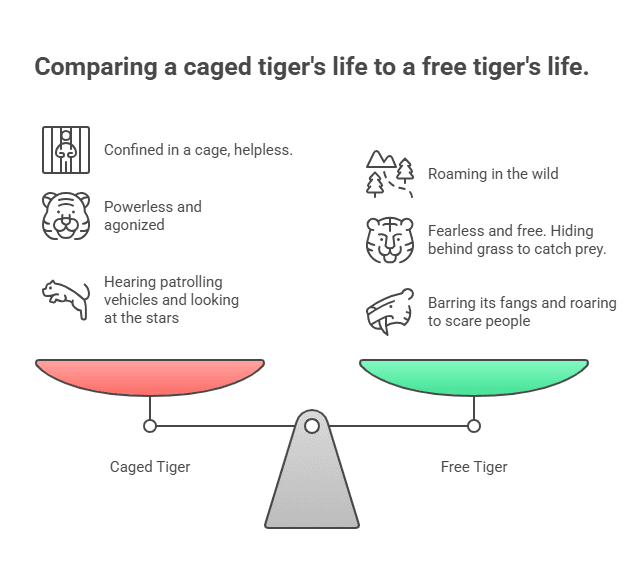
- Captivity: The tiger is kept in a cage in the zoo. It knows that it has been rendered powerless so it remains silent. It does not roar at the visitors or scare them by showing its sharp fangs. It simply walks to and fro in the cage and has lost its natural habitat.
A Tiger in the Zoo Quick Overview
| Detail | Information |
| Poem Title | A Tiger in the Zoo |
| Author | Robert Frost |
| Book | First Flight (CBSE Class 10 English) |
| Poem No. | 3 |
| Narrator | Poet |
| Setting | Zoo |
| Theme | Freedom versus captivity |
- A Tiger in the Zoo Summary
- Theme-based Questions – A Tiger in the Zoo
- A Tiger in the Zoo Previous Year Questions with Model Answers PDF
- A Tiger in the Zoo Poem Explanation
- A Tiger in the Zoo Video Explanation
- A Tiger in the Zoo Summary in Hindi
Related:

- Tiger in the Zoo Question Answers (Important)
- A Tiger in the Zoo Character sketches
- A Tiger in the Zoo MCQs
- A Tiger in the Zoo Previous Years Question with Answers
A Tiger in the Zoo Summary
Finish your entire English prep in 24 hrs & shine in Boards 2026! – Concise chapter summaries (key events & ideas), lesson themes, Visual character sketches using mind maps Click here
The poem written by Leslie Norris explains the agony and helplessness of a caged tiger that lives in a zoo. The poet explains what his life could be if he had been a free animal. The poet has tried to explain about the condition of animals that are caged by human beings for their own fun.
The poem begins with a description of a tiger that is very beautiful and is walking in his little cage. He has beautiful stripes on his skin and has velvet like soft paws. But the tiger is not happy and is quite angry about being confined in the cage. The poet says that if the tiger was not confined to the zoo cage, he would have been hiding himself behind the long grass near some water body, in order to catch its prey that is the deer. Also, he would have terrorised the residents of the villages around the forest area. But the reality is totally opposite to this. He was confined in a cage which was made up of strong building material and he was helpless there. He could not show his power to the visitors, therefore, never tried to terrorize them. The tiger is described as being powerless and agonized by the poet. He says that during night also he is alone, hearing the voice of the patrolling vehicles of police and looking at the stars. The cage life has totally changed the tiger’s personality. The poet is trying to say that the animal which is famous for its fearlessness and freedom is confined and sad due to the human beings who want to derive pleasure by looking at him in the zoo cage.
Theme-based Questions – A Tiger in the Zoo
Question: How does the contrast between the tiger in the wild and the tiger in the zoo convey the poet’s message about freedom and captivity?
Ans. In the poem “A Tiger in the Zoo”, Leslie Norris highlights the contrast between the tiger in the wild and the tiger in the zoo. The contrast shows how damaging captivity can be and the importance of a natural habitat. Loss of freedom changes the behaviour of a living being, like in this case, the tiger acts differently in the wild and in the cage. In the forest, the tiger is strong, free, and powerful. He moves quietly through long grass, hunts near waterholes, and can roar near villages. He is free to bare his fangs and claws, allowing him to terrorise his prey and the villagers. This life matches his nature and lets him use all his strength and instincts. In the zoo, the same tiger walks only a few steps in a small cage, locked behind bars. His eyes are full of anger and sadness, but he cannot act in his wild nature. His strength is wasted, and he feels helpless and lonely. He does not attack or look at the visitors of the zoo, unlike his natural instinct to show dominance over other animals. This shows that captivity leads to a drastic loss of the tiger’s instincts. We see in the last lines of the poem that a tiger’s brilliance is comparable to the brilliance of the stars. However, the tiger’s spirit is unable to shine because of his captivity, while the stars are unbound and shine without any restraints. Therefore, being put in a cage restricts the tiger from showing his natural fiery personality. Living beings, when displaced from their homes and put into confined spaces, feel uncomfortable, restless, stressed, oppressed, and depressed. Tigers need to be given free space in order to live their lives to the fullest. Confining them only leads to these majestic creatures losing their shine and brilliance, harming the animals mentally. Henceforth, by comparing the pictures of two types of lives a tiger experiences, the poet shows that captivity is cruel and unnatural for wild animals.

A Tiger in the Zoo Previous Year Questions with Model Answers PDF
Download the previous year questions of the Poem A Tiger in the Zoo of class 10 for free. With the help of this, you can prepare for the exam.
To Download A Tiger in the Zoo Previous Year Questions with Model Answers- Click Here
A Tiger in the Zoo Poem Explanation
Poem
He stalks in his vivid stripes
The few steps of his cage,
On pads of velvet quiet,
In his quiet rage.
Word Meaning
Stalks: follows
Vivid: bright colored
Pads: paws of tiger
Rage: anger
Explanation of the poem passage above – Here the poet says that the tiger that is confined in the zoo moves around in the cage under his bright coloured skin. He further says that the tiger can take only a few steps because the cage is small and it is not easy to move in it. One cannot hear his footsteps because he has very soft feet, like velvet because of which there is no sound of the tiger’s footsteps. The tiger tries to control his anger by quietly walking in the limited area of his cage. He is angry because he is not free.
Literary Devices
Rhyme scheme: abcb (cage-rage)
Personification: The tiger is personified because the poet refers him as ‘he’.
Metaphor: Tiger’s paws are compared with velvet (pads of velvet)
Enjambment: Sentence is continuing to next line without any punctuation mark.
Imagery: poet tries to create an image about the tiger (He stalks in his vivid stripes The few steps of his cage)
Consonance: use of ‘s’ sound (stalks, his, stripes)
Assonance: use of vowel sound ‘I’ (in his vivid stripes)
Oxymoron: use of adjectives opposite in meaning (quiet rage)
Questions based on the stanza above-
Question: What does “stalks in his vivid stripes” mean?
Ans. The line “stalks in his vivid stripes” means that the tiger walks in the cage and has bright-coloured stripes over his body. The line creates an image of a tiger walking in his cage by highlighting his movement and majestic appearance.
Question: What is the poetic device used in “vivid stripes”?
Ans. The poetic device in “vivid stripes” is imagery as it talks of a tiger’s appearance and creates an image of a tiger in the reader’s mind.
Question: What figure of speech is used in “on pads of velvet quiet”?
Ans. The line “on pads of velvet quiet” is a metaphor as it compares the tiger’s paws to soft, velvety pads which do not make noise.
Question: What does “in his quiet rage” mean?
Ans. The line “in his quiet rage” means that the tiger is furious at being put in the cage but he cannot show his anger and fight for his freedom, thereby remaining quiet.
Question: What is the oxymoron in “quiet rage”?
Ans. An oxymoron is a poetic device used when two opposite words are used to describe one thing. The words ‘quiet’ and ‘rage’ are opposites because rage is an aggressive and loud emotion but quiet means that there is no sound or expression of emotion.
Question: Why does the tiger express his rage quietly as mentioned in the poem “A tiger in the Zoo”?
Ans. The tiger expresses his rage quietly. In the poem, the tiger is locked inside a cell in the zoo. He cannot express his emotions because he does not have the freedom to do so. He is angry at how his freedom and natural habitat have been taken away, but he cannot show that anger because of the captivity.
Poem
He should be lurking in shadow,
Sliding through long grass
Near the water hole
Where plump deer pass.
Word Meaning
Lurking: To be hidden as to wait for your prey
Explanation of the poem passage above – The poet says that if this tiger was free, he would have hid himself behind the long grass near the water bodies so that he could easily catch a deer in order to have it as its food. Basically, the poet wants to say that the actual life of a tiger is to live in jungle where he could catch his prey and eat it but the tiger in the cage can not do so.
Literary Devices/ Poetic Devices
Rhyme: rhyme scheme is abcb (grass-pass)
Enjambment: Line continues to next line without punctuation marks. (Sliding through….deer pass)
Alliteration: use of sound ‘p’ at the start of two words (plump pass)
Imagery: The poet has tries to create an image of tiger’s activities (lurking in shadow).
Questions based on the stanza above-
Question: What is the meaning of the line “He should be lurking in shadow”?
Ans. The line “He should be lurking in shadow” means that the tiger should be hidden in the shadows of the tall grass instead of being in the cage of the zoo.
Question: Why did the poet say a tiger should be lurking in the shadow?
Ans. The line in the poem “A Tiger In the Zoo” shows that the tiger should be given the freedom to follow their natural instinct to hide in the shadows to catch his prey.
Question: Which poetic device is used in “where plump deer pass”?
Ans. Alliteration is used in “where plump deer pass” due to the repeated sound of ‘p’ in ‘plump pass’.
Question: Why do deer pass near the water hole?
Ans. Deer pass near the water hole for two reasons. One, to drink water from the water hole. Two, to eat the grass growing at the edges because they are herbivores.
Poem
He should be snarling around houses
At the jungle’s edge,
Baring his white fangs, his claws,
Terrorising the village!
Word Meaning
Snarling: warning sounds made by animals
Baring: uncovered
Fangs: Sharp tooth of animals
Explanation of the poem passage above- The poet says that if the tiger would have been free, he would have snarled around the houses located at the outskirts of the forest. He would terrorise people with his sharp tooth and claws. This would create fear among the people living in the villages.
Literary devices
Rhyme Scheme: abcb rhyme scheme is followed (edge, village)
Enjambment: Line continues to next line without punctuation marks (He should be snarling around houses At the jungle’s edge,)
Onomatopoeia: using words which denote sound (snarling)
Assonance: use of vowel sound ‘o’ and ‘I’ (should, around, houses), (Baring, his, white, his)
Consonance: use of consonant sound ‘s’ (his, fangs, his, claws)
Questions based on the stanza above-
Question: Why does the poet mention the tiger should be snarling around houses at the jungle’s edge?
Ans. The poet mentions that the tiger should be snarling around houses at the jungle’s edge because that is a tiger’s natural instinct. It is his personality to want to show off his power, which he cannot do in a cage.
Question: How does a tiger create terror for the villagers?
Ans. A tiger creates terror for the villagers by showing off his dominant and brave nature and being violent. He snarls and uncovers his white fangs and claws, showing the villagers how strong and dangerous he is.
Poem
But he’s locked in a concrete cell,
His strength behind bars,
Stalking the length of his cage,
Ignoring visitors.
Word Meaning
Concrete: building made of bricks, cement, sand and water
Explanation of the poem passage above- Now the poet comes to the reality of the tiger that is inside the cage. He says that the tiger is confined in a strong cell which is made of strong building material. He further says that as the tiger is behind bars, so his ferociousness is also behind the bars. He just stalks in the cage. He never tries to terrorise the visitors because his power is restricted by the cage. Therefore, he never tries to terrorise the visitors as he cannot attack them.
Literary devices
Rhyme Scheme: abcb rhyme scheme is followed (bars-visitors)
Personification: The tiger is personified because the poet refers him as ‘he’.
Assonance: use of vowel sound ‘e’ (he, locked, concrete, cell)
Consonance: use of consonant sound ‘s’ (his, strength, bars)
Alliteration: use of sound ‘b’ at the start of two words (behind bars)
Question: What literary devices are used in “but he’s locked in a concrete cell”?
Ans. The line “but he’s locked in a concrete cell” has many literary devices. It has metaphor because the ‘concrete cell’ compares the cage in which the tiger is locked to a prison in which we humans are locked in. It has personification because the tiger is referred to as ‘he’ and is given human abilities. There is assonance because the sound of the vowel ‘e’ is repeated in ‘he’, ‘in’, and ‘concrete’.
Question: What is the figure of speech used in “his strength behind bars”?
Ans. The figure of speech in “his strength behind bars” is alliteration with the consonant ‘b’ repeated in “behind bars”.
Question: What does the poet mean by “his strength behind bars”?
Ans. Leslie Norris in “A Tiger In the Zoo” describes how the confinement of a tiger in the cage of the zoo puts the tiger’s strength behind bars. It shows how a brave creature like a tiger becomes powerless in a cage.
Question: Why is the tiger stalking the length of his cage?
Ans. A tiger’s natural instinct is to roam in the vast forest and stalk his prey with a fast speed. However, due to the cage, he can only walk inside his cage, which is a limited space and restrictive environment. We see the tiger’s restlessness and desire for a bigger space to roam in through this behaviour.
Question: Why does the tiger ignore the visitors?
Ans. The tiger ignores his visitors instead of being aggressive. He is losing his instincts due to the captivity. He has lost his freedom, so he feels indifferent and powerless towards his prey.
Poem
He hears the last voice at night,
The patrolling cars,
And stares with his brilliant eyes
At the brilliant stars.
Word Meaning
Patrolling: to guard, to vigil
Explanation of the poem passage above- The poet says that in the night, the tiger hears the sounds of the patrolling cars. Patrolling cars are the vehicles of police which are used to guard at night. So, in the night the tiger hears the sounds of these cars. He then stares at the shining stars with his shining eyes. The poet wants to say that the tiger is sad and as he is confined in the cage, so, he cannot do anything. Therefore, he stares at the stars in the night and tries to divert his thoughts towards them.
Literary devices:
Rhyme Scheme: abcb rhyme scheme is followed (cars-stars)
Enjambment: Line three continues to line four without any punctuation mark. (And stares with his brilliant eyes At the brilliant stars.)
Alliteration: use of sound ‘h’ in the starting of two words (he hears)
Assonance: use of ‘I’ sound (with, his, brilliant)
Questions based on the stanza above-
Question: What is the last voice heard by the tiger in the poem “A Tiger in the Zoo”?
Ans. The last heard by the tiger is the sound of the watchmen and caretakers and their cars patrolling the zoo.
Question: What does the mention of the last voice at night and the patrolling cars suggest?
Ans. In the poem “A Tiger In the Zoo’, the mention of the last voice at night and the patrolling cars suggests that instead of hearing the sounds of other animals or the sounds of the forest around him, he hears the sound of the watchmen and caretakers of the zoo. This further highlights the agony the tiger feels due to his captivity.
Question: What emotions are evoked by the line “Stares with his brilliant eyes at the brilliant stars”?
Ans. The emotions of sadness and empathy towards the tiger are evoked by the line “Stares with his brilliant eyes at the brilliant stars”.
Question: Why does the poet say “and stares with his brilliant eyes at the brilliant stars”?
Ans. The poet Leslie Norris says the line at the end of the poem “A Tiger In the Zoo”. A star is a celestial mass of fire. Similarly, the tiger is a majestic animal with a fiery, fearless, and dominant personality. Like the stars shine with brilliance, the eyes of the tiger hold the same sparkle and brilliance. However, a star is present freely in the sky whereas the tiger in this context is confined in a cell in the zoo. Unlike the stars, the tiger does not have the freedom to shine and be brilliant. This line encapsulates the harmful and cruel nature of locking up animals in the zoo.
A Tiger in the Zoo Video Explanation
A Tiger in the Zoo FAQs
Question: Who is the writer of A Tiger in the Zoo?
Ans. The class 10 poem A Tiger in the Zoo has been composed by Leslie Norris.
Question: What is the theme of the class 10 poem A Tiger in the Zoo?
Ans. The poem Fire and Ice conveys the message that every living being desires freedom. The tiger in the zoo is in captivity. The poem presents the contrast between the animal’s wild, untamed soul and the constrained life that it is forced to live in captivity.
Question: What does ‘pads of velvet’ mean in the poem A Tiger in the Zoo?
Ans. In the class 10 poem A Tiger in the Zoo, the phrase pads of velvet refers to the paws of the tiger which are soft like velvet fabric and do not make any noise when the tiger walks.
Question: What does the title “A Tiger in the Zoo” denote?
Ans. The title of the poem indicates the caged life of the tiger who is captivated in the zoo. The poet expresses the desire for freedom and living in its natural habitat.
Question: What is the poem A Tiger in the Zoo about?
Ans. The poem is about the life of a tiger who lives under captivity in the cage of a zoo. The tiger loses its natural persona, does not roar or scare people by showing its sharp teeth because it knows that the cage has restricted it. The tiger remains silent and walks in the restricted area of the cage. The poet expresses the tiger’s desire to live in its natural habitat, hunt its prey and scare villagers with its loud roar and sharp teeth.
Summary of the poem A Tiger in the Zoo in Hindi
कविता एक बाघ के वर्णन से शुरू होती है जो बहुत सुंदर है और अपने छोटे से पिंजरे में चल रहा है।
उसकी त्वचा पर सुंदर धारियाँ होती हैं और मुलायम पंजे मखमली है। लेकिन बाघ खुश नहीं है और पिंजरे में कैद होने को लेकर काफी गुस्से में है।
कवि का कहना है कि यदि बाघ चिड़ियाघर के पिंजरे तक ही सीमित नहीं होता, तो वह अपने शिकार यानी हिरण को पकड़ने के लिए किसी जल निकाय के पास लंबी घास के पीछे छिपा होता।
साथ ही वह वन क्षेत्र के आसपास के गांवों के निवासियों को भी आतंकित कर देता लेकिन हकीकत इससे बिल्कुल उलट है।
उसे एक पिंजरे में बंद कर दिया गया था जो मजबूत निर्माण सामग्री से बना था और वह वहां असहाय था।
वह आगंतुकों को अपनी शक्ति नहीं दिखा सका, इसलिए, उन्हें कभी भी आतंकित करने की कोशिश नहीं की। कवि ने बाघ को शक्तिहीन और तड़पता हुआ बताया है।
पिंजरे के जीवन ने बाघ के व्यक्तित्व को पूरी तरह से बदल दिया है। कवि यह कहने की कोशिश कर रहा है कि जो जानवर अपनी निडरता और स्वतंत्रता के लिए प्रसिद्ध है, वह मनुष्यों के कारण सीमित और दुखी है जो उसे चिड़ियाघर के पिंजरे में देखकर आनंद प्राप्त करना चाहते हैं।
Explanation and Summary of Class 10 Poems from First Flight book
Also see:
- Class 10 English Syllabus
- CBSE Class 10 English Lesson Explanation, Summary
- CBSE Class 10 English Important Questions (Chapter wise)
- Character Sketches of Class 10 English
- CBSE Class 10 English MCQs
- Class 10 English First Flight word meanings
- Class 10 English First Flight Poems word meanings
- Class 10 English Footprints without Feet word meanings
- Poetic Devices in Poems of First Flight book
- Class 10 English Complete Study Guide
- Class 10 English Important Questions Videos
- Class 10 Science Important Question Answers Videos
Important Videos Links



Better to study the concept
Aacha hame shikha rhi h
Nice explanation
Correct
Hey..!! Where are You from ?
There is synecdoche in the first stanza
Vivid stripes is used for the full body of the tiger.
OMG, thank you so much.. I’m writing for 25-26 boards
SAMEEEEE
This is very usefull to me
sameeeeeeeeeeeeeeeeeeeeeeee
Best website ever I have studied all the poems from here for my 25-26 boards
IT IS USEFUL FOR QUICK STUDY FOR TEST
Just love their explanation and everything
The info is concrete and crisp. Loved it… 🙂
IT IS USEFUL FOR STUDY FOR TEST
Thank you! This was indeed very helpful for my studies.
Very Nice Explain
The explanation is very solid …. Helped me quite alot to form answers of value based questions
Love this site , so helpful for every english exam
Oh my god , i love this site…quick and informative ❤️
It’s so helpful !!
Been very helpful since the starting, the vocabulary is so good for each chapter
No we can’t call it synecdoche in the first stanza for ” Vivid stripes ” , because here it is just a simple description which instantiate an imagery but not synecdoche . synecdoche represents a whole body (of people, of things, of any common noun ) just by a small clue .
example of synecdoche “all hands on the desk” here “all hands” is for all the people present in the meeting. “India won the match “, ‘India’ is for team.
PS: He stalks in his vivid stripes – not synecdoche
All hands on the desk. -synecdoche.