Word meaning
demeanour: A person’s appearance or behavior.
artless : guileless; innocent
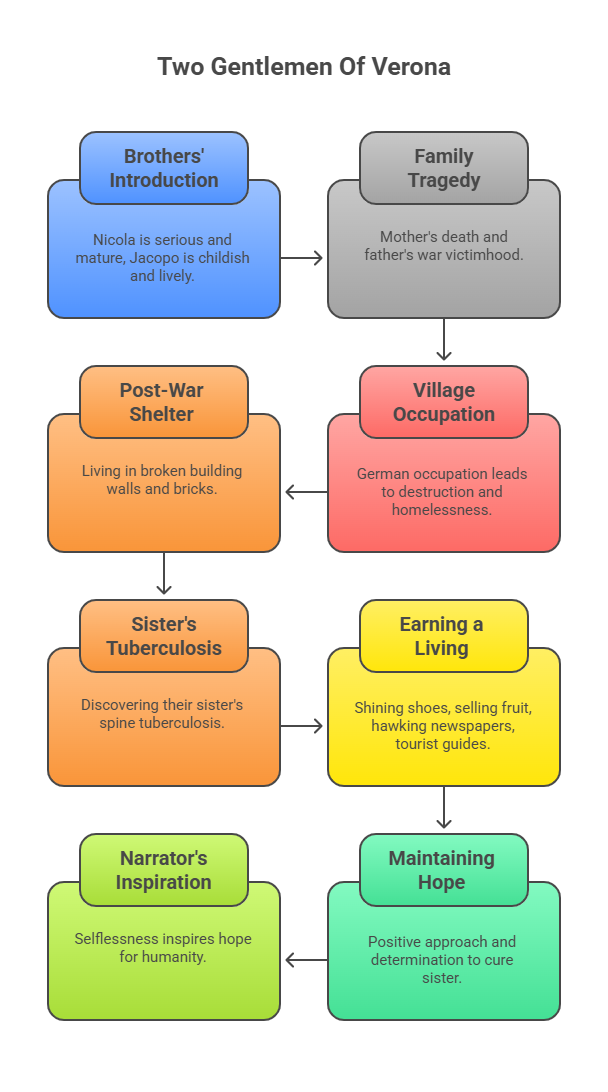
Explanation /Answer: The author noticed their appearance, as childish, simple and innocent. Here, the author uses a simile and compares Jacopo to squirrel, as he feels that the little boy is full of life and energy like a squirrel. On the other hand Nicola was serious and mature. The narrator draws a comparison between the two boys – the younger one Jacopo is childish and lively while the elder one, Nicola is serious and mature.’
Even though the boys had a childish face, yet there was a seriousness in their eyes which was way beyond their age(way beyond their age means that although they were just 12 and 13 years of age respectively, but their facial expressions were of much older people), which tells that they are burdened with a lot of responsibilities, and faced the harshness of life at such a young age.
Question: What variety of jobs do Nicola and Jacopo perform to satisfy visitors’ needs?
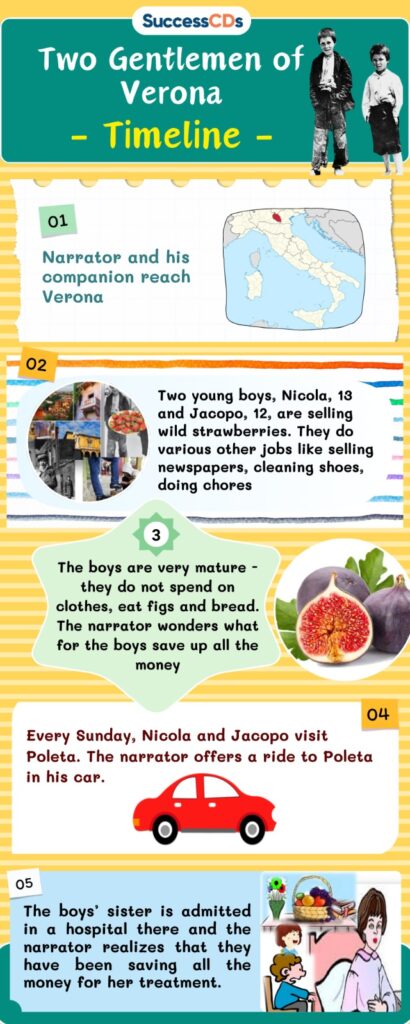
Passage – In the week which followed we saw them frequently, for they proved extremely useful to us. If we wanted a pack of American cigarettes, or seats for the opera or the name of a good restaurant, Nicola and Jacopo could be relied upon to satisfy our needs. What struck one most was their willingness to work. During these summer days, under the hot sun, they shined shoes, sold fruit, hawked newspapers, conducted tourists round the town, and ran errands.
Word meaning
Hawked: To offer for sale by calling out in the street.
Errands: Short work or business trip.
Explanation /Answer: This shows that the narrator trusts the innocent boys with their suggestions and advices, and is amazed to see their desire to do work. And the paragraph also describes the busy routine and variety of work they do.
“Hawked newspapers” means to sell newspapers by calling out loud in the street.
Question: What scene reveals Nicola and Jacopo’s exhausting work schedule?
Passage – One night, we came upon them in the windy and deserted square, resting on the stone pavement beneath the lights. Nicola sat upright, tired. A bundle of unsold newspapers lay at his feet. Jacopo, his head resting upon his brother’s shoulder was asleep. It was nearly midnight.
Word meaning
Deserted: Empty or sparsely occupied.
Explanation /Answer: The paragraph illustrates that one night after a tiring day, the narrator saw the boys resting on a stone pavement with a bundle of newspapers, in an isolated place which had no people.
Question: Why are Nicola and Jacopo working until nearly midnight?
Passage – “Why are you out so late, Nicola?”
“Waiting for the last bus from Padua. We shall sell all our papers when it comes in.”
“Must you work so hard? You both look rather tired.”
“We are not complaining, sir.”
Explanation /Answer: This conversation explains the dedication and the willingness to work even after a full working day, it shows the hope they hold to gain the maximum of what they can.
When enquired Nicola immediately clarified that he had absolutely no problem in working this late, despite being tired.
Passage – But next morning, when I went over to the fountain to have my shoes shined, I said, “Nicola, the way you and Jacopo work, you must earn quite a bit. You spend nothing on clothes. You eat little enough — when I see you have a meal it’s usually black bread and figs. Tell me, what do you do with your money?”
He coloured deeply under his sunburn, then grew pale. He looked to the ground.
“You must be saving up to emigrate to America,” I suggested. He looked at me sideways, spoke with an effort.
“We should greatly like to go to the States. But here, at present, we have other plans.”
“What plans?”
He smiled uncomfortably. “Just plans, sir,” he answered in a low voice.
Word meaning
Emigrate: Leave one’s own country in order to settle permanently in another.
Explanation /Answer: On seeing them working so hard, yet dressed shabbily, and eating relatively lower nutritious meal, the narrator asked Nicola “you must earn quite a bit, where do you spend your money?”. This question initially made him blush, (the pink colour on his face was so prominent that it was visible through his dark sun burnt skin.) after the initial blush, Nicola had an after thought which made him sad and depressed. The blush on his face disappeared all of a sudden and it became pale, as he got reminded of his miseries and problems which made him work so hard.
The narrator sarcastically asks if he is saving up to move to America. On being asked about his plans he got uncomfortable and was reluctant to answer. He did not want to share his problems with anyone and so he spoke in a low voice.
Question: What generous offer does the narrator make to Nicola and Jacopo before leaving Verona?
Passage – “Well,” I said, “we’re leaving on Monday. Is there anything I can do for you before we go?”
Explanation /Answer: Another good gesture by narrator, as he wanted to help the pre-matured gentlemen.
Question: Why does Jacopo boldly request a car ride despite Nicola’s refusal?
Passage – Nicola shook his head, but suddenly Jacopo said, “Sir,” he burst out, “every Sunday we make a visit to the country, to Poleta, 30 kilometres from here. Usually we hire bicycles. But tomorrow, since you are so kind, you might send us in your car.”
I had already told Luigi he might have the Sunday off. However, I answered, “I’ll drive you out myself.”
Explanation /Answer: Despite the mild refusal by his brother, Jacopo out of innocence asked if the narrator could help them to get to Poleta in his car. This shows the contrast between the behavior of the two brothers, one showing maturity, while the other showed innocence and childishness.
On which the narrator agreed, despite the fact the driver was unavailable, another example of his kindness.
Question: Why does Nicola glare at Jacopo in vexation over the car ride request?
Passage – There was a pause. Nicola was glaring at his young brother in vexation. “We could not think of troubling you, sir.”
“It won’t be any trouble.”
He bit his lip, then, in a rather put out tone, he said, “Very well.”
Word meaning
Vexation: Annoyed state.
put out : offended; annoyed
Explanation /Answer: Nicola gave an annoying look to Jacopo, and asked the narrator not to worry for them, but the narrator insisted.
Nicola was not comfortable with this plan as he did not like taking help and sympathy, but he agreed.
Question: Why is the narrator shocked by Nicola and Jacopo’s destination in Poleta?
Passage – The following afternoon we drove to the tiny village set high upon the hillside. I imagined that our destination would be some humble dwellings. But, directed by Jacopo, we drew up at a large red-roofed villa, surrounded by a high stone wall. I could scarcely believe my eyes and before I could recover breath my two passengers had leaped from the car.
“We shall not be long, sir. Perhaps only an hour. May be you’d like to go to the cafe in the village for a drink?” They disappeared beyond the corner of the wall.
Word meaning
Humble Dwellings: A simple living space
Explanation /Answer: The narrator had thought that the boys would be heading to some shabby huts, according to the conditions in which they lived and worked in Verona. He was shocked to see that their destination in the village of Poleta was a large villa.
Narrator was amazed to see the large villa, by the time he could recover from the shock, the boys had jumped out of the car and rushed inside the villa, as they didn’t want the narrator to know where they were going, and suddenly they disappeared.
Question: What surprises the narrator when he investigates the Poleta villa?
Passage – After a few minutes I followed. I found a grilled side-entrance and, determinedly, rang the bell. A pleasant-looking woman with steel-rimmed spectacles appeared. I blinked as I saw that she was dressed in the white uniform of a trained nurse.
Word meaning
Steel-rimmed: The upper or outer edge of an object, especially when curved or circular.
Explanation /Answer: Upon entering the villa the bell was answered by a nurse. He realized that it had been converted to a hospital.
Question: How does the nurse react upon hearing about Nicola and Jacopo at the Poleta villa?
Passage – “I just brought two small boys here.”
“Ah, yes.” Her face lit up; she opened the door to admit me. “Nicola and Jacopo. I will take you up.” She led me through a cool, tiled vestibule into the hospital — for hospital the villa had become. At the door of a little cubicle the nurse paused, put her finger to her lips, and with a smile bade me look through the glass partition.
Word meaning
Vestibule: An entrance hall inside a building.
Explanation /Answer: Upon hearing about Nicola and Jacopo, the nurse smiled, which tells us that she knows them really well, and she took the narrator through an entrance lobby into the hospital to a small room.
Question: What does the narrator discover about Nicola and Jacopo’s purpose at the Poleta villa hospital?
Passage – The two boys were seated at the bedside of a girl of about twenty who, propped up on pillows, wearing a pretty lace jacket, was listening to their chatter, her eyes soft and tender. One could see at a glance her resemblance to her brothers. A vase of wild flowers stood on her table, beside a dish of fruit and several books.
Explanation /Answer: The above paragraph tells us that the boys were visiting their sister. The girl was well dressed, there was a vase of wild flowers on the table which was not essential for living, which tells us how much she was loved by her brothers, along with a dish of fruits and books, which tells us that how well those two gentlemen took care of their sister, she was living in no shortage, which is in contrary to how those boys lived their life.
Question: Why does the narrator refuse to enter Lucia’s room despite the nurse’s invitation?
Passage – “Won’t you go in?” the nurse murmured. “Lucia will be pleased to see you.”
I shook my head and turned away. I felt I could not bear to intrude upon this happy family party. But at the foot of the staircase I drew up and begged her to tell me all she knew about these boys.
Word meaning
Intrude: To interrupt someone’s privacy.
Explanation /Answer: The narrator refused to go in as he thought he would disturb the family time, but he now really started respecting them, he wanted to know everything about them, so he begged the nurse to tell her.
Question: What tragic family history does the nurse reveal about Nicola, Jacopo, and Lucia?
Passage – She was eager to do so. They were, she explained, quite alone in the world, except for this sister, Lucia. Their father, a widower, a well-known singer, had been killed in the early part of the war. Shortly afterward a bomb had destroyed their home and thrown the three children into the streets. They had always known a comfortable and cultured life — – Lucia had herself been training as a singer — and they had suffered horribly from near starvation and exposure to the cold winter.
Explanation /Answer: The nurse told the family history of those boys, that their mother died early in their life, their father was a well-known singer but became a victim of the early war. They got homeless as their home got destroyed, and suffered starvation and the cold winter.
She also tells him that at that time Lucia had been training to be a singer.
Question: What further hardships did Nicola and Jacopo endure after losing their home and father?
Passage – For months they had barely kept themselves alive in a sort of shelter they built with their own hands amidst the rubble. Then for three years the Germans ruled the city. The boys grew to hate the Germans. When the resistance movement began secretly to form they were among the first to join. When the war was over, and we had peace at last, they came back to their beloved sister. And they found her ……suffering from tuberculosis of the spine.”
Word meaning
Rubble: Waste or rough fragments of stone, brick, concrete, etc., especially as the debris from the demolition of buildings.
Explanation /Answer: The family struggled for life, they lived in the shelter made of broken building walls and bricks.
The boys hated Germans as they were the reason for their drastic and miserable change of life, which also made them stand against them as rebels.
After the war, they got back to their sister, and found her suffering from tuberculosis of spine, which was another shock to these poor kids.
Question: How have Nicola and Jacopo supported Lucia’s treatment despite post-war hardships?
Passage – She paused, took a quick breath.
“Did they give up? I do not have to answer that question. They brought her here, persuaded us to take her into the hospital. In the twelve months she has been our patient she has made good progress. There is every hope that one day she will walk – and sing – again.”
“Of course, everything is so difficult now, food so scarce and dear, we could not keep going unless we charged a fee. But every week, Lucia’s brothers have made their payment.” She added simply, “I don’t know what they do, I do not ask. Work is scarce in Verona. But whatever it is, I know they do it well.”
Word meaning
Scarce: Very small in amount.
Explanation /Answer: Despite facing so many problems in their early life, the boys did not lose hope, the brothers’ positive approach and determination to get their sister cured had helped the staff treat her well.
The nurse, explained the helpless state of the hospital, that there is less availability of food, therefore they could not treat her for free and they had to charge a fee to keep things going.
The nurse, was even shocked as so less work was available in Verona, still the boys manages to pay the fees.
Question: Why does the narrator agree with the nurse, saying “Yes… They couldn’t do it better”?
Passage – “Yes,” I agreed. “They couldn’t do it better.”
Explanation /Answer: On which the narrator agreed as he actually knew that the boys really worked hard to get the money for their sister’s treatment.
Question: Why does the narrator remain silent during the drive back to the city with Nicola and Jacopo?
Passage – I waited outside until the boys rejoined me, then drove them back to the city. They sat beside me, not speaking. For my part, I did not say a word — I knew they would prefer to feel that they had safely kept their secret. Yet their devotion had touched me deeply. War had not broken their spirit. Their selfless action brought a new nobility to human life, gave promise of a greater hope for human society.
Explanation /Answer: The narrator was touched by the love and devotion with which the boys worked for their sister. Hardships and sadness had not deterred them.
The narrator had understood their character really well, and he knew they won’t like being sympathized. Therefore he did not confront the boys.
They did not bother about their needs but worked so hard to provide the best to her. This showed their selflessness.
The narrator felt that such a humble youth gives our society hope for a better tomorrow. In such times of war, weapons and hatred, still there is hope for humanity
Top
Important Videos Links
Two Gentlemen of Verona – FAQs
Question: In the story ‘Two Gentlemen of Verona’ who are the gentlemen?
Ans. The young boys, Jacopo and Nicola are the ‘gentlemen’. They have been called so because they behave maturely, more wisely than children of their age do.
Question: Which textbook is in the syllabus of Class 10 Communicative English?
Ans. The name of the book that is in the syllabus of class 10 Communicative English is Literature Reader.
Question: Jacopo and Nicola worked hard for the treatment of their ______.
Ans. sister.
Question: Was the narrator related to the ‘gentlemen’ in the story “Two gentlemen of Verona”?
Ans. No, the narrator was not related to the gentlemen. The narrator was on a visit to the city if Verona where he encountered the boys who were like gentlemen.
Question: What is the marks weightage for the literature section in the class 10 Communicative English paper?
Ans. The literature section carries 26 marks weightage, out of the 80 marks total weightage of the English paper.
Question: Who wrote Two Gentlemen of Verona?
Ans. Two Gentlemen of Verona was written by A.J. Cronin, a famous Scottish novelist and physician. It appears in the CBSE Class 10 English textbook as Chapter 1. Cronin is also known for famous novels like The Citadel and Hatter’s Castle.
Question: What is the theme of Two Gentlemen of Verona?
Ans. The central theme is selfless love and family devotion. The story also explores human nobility, the devastating impact of war on innocent lives and the extraordinary strength of the human spirit when driven by love and compassion for family.
Question: Who are Nicola and Jacopo?
Ans. Nicola and Jacopo are two young brothers aged 13 and 12 from Verona Italy. They work extremely hard at various jobs to pay for the hospital treatment of their sister Lucia who is suffering from tuberculosis of the spine.
Question: What was wrong with Lucia?
Ans. Lucia was suffering from tuberculosis of the spine. She had fallen ill due to poverty, starvation and exposure to the cold after their home was destroyed during World War II. Her brothers worked tirelessly every week to pay for her hospital treatment in Poleta.
Question: What is the moral of Two Gentlemen of Verona?
Ans. The moral is that true nobility lies not in wealth or social status but in the quality of one’s character and the depth of one’s love for others. The story teaches us that selfless devotion, dignity and an unbreakable spirit in the face of hardship are the greatest qualities any human being can possess.
Top
Two Gentlemen of Verona Summary in Hindi
टू जेंटलमैन ऑफ वेरोना 12 और 13 साल के दो भाइयों की प्रेरणादायक कहानी है – छोटे भाई जैकोपो का स्वभाव बचकाना और जीवंत है जबकि बड़े भाई निकोला का स्वभाव गंभीर और परिपक्व है। लेखक उनसे वेरोना शहर में मिले। ए.जे.क्रोनिन ने “टू जेंटलमेन ऑफ वेरोना” शीर्षक का उपयोग व्यंग्यात्मक तरीके से किया, क्योंकि बहुत कम उम्र में उन्हें जीवन की कठिनाइयों का सामना करना पड़ा, उनकी माँ की मृत्यु हो गई, उनके पिता एक प्रसिद्ध गायक थे लेकिन शिकार बन गए प्रारंभिक युद्ध का. जर्मन कब्जे के कारण उनके गाँव को नुकसान उठाना पड़ा। उनका घर नष्ट हो जाने के कारण वे बेघर हो गये और उन्हें भुखमरी तथा कड़ाके की सर्दी का सामना करना पड़ा। परिवार ने जीवन के लिए संघर्ष किया, वे टूटी हुई इमारत की दीवारों और ईंटों से बने आश्रय में रहते थे। युद्ध के बाद, वे अपनी बहन के पास वापस आये, और उसे रीढ़ की हड्डी के तपेदिक से पीड़ित पाया, जो इन गरीब बच्चों के लिए एक और झटका था। चूंकि वे अपनी बहन के परिवार में इकलौते थे, इसलिए उन्हें काम करना पड़ा और उसके इलाज के लिए पैसों का इंतजाम करना पड़ा। अपने शुरुआती जीवन में इतनी सारी समस्याओं का सामना करने के बावजूद, लड़कों ने उम्मीद नहीं खोई, भाइयों के सकारात्मक दृष्टिकोण और अपनी बहन को ठीक करने के दृढ़ संकल्प ने कर्मचारियों को उसके साथ अच्छा व्यवहार करने में मदद की। शहर में नौकरियों की कमी होने के बावजूद, वे अपनी बहन को अपना सर्वश्रेष्ठ देने में कामयाब रहे। इसके विपरीत वे बहुत गरीब जीवन जीते थे, उनके पहनावे और खान-पान की आदतें इसे दर्शाती थीं। अपनी आजीविका कमाने के लिए उन्होंने जूते चमकाए, फल बेचे, अखबार बेचे और यहाँ तक कि पर्यटक गाइड के रूप में भी काम किया। जीवन में इतना कुछ झेलने के बाद भी उन्होंने कभी किसी की सहानुभूति लेने की कोशिश नहीं की, बल्कि कड़ी मेहनत की। इन दोनों युवा लड़कों में सज्जन कहलाने के सभी गुण हैं, उनकी सकारात्मकता और निस्वार्थता ने कथावाचक को प्रेरित किया। कथावाचक को लगा कि ऐसा विनम्र युवा हमारे समाज को बेहतर कल की आशा देता है। युद्ध, हथियार और नफरत के ऐसे समय में, अभी भी मानवता के लिए आशा है।
Top
Also See:
- Julius Caesar Class 10 English Summary, Explanation, Difficult Words and Question Answers
- Snake Class 10 English Summary, Explanation, Difficult Words and Question Answers
- The Rime of the Ancient Mariner Class 10 English Summary, Explanation, Difficult Words and Question Answers
- Ozymandias Class 10 English Summary, Explanation, Difficult Words and Question Answers
- Not Marble, nor the Gilded Monuments Class 10 English Summary, Explanation, Difficult Words and Question Answers
- Poem Mirror Class 10 English Summary, Explanation, Difficult Words and Question Answers
- The Frog and the Nightingale Class 10 English Summary, Explanation, Difficult Words and Question Answers
- VIRTUALLY TRUE Class 10 English Summary, Explanation, Difficult Words and Question Answers
- The Letter Class 10 English Summary, Explanation, Difficult Words and Question Answers
- Mrs. Packletide’s Tiger Class 10 English Summary, Explanation, Difficult Words and Question Answers
- Patol Babu, Filmstar Class 10 English Summary, Explanation, Difficult Words and Question Answers
- Shady Plot Class 10 English Summary, Explanation, Difficult Words and Question Answers
- The Dear Departed Class 10 English Summary, Explanation, Difficult Words and Question Answers
Also see: