
CBSE Class 8 English Chapter 3 – Glimpses of the Past Important Question Answers from Honeydew Book
Class 8 Glimpses of the Past Question Answers – Looking for Glimpses of the Past Important questions and answers for CBSE Class 8 English Honeydew Book Chapter 3? Look no further! Our comprehensive compilation of important questions will help you brush up on your subject knowledge. Practicing Class 8 English question answers can significantly improve your performance in the exam. Improve your chances of scoring high marks by exploring Chapter 3: Glimpses of the Past now. The questions listed below are based on the latest CBSE exam pattern, wherein we have given Text book Questions (NCERT Solutions) to the chapter’s Extract-based Questions and Extra Question Answers
Also, practising with different kinds of questions can help students learn new ways to solve problems that they may not have seen before. This can ultimately lead to a deeper understanding of the subject matter and better performance on exams.
- Glimpses of the Past Text Book Questions
- Glimpses of the Past Grammar Exercises
- Glimpses of the Past Extract Based Questions
- Glimpses of the Past Extra Question Answers
Related:
- Glimpses of the Past Summary, Explanation
- Glimpses of the Past MCQs
- Glimpses of the Past Character Sketch
Class 8 English Glimpses of the Past Text Book Questions – NCERT Solutions
Comprehension Check
1. Look at picture 1 and recall the opening lines of the original song in Hindi. Who is the singer? Who else do you see in this picture?
A. The opening lines of the song that can be depicted in picture 1 are-
“Aye mere vatan ke logon, tum khub laga lo naara
yeh shubh din hai ham sab kaa, lahara lo tiranga pyaara
par mat bhulo sima paar, viron ne hai praan ganvaaye
kuchh yaad unhe bhee kar lo – (2)
jo laut ke ghar naa aaye – (2)”
Ans. The song is sung by Lata Mangeshkar. In the picture, we can also see Indira Gandhi, Pandit Jawaharlal Nehru and Lal Bahadur Shastri.
2. In picture 2 what do you understand by the Company’s “superior weapons”?
Ans. The British East India company used “superior weapons” to conquer most parts of India. Superior weapons refer to their strategizing abilities that enabled them to take advantage of the already existing tensions among Indian princes. It also refers to the better quality of weapons and power that they possessed.
3. Who is an artisan? Why do you think the artisans suffered? (picture 3)
Ans. Artisan refers to a worker, skilled in a particular trade, especially one that involves making things by hand. The artisans suffered because the Britishers were importing goods from Britain without paying any import duty that made them cheaper than what was being made by the local artisans. They imported cotton from the cotton mills that left the cotton weavers to die due to starvation.
4. Which picture, according to you, reveals the first sparks of the fire of revolt?
Ans. Picture 7, according to me, reveals the first sparks of the fire revolt.
Working with the Text
Answer the following questions.
1. Do you think the Indian princes were short-sighted in their approach to the events of 1757?
Ans. Yes, Indian princes were “short-sighted” in their approach to the events of 1757 which means they only considered immediate benefits but ignored its long-term consequences. They were not at peace amongst themselves. So, they took help from the English merchants to be able to defeat their rivals. This helped the British East India Company in successfully taking over control from the Indian rulers. The British adopted the “Divide and Rule” policy.
2. How did the East India Company subdue the Indian princes?
Ans. The British East India Company took advantage of the prevailing tensions among the Indian princes of various provinces. They eagerly helped them in their wars against each other and subdued the Indian princes one by one. They adopted the policy of “Divide and Rule”.
3. Quote the words used by Ram Mohan Roy to say that every religion teaches the same principles.
Ans. A. In the words of Raja Ram Mohan Roy, “Cows are of different colours, but the colour of their milk is the same”. He used these words to explain that, regardless of every teacher having varied opinions, every religion has the same essence and is based on similar principles.
4. In what ways did the British officers exploit Indians?
Ans. The British officers kept on finding ways to exploit Indians. They levied heavy taxes upon the farmers which forced the poor farmers to give up their lands. They even threatened to imprison them if they did not clear their arrears. Not only this, they even passed Regulation III that allowed them to imprison any Indian without following a proper trial procedure in court. They removed all the import duties on goods being imported from Britain. By 1829, goods worth seven crore rupees were being imported to India. This led to extinction of small businesses and individual artisans. It caused massive famines leading to deaths in large numbers. They even pressurised Indians to convert into Christianity. Those working under the East India company were exploited and given inadequate wages. They were hardly promoted.
5. Name these people.
(i) The ruler who fought pitched battles against the British and died fighting.
(ii) The person who wanted to reform the society.
(iii) The person who recommended the introduction of English education in India.
(iv) Two popular leaders who led the revolt (Choices may vary.)
Ans.
(i) Tipu Sultan of Mysore
(ii) Raja Ram Mohan Roy of Bengal
(iii) Lord Macaulay
(iv) Nana Sahib Peshwa, Kunwar Singh
6. Mention the following.
(i) Two examples of social practices prevailing then.
(ii) Two oppressive policies of the British.
(iii) Two ways in which common people suffered.
(iv) Four reasons for the discontent that led to the 1857 War of Independence.
Ans.
(i) Untouchability and Child Marriage
(ii) 1. No import duty on goods imported from Britain
2. Introducing Regulation III that allowed them to send Indian to jail without a trial in court
(iii) Two ways in which common people suffered.
1. Untouchability
2. Child marriage
(iv)
1. Inadequate wages, slow promotions to those working under the East India Company.
2. Landlords were sore after they lost their land and estate under the new land rules.
3. Brahmin soldiers when they discovered that the bullet grease they were supposed to bite was made of cow and pig fat.
4. Former rulers who had lost their kingdoms.
Glimpses of the Past- Grammar Exercises
1. Change the following sentences into indirect speech.
(i) First man: We must educate our brothers.
Second man: And try to improve their material conditions.
Third man: For that we must convey our grievances to the British Parliament.
The first man said that ______________________________________________ ___________________________________________________________________
The second man added that _______________________________________ ___________________________________________________________________
The third man suggested that ________________________________________ ___________________________________________________________________
Ans.
The first man said that they must educate their brothers.
The second man added that they must also try to improve their material conditions.
The third man suggested that they must convey their grievances to the British Parliament.
(ii) First soldier: The white soldier gets huge pay, mansions and servants.
Second soldier: We get a pittance and slow promotions.
Third soldier: Who are the British to abolish our customs?
The first soldier said that ___________________________________________ ___________________________________________________________________
The second soldier remarked that __________________________________ __________________________________________________________________
The third soldier asked __________________________________________ _________________________________________________________________
Ans.
The first soldier said that the white soldier gets huge pay, mansions and servants.
The second soldier remarked that they get pittance and slow promotions.
The third soldier asked who were the British to abolish their customs.
Class 8 English Glimpses of the Past Chapter 3 Extract Based Questions
Read the following extract and answer the questions that follow-
A.
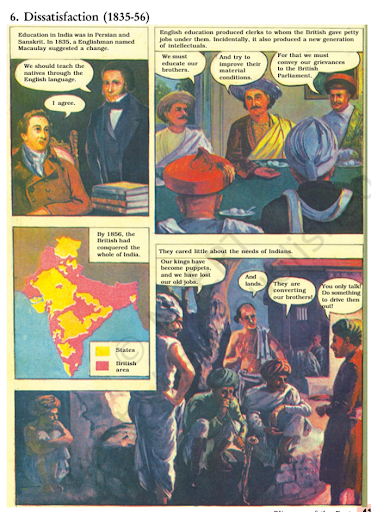
Q1. Before the arrival of the British, education in India was in which languages?
Ans. Sanskrit and Persian
Q2. Who suggested a change in the Indian education system? When?
Ans. An Englishman Macaulay suggested the changes in Indian Education system in the year 1835.
Q3. What did the new education system produce?
Ans. It produced clerks who were employed by the British at petty jobs.
Q4. By when had the British conquered the whole of India?
Ans. By 1856, the British had conquered the whole of India.
Q5. What did the kings become in the hands of the British?
Ans. The kings became puppets in the hands of the British.
B.
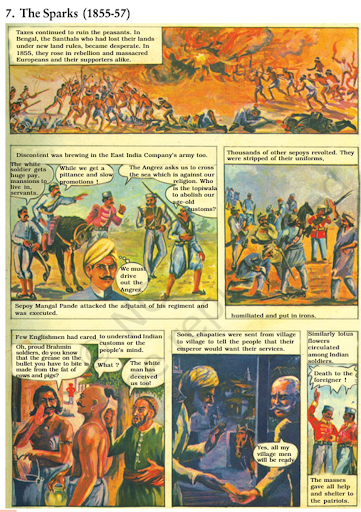
Q1. Why did the Santhals rise in rebellion?
Ans. The Santhals of Bengal had lost their land. In 1855, they rose in revolt and massacred the British.
Q2. What led to discontent in the East India company’s army?
Ans. The Indian soldiers were dissatisfied because the white soldiers got huge pay, mansions to live and servants while they got pittance and slow promotions.
Q3. What act forced by the British was against the religious sentiments of the Indian armymen?
Ans. The Indian soldiers were forced to cross the sea which was against their religious sentiments.
Q4. Who was the sepoy who attacked the adjutant of his army?
Ans. Sepoy Mangal Pandey attacked the adjutant of his army.
Q5. What happened to the soldiers who revolted?
Ans. They were stripped of their uniforms, humiliated and put in irons.
C.
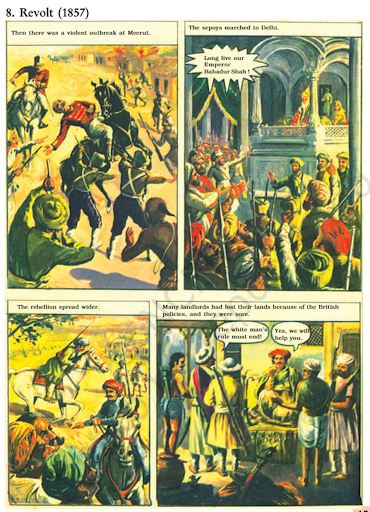
Q1. Where did the violent outbreak take place?
Ans. It happened at Meerut.
Q2. Whom did the sepoys hail at Delhi?
Ans. The sepoys hailed the Mughal ruler Bahadur Shah, at Delhi.
Q3. The revolt of 1857 happened among the ______.
Ans. sepoys.
Q4. Why were Indian landlords sore?
Ans. Their lands were taken away by the British which made them sore.
Q5. What did all the Indians want?
Ans. They wanted to bring an end to the white man’s rule.
D.
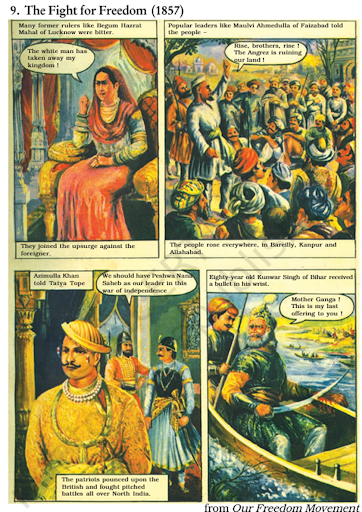
Q1. Begum Hazrat Mahal was from ________
Ans. Liucknow
Q2. Why was she bitter?
Ans. The British took away her kingdom which made her bitter.
Q3. Malvi Ahmedullah belonged to _________-
Ans. Faizabad.
Q4. Who said “we should have Peshwa Nana Saheb as our leader in this war of independence?
Ans. Azimullah Khan
Q5. Who received a bullet in his wrist?
Ans. Kunwar Singh of Bihar received a bullet in his wrist.
Class 8 Glimpses of the Past Extra Question Answers
Answer the following questions-
Q1. What helped the East India company to subdue Indian princes?
Ans. The rivalries among Indian princes helped the East India company to subdue and overpower them.
Q2. Who was the brave Indian ruler?
Ans. Tipu Sultan was the brave Indian soldier who fought the British and even died while fighting them.
Q3. What did the religious leaders preach?
Ans. They preached ideas like untouchability, child marriage. They even said that the one who crosses the sea loses his religion. They even said that women were the cause of all misery.
Q4. How did the British treat Indians?
Ans. Indians were hated by the British. They lost self-respect. The British showed them down by making false allegations that they were untrustworthy and dishonest.
Q5. Who was Raja Ram Mohan Roy and what did he propagate?
Ans. He was a learned man from Bengal who wanted to free Indian society from superstitions. He said that all religions were the same. He was attracted to science and modern knowledge. He even started newspapers which were later stopped by the British. He even crossed the sea and went to England to see what made the British so powerful.
Also See: