
CBSE Class 8 English Unit 1 Wit And Wisdom Chapter 1 The Wit That Won Hearts Important Question Answers from Poorvi Book
Updated for the CBSE 2026-27 session as per the rationalised syllabus.
Class 8 English The Wit That Won Hearts Question Answers – Looking for questions and answers for CBSE Class 8 English Unit 1 Wit And Wisdom Chapter 1 – The Wit That Won Hearts? Look no further! Our comprehensive compilation of important questions will help you brush up on your subject knowledge. Practising Class 8 English question answers can significantly improve your performance in the exam. Improve your chances of scoring high marks by exploring Unit 1 Wit And Wisdom Chapter 1 – The Wit That Won Hearts now. The questions listed below are based on the latest CBSE exam pattern, wherein we have given NCERT solutions to the chapter’s extract-based questions, multiple choice questions and Extra Question Answers
Also, practising with different kinds of questions can help students learn new ways to solve problems that they may not have seen before. This can ultimately lead to a deeper understanding of the subject matter and better performance on exams.
- The Wit That Won Hearts NCERT Solutions
- The Wit That Won Hearts Grammar Exercises
- The Wit That Won Hearts Extract Based Questions
- The Wit That Won Hearts Multiple Choice Questions
- The Wit That Won Hearts Extra Question Answers
Related:
- The Wit That Won Hearts Summary, Explanation
- The Wit That Won Hearts Character Sketch
- Class 8 English Poorvi Book Lesson Notes
The Wit That Won Hearts Textbook Questions (NCERT Solutions)
Let us do these activities before we read.
I Select qualities of a person who uses wit from the box given below.
| wise | serious | clever | powerful | humorous |
| stubborn | courageous | observant | charming | creative |
| punctual | confident | energetic |
Ans. wise, punctual, serious, courageous, confident, observant, clever, powerful, humorous
Now, discuss reasons for your choice of qualities.
Ans. One who is witty will gain wisdom due to his intelligence. His intelligence and wisdom will enable him with the remaining qualities.
II Work in pairs and answer the riddles that are given below. Share the answers with your classmates and teacher.
Note: You will find the answers of these riddles on page 16.
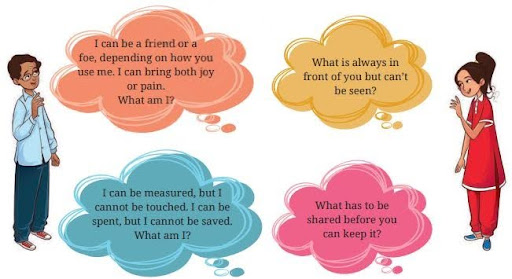
Ans.
1. Words
2. Time
3. Future
4. Secret
Discuss in pairs.
1. Why are qualities like humour and wit important in a person?
Ans. These two qualities make a person intelligent and enable him to handle challenges with a positive outlook. A witty person is not easily fooled and his humorous nature prevents him from unpleasantness with those who try to fool or cheat him.
2. Why do you think kings and queens preferred to have witty people among their courtiers?
Ans. They preferred to have such people because their ideas went beyond prejudices. Such people had well-developed social skills due to their wit and humour.
3. If you were asked to solve a disagreement between two people, what approach would you take?
Ans. I would make them realize that no one is right or wrong. I would try to give such an example that would make them automatically realize this.
4. Have you ever been in a situation where a small misunderstanding led to a big problem? How was it resolved?
Ans. Yes. It was resolved when a friend cleared the misunderstanding and put forth the facts.
Let us discuss
I Rectify the following false statements from the text.
1. The queen insulted the king by speaking against the quality of his poem.
2. Tenali Rama immediately went to the king and convinced him to talk to the queen.
3. The courtiers admired the king’s poem and praised his literary talent.
4. The ministers in the court were eager to hear Tenali Rama’s idea about paddy cultivation.
5. The king never realised his mistake and continued to stay angry with the queen.
Ans.
1. The queen was confused by the unclear expression in the king’s poem.
2. Tenali thought of a plan to resolve the fight between the royal couple.
3. The courtiers escaped listening to the king’s poem on one pretext or other.
4. The ministers in the court mocked and laughed at Tenali’s suggestion of using revolutionary seeds.
5. The king realised his mistake and patched up with the queen.
Let us think and reflect
I Read the extracts and answer the questions that follow.
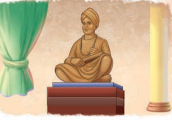 1. “… The king thought I was disrespecting his poem and stormed off. Since then, he has not spoken to me. If I had known this would happen I would have chosen another day. Help me, please, Rama. Only you can help the king understand.”
Rama nodded thoughtfully. “If you like, I will try my best to resolve this matter, Your Highness. But this needs a well-planned approach and I may need time to find the right strategy.”
(i) Why does the queen believe that only Tenali Rama can help the king understand?
Ans. Tenali is known for his wit and humour and so, the queen believes that only he can resolve the misunderstanding.
(ii) What does the queen’s statement, “If I had known this would happen, I would have chosen another day”, suggest about her feelings?
A. She is angry at the king for overreacting.
B. She regrets the unintended misunderstanding.
C. She believes the poem was not worth listening to.
D. She is worried that the king might punish her.
Ans. B. She regrets the unintended misunderstanding.
(iii) How does Tenali Rama’s response reflect his wisdom and problem-solving skills?
Ans. Tenali proposed such an idea which itself made the king yawn and thus, he realised that yawning was a natural activity and not an offense to disrespect him.
(iv) Fill in the blank by choosing the correct option from those given in the brackets.
The king’s reaction shows that he is sensitive and _________ (has a lot of faith/takes great pride) in his poetry.
Ans. takes great pride
2. That evening, the king approached the queen with a softened expression. “Thirumalambal”, he began, his voice gentle, “I have been foolish. I see now that I overreacted. I let my pride blind me. I’m so sorry.”
The queen, who had longed for this moment, smiled and replied, “If you like, we can leave this quarrel behind us. I would very much like to listen to your poem.”
(i) Complete the following with a suitable explanation.
When the king said, “I let my pride blind me”, he means that ____.
Ans. His pride clouded his judgement and made him think that he had been disrespected.
(ii) Why does the queen say, “If you like, we can leave this quarrel behind us”?
Ans. She does not want to discuss the unpleasant incident.
(iii) Fill in the blank by choosing the correct option from those given in the brackets.
The king acknowledges that his pride clouded his judgement, which shows _________. (intelligence and courage/maturity and self-awareness)
Ans. maturity and self-awareness
(iv) State any one characteristic that the queen’s response to the king’s apology shows about her.
Ans. It shows her immense love for the king.
II Answer the following questions.
1. Why was the Vijayanagara Empire considered to be in its ‘Golden Era’ during Krishnadeva Raya’s reign?
Ans. Krishnadevaraya’s reign was the Golden era because during his rule, there was a lot of progress in the fields of art, literature and architecture.
2. How did Tenali Ramakrishna gain a special place in the king’s court?
Ans. Tenali was one of the eight celebrated poets or ashtadiggajs in the royal court. He was known for his wit and humour.
3. How did the quarrel between the king and the queen affect the palace?
Ans. The quarrel between the royal couple created a tense and lonely atmosphere in the palace.
4. What strategy did Tenali Rama use to make the king realise his mistake?
Ans. Tenali presented a variety of revolutionary paddy seeds and claimed that they could increase the yield by three times provided the person who sowed them was careful not to yawn and scatter them unevenly. Thus, he highlighted that yawning was a natural process like breathing and anyone could yawn, leading to the king yawning unconsciously. This made the king realise that his anger with the queen was unjustified.
5. What was the reaction of the courtiers when Tenali Rama introduced his ‘special’ paddy seeds?
Ans. The courtiers made mockery of Rama and said that perhaps he had gotten some magic seeds. He added that next Rama would claim that they could grow without water. Another man spoke that perhaps he had found the seeds on the moon. The court was filled with suppressed laughter at Rama’s suggestion.
6. How does the story conclude, and what lesson can be learnt from it?
Ans. The story concludes on a happy note whereby the royal couple patch up. The lesson learned is that wit can win hearts because Tenali used such plans which went well with everyone.
The Wit That Won Hearts Grammar Exercises
Let us learn
I Fill in the blanks and complete the paragraph by choosing suitable expressions from the box given below.
| cast a shadow | murmur swept through the room | hush fell over |
| mind raced back | stormed off | rippled through |
My mother is quite witty, and her sense of humour always lightens stressful moments. Once, at a family dinner, an argument began over a minor issue, and 1. ______ , making everyone feel uncomfortable. Just as things were getting serious, she made a clever remark and laughter 2. ______ the gathering, making everyone relaxed. The person who started the argument 3. ______. Everyone disapproved of the action and a 4. ______. My 5. ______ to how my mother had saved other situations like this. Without her, such moments would have 6. ______ over the gatherings. I hope that I grow up to be as witty as my mother.
Ans.
1. Hush fell over
2. Rippled through
3. Stormed off
4. Murmur swept through the room
5. Mind raced back
6. Cast a shadow
 II The writer uses words like ‘roared’, ‘murmur’ in the text to indicate the sound produced. Fill in the blanks with suitable sound words from the box given below. You may refer to a dictionary.
| murmur | sighed | mumble | gasped |
| snickers | thud | groan | rattle |
| roared | whispered |
1. As the teacher began the riddle challenge, a __________ of excitement spread through the classroom.
2. Anaya __________ in relief—she loved riddles more than solving Mathematics problems.
3. ‘Think carefully,’ the teacher began to ___________ , as she wrote a riddle on the board.
4. When the question was revealed, a few students __________ , realising it wasn’t as easy as they had expected.
5. Some exchanged ____________ , wondering if anyone at all would be able to solve it.
6. Just then, Anaya tapped her book on the desk with a small ___________ , deep in thought.
7. ‘Ah, I see it now!’ she said stretching with a ___________ , as if it had taken her great effort.
8. A small breeze made the windows __________ , adding to the suspense of the moment.
9. ‘So, what’s the answer?’ the students ___________ , their voices filled with playful enthusiasm.
10. Leaning forward with a smile, Anaya __________ , ‘Sometimes, the trickiest questions have the simplest answers.’
Ans.
1. roar
2. Sighed
3. murmur
4. gasped
5. groans
6. thud
7. mumble
8. rattle
9. snickered
10. whispered
III As you have learnt, a compound word is formed when two or more words are combined to create a new word with a distinct meaning. These are of three types: closed compounds (sunlight, courtroom), hyphenated compounds (well-planned), and open compounds (paddy seeds).
1. Create new compound words by matching words in Column 1 with those in Column 2.
| Column 1 | Column 2 |
| (i) quick | A. hall |
| (ii) soft | B. tempered |
| (iii) common | C. spoken |
| (iv) house | D. blue |
| (v) book | E. store |
| (vi) ill | F. sense |
| (vii) sky | G. witted |
| (viii) dance | H. Hold |
Ans.
(i) Quick-witted
(ii) Soft-spoken
(iii) Common sense
(iv) Household
(v) Bookstore
(vi) Ill-tempered
(vii) Sky blue
(viii) Dance hall
2. Fill in the blanks with the words created in the previous question.
Ravi was (i) __________, always speaking calmly even in arguments. He grew up in a lively (ii) __________, where he learned to handle different personalities. His friend Arun, however, was (iii) __________ and often lost his patience. Despite this, Arun admired Ravi’s (iv) __________ thinking. One evening, as they passed a (v) __________, they saw some performers rushing out. Ravi noticed that one of them dropped a (vi) __________ book on the ground. “Is this yours?” he asked. “Oh thank you, young man!” the performer smiled. “It’s a recent purchase from the (vii) ________ round the corner.” True to his nature Arun promptly said to Ravi, “ It’s (viii) ________ that it’s not from a bakery but bookshop!” Ravi smiled and they walked on.
Ans.
(i) soft-spoken
(ii) household
(iii) ill-tempered
(iv) quick-witted
(v) dance hall
(vi) sky blue
(vii) bookstore
(viii) common sense
IV Read the sentences from the text and their explanation given in the table below.
| Sentences from the Text | Tenses | Explanation |
| 1. If you like, I will try my best to resolve this matter. | Simple Present + Present Modal | The condition in the ‘if’ clause may or may not be fulfilled. The present tense refers only to a possible future action. |
| 2. If, by chance something were to go wrong, our farmers would suffer. | Simple Past + Past Modal | The condition in the ‘if’ clause expresses a hypothetical or imaginary situation. |
| 3. If I had known this would happen, I would have chosen another day. | Past Perfect + would have + Past Participle | The condition in the ‘if’ clause describes what the speaker would have done (differently) if the past situation had been different and it is impossible to rectify it in the present. |
In sentence 1 ‘if you like’ is the subordinate clause (if clause) and ‘I will try my best to resolve this matter’ is the main clause.
Identify the subordinate and main clauses in sentences 2 and 3.
Ans.
2. Main clause – If, by chance something were to go wrong
Subordinate clause – our farmers would suffer
3. Main clause– I would have chosen another day.
Subordinate clause– If I had known this would happen
Now, match the subordinate clauses (if clauses) in Column 1 with the appropriate main clauses in Column 2 to make complete sentences.
| Column 1 | Column 2 |
| (i) If I had a magic wand, | A. We will go to the theatre. |
| (ii) If it rains tomorrow, | B. I would sneak into the secret room. |
| (iii) If you had listened carefully, | C. I would give myself wings. |
| (iv) If you finish your homework, | D. The boys would have woken up on time. |
| (v) If I were invisible, | E. We will stay indoors and play board games. |
| (vi) If the alarm had rung, | F. You would have solved the puzzle. |
Ans.
| Column 1 | Column 2 |
| (i) If I had a magic wand, | C. I would give myself wings. |
| (ii) If it rains tomorrow, | E. We will stay indoors and play board games. |
| (iii) If you had listened carefully, | F. You would have solved the puzzle. |
| (iv) If you finish your homework, | A. We will go to the theatre. |
| (v) If I were invisible, | B. I would sneak into the secret room. |
| (vi) If the alarm had rung, | D. The boys would have woken up on time. |
V Complete the following sentences appropriately with either the main clause or the subordinate clause (if clause).
1. Your teacher will be unhappy if _______________________.
2. They would have caught the train if _______________________.
3. _______________________ if you continue to stay up late every night.
4. If she knew the answer, _______________________.
5. _______________________ if she had studied harder.
6. If I had a million rupees, _______________________.
Ans.
1. You fail the exam.
2. They would not have wasted time arguing with the taxi driver.
3. You will get dark circles,
4. She would have won the quiz.
5. She would have cleared the exam,
6. I would move to Switzerland.
VI Complete the following sentences. One example has been done for you.
1. If I were a tree, I would play with the wind and talk to the birds.
2. If I were the Head Teacher of my school, _______.
3. If I were a bird, _______.
4. If I were a magician, _______.
5. If I had studied harder, _______.
Ans.
2. I would remove the compulsion of wearing uniforms.
3. I would fly and fly around the world.
4. I would amass wealth.
5. I would have cleared the exam.
Let us listen
I You will listen to a woman narrating a story. As you listen, fill in the blanks in the following sentences by selecting the correct options. (Transcript for teacher on page 46)
1. The rope tying the bundle of sticks was _____.
(i) loose
(ii) thick
(iii) short
Ans. (ii) thick
2. The scholar is finally referred to as ________.
(i) irritable
(ii) mischievous
(iii) arrogant
Ans. (iii) arrogant
II You will once again listen to the story. As you listen, number the events of the story in the correct order of occurrence.
1. The great scholar was ashamed because he did not know what to say.
2. Rama accepted the challenge thrown by the visitor.
3. Rama had a bundle tied in silk when he came to the palace.
4. The king laughed at the explanation given by Rama.
5. The visitor wanted to show his superiority over others in the palace.
6. Rama showed the work to be a bundle of sticks tied together by a rope.
7. The king wanted to know more about the work mentioned by Rama.
8. The court scholars were afraid of the king’s anger
Ans.
1. 5. The visitor wanted to show his superiority over others in the palace.
2. 8. The court scholars were afraid of the king’s anger
3. 2. Rama accepted the challenge thrown by the visitor.
4. 3. Rama had a bundle tied in silk when he came to the palace.
5. 1. The great scholar was ashamed because he did not know what to say.
6. 7. The king wanted to know more about the work mentioned by Rama.
7. 6. Rama showed the work to be a bundle of sticks tied together by a rope.
8. 4. The king laughed at the explanation given by Rama.
Let us write
A narrative essay is written on a personal experience or an imagined experience.
I. Read the narrative essay given below.
A Lesson in Responsibility
One bright Monday morning, I woke up to the sounds of birds chirping loudly. For once, I wasn’t late for school. My uniform was neatly laid out, and my homework was already packed in my bag. I felt proud of myself for being so organised. But little did I know, the day would still teach me an important lesson.
During the morning assembly, our teacher, Mrs. Rao, announced a surprise Science quiz. My heart skipped a beat. I had studied the chapter a week ago, but I had forgotten to revise it over the weekend. As I sat at my desk with the question paper in front of me, I froze. The questions looked familiar, yet I couldn’t recall the answers clearly. I tried my best to focus, but it wasn’t enough. Later, when the results were announced, I scored much lower than I expected. Disappointed, I spoke to Mrs. Rao after the class. She smiled and said, “It’s not about how much you know but how consistently you prepare. Small efforts add up every day.”
Her words stayed with me. From that day on, I made it a habit to revise my lessons regularly, even if there wasn’t an immediate test. Responsibility isn’t just about being on time or finishing tasks—it’s about being ready for what’s unexpected.
Now, work in pairs and check () if the following features are present in the narrative essay.
1. Introduction
• The essay begins with a clear and engaging opening.
• The introduction sets the context for the narrative.
• The central idea or purpose is clear.
2. Body of the essay
• Events are narrated in a logical sequence.
• Descriptive details are used.
• Characters and settings are clearly described.
• The narrator’s emotions or thoughts are shared.
• The essay includes a challenge or a problem or a turning point.
3. Conclusion
• The essay ends with an outcome.
• A lesson or a message is clearly stated.
4. Writing Style
• The tone is personal and engaging.
• First person narration is used (for example, ‘I,’ ‘my’).
5. Language
• The essay uses simple and clear language.
• Grammar, punctuation, and spellings are correctly used.
Note: A narrative essay focuses on sharing a personal experience to convey a specific lesson, a reflection, or an idea. It has an introduction, a body, and a conclusion.
Now, write a narrative essay based on any one of the situations given below.
• The Day I Learnt the Value of Teamwork
• A Small Act of Kindness that Made a Difference
Ans.
The Day I Learnt the Value of Teamwork
I always believed that my work was superior to that of my classmates. This made me proud and I would show them down. Even our class teacher praised me extensively which made me so haughty that I became sarcastic and made mockery of my fellow students.
It was the inter-class dumbcharades competition when then entire class was divided into groups of four, to select one group that would represent the class and go for the second stage of the contest. I found it tough to collaborate with my team mates because I doubted their intelligence. However, deep down, I was too keen to get selected.
Once the round started, I realized that I had to collaborate well in order to sail through. During the practice session, I became accommodating and accepting. This twist in my outlook made me see the other side of the coin and I realized that all the teammates had some unique quality through which they contributed towards our victory.
Thus, the competition made me humane and endowed me with the skill of working in a team.
A Small Act of Kindness that Made a Difference
It was a cold, rainy morning when suddenly, the speeding car screeched to a halt. The little kitten born to my neighbour’s pet cat, Ruth had wandered onto the road, whining for its mother.
The driver, my dad was alert to spot the little being, despite the heavy downpour. He did not mind getting wet and got out of the car. The brown and white furry kitten had gotten so scared that it sat huddled at the edge of the road. Dad mimicked Ruth’s “meow! meow!” and successfully rescued it.
The kitten was restored with its mother and everyone was elated to see the union. Such acts of kindness bring out our inner humanity and sensitize us.
CBSE Class 8 English Unit 1 Chapter 1 The Wit That Won Hearts Extract-Based Questions
A. The Vijayanagara Empire was renowned for its glory, wealth, and cultural achievements. Among its many illustrious rulers, King Krishnadeva Raya (ruled 1509–29 CE) stood out as a wise and powerful monarch. His reign is often referred to as the Golden Era of the Vijayanagara Empire, a time when art, literature, and architecture flourished. A great patron of learning, Krishnadeva Raya was not only an eminent warrior but also a gifted poet. His works, such as the epic Amuktamalyada and the Sanskrit drama Jambavati Parinayam, are acclaimed even today.
Q1. Krishnadeva Raya belonged to the ________ empire.
Ans. Vijayanagara
Q2. King Krishnadeva Raya’s rule is known as _________
Ans. the Golden era
Q3. Why was Krishnadeva Raya’s reign known as the Golden era?
Ans. It was known as the Golden era because it was a time when art, literature, and architecture flourished.
Q4. Other than being a warrior, what quality did the king possess?
Ans. He was a great poet.
Q5. Name some famous works of king Krishnadeva Raya.
Ans. The epic Amuktamalyada and the Sanskrit drama Jambavati Parinayam are some famous works of king Krishnadeva Raya.
B. Krishnadeva Raya’s court was home to eight celebrated poets, collectively known as the Ashtadiggajas. These poets, including Allasani Peddana and Tenali Ramakrishna, enriched the literary tradition with their masterpieces. Tenali Ramakrishna, in particular, was known for his quick wit and humour, earning him a special place in the king’s court as both a poet and a witty advisor. His clever solutions to seemingly insurmountable problems made him a beloved figure in the empire’s history.
Even the wisest rulers face moments of disharmony, and at one such time, the king had a quarrel with his queen, Thirumalambal, over a seemingly trivial matter. For weeks, he did not utter a single word to her, and in his frustration, stopped visiting her altogether. His absence cast a shadow over the palace, and the once cheerful corridors seemed quiet and forlorn.
Q1. There were ______ celebrated poets in the king’s court.
Ans. eight
Q2. The poets were collectively called __________
Ans. Ashtdiggajas
Q3. Name some of the Ashtadiggajas.
Ans. Allasani Peddana and Tenali Ramakrishna
Q4. Tenali was known for which qualities?
Ans. He was known for his wit and humour.
Q5. What positions did Tenali hold in the king’s court?
Ans. He was a poet and a witty advisor.
C. “The king wrote a poem,” she began, her voice trembling. “It was filled with vague expressions—sun, moon, stars, beautiful sky—but it made no sense. When he tried reciting it to his ministers, they all avoided him, making excuses. It was late evening when he came to me, seeking an audience. He began reciting it to me, but I was so exhausted after a tiring day that I yawned— not once, but several times. The king thought I was disrespecting his poem and stormed off. Since then, he has not spoken to me. If I had known this would happen I would have chosen another day. Help me, please, Rama. Only you can help the king understand.”
Q1. Whom does ‘she’ refer to?
Ans. The Queen Thirumalambal.
Q2. Why was her voice trembling?
Ans. The king was annoyed with her which made her sad and so, her voice trembled.
Q3. What did the king do when the ministers avoided him?
Ans. He went to the queen to narrate the poem to her.
Q4. Was the king successful in narrating the poem to the queen?
Ans. No, he was not successful because the queen yawned several times which made him feel that she was disrespecting him.
Q5. What did the king do in response to the queen?
Ans. The king stormed off and stopped talking to the queen.
D. Finally, the king called upon Rama. The chatter in the court died down as all eyes turned to him. Rama approached the throne, carrying a plateful of paddy seeds. Bowing low, he began, “Your Majesty, I bring you a revolutionary type of paddy seeds. If these are sown, the yield will be three times greater than the current results.”
A murmur swept through the room. One of the courtiers, known for his sarcasm, whispered just loud enough to be heard, “I wonder if these are magic seeds! Next, he’ll claim they grow without water.” Another muttered, “Perhaps he found them on the moon!” Snickers rippled through the court.
The king frowned, unimpressed. “That sounds absurd,” he muttered. “Such cultivation would need special soil, manure, and pest and insect repellents. If, by chance, something were to go wrong, our farmers would suffer.”
Q1. Why did the king call Rama?
Ans. He was seeking a solution to increase the yield of paddy crop.
Q2. What was Rama’s claim?
Ans. He claimed that the paddy seeds were revolutionary and could give three times more crop.
Q3. Who said – “I wonder if these are magic seeds! Next, he’ll claim they grow without water.”
Ans. One of the courtiers who was known for his sarcasm said it.
Q4. How did the king react to Rama’s suggestion?
Ans. He frowned and was unimpressed.
Q5. According the the king, who would suffer if something went wrong?
Ans. The farmers would suffer.
Class 8 The Wit That Won Hearts Multiple Choice Questions
Q1. The story is about the King Krishnadeva Raya of the ______________ empire
A. Pandava
B. Chalukya
C. Vijayanagara
D. Mughal
Ans. C. Vijayanagara
Q2. How was the king related to Thirumalambal?
A. father
B. brother
C. uncle
D. husband
Ans. D. husband
Q3. Which seeds did Tenali carry in a plate?
A. wheat
B. paddy
C. maize
D. none of these
Ans. B. paddy
Q4. Tenali was one of the _______ in the king’s court
A. eight poets
B. ashtadiggajas
C. both A and B
D. None of these
Ans. C. both A and B
Q5. Vague means ______
A. unclear
B. understand
C. clear
D. quick
Ans. A. unclear
Q6. How do we know that the queen was tired?
A. she dozed off
B. she yawned
C. she said that she was exhausted
D. all of these
Ans. B. she yawned
Q7. Which qualities did the king possess?
1. Warrior
2. Writer
3. Singer
4. Poet
5. painter
A. 1, 2, 3, 4, 5
B. 1, 4, 5
C. 2, 4
D. 1, 4
Ans. D. 1, 4
Q8. The king’s poem did NOT include the expression-
A. sun
B. flowers
C. moon
D. sky
Ans. B. flowers
Q9. Find a synonym of ‘renowned’.
A. proud
B. famous
C. weak
D. big
Ans. B. famous
Q10. Find the option that uses the word ‘blind’ as is used here –
“I have been foolish. I see now that I overreacted. I let my pride blind me. I’m so sorry.”
A. The blind man was helped by the boy as he crossed the busy street.
B. I went to the school for the blind to donate blankets.
C. The old woman was blinded by her greed and couldn’t see the suffering of the poor.
D. I went on a blind date yesterday.
Ans. C. The old woman was blinded by her greed and couldn’t see the suffering of the poor.
Q11. What does the word ‘longed’ mean here-
“The queen, who had longed for this moment, smiled”
A. gained height
B. desired
C. both A and B
D. None of these
Ans. B. desired
Q12. Why was the king annoyed?
A. The queen had avoided listening to his poem.
B. The queen had yawned and disrespected him.
C. No one in the kingdom was listening to his poem.
D. Tenali had commented that the king was not a good poet.
Ans. B. The queen had yawned and disrespected him.
Q13. What could hamper the yield of the revolutionary paddy seeds?
A. poor rains could lead to lesser yield
B. excessive heat could damage the crop and hamper the yield
C. if the one who sowed the seeds yawned and scattered them unevenly, it could hamper the yield
D. none of these
Ans. C. if the one who sowed the seeds yawned and scattered them unevenly, it could hamper the yield
Q14. How many children did the royal couple have?
A. 4
B. 3
C. 2
D. not mentioned
Ans. D. not mentioned
Q15. Wo said – ““That sounds absurd,” he muttered. “Such cultivation would need special soil, manure, and pest and insect repellents. If, by chance, something were to go wrong, our farmers would suffer.””?
A. king
B. queen
C. Tenali
D. courtier
Ans. A. king
Q16. Find an antonym for ‘absurd’.
A. senseless
B. logical
C. mad
D. prestige
Ans. B. logical
Q17. “A hush fell over the court as Rama’s words hung in the air.”
The underlined phrase means _________
A. they were flying
B. to convey a sense of uncertainty
C. they were decorations hanging from the ceiling
D. none of these
Ans. B. to convey a sense of uncertainty
Q18. Tenali was known for _______
A. strength
B. wit
C. knowledge
D. riches
Ans. B. wit
Q19. Tenali’s full name is-
A. Tenali Radhakrishna
B. Tenali Ramakrishna
C. Tenali RamaSita
D. Tenali Ramaswami
Ans. B. Tenali Ramakrishna
Q20. “Even the wisest rulers face moments of disharmony, and at one such time, the king had a quarrel with his queen, Thirumalambal, over a seemingly trivial matter.” Trivial means –
A. small
B. tiny
C. unimportant
D. All of these
Ans. D. All of these
CBSE Class 8 English Poorvi Book Unit 1 – Wit And Wisdom Chapter 1 – The Wit That Won Hearts Extra Question and Answers
Answer the following questions-
Q1. Describe the king.
Ans. A great patron of learning, Krishnadeva Raya was not only an eminent warrior but also a gifted poet. His works, such as the epic Amuktamalyada and the Sanskrit drama Jambavati Parinayam, were acclaimed even many years later.
Q2. What qualities helped Tenali earn a special place in the royal court?
Ans. Tenali’s wit and humour earned him a special place of an advisor in the royal court. He would give clever solutions to seemingly insurmountable problems made him a beloved figure in the empire’s history.
Q3. Describe the matter over which the king quarelled with the queen.
Ans. It was late evening when the king visited the queen, seeking an audience. He began reciting the poem, but she was so exhausted after a tiring day that she yawned— not once, but several times. The king thought that the queen was disrespecting his poem and stormed off. Since then, he did not speak to her.
Q4. For what did the queen seek Rama’s help?
Ans. She sought his help to make the king understand her innocence. Rama could use his wit and change the king’s belief that he had been disrespected by the queen’s yawning.
Q5. What matter was being discussed in the royal court that day? What was Rama’s contribution to it?
Ans. The court was discussing ways to improve the yield of paddy. Rama carried a plate full of revolutionary paddy seeds which could increase the yield by three times, provided the person who sowed them did not yawn and would scatter them evenly.
Pls give us notes summary and quiz flashcards like a study app