
CBSE Class 8 English Unit 3 Mystery And Magic Chapter 3 Spectacular Wonders Important Question Answers from Poorvi Book
Class 8 English Spectacular Wonders Question Answers – Looking for questions and answers for CBSE Class 8 English Unit 3 Mystery And Magic Chapter 3 – Spectacular Wonders? Look no further! Our comprehensive compilation of important questions will help you brush up on your subject knowledge. Practising Class 8 English question answers can significantly improve your performance in the exam. Improve your chances of scoring high marks by exploring Unit 3 Mystery And Magic Chapter 3 – Spectacular Wonders now. The questions listed below are based on the latest CBSE exam pattern, wherein we have given NCERT solutions to the chapter’s extract-based questions, multiple choice questions and Extra Question Answers
Also, practising with different kinds of questions can help students learn new ways to solve problems that they may not have seen before. This can ultimately lead to a deeper understanding of the subject matter and better performance on exams.
- Spectacular Wonders NCERT Solutions
- Spectacular Wonders Grammar Exercises
- Spectacular Wonders Extract Based Questions
- Spectacular Wonders Multiple Choice Questions
- Spectacular Wonders Extra Question Answers
Related:
Spectacular Wonders Textbook Questions (NCERT Solutions)
Exercises
Let us do these activities before we read.
1. Look at the pictures given below and sort them into natural and man-made wonders.
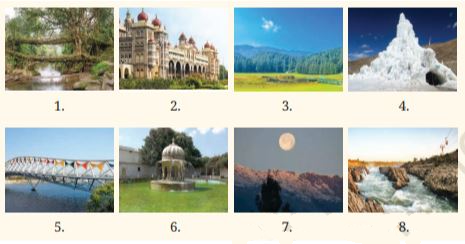
Natural: ______, ______, ______, and ______
Man-made: ______, ______, ______, and ______
II. Which of these wonders—man-made or natural—are more appealing and why? Share your answers with your classmates and teacher.
III. Work in pairs. Write down two wonders of nature that have amazed you. Discuss what makes them impressive. Share your answers with your classmates and teacher.
IV. Work in groups of four. Complete the web chart given below with words that you associate with the phrase, ‘Nature’s Power’. Share your answers with your classmates and teacher.
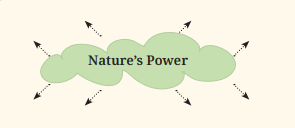
Ans.
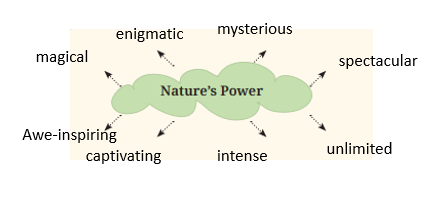
Let us discuss
I. Complete the information in the table given below. One example has been done for you. Share your answers with your classmates and teacher.
| Amazing Natural Phenomena | Location | One Unique Feature |
| 1. The Valley of Flowers | Chamoli district, Uttarakhand | Around 600 species of exotic flowers |
| 2. The Living Root Bridges | ||
| 3. | Buldhana district, Maharashtra | |
| 4. Magnetic Hills | ||
| 5. Glowing Waters | ||
| 6. | West Bengal | |
| 7. | Balasore district, Odisha |
Ans.
| Amazing Natural Phenomena | Location | One Unique Feature |
| 1. The Valley of Flowers | Chamoli district, Uttarakhand | Around 600 species of exotic flowers |
| 2. The Living Root Bridges | Meghalaya | The longest root bridge measures 175 feet in length |
| 3. Lonar Crater Lake | Buldhana district, Maharashtra | A blend of celestial impact and terrestrial beauty |
| 4. Magnetic Hills | Leh, Ladakh | Cars parked at the Magnetic Road appear to roll up the hill |
| 5. Glowing Waters | Kumbalangi Village, Kochi, Kerala | Bioluminescence of microplanktons in the backwaters |
| 6. Sundarbans | West Bengal | Lies in the delta of three rivers |
| 7. Chandipur Beach | Balasore district, Odisha | Sea disappears during the ebb period |
Let us think and reflect
I. Read the given extracts and answer the questions that follow.
1. India is home to some of the most mystifying natural phenomena that surprise and spark our imagination.
(i) Replace the underlined phrase with one from the extract. India is the birthplace of several rare species of flora and fauna that thrive in its diverse ecosystems.
Ans. India is home to several rare species of flora and fauna that thrive in its diverse ecosystems.
(ii) What does the phrase ‘nature’s unusual side’ suggest about the phenomena described?
Ans. It suggests that the phenomena is not a common occurrence.
(iii) Complete the similarity by choosing the correct option. spark: imagination : : ______________ : ______________.
A. inspiration; creativity
B. wonder; amazement
C. effort; reward
D. knowledge; books
Ans. B. wonder; amazement
(iv) Identify whether the following statement is true or false. Some natural phenomena can surprise people.
Ans. True
2. Have you seen things disappearing in front of your eyes? Well, such things happen at times, when we keep things at some place, and just forget where we have kept them. But, what if there’s a sea that disappears?
This happens in Odisha. It is a beach in the Balasore district where one can witness the sea disappearing mysteriously—the Chandipur Beach which is known for its unique feature of playing hide-and-seek with its visitors.
(i) Complete the following sentence with a suitable reason.
The writer’s most likely purpose to introduce the information about the Chandipur Beach phenomenon with a question is to ____________________. (engage the reader’s curiosity and create a sense of suspense/draw the reader to learn more about the unusual phenomenon/set the tone for the surprising nature of the content that follows)
Ans. draw the reader to learn more about the unusual phenomenon
(ii) Select the option that is correct for both Assertion (A) and Reason (R).
(A): Chandipur Beach in Odisha is known for its unique feature of the sea disappearing. (R): The tides retreat drastically, exposing the Chandipur beach.
A. Both (A) and (R) are true, and (R) is the correct explanation of (A).
B. Both (A) and (R) are true, but (R) is not the correct explanation of (A).
C. (A) is true, but (R) is false.
D. (A) is false, but (R) is true
Ans. A. Both (A) and (R) are true, and (R) is the correct explanation of (A).
(iii) What does the term ‘unique’ suggest about the beach in Balasore?
A. very popular
B. one of its kind
C. ancient place
D. far from city
Ans. B. one of its kind
(iv) What does the writer want to convey with the use of the phrase ‘playing hide-and-seek with its visitors’?
Ans. The writer wants to convey how the sea disappears and appears periodically.
II. Answer the following questions.
1. How are the living root bridges a boon for the local people of Meghalaya?
Ans. The wood and bamboo bridges cannot withstand the heavy and harsh monsoon of Meghalaya. The local people of Meghalaya, who were more familiar with the region, utilised their regional and cultural knowledge to create the living root bridges. They harnessed nature and used it to connect the villages of Meghalaya.
2. Why is the Lonar Crater Lake considered a remarkable and rare site?
Ans. The Lonar Crater Lake was formed when a meteorite struck the basaltic region, impacting the area to create a circular depression. A salt lake was formed in the circular depression. Therefore, Lonar Crater Lake is considered a remarkable and rare site due to the harmony between celestial and terrestrial beauty. It is the only crater in India formed in basaltic rock by a meteorite impact and ranks as the third largest in the world, placing it among the top five largest craters globally. Thus making it a rare sight.
3. What might be the writer’s purpose of highlighting the awe-inspiring natural wonders of India?
Ans. The writer highlights the awe-inspiring natural wonders of India. The writer portrays the seven spectacular wonders of India appreciatively to showcase the stunning allure of nature and India, and how the diverse topographies in one country enrich the beauty of the place.
4. The writer uses descriptive language and introductory questions for some of the natural phenomena. What impact does it have on the readers?
Ans. The descriptive language and introductory questions make the chapter more interesting and engaging to the readers. It draws the readers into the attractive landscapes that the writer wants to talk about. It sparks the interest and curiosity of the readers by describing each detail and introducing the strange natural phenomena.
5. Which of these unusual phenomena did you find the most interesting and why?
Ans. I found the Lonar Crater Lake in Maharashtra the most interesting. It is because it is so fascinating that there is a saltwater lake in the centre of the circular depression of the meteorite’s impact.
Spectacular Wonders Grammar Exercises
Let us learn
1. Fill in the blanks with the correct expressions from the text given in the box below.
| came into existence | to no end | in full glory |
| in disbelief | to name a few | age-old problem |
1. I have read many stories _____________________.
2. Do you know when this little town _____________________?
3. His hard work has helped him _____________________.
4. There are no simple solutions to the _____________________ of traffic jams.
5. He opened the ancient wooden box and stared at the treasure _____________________.
6. The garden is _____________________ in spring with lots of beautiful flowers in bloom.
Ans.
1. to name a few
2. came into existence
3. to no end
4. age-old problem
5. In disbelief
6. in full glory
II. Select the correct synonyms from the box given below that match the list of words in 1–5. You may refer to a thesaurus.
| colossal | exotic | serene |
| enigmatic | spectacular |
1. mysterious, puzzling, baffling
2. mighty, gigantic, huge
3. breath-taking, stunning, awe-inspiring
4. peaceful, calm, tranquil
5. unusual, peculiar, foreign
Ans.
1. enigmatic
2. colossal
3. spectacular
4. serene
5. exotic
III. The expressions ‘hide-and-seek’ and ‘flora and fauna’ are used in the text. These are called binomials—a pair of fixed words joined by ‘and’ or ‘or’. The binomials are mostly synonyms, antonyms, rhyming words, same sound words (alliterations), etc.
Match the binomials in Column 1 with their meanings in Column 2. You may refer to a dictionary.
| Column 1 | Column 2 |
| 1. odds and ends | (i) put different things together to get a range of possibilities |
| 2. on and off | (ii) complete part of or belong to |
| 3. mix and match | (iii) choose only the best (things, people, etc.) |
| 4. all or nothing | (iv) at some time in the future |
| 5. part and parcel | (v) sometimes, occasionally |
| 6. pick and choose | (vi) increase or develop very quickly |
| 7. sooner or later | (vii) small, unimportant things |
| 8. leaps and bounds | (viii) something to be done completely or not at all |
Use the binomials given in Column 1 in sentences of your own.
Ans.
| Column 1 | Column 2 |
| 1. odds and ends | (vii) small, unimportant things |
| 2. on and off | (v) sometimes, occasionally |
| 3. mix and match | (i) put different things together to get a range of possibilities |
| 4. all or nothing | (viii) something to be done completely or not at all |
| 5. part and parcel | (ii) complete part of or belong to |
| 6. pick and choose | (iii) choose only the best (things, people, etc.) |
| 7. sooner or later | (iv) at some time in the future |
| 8. leaps and bounds | (vi) increase or develop very quickly |
I will work on the odds and ends when I have extra time.
I go to the arcade and play the dunk game on and off.
Just mix and match the outfits until you get the perfect one for the meeting.
You need your full focus because this test is all or nothing.
Stress is part and parcel of our life.
Beggars can’t pick and choose.
You have to work hard sooner or later.
This invention can be leaps and bounds for the mankind.
IV. Study the highlighted words in the following sentences from the text.
• The living root bridges are one of Meghalaya’s most beautiful…
• …creating a striking visual contrast against the surrounding rugged terrain.
In the given sentences, the highlighted words ‘living’, ‘striking’, and ‘rugged’ are examples of verbs used as adjectives. Such verbs are called participles.
| Participles are verb forms that can function as adjectives, and they come in two types: present participles (‘living’ and ‘striking’) usually ending in –ing, and past participles (‘rugged’) usually ending in -ed, -d, -t, -en, or –n. (though irregular verbs may vary) Present participles are used to describe ongoing or continuous actions. For example, People have seen these lights moving quickly in random directions but often hanging out in one spot for a while before fading. Past participles usually describe actions that have already been completed. For example, When the vehicles are parked at the indicated spot, they begin moving forward at a speed of almost 20km/h. |
Now, fill in the blanks using present participle or past participle form of the verbs in the box given below.
| stand | amaze | carve | scatter | glow |
1. The _______________ marble monument looks even more spectacular in the moonlight.
2. The _______________ view of the Himalayas from Darjeeling attracts visitors from all over the world.
3. The Sun Temple in Konark features intricately _______________ stone wheels and walls.
4. _______________ at a height of 182 m, the Statue of Unity is dedicated to Sardar Vallabhbhai Patel.
5. The _______________ islands of the Andaman and Nicobar offer some of the cleanest beaches in India.
Ans.
1. glowing
2. amazing
3. carved
4. Standing
5. scattered
V. Study the highlighted word in the following sentence from the text.
Crossing the many waterways without bridges was difficult for people in the past, during monsoons.
In the given sentence, the highlighted word ‘crossing’, is one example of a verb used as a noun. Such a verb is called gerund.
| Gerunds are verb forms that can function as nouns and they end in –ing. They can serve as the subject, complement, or object in a sentence, as well as the object of a preposition. For example, • Subject of a sentence: Swimming is my favourite hobby. • Subject complement: Her passion is painting. • Object of a verb: I enjoy reading books in my free time. • Object of a preposition: She is interested in learning new languages. • After certain verbs: Shekar avoided talking about his weekend plans. |
Underline the gerunds and participles in the following sentences. Write ‘G’ for gerunds and ‘P’ for participles in the space provided. One example has been done for you.
1. Dancing is a great way to express emotions. G
2. Travelling can broaden your perspective.
3. The falling leaves signalled the arrival of autumn.
4. She enjoys cooking new recipes for her family.
5. Reading helps improve your vocabulary.
6. He watched the shimmering stars in the night sky.
7. Forgetting the keys inside, Kanchan locked the door.
Ans.
1. Dancing is a great way to express emotions. G
2. Travelling can broaden your perspective.G
3. The falling leaves signalled the arrival of autumn. P
4. She enjoys cooking new recipes for her family. G
5. Reading helps improve your vocabulary. G
6. He watched the shimmering stars in the night sky. P
7. Forgetting the keys inside, Kanchan locked the door. G
VI. Combine the following pairs of sentences using participles or gerunds. You may use the clues given in brackets. One example has been done for you.
1. Nitesh entered the room. He saw his friend sitting in the corner. (participle)
Ans. Entering the room, Nitesh saw his friend sitting in the corner.
2. Smitha walked carelessly. She slipped on the doormat. (participle)
3. Sleep for eight hours. It is good for health. (gerund)
4. Ranjith felt happy about the result. He called his parents. (participle)
5. Father encouraged Meena. Meena joined the course. (gerund)
Ans.
2. Walking carelessly, she slipped on the doormat.
3. Sleeping for eight hours is good for health.
4. Feeling happy about the result, he called his parents.
5. Father encouraged Meena’s joining the course.
Let us listen
I. You will listen to a brother and sister discuss a natural phenomenon. As you listen, mark the four true statements from 1–6 given below. (Transcript for teacher on page 153)
1. The brother was taken aback to see the posted pictures.
2. The brother admitted to not knowing about his sister’s favourite picture.
3. The sister stated that the rainbow mountain was like any other mountain.
4. The brother was aware of the reason for the formation of colours on the mountain.
5. The brother was surprised to learn about the mountain being covered with snow till recently.
6. The sister understood nature’s role in the beauty of the mountain.
Ans.
1. False
2. True
3. False
4. True
5. True
6. True
Let us write
I. You just read vivid descriptions of the natural wonders of our country. Write a descriptive essay for your school magazine describing anything from nature that attracted your attention. It may be an object, a place, or an event experienced by you. Remember to give a title to your essay.
Use proper format and content organisation—begin with a title, include introduction (one paragraph), body (two to three paragraphs), and conclusion (one paragraph).
Ans.
The Calming Scent of Munnar
India is a land of breathtaking natural beauty, but nothing captivated me more than the quiet majesty of Munnar, a hill station nestled in the Western Ghats of Kerala. During my family trip last winter, I found myself enchanted by its rolling tea gardens, misty mornings, and the calming silence that only nature can provide.
We visited a nearby tea plantation. Walking through the narrow pathways between the bushes, I was struck by the precision and care with which the plants were arranged. Our guide explained how the tea was hand-plucked. Women in colourful sarees move with grace and speed through the fields. The scent of fresh leaves mixed with the earthy aroma of the soil made the experience even more unforgettable. I even got to taste freshly brewed tea at the end of the tour—its warm, rich flavor felt like a gift from the very hills we had explored.
Munnar taught me the quiet power of nature. It made me pause, breathe, and appreciate the simple wonders and earthly scent that surround us. Munnar remains a reminder to calm down and feel life and nature instead of surviving in the fast-paced world.
CBSE Class 8 English Unit 3 Chapter 3 Spectacular Wonders Extract-Based Questions
A. The Valley of Flowers is an eyecatching spectacle with around 600 species of exotic flowers, including orchids, poppies, primulas, marigold, daisies, and anemones. It is a place where nature blooms in its full glory offering an attractive view. The trek to the valley offers spectacular views of beautiful waterfalls and wild streams. The valley is also home to rare wildlife species like the grey langur, flying squirrel, red fox, lime butterfly, and snow leopard, to name a few.
With a stunning backdrop of the mighty Himalayan ranges, the Valley of Flowers National Park presents an unforgettable experience for visitors. Spread over a huge area in the Chamoli district, the Valley of Flowers National Park is a UNESCO World Heritage Site. Between the months of May and October, this area turns into a botanical wonderland!
Q1. The valley of flowers is in _________ state.
Ans. Uttarakhand
Q2. Which mountain range forms the backdrop of the valley of flowers?
Ans. The Himalyan range
Q3. Which wonder is located in Chamoli district?
Ans. The Valley of Flowers
Q4. What happens in the months of May to October in the valley of flowers?
Ans. It becomes a botanical wonderland with several varieties of flowers in bloom.
Q5. Name a UNESCO World Heritage site.
Ans. The Valley of Flowers in Uttarakhand.
B.
They are made of intertwined roots which are a sort of magic, but they aren’t imaginary. These bridges have been built for centuries by the indigenous people of the land. It is a naturally built ecosystem of local flora. It also symbolises the relationship and knowledge that the local people have over their region and the cultural significance that it holds for them. Under ideal conditions, a root bridge is thought to be able to persist for hundreds of years. These bridges frequently rise 50 to 100 feet in the air. The state’s longest living root bridge is said to be a whopping 175 feet in length. There are approximately 100 or so known living root bridges across different villages.
Q1. What are made of roots?
Ans.bridges
Q2. Who builds these bridges?
Ans. The indigenous or local people.
Q3. For how long does the root bridge remain?
Ans. It can persist for hundreds of years.
Q4. What can be the height of a root bridge?
Ans. They can go upto 50 to 100 feet in the air.
Q5. Meghalaya’s longest living root bridge is ________ feet in length.
Ans. 175
C. In the travels around Leh-Ladakh, is a fascinating sight which arouses curiosity to no end—the Magnetic Hill, a place where gravity takes a backseat!
Lying at a distance of around 30 km from Leh, the Magnetic Hill is marked by a yellow signboard which reads ‘The Phenomenon That Defies Gravity’. It also instructs visitors to park vehicles in the box marked with a white point on the road, which is known as the Magnetic Road. When the vehicles are parked at the indicated spot, they begin moving forward at a speed of almost 20km/h. This unusual place creates an optical illusion where vehicles appear to roll uphill, a sight that has left tourists in disbelief for years, caused by the peculiar alignment of surrounding slopes and the horizon line.
Q1. The magnetic hill is located in ____
Ans. Leh
Q2. How does the magnetic hill defy gravity?
Ans. It deifes gravity because if a vehicle is parked or in neutral, it rolls uphil at a speed of 15 to 20 km/hr.
Q3. There is a _____________ with the magnetic hill.
Ans. magnetic road
Q4. What causes the strange occurrence at the magnetic hill?
Ans. It is caused by the peculiar alignment of surrounding slopes and the horizon line.
Q5. How far is the magnetic hill from Leh?
Ans. It is approximately 30km from Leh.
D. Can a forest exist in a coastal zone? Yes, they are called mangrove forests, where trees take root under water in the low-oxygen soil. The roots slow down the movement of tidal waters, stabilising the coastline and reducing erosion. The Sundarbans is one such mangrove forest spread over 1,400 kms in West Bengal, lying in the delta of rivers, such as the Ganga, the Brahmaputra, and the Meghna. The name is derived from sundari trees that are plentiful in the area.
The area is also populated by an extensive range of flora and fauna, including many bird species, the majestic Bengal tiger, and other threatened species, such as the estuarine crocodile and the Indian python.
Q1. The sunderbans are a type of _____ forest.
Ans. mangrove
Q2. Which tree is popular in the sundarbans?
Ans. The Sundari tree
Q3. The Sunderbans is in the delta of which rivers?
Ans. It is in the delta formed by the Ganga, Brahmaputra and Meghna rivers.
Q4. Which threatened species are found here?
Ans. The estuarine crocodile and Indian python.
Q5. How much area does the sunderbans cover?
Ans. It covers almost 1400km area in West Bengal.
Class 8 Spectacular Wonders Multiple Choice Questions
Q1. Which of these is located in West Bengal?
A. Valley of Flowers
B. Sunderbans
C. Chandipur
D. Lonar crater
Ans. B. Sunderbans
Q2. Which of these is located in Odisha?
A. Valley of Flowers
B. Sunderbans
C. Chandipur
D. Lonar crater
Ans. C. Chandipur
Q3. Which of these is located in Maharshtra?
A. Valley of Flowers
B. Sunderbans
C. Chandipur
D. Lonar crater
Ans. D. Lonar crater
Q4. Where is the Magnetic Hill?
A. Ladakh
B. Kashmir
C. Himachal Pradesh
D. Rajasthan
Ans. A. Ladakh
Q5. The Living Roots bridge is in which state?
A. Ladakh
B. Meghalaya
C. Himachal Pradesh
D. Manipur
Ans. B. Meghalaya
Q6. What phenomena occurs at the Chandipur beach?
A. Sea is silver in colour
B. Sea vanishes
C. The sea is extremely rough
D. Swimmers disappear in the sea
Ans. B. Sea vanishes
Q7. What is mentioned on the board at the Magnetic Hill?
A. ‘The Man That Defies Gravity’
B. ‘The Phenomenon That Fulfils Gravity’
C. ‘The Funda That Defies Gravity’
D. ‘The Phenomenon That Defies Gravity’
Ans. D. ‘The Phenomenon That Defies Gravity’
Q8. What happens on the Magnetic road?
A. Travellers get stuck to the road
B. Travellers fly away from the road
C. Vehicles roll up the hill
D. Vehicles fall off the road
Ans. C. Vehicles roll up the hill
Q9. What is the wonder visible at Kumbalangi village?
A. Large whales in the backwater
B. Glowing backwaters
C. Multicoloured backwaters
D. All of these
Ans. B. Glowing backwaters
Q10. What do the tourists NOT enjoy at Kumbalangi?
A. Cuisine
B. Village life
C. water sport
D. Glowing water at night
Ans. C. water sport
Q11. Which of the following is NOT true about Kumbalangi?
A. It is an eco-tourism village
B. It is located in Kerala
C. It has amazing club life at night
D. Tourists enjoy the local cuisine
Ans. C. It has amazing club life at night
Q12. What type of water is there in the Lonar Crater lake?
A. fresh water
B. rain water
C. sea water
D. saline water
Ans. D. saline water
Q13. Which of the following is NOT true for the Chandipur beach?
A. located in Odisha
B. people enjoy water sports
C. sea vanishes here
D. view of exotic sea life
Ans. B. people enjoy water sports
Q14. The Living roots bridge is made by ______
A. government agency
B. private builders
C. local people
D. all of these
Ans. C. local people
Q15. The Living roots bridge is made of ___
A. cement
B. bamboo
C. roots of trees
D. all of these
Ans. C. roots of trees
Q16. What is the height of the highest living root bridge?
A. 20 feet
B. 120 feet
C. 175 feet
D. not known
Ans. C. 175 feet
Q17. Which of the following rivers DOES NOT form a delta in the Sunderbans?
A. Yamuna
B. Ganga
C. Brahmaputra
D. Meghna
Ans. A. Yamuna
Q18. How much area does the Sunderbans cover?
A. 150 kms
B. 1400 km
C. 2000 kms
D. not known
Ans. B. 1400 km
Q19. Where is the Esturian crocodile found?
A. Lonar crater lake
B. Sunderbans
C. Kumbalangi
D. Chandipur beach
Ans. B. Sunderbans
Q20. Which tree is found in the Sunderbans?
A. Mango
B. Sundari
C. Banyan
D. All of these
Ans. B. Sundari
CBSE Class 8 English Poorvi Book Unit 3 Mystery And Magic Chapter 3- Spectacular Wonders Extra Question and Answers
Answer the following questions-
Q1. Describe the Magnetic Hill and the phenomena that occurs there?
Ans. The Magnetic Hill is approximately 30 kms away from Leh. Here gravity doesn’t work. When a vehicle is parked at the mentioned spot on the Magnetic road, it rolls towards the Magnetic hill at a speed of 15 to 20 kms per hour. This illusion is caused due to the slope of the hill and surrounding area.
Q2. What is the scientific reasoning behind the glowing waters of Kumbalangi?
Ans. The backwaters of Kumbalangi are rich in Marine life of Phytoplanktons. These plants emit light due to a chemical reaction. This is called bioluminescence and verifies the glowing waters of Kumbalangi.
Q3. When does the sea vanish from the Chandipur beach?
Ans. The Chandipur beach at Odisha witnesses the disappearance of sea water upto 5kms which occurs during ebb tide, the duration between the high tide and low tide, and comes back to the shore at the time of high tide.
Q4. Which of the Spectacular wonders discussed in the lesson are UNESCO World Heritage sites?
Ans. The Valley of Flowers in Uttarakhand and The Living Roots bridge in Meghalaya are UNESCO World Heritage Sites.
Q5. Mention the states in which the spectacular wonders discussed are located.
Ans. The Spectacular Wonders discussed in the lesson are located in the states of Uttarakhand, Meghalaya, Ladakh, Maharashtra, Kerala and Odisha.