
CBSE Class 8 English Unit 1 Wit And Wisdom Chapter 3 Wisdom Paves the Way Important Question Answers from Poorvi Book
Updated for the CBSE 2026-27 session as per the rationalised syllabus.
“Wisdom Paves the Way” is a play about four young men who accurately deduce details about a merchant’s lost camel just from its footprints, leading the merchant to falsely accuse them of theft before the king. Impressed by their sharp observation and reasoning, the king clears their names and appoints them as his royal advisors. The lesson teaches that true wisdom is intelligence applied wisely, not just intelligence itself — and it stresses thinking carefully before acting, since the merchant’s hasty accusation (unlike the king’s careful judgement) shows what happens when you jump to conclusions.
Are you looking for questions and answers for CBSE Class 8 English Unit 1 Wit And Wisdom Chapter 3 – Wisdom Paves the Way? Look no further! Our comprehensive compilation of important questions will help you brush up on your subject knowledge. Practising Class 8 English question answers can significantly improve your performance in the exam. Improve your chances of scoring high marks by exploring Unit 1 Wit And Wisdom Chapter 3 – Wisdom Paves the Way now. The questions listed below are based on the latest CBSE exam pattern, wherein we have given NCERT solutions to the chapter’s extract-based questions, multiple choice questions and Extra Question Answers
Also, practising with different kinds of questions can help students learn new ways to solve problems that they may not have seen before. This can ultimately lead to a deeper understanding of the subject matter and better performance on exams.
- Wisdom Paves the Way NCERT Solutions
- Wisdom Paves the Way Grammar Exercises
- Wisdom Paves the Way Extract Based Questions
- Wisdom Paves the Way Multiple Choice Questions
- Wisdom Paves the Way Extra Question Answers
Related:
- Wisdom Paves the Way Summary, Explanation
- Wisdom Paves the Way Character Sketch
- Class 8 English Poorvi Book Lesson Notes
4
Wisdom Paves the Way Textbook Questions (NCERT Solutions)
Let us do these activities before we read.
I Why do we seek advice of the elderly in our family? Share your thoughts with your classmates and teacher.
Ans. They are more experienced and so, they can guide us.
II Knowledge is about learning facts and information, while wisdom is about using that knowledge with good judgement.
Work in pairs.
Read the following situations and classify each one as either ‘knowledge’ or ‘wisdom’. One example has been done for you.
1. Riya’s understanding of plant care helped her grow a healthy vegetable garden in her backyard.
2. Mr. Kumar values time with family over chasing wealth.
3. Karuna’s expertise in computer programming helped her develop a successful app.
4. Rohan understood the value of time management and created a timetable to complete his assignments systematically.
5. Ramesh chose to forgive his friend for a misunderstanding.
6. Ms. Vaijayanthi delivered a lecture on Indian Classical music at the cultural festival.
Ans.
| Knowledge | Wisdom |
| 1. Riya’s understanding of plant care helped her grow a healthy vegetable garden in her backyard. | 2. Mr. Kumar values time with family over chasing wealth. |
| 3. Karuna’s expertise in computer programming helped her develop a successful app. | 4. Rohan understood the value of time management and created a timetable to complete his assignments systematically. |
| 6. Ms. Vaijayanthi delivered a lecture on Indian Classical music at the cultural festival. | 5. Ramesh chose to forgive his friend for a misunderstanding. |
III Observe the picture carefully. What do you think might have happened?
Share your answers with your classmates and teacher.
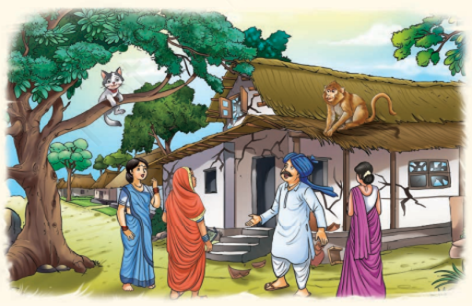
Ans. The monkey has ransacked the house by breaking window panes and clay pots. The neighbours have gathered on hearing noises and are figuring out how to get rid of the menacing monkey.
Let us discuss
I Complete the following sentences with suitable reasons. One example has been done for you. Share your answers with your classmates and teacher.
1. Shiv Datt said, “I believe it has been over a week, perhaps even longer,” because it had been a long time since they left the village.
2. Dev Datt said, “Indeed, we ought to be united in this hope. That is why we press on towards Ujjain,” because __________________________.
3. Har Datt said, “Look there, friends. A camel has passed this way. The tracks are fresh,” because ___________________________.
4. Shiv Datt said, “It appears to be a merchant, running as if pursued by trouble,” because ___________________________.
5. The merchant said, “How could you possibly know that? The poor creature has been unwell for two weeks now. Surely you are a healer!”
because ___________________________.
6. Dev Datt said, “You are free to do as you wish, sir. If the King desires our presence, we shall be waiting under that banyan tree yonder,” because ___________________________.
Ans.
2. They were going to Ujjain, hopeful of meeting the king who would recognize their talent and give them suitable job.
3. He saw the footprints of a camel.
4. A merchant was panting and running towards them.
5. Dev Datt had inquired if the camel had been suffering from stomach pain.
6. The merchant had accused them for stealing and selling his camel.
Let us discuss
I Arrange the following events in order of their occurrence from Scene II of the play. One example has been done for you. Share your answers with your classmates and teacher.
1. The King makes the four young men his advisers, impressed by their skills. (8)
2. Ram Datt explains how he infers from the tracks that the camel is lame.
3. The King asks the merchant to clearly state his accusation.
4. The King praises the young men for their observations and dismisses the merchant’s accusation.
5. Shiv Datt reveals that the camel is blind in its right eye as it had only chewed on the leaves on the left side of the road.
6. Dev Datt explains his observation about the camel’s pain and careful movement.
7. Har Datt clarifies how he knew that the camel has a short tail.
8. The merchant accuses the four men of knowing a lot about his missing camel.
Ans.
1. The King makes the four young men his advisers, impressed by their skills. (8)
2. Ram Datt explains how he infers from the tracks that the camel is lame. (3)
3. The King asks the merchant to clearly state his accusation. (2)
4. The King praises the young men for their observations and dismisses the merchant’s accusation. (7)
5. Shiv Datt reveals that the camel is blind in its right eye as it had only chewed on the leaves on the left side of the road. (4)
6. Dev Datt explains his observation about the camel’s pain and careful movement. (6)
7. Har Datt clarifies how he knew that the camel has a short tail. (5)
8. The merchant accuses the four men of knowing a lot about his missing camel. (1)
Let us think and reflect
I Read the given extracts and answer the questions that follow.
1. Dev Datt: Ten days are but a short span in the grand scheme of things.
We may still have many more roads to wander before we find employment befitting all four of us.
Ram Datt: If only we could secure an audience with the King of Ujjain.
I am confident he would recognise our talents and appoint us to his service.
Shiv Datt: I share your belief.
Dev Datt: Indeed, we ought to be united in this hope. That is why we press on towards Ujjain.
Har Datt: (Pausing thoughtfully) Gaining an audience with the King is no simple task. We need to devise a strategy.
(i) Identify the false statement from the two given below and rectify it.
A. Dev Datt believes that finding employment is an easy task.
B. Ram Datt is confident that the King would recognise their talents.
Ans. Statement A is false. Dev Datt says that they might have to wander many more roads before they get suitable work.
(ii) What does Ram Datt’s confidence in gaining the King’s recognition tell us about him?
Ans. It shows his positive outlook.
(iii) Complete the sentence given below with the correct option from those given.
In the line, ‘That’s why we press on towards Ujjain’, the phrase ‘press on’ refers to __________.
A. walking with heavy steps
B. moving forward with determination
C. slowing down frequently for rest
D. stopping briefly to save time
Ans. B. moving forward with determination
(iv) Har Datt says, “We need to devise a strategy.” What can be inferred about Har Datt’s character from his statement?
A. He is doubtful of their abilities and wants to give up.
B. He is eager to rush into the palace without preparation.
C. He is cautious and thoughtful, preferring to plan ahead.
D. He relies on others to make decisions for the group.
Ans. C. He is cautious and thoughtful, preferring to plan ahead.
2. King: (To the four men) You have demonstrated remarkable intelligence and the ability to see beyond the obvious. Such minds are rare and highly valued in my court. I extend to you the honour of becoming my advisers. Your counsel shall guide my decisions, and your wisdom shall be a beacon for my kingdom. What do you say to my offer?
Ram Datt: (Stepping forward) Your Highness, it is an honour we had not dared to dream of.
(i) Select the option that is true for both Assertion (A) and Reason (R).
(A): The Merchant left the court feeling humbled and ashamed.
(R): The King commanded that the four wise men join his court.
A. Both (A) and (R) are true, and (R) is the correct explanation of (A).
B. Both (A) and (R) are true, but (R) is not the correct explanation of (A).
C. (A) is true, but (R) is false.
D. (A) is false, but (R)
Ans. B. Both (A) and (R) are true, but (R) is not the correct explanation of (A).
(ii) Complete the following sentence by choosing the correct option. The line, ‘See beyond the obvious’ means that the men had the ability to ______.
A. challenge common beliefs with reasoning
B. interpret information in traditional ways
C. notice details that others might overlook
D. predict what is going to happen in the future
Ans. C. notice details that others might overlook
(iii) Complete the following sentence with a suitable reason.
Ram Datt described the King’s offer as ‘an honour we had not dared to dream of’ because ___________.
Ans. they had not thought that the king would himself offer them to be his royal advisors.
(iv) How does the King’s offer to the four men reflect his values as a ruler?
Ans. The king’s offer shows that he values wise men and so, he himself offers the four wise men to be his royal advisors who would bring prosperity in his kingdom.
II Answer the following questions.
1. What does the dusty road leading to Ujjain tell us about the challenges of the young men’s journey?
Ans. The young men have to walk on the dusty road for several days before they reach the destination.
2. Why did the merchant become suspicious of the four men? What does this tell us about him?
Ans. The four men gave accurate information about the camel that made the merchant suspicious. He could not accept that they had not seen the camel. This shows that the merchant is a suspicious man who does not believe the men’s claim that they had not seen the camel.
3. How do the four young men’s observations about the camel serve as a turning point in the play?
Ans. Their observations about the camel made the merchant suspicious. Thus, he took them to the king, accusing them of stealing and selling his camel. There the king identified their wisdom and thus, their life changed.
4. Why did the King believe the four young men and not the merchant?
Ans. The four men gave logical reasons for their observations. Thus, the king believed them.
5. How does the capability of the four young men make them suitable to become advisors?
Ans. The men are wise and have deep observation skills which makes them suitable for being advisors to the king.
6. Why does the merchant feel ashamed for accusing the four young men of stealing his camel? Explain in your own words.
Ans. He is ashamed because the king scolds him for accusing wise men.
Wisdom Paves the Way Grammar Exercises
Let us learn
I Complete the sentences by filling in the noun form of the textual words given in the brackets.
1. Some word games need a lot of thought and _________________. (deduce)
2. We need to make close _________________of animals in order to understand their behaviour. (observe)
3. A detailed _________________ of the documents shows a lot of errors. (scrutinise)
4. You should not make any false _________________against anyone. (accuse)
5. She was given an award in _________________of her contribution to literature. (recognise)
Ans.
1. deduction
2. observation
3. scrutiny
4. accusation
5. recognition
II Match the expressions in Column 1 with their meanings in Column 2.
| Column 1 | Column 2 |
| 1. with all our hearts | (i) surprised |
| 2. to be precise | (ii) starts cheering together |
| 3. gain an audience with | (iii) hidden information that is not obvious |
| 4. catch his breath | (iv) exact and accurate |
| 5. erupts in applause | (v) meeting or hearing someone |
| 6. grand scheme of things | (vi) complete sincerity |
| 7. taken aback | (vii) to pause or rest for some time |
| 8. more than meets the eye | (viii)overall plan of life in a larger context |
Ans.
| Column 1 | Column 2 |
| 1. with all our hearts | (vi) complete sincerity |
| 2. to be precise | (iv) exact and accurate |
| 3. gain an audience with | (v) meeting or hearing someone |
| 4. catch his breath | (vii) to pause or rest for some time |
| 5. erupts in applause | (ii) starts cheering together |
| 6. grand scheme of things | (viii) overall plan of life in a larger context |
| 7. taken aback | (i) surprised |
| 8. more than meets the eye | (iii) hidden information that is not obvious |
Now, make sentences using any five of the expressions from Column 1.
Ans.
1. I was taken aback to see that someone had taken my lunchbox.
2. The parents could not deposit the fee and came to gain an audience with the principal.
3. We tried with all our hearts to convince her not to go.
4. Rahul paused to catch his breath before asking me if I had made tea for him.
5. As Rohan scored another goal, the audience erupted in an applause.
III Match the different meanings of ‘face’ and ‘bear’ with the correct usage in the sentences given in the table below. (n. stands for the word noun and v. stands for the word verb.)
| Words | Meanings | Sentences |
| face | 1. (n.) the front part of a person’s head from the forehead to the chin | (i) Ravi turned to face his father, when he was called. |
| 2. (v.) to be positioned with the face or front towards | (ii) The face of the clock was painted red and blue. | |
| 3. (v.) to deal with a difficult task or situation | (iii) She has a round, smiling face. | |
| 4. (n.) the front or surface of a thing | (iv) We should be ready to face life’s challenges. | |
| bear | 1. (v.) tolerate | (i) The trees that I planted in my garden took a long time to bear fruit. |
| 2. (v.) accept | (ii) I spotted a bear on a wildlife safari. | |
| 3. (n.) a large heavy mammal | (iii) Riya agreed to bear the responsibilities with confidence. | |
| 4. (v.) produce; give birth to | (iv) I can’t bear the sound of vehicles honking. | |
Ans.
| Words | Meanings | Sentences |
| face | 1. (n.) the front part of a person’s head from the forehead to the chin | (iii) She has a round, smiling face. |
| 2. (v.) to be positioned with the face or front towards | (i) Ravi turned to face his father, when he was called. | |
| 3. (v.) to deal with a difficult task or situation | (iv) We should be ready to face life’s challenges | |
| 4. (n.) the front or surface of a thing | (ii) The face of the clock was painted red and blue.. | |
| bear | 1. (v.) tolerate | (iv) I can’t bear the sound of vehicles honking. |
| 2. (v.) accept | (iii) Riya agreed to bear the responsibilities with confidence. | |
| 3. (n.) a large heavy mammal | (ii) I spotted a bear on a wildlife safari. | |
| 4. (v.) produce; give birth to | (i) The trees that I planted in my garden took a long time to bear fruit. | |
IV Match the highlighted words in the sentences in Column 1 with the functions they express in Column 2.
| Column 1 | Column 2 |
| 1. I will gladly pay your fee if you can cure it. | (i) expression of disbelief |
| 2. You must have stolen it and sold it off. | (ii) imagined (hypothetical) possibility |
| 3. You shall come with me to face the King! | (iii) moral obligation or advice |
| 4. How could you possibly know that? | (iv) challenge |
| 5. I am confident he would recognise our talents and appoint us to his service. | (v) logical conclusion |
| 6. A camel with a long tail would have fended off these pests with ease | (vi) wish or hope |
| 7. They may tell us more than meets the eye. | (vii) necessity |
| 8. May your wisdom shine upon Ujjain and guide us to prosperity. | (viii) prediction |
| 9. Indeed, we ought to be united in this hope. | (ix) willingness |
| 10. We need to devise a strategy. | (x) command |
| 11. You speak of my camel as if it stood before you, yet you dare to claim not to have seen it! | (xi) possibility |
Ans.
| Column 1 | Column 2 |
| 1. I will gladly pay your fee if you can cure it. | (ix) willingness |
| 2. You must have stolen it and sold it off. | (viii) prediction |
| 3. You shall come with me to face the King! | (x) command |
| 4. How could you possibly know that? | (i) expression of disbelief |
| 5. I am confident he would recognise our talents and appoint us to his service. | (ii) imagined (hypothetical) possibility |
| 6. A camel with a long tail would have fended off these pests with ease | (v) logical conclusion |
| 7. They may tell us more than meets the eye. | (xi) possibility |
| 8. May your wisdom shine upon Ujjain and guide us to prosperity. | (vi) wish or hope |
| 9. Indeed, we ought to be united in this hope. | (iii) moral obligation or advice |
| 10. We need to devise a strategy. | (vii) necessity |
| 11. You speak of my camel as if it stood before you, yet you dare to claim not to have seen it! | (iv) challenge |
V Complete the following story with modal verbs in the box given below by using the clues from the functions given within brackets.
| may | must | should | can |
| might | could | need to |
An old man, known for his wisdom, lived in a small village. One day, a young boy asked him, “How 1. _______ (ability) I become wise like you?” The old man smiled and said, “Wisdom 2._______ (necessity) be earned through patience. You 3. _______ (suggestion) listen, more than you speak.” The boy thought for a while and replied, “It 4. _______ (weak possibility) take years, but I’ll try.” The old man nodded. “You 5._______ (obligation) learn from your mistakes too. Wisdom 6. _______ (possibility) come slowly, but it always arrives for those who seek it.” The boy knew he 7. _______ (ability) become wise if he followed the old man’s advice.
Ans.
An old man, known for his wisdom, lived in a small village. One day, a young boy asked him, “How 1. can (ability) I become wise like you?” The old man smiled and said, “Wisdom 2. Needs to (necessity) be earned through patience. You 3. should (suggestion) listen, more than you speak.” The boy thought for a while and replied, “It 4. might (weak possibility) take years, but I’ll try.” The old man nodded. “You 5. must (obligation) learn from your mistakes too. Wisdom 6. may (possibility) come slowly, but it always arrives for those who seek it.” The boy knew he 7. could (ability) become wise if he followed the old man’s advice.
VI Rewrite the following sentences using appropriate modal verbs. You may take clues from the highlighted words. One example has been done for you.
1. It is advisable for you to think before you speak.
Ans. You should think before you speak.
2. It is unnecessary to worry about things beyond your control.
Ans. You must not worry about things beyond your control.
3. It is not possible for a person to gain experience without taking risks.
Ans. One may not gain experience without taking risks.
4. It is essential to treat others with kindness, even when they disagree with you.
Ans. One ought to treat others with kindness, even when they disagree with you.
5. It is not allowed to interrupt when someone else is speaking.
Ans. One cannot interrupt when someone else is speaking.
Let us listen
I You will listen to four people sharing their thoughts on why they enjoy witty characters in stories. As you listen, match statements 1–6 given below to the speakers (i)–(iv). There are two statements you do not need. (Transcript for teacher on page 48)
| Statements | Speaker No. |
| 1. Witty characters prove that cleverness is as powerful as strength. | |
| 2. Witty characters show us ways to make learning enjoyable. | |
| 3. Witty characters in a story keep the reader involved. | |
| 4. Witty characters teach me that tricky situations can be managed calmly. | |
| 5. Witty characters add excitement to a story by their extraordinary deeds. | |
| 6. Witty characters can deactivate tense situations with their cleverness. |
Ans.
| Statements | Speaker No. |
| 1. Witty characters prove that cleverness is as powerful as strength. | |
| 2. Witty characters show us ways to make learning enjoyable. | |
| 3. Witty characters in a story keep the reader involved. | iv |
| 4. Witty characters teach me that tricky situations can be managed calmly. | iii |
| 5. Witty characters add excitement to a story by their extraordinary deeds. | ii |
| 6.Witty characters can deactivate tense situations with their cleverness. | i |
Let us write
I You have observed that the kutcha road leading to your colony is in a very bad condition due to heavy rains. The potholes are dangerous for people and can lead to accidents. They also serve as a breeding ground for mosquitoes as there is stagnant water all around.
Write a letter of complaint to the Commissioner, Municipal Corporation or the Sarpanch, Gram Panchayat to look into the matter and take necessary action.
Follow the format of a formal letter and draft the letter with the help of cues given below.
| Body of the Letter | Useful Phrases |
| Paragraph 1: state the purpose of writing and the issue | • I would like to bring to your attention…
• I am writing to draw your attention towards… |
| Paragraph 2: give details and consequences of the problem | • The problems that we face are…
• … is causing inconvenience as… • As a result… • Consequently….. |
| Paragraph 3: give suggestions and request for swift action | • Firstly, I would like to suggest…Secondly…
• I request you to look into this matter and… • I look forward to your prompt response… |
Ans.
The Commissioner
Municipal Corporation
Panchkula
Dated: 25 August 2025
Subject: Bad condition of roads
Sir
I am Naveen / Nisha, a resident of Janta Colony. I am writing to you to complain regarding the bad condition of the katcha road leading to our colony due to the heavy rains.
Since the last two months, the road has developed deadly potholes, which have injured many bikers. Travelling on the path has become a nightmare. Many service providers like the milkman have stopped coming to the colony because of the poor condition of the katcha road. The residents are facing a tough time.
I request you to get the road repaired at the earliest.
Yours Sincerely
Naveen / Nisha
CBSE Class 8 English Unit 1 Chapter 3 Wisdom Paves the Way Extract-Based Questions
A.
Ram Datt: Is your camel lame in one leg, by any chance?
Merchant: (Surprised) Yes, yes, it is!
Shiv Datt: Is it blind in the right eye?
Merchant: Precisely! It is blind in one eye—the right one, as you say.
Har Datt: And does it have a short tail?
Merchant: (Astonished) You describe it perfectly! Yes, it has a short tail.
Dev Datt: Tell me, sir, has it not been suffering from a pain in the stomach?
Merchant: (Taken aback) How could you possibly know that?
The poor creature has been unwell for two weeks now. Surely you are a healer! I will gladly pay your fee if you can cure it. But tell me, where is my camel?
Q1. Whose camel is lost?
Ans. The merchant’s camel is lost.
Q2. Who asks if the camel is lame?
Ans. Ram Datt
Q3. The camel is blind from the _____ eye.
Ans. right
Q4. The camel has a ____ tail
Ans. short
Q5. Who says that the camel was perhaps suffering from pain in the stomach?
Ans. Dev Datt
B.
Ram Datt: If only we could secure an audience with the King of Ujjain. I am confident he would recognise our talents and appoint us to his service.
Shiv Datt: I share your belief.
Dev Datt: Indeed, we ought to be united in this hope. That is why we press on towards Ujjain.
Har Datt: (Pausing thoughtfully) Gaining an audience with the King is no simple task. We need to devise a strategy.
Dev Datt: Let us reach the city gates first. We can deliberate once we are closer.
(As they walk, Ram Datt notices something on the ground.)
Shiv Datt: Look there, friends. A camel has passed this way. The tracks are fresh.
Ram Datt: (Studying the tracks) Yes, let us observe them as we continue. They may tell us more than meets the eye.
(The four men continue walking, occasionally stopping to examine the camel’s tracks. They scrutinise every detail, exchanging glances but saying little.)
Q1. The four men desire an audience with the king of _____
Ans. Ujjain
Q2. Press on means ______
Ans. to move towards the destination with determination
Q3. Har Datt feels that gaining audience with the king is an easy task. (true / false)
Ans. False
Q4. Who suggests that they reach the city gates first?
Ans. Dev Datt suggests that they should reach the city gates first.
Q5. What does Ram Datt mean when he says – “They may tell us more than meets the eye”?
Ans. He means that on care ful look, the tracks may give them more details about the camel than were seen on the face.
C.
Ram Datt: A merchant indeed, and judging by his countenance, he has lost something of great value—perhaps his camel.
(The Merchant, panting and distressed, reaches the group. He pauses to catch his breath, then addresses them anxiously.)
Merchant: (Breathlessly) Good day, kind sirs.
All Four: Good day, brother.
Merchant: I seek your help. My camel has gone astray. Have you, by chance, seen it?
Ram Datt: Is your camel lame in one leg, by any chance?
Merchant: (Surprised) Yes, yes, it is!
Shiv Datt: Is it blind in the right eye?
Merchant: Precisely! It is blind in one eye—the right one, as you say.
Har Datt: And does it have a short tail?
Merchant: (Astonished) You describe it perfectly! Yes, it has a short tail.
Dev Datt: Tell me, sir, has it not been suffering from a pain in the stomach?
Merchant: (Taken aback) How could you possibly know that?
The poor creature has been unwell for two weeks now. Surely you are a healer! I will gladly pay your fee if you can cure it. But tell me, where is my camel?
Q1. What did Ram Datt deduce about the camel?
Ans. Ram Dutt noticed that one of the camel’s legs was lame.
Q2. What did Shiv Datt deduce about the camel?
Ans. Shiv Datt noticed that the camel was blind in the right eye.
Q3. What did Har Datt deduce about the camel?
Ans. Har Datt deduced that the camel had a short tail.
Q4. What did Dev Datt deduce about the camel?
Ans. Dev Datt deduced that the camel had pain in the stomach.
Q5. How does the emotions of the merchant change with each revelation?
Ans. The merchant was first anxious in his search. He became surprised, then astonished, and then completely shocked by each thing the brothers said.
D.
(The Merchant, chastened and embarrassed, bows deeply and exits, his face red with shame.)
King: (To the four men) You have demonstrated remarkable intelligence and the ability to see beyond the obvious. Such minds are rare and highly valued in my court. I extend to you the honour of becoming my advisers. Your counsel shall guide my decisions, and your wisdom shall be a beacon for my kingdom. What do you say to my offer?
Ram Datt: (Stepping forward) Your Highness, it is an honour we had not dared to dream of.
Shiv Datt: We are humbled and deeply grateful for your trust in our abilities.
Har Datt: To serve a wise and just ruler like yourself is a privilege we accept with all our hearts.
Dev Datt: We shall dedicate ourselves to your service, offering our insights and counsel in all matters you see fit.
Q1. Why was the merchant embarrassed?
Ans. The merchant felt embarrassed because he had wrongly misjudged the four brothers. He had called them thieves without knowing the whole context, which got him scolded by the King.
Q2. What did the King offer to the four men?
Ans. The King offered the four men the opportunity to become a part of his counsel.
Q3. Did the four men accept or deny the offer?
Ans. The four brothers accepted the offer to become a part of the King’s counsel.
Q4. How can wisdom become a beacon for a kingdom?
Ans. Wisdom gives people the ability to perceive and understand every aspect of a situation and to come up with advice and solutions that can simplify a complex situation. Therefore, wisdom can give a King the insight needed to protect and develop his kingdom.
Q5. According to the King, what ability did the four men have?
Ans. According to the King, the four men have the ability to see beyond the obvious.
Class 8 Wisdom Paves the Way Multiple Choice Questions
Q1. The four men were going towards _______
A. Benaras
B. Lucknow
C. Ujjain
D. none of these
Ans. C. Ujjain
Q2. The four men were out of their village since the last ____ days.
A. 15
B. 10
C. 5
D. 0
Ans. B. 10
Q3. They were going to the city _____________
A. in search of accomodation
B. in search of work
C. in search of a missing friend
D. in search of better life
Ans. B. in search of work
Q4. They saw the ____ of a camel.
A. tail
B. hump
C. tracks
D. herd
Ans. C. tracks
Q5. Who out of the following is NOT one of the four men?
A. Shiv Datt
B. Ram Datt
C. Dev Datt
D. Mann Datt
Ans. D. Mann Datt
Q6. Who observes that the camel has a short tail?
A. Shiv Datt
B. Ram Datt
C. Dev Datt
D. Har Datt
Ans. D. Har Datt
Q7. What clue leads to the deduction about the camel’s short tail?
A. droplets of saliva
B. droplets of blood
C. chopped tail
D. none of these
Ans. B. droplets of blood
Q8. Who discovered that the camel was blind from one eye?
A. Shiv Datt
B. Ram Datt
C. Dev Datt
D. Har Datt
Ans. A. Shiv Datt
Q9. Who discovered that the camel was lame?
A. Shiv Datt
B. Ram Datt
C. Dev Datt
D. Har Datt
Ans. B. Ram Datt
Q10. What observation led Ram Datt to conclude that the camel was lame?
A. foot impressions
B. tracks were not in straight line
C. the faint noise of the camel
D. none of these
Ans. A. foot impressions
Q11. What observation helped to deduce that the camel was blind?
A. injury marks on tree
B. uneaten leaves on right side of the road
C. used eye mask was fallen on the road
D. none of these
Ans. B. uneaten leaves on right side of the road
Q12. Who came looking for the camel?
A. a camel dealer
B. a merchant
C. a sepoy
D. the king’s guard
Ans. B. a merchant
Q13. Why did the merchant accuse the men of selling his camel?
A. They knew so many details about the camel
B. they had a lot of money
C. they confessed to having sold it
D. all of these
Ans. A. They knew so many details about the camel
Q14. What did the men claim?
A. They did not sell the camel
B. The had not seen the camel
C. They only saw the camel’s photo
D. They had dreamt of the camel
Ans. B. The had not seen the camel
Q15. What was the king’s judgement?
A. That the men were cheat
B. That the men were wise and intelligent
C. That the men had stolen and sold the camel
D. That the men were fooling the merchant
Ans. B. That the men were wise and intelligent
Q16. What did the king do with the men?
A. sentenced them with a penalty
B. put them in jail
C. offered them a position as royal advisors
D. none of these
Ans. C. offered them a position as royal advisors
Q17. What did the king do with the merchant?
A. he sympathised with him
B. he scolded him
C. he punished him
D. he penalised him
Ans. B. he scolded him
Q18. What did Dev Datt predict?
A. Camel was lame
B. camel was blind
C. camel had a short tail
D. camel suffered from stomach pain
Ans. D. camel suffered from stomach pain
Q19. What had happened with the camel?
A. it died
B. it went astray
C. it was stolen
D. it went mad
Ans. B. it went astray
Q20. What can be inferred about the king?
A. He was intelligent
B. He was foolish
C. He was impressionable
D. He was hard working
Ans. A. He was intelligent
CBSE Class 8 English Poorvi Book Unit 1 – Wit And Wisdom Chapter 3 – Wisdom Paves the Way Extra Question and Answers
Answer the following questions-
Q1. If they had not seen the camel, then how did the four men share so many accurate observations about it?
Ans. They analysed the tracks left by the camel and the places visited by it to determine it’s condition.
Q2. Why were the men not afraid of visiting the king?
Ans. The four men were sure that they had not sold the camel. They had not even seen it. So, they were not afraid to visit the king.
Q3. How were the men rightly rewarded?
Ans. The men had left for Ujjain in their search for appropriate work. When the king recognised their talent and offered them the position of royal advisors, they were rightly awarded.
Q4. What can be said about the king of Ujjain?
Ans. The king was a young and intelligent man. He could understand the righteousness of the four men. He even accepted their keen observation skills and rewarded them suitably.
Q5. Can we say that the merchant was right in his way?
Ans. Yes, the merchant was right. When the four men made accuarte observations about the camel, it was right for him to think that they had seen his camel. However, his accusation that they sold the camel was far-fetched and lacked any evidence.
Q6. How did the king react toward the merchant after hearing the four men’s explanation?
Ans: The king was convinced by the young men’s well-reasoned explanations, so he dismissed the merchant’s accusation and reprimanded him for making a baseless claim — the merchant then left the court feeling embarrassed about how he’d misjudged them.