
CBSE Class 8 English Unit 4 Environment Chapter 3 Waiting for the Rain Important Question Answers from Poorvi Book
Class 8 English Waiting for the Rain Question Answers – Looking for questions and answers for CBSE Class 8 English Unit 4 Environment Chapter 3 Waiting for the Rain? Look no further! Our comprehensive compilation of important questions will help you brush up on your subject knowledge. Practising Class 8 English question answers can significantly improve your performance in the exam. Improve your chances of scoring high marks by exploring Unit 4 Environment Chapter 3 Waiting for the Rain Tree now. The questions listed below are based on the latest CBSE exam pattern, wherein we have given NCERT solutions to the chapter’s extract-based questions, multiple choice questions and Extra Question Answers
Also, practising with different kinds of questions can help students learn new ways to solve problems that they may not have seen before. This can ultimately lead to a deeper understanding of the subject matter and better performance on exams.
- Waiting for the Rain NCERT Solutions
- Waiting for the Rain Grammar Exercises
- Waiting for the Rain Extract Based Questions
- Waiting for the Rain Multiple Choice Questions
- Waiting for the Rain Extra Question Answers
Related:
- Waiting for the Rain Summary, Explanation
- Waiting for the Rain Character Sketch
- Class 8 English Poorvi Book Lesson Notes
Waiting for the Rain Textbook Questions (NCERT Solutions)
Let us do these activities before we read.
I. Have you ever waited for the rains? Why?
II. How do you feel when it rains after a long time?
III. Why do you think the farmers wait for the rains?
IV. Discuss in groups what happens when you wait for something or someone for a long period of time.
1. How do you spend the waiting period?
2. What do you think about?
3. How do you feel?
Share your answers with your classmates and teacher.
Ans.
I. Yes, I waited for the rains so that I could make paper boats and let them drift in the streams of rainwater.
II. I like the rain and enjoy the fragrance of the wet earth when it rains after a long time.
III. Farmers want to wet the soil before they can plough it. So, they need rains for it.
IV. We get anxious and desperate when we wait for a long period of time.
1. We look at the window again and again.
2. I think about the well being of the person for whom I am waiting.
3. I feel anxious and curious.
Let us discuss
I Complete the table given below. One example has been done for you. Share your answers with your classmates and teacher.
| What was Said | Who Said | What was Said | Who Said |
| 1. It doesn’t look encouraging. | Velu | to himself | He looked up at the sky. |
| 2. The rains came all these years without any such consultations… | Velu | ||
| 3. So many favourable conditions but still no rain. |
Ans.
| What was Said | Who Said | What was Said | Who Said |
| 1. It doesn’t look encouraging. | Velu | to himself | He looked up at the sky. |
| 2. The rains came all these years without any such consultations… | Velu | To his companions | I can’t see how talking to astrologers will bring rain |
| 3. So many favourable conditions but still no rain. | officials | To Velu | Very odd |
II Do you think the old woman would help Velu? If yes, why? If no, why not?
Ans. the old woman helped Velu by informing him to be patient as the earth was taking rest.
III Will Velu’s wait continue or will it rain?
Ans. After a breab, it will rain.
Let us discuss
I Complete the following statements given below with suitable reasons.
1. Velu asked the old woman to stop smiling because _________________.
2. Velu said that it was hard not being able to work since _________________.
3. Velu was confused when the old lady said that the land needed rest because _________________.
4. The old lady said that it was good for the land when it didn’t rain as _________________.
5. Velu ran home laughing and happy because _________________.
Ans.
1. There were no rains
2. It hadn’t rained.
3. It had been working continuously for several thousand years.
4. It could remain idle and take rest.
5. It had started to rain.
Let us think and reflect
I Read the given extracts and answer the questions that follow.
1. “…I can’t see how talking to astrologers will bring rain.”
He decided to go to the weather office in the city and talk to someone. But the people at the weather office said they couldn’t really tell him when the sky would gather clouds and bring rain. “We are at a loss ourselves!” they exclaimed. “So many favourable conditions but still no rain. Very odd!”
(i) What does the first line of the extract tell us about Velu’s beliefs?
Ans. Velu is practical and does not believe in superstitions.
(ii) Complete the following sentence with a suitable reason.
Velu is determined to seek information about the rain because ___________________. (he was at a loss of words/he wants to find a practical solution to the drought affecting his farm)
Ans. he wants to find a practical solution to the drought affecting his farm
(iii) Complete the table with reference to Velu’s weather office visit.
| Expectation (What I think will happen) | Outcome (What actually happened) |
Ans.
| Expectation (What I think will happen) | Outcome (What actually happened) |
| Get information about the rain | No clue was given about the rain |
(iv) Complete the following sentence with a suitable option.
The absence of rain despite favourable conditions, shows ___________________.
A. lack of astrological knowledge
B. ineffectiveness of farmers like Velu
C. delay in understanding the weather
D. unpredictability of nature
Ans. D. unpredictability of nature
2. “The soil, the land, the earth… shouldn’t someone let the land rest a bit?” the old woman said, softly, smiling.
“Rest? Let the land rest? I don’t understand,” Velu looked at her, a little puzzled.
“Yes, my son, that is the difficulty. You don’t realise that the earth is old…”
(i) The old woman’s advice was accompanied with a soft tone and a smile. What does that tell us about her?
Ans. She is patient and has a positive attitude.
(ii) Fill in the blank with the correct option from those given below.
The old woman’s advice ___________ Velu, at that moment.
A. failed to impress
B. confused
C. scared
D. made sense to
Ans. B. confused
(iii) State one thing about the old woman when she referred to Velu as ‘my son’, while offering advice.
Ans. The old woman is mature and loving.
(iv) Complete the following sentence with a suitable explanation.
The ‘difficulty’ that the old woman mentions is due to the fact that ________________.
Ans. Velu didn’t understand that the earth also needed rest.
II Answer the following questions.
1. How does the old woman convey Nature’s wisdom to Velu?
Ans. She tells Velu that the nature is intelligent and by not sending rain, it is allowing the earth to take rest.
2. The writer says, ‘The fields lay untended…’ Why couldn’t the farmers tend to their fields in the absence of rain?
Ans. They needed the rainwater to wet the soil so that it could be tilled.
3. Support the old woman’s perspective that the land needs rest just like people do.
Ans. The land is a living being and like humans, it too needs rest after working continuously for so many years.
4. What can be inferred about Velu’s character based on his reaction to the drought?
Ans. Velu is sincere and committed to his work. He is honest and his family depends on his work. So, he is in panic at the failure of rains.
5. What does the story suggest about the life of farmers and their relationship with nature?
Ans. The life of farmers depends on nature and nature is unpredictable.
6. How might the rest and care of land contribute to a balanced and sustainable ecosystem?
Ans. By taking rest, land gets rejuvenated and can give a better yield when put to use next.
Waiting for the Rain Grammar Exercises
Let us learn
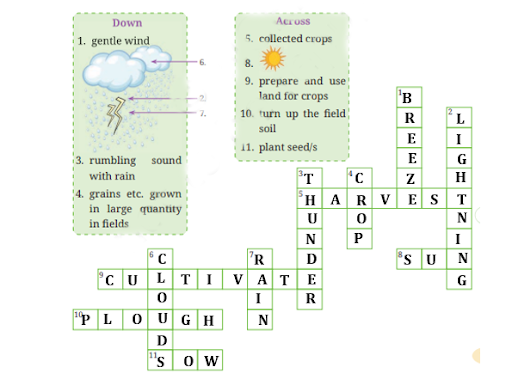
I. Solve a crossword using picture and word clues. All clues are related to the words from the text that are connected to weather or agriculture.
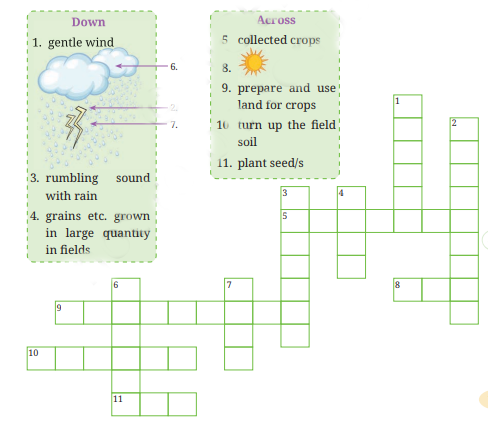
Ans.
II The text uses words like ‘piece,’ ‘weather,’ ‘son,’ and ‘rain’. These words are the same as other words that are spelt differently—peace, whether, sun, and reign.
Words that are pronounced the same as other words but differ in meaning or in spelling are called homophones.
Now, complete the paragraph by filling in the correct option of homophones given in the brackets.
The farmer looked at the sky and wondered 1. ________________ (weather/whether) the clouds would finally bring rain. He sat down on the ground, breaking a small 2. ________________ (piece/peace) of roti for his meal. The 3. ________________ (plain/plane) fields stretched endlessly before him, completely dry. He thought about how he could 4. ________________ (sell/cell) his last sack of grain to buy some essentials for his family. Without the rains, it didn’t 5. ________________ (seam/seem) possible to grow another crop this season. Despite his worries, he smiled, knowing that every farmer hopes for the next 6. ________________ (rain/reign) by nature to bring life back to the land.
Ans.
1. Whether
2. Piece
3. Plain
4. Sell
5. Seem
6. Rain
III Choose the correct meanings from the given options for the underlined words or phrases in the following sentences.
1. Being annoyed, she muttered something which nobody heard.
(i) spoke in a low voice
(ii) spoke slowly
(iii) spoke angrily
Ans. (i) spoke in a low voice
2. At the new work place, Riya felt forlorn for a week.
(i) upset and irritated
(ii) angry and bitter
(iii) sad and neglected
Ans. (iii) sad and neglected
3. When all his friends had gone, he was at a loss because he did not know what to do.
(i) confused
(ii) shocked
(iii) lonely
Ans. (iii) lonely
4. When the little child saw her father, her eyes sparkled.
(i) glowed dimly
(ii) showed joy
(iii) opened wide
Ans. (ii) showed joy
IV Match each word (adjective) in Column 1 with a word (noun) that collocates in Column 2. Write the adjective-noun collocation in Column 3. One example has been done for you.
| Column 1 | Column 2 | Column 3 |
| 1. favourable | (i) country | favourable weather |
| 2. wrinkled | (ii) activity | |
| 3. dejected | (iii) weather | |
| 4. fragrant | (iv) skin | |
| 5. ceaseless | (v) garden | |
| 6. beloved | (vi) expression |
Ans.
| Column 1 | Column 2 | Column 3 |
| 1. favourable | (iii) weather | favourable weather |
| 2. wrinkled | (iv) skin | Wrinkled skin |
| 3. dejected | (vi) expression | Dejected expression |
| 4. fragrant | (v) garden | Fragrant garden |
| 5. ceaseless | (ii) activity | Ceaseless activity |
| 6. beloved | (i) country | Beloved country |
V Underline the verbs and identify the forms of tenses for the following sentences from the text.
1. Oh, it is hard not to be able to work…
2. …I am too old.
3. What are you smiling at, Amma?
4. But my son, that is what I am talking about.
5. The earth has worked for years, centuries….
6. I have worked hard and honestly.
Ans.
1. Oh, it is hard not to be able to work… Simple present
2. …I am too old. Simple present
3. What are you smiling at, Amma? Present continuous
4. But my son, that is what I am talking about. Present continuous
5. The earth has worked for years, centuries…. Present perfect
6. I have worked hard and honestly. Present perfect
Now, fill in the blanks with the correct form of Simple Present, Present Progressive or Present Perfect tenses of the verbs given in brackets.
Ravi (i) __________ (be) a farmer who (ii) __________ (practise) crop rotation on his land. Each season, he (iii) __________ (plant) different crops to maintain the soil’s health. This year, he (iv) __________ (grow) legumes, which help restore the nutrients in the soil. Over the years, Ravi (v) __________ (learn) that planting the same crop repeatedly (vi) __________ (deplete) the soil, making it less fertile. By rotating crops, he (vii) __________ (keep) the land productive and fertile. He (viii) __________ (see) a noticeable improvement in his yields since adopting this method. Now, Ravi (ix) __________ (share) his knowledge with other farmers, explaining how crop rotation(x) __________ (benefit) both the soil and their harvests.
Ans.
(i) is
(ii) practises
(iii) plants
(iv) has grown
(v) has learned
(vi) depletes
(vii) keeps
(viii) has seen
(ix) shares
(x) benefits
VI Study the highlighted words in the following sentences from the text.
- The rains came all these years without any such consultations.
- So many favourable conditions, but still no rain.
- Every day they hoped that the rains would come.
- But this year turned out to be different.
- This is the first season in five, no, six years that I have not sown, nor ploughed.
- We ought to talk to some astrologers.
- I have only done what any hard-working farmer would do.
- Velu looked at her, a little puzzled.
- She takes care to give her children the rest they need…
- Velu felt a cool breeze on his back.
The highlighted words or phrases that come before a noun but do not describe them are called determiners.
Let us learn the use of some common determiners.
Articles: a, an, the
These are used to introduce nouns.
Demonstrative Determiners: this, that, these, those
These are used to point out specific items.
Possessive Determiners: my, our, your, his, her, its, their, one’s
These indicate ownership or relationship.
Definite Numeral Determiners: one, two, three, etc.
These specify exact quantities.
Indefinite Numeral Determiners: some, any, no, all, much, many, few, less, several, little and few
- ‘Some’ is used in affirmative sentences, while ‘any’ and ‘no’ are used in negative and interrogative sentences.
- ‘All’ refers to the entirety of a group.
- ‘Much’ and ‘many’ denote large quantities of uncountable and countable nouns, respectively.
- ‘Few’ indicates a small number, ‘less’ refers to a smaller quantity, and ‘several’ means more than two but not many.
- ‘Little’ means not much, ‘few’ means not many. Use ‘a little’ and ‘a few’ to convey a positive sense.
Distributive Determiners: each, every, either, neither
- ‘Each’ refers to individual items or people, ‘every’ refers to all items or people collectively.
- ‘Either’ means one of two options and ‘neither’ means not one of the two options.
Now, fill in the blanks by choosing the correct determiner from those given in the brackets.
It was 1. ________ (a/an) rainy afternoon, and 2. ________ (a/the) sky was thick with dark clouds. Mala noticed a large puddle quickly forming in front of 3. ________ (her/their) house. Excited, she called for her brother to join her, knowing that both of them always loved playing in 4. ________ (a/the) rain. While jumping from 5. ________ (some/one) puddle to another, Mala spotted 6. ________ (few/a few) snails slowly creeping along the wet sidewalk and pointed them out to her brother. With 7. ________ (each/every) jump, the sound of both 8. ________ (her/their) squeals and laughter was heard through the soft patter of raindrops. Though they were fully drenched 9. ________ (either/neither) siblings minded it. It had been a perfect rainy day.
Ans.
1. A
2. The
3. Her
4. The
5. One
6. Few
7. Every
8. Their
9. Neither
Let us listen
I Listen to the weather forecast. As you listen, fill in the blanks with the exact word you listen to. (Transcript for teacher on page 204)
1. Delhi will mostly have a ___________ sky with light rain.
2. Moderate rain is likely to happen in ___________.
3. Kolkata is likely to have a maximum temperature of around___________ °C.
4. There is a chance of a ___________ in Chennai.
5. Bengaluru will have a ___________ temperature of 29 °C.
6. Taking an ___________ is advisable because of the weather conditions.
Ans.
1. Cloudy
2. Mumbai
3. 34°C
4. Thunderstorm
5. Maximum
6. umbrella
Let us speak
I. Here is a tongue twister about ‘weather’. Practice saying it as fast as you can.
| Whether the weather be fine, or whether the weather be not, whether the weather be cold, or whether the weather be hot, we’ll weather the weather, whatever the weather, whether we like it or not. |
II. Rain has arrived after a long dry spell on the Earth. Imagine the Rain and the Earth have a conversation. Work in pairs and present the role-play.
You may use the hints in the table given below.
You may start the conversation in the following way.
Rain: Greetings, Earth! It’s been a while since we’ve met. How have you been?
Earth: Hello Rain! I am so glad to see you.
To continue the conversation, use the hints given below.
| Rain | Earth |
| Ask about how the Earth has been. | Respond and express relief at the arrival of Rain. |
| Speak about your long journey from the Earth to the sky and back again to the Earth. | Enquire why it took so long for Rain to arrive. |
| Express gratitude for the gift of water. | |
| Ask about how the Earth can use the gift you brought—rain water. | Speak about how important Rain is to you—for agriculture, for plants and animals to survive. |
| Elaborate how much you enjoy being on the Earth. | Enquire how Rain feels about being on Earth. |
| Thank the Earth for the invite. Promise to return on time the next year. | Invite Rain to join the celebration of the rivers, forests, and people of Earth. |
Ans.
Rain: Greetings, Earth! It’s been a while since we’ve met. How have you been?
Earth: Hello Rain! I am so glad to see you.
Rain: I have been going around my cycle which is a long journey.
Earth: I am thankful for your arrival but what took you so long to come?
Rain: The journey was long and tiring. How would you use the gift of water that I have got?
Earth: The water is precious for sustaining life. All plants, animals and crops need it.
Rain: Even I like falling on the thirsty earth and quenching its thirst.
Earth: I invite you to come again and enjoy the celebration of rain with the people on the earth.
Rain: Thanks! Surely, I will return.
Let us write
I. You have observed the difficulties faced by the people in your neighbourhood due to scarcity of water especially during the summer months. Write a letter to the Councillor of your Municipal ward, requesting her/him to set up a rain water harvesting unit. Provide suggestions to address the issue.
Remember to
• use formal language
• keep sentences short and to the point
• state the purpose clearly and concisely
• give relevant details
Format and Layout:
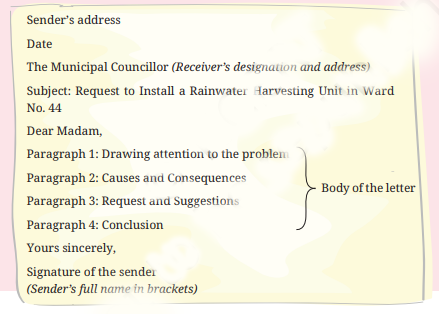
Ans.
143, JP Nagar
New Delhi
Date: 28 October 2025
The Municipal Councillor
MC Office
New Delhi – 110001
Subject: Request to install a rainwater harvesting unit in ward no. 44
Dear Madam,
I am Sundari, a resident of JP Nagar. I have observed the difficulties faced by the people in my neighbourhood due to scarcity of water especially during the summer months of May and June. The taps run dry due to no supply of water and the residents have to pay an exorbitant price for water tanker supply.
This is mainly due to the shortage of water with the authorities. The problem is so grim that residents are not able to get basics like drinking water and water for basic requirements.
My suggestion is to install water harvesting system in the locality so that the stored water can be out to tertiary use. Thus, there will be spare water available for the residents. Kindly get the required system in place to ease out the lives of the residents.
Yours Sincerely
Sundari Mehta
CBSE Class 8 English Unit 4 Environment Chapter 3 Waiting for the Rain Extract-Based Questions
A. “I hope it rains at least today,” Velu thought, as he opened his eyes.
Velu was a farmer. The sun was beginning to rise, glowing crimson like fire. Velu scanned the sky. There was not a cloud.
“It doesn’t look encouraging,” he muttered to himself and got up.
Rain or no rain, a farmer wakes up early. Velu worked hard. His piece of land never failed him. Season after season he cultivated it, harvesting jowar one season and dhal the next. Throughout the year he worked, never thinking of rest or taking a holiday. For nearly six years it had been so, ever since he had got his own piece of land.
Q1. Who is Velu?
Ans. Velu is a farmer.
Q2. Why did Velu hope that it should rain?
Ans. Perhaps the rain was needed for his crop’s growth. As he was dependent on the produce of the field, he desired a good harvest and so, he was eager that it rains.
Q3. The sun was beginning to rise, glowing crimson like fire means ________
Ans. that the Sun was shining bright and emitting a lot of heat.
Q4. What had changed since the last six years?
Ans. Since the last six years, Velu had owned a piece of land. Since that day he had worked throughout the year and never took rest or holiday.
Q5. What did Velu grow on his farm?
Ans. He grew grains like jowar and dhal.
B. But this year turned out to be different. At the end of summer, the rains didn’t come. Velu and his neighbours waited, but their waiting didn’t end. Days, weeks and months passed, and still there was no rain.
The fields lay untended, the earth hardened, crusted and cracked. The barren land looked forlorn and the farmers lived entirely on hope. Every day they hoped that the rains would come.
Q1. What was different that year?
Ans. That year, the rains did not come after the summer season ended.
Q2. What did Velu do?
Ans. He and other fellow farmers waited for the rain.
Q3. In the absence of rain the fields ____________ (became barren / were lush green with crop)
Ans. became barren
Q4. Forlorn means _______
Ans. sad and neglected
Q5. In the absence of rain, what solution did the farmers opt for?
Ans. The farmers had no other way out than to pray and hope for it to rain.
C. Someone said, “We ought to talk to some astrologers. They can tell us what will please the heavens and the heavens will send down rain.”
Velu didn’t agree. He said, “The rains came all these years without any such consultations; I can’t see how talking to astrologers will bring rain.”
He decided to go to the weather office in the city and talk to someone. But the people at the weather office said they couldn’t really tell him when the sky would gather clouds and bring rain. “We are at a loss ourselves!” they exclaimed. “So many favourable conditions but still no rain. Very odd!”
Velu, too, was at a loss. He walked back to the village, tired, and dejected. He was thirsty and the dust made him cough and sneeze. He decided to rest for a while.
Q1. Why did a person suggest to consult an astrologer?
Ans. He suggested that maybe an astrologer could guide them how to please the god in the heaven above who would then send rain.
Q2. What was Velu’s opinion?
Ans. Velu suggested to visit the weather office in the city and talk to someone there.
Q3. Did the officials at the weather office help?
Ans. No, they were not able to tell Velu when it would rain.
Q4. The weather officials were astonished that _____________
Ans. there were favourable conditions for rain but still it wasn’t raining.
Q5. Why did Velu decide to rest for a while?
Ans. After visiting the weather office in the city, he was tired and dejected. Thirst and dust made him cough and sneeze. So, he decided to rest.
D. Her skin was wrinkled, but her eyes sparkled when she smiled. She looked at Velu and her smile grew wider, her wrinkles deeper.
“What are you smiling at, Amma?” Velu asked. “Without the rains, there’s nothing to smile about.”
“Yes, yes, you’re right,” the old woman said, the smile leaving her lips.
“I wonder what I have done to deserve this,” Velu began. “I have worked hard and honestly. Yet I am being punished. Without the rains I can’t till the land. If I don’t till the land no crop will grow.
What will happen to me? How shall I feed my family?” he asked, somewhat bitterly. He wasn’t speaking to anyone in particular, but the old lady thought that he was opening his heart to her.
Q1. Who is Amma?
Ans. A stranger woman who was sitting under the tree where Velu sat to rest.
Q2. What did Velu ask her?
Ans. He asked her why she was smiling.
Q3. What was Velu’s complaint?
Ans. Velu complained that without rain, he could not till his land, and so, he would not get any crop. He would not be able to provide food for his family.
Q4. Did the old woman understand Velu’s problem?
Ans. Yes, she stopped smiling and shared Velu’s grief.
Q5. Velu sounded bitter. To whom could his bitterness be directed?
Ans. It hadn’t rained, and so, he could have been bitter at the rain gods in heaven above.
Class 8 Waiting for the Rain Multiple Choice Questions
Q1. Who is Velu?
A. a farmer
B. a labourer
C. a teacher
D. all of these
Ans. A. a farmer
Q2. The old woman is _______
A. Velu’s neighbour
B. a stranger
C. Velu’s mother
D. none of these
Ans. B. a stranger
Q3. Velu was sad because _____________
A. he had no land
B. there was no rain
C. he had no family
D. he didn’t work hard
Ans. B. there was no rain
Q4. Which of the following is a suggestion given by Velu’s acquaintances?
A. to do a havan
B. to consult an astrologer
C. to stop farming
D. to try drip irrigation
Ans. B. to consult an astrologer
Q5. Velu cultivated ______on his land.
A. paddy
B. wheat
C. jowar
D. beans
Ans. C. jowar
Q6. On his way back from the city, Velu decided to _________
A. visit the astrologer
B. sit and rest
C. run away
D. kill himself
Ans. B. sit and rest
Q7. After visiting the weather office, Velu felt _______
A. excited
B. satisfied
C. sad
D. hopeful
Ans. C. sad
Q8. Without the rain Velu could not ________
A. till his land
B. harvest the crop
C. swim
D. go for boating
Ans. A. till his land
Q9. The old woman was sitting _________
A. on a bench
B. under the tree
C. in a hut
D. on a horse
Ans. B. under the tree
Q10. Why was the old woman sitting there?
A. to shelter from the Sun
B. to shelter from the rain
C. she was cutting the grass there
D. she owned that piece of land
Ans. A. to shelter from the Sun
Q11. The old woman suggested that the land was _________
A. useless
B. taking rest
C. good
D. none of these
Ans. B. taking rest
Q12. Which of the following best describes the old woman?
A. wrinkled face, smiling, sparkly eyes
B. dull face, sad smile, blank eyes
C. wrinkled face, frowning, weeping eyes
D. bright face, dark skin, blind
Ans. A. wrinkled face, smiling, sparkly eyes
Q13. Due to lack of rain, Velu would NOT be able to –
A. feed his family
B. swim in rain water
C. visit his friend
D. buy more land
Ans. A. feed his family
Q14. Velu was ______
A. dishonest
B. hard worker
C. work shirker
D. all of these
Ans. B. hard worker
Q15. He wasn’t speaking to anyone in particular, but the old lady thought that he was opening his heart to her.
‘Opening his heart’ means-
A. cutting his chest
B. sharing his feelings
C. opening the buttons of his shirt
D. none of these
Ans. B. sharing his feelings
Q16. The old woman addresses Velu as ______
A. sir
B. son
C. brother
D. all of these
Ans. B. son
Q17. Nature is a _______ to all of us.
A. family
B. sister
C. friend
D. mother
Ans. D. mother
Q18. When it doesn’t rain, the land __________
A. dances
B. becomes happy
C. lies undisturbed
D. gets deserted by people
Ans. C. lies undisturbed
Q19. What happened after the old woman left?
A. Velu fainted
B. there was a duststorm
C. snow came
D. clouds gathered
Ans. D. clouds gathered
Q20. At the end, which of the following best describes Velu?
A. happy
B. dejected
C. angry
D. none of these
Ans. A. happy
CBSE Class 8 English Poorvi Book Unit 4 Environment Chapter 3 Waiting for the Rain Extra Question and Answers
Answer the following questions-
Q1. Who is Velu and why is he sad?
Ans. Velu is a farmer. He is sad because it hasn’t rain and he has not been able to till his land. If the rains fail, he will not have any crop and will fail to feed his family.
Q2. What are the various ideas given by Velu and his companions to determine if rain will come or not?
Ans. There is a lot of uncertainty over the occurrence of rains. Some of Velu’s companions suggest to consult an astrologer. Velu decides to visit the weather office in the city and ask their prediction of the rain.
Q3. Who meets Velu on his way back from the city?
Ans. On his way back, Velu is sad and dejected. He feels tired and decides to sit under a tree. There he meets an old woman who is already sitting under the shade of the tree.
Q4. What guidance does the old woman give?
Ans. The old woman says that the earth has worked for years, centuries, in fact, thousands of years. The soil, the land, the earth is too old and needs some rest. No rain is nature’s way of giving rest to the mother earth. Velu should wait patiently for the rain.
Q5. What magic happens in the end of the story?
Ans. As Velu walks back home, he feels a tiny drop of water on his shoulder and a stroke of wind. It starts raining and Velu couldn’t be happier.