
CBSE Class 8 English Unit 2 Values and Dispositions Chapter 2 Somebody’s Mother Important Question Answers from Poorvi Book
Updated for the CBSE 2026-27 session as per the rationalised syllabus.
The poem describes a kind schoolboy who helps a frail old woman cross a snowy, slippery street when no one else stops for her. He tells his friends she’s “somebody’s mother,” hoping that someone will show the same kindness to his own mother when she’s old.
Are you looking for questions and answers for CBSE Class 8 English Unit 2 Values and Dispositions Chapter 2 – Somebody’s Mother? Look no further! Our comprehensive compilation of important questions will help you brush up on your subject knowledge. Practising Class 8 English question answers can significantly improve your performance in the exam. Improve your chances of scoring high marks by exploring Unit 2 Values and Dispositions Chapter 2 – Somebody’s Mother now. The questions listed below are based on the latest CBSE exam pattern, wherein we have given NCERT solutions to the chapter’s extract-based questions, multiple choice questions and Extra Question Answers
Also, practising with different kinds of questions can help students learn new ways to solve problems that they may not have seen before. This can ultimately lead to a deeper understanding of the subject matter and better performance on exams.
To download Free Question Answer PDF Click Here
- Somebody’s Mother NCERT Solutions
- Somebody’s Mother Grammar Exercises
- Somebody’s Mother Extract Based Questions
- Somebody’s Mother Multiple Choice Questions
- Somebody’s Mother Extra Question Answers
Related:
Somebody’s Mother Textbook Questions (NCERT Solutions)
Exercises
Let us do these activities before we read.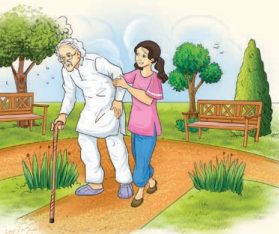
I. Recall a time you helped someone. Write two words describing:
1. What were your feelings after you did so?
Ans. Contentment and pride.
2. What might have been the feelings of the person whom you helped?
Ans. Gratitude and happiness.
Share your answers with your classmates and teacher.
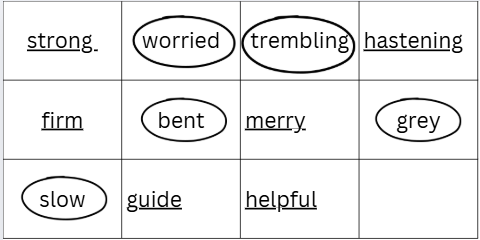
II. Work in pairs. Read the words given below. Circle the words you would associate with an elderly person and underline the words you would associate with a school student. Share the reasons for your choices with your classmates and teacher.
| strong | worried | trembling | hastening |
| firm | bent | merry | grey |
| slow | guide | helpful |
Ans.
III. Read the lines.
The woman was old and ragged and grey
And bent with the chill of the Winter’s day.
Select the suitable meaning of ‘ragged’ as used in these lines. There are other four meanings given below. Discuss with your classmates and teacher.
1. (of clothes) old and torn; synonym: shabby
• a ragged jacket
2. Having an outline, an edge, or a surface that is not straight or even
• a ragged coastline
3. Not smooth or regular; not showing control or careful preparation
• I could hear the sound of his ragged breathing.
• Their performance was still very ragged.
4. (Informal) very tired, especially after physical effort
• The elderly man was ragged after climbing the stairs.
Let us discuss
I. Arrange the events of the poem in the correct order of occurrence.
Share your answers with your classmates and teacher.
1. The boy returned to his friends, feeling proud of what he had done.
2. The old woman stood alone at the crossing, hesitant to move.
3. A group of schoolboys passed by, playing, and laughing.
4. The boy offered to help the old woman cross the street.
5. The woman prayed for the boy who helped her.
6. The children hurried past the old woman without offering help.
7. The woman placed her hand on the boy’s arm, and he guided her safely across the street.
8. The boy thought about his own mother and hoped someone would help her one day.
Ans. 2-6-3-4-7-1-8-5
II. Fill in the blanks by choosing the correct answer from the options given in the brackets.
1. The central theme of the poem is _____________. (kindness and empathy/ adventure and courage)
Ans. kindness and empathy
2. The tone of the poem is _____________. (humorous and playful/ sympathetic and hopeful)
Ans. sympathetic and hopeful
3. The poem is written in couplets with _____________ lines in each stanza. (four/two)
Ans. two
4. The structure of the poem gives a rhythmic flow that reflects both the _____________. (narrative and emotions/story’s pace and message)
Ans. story’s pace and message
5. The poem follows a rhyme scheme of _____________. (AABB/ABAB)
Ans. AABB
III. Pick examples from the poem for the following poetic devices.
1. Simile
Ans. “Came the boys like a flock of sheep.”
2. Alliteration
Ans. “helping hand” and “slippery street.”
3. Repetition
Ans. “old and grey”
IV. Complete the following sentences appropriately explaining the imagery.
1. The poem uses imagery to describe scenes of a bustling street. We know this by the phrase _______________________.
Ans. Alone, uncared for, amid the throng
2. The line ‘The street was wet with a recent snow’ suggests a cold and _______________________ weather, emphasising the woman’s helplessness.
Ans. snowy
V. Complete the following sentence with a suitable reason.
The poet repeats the phrase Somebody’s mother because it _______________________.
Ans. reflects how the old woman was once a mother who nurtured someone and now she needed someone to take care of her.
VI. Complete the analogy:
The old woman: vulnerable and neglected :: The young boy: _______________________.
Ans. strong and helpful
Let us think and reflect
I Read the given extracts and answer the questions that follow.
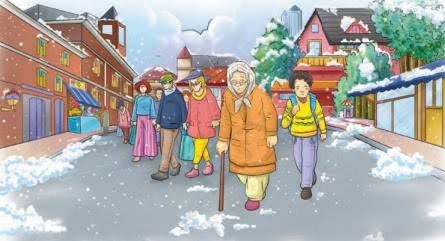
1. The woman was old and ragged and grey
And bent with the chill of the Winter’s day.
The street was wet with a recent snow
And the woman’s feet were aged and slow.
(i) What does the phrase ‘ragged and grey’ refer to ?
A. The woman’s emotional state that day.
B. The woman’s old and worn-out appearance.
C. The weather conditions of the particular day.
D. The colour of the street and the surroundings.
Ans. B. The woman’s old and worn-out appearance.
(ii) Complete the following sentence with a suitable reason:
The woman was ‘bent’ with the chill of the Winter’s day because she was _______________________.
Ans. slouching
(iii) Identify the fact and opinion from the following sentences:
A. The street was wet with recent snow. _____________________
B. The woman was too weak to cross the street on her own. _______________________
Ans. A – Fact, B – Opinion.
(iv) Why do you think the woman’s feet were described as ‘aged and slow’?
Ans. The woman’s feet were described as ‘aged and slow’ because she was old and the streets were wet with snow, and so she was walking slowly.
2. He guided the trembling feet along,
Proud that his own were firm and strong.
Then back again to his friends he went,
His young heart happy and well content.
(i) What does the contrast between the ‘trembling feet’ of the old woman and the ‘firm and strong’ feet of the boy emphasise?
Ans. It emphasises the difference in strength between the old woman and the boy. The old woman is aged and weak, while the boy is young and strong.
(ii) Fill in the blank given below by selecting the correct option from the brackets.
• The poem tells us that the boy was ‘proud’ that his feet were strong.
• This tells us that the boy was ________. (arrogant about being strong/grateful for his ability to help)
Ans. grateful for his ability to help
(iii) What is the boy most likely to tell his friends on getting back?
A. I’m so glad I could help her.
B. I’m worried about her safety.
C. I’m surprised she forgot to thank me.
D. I’m thankful for all your support.
Ans. A. I’m so glad I could help her.
(iv) Rectify the false sentence given below.
The young boy’s actions were driven by a logical decision.
Ans. False
II. Answer the following questions.
1. What might be the old woman’s fears as she waited for a long time at the crossing?
Ans. As she waited for a long time at the crossing, the old woman feared that she would never be able to cross the road or that she would slip due to the wet, slippery roads.
2. How does the poet show the helplessness of the old woman? Support your answer with evidence from the poem.
Ans. The poet shows the helplessness of the old woman by emphasising her anxiety. For example, “So meek, so timid, afraid to stir” shows that the woman was too nervous to approach anyone even though she needed help to cross the road.
3. Why does the boy decide to help the old woman? What does this tell us about him?
Ans. The boy decides to help the old woman because he thinks of her as somebody’s mother. The old woman reminds him of how one day, his mother will also be old and alone. He feels sympathy for the old woman and steps forward to help her cross the road. This tells us that the boy is sympathetic, sensitive, helpful, kind, and selfless.
4. How was the boy’s approach towards the old woman different from that of the other boys in the group?
Ans. The other boys in the group just walked past the old woman without even noticing the old woman’s helplessness and anxiety. However, the boy did notice the old woman and her being in need. He could compare the old woman to his mother in the future and sympathised with the old woman. Therefore, the boy was different from the other boys because he noticed that a person needed help. He was also different because he proceeded to help the person instead of ignoring them entirely.
5. Justify the appropriateness of the title of the poem.
Ans. The title of the poem is “Somebody’s Mother.” In the poem, the boy helps the old woman because he compares the old woman to how his mother will be in the future. Therefore, the poem revolves around how the boy helps the old woman because she was somebody’s mother. Therefore, the title of the poem is appropriate for the poem.
6. What does the poem suggest about the role of empathy and humanity in society?
Ans. The poem depicts empathy by how the boy understood the old woman’s helplessness by comparing her to his own mother. The poem depicts humanity by how the boy did not choose to ignore the old woman and helped her cross the road.
Somebody’s Mother Grammar Exercises
Let us learn
I. The grid given below has the antonyms of the words from the text.
Locate these words in the grid horizontally, vertically, and diagonally.
One example has been done for you. You may refer to a dictionary.
| firm | meek | merry | kind | anxious | bent |
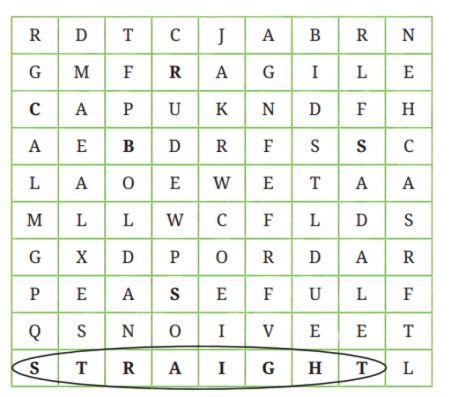
Ans.
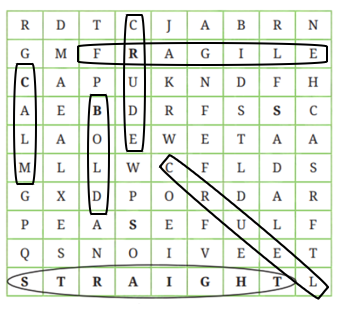
II. Match the words from the text given in Column 1 with the underlined phrases in Column 2
| Column 1 | Column 2 |
| 1. hastened | (i) The mother heard the baby move slightly in the cradle at night. |
| 2. heeded | (ii) It is our duty to give support to the poor. |
| 3. stir | (iii) The students worked quickly to complete the project and submit it on time. |
| 4. lend | (iv) All the boxes were kept in a heap at one place. |
| 5. piled | (v) They came forward to help us when we were in need. |
| 6. offered | (vi) The stranded people were brought to safety because they paid attention to our advice. |
Ans.
| Column 1 | Column 2 |
| 1. hastened | (iii) The students worked quickly to complete the project and submit it on time. |
| 2. heeded | (vi) The stranded people were brought to safety because they paid attention to our advice. |
| 3. stir | (i) The mother heard the baby move slightly in the cradle at night. |
| 4. lend | (ii) It is our duty to give support to the poor. |
| 5. piled | (iv) All the boxes were kept in a heap at one place. |
| 6. offered | (v) They came forward to help us when we were in need. |
III. In the poem, the poet uses the idiom ‘lend a hand’ which means ‘help somebody’. Some more idioms using ‘hand’ are given in Column 1. Match these idioms with their meanings in Column 2. You may refer to a dictionary.
| Column 1 | Column 2 |
| 1. get out of hand | (i) do something new |
| 2. try your hand at something | (ii) applaud somebody |
| 3. give somebody a free hand | (iii) work together |
| 4. give somebody a big hand | (iv) become difficult to control |
| 5. work hand in hand | (v) be very busy |
| 6. have your hands full | (vi) allow somebody to do something with full freedom |
Ans.
| Column 1 | Column 2 |
| 1. get out of hand | (iv) become difficult to control |
| 2. try your hand at something | (i) do something new |
| 3. give somebody a free hand | (iii) work together |
| 4. give somebody a big hand | (ii) applaud somebody |
| 5. work hand in hand | (vi) allow somebody to do something with full freedom |
| 6. have your hands full | (v) be very busy |
IV. Complete the following analogy by filling in the blanks with the correct words from the poem.
1. ___________ : winter :: heat : summer
2. hurt : ___________ :: old: aged
3. whispered : shouted :: humble : ___________
4. eyes : ___________ :: legs : walk
5. having a lot of money: wealthy :: densely packed people: ___________
Ans.
1. cold
2. young
3. whispered
4. glance
5. throng
Let us listen
I. You will listen to a woman read the special broadcast of the news. As you listen, arrange the pictures in the correct sequence of the events that took place. (Transcript for teacher on page 99)
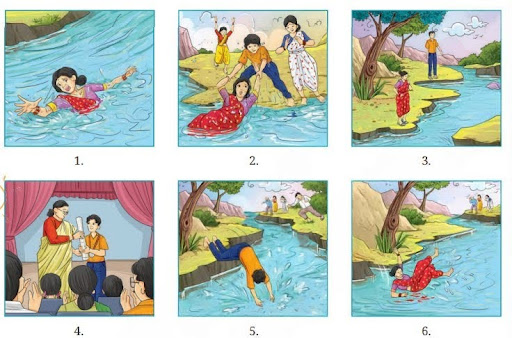
Ans. 3-6-1-5-2-4
II. You will once again listen to the special broadcast of the news. As you listen, complete the following sentences with one to three exact words.
1. The woman was having a difficult time staying afloat due to the _________________.
2. Rohan leapt into the river to save the woman without any _________________.
3. Rohan’s act of bravery was witnessed by _________________.
4. Rohan was honoured at the Vigyan Bhawan for his incredible courage and _________________.
5. Rohan proved that when it comes to saving lives, age is _________________.
Ans.
1. strong currents
2. hesitation
3. onlookers
4. determination
5. not a barrier
Let us speak
I. Read aloud the list of words from the poem that end in ‘-ed’. As you read, focus on the final sound of each word and place them in the appropriate columns. One example has been done for you.
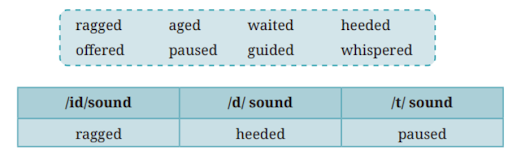
Ans.
| /id/ sound | /d/ sound | /t/ sound |
| ragged | heeded | paused |
| waited | guided | whispered |
| aged | offered |
Note: Adjectives that come before a noun and end with ‘-ed’ have /id/ as the final sound.
Let us write
I. Write a diary entry of a day you helped someone in need.
Remember to include the following points while writing it.
- Start with a sentence describing the day.
- Mention whom you helped.
- Explain the situation in which the other person needed help.
- Add the place and time of the day when the situation arose.
- Describe how you helped the other person.
- Describe the reaction of the person you helped.
- Mention how you felt during and after helping the person.
- Conclude by mentioning why you would do something like this again.
You may begin like this:
26 April 20xx, Saturday 8:00 p.m.
Dear Diary,
Today, I feel was a special day…
Ans.
26 April 20xx
Saturday
8:00 p.m
Dear Diary,
Today, I feel was a special day. It was about 2:15 p.m. School had just gotten over and my friends and I were walking down the street, chatting and laughing freely.
Then, through the snow-covered pavements, I spotted an old woman standing on the edge of the crosswalk. My instincts told me that she wanted to cross it. The snow made the roads slippery and the cold weather made her tremble even more. Guess what? No one was helping her! Not even my fellow schoolmates. I felt sympathetic towards the old woman. I couldn’t help but think of my mother. What if she grows up to be old and weak and lonely like that old woman and no one is there to help her? So, I made up my mind and went to the old woman. I gently offered her help, and the way her face lit up with relief at my words!
When we crossed the road, she thanked and blessed me. I went back to my friends, my heart filled with pride and satisfaction. It felt so incredibly warm to be helpful. And I will never stop being kind, dear diary.
(Your Name)
CBSE Class 8 English Unit 2 Chapter 2 Somebody’s Mother Extract-Based Questions
A. The woman was old and ragged and grey
And bent with the chill of the Winter’s day.
The street was wet with a recent snow
And the woman’s feet were aged and slow.
She stood at the crossing and waited long,
Alone, uncared for, amid the throng
Q1. Describe the woman.
Ans. The woman was old, ragged and grey. She was bent forward, perhaps due to the cold weather of the winter morning.
Q2. Why was the street wet?
Ans. It was wet because of the snow which was melting.
Q3. What does the poet mean by saying – “And the woman’s feet were aged and slow”
Ans. She means to say that the old woman was walking slowly.
Q4. Why was she standing at the crossing?
Ans. She was standing at the crossing because she wanted to cross the road.
Q5. Throng means –
Ans. crowd
B. Of human beings who passed her by
Nor heeded the glance of her anxious eyes.
Down the street, with laughter and shout,
Glad in the freedom of “school let out,”
Came the boys like a flock of sheep,
Hailing the snow piled white and deep.
Q1. Fill in the blank with the suitable option-
The passersby ____________________ to her curious looks. (did not pay attention / responded with a rude expression)
Ans. did not pay attention
Q2. The school children walked down the street laughing. (true / false)
Ans. True
Q3. The school boys were like a group of wolves. (true / false)
Ans. False
Q4. How is the snow described?
Ans. The snow is described as a big pile which was white in colour.
Q5. The children enjoyed the _________ from school.
Ans. freedom
C. Past the woman so old and grey
Hastened the children on their way.
Nor offered a helping hand to her
So meek, so timid, afraid to stir
Lest the carriage wheels or the horses’ feet
Should crowd her down in the slippery street.
Q1. The children _______ on their way.
Ans. hastened
Q2. Did anyone help the woman. Mention supporting evidence.
Ans. No one helped her which is evident from the line – ‘Nor offered a helping hand to her’
Q3. Why did the children not help her?
Ans. Perhaps they were meek or nervous or afraid to move to help her.
Q4. Which poetic device is used in the line – ‘Should crowd her down in the slippery street.’
Ans. Alliteration
Q5. Why did the children hurry up on their way?
Ans. The children hurried up on their way to see the old woman.
D. He paused beside her and whispered low,
“I’ll help you cross, if you wish to go.”
Her aged hand on his strong young arm
She placed, and so, without hurt or harm,
He guided the trembling feet along,
Proud that his own were firm and strong.
Then back again to his friends he went,
His young heart happy and well content.
Q1. Who is ‘he’?
Ans. He is a young boy.
Q2. The boy paused beside ______
Ans. the old woman standing at the crossing.
Q3. What help did the boy offer her?
Ans. He offered to help her cross the road if she wanted to go.
Q4. The boy was proud of ____________
Ans. His firm and strong feet
Q5. How did he feel after helping her?
Ans. He felt happy and satisfied after helping her.
Class 8 Somebody’s Mother Multiple Choice Questions
Q1. What is the rhyme scheme of the poem?
A. abab
B. aabb
C. aaab
D. abcd
Ans. B. aabb
Q2. The young boys have been compared to __________
A. a pack of wolves
B. a bunch of flowers
C. a flock of sheep
D. none of these
Ans. C. a flock of sheep
Q3. What season is the poem set it?
A. spring
B. winter
C. summer
D. autumn
Ans. B. winter
Q4. Which of the following is mentioned in the poem?
A. umbrella
B. book
C. snow
D. rain coat
Ans. C. snow
Q5. Why was the street wet?
A. it had rained
B. the snow was melting
C. it had been washed
D. all of these
Ans. B. the snow was melting
Q6. The woman prayed for whom?
A. for her son
B. for the young boy who had helped her
C. for everyone
D. she didnt pray
Ans. B. for the young boy who had helped her
Q7. The poet hopes that –
A. everyone helps elders
B. someone would help her mother
C. she will help an old woman
D. no one helps anyone
Ans. B. someone would help her mother
Q8. How did the boys react to the pile of snow?
A. disappointed
B. hailed it
C. hated it
D. cleared it
Ans. B. hailed it
Q9. Identify the figure of speech used-
‘Nor offered a helping hand to her’
A. personification
B. alliteration
C. metaphor
D. simile
Ans. B. alliteration
Q10. Find the most suitable word for ‘laddie’-
A. helper
B. scholar
C. boy
D. horse
Ans. C. boy
CBSE Class 8 English Poorvi Book Unit 2 – Values and Dispositions Chapter 2 – Somebody’s Mother Extra Question and Answers
Answer the following questions-
Q1. What is the message conveyed by the poem ‘Somebody’s mother’?
Ans. The poet conveys the message that whenever we see an aged woman in need of help, we must help her considering that she is somebody’s mother and her son is far away. Thus, every mother in need will be taken care of by some young boy who will think that she is somebody’s mother and likewise, someone will help his mother also.
Q2. What harm could happen to the old woman?
Ans. The woman could be trodded upon by a horse cart when she would cross the road.
Q3. Did someone help the old woman?
Ans. Yes, a young lad from the group of school boys offered to help her cross the road if she wanted to go. He offered his strong arm and guided her trembling old feet.
Q4. How did the young laddie feel after helping the old woman?
Ans. He felt happy and satisfied that he had helped the old woman who was somebody’s mother. He hoped that someone would help his mother too.
Q5. How did the people who passed the old woman, react to her?
Ans. The people did not pay attention to her anxious look. The school boys also hurried down the street when they saw the old woman standing at the crossing.
Q6. Why did the old woman find it difficult to cross the street?
Ans. The recent snowfall had made the street wet and slippery, and being old, grey, and frail, her feet were slow and unsteady, making her afraid to cross on her own.
Q7. What poetic devices are used in “Somebody’s Mother,” and can you give an example of each?
Ans: The poem uses simile (“Came the boys like a flock of sheep”), alliteration (“helping hand,” “slippery street”), and repetition (“old and grey”) to add rhythm and emphasis to the poem.