
CBSE Class 8 English Unit 5 Science and Curiosity Chapter 2 Magnifying Glass Important Question Answers from Poorvi Book
Class 8 English Magnifying Glass Question Answers – Looking for questions and answers for CBSE Class 8 English Unit 5 Science and Curiosity Chapter 2 Magnifying Glass? Look no further! Our comprehensive compilation of important questions will help you brush up on your subject knowledge. Practising Class 8 English question answers can significantly improve your performance in the exam. Improve your chances of scoring high marks by exploring Unit 5 Science and Curiosity Chapter 2 Magnifying Glass now. The questions listed below are based on the latest CBSE exam pattern, wherein we have given NCERT solutions to the chapter’s extract-based questions, multiple choice questions and Extra Question Answers
Also, practising with different kinds of questions can help students learn new ways to solve problems that they may not have seen before. This can ultimately lead to a deeper understanding of the subject matter and better performance on exams.
- Magnifying Glass NCERT Solutions
- Magnifying Glass Grammar Exercises
- Magnifying Glass Extract Based Questions
- Magnifying Glass Multiple Choice Questions
- Magnifying Glass Extra Question Answers
Related:
Magnifying Glass Textbook Questions (NCERT Solutions)
Exercises
Let us do these activities before we read.
I. Work in pairs. Answer the questions that follow the pictures given below.
Share your answers with your classmates and teacher.
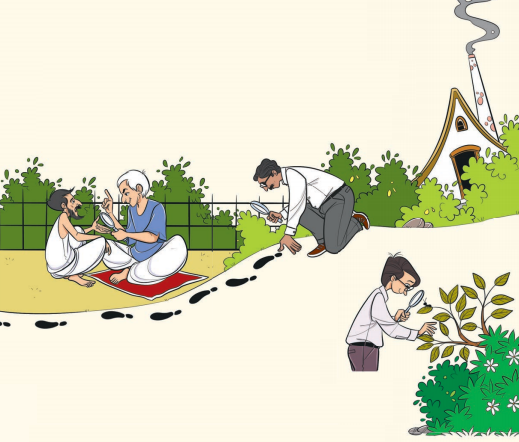
1. What is common in all these pictures?
Ans. The magnifying glass is common in all these pictures.
2. Select the pictures you are familiar with.
Ans. The picture I am familiar with is the picture of a boy using the magnifying glass to study the ant on the leaf.
3. Why do you think the people in the pictures need to use a magnifying glass?
Ans. The first picture shows an astrologer magnifying the palm of a person to do palm-reading. The second picture shows a detective using the magnifying glass to study footprints of a criminal. The third picture shows a boy using the magnifying glass to study the ant on the leaf. Therefore, the people in the pictures need to use a magnifying glass to study something small and intricate. The glass makes the thing appear bigger in size and one can see the tiny details.
4. What other instruments magnify objects?
Ans. The other instruments that can magnify objects are microscopes, telescopes, spectacles, and camera lenses.
II. If you have a magnifying glass, what would you like to use it for and why? Share your answers with your classmates and teacher.
Ans. If I had a magnifying glass, I would use it to make a fire. I find it interesting how a convex lens can converge sunlight to a specific point and it can light leaves or paper on fire.
Let us discuss
I. Complete the summary of the poem given below with suitable words from the poem.
The poem describes the magic of seeing the world through a 1. __________. It reveals how tiny things like 2. __________ and 3. __________ can appear vast and complex. Even a 4. __________ of water can seem like a hive of 5. __________. The poet is impressed at how the spider spins its 6. __________ from its 7. __________. The poem ends with the idea that, through lenses, the 8. __________ could seem within reach.
Ans.
The poem describes the magic of seeing the world through a magnifying glass. It reveals how tiny things like chalk and forests can appear vast and complex. Even a drop of water can seem like a hive of bees. The poet is impressed at how the spider spins its web-silk from its spinnerets. The poem ends with the idea that, through lenses, the moon could seem within reach.
II. Fill in the blanks by choosing the correct answer from the brackets.
1. The main idea of the poem is the transformative power of __________ (wonders in nature/close observation) through the magnifying glass.
Ans. close observation
2. The tone of the poem is __________ . (wonder and curiosity/peaceful and emotional)
Ans. wonder and curiosity
3. The poem has __________ stanzas with __________ lines in each stanza. Hence, it is a quatrain. (four; six/six; four)
Ans. six; four
4. The rhyme scheme of the poem is __________. (ABCD; ABCB)
Ans. ABCB
III. Pick examples from the poem for the following poetic devices.
1. Simile
Ans. “A drop of water, Like hive of bees.”
2. Alliteration
Ans. “Will make more marvellous”
3. Metaphor
Ans. “With this round glass
I can make Magic talk—”
4. Imagery
Ans. “Eyeing the moon,‘Twould seem you’d walk there, In an afternoon!”
IV. The poem is rich in visual imagery, painting vivid pictures of small, everyday things magnified into something grand.
1. In the line, ‘A myriad shells show in a scrap of chalk’, the magnifying glass reveals ______________________.
2. In the line, ‘A forest—flowers and trees’ the poet uses the imagery of nature to emphasise ______________________.
Ans.
1. the composition and shell-shaped patterned texture of chalk
2. the different components of the forest that can be studied
V. Complete the following sentences with a reason.
1. The poet uses exclamation marks in lines, ‘The tigerish claws he has!’, ‘With all those eyes!’ and ‘In an afternoon!’ because it _______________________.
Ans. shows how excited and curious the poet is while using the magnifying glass.
2. In the phrase, ‘Magic talk’ the poet uses personification to describe the magnifying glass because it ______________________.
Ans. reveals magical secrets behind everything.
3. Each stanza follows a repetitive pattern of introducing a small or ordinary object and then describing the extraordinary details revealed through magnification.
This is because it supports the theme of __________ as the speaker reveals ____________.
Ans. importance of small details, small details behind each ordinary object.
4. In the final stanza the poet shifts from small, everyday objects being magnified to a celestial body like moon because __________.
Ans. the poet wishes to highlight that celestial bodies which are far away appear nearer when seen through a magnifying glass.
Let us think and reflect
I. Read the given extracts and answer the questions that follow.
1. With this round glass
I can make Magic talk—
A myriad shells show
In a scrap of chalk;
Of but an inch of moss
A forest—flowers and trees;
(i) Identify whether the following statement is true or false.
The poet uses his magical powers to make the round glass powerful.
Ans. False
(ii) Select the line from the extract that expresses the presence of intricate patterns in ordinary objects.
Ans. A myriad shells show
In a scrap of chalk;
(iii) What does the comparison of ‘an inch of moss’ to a ‘forest’ suggest about the speaker’s view of the world through the magnifying glass?
Ans. It suggests that the speaker can study the forest’s every single inch through the magnifying glass.
(iv) How does the poet feel about the ability of the magnifying glass to reveal hidden wonders?
A. Satisfied
B. Fascinated
C. Grateful
D. Determined
Ans. B. Fascinated
II. Answer the following questions.
1. What is the significance of the spider in the poem?
Ans. The significance of the spider in the poem is that even living creatures hold various amazing minute secrets that can blow our minds.
2. How might the speaker’s view of the natural world change if there was no use of a magnifying glass?
Ans. If there was no use of a magnifying glass, the speaker’s view of the natural world might change drastically. The poet might think that the natural world has nothing interesting or any small details that reveal secrets about the natural world.
3. Why does the poem end with the idea of the moon being within reach?
Ans. The poem ends with the idea of the moon being within reach to invoke a sense of curiosity in the readers. If the magnifying glass can magnify small creatures like spiders and celestial objects like the moon, just imagine what all the magnifying glass can reveal.
4. What is the speaker’s attitude towards nature and the act of observation?
Ans. The speaker’s attitude towards nature and the act of observation is positive. The speaker loves nature and its interesting details. The speaker has a keen, observant eye to study the nature better through the magnifying glass.
5. Which is your favourite part of the poem? Why?
Ans. My favorite part of the poem is the description of the spiders through the magnifying glass because it is interesting to know spider’s secrets.
Magnifying Glass Grammar Exercise
Let us learn
I. Fill in the blanks in the sentences with the words given in the box below.
| woven | myriad | deft |
| stumble | surpass | marvellous |
With his 1. ____________ description, the author has written the story beautifully 2. ____________with fascinating details. When you read the story, you will surely enjoy the 3. ____________storytelling technique that attracts all kinds of readers. What makes the story interesting is the superb way of describing the 4. ____________emotions and feelings of the characters. The reader will 5. ____________upon the unexpected twists and turns that 6. ____________ all our understanding and make us wonder at the narrative power of the author.
Ans.
With his deft description, the author has written the story beautifully woven with fascinating details. When you read the story, you will surely enjoy the marvellous storytelling technique that attracts all kinds of readers. What makes the story interesting is the superb way of describing the myriad emotions and feelings of the characters. The reader will stumble upon the unexpected twists and turns that surpass all our understanding and make us wonder at the narrative power of the author.
II. The collective noun ‘a hive of bees’, is used in the poem. Match the phrases in Column 1 with suitable words in Column 2 to make collective nouns.
| Column 1 | Column 2 |
| 1. a swarm of | (i) ships |
| 2. a constellation of | (ii) soldiers |
| 3. a grove of | (iii) dancers |
| 4. a troupe of | (iv) locusts |
| 5. a battalion of | (v) trees |
| 6. a fleet of | (vi) stars |
Ans.
| Column 1 | Column 2 |
| 1. a swarm of | (iv) locusts |
| 2. a constellation of | (vi) stars |
| 3. a grove of | (v) trees |
| 4. a troupe of | (iii) dancers |
| 5. a battalion of | (ii) soldiers |
| 6. a fleet of | (i) ships |
III. The poet uses the expression ‘eyeing the moon’ in the poem. Match the idiomatic expressions with ‘eye’ given in Column 1 with their meanings in Column 2. You may refer to a dictionary.
| Column 1 | Column 2 |
| 1. apple of one’s eye | (i) watch something or someone closely |
| 2. in the blink of an eye | (ii) act as if you do not see or notice |
| 3. keep an eye on something or somebody | (iii) something that happens very quickly |
| 4. turn a blind eye | (iv) an overall look at something |
| 5. see eye to eye | (v) a person who is very precious or important |
| 6. bird’s-eye view | (vi) agree with each other |
Ans.
| Column 1 | Column 2 |
| 1. apple of one’s eye | (v) a person who is very precious or important |
| 2. in the blink of an eye | (iii) something that happens very quickly |
| 3. keep an eye on something or somebody | (i) watch something or someone closely |
| 4. turn a blind eye | (ii) act as if you do not see or notice |
| 5. see eye to eye | (vi) agree with each other |
| 6. bird’s-eye view | (iv) an overall look at something |
IV. The poet uses the adjective form ‘tigerish’ in the poem by adding the suffix -‘ish’ to the noun ‘tiger’. In the same way, we can make adjectives by adding the suffix -‘ish’ to some nouns.
Choose the nouns to which you can add the suffix -‘ish’ to make adjectives.
| girl | glass | book | silk |
| boy | water | moon | scrap |
Ans.
| girlish | glass | bookish | silk |
| boyish | waterish | moonish | scrap |
Glass, silk, scrap are words that do not have -ish as a suffix.
Let us listen
I. You will listen to a conversation between a father and daughter about lesser-known Indian inventions. As you listen, mark the four true statements from (1)–(6) given below. (Transcript for teacher on page 250).
| 1. The father is surprised by the fact that India was involved in the invention of radio broadcasting and fibre optics. | |
| 2. The daughter appears indifferent when learning the origins of the USB port. | |
| 3. The father shows little interest in the information about the origin of snakes and ladders. | |
| 4. The father was simply confirming all the facts shared by the daughter. | |
| 5. The daughter expresses pride and admiration for India’s role in global inventions. | |
| 6. The daughter is excited as she shares new discoveries about India’s contributions with her father. |
Ans.
| 1. The father is surprised by the fact that India was involved in the invention of radio broadcasting and fibre optics. | True |
| 2. The daughter appears indifferent when learning the origins of the USB port. | False |
| 3. The father shows little interest in the information about the origin of snakes and ladders. | False |
| 4. The father was simply confirming all the facts shared by the daughter. | True |
| 5. The daughter expresses pride and admiration for India’s role in global inventions. | True |
| 6. The daughter is excited as she shares new discoveries about India’s contributions with her father. | True |
Let us write
I. In a conversation, we communicate through dialogues. While writing a conversation, we need to ensure that the dialogues are engaging and serve a purpose.
Points to remember:
• Mention where, when, and with whom the conversation is taking place.
• Identify the word choice and tone—formal or informal.
• Include key information, points of agreement and disagreement, etc.
• Use words in brackets to express emotions or actions, such as (joyfully) (sits down).
• You may use filler words like Uff, Er… , Ugh, etc.
Deepa and Asma, members of the Science Club have a conversation to take a decision about making a model for an upcoming Science Fair. Create this conversation between Deepa and Asma.
You may begin the conversation like this.
Deepa: Hi Asma! Our Science teacher mentioned that you have a wonderful idea for the Science Fair project.
Asma: (hesitatingly) Yes, I do. But I’m not sure if it is good enough.
Deepa: (encouragingly) Don’t worry…
Ans. Deepa: Hi Asma! Our Science teacher mentioned that you have a wonderful idea for the Science Fair project.
Asma: (hesitatingly) Yes, I do. But I’m not sure if it is good enough.
Deepa: (encouragingly) Don’t worry, I’m sure it’s great! Tell me what you have in mind.
Asma: Um… I was thinking of making a working model of a water purification system using natural materials like sand, gravel, and charcoal.
Deepa: (amazed) That sounds so cool! It’s useful, eco-friendly, and easy to explain. We could even compare it with a commercial filter to show efficiency.
Asma: (confidently) That’s a great idea. We can also add a simple diagram to show each layer’s role in purification.
Deepa: Yes! We could collect water samples from different sources and test the results before and after filtration.
Asma: (smiles) Perfect. That would make our project more scientific and practical.
Deepa: Then it’s settled. We’ll work on the water purification model! Let’s list the materials and divide the tasks tomorrow.
Asma: (nods firmly) Agreed! I’ll start gathering the materials, and you can work on the presentation part.
Deepa: Great teamwork! Our Science Fair project is going to be amazing.
CBSE Class 8 English Unit 5 Science and Curiosity Chapter 2 Magnifying Glass Extract-Based Questions
A.I lie in wait and watch
How the deft spider jets
The woven web-silk
From his spinnerets;
Q1. What are ‘spinnerets’?
Ans. ‘Spinnerets’ are organs from which spiders and other insects produce silk and other substances for various functions.
Q2. Name one function of spinnerets in spiders.
Ans. Spinnerets produce web silk, which spiders use to make spiderwebs.
Q3. What is the juxtaposition between the speaker and the spider?
Ans. The juxtaposition between the speaker and the spider is that the speaker waits and watches the spider make the spiderweb while the spider is quickly working on producing silk from spinnerets and constructing the web.
Q4. What does the word ‘jets’ signify?
Ans. The word ‘jets’ signifies that the web-silk is produced at a rapid pace and comes out in a jet from the spinnerets.
Q5. Name one poetic device used in this extract.
Ans. Alliteration.
B. The tigerish claws he has!
And oh! the silly flies
The stumble into his net—
With all those eyes!
Q1. Why are spider’s claws described as ‘tigerish’?
Ans. The spider’s claws are described as ‘tigerish’ because they look wild and dangerous under the magnifying glass.
Q2. Why does the speaker call flies ‘silly’?
Ans. The speaker calls the flies ‘silly’ because even though they have so many eyes, they still fall into the trap of the spider’s web.
Q3. What does ‘stumble’ mean?
Ans. ‘Stumble’ means falling into or onto something.
Q4. Name the one thing in the extract that the magnifying glass zooms into.
Ans. The magnifying glass zooms into the claws of the spiders in the extract.
Q5. Why does the line “The tigerish claws he has!” end in an exclamation mark?
Ans. The line “The tigerish claws he has!” ends in an exclamation mark because of how amazed the speaker is at how dangerous the spider’s claws look.
C. Not even the tiniest thing
But this my glass
Will make more marvellous
And itself surpass.
Q1. What is ‘my glass’?
Ans. ‘My glass’ is the speaker’s magnifying glass.
Q2. How can a magnifying glass make the tiniest thing “surpass itself”?
Ans. A magnifying glass makes the tiniest thing “surpass itself” by magnifying it to make it much bigger. Therefore, it makes the tiny thing surpass its own size.
Q3. How can a magnifying glass make the tiniest thing more marvellous?
Ans. A magnifying glass makes the tiniest thing more marvellous by showing its importance to the one magnifying it.
Q4. Give one antonym of marvellous.
Ans. Awful and ordinary.
Q5. Name one poetic device used in this extract.
Ans. Alliteration.
D. Yes, and with lenses like it,
Eyeing the moon,
‘Twould seem you’d walk there
In an afternoon!
Q1. What does ‘Twould mean?
Ans. ‘Twould means ‘It would’.
Q2. Why has the speaker think of walking on the moon in the afternoon even though there is no moon during the afternoon?
Ans. The speaker thinks of walking on the moon in the afternoon, even though there is no moon during the afternoon to create humor and to rhyme moon with another word.
Q3. Which lens is the speaker talking about here?
Ans. The lens is a magnifying lens.
Q4. Which instrument do we use to see the moon?
Ans. We use the telescope to see the moon.
Q5. What is the difference between the moon and the other objects studied under the magnifying glass in the poem?
Ans. The difference between the moon and the other objects studied under the magnifying glass in the poem is that the moon is a celestial object, whereas the other items are earthly objects.
Class 8 Magnifying Glass Multiple Choice Questions
Q1. What is the rhyming scheme of each stanza?
A. ABCD
B. ABBC
C. ABCB
D. ABAB
Ans. C. ABCB
Q2. What is the poetic device used in the line:
A myriad shells show
In a scrap of chalk
A. Metaphor
B. Anaphora
C. Alliteration
D. Imagery
Ans. D. Imagery
Q3. What does the speaker not observe about the spider under the magnifying glass?
A. Production of web-silk
B. Formation of spiderweb
C. Spider eating flies
D. Spider’s dangerous claws
Ans. C. Spider eating flies
Q4. What is an antonym of myriad?
A. numerous
B. various
C. several
D. None of these
Ans. D. None of these
Q5. What does the speaker not observe under the magnifying glass?
A. Worms
B. Boiling water
C. Both A and B
D. None of these
Ans. C. Both A and B
Q6. What emotion does this poem convey?
A. Amazement
B. Annoyance
C. Boredom
D. Nonchalance
Ans. A. Amazement
Q7. What is the poetic device in “Will make more marvellous”?
A. Repetition
B. Anaphora
C. Alliteration
D. Personification
Ans. C. Alliteration
Q8. In the first stanza, which word is used to rhyme with chalk?
A. Walk
B. Talk
C. Gawk
D. Frock
Ans. B. Talk
Q9. What is the nature of lens in a magnifying glass?
A. Convex
B. Concave
C. Both A and B
D. None of these
Ans. A. Convex
Q10. The claws of spiders are compared to those of which animal?
A. Leopard
B. Tiger
C. Cheetah
D. Lion
Ans. B. Tiger
Q11. What tone is used towards the flies caught in the spiderweb?
A. Mockery
B. Sympathy
C. Concern
D. Nonchalance
Ans. A. Mockery
Q12. Which celestial object does the speaker study through the magnifying glass?
A. Mars
B. Moon
C. Venus
D. Sun
Ans. B. Moon
Q13. Eyeing the moon,
‘Twould seem you’d walk there
In an afternoon!
Which two poetic devices are used in these lines?
A. Hyperbole and Anaphora
B. Anaphora and Alliteration
C. Imagery and Hyperbole
D. Simile and Personification
Ans. C. Imagery and Hyperbole
Q14. I lie in wait and watch
How the deft spider jets
The woven web-silk
Which poetic device is used twice in these lines?
A. Repetition
B. Alliteration
C. Simile
D. Metaphor
Ans. B. Alliteration
Q15. What else can the magnifying glass magnify?
A. An ant carrying a small morse
B. Music notes from a piano
C. Dance steps
D. None of these
Ans. A. An ant carrying a small morsel
Q16. Which of these does not magnify an object?
A. Telescopes
B. Smartphone camera
C. Video recorder
D. A plane mirror
Ans. D. A plane mirror
Q17. What message does the poem wish to convey?
A. Importance of small details
B. Importance of spiders
C. Importance of the moon
D. Importance of a drop of water
Ans. A. Importance of small details
Q18. With this round glass
I can make Magic talk—
What is the poetic device in these lines?
A. Imagery
B. Personification
C. Metaphor
D. Both B and C
Ans. D. Both B and C
Q19. What is the shape of the magnifying glass?
A. Square
B. Rectangular
C. Round
D. Diamond
Ans. C. Round
Q20. A drop of water
Like hive of bees.
What is the poetic device used here?
A. Alliteration
B. Simile
C. Metaphor
D. Imagery
Ans. B. Simile
CBSE Class 8 English Poorvi Book Unit 5 Science and Curiosity Chapter 2 Magnifying Glass Extra Question and Answers
Answer the following questions:
Q1. Is there a juxtaposition between the speaker and the spider? If yes, then explain it briefly.
Ans. In Stanza 3, there is a clear juxtaposition between the speaker and the spider. Stanza 3 talks about the speaker studying the spider under the magnifying glass. The spider was moving quickly, jetting out streams of web-silk from the spinnerets and weaving it into a spiderweb. In contrast, the speaker was sitting still and watching the spider quietly under the magnifying glass. The difference in movement and stillness of the two sides, and also because one was above the lens and the other was under it, creates a juxtaposed situation between the spider and speaker.
Q2. What can you infer about the character of the speaker from the poem?
Ans. The speaker of the poem uses his magnifying glass to inspect a variety of things, like moss, a drop of water, and a spider. The speaker is curious about the minute details of objects and living beings. The speaker has a keen and observant mind and likes to learn about both terrestrial and celestial bodies. The speaker is amazed by each new thing he learns with the help of the magnifying glass. The speaker is also proud of his magnifying glass in the first stanza. The last stanza shows the speaker’s excited and imaginative mind.
Q3. Why is the speaker excited to magnify the moon?
Ans. The speaker is excited to magnify the moon because a magnified view makes it feel like he can walk on the moon. Any person would be excited to walk on the moon because of how different and adventurous it would be. Walking on the moon would be a monumental moment of every person’s life.
Q4. What are the poetic devices used in the poem? Give the name of the poet.
Ans. The poem “Magnifying glass” is written by Walter de la Mare. The poetic devices used in the poem are: Alliteration, Simile, Metaphor, Imagery, Personification, and Hyperbole.
Q5. Why is a drop of water compared to a hive of bees?
Ans. A hive of bees is a swarm of bees inside a beehive. The speaker observes a drop of water under the magnifying glass. He sees how even a drop of water is so full of life, color, and complexity. The comparison to the hive of bees illustrates how small elements in nature are just as complex as a bee hive.