
CBSE Class 8 English Unit 5 Science and Curiosity Chapter 3 Bibha Chowdhuri: The Beam Of Light That Lit The Path For Women In Indian Science Important Question Answers from Poorvi Book
Class 8 English Bibha Chowdhuri: The Beam Of Light That Lit The Path For Women In Indian Science Question Answers – Looking for questions and answers for CBSE Class 8 English Unit 5 Science and Curiosity Chapter 3 Bibha Chowdhuri: The Beam Of Light That Lit The Path For Women In Indian Science? Look no further! Our comprehensive compilation of important questions will help you brush up on your subject knowledge. Practising Class 8 English question answers can significantly improve your performance in the exam. Improve your chances of scoring high marks by exploring Unit 5 Science and Curiosity Chapter 3 Bibha Chowdhuri: The Beam Of Light That Lit The Path For Women In Indian Science now. The questions listed below are based on the latest CBSE exam pattern, wherein we have given NCERT solutions to the chapter’s extract-based questions, multiple choice questions and Extra Question Answers
Also, practising with different kinds of questions can help students learn new ways to solve problems that they may not have seen before. This can ultimately lead to a deeper understanding of the subject matter and better performance on exams.
- Bibha Chowdhuri NCERT Solutions
- Bibha Chowdhuri Grammar Exercises
- Bibha Chowdhuri Extract Based Questions
- Bibha Chowdhuri Multiple Choice Questions
- Bibha Chowdhuri Extra Question Answers
Related:
- Bibha Chowdhuri Summary, Explanation
- Bibha Chowdhuri Character Sketch
- Class 8 English Poorvi Book Lesson Notes
Bibha Chowdhuri: The Beam Of Light That Lit The Path For Women In Indian Science Textbook Questions (NCERT Solutions)
Exercises
Let us do these activities before we read.
I. Work in pairs. What qualities do you associate with a scientist? Share your answers with your classmates and teacher. Complete the word web given below.
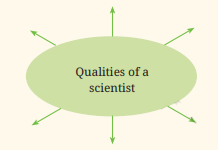
Ans.
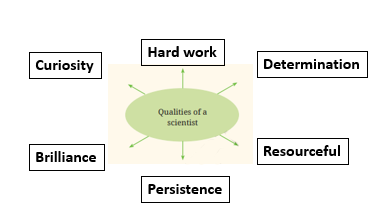
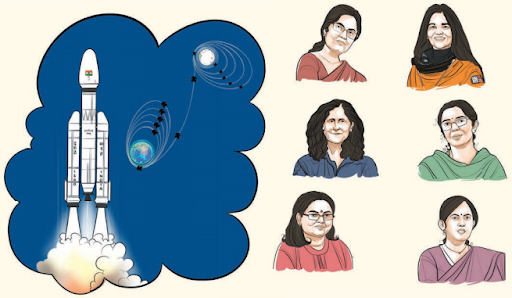
II. Some pictures of women scientists are given below. What do you know about their work? Share your answers with your classmates and teacher.
Let us discuss
I. Arrange the following events from Bibha Chowdhuri’s life in the correct order of occurrence. Share your answers with your classmates and teacher.
1. The International Astronomical Union (IAU) honoured her legacy by renaming a star in the constellation Leo—HD 86081—as ‘Bibha’.
2. She became the first woman faculty member at the Tata Institute of Fundamental Research (TIFR).
3. Bibha Chowdhuri was born in pre-independent India.
4. The Government of India declared a chair professorship in Bibha’s name.
5. She joined the University of Manchester under the guidance of the celebrated Nobel Laureate, Patrick M.S. Blackett.
6. She was nominated for a Nobel Prize by Erwin Schrödinger.
Ans. 3-5-6-2-1-4
Let us think and reflect
I. Read the given extracts and answer the questions that follow.
1. In 1945, Bibha’s academic journey took her to the University of Manchester. Under the guidance of the celebrated Nobel Laureate, Patrick M.S. Blackett, she delved deeper into the field of cosmic rays. Her Ph.D. thesis on cosmic rays earned local recognition, with newspapers introducing her as ‘India’s New Woman Scientist—She has an eye for Cosmic Rays’.
(i) Why is the mention of Patrick M.S. Blackett, a Nobel Laureate, significant in this extract?
Ans. The mention of Patrick M.S. Blackett, a Nobel Laureate is significant in this extract because it shows that someone as prominent and brilliant as Patrick M.S. Blackett recognised her great mind and took her under his wing.
(ii) What can be inferred about the public perception of women scientists in the 1940s from the title given to her by the press ‘India’s New Woman Scientist’?
A. Women scientists were widely accepted and celebrated at that time.
B. The world was still doubtful about the capabilities of women scientists.
C. Women scientists were as common and renowned as men in the 1940s.
D. Women were not allowed to study sciences or pursue scientific careers.
Ans. B. The world was still doubtful about the capabilities of women scientists.
(iii) In the phrase ‘celebrated Nobel Laureate,’ the word ‘celebrated’ refers to all of the following EXCEPT someone who is
A. famous and highly respected
B. frequently seen in public
C. renowned for their achievements
D. well-regarded in their field
Ans. B. frequently seen in public
(iv) Complete the following sentence suitably. The phrase ‘She has an eye for Cosmic Rays’ suggests that __________.
Ans. she has a curious mind in the niche field of Cosmic Rays.
2. The journey from Bibha Chowdhuri’s era to today’s women scientists has been long and arduous, but it is also inspiring. The struggles Chowdhuri faced are a stark reminder of how far we’ve come—and how much further we have to go. But with every cosmic achievement— be it landing on the moon or reaching Mars—these women prove that the journey is well worth it.
Bibha Chowdhuri’s legacy lives on. Her story continues to inspire young women to pursue their passions, break barriers, and leave their mark on the world. As the stars of Indian science shine brighter, Bibha Chowdhuri, the beacon–‘beam of light,’ will always guide the way.
(i) What can be inferred about the challenges faced by women scientists today, as compared to Bibha Chowdhuri’s era?
A. Women scientists no longer face any barriers.
B. The challenges remain, but progress has been made.
C. The struggles have become more difficult over time.
D. The struggles are the same as they were for Chowdhuri.
Ans. B. The challenges remain, but progress has been made.
(ii) The phrase ‘Bibha Chowdhuri’s legacy lives on’ suggests that __________.
Ans. women continue to break barriers and make progress for today and future generations.
(iii) Why is Bibha Chowdhuri referred to as a ‘beacon’ and a ‘beam of light’ in the extract?
Ans. The name ‘Bibha’ means ‘a beam of light’. She is referred to as a ‘beacon’ because of her innovative work on cosmic rays and subatomic particles and her legacy as the first Indian female physicist. She has laid down the foundation for today’s women to excel in various domains which were previously male-dominated.
(iv) State whether the following sentence is a fact or an opinion.
Bibha Chowdhuri was the beacon, the ‘beam of light’ whose story continues to inspire young women.
Ans. The following sentence is a fact.
II. Answer the following questions.
1. Why is Bibha Chowdhuri considered a pioneer in the field of science?
Ans. Bibha Chowdhuri is considered a pioneer in the field of science for her work on cosmic rays, the discovery of pi-mesons, and her status as the first Indian female physicist.
2. What does Bibha Chowdhuri’s nomination by Erwin Schrödinger tell us about her abilities?
Ans. Bibha Chowdhuri’s nomination by Erwin Schrödinger highlights her brilliant mind and innovative work.
3. Bibha Chowdhuri never worked for awards or recognition. Support this statement with evidence from the text.
Ans. “Her life, full of challenges and struggles, was marked by an uphill battle to be heard and seen in the field of science. Chowdhuri never received any awards during her lifetime, but continued her work tirelessly.”
This part of the text is the proof that Bibha Chowdhuri worked for women’s overall progress, not for awards or recognition.
4. How does the renaming of a star as ‘Bibha’ serve as both a literal and symbolic recognition of her contributions to science?
Ans. ‘Bibha’ means ‘a beam of light’. In 2019, the International Astronomical Union (IAU) renamed a star in the constellation Leo, HD 86081, in her name to highlight her contribution to science and women’s empowerment. Literally, Bibha means a beam of ligh,t which is similar to the star’s quality of giving out light. Symbolically, the naming of the star after Bibha gives recognition to her achievements and acknowledges the abilities of women in the field of Science.
5. How do the roles of women in ISRO today reflect broader changes in societal attitudes towards women in STEM in India?
Ans. Today, the female scientists and engineers in ISRO do not remain in the shadows of their male counterparts. Instead, the women lead the current missions and projects. One such example is Dr. Ritu Karidhal Srivastava, popularly referred to as the ‘Rocket Woman of India.’
6. What is the writer’s purpose of highlighting the contributions of Bibha Chowdhuri and other modern women scientists?
Ans. The writer’s purpose of highlighting the contributions of Bibha Chowdhuri and other modern women scientists is to shed light on the growth and progression of women in male-dominated fields. They aim to make the female students, who constitute the next generation of leaders and pioneers, empowered and encouraged to break through the societal barriers on women. They also aim to make the male students aware of societal expectations on females to make them more sensitive towards gender equality and upliftment of their female counterparts.
7. How might this text help shape people’s perception of the role of women in other traditionally male-dominated fields?
Ans. This chapter is extremely useful for the proper development of the young, impressionable minds of the students. This text helps shape people’s perception of the role of women in other traditionally male-dominated fields. It ensures that the students will be more open-minded and less susceptible to conventional gender barriers. Young girls will learn that they can grow beyond predefined gender roles. Young boys will learn that they should not contribute to the oppression of women. This text will teach young minds that they should not allow traditional gender views to stop them and the people around them from achieving great heights.
Bibha Chowdhuri: The Beam Of Light That Lit The Path For Women In Indian Science Grammar Exercise
Let us learn
I. Complete the crossword puzzle by filling in the antonyms from the clues given below in the table. You may refer to the text.
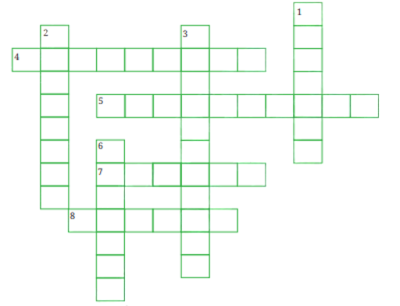
| Across | Down |
| 4. core | 1. effortless |
| 5. dependent | 2. weakness |
| 7. extinguish | 3. neglect |
| 8. terrestrial | 6. trivial |
Ans.
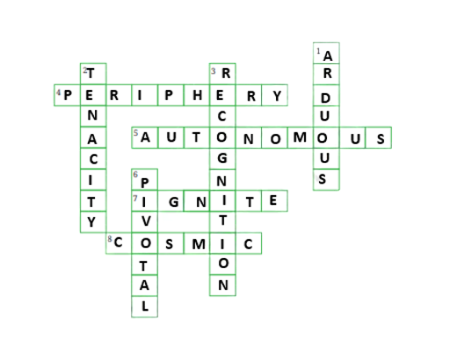
II. Substitute the underlined phrase in the sentences with the suitable words from the box given below.
| physicist | luminaries | pioneers |
| peers | barriers | persistence |
1. They are considered to be the first people to start the online markets.
2. A scientist who studies matter, energy, light, etc.
3. Most of my friends are my classmates and are my age.
4. We first welcomed all the famous and important people in folk song for the award ceremony.
5. My brother finally succeeded in his business because of his continuous efforts and determination.
6. We should remove all the things that block our way in achieving success.
Ans.
1. They are considered to be luminaries of the online markets.
2. A physicist studies matter, energy, light, etc.
3. Most of my peers are my age.
4. We first welcomed all the pioneers in folk song for the award ceremony.
5. My brother finally succeeded in his business because of his persistence.
6. We should remove all the barriers to achieve success.
III. The words ‘professorship’, ‘mentorship’, and ‘leadership’ are used in the text. These words are made by adding the suffix ‘-ship’ to the words ‘professor’, ‘mentor’ and ‘leader’. Similarly, we can make words by adding -ment and -hood to certain words.
Now, make words by adding suitable suffixes -ship, -ment, and -hood to the words given below. One example has been done for you.
achieve + ment = achievement
1. member + _______________ = _________________
2. govern + _______________ = _________________
3. partner + _______________ = _________________
4. child + _______________ = _________________
5. citizen + _______________ = _________________
6. entertain + _______________ = _________________
7. brother + _______________ = _________________
8. agree + _______________ = _________________
Ans.
1. member + ship = membership
2. govern + ment = government
3. partner + ship = partnership
4. child + hood = childhood
5. citizen + ship = citizenship
6. entertain + ment = entertainment
7. brother + hood = brotherhood
8. agree + ment = agreement
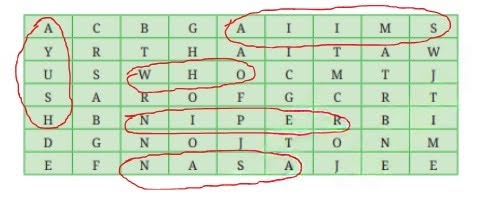
IV. The abbreviations—ISRO and STEM—used in the text are called acronyms because they are read or pronounced as full words.
The grid given below has acronyms for the following. Circle the acronyms in the grid.
1. National Aeronautics and Space Administration
2. All India Institute of Medical Sciences
3. Ayurveda, Yoga and Naturopathy, Unani, Siddha, and Homoeopathy
4. National Institute of Pharmaceutical Education and Research
5. World Health Organization
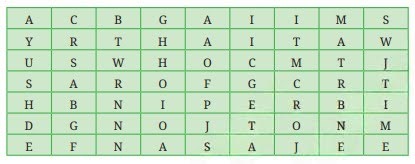
Ans
|
Clipping The short form of laboratory is lab. In making this short form, the front part of the word is retained and the end part is removed or clipped. |
V. Read the following sentence from the text and the table that follows.
…, the foundation was laid by early pioneers like Bibha Chowdhuri…
| Subject | Verb | Object |
| The foundation | was laid | early pioneers like Bibha Chowdhuri… |
Here the verb is expressed in passive form.
Verbs can be expressed in either active voice or passive voice.
When the subject performs the action, the sentence is said to be in active voice. On the other hand, when the subject receives the action, the sentence is in passive voice.
Generally, sentences written in active voice are considered effective.
However, passive voice is used when the
• action is more important than the doer,
A cure for the disease was discovered.
(The focus is on the discovery, not on who discovered it.)
• doer of the action (agent) is obvious,
The national anthem is sung at the beginning of the event.
(It is clear that people sing it, so mentioning the doer is unnecessary.)
• doer of the action is unknown.
The car was stolen last night.
(The identity of the thief is unknown.)
Now, complete the following news report with the passive form of verbs given in the box below. (Remember that the verb must agree with the subject.)
| discover | test | measure | publish | record | take |
Last year, significant advancements in medical science 1. __________ in leading medical journals when a new vaccine for malaria 2. __________. The vaccine 3. __________ through several clinical trials and results 4. _________ in those journals. During the trials, blood samples 5. __________ regularly from participants to monitor their immune response. The amount of antibodies produced 6. __________ carefully to assess the effectiveness of the vaccine.
Ans. Last year, significant advancements in medical science were published in leading medical journals when a new vaccine for malaria was discovered. The vaccine was tested through several clinical trials and results were recorded in those journals. During the trials, blood samples were taken regularly from participants to monitor their immune response. The amount of antibodies produced were measured carefully to assess the effectiveness of the vaccine.
VI. Read the following report of an experiment. Rewrite the report using passive verbs wherever necessary.
I conducted an experiment to investigate the effects of light on plant growth. I placed various plants under different light conditions and measured their growth over several weeks. I recorded data daily to track the height of each plant. At the end of the experiment, I analysed the results and found that plants exposed to natural light grew significantly taller than those under artificial light. I concluded that sunlight plays a crucial role in plant development. I presented my findings to the class, highlighting the importance of light in enhancing photosynthesis and overall plant health.
You may begin like this.
An experiment was conducted…
Ans. An experiment was conducted to investigate the effects of light on plant growth. Various plants were placed under different light conditions and their growth was measured over several weeks. The height of each plant was tracked by daily recording of data. The results were analysed at the end of the experiment. It was found that the plants exposed to natural light grew significantly taller than those under artificial light. It was concluded that sunlight plays a crucial role in plant development. My findings were presented to the class. The importance of light in enhancing photosynthesis and overall plant health was highlighted.
VII. Read the instructions given in the box on landing of Chandrayaan. Complete the passage by choosing the correct answer from the options given.
|
Chandrayaan’s landing mission involves several key steps. First, the spacecraft 1.________ towards the Moon from the Earth. Then, it 2. ________ to enter the Moon’s orbit. After reaching the Moon’s orbit, the spacecraft’s path 3. ________ for landing. Next, the spacecraft 4. ________ as it nears the Moon’s surface. Finally, the rover 5.________ to explore the surface and collect valuable data.
(i) A. launched
B. were launched
C. was launched
D. is launched
Ans. D. is launched
(ii) A. position
B. was positioned
C. is positioned
D. has positioned
Ans. C. is positioned
(iii) A. adjusted
B. was adjusted
C. is adjusted
D. were adjusted
Ans. C. is adjusted
(iv) A. slowed down
B. was slowed down
C. is slowed down
D. were slowed down
Ans. C. is slowed down
(v) A. is released
B. has released
C. were released
D. was released
Ans. A. is released
Let us listen
I. You will listen to a podcast about Artificial Intelligence. As you listen, answer the following questions by selecting the correct options.
(Transcript for teacher on page 251)
1. What is one of the key benefits of AI in the healthcare sector?
(i) Helps doctors communicate faster with patients.
(ii) Provides personalised treatments and faster diagnoses.
(iii) Focuses on cosmetic surgeries to improve appearance.
Ans. (ii) Provides personalised treatments and faster diagnoses.
2. How did AI play a crucial role during the global pandemic?
(i) AI robots monitored patient behaviour in hospitals.
(ii) AI assisted in speeding up the discovery of new medicines.
(iii) AI developed different types of vaccines by itself.
Ans. (ii) AI assisted in speeding up the discovery of new medicines.
3. What example was given regarding AI’s role in renewable energy?
(i) AI is optimising the placement of wind turbines and solar panels in cities.
(ii) AI is promoting alternative energy from wind turbines and solar panels.
(iii) AI is improving the performance of wind turbines and solar panels.
Ans. (iii) AI is improving the performance of wind turbines and solar panels.
4. What does AI offer to teachers in the field of education?
(i) Helps teachers assign grades more quickly.
(ii) Allows teachers to communicate better with students.
(iii) Helps teachers analyse student performance.
Ans. (iii) Helps teachers analyse student performance.
5. What is one of the user-friendly features that AI is enhancing for people with disabilities?
(i) Helps them find better jobs in the mainstream.
(ii) Improves speech recognition and voice command technologies.
(iii) Trains individuals to interact with robots.
Ans. (ii) Improves speech recognition and voice command technologies.
Let us write
I. Your school recently hosted the Zonal Science Exhibition, in which teams of students from 25 schools participated enthusiastically. As the student editor, write a report on the exhibition to be published in your school magazine. Use the cues given below with your own ideas to compose this report.
• Who was the organiser and who hosted the exhibition?
• When (date and time) and where was it held?
• Why was it held?
• Who participated?
• Who was the Chief Guest?
• What were the competitions held? For example: Science Quiz, Science Models, etc.
• What were the topics of models exhibited? Give details.
• Which team got the trophy for best exhibit?
• What were the observations of the Chief Guest and other visitors?
Points to remember:
1. Write the report in past tense, passive voice, and third person.
2. Follow proper format with a headline, reporter’s name, and three paragraphs.
Ans.
Zonal Science Exhibition
By [Your Name], Student Editor
The Zonal Science Exhibition was organised by the Directorate of Education and hosted by Green Valley Public School for classes 6 to 10 on 12th November 2025 from 9 a.m. to 5 p.m. in the school auditorium.
Teams from twenty-five schools across the city participated enthusiastically. The event was inaugurated by our honourable Chief Guest, Dr. Meera Joshi, the renowned environmental scientist. Various competitions were conducted for different classes: Poster Making for Class 6, Slogan Writing for Class 7, Speech Presentation for Class 8, Model Presentation for Class 9, and Science Quiz for Class 10. Participants exhibited interesting knowledge on topics like renewable energy, water conservation, robotics in daily life, and waste management. The model on “Smart Waste Segregation System” presented by Bluebells Modern School was the highlight of the event.
The Chief Guest praised the young innovators for their knowledge, creativity, and awareness of global issues. Visitors appreciated the students’ efforts and remarked that such exhibitions helped build a scientific outlook among the youth.
CBSE Class 8 English Unit 5 Science and Curiosity Chapter 2 Magnifying Glass Extract-Based Questions
A. The stars are not meant to remain hidden forever. In 2019, the International Astronomical Union (IAU) honoured her legacy by renaming a star in the constellation Leo—HD 86081—as ‘Bibha,’ meaning ‘beam of light.’ Fittingly, she is now a ‘star in heaven,’ a symbol of the light she brought to Indian science. A fitting tribute to a woman whose life was a radiant example of tenacity, brilliance, and quiet determination. In 2020, the Government of India declared a chair professorship in her name.
Q1. What is the full form of IAU?
Ans. The full form of IAU is the International Astronomical Union.
Q2. What was the previous name of the star ‘Bibha’?
Ans. The previous name of the star ‘Bibha’ was HD 86081.
Q3. What does ‘Bibha’ mean?
Ans. ‘Bibha’ means ‘beam of light.’
Q4. How was she honoured in 2020?
Ans. In 2020, the Government of India honoured her by declaring a chair professorship in her name.
Q5. What does the line ‘The stars are not meant to remain hidden forever’ mean?
Ans. The line ‘The stars are not meant to remain hidden forever’ refers to Bibha Chowdhuri’s story. She was not as recognised for her work and contributions to Indian science as her male counterparts. However, her story was coming into the light now, and after women’s progression in society, she was being honoured appropriately by the Government of India and the IAU. Therefore, Bibha Chowdhuri is a star in heaven whose story, legacy, and contributions could not remain uncovered forever.
B. One such luminary is Dr. Ritu Karidhal Srivastava, popularly referred to as the ‘Rocket Woman of India.’ Her pivotal role in ISRO’s Mars Orbiter Mission and subsequent leadership in Chandrayaan-2 and Chandrayaan-3 reflect the leaps women have made in STEM in India. Over 50 women contributed to Chandrayaan-3, and their success is built upon the shoulders of pioneers like Bibha Chowdhuri. Their roles in developing autonomous systems for spacecraft and managing mission-critical operations highlight the capabilities of women in pushing India’s space programme forward.
Q1. Who is the ‘Rocket Woman of India’?
Ans. Dr. Ritu Karidhal Srivastava is the ‘Rocket Woman of India’.
Q2. Why is Dr. Ritu Karidhal Srivastava called the ‘Rocket Woman of India’?
Ans. Dr. Ritu Karidhal Srivastava is called the ‘Rocket Woman of India’ because of her crucial contribution to the Mars Orbiter Mission and leadership role in rocket missions like Chandrayaan-2 and Chandrayaan-3.
Q3. What is the full form of STEM?
Ans. The full form of STEM is Science, Technology, Engineering, and Mathematics.
Q4. Replace the underlined word with the antonym: Their roles in developing autonomous systems for spacecraft and managing mission-critical operations highlight the capabilities of women in pushing India’s space programme forward.
Ans. Their roles in developing dependent systems for spacecraft and managing mission-critical operations highlight the capabilities of women in pushing India’s space programme forward.
Q5. What is the major contribution of the 50 women working for the Chandrayaan-3 mission?
Ans. The development of autonomous systems for spacecraft and managing mission-critical operations is the major contribution of the 50 women working for the Chandrayaan-3 mission
C. Bibha’s persistence eventually earned her a place at the Bose Institute. She had already begun to chip away at the walls of exclusion, becoming the first Indian woman to excel in high-energy particle physics.
Q1. Where did Bibha pursue her research in India?
Ans. Bibha pursued her physics research at the Bose Institute.
Q2. What did Bibha study?
Ans. Bibha studied high-energy particle physics.
Q3. Why were there walls of exclusion?
Ans. Walls of exclusion were put up between the women and men to keep women away from what were perceived as male-dominated fields.
Q4. How do you think the other researchers and students reacted to seeing the first Indian woman to excel in high-energy particle physics?
Ans. The other researchers and students, who were all male, might have been shocked by seeing a capable woman break through all the gender barriers. Some might have been a bit disapproving too because they are not used to seeing a woman chip away at the walls of exclusion.
Q5. What is the opposite of exclusion?
Ans. The opposite of exclusion is inclusion.
D. In 1949, upon her return to India, she became the first woman faculty member at the Tata Institute of Fundamental Research (TIFR), personally selected by Homi J. Bhabha. Chowdhuri’s contributions spanned across research institutes like the Physical Research Laboratory in Ahmedabad and the Saha Institute of Nuclear Physics in Kolkata. This is where she continued her work on cosmic rays and subatomic particles. Through decades of crucial research, from Kolar Gold Mines to the Physical Research Laboratory under the mentorship of Vikram Sarabhai, Bibha’s work went on quietly, as she remained in the periphery of Indian scientific acclaim. She passed away in 1991, her story untold, her name largely forgotten.
Q1. When did she return to India?
Ans. She returned to India in the year 1949.
Q2. What is the full form of TIFR?
Ans. The full form of TIFR is the Tata Institute of Fundamental Research.
Q3. State whether the statement is True or False: Chowdhuri’s contributions spanned across research institutes like the Physical Research Laboratory in Kolkata and the Saha Institute of Nuclear Physics in Ahmedabad.
Ans. The statement is false.
Q4. Who was she mentored by during the Physical Research.
Ans. Vikram Sarabhai mentored her.
Q5. Who selected her to work at the TIFR?
Ans. Homi J. Bhabha had personally selected her to work at the TIFR.
Class 8 Magnifying Glass Multiple Choice Questions
Q1. Who nominated her for the Nobel Prize in 1950?
A. Albert Einstein
B. Patrick M.S. Blackett
C. Erwin Schrödinger
D. Vikram Sarabhai
Ans. C. Erwin Schrödinger
Q2. Name the institute in Ahmedabad where Bibha Chowdhuri continued her research on cosmic rays after coming back to India.
A. Saha Institute of Nuclear Physics
B. Physical Research Laboratory
C. Bose Institute
D. Tata Institute of Fundamental Research
Ans. B. Physical Research Laboratory
Q3. When and where was she born?
A. 1919, Kolkata
B. 1915, Ahmedabad
C. 1913, Chennai
D. 1913, Kolkata
Ans. D. 1913, Kolkata
Q4. Who guided her at the University of Manchester?
A. Albert Einstein
B. Patrick M.S. Blackett
C. Erwin Schrödinger
D. Vikram Sarabhai
Ans. B. Patrick M.S. Blackett
Q5. The IAU renamed a star in the constellation ________ to honour her memory.
Complete the blank.
A. Leo
B. Aries
C. Sagittarius
D. Taurus
Ans. A. Leo
Q6. What does the “I” in the IAU stand for?
A. Indian
B. International
C. Indigenous
D. None of these
Ans. B. International
Q7. When did the Government of India declare a chair professorship in Bibha’s name?
A. 2019
B. 2021
C. 2020
D. 2022
Ans. C. 2020
Q8. Which subatomic particle did Bibha Chowdhuri discover?
A. Alpha particles
B. Pi-mesons
C. Quarks
D. All of these
Ans. B. Pi-mesons
Q9. Bibha Chowdhuri paved the way in the field of:
A. STEM
B. Music
C. Engineering
D. All of these
Ans. A. STEM
Q10. The local newspapers in UK introduced Bibha Chowdhuri with the title–
A. ‘India’s New Woman Scientist—She has an eye for Cosmic Rays’
B. ‘India’s New Woman Scientist—She has an eye for Pi-Mesons’
C. ‘India’s New Woman Scientist—She has an eye for Breaking Traditional Gender Roles’
D. ‘India’s New Woman Scientist—She has an eye for Nobel Prize’
Ans. A. ‘India’s New Woman Scientist—She has an eye for Cosmic Rays’
Q11. When did Bibha Chowdhuri pass away?
A. 1919
B. 1991
C. 2000
D. 1998
Ans. B. 1991
Q12. Why did she remain in the periphery of scientists and scientific contributions?
A. Her contributions were not significant enough
B. Due to predefined conventional gender perceptions, her work could never be in the spotlight
C. Both A and B
D. None of these
Ans. B. Due to predefined conventional gender perceptions, her work could never be in the spotlight
Q13. This scientist is NOT mentioned in the chapter.
A. C. V. Raman
B. Patrick M.S. Blackett
C. Both A and B
D. None of these
Ans. A. C. V. Raman
Q14. Which ISRO mission is being led by the Rocket Woman of India and over 50 female scientists?
A. Chandrayaan-2
B. Chandrayaan-3
C. Both A and B
D. None of these
Ans. B. Chandrayaan-3
Q15. When did she study at the University of Manchester?
A. 1949
B. 1950
C. 1940
D. 1945
Ans. D. 1945
Q16. The star which was renamed was previously called-
A. HD 86081
B. HD 86061
C. HD 87081
D. HD 88081
Ans. A. HD 86081
Q17. Bibha’s PhD thesis was on the topic-
A. Pi-Mesons
B. Subatomic particles
C. Cosmic rays
D. None of these
Ans. C. Cosmic rays
Q18. Bibha is symbolised to be a-
A. star in heaven
B. beam of light
C. Both A and B
D. None of these
Ans. C. Both A and B
Q19. What was Bibha’s first step in breaking down gender barriers?
A. Studying at the Bose Institute
B. Going to the University of Manchester
C. Talking to men before marriage
D. None of these
Ans. A. Studying at the Bose Institute
Q20. Which of the following qualities will NOT be attributed to Bibha Chowdhuri?
A. Fierce loyalty
B. Timid submission
C. Loud activism
D. Quiet persistence
Ans. D. Quiet persistence
CBSE Class 8 English Poorvi Book Unit 5 Science and Curiosity Chapter 2 Magnifying Glass Extra Question and Answers
Answer the following questions-
Q1. What can you say about the male scientists who helped a female physicist like Bibha Chowdhuri?
Ans. The male scientists who mentored and uplifted Bibha show open-mindedness and willingness to allow capable women to contribute to science. They cared more about progress and breakthroughs in science than traditional and illogical gender perceptions.
Q2. Name all the male scientists who helped and recognised Bibha Chowdhuri in her career. How did they contribute to her journey?
Ans. Patrick M.S. Blackett guided her thesis on Cosmic Rays at the University of Manchester. Erwin Schrödinger nominated her for the 1950 Nobel Prize. Homi J. Bhabha personally selected her to work as the first female scientist at TIFR. Vikram Sarabhai mentored her as well.
Q3. Give one example of an Indian woman in the field of STEM to follow Bibha Chowdhuri’s legacy.
Ans. Today, Indian women are breaking through gender barriers with each step forward. Bibha Chowdhuri was India’s first female physicist. She built the foundations of women’s progression in STEM. Now, women like Dr. Ritu Karidhal Srivastava in ISRO not only have pivotal roles in the Mars Orbiter Mission but also lead missions like Chandrayaan-3.
Q4. What did Bibha Chowdhuri study at the Bose Institute?
Ans. Bibha Chowdhuri studied high-energy particle physics at the Bose Institute.
Q5. What was Bibha’s most remarkable scientific discovery? How was it honoured?
Ans. Her most remarkable scientific discovery was the discovery of pi-mesons, a subatomic particle. It was honoured by Erwin Schrodinger, who nominated her for the Nobel Prize in the year 1950.