

CBSE Class 9 English Chapter 1 How I Taught My Grandmother to Read Question Answers (Important) from Kaveri Book
Class 9 English How I Taught My Grandmother to Read Question Answers – Looking for How I Taught My Grandmother to Read question answers (NCERT solutions) for CBSE Class 9 English Kaveri Book Chapter 1? Look no further! Our comprehensive compilation of important questions will help you brush up on your subject knowledge. Practising Class 9 English question answers can significantly improve your performance in the exam. Our solutions provide a clear idea of how to write the answers effectively. Improve your chances of scoring high marks by exploring Chapter 1: How I Taught My Grandmother to Read now. The questions listed below are based on the latest CBSE exam pattern, wherein we have given NCERT solutions (Textbook Questions) to the chapter’s, Extract Based Questions, Multiple Choice Questions, and Extra Question Answers
Also, practising with different kinds of questions can help students learn new ways to solve problems that they may not have seen before. This can ultimately lead to a deeper understanding of the subject matter and better performance on exams.
- How I Taught My Grandmother to Read Textbook Questions (NCERT Solution)
- How I Taught My Grandmother to Read Grammar Exercises
- How I Taught My Grandmother to Read Extract-Based Questions
- How I Taught My Grandmother to Read Multiple Choice Questions
- How I Taught My Grandmother to Read Extra Questions
Related:
- How I Taught My Grandmother to Read Summary, Explanation
- How I Taught My Grandmother to Read Character Sketch
How I Taught My Grandmother to Read Textbook Questions (NCERT Solution)
Reflect and Respond
I. Complete the given word web.
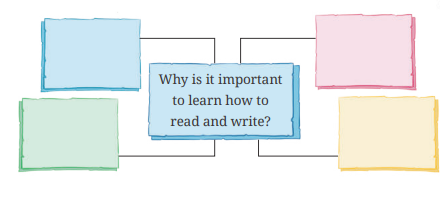
Ans.
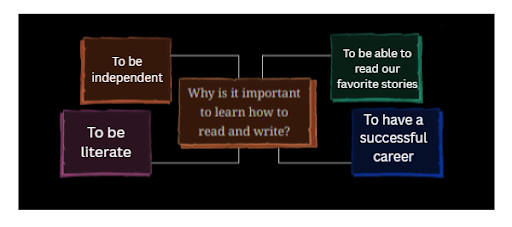 1. To be independent
2. To be literate
3. To be able to read our favorite stories
4. To have a successful career
II Read the questions given below and share your answers with your classmates and teacher.
1. Which language(s) do your grandparents or elderly relatives speak?
2. How do they spend their time? How do you spend time with them?
3. What is your favourite experience with them?
4. What is something that the elderly in your family cannot do easily but enjoy watching you do?
III Read the following passage. Match the highlighted words with their meanings given in the box below.
| 1. excitedly 2. believable 3. people living in one particular area 4. discussion 5. a part of a story 6. focus 7. main character 8. directed |
The casting for the (i) protagonist of our school’s annual play was done after a lot of (ii) debate as many good actors had auditioned for the role. We had decided to present an (iii) episode from an inspirational story. It was a life story of a group of children who worked with the (iv) community to spread literacy. Every day, we reached school early to practise with (v) concentration. We waited (vi) eagerly for the final presentation. All of us played our roles in a very (vii) convincing manner as our theatre teacher had (viii) guided us well.
Ans.
(i) protagonist: main character
(ii) debate: discussion
(iii) episode: a part of a story
(iv) community: people living in one particular area
(v) concentration: focus
(vi) eagerly: excitedly
(vii) convincing: believable
(viii) guided: directed
Check Your Understanding
I. Complete the cause and effect table given below based on Part I of the story. Share your answers with your classmates and teacher.
| Cause | Effect |
| 1. | (i) The morning papers arrived late in the day and weekly magazines would come one day late. |
| 2. The grandmother, Krishtakka, never went to school. | (ii) |
| 3. | (iii) She was deeply interested in the story and discussed it with her friends. |
| 4. The narrator went to a wedding for a week. | (iv) |
| 5. | (v) The grandmother never went to school. |
| 6. The grandmother regretted not going to school. | (vi) |
Ans.
| Cause | Effect |
| 1. The transport system in the village was not very good. | (i) The morning papers arrived late in the day and weekly magazines would come one day late. |
| 2. The grandmother, Krishtakka, never went to school. | (ii) She never learnt to read and write at a young age. |
| 3. The narrator read the Kashi Yatre to her grandmother. | (iii) She was deeply interested in the story and discussed it with her friends. |
| 4. The narrator went to a wedding for a week. | (iv) The grandmother could not read the Kashi Yatre. |
| 5. The grandmother got married at a very young age. | (v) The grandmother never went to school. |
| 6. The grandmother regretted not going to school. | (vi) She made sure all her children and grandchildren went to school and studied well. |
II Do you think the narrator expected to see her grandmother in tears when she returned to the village? If yes, why? If no, why not?
Ans. No, the narrator did not expect to see her grandmother in tears when she returned to the village. We know this because the narrator said that she was surprised when she saw her grandmother crying. She described her grandmother to be a resilient and strong person as she did not cry even in tough situations.
III How might the narrator help her grandmother to fulfil her desire to learn to read and write?
Ans. The narrator helped her grandmother to fulfil her desire to learn to read and write by teaching her the different alphabets and how to pronounce and write them. She then moved on to teach how to form words, and then how to form sentences, similar to how we are taught in schools. She would give her homework and asked her to read, write and speak repeatedly to make sure she learnt. Therefore, starting from the basics and moving to complex parts slowly and with repetitions helped her grandmother learn Kannada.
Check Your Understanding
I. State whether the following sentences are true or false. Share your answers with your classmates and teacher.
| 1. The grandmother wanted to learn the Kannada alphabet to gain independence. | |
| 2. The grandmother asked someone in the village to read Kashi Yatre to her while the narrator was away. | |
| 3. The narrator was the grandmother’s first teacher and taught her how to read Kannada. | |
| 4. The grandmother believed that there was no age limit for learning. | |
| 5. The grandmother touched the narrator’s feet as a mark of respect for her as a teacher. | |
| 6. The narrator was disappointed with the progress her grandmother made in learning to read. |
Ans.
| 1. The grandmother wanted to learn the Kannada alphabet to gain independence. | True |
| 2. The grandmother asked someone in the village to read Kashi Yatre to her while the narrator was away. | False |
| 3. The narrator was the grandmother’s first teacher and taught her how to read Kannada. | True |
| 4. The grandmother believed that there was no age limit for learning. | True |
| 5. The grandmother touched the narrator’s feet as a mark of respect for her as a teacher. | True |
| 6. The narrator was disappointed with the progress her grandmother made in learning to read. | False |
Critical Reflection
I. Read the extracts given below and answer the questions that follow.
1. When I came back to my village, I saw my grandmother in tears. I was surprised, for I had never seen her cry even in the most difficult situations. What had happened? I was worried.
‘Avva, is everything all right? Are you okay?’
I used to call her Avva, which means mother in the Kannada spoken in north Karnataka.
She nodded but did not reply. I did not understand and forgot about it. In the night, after dinner, we were sleeping in the open terrace of our house. It was a summer night and there was a full moon. Avva came and sat next to me. Her affectionate hands touched my forehead.
(i) Complete the following sentence with the appropriate option.
The phrase ‘never seen her cry in the most ‘difficult situations’ tells us that the grandmother was ________________________.
A. strong-willed
B. understanding
C. considerate
D. bold
Ans. A. strong-willed
(ii) Complete the following with the correct option from those given in the brackets.
Grandmother did not reply when the narrator asked if she was alright because she might have been too ________________________(emotional/tired) to respond.
Ans. emotional
(iii) Identify the clue from the extract that indicates a rural setting with traditional customs.
Ans. “I used to call her Avva, which means mother in the Kannada spoken in north Karnataka.” This line depicts that it is a custom in North Karnataka to call a mother ‘Avva’ as per the regional language there, which is Kannada.
(iv) Which lines of the extract establish a tender atmosphere?
Ans. “It was a summer night and there was a full moon. Avva came and sat next to me. Her affectionate hands touched my forehead.”
(v) Which of the following aspect is NOT emphasised in the given extract?
A. the emotional turmoil of the grandmother
B. the affectionate bond between the narrator and her grandmother
C. the grandmother’s regret over her lack of education
D. the narrator’s concern for her grandmother
Ans. C. the grandmother’s regret over her lack of education
2. ‘I have decided I want to learn the Kannada alphabet from tomorrow onwards. I will work very hard. I will keep Saraswati Puja day during Dassara as the deadline. That day I should be able to read a novel on my own. I want to be independent.’
I saw the determination on her face. Yet I laughed at her.
‘Avva, at this age of sixty-two you want to learn the alphabet? All your hair is grey, your hands are wrinkled, you wear spectacles and you work so much in the kitchen…’
Childishly I made fun of the old lady. But she just smiled.
‘For a good cause if you are determined, you can overcome any obstacle. I will work harder than anybody but I will do it. For learning there is no age bar.’
(i) What does the grandmother’s statement,
“I want to be independent,” reveal about her character?
A. She wanted to be literate.
B. She desires self-sufficiency.
C. She wants to prove her intelligence to others.
D. She feels pressured by society to learn.
Ans. B. She desires self-sufficiency.
(ii) Fill in the blank with the appropriate option from those given in brackets.
The grandmother’s determination shows that learning has no ___________________.
(age limit/gender bias/cultural barriers)
Ans. age limit
(iii) Complete the following with a suitable reason.
The narrator laughs at her grandmother’s decision to learn the alphabet at the age of sixty-two because ______________.
Ans. The narrator laughs at her grandmother’s decision to learn the alphabet at the age of sixty-two because she believed that her grandmother was too old to learn the Kannada alphabet.
(iv) List any two qualities displayed by the grandmother.
Ans. The grandmother displayed determination and willingness to learn.
(v) How can we say that the narrator is making assumptions about her grandmother?
Ans. We can say that the narrator is making assumptions about her grandmother because she childishly laughs at her and believes that a person at the age of sixty-two cannot learn anything new.
II Answer the following questions.
1. Why do you think the grandmother felt embarrassed to ask someone else to read to her while the narrator was away?
Ans. The grandmother felt embarrassed to ask someone else to read to her because it made her feel weak and dependent on others. She felt helpless that even though her family had more than enough money to live a comfortable life, she was still dependent on others due to her illiteracy.
2. Why does the narrator initially laugh at her grandmother’s determination to learn at the age of sixty-two?
Ans. The narrator initially laughed at her grandmother’s determination to learn at the age of sixty-two. She believed that old people cannot learn new things. She pointed out her grey hair, wrinkled hands, spectacles, and her work in the kitchen, stating she was too old and busy to learn the Kannada alphabet. This shows the prevalence of the misconception that learning stops when we become old. The narrator had never seen an old person learning something, so she childishly laughed at her grandmother’s determination and made fun of her.
3. What significance does the story of Kashi Yatre have in both the grandmother’s life and the story?
Ans. Kashi Yatre is a novel, written by Triveni, which appeared as a serial in the Kannada weekly Karmaveera. It is the story of an old lady and her ardent desire to go to Kashi and worship Lord Vishweshwara and to perform the ultimate punya. However, this desire is met with financial struggles. There is a character of a young orphan girl who falls in love but has no money for the wedding. In the end, the old lady gives away all her savings to the girl without going to Kashi. The grandmother could relate to the plot and the old lady because she herself once wished to go to Kashi, but she couldn’t. Therefore, she formed a strong emotional connection with the story and the protagonist. The story had a profound impact on the grandmother’s life, and she eagerly waited for the next week of Karmaveera and went to the temple courtyard to discuss it with her friends. Due to the narrator’s absence, she realised that she could not read on her own, invoking embarrassment and helplessness in her. In order to read the novel on her own, she determinedly worked hard to learn the Kannada alphabet. If she were not immersed in the story, she would not have felt the need to push herself and learn to read despite her age. The story made her realise that she needed to be literate to be independent, thereby becoming a motivating force for her personal independence.
4. What does the grandmother’s desire to learn the Kannada alphabet reflect about her?
Ans. The grandmother’s desire to learn the Kannada alphabet reflects her determination and willingness to learn new things. We believe in the misconception that old people cannot learn. As we grow old, our brains become rigid and less open to new concepts. However, the grandmother does not let her age stop her from becoming independent, showing her willpower and resilience. The narrator describes how her grandmother did her homework diligently and read and wrote repeatedly to grasp the concept firmly. This shows that the grandmother is a hard-working person.
5. What lessons can we infer from the grandmother’s action of touching the narrator’s feet?
Ans. When the Dassara festival arrived, it was time for the grandmother to try reading the novel, Kashi Yatre on her own. Before she did so, she bent down and touched the narrator’s feet. At that moment, the grandmother saw the narrator not as her granddaughter but as her teacher who taught her the Kannada alphabet. The namaskar was a gesture of gratitude and respect to the narrator, who showed faith in her grandmother and helped her be literate and independent. The lessons that we can infer from the grandmother’s action of touching the narrator’s feet are that age is not a barrier to who can learn and who can teach and all teachers should be respected by their students regardless of their ages.
6. What does the following line tell us about the broader theme of the story?
‘For a good cause if you are determined, you can overcome any obstacle.’
Ans. ‘For a good cause if you are determined, you can overcome any obstacle.’ The story, “How I Taught My Grandmother to Read”, is centred around the theme of lifelong learning. It shows that learning does not stop at a certain age. At an old age, our minds become less flexible and open to new concepts, making it hard for older people to learn things like a language. However, it is not completely impossible. In the story, we see how the grandmother worked hard and determinedly, reading and writing each alphabet in the Kannada language repeatedly and doing her homework diligently. She overcame the difficulties of old age and learnt the Kannada alphabet, giving her the ability to read the Kashi Yatre novel on her own. This aligns with the given line. The grandmother wished to be independent and literate, which is a good cause. Due to her diligent, determined, and resilient nature, she was able to overcome the obstacles of old age and learnt how to read the Kannada alphabet successfully.
7. How effectively does the story highlight the value of education in supporting personal independence?
Ans. The story “How I Taught My Grandmother to Read” highlights the role of education in personal independence. The story shows the narrator’s grandmother, who is attached to a story but cannot read it on her own. The grandmother had never received her education and she was married off at a young age. She was too busy with her children and grandchildren to think about her own needs and independence. Because of this, she is unable to read her favorite story on her own, making her feel embarrassed and helpless. This changes when the narrator teaches her the Kannada alphabet and she is able to read the novel at the day of Dassara. Therefore, education does not just give us knowledge and help us in our careers, but it also empowers us and fosters personal independence. It gives us the ability to sustain a good lifestyle without relying on someone else for the basic needs. Because of education, we will be able to read and write without any difficulties and external support, helping us to stand on our own feet.
How I Taught My Grandmother to Read Grammar Exercises
Vocabulary and Structures in Context
I. The expression ‘hide and seek’ is used in the text. This is called a binomial.
Binomials are expressions consisting of two words, usually linked by a conjunction like ‘and’ or ‘or’, that are commonly used together in a fixed order. For example: odds and ends, right or wrong.
Match the binomials in Column 1 with their meanings in Column 2. You may refer to a dictionary.
| Column 1 | Column 2 |
| 1. sink or swim | (i) put different things together to get a range of possibilities |
| 2. on and off | (ii) complete part of or belong to |
| 3. mix and match | (iii) choose only the best (things, people, etc.) |
| 4. all or nothing | (iv) at sometime in the future |
| 5. part and parcel | (v) sometimes, occasionally |
| 6. pick and choose | (vi) increase or develop very quickly |
| 7. sooner or later | (vii) succeed or fail without help |
| 8. leaps and bounds | (viii) something to be done completely or not at all |
Ans.
| Column 1 | Column 2 |
| 1. sink or swim | (vii) succeed or fail without help |
| 2. on and off | (v) sometimes, occasionally |
| 3. mix and match | (i) put different things together to get a range of possibilities |
| 4. all or nothing | (viii) something to be done completely or not at all |
| 5. part and parcel | (ii) complete part of or belong to |
| 6. pick and choose | (iii) choose only the best (things, people, etc.) |
| 7. sooner or later | (iv) at sometime in the future |
| 8. leaps and bounds | (vi) increase or develop very quickly |
Now, use any five of the above binomials in sentences of your own.
Ans.
1. You’ll sink or swim based on your own efforts.
2. I’ve been exercising on and off for years.
3. You can mix and match colors to create your own outfit.
4. She has an all or nothing attitude toward her goals.
5. Rain is part and parcel of living in this coastal city.
6. You can pick and choose your favorite desserts from the menu.
7. He’ll realize his mistake sooner or later.
8. Her English skills have improved by leaps and bounds.
II. Read the following words from the text given in the box below.
| unhappy | unusual | unfortunately |
| irrespective | independent |
These words are made by adding suitable prefixes (‘un’, ‘ir’, and ‘in’) to give an opposite or negative meaning to the words.
Now, make words by adding the suitable prefixes given in the box to the words from the text in Column 1. Write the prefixed words in Column 2. One example has been done for you.
| un | im | dis |
| in | mis | extra |
| Column 1 | Column 2 |
| 1. popular | (i) unpopular |
| 2. belief | (ii) |
| 3. important | (iii) |
| 4. respect | (iv) |
| 5. correct | (v) |
| 6. continue | (vi) |
| 7. understand | (vii) |
| 8. ordinary | (viii) |
| 9. interesting | (ix) |
| 10. possible | (x) |
Ans.
| Column 1 | Column 2 |
| 1. popular | (i) unpopular |
| 2. belief | (ii) disbelief |
| 3. important | (iii) unimportant |
| 4. respect | (iv) disrespect |
| 5. correct | (v) incorrect |
| 6. continue | (vi) discontinue |
| 7. understand | (vii) misunderstand |
| 8. ordinary | (viii) unordinary |
| 9. interesting | (ix) uninteresting |
| 10. possible | (x) impossible |
III. Identify any five words with prefixes from the story and make sentences using each.
Ans.
1. Unfortunately: Unfortunately, I did not reach the exam centre on time.
2. Unhappy: Sonia is unhappy because she did not win first place in the competition.
3. Independent: India is an independent country.
4. Unusual: It is unusual to see rain in this month.
5. Irrespective: We should be fair to all irrespective of race, gender, and class.
IV In the sentence, “I knew, then, that my student had passed with flying colours”, the phrase “passed with flying colours” is an idiom. It means outstanding performance.
Now, match the idioms related to ‘learning’ given in Column 1 with their meanings in Column 2. You may refer to a dictionary.
| Column 1 | Column 2 |
| 1. to hit the books | (i) to memorise something |
| 2. to draw a blank | (ii) to think very hard |
| 3. to learn the ropes | (iii) to study seriously |
| 4. to rack one’s brain | (iv) to study or work late into the night |
| 5. to learn by heart | (v) to be unable to remember |
| 6. burn the midnight oil | (vi) to understand how to do an activity |
Ans.
| Column 1 | Column 2 |
| 1. to hit the books | (iii) to study seriously |
| 2. to draw a blank | (v) to be unable to remember |
| 3. to learn the ropes | (vi) to understand how to do an activity |
| 4. to rack one’s brain | (ii) to think very hard |
| 5. to learn by heart | (i) to memorise something |
| 6. burn the midnight oil | (iv) to study or work late into the night |
Now, use these idioms in sentences of your own.
Ans.
1. She needs to hit the books tonight to prepare for her exam.
2. I tried to remember his name but drew a blank.
3. New employees spend the first week learning the ropes.
4. He racked his brain all day for a solution to the puzzle.
5. The students had to learn the poem by heart for class.
6. She burned the midnight oil to finish her project on time.
V Read the following sentences from the text and underline the verbs.
1. Secretly, I bought Kashi Yatre which had been published as a novel by that time.
2. I knew, then, that my student had passed with flying colours.
Ans.
1. Secretly, I bought Kashi Yatre which had been published as a novel by that time.
2. I knew, then, that my student had passed with flying colours.
In sentence 1, verb ‘bought’ is in simple past tense. In sentence 2, verb ‘had passed’ is in past perfect tense.
| We use past perfect tense to indicate two completed actions — one occurring earlier (later past) and the other more recently (recent past). The more recent action is expressed in the simple past, while the earlier action takes the past perfect tense. Examples |
- V By the time I reached the party, everyone had finished eating.
- V When she returned home, her brother had finished the project.
(i) Fill in the blanks with simple past and past perfect tense form of the verbs given in brackets.
A. When the delegates _________ (arrive) at the conference, the keynote speaker _________ (already begin) the session.
B. After the students _________ (learn) how to identify fake news online, they _________ (start) verifying information before sharing it.
C. Before Kiran _________ (start) using digital payment platforms, she _________ (ensure) her understanding of online fraud prevention.
D. By the time Varun _________ (recognise) the importance of budgeting, he _________ (exhaust) most of his savings.
E. When Raghu _________ (log in) to the cybersecurity webinar, the instructor _________ (already discuss) the importance of strong passwords.
Ans.
A. When the delegates arrived at the conference, the keynote speaker had already begun the session.
B. After the students had learnt how to identify fake news online, they started verifying information before sharing it.
C. Before Kiran started using digital payment platforms, she had ensured her understanding of online fraud prevention.
D. By the time Varun recognised the importance of budgeting, he had exhausted most of his savings.
E. When Raghu logged in to the cybersecurity webinar, the instructor had already discussed the importance of strong passwords.
(ii) Fill in the blanks with the correct form of verbs given in brackets.
Last year, my parents and I A. _________ (take) a financial planning course. When we B. _________ (review) our expenses, we realised we C. _________ (spend) too much on unnecessary purchases. After my parents D. _________ (discuss) ways to save, I E. _________ (open) a savings account.
By the time we F. _________ (set) our budget, the course G. _________ (already introduce) investment strategies. We H. _________ (hurry) to take notes, but many participants I. _________ (complete) their financial plans. Despite that, we J. _________ (enjoy) learning how to manage money wisely.
Ans.
A. took
B. reviewed
C. had spent
D. had discussed
E. opened
F. set
G. had already introduced
H. hurried
I. had completed
J. enjoyed
Listen and Respond
I. You will listen to a speaker talk about digital literacy. As you listen, complete the following sentences with one to three exact words that you hear. (Transcript for teacher on page 259)
1. Literacy these days includes the ability to use _____________.
2. Digital literacy is also about protecting _____________.
3. Digital literacy enables the elderly to ______________.
4. Digital literacy encourages using the internet safely by helping us recognise ______________ and _______________.
5. The National Digital Literacy Mission helps people across the country by imparting ______________.
Ans.
1. digital tools effectively and responsibly
2. personal data
3. stay connected
4. misinformation, scams, and cyber threats
5. IT training
Speaking Activity
Turncoat is a type of solo debate where the speaker argues for and against a topic, switching sides after a certain period of time.
I. Choose your topic and speak ‘for’ and ‘against’ for not more than one minute each.
Topic 1: It is important to learn a new language apart from your mother tongue.
Topic 2: Learning can happen only when you are young.
Use the guidelines given below.
- Begin with speaking ‘for’ the topic for one minute.
- Your teacher will signal that it is time to switch sides.
- Then speak ‘against’ the topic for one minute.
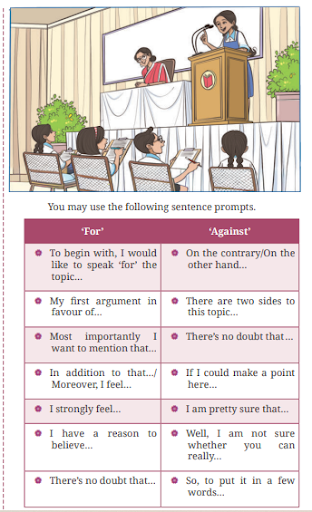
Ans.
Topic 1: It is important to learn a new language apart from your mother tongue.
Good day, everyone. To begin with this topic, I would like to speak ‘for’ the topic, “It is important to learn a new language apart from your mother tongue.”
My first argument in favour of the topic is that learning a new language boosts career prospects. In India, knowing English alongside Hindi or regional languages opens doors to multinational jobs. A person wishing to work or live abroad will need to know the regional languages of the particular country before moving there. Studies show that multilingual people earn 20% more on average. Second, it fosters cultural understanding. Languages carry history, cultural facts, beauty, and values. This builds empathy and reduces cultural barriers. I strongly feel that we cannot establish equality all over the world if we cannot understand other cultures. I have a reason to believe that learning languages involves learning the meaning behind popular sayings, thereby helping understand the culture. Most importantly, I want to mention that it sharpens the brain. Learning new languages stimulates the rigid muscles in our brain and encourages problem-solving when we try to express ourselves properly in a foreign language.
I would like to conclude with the point that learning a new language equips us for success in both personal and professional spheres.
Now, I will be putting forward the discussion ‘against’ the topic.
There is no doubt that knowing multiple languages has significant value, especially in today’s world of networking and globalisation. However, mandating a new one isn’t essential and can harm progress.
Primarily, it overloads students. Students already juggle so many subjects. Adding foreign languages like French and German will create unnecessary pressure on them. CBSE data reveals high dropout rates in language classes due to poor results. Next, technology bridges gaps. Apps like Google Translate make communication instant. I am pretty sure that it would be more beneficial to spend time on STEM or local skills. Moreover, it risks cultural erosion. Prioritising English over Punjabi in Chandigarh weakens regional identity. Institutions should focus on the mother tongue language foremost.
So, to put in a few words, I would like to reference the saying “jack of all, master of none”. If we aim at learning new languages but not strengthening our core in a few languages, we will not be able to articulate our comprehension, listening, reading, and speaking abilities in even one language.
Topic 2: Learning can happen only when you are young.
Good day. My first argument in favour of the topic is that learning happens best when you are young.
Young brains are fresh and ready. They can take in new things quickly. Children remember words, numbers, and skills easily. As people grow older, their brains get full and slow down. It becomes hard to learn new things. In addition to that, young people have more time. They do not have big jobs or family duties. They can study all day without worry. Older people are busy with work and home. They get tired and forget what they learned. Moreover, children love to learn. They are curious and ask many questions. This makes learning fun and fast. Older people sometimes lose this interest. They think learning is too much work. I strongly feel that habits start young. Good study habits form early. Older people find it tough to change old ways.
In short, young people learn faster, deeper, and longer.
Now, I will be putting forward the discussion ‘against’ the topic. I’m not really sure that we can limit learning and impose any sort of barrier.
I am pretty sure that grown-up brains can still learn. They do not stop working. Older people learn from life every day. They use what they know to understand new things better. There’s no doubt that adults have more focus. Young children play and get distracted. Older people pay full attention because they see why learning matters. They learn skills for jobs or family. Moreover, life gives second chances for every opportunity, including learning. Many adults go back to school or take classes. They learn driving, cooking, or computers when they need them. Additionally, older people have patience. They practise slowly and remember well. Young people rush and forget quickly. Adults make learning part of daily life. It is important to remember that everyone learns differently. Some need time to grow before they learn best. Forcing all learning at a young age does not work for everyone. To top this off, today we have books, classes, and helpers for all ages. The Internet and online education have made learning more flexible and accessible. Older people can learn anytime they want.
So, learning happens well at any time. Age is not a limit. Learning never ends.
Writing Task
I. As a socially responsible citizen, you strongly believe that students can contribute significantly in promoting adult literacy. Write a letter to the Editor of a local newspaper emphasising the importance of student participation in adult literacy camps conducted by various organisations. Discuss the benefits of such initiatives for both students and society. Suggest effective ways to spread awareness and encourage more students to volunteer for this noble cause.
A letter to the editor is a formal letter in which the writer gives suggestions and creates awareness on an issue of public interest or an issue already raised in an article/write-up/published letter.
POINTS TO REMEMBER
Format
- Name, designation, address
- Date
- Subject: 4–5 words in title case
- Salutation: Sir/Madam
- Body of the letter: In at least three paragraphs
- Paragraph 1: Statement of problem: Raise the issue by citing some latest news items, survey report or personal experience, etc.
- This is with reference to the article about _______________ dated _______________ in your newspaper.
- As a concerned citizen I would like to draw your attention towards…
- Paragraph 2: Analyse the issue in terms of its causes and consequences.
- The issue at hand affects a large section of society and…
- It is imperative that…
- It would be beneficial if…
- Such initiatives nurture a sense of…
- By engaging in these programmes students…
- Paragraph 3: Offer suggestions/solutions. Request the relevant authorities to take the action and request the editor to publish your views.
- A possible solution to this issue could be…
- One effective way to address this might be…
- Authorities could consider implementing…
- I trust this matter will be considered seriously for the benefit of all.
- I am hopeful that necessary steps will be taken to…
- I hope this letter gets published in the columns of your esteemed daily.
- Complimentary close: Yours truly,
- Language
- Formal, clear, and specific
- Short and to the point sentences
- Purpose stated clearly and concisely
- Relevant details to be given
Ans.
Sector 17, Chandigarh
Chandigarh – 160017
April 3, 2026
The Editor
The Tribune
Sector 17, Chandigarh
Chandigarh – 160017
Subject: Empowering Society Through Student-Led Adult Literacy Drives
Dear Editor,
This is with reference to the article about adult literacy dated April 1, 2026, in your newspaper. I have seen adult literacy in my own home, with my grandparents unable to read fluidly. As a concerned citizen, I would like to draw your attention towards my viewpoint on the matter.
As a socially responsible citizen and student, I strongly believe that young minds like ours hold immense potential to drive adult literacy in India. We have initiatives like literacy camps by NGOs such as Pratham and various other local organisations. Yet, student participation remains low. This is because most adults are not aware of adult literacy camps, and those who are aware seem to be too ashamed and embarrassed to go to one. Admitting weakness is a difficult obstacle as well, and most adults and elderly people would rather rely on technology and the youth than work on their literacy. Additionally, the majority of the youth is not concerned with adult literacy and are more focused on themselves instead of the overall growth of the community.
I urge more youth to volunteer, as it benefits both participants and society at large. For students, these camps build empathy and leadership. Teaching adults hones communication skills, boosts confidence, and offers real-world experience beyond textbooks. I volunteered at a camp last year and saw how explaining simple words ignited joy in learners. Society gains even more: literate adults secure better jobs, make informed health choices, and vote wisely, fostering inclusive growth. To spread awareness and encourage volunteers, schools should integrate camp credits into curricula, like NSS programmes. Social media campaigns with hashtags like #StudentsForLiteracy can go viral, while partnerships with influencers and local celebrities could inspire participation. Weekly awareness drives in colleges, featuring success stories, would motivate action. Lastly, the adults who overcome their embarrassment and enrol themselves on the programmes should be acknowledged, so that the others feel encouraged to take the first step.
Students stepping up today can build a literate India tomorrow. I call on peers to join these noble efforts and newspapers like yours to amplify this cause.
Yours sincerely,
[Your Name]
Learning Beyond the Text
I. India has 22 major languages according to the Eighth Schedule of the Indian Constitution. Each language has its own unique identity. Talk to your classmates and teacher and complete the given table with words from any five Indian languages.
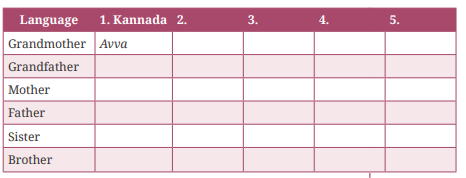
Ans.
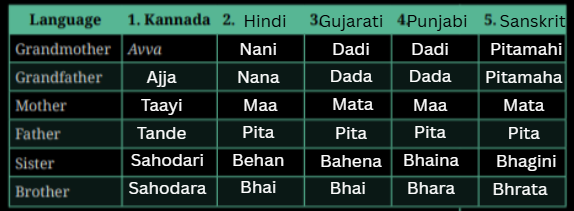
CBSE Class 9 English Chapter 1 How I Taught My Grandmother to Read Extract-Based Questions
A. “I could’ve asked somebody in this village but I was too embarrassed to do so. I felt so very much dependent and helpless. We are well off but what use is money when I cannot be independent.”
1. Who is ‘I’ in these lines?
Ans. ‘I’ in these lines is the grandmother.
2. Why did she feel dependent?
Ans. She felt dependent because she was illiterate. She could not read on her own.
3. What does grandmother mean by ‘I could’ve asked somebody’ ?
Ans. The grandmother meant by ‘I could’ve asked somebody’ that she could’ve asked somebody to read the story ‘Kashi Yatre’ to her.
4. Why would she feel embarrassed ?
Ans. She feels embarrassed to reveal her inability to read and write.
5. What is ‘being independent’ according to her ?
Ans. To be independent, according to her, is to be self-reliant, not seeking anybody’s help.
B. “We have always touched the feet of God, elders and teachers. We consider that as a mark of respect. It is a great tradition but today the reverse has happened. ”
1.To which traditional Indian custom is the speaker referring to in the above extract?
Ans. The traditional Indian custom referred to is touching the feet of God, elders and teachers.
2. What does the speaker consider as a mark of respect in the context of the story?
Ans. The speaker considers touching the feet of elders as a mark of respect.
3.What is the meaning of ‘reverse’? What reverse had happened on that day?
Ans. Reverse means ‘change something to the opposite’. On that day, grandmother had touched the feet of her granddaughter.
4. What does the term “great tradition” refer to?
Ans. The term “great tradition” refers to the tradition of touching the fret of elders.
5. Why had this reverse happened?
Ans. The “reverse” had happened as the granddaughter had taught her grandmother to read and write.
C. “She nodded but did not reply. I did not understand and forgot about it. In the night after dinner, we were sleeping on the open terrace of the house. It was a summer night and there was a full moon.”
1. Who are ‘she’ and ‘I’ in the above extract?
Ans. ‘She’ and ‘I’ in the above extract are the grandmother and the narrator respectively.
2. What did ‘I’ forget about?
Ans. ‘I’ forgot about the grandmother’s crying and sadness.
3.What do you mean by the word ‘nodded’?
Ans. Moving one’s head in agreement is referred to as ‘nodded’.
4. What was the grandmother upset about ?
Ans. The grandmother was upset because she was not able to read.
5. Why did the grandmother nod but not reply, and what is the setting described in the night after dinner?
Ans. The grandmother’s nod without a reply suggests a silent acknowledgment or agreement. As for the setting after dinner, the scene unfolds on the open terrace of the house on a summer night with a full moon. This setting provides a tranquil and atmospheric backdrop.
D. ‘When I came back to my village, I saw my grandmother in tears. I was surprised, had never seen her cry even in the most difficult situations. What had happened? I was worried.”
1. Why was the grandmother in tears?
Ans. The grandmother was in tears because she realized how helpless and dependent she was because of illiteracy.
2. Where had the narrator gone?
Ans. The narrator had gone for a wedding to the neighboring village.
3. Why was the grandmother so depressed?
Ans. The grandmother was depressed because of her inability to read Triveni’s story by herself.
4. What kinds of emotion were expressed in this extract? What is the word/phrase used to describe sadness?
Ans. Emotions such as Sadness, surprise/shock, anxiety were expressed in the extract. The phrase ‘in tears’ and the word ‘cry’ describes sadness.
5. What does the last line of the extract tell you about the grandmother’s character?
Ans. The last line tells us that the grandmother was very strong, resilient and tough in usual situations therefore, her distressing state shocked the narrator.
Class 9 How I Taught My Grandmother to Read Multiple Choice Questions
Q1. What is the name of the novel the grandmother loved?
A. Varanasi Yatre
B. Kashi Yatra
C. Kashi Yatre
D. Kannada Yatra
Ans. C. Kashi Yatre
Q2. Where was the novel featured in as a serial?’
A. Hindustan Times
B. Karmaveera
C. Tribune
D. Kannada Prabha
Ans. B. Karmaveera
Q3. Who wrote Kashi Yatre?
A. Trivedi
B. Triveni
C. Krishtakka
D. Sudha Murthy
Ans. B. Triveni
Q4. What did Sudha Murthy call her grandmother?
A. Grandma
B. Appa
C. Nani
D. Avva
Ans. D. Avva
Q5. What was the grandmother’s name?
A. Sudha Murthy
B. Kritika
C. Krishtakka
D. Triveni
Ans. C. Krishtakka
Q6. How old was the grandmother?
A. 62
B. 60
C. 69
D. 65
Ans. A. 62
Q7. What were the two emotions the grandmother felt when she thought about going to the village and asking someone to read to her?
A. Joy and happiness
B. Excitement and eagerness
C. Fear and anger
D. Embarrassment and helplessness
Ans. D. Embarrassment and helplessness
Q8. What did the narrator feel when she saw her grandmother crying?
A. Fear
B. Anger
C. Surprise
D. Confusion
Ans. C. Surprise
Q9. When the narrator made fun of her grandmother, what did she point out?
A. Grandmother’s age
B. Grandmother’s grey hair
C. Grandmother’s wrinkles
D. All of the above
Ans. D. All of the above
Q10. What did the grandmother want to learn?
A. How to drive a car
B. How to read and write the Kannada language
C. How to climb a mountain
D. How to dance
Ans. B. How to read and write the Kannada language
Q11. Which festival was kept as the deadline?
A. Diwali
B. Onam
C. Hampi
D. Dassara
Ans. D. Dassara
Q12. Who was the narrator’s first student?
A. Her mother
B. Her grandfather
C. Her grandmother
D. Her sister
Ans. C. Her grandmother
Q13. What did the narrator do later on in her life?
A. Become a public speaker
B. Become a teacher
C. Become a dancer
D. Become an actress
Ans. B. Become a teacher
Q14. What gift did the grandmother give to the narrator?
A. Book
B. Frock
C. Flowers
D. Jewellery
Ans. B. Frock
Q15. When did the narrator know that her student passed with flying colors?
A. When she read the newspaper
B. When she read the subtitles of a movie
C. When she read the name of the novel and the writer
D. All of the above
Ans. C. When she read the name of the novel and the writer
Q16. What did the narrator teach later on to hundreds of students?
A. Computer Science
B. Kannada
C. English
D. None of the above
Ans. A. Computer Science
Q17. What Puja was kept as the deadline?
A. Saraswati Puja
B. Vishnu Puja
C. Lakshmi Puja
D. None of the above
Ans. A. Saraswati Puja
Q18. Touching the feet of God, elders, and teachers is seen as a mark of ______ .
A. Admiration
B. Respect
C. Humility
D. Gratitude
Ans. B. Respect
Q19. Which of these is NOT the reason why she never went to school as a child?
A. She got married at a young age.
B. Education was not considered essential for girls.
C. She was too ill.
D. She was too busy with family and housework affairs.
Ans. C. She was too ill.
Q20. What is the theme of the chapter “How I Taught My Grandmother to Read”?
A. Never give up
B. Importance of hardwork
C. Importance of good health
D. Lifelong learning
Ans. D. Lifelong learning
CBSE Class 9 English Kaveri Book Chapter 2 – How I Taught My Grandmother to Read Extra Question and Answers
Q1. Who is the author of “How I Taught My Grandmother to Read”?
Ans. Sudha Murthy is the author of “How I Taught My Grandmother to Read.”
Q2. How does Sudha Murthy describe her grandmother’s initial reaction to learning to read?
Ans. Sudha Murthy’s grandmother was initially hesitant and fearful about the prospect of learning to read.
Q3. How did Sudha Murthy’s determination impact the teaching process?
Ans. Sudha Murthy’s determination helped her overcome obstacles and persist in teaching her grandmother, showcasing her commitment to the cause.
Q4. The grandmother touched the feet of her granddaughter. How did she justify this gesture of hers?
Ans. The grandmother justified touching her granddaughter’s feet by considering her a teacher who imparted knowledge with affection. She believed that teachers, regardless of age and gender, deserve respect, aligning with the tradition of touching feet as a sign of reverence.
Q5. The grandmother in the story “How I Taught My Grandmother to Read” was a very determined woman, yet at the same time very emotional. Justify.
Ans. The grandmother’s determination was evident in her self-imposed deadline and hard work to learn. Simultaneously, her emotional side surfaced as she identified with the novel’s characters and expressed gratitude by touching her granddaughter’s feet.
Q6. What was Sudha Murthy’s grandmother’s attitude towards learning at the beginning?
Ans. Initially, Sudha Murthy’s grandmother was reluctant and unsure about the idea of learning to read.
Q7. Describe the manner in which the grandmother would listen to the story?
Ans. The grandmother listened to the story with intense concentration, relating to the characters. She immersed herself to the extent of forgetting other tasks, later demonstrating an impressive ability to recall and repeat the entire text verbatim.
Q8. How had the narrator planned to surprise her grandmother? How was she herself surprised?
Ans. The narrator planned to surprise her grandmother with the novel “Kashi Yatre.” However, she was surprised when her grandmother, in turn, gifted her frock material and touched her feet, expressing unexpected gratitude.
Q9. What was the nature of the debate in the temple courtyard, and why did the narrator struggle to comprehend its significance?
Ans. The women passionately debated the characters’ fate, actions, and societal changes depicted in ‘Kashi Yatre.’ The narrator, being just twelve years old, found it challenging to grasp the nuanced reasons and outcomes of the discussions, except for the understanding that the women were dissecting the life of the novel’s central character.
Q10. Analyze the emotional impact of literacy on Sudha Murthy’s grandmother.
Ans. Literacy had a profound emotional impact on Sudha Murthy’s grandmother. In the chapter “How I Taught My Grandmother to Read,” Sudha Murthy likely paints a vivid emotional landscape centered around the transformative power of literacy. As she undertakes the role of an educator for her grandmother, the emotional impact on her grandmother becomes palpable. The process of learning to read is not merely an acquisition of a skill but a journey that fosters a deep sense of accomplishment. The act of teaching becomes a conduit for generational bonding, creating a shared experience that strengthens their connection. This chapter likely encapsulates a blend of emotions—joy, nostalgia, and perhaps even a touch of humor—as literacy brings not just a practical skill but a transformation in the emotional fabric of the family. Sudha Murthy’s narrative may resonate with themes of respect, gratitude, and cultural significance, portraying literacy as a gateway to emotional enrichment and familial understanding.
good
understood everything thankyou
Nicely presented the answer of the text. Language is easy for students to understand
wow super content for teachers as well as students
i am a pgt english teacher always take help from your website and content
please provide me your full book as a specimen if you do so
i am eagerly waiting for your reply
why is the lady learning kannada couldn’t she learn english she could read many novels then, and even kashi yatre in english.?