
Magnifying Glass Summary and Explanation
CBSE Class 8 English Unit 5 Science and Curiosity Chapter 2 Magnifying Glass Summary, Explanation along with Difficult Word Meanings from Poorvi Book
Magnifying Glass Summary– Are you looking for the summary, theme and lesson explanation for CBSE Class 8 English Unit 5 Science and Curiosity Chapter 2 Magnifying Glass from English Poorvi Book. Get Lesson summary, theme, explanation along with difficult word meanings
CBSE Class 8 English Unit 5 Science and Curiosity Chapter 2 Magnifying Glass
By Walter de la Mare
The poem describes the wonders that can be revealed by the magnifying power of a magnifying glass. When we look at things through a magnifying glass, their size increases and then, we can spot the tiny details also.
- Magnifying Glass Summary
- Magnifying Glass Summary in Hindi
- Magnifying Glass Theme
- Magnifying Glass Explanation
- Magnifying Glass Poetic Devices
Related:
Magnifying Glass Summary
The poet describes the magnifying glass as a round lens that can reveal something small, like the process behind a magic trick. Therefore, the magnifying glass can show us how the object or being we are inspecting under it functions or is built. The poet inspects the following under a magnifying glass: chalk, moss, forests, flowers, trees, a drop of water, beehives, spiders, and the moon. Under the appropriate power of a magnifying glass, the lens can zoom into spinnerets, which are the organs from which spiders can produce web-silk. The magnifying glass can be used to see how the spider moves quickly to produce and make the spiderweb. The poet finds the flies that fly into the trap to be silly and foolish. The poet zooms in on the moon. A telescope has a magnifying glass, which can be used to zoom in so much on the moon that they feel like they are walking on the moon.
Summary of the Poem Magnifying Glass in Hindi
कवि आवर्धक काँच को एक गोल लेंस के रूप में वर्णित करता है जो किसी छोटी सी चीज़ को प्रकट कर सकता है, जैसे किसी जादू के पीछे की प्रक्रिया। इसलिए, आवर्धक काँच हमें दिखा सकता है कि जिस वस्तु या प्राणी का हम उसके नीचे निरीक्षण कर रहे हैं, वह कैसे कार्य करती है या कैसे बनी है। कवि आवर्धक काँच के नीचे निम्नलिखित का निरीक्षण करता है: चाक, काई, जंगल, फूल, पेड़, पानी की एक बूँद, मधुमक्खियों के छत्ते, मकड़ियाँ और चाँद। आवर्धक काँच की उपयुक्त शक्ति के तहत, लेंस स्पिनरेट्स पर ज़ूम कर सकता है, जो वे अंग हैं जिनसे मकड़ियाँ जाला-रेशम का उत्पादन करती हैं। आवर्धक काँच का उपयोग यह देखने के लिए किया जा सकता है कि मकड़ी मकड़ी का जाला बनाने और बनाने के लिए कितनी तेज़ी से चलती है। कवि को जाल में फँसने वाली मक्खियाँ मूर्ख और नासमझ लगती हैं। कवि चाँद पर ज़ूम करता है। एक दूरबीन में एक आवर्धक काँच होता है, जिसका उपयोग चाँद पर इतना ज़ूम करने के लिए किया जा सकता है कि उन्हें ऐसा लगे कि वे चाँद पर चल रहे हैं।
Theme of the Poem Magnifying Glass
The poem is centred on the importance and beauty of minute details. A magnifying glass can zoom into small parts of an object or creature, showing us the composition, history, beauty, and other intriguing aspects of the thing or being that we zoom into. The poem shows the usefulness of a magnifying glass, its features, and how it can give more knowledge to a curious mind.
Magnifying Glass Poem Explanation
Stanza:
With this round glass
I can make Magic talk—
A myriad shells show
In a scrap of chalk;’
Word-meanings:
myriad: countless or extremely great in number
shells: outer coverings
Explanation: The glass in the magnifying glass is round in shape. The magnifying glass can be used to see each magical trick that a magician performs. It can magnify the outer surface of chalk, showcasing the power of the magnifying glass and how it can unravel the intricate patterns and history of chalk. On having a close look at a piece of chalk, he sees the pattern of shells on its surface.
Stanza:
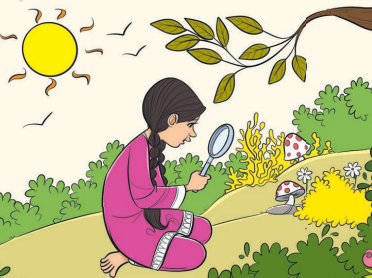
Of but an inch of moss
A forest—flowers and trees;
A drop of water
Like hive of bees.
Explanation: The magnifying glass can zoom into moss, forests, flowers, trees, a drop of water, and a bee hive, revealing interesting, minute details of each of these items.
Stanza:
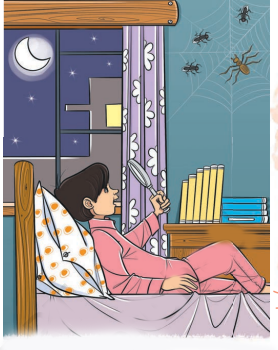
I lie in wait and watch
How the deft spider jets
The woven web-silk
From his spinnerets;
Word-meanings:
deft: neatly skilful and quick in one’s movements
jets: forced out of a small opening
spinnerets: any of several different organs through which the silk, gossamer, or thread of spiders, silkworms, and certain other insects is produced
Explanation: The poet used his magnifying glass and watched a spider weave its web patiently and skillfully. The round glass showed how neatly and quickly the spider would produce a rapid stream of web-silk from the spinnerets and weave it into a spider web where it would live.
Stanza:
The tigerish claws he has!
And oh! the silly flies
The stumble into his net—
With all those eyes!
Explanation: The poet used the magnifying glass to study the spider more. The spider had tigerish or very sharp claws like tigers have. The poet would see how flies would get caught into the spider web. The poet would find the flies silly and foolish because of how the flies would get so easily caught in the spider’s web-silk despite having eyes which perhaps overlooked the web.
Stanza:
Not even the tiniest thing
But this my glass
Will make more marvellous
And itself surpass.
Word-meanings:
marvellous: excellent, extraordinary
Explanation: This stanza shows that the poet was proud of his magnifying glass. Nothing could go unnoticed by the magnifying glass because it zoomed in and highlighted each tiny detail to a huge size. The magnifying glass made every small thing interesting and extraordinary because of its magnifying feature.
Stanza:
Yes, and with lenses like it,
Eyeing the moon,
‘Twould seem you’d walk there
In an afternoon!
Explanation: Because of the magnifying lens of the magnifying glass, the moon can also be magnified. According to the poet, the magnifying glass can zoom in on the moon so much that they feel they could walk on it. This is an exaggeration.
Magnifying Glass Poetic Devices
Rhyming Scheme: The rhyming scheme of each stanza is abcb.
Alliteration: It is the repetition of a consonant sound in one line at the beginning of the words. Like, “Will make more marvellous” ‘m’ sound repeats at the start of make more marvellous. Wait and watch, woven web-silk, shells show, he has, lenses like.
Simile: It is the description of an object or person or animal by comparing it something or someone else with the help of ‘as’ and/or ‘like’. For example, “A drop of water
Like hive of bees.”
Metaphor: It is a direct comparison between two objects. For example, “With this round glass
I can make Magic talk—”
Imagery: It is a vivid description of someone, something, or a scene that invokes the reader’s imagination. For explanation, “Eyeing the moon,‘Twould seem you’d walk there in an afternoon!”
Hyperbole – use of exaggeration like the poet says –
lenses like it,
Eyeing the moon,
‘Twould seem you’d walk there
In an afternoon!
Where he implies that the magnifying glass will make the moon so huge that it will seem that we are walking on it.
Personification: It is giving an object or non-living component of the world human qualities. For example,
“With this round glass
I can make Magic talk—”
Conclusion
This post on NCERT Class 8 English Poorvi book Unit 5 Science And Curiosity Chapter 2 Magnifying Glass. Students can check out the summary, word meanings and explanation of the lesson to get a better grasp and answer questions in the exam.