
Waiting for the Rain Summary and Explanation
CBSE Class 8 English Unit 4 Environment Chapter 3 Waiting for the Rain Summary, Explanation along with Difficult Word Meanings from Poorvi Book
Waiting for the Rain Summary– Are you looking for the summary, theme and lesson explanation for CBSE Class 8 English Unit 4 Environment Chapter 3 Waiting for the Rain from English Poorvi Book. Get Lesson summary, theme, explanation along with difficult word meanings
CBSE Class 8 English Unit 4 Environment Chapter 3 Waiting for the Rain
By Kamakshi Balasubramanian
The story gives us a sneek peek into the life of an Indian farmer and his dependence on rains. A chance meeting sensitize him towards the working of nature and imbibes acceptance in him.
- Waiting for the Rain Summary
- Waiting for the Rain Summary in Hindi
- Waiting for the Rain Theme
- Waiting for the Rain Explanation
Related:
- Waiting for the Rain Question Answers
- Waiting for the Rain Character Sketch
- Class 8 English Poorvi Book Lesson Notes
Waiting for the Rain Summary
Velu, a farmer is desperately waiting for the rain. He looks at the blazing hot Sun and prays for rain. He grows grains like jowar and dhal on his land. He has owned a piece of land for the last six years. Since then, he has worked continuously day and night to harvest it. Velu needs the rain to till and plough the land. The summer has ended and months have passed but there is no rain. The land is lying vacant, has dried up and developed cracks.
His companions also worry over the unpredictable weather. They suggest to seek an astrologer’s advise. However, Velu decides to visit the weather office in the city. The officials are clueless because the conditions are favourable, yet there is no rain.
Velu is sad and feels tired on his way back. He decides to rest for a while. As he reaches the shade of a large tree, he mmets and old woman who has a wrinkled and smiling face. Velu asks her the reason for her smile because as it has not rained, there is nothing to be happy about. The woman stops smiling and understands Velu’s sentiments. She comments that Velu works too hard. Velu replies that he only does what all farmers do. The woman asks him to understand that no rain is nature’s way of giving rest to the exhausted earth that has been working continuously for several thousand years. The Earth is also a living being and it too gets tired. It is lying barren and looking at the sky above. If it would have rained, again activity on it would have started and it would have been put to use. By not sending rain, nature is allowing the land to rest. So that later, it gets energised and gets back to work again. She asks Velu to wait patiently. She leaves and Velu tooo walks back home. As the sun sets, velu feels a breeze and a drop of rain falls on his shoulder. Velu sees clouds gathering in the sky and a storm is awaited. Thus he becomes happy to see the rain come.
Summary of the Lesson Waiting for the Rain in Hindi
वेलू, एक किसान, बेसब्री से बारिश का इंतज़ार कर रहा है। वह तपते सूरज को देखता है और बारिश के लिए प्रार्थना करता है। वह अपनी ज़मीन पर ज्वार और दाल जैसे अनाज उगाता है। पिछले छह सालों से उसके पास ज़मीन का एक टुकड़ा है। तब से, वह इसे काटने के लिए दिन-रात लगातार काम करता है। वेलू को ज़मीन जोतने के लिए बारिश की ज़रूरत है। गर्मियाँ खत्म हो गई हैं और महीनों बीत गए हैं लेकिन बारिश नहीं हुई है। ज़मीन खाली पड़ी है, सूख गई है और उसमें दरारें पड़ गई हैं।
उसके साथी भी अप्रत्याशित मौसम को लेकर चिंतित हैं। वे किसी ज्योतिषी की सलाह लेने का सुझाव देते हैं। हालाँकि, वेलू शहर के मौसम कार्यालय जाने का फैसला करता है। अधिकारी बेख़बर हैं क्योंकि परिस्थितियाँ अनुकूल हैं, फिर भी बारिश नहीं हो रही है।
वेलू उदास है और वापस आते समय थका हुआ महसूस करता है वेलु उससे उसकी मुस्कुराहट का कारण पूछता है क्योंकि चूँकि बारिश नहीं हुई है, इसलिए खुश होने की कोई बात नहीं है। महिला मुस्कुराना बंद कर देती है और वेलु की भावनाओं को समझती है। वह टिप्पणी करती है कि वेलु बहुत मेहनत करता है। वेलु जवाब देता है कि वह केवल वही करता है जो सभी किसान करते हैं। महिला उसे यह समझने के लिए कहती है कि बारिश न होना प्रकृति का उस थकी हुई धरती को आराम देने का तरीका है जो कई हज़ार वर्षों से लगातार काम कर रही है। पृथ्वी भी एक जीवित प्राणी है और वह भी थक जाती है। यह बंजर पड़ी है और ऊपर आसमान को देख रही है। अगर बारिश होती, तो फिर से इस पर गतिविधि शुरू हो जाती और इसका उपयोग किया जाता। बारिश न भेजकर, प्रकृति भूमि को आराम करने दे रही है। ताकि बाद में, यह ऊर्जावान हो जाए और फिर से काम पर लग जाए। वह वेलु को धैर्यपूर्वक प्रतीक्षा करने के लिए कहती है। वह चली जाती है और वेलु भी घर वापस चला जाता है
Theme of the Lesson Waiting for the Rain
The story conveys the message that we must respect and accept nature. Creations of God are living entities and they also get tired. Thus, they need time to rest, relax and rejuvenate. We must not put excessive pressure on the bounties of nature like mother earth. We also get to see the life of a farmer who is solely dependent on the natural occurrences like rains.
Waiting for the Rain Lesson Explanation
I
Passage: “I hope it rains at least today,” Velu thought, as he opened his eyes.
Velu was a farmer. The sun was beginning to rise, glowing crimson like fire. Velu scanned the sky. There was not a cloud.
“It doesn’t look encouraging,” he muttered to himself and got up.
Word-meanings:
crimson: deep red colour
Explanation: Velu was a farmer. He was working in the fields during the early morning. The sun was rising, as red as a fire. It was a hot sunny day. He hoped that it would rain that day so that he could till the fields. When Velu searched for a cloud in the morning sky, he saw that there was not one in sight. He felt a bit discouraged by the cloudless sky.
Passage: Rain or no rain, a farmer wakes up early. Velu worked hard. His piece of land never failed him. Season after season he cultivated it, harvesting jowar one season and dhal the next. Throughout the year he worked, never thinking of rest or taking a holiday. For nearly six years it had been so, ever since he had got his own piece of land.
Explanation: However, he did not let the cloudless sky stop him from working in the fields. He was still confident because his land always gave him a good harvest. Velu grew jowar and dhal in a seasonal order. He had this land for six years, and he worked hard and nonstop. He never took time to rest or go on a holiday.
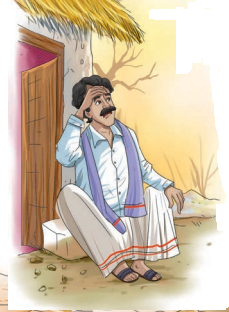
Passage: But this year turned out to be different. At the end of summer, the rains didn’t come. Velu and his neighbours waited, but their waiting didn’t end. Days, weeks and months passed, and still there was no rain.
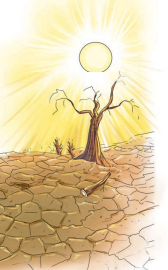
The fields lay untended, the earth hardened, crusted and cracked. The barren land looked forlorn and the farmers lived entirely on hope. Every day they hoped that the rains would come.
Word-meanings:
crusted: formed a hard outer layer
forlorn: sad and neglected
Explanation: However, this year, his hopes did not get fulfilled. This summer season, it did not rain at all and his crops were unirrigated. Velu and his neighbouring farmers waited and waited. The arrival of rain would have ended their wait, but it did not arrive. The fields were dry, the soil became hard and cracked due to no water. Therefore, the fields were dehydrated. The lack of irrigation made the fields look sad and neglected. The farmers could only hope for rain to come and they hoped everyday for it.
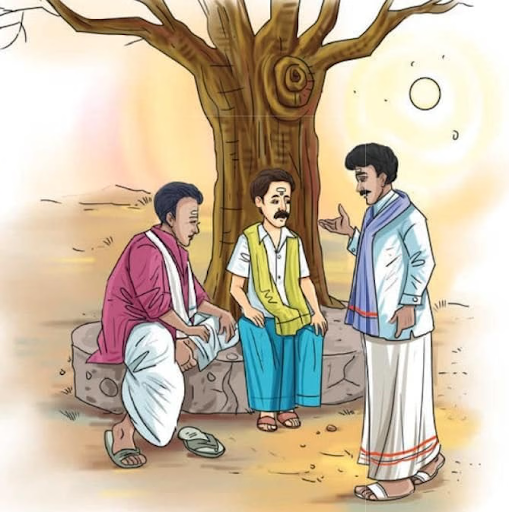
Passage: Someone said, “We ought to talk to some astrologers. They can tell us what will please the heavens and the heavens will send down rain.”
Velu didn’t agree. He said, “The rains came all these years without any such consultations; I can’t see how talking to astrologers will bring rain.”
Word-meanings:
please: to make someone happy
consultations: discussions
Explanation: One of the farmers suggested that they discuss this problem with the astrologers. The astrologers could tell the farmers what they needed to do to make the gods in heaven happy. According to them, rain would come if they pleased the heavens. However, Velu did not think the astrologers could help. He said that the rain used to come without any such discussion for so many years. This shows that Velu was quite logical.
Passage: He decided to go to the weather office in the city and talk to someone. But the people at the weather office said they couldn’t really tell him when the sky would gather clouds and bring rain. “We are at a loss ourselves!” they exclaimed. “So many favourable conditions but still no rain. Very odd!”
Explanation: Velu planned to visit the weather office in the city and ask them. The officials failed to predict if and when the clouds would appear and bring rain. They found it strange because there were favourable conditions for rain but there wasn’t any.
Passage: Velu, too, was at a loss. He walked back to the village, tired, and dejected. He was thirsty and the dust made him cough and sneeze. He decided to rest for a while.
Word-meanings:
dejected: sad and disappointed
Explanation: Velu also failed and walked back to the village. He was tired and sad. He was thirsty and the dust irritated him. Velu decided to take some rest.
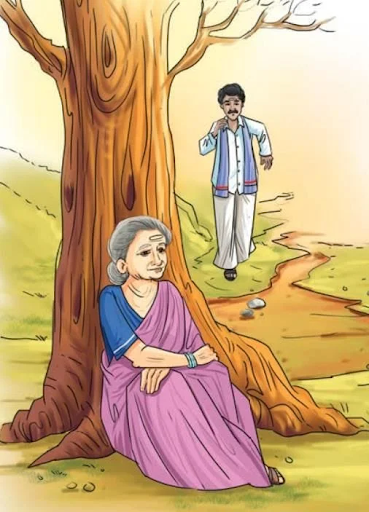
Passage: He saw a large tree. Its shade was cool and inviting. As he sat down, he noticed that an old woman was also sitting there, sheltering from the sun.
Explanation: Velu saw a huge shady tree which had a cool shade. He sat and saw an old woman who was sitting there in the shade of the tree protecting her from the hot sun.
II
Passage: Her skin was wrinkled, but her eyes sparkled when she smiled. She looked at Velu and her smile grew wider, her wrinkles deeper.
“What are you smiling at, Amma?” Velu asked. “Without the rains, there’s nothing to smile about.”
“Yes, yes, you’re right,” the old woman said, the smile leaving her lips.
“I wonder what I have done to deserve this,” Velu began. “I have worked hard and honestly. Yet I am being punished. Without the rains I can’t till the land. If I don’t till the land no crop will grow.
Word-meanings:
Wrinkled: having deep lines
Explanation: The old woman’s skin had deep lines due to aging. Her eyes shone as she smiled. She saw Velu and her smile increased and wrinkles became deeper. Velu asked her why she was smiling because he was sad due to the failure of the rain. He added that as it hadn’t rained, there was nothing to smile about. The woman agreed and stopped smiling. Velu complained that what was his fault that he saw such a day. He had worked hard with honesty but still he was being punished. He could not till his land and no crop would grow.
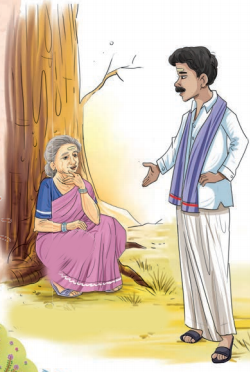
Passage: What will happen to me? How shall I feed my family?” he asked, somewhat bitterly. He wasn’t speaking to anyone in particular, but the old lady thought that he was opening his heart to her.
Word-meanings:
bitterly: hurtfully
Explanation: Velu worried about the future of his family. He spoke to himself but the old woman thought that he was sharing his sorrow with her.
Passage: “Perhaps you have worked too hard,” she said.
“What do you mean? Can anyone work too hard? I have only done what any hard-working farmer would do. I shall work and never rest until I am too old. This is the first season in five, no, six years that I have not sown, nor ploughed. Oh, it is hard not to be able to work…” said Velu a little angrily.
Explanation: The old woman guessed that Velu had worked very hard. Velu said that no one could work too hard. He had just done what a hard working farmer would do. Velu said that he would work continuously till he became old. It was the first time in the last six years that he hadn’t sown nor ploughed his field. Velu was angry and complained that it was tough not to be able to work for a hardworker like Velu.
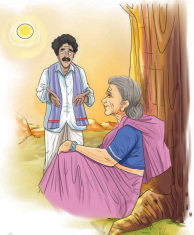
Passage: “But my son, that is what I am talking about. You have strength now. You can work without a break. But have you thought about the land? The earth works, too, when you plough, and sow, and plant. The earth has worked for years, centuries, in fact, thousands of years. The soil, the land, the earth… shouldn’t someone let the land rest a bit?” the old woman said, softly, smiling.
Explanation: The old woman also said that she was talking of this only. She said that in the present Velu had strength and could work continuously but he hadn’t thought about the land. The earth also worked when he ploughed, sowed and planted the field. The earth had been working for several thousand years and someone had to let it rest for a while.
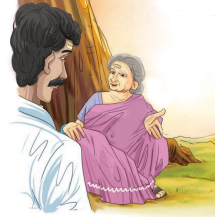
Passage “Rest? Let the land rest? I don’t understand,” Velu looked at her, a little puzzled.
“Yes, my son, that is the difficulty. You don’t realise that the earth is old… But Nature is a mother to all of us. To you and to me. And to the trees, the water and the soil. She takes care to give her children the rest they need…”
Velu began to understand.
Explanation: Velu was confused what she meant by saying that land needed rest. She added that this was the difficulty. He didn’t realize that the earth was old and nature was our mother. Humans, trees, water and soil were nature’s children. Mother nature took care of its children and decides if they need rest. Velu started understanding her.
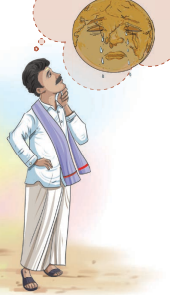
Passage: “When the rains don’t come, you are dejected. But in that way the land is left alone. The land lies undisturbed, staring at the sky, resting… And when the rains come, it will spring back into activity, fresh and ready for your crop. Go home, my son, Nature knows a thing or two… go home,” she said, and got up.
Word-meanings:
Dejected: sad
Explanation: The woman said that Velu was sad because it hadn’t rained but due to the lack of rain, the land was left alone. The land lied, rested and looked at the sky above. When it would rain, the land would get back into action with freshness and would be ready for harvest. She asked Velu to go back home. Nature was intelligent. She stood up.
Passage: She walked away. After a while Velu, too, got up and walked home-ward. He thought about the land, his beloved piece of land, which, if he were to believe the old woman, was perhaps breathing peacefully, taking a break from the constant, ceaseless year-round cultivation.
Word-meanings:
ceaseless: continuous
Explanation: The old woman walked away and after sometime Velu also returned home. He thought of his precious land and as per the woman, it was lying peacefully and resting. It was taking a break from the continuous work that it had been doing.
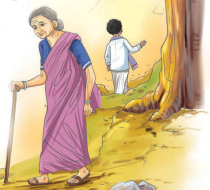
Passage: “Perhaps she is right,” he thought, as he approached the village. It was already evening. The sun was low in the sky. And… what was that? Velu felt a cool breeze on his back.
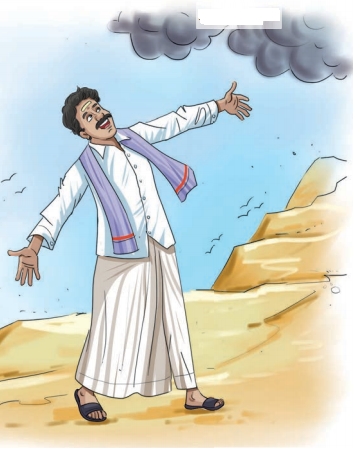
Then he felt a tiny drop on his shoulder. He looked up. Yes… the clouds were gathering in the distance. It was growing dark. Soon there would be lightning. And thunder. And sweet, fragrant rain.
Velu ran home, laughing and happy.
Word-meanings:
Approached: went closer
Explanation: Velu thought that the waman was right. He reached the village and it was evening by then. The sun was about to set. He felt a cool wave of wind and a drop of rain hit his shoulder. There were clouds in the sky, it was getting dark. Velu thought that a storm was round the corner and it would rain. He was now happy and laughed as he ran towards his home.
Conclusion
This post provides the summary, explanation and word meanings of the lesson Waiting for the Rain from Unit Environment of Class 8 English Poorvi book. Students can get a quick recap of the story with the help of this post.