
CBSE Class 8 English Unit 4 Environment Chapter 2 Harvest Hymn Important Question Answers from Poorvi Book
Class 8 English Harvest Hymn Question Answers – Looking for questions and answers for CBSE Class 8 English Unit 4 Environment Chapter 2 Harvest Hymn? Look no further! Our comprehensive compilation of important questions will help you brush up on your subject knowledge. Practising Class 8 English question answers can significantly improve your performance in the exam. Improve your chances of scoring high marks by exploring Unit 4 Environment Chapter 2 Harvest Hymn now. The questions listed below are based on the latest CBSE exam pattern, wherein we have given NCERT solutions to the chapter’s extract-based questions, multiple choice questions and Extra Question Answers
Also, practising with different kinds of questions can help students learn new ways to solve problems that they may not have seen before. This can ultimately lead to a deeper understanding of the subject matter and better performance on exams.
- Harvest Hymn NCERT Solutions
- Harvest Hymn Grammar Exercises
- Harvest Hymn Extract Based Questions
- Harvest Hymn Multiple Choice Questions
- Harvest Hymn Extra Question Answers
Related:
Harvest Hymn Textbook Questions (NCERT Solutions)
Exercises
Let us do these activities before we read.
I. Work in pairs and share your responses with your classmates and teacher.
1. India celebrates many harvest festivals. When is the harvest festival celebrated in your region and how is it celebrated?
Ans. The different harvest festivals are Lohri in Punjab, Makar Sakranti in Haryana and Punjab, Magh Bihu in Assam, Poush Parbon in West Bengal, Nuakhai in Odisha, Pongal in Tamil Nadu, Onam in Kerala, Ugadi in Andhra Pradesh, Telangana, and Karnataka, Gudi Padwa in Maharashtra, and Uttarayan in Gujarat.
2. A hymn refers to a song of praise.
(i) To whom do we offer a hymn?
(ii) When and where do we sing a hymn?
(iii) Why do we offer it?
Ans. (i) We offer a hymn to someone whom we idolise or admire or respect or are grateful to.
(ii) We sing hymns in places of worship during rituals or celebratory ceremonies.
(iii) We offer our hymns to display our respect, admiration and gratitude to the object centered around the hymn.
II. Some poets and authors use words that are no longer a part of common usage. Such words are called archaic words.
Work in pairs. Read the sentences given below. Match the underlined archaic words in Column 1 with their meanings in Column 2. Share your answers with your classmates and teacher.
‘Thou art my friend, and I trust thee. Thy kindness is great, and everything that is mine is thine.’
| Column 1 | Column 2 |
| 1. thou | (i) yours |
| 2. art | (ii) you (object) |
| 3. thee | (iii) you (subject) |
| 4. thy | (iv) are |
| 5. thine | (v) your |
Ans.
| Column 1 | Column 2 |
| 1. thou | (iii) you (subject) |
| 2. art | (iv) are |
| 3. thee | (ii) you (object) |
| 4. thy | (v) your |
| 5. thine | (i) yours |
III. Work in pairs. Read the paragraph and select the correct meaning for each underlined word from the options given below. Share your answers with your classmates and teacher.
Under the golden 1. radiance of the evening sun, the villagers gathered to pay 2. tribute to their 3. cherished elder, who had dedicated his life to their well-being. His wise 4. counsel had guided generations, steering them through challenges. Known for his 5. munificent spirit, he never hesitated to share his resources generously.
| 1. radiance | : | (i) glow | (ii) brilliance |
| 2. tribute | : | (i) respect | (ii) gratitude |
| 3. cherished | : | (i) preserved | (ii) loved |
| 4. counsel | : | (i) advice | (ii) decision |
| 5. munificent | : | (i) rich | (ii) generous |
Ans.
| 1. radiance | : | (i) glow | (ii) brilliance |
| 2. tribute | : | (i) respect | (ii) gratitude |
| 3. cherished | : | (i) preserved | (ii) loved |
| 4. counsel | : | (i) advice | (ii) decision |
| 5. munificent | : | (i) rich | (ii) generous |
Let us discuss
1. Write the stanza number for the main idea of each stanza given below. Share your answers with your classmates and teacher.
| 1. The speakers recognise the lord’s kindness and praise him for nourishing the field. | |
| 2. The speakers praise the generosity of the creator of the universe who ensures a rich harvest. | |
| 3. The speakers devote their lives and work as a mark of respect to the lord and seek his support, wisdom, and care. | |
| 4. The speakers pay homage to the Earth and appreciate her role in supporting life, by dedicating their harvest. |
Ans.
| 1. The speakers recognise the lord’s kindness and praise him for nourishing the field. | 1 |
| 2. The speakers praise the generosity of the creator of the universe who ensures a rich harvest. | 4 |
| 3. The speakers devote their lives and work as a mark of respect to the lord and seek his support, wisdom, and care. | 2 |
| 4. The speakers pay homage to the Earth and appreciate her role in supporting life, by dedicating their harvest. | 3 |
II. Fill in the blanks by choosing the appropriate words or phrases from within the brackets.
1. The setting of the poem is a rural landscape, possibly during a________________________ (harvest/religious) festival.
2. The tone of the poem is respectful and celebratory because it praises_________________ (the men and women/ nature and the Lord) with deep respect and gratitude.
3. In the line ‘Thou art our Hands and our Heart and our Home’, the letter ‘h’ is capitalised in ‘Hands’, ‘Heart’ and ‘Home’ because ___________________. (it represents the hard work of farmers/God resides in them)
Ans.
1. The setting of the poem is a rural landscape, possibly during a harvest festival.
2. The tone of the poem is respectful and celebratory because it praises nature and the Lord with deep respect and gratitude.
3. In the line ‘Thou art our Hands and our Heart and our Home’, the letter ‘h’ is capitalised in ‘Hands’, ‘Heart’ and ‘Home’ because God resides in them.
III. Identify the poetic device used in the following lines from the poem.
• Bright and munificent lord of the morn!
• We bring thee our lives and our labours for tribute
Ans. The poetic device used in the following lines from the poem is ‘Alliteration’ (‘munificent’ and ‘morn’, and ‘lives’ and ‘labourers’.)
IV. Match the lines from the poem in Column 1 with their expressions in Column 2. Choose the appropriate poetic device from the box given below and write in Column 3.
| imagery | alliteration | simile | metaphor | personication |
| Column 1 | Column 2 | Column 3 |
| 1. sweet and omnipotent mother | (i) creates a clear description of the scene and appeals to the senses | |
| 2. The wealth of our valleys, new-garnered and ripe | (ii) implied comparison of growth and reaping with beginning and end of all life | |
| 3. Thou art the Seed and the Scythe | (iii) the earth is being given human-like qualities |
Ans.
| Column 1 | Column 2 | Column 3 |
| 1. sweet and omnipotent mother | (iii) the earth is being given human-like qualities | Personification |
| 2. The wealth of our valleys, new-garnered and ripe | (i) creates a clear description of the scene and appeals to the senses | Imagery |
| 3. Thou art the Seed and the Scythe | (ii) implied comparison of growth and reaping with beginning and end of all life | Metaphor |
V. Certain words or phrases are repeated in the same line of the poem.
For example, The gold of our fields and the gold of our fruit;
Find more such repetitions from the poem. What is the poet’s purpose of using repetition in the poem?
Ans. Repetition: It is a poetic device in which a phrase or multiple phrases which are repeated in each stanza to make the poem more lyrical. This poetic device is particularly useful, as it is a hymn. For example: “we hail thee, We praise thee,”.
VI. The poem uses symbolism to convey deeper meanings. Match the symbols in Column 1 with the meanings they convey in Column 2.
| Column 1 | Column 2 |
| 1. Prithvi (the Earth) | (i) light, energy, life—representing the giver of warmth and prosperity |
| 2. Surya (the Sun) | (ii) mercy and nourishment—crucial for agriculture and sustenance |
| 3. Varuna (Rain) | (iii) fertile land, motherhood, nurturing— the source of all life |
Ans.
| Column 1 | Column 2 |
| 1. Prithvi (the Earth) | (iii) fertile land, motherhood, nurturing— the source of all life |
| 2. Surya (the Sun) | (i) light, energy, life—representing the giver of warmth and prosperity |
| 3. Varuna (Rain) | (ii) mercy and nourishment—crucial for agriculture and sustenance |
Let us think and reflect
I. Read the given extracts and answer the questions that follow.
1. We bring thee our songs and our garlands for tribute,
The gold of our fields and the gold of our fruit;
O giver of mellowing radiance, we hail thee,
We praise thee, O Surya, with cymbal and flute.
(i) What does the act of bringing songs and garlands as tribute suggest about the people’s relationship with the divine?
A. They fear the gods and wish to calm them in any way possible.
B. They have a deep sense of reverence and gratitude towards the divine.
C. They are forced to perform rituals without understanding the divine.
D. They depend on the gods for their daily needs and activities.
Ans. B. They have a deep sense of reverence and gratitude towards the divine.
(ii) Complete the following sentence suitably.
The word ‘gold’ in the phrases ‘the gold of our fields’ and ‘the gold of our fruit’ symbolises ________________.
Ans. It symbolises the wealth or goodness of the field’s produce.
(iii) How does the description ‘O giver of mellowing radiance’ help us understand Surya’s role in the harvest?
Ans. The description shows that Lord Surya gives sunlight which is warm to the farmers and gives brilliant light to the harvest for their proper growth and development.
(iv) Fill in the blank by selecting the correct option from those given in the brackets.
The use of cymbal and flute signifies ________________. (joy and celebration/meditation and worship)
Ans. The use of cymbal and flute signifies joy and celebration.
2. All Voices:
Lord of the Universe, Lord of our being,
Father eternal, ineffable Om!
Thou art the Seed and the Scythe of our harvests,
Thou art our Hands and our Heart and our Home.
(i) In the phrase ‘Lord of our being,’ what does the word ‘being’ most likely refer to?
A. Our physical body
B. Our entire existence
C. Our spiritual practices
D. Our earthly possessions
Ans. B. Our entire existence


(ii) Identify whether the following statement is true or false.
The imagery of ‘the Seed and the Scythe’ symbolises the divine’s role as both the beginning (creation) and the end (harvest) of the agricultural cycle.
Ans. True
(iii) Identify the phrases from the extract that mean the following:
A. The divine as a timeless, everlasting presence
B. Beyond human comprehension or description
Ans. A. eternal
B. ineffable
(iv) How do we know that these lines from the extract are spoken as a chorus?
Ans. We know that these lines from the extract are spoken as a chorus due to the rhyme of ‘Om’ and ‘Home’.
II. Answer the following questions.
1. Why do the farmers hail the God of rain?
Ans. Farmers depend on rain for irrigation of their fields. Most farmers do not have other means of irrigation. Even if they do have other means, they prefer rainfall because it requires no power or money or effort of their own. Therefore, the farmers hail the God of rain because God blesses the crops and protects them from drought and dehydration.
2. What is being referred to as ‘wealth of our valleys’? Why?
Ans. The crops are being referred to as ‘wealth of our valleys’ because it is the useful product of the farmers’ fields.
3. State one reason why the women refer to the Earth as a ‘source of manifold gladness’.
Ans. Women refer to the Earth as a ‘source of manifold gladness.’ “Manifold” means “many,” and “gladness” means “happiness.” So, they refer to the Earth as a mother who nurtures us and gives us food, shelter, water, and life. The wealth, food, and other sources of life are many sources of happiness.
4. Why does everyone in the poem offer their ‘labours for tribute’?
Ans. Everyone in the poem offers their fruits of labour, which are the crops and products of livestock, as tribute to the Gods. The goods are made because of the blessings of the Gods, and so the farmers offer them as tribute to show their respect, gratitude, or appreciation to the divine powers.
5. Why has the poet presented the poem as voices of men, women, and all voices?
Ans. The hymn is chanted in three parts—the first part by men, the second part by women, and the last part by everyone. Men and women address different deities and parts of nature. Men hail the prosperity of the harvest, the radiance of the sun, and the blessing of rain. This is because men are generally tasked with Women hail the nurturement of the Mother Earth. Then, everyone comes together, and they celebrate the Earth and praise it together.
6. How does the poet create the joyous atmosphere of rural India at harvesting time?
Ans. The poet creates the joyous atmosphere of rural India at harvesting time by introducing hymns played on cymbals and a variety of other musical instruments like flute, drums, etc.
7. Why is the poem presented as a hymn?
Ans. The poem is presented as a hymn because it is a song which is a tribute to the deities. It is chanted during the harvest season to celebrate the wealth of their fields to thank the deities of their blessings.
Harvest Hymn Grammar Exercises
Let us learn
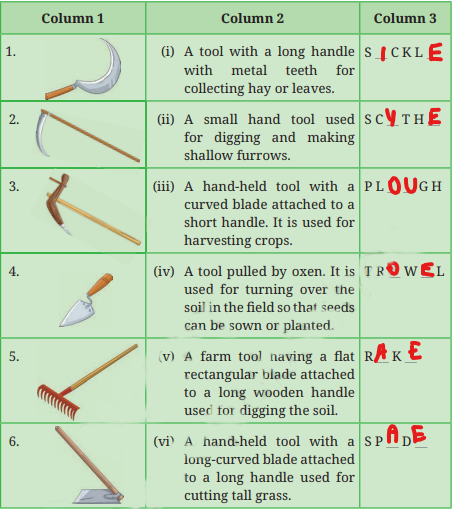
I. Match the pictures of the farming implements given in Column 1 with their use given in Column 2. Then, fill in the blanks in Column 3 to complete the name of the implement.
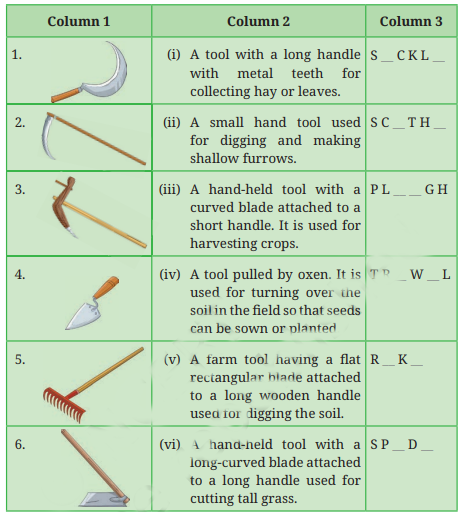
Ans.
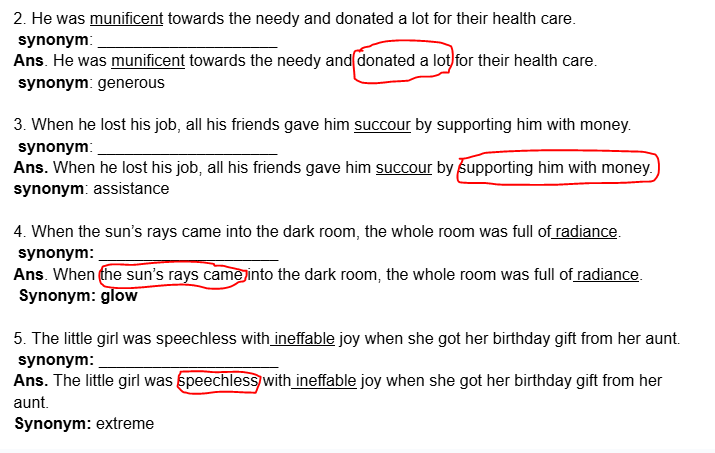
II. Choose the correct synonyms for the underlined words in the given sentences from the box below. Circle the words or phrases in the sentences that helped you to infer the meanings. One example has been done for you.
| generous | help | brightness | indescribable | kind |

III. You have learnt about some archaic words. Some more archaic words are given below. Refer to a dictionary to find commonly used words which are similar in meaning.
1. morrow
2. hither
3. quoth
4. betwixt
5. yonder
Ans.
1. morrow-tomorrow
2. hither-here
3. quoth-quote
4. betwixt-between
5. yonder-over there
Let us listen
I. Listen to the talk about paddy cultivation. As you listen, number the events in the correct order in which they happen. (Transcript for teacher on page 203)
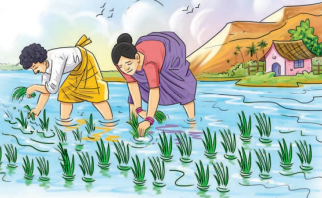
1. Transplanting of seedlings
2. Ploughing of soil
3. Threshing of grains
4. Puddling of land
5. Harvesting of paddy
6. Irrigating the field
7. Milling of rice
Ans. 2-4-6-1-5-37
II. Now, listen to the talk again. As you listen, choose the correct option to answer the questions that follow.
1. What is the main step in preparing the soil for cultivation of rice?
(i) Ploughing the soil (ii) Clearing the soil (iii) Puddling the soil
2. How long does it take for rice seeds to grow into seedlings before being transplanted?
(i) 2–3 weeks (ii) 4–5 weeks (iii) 6–7 weeks
3. Why is drying rice grains important after threshing?
(i) To get rice seeds for plantation
(ii) To separate the rice grains easily
(iii) To store the rice grains for longer
Ans.
1. (iii) Puddling the soil
2. (ii) 4–5 weeks
3. (iii) To store the rice grains for longer
Let us speak
I. In English, some letters are not pronounced in certain words. For example, in words like ‘knife’, ‘knowledge’, and ‘know’, the first letter ‘k’ is not pronounced. Let us look at a few more such examples.
• In the words given below the letter ‘n’ is silent when it appears with ‘m’ at the end of the word.
hymn, column, autumn, solemn
Now, say these words aloud.
• In the words given below the letter ‘b’ is silent when it appears with ‘m’.
womb, tomb, bomb, climb, comb
Now, say these words aloud.
II. In our country, harvest is celebrated with the preparation of delicious dishes. Work in groups and make a presentation on any popular dish made during the harvest festival in your region. Use the prompts given in the box to make your presentation. Make sure that all the members share their views.
Include the following:
• What is the dish called? Is it known by any other name in other parts of India?
• What ingredients are used to make the dish?
• How is the dish prepared?
• How is the dish served?
• What does the dish taste like?
• What is the special ritual related to the preparation of this dish?
• Describe any special memory associated with the preparation of this dish.
| Column 1 | Column 2 |
| Greet the audience | Good morning to all of you gathered here… |
| Introduce the members of your group and your topic | Today we, ____, ____ and ____ are here to tell you about… |
| Explain the structure of your presentation |
|
| Speak about the first point |
|
| Describe the details |
|
| Conclude your presentation |
|
| Thank the audience | • Thank you for listening. • Thank you for your attention. |
Ans. Good morning to all of you gathered here. Today we, Neena, Meena and Teena are here to tell you about “The Harvest Dish Of Punjab”.
We will start off by
Let us write
Creative slogans are used to spread a message to capture the reader’s attention. Some examples are given below:
|
Your school wishes to express gratitude to the farmers who play an important role in providing us the food on our plates. Draft a creative slogan to be put up on the school notice board.
Remember to
• focus on the main idea to be expressed
• use simple language
• be concise—express yourself in a few words
You may write the slogan on a chart paper and decorate it.
CBSE Class 8 English Unit 4 Environment Chapter 2 Harvest Hymn Extract-Based Questions
A. Men’s Voices:
Lord of the lotus, lord of the harvest,
Bright and munificent lord of the morn!
Thine is the bounty that prospered our sowing,
Thine is the bounty that nurtured our corn.
Q1. What is the rhyme scheme of the stanza?
Ans. abcb
Q2. ‘Morn’ stands for _______
Ans. morning
Q3. Which word in the stanza means ‘showing generosity’?
Ans. munificent
Q4. What are the men saying?
Ans. They are thanking the gods for giving them a bounty in the form of a good harvest.
Q5. ‘Thine’ means _______
Ans. Your
B. Lord of the rainbow, lord of the harvest,
Great and beneficent lord of the main!
Thine is the mercy that cherished our furrows,
Thine is the mercy that fostered our grain.
Q1. Which figure of speech has been used?
Ans. Anaphora. The last two lines start with the same word.
Q2. What does a furrow mean here?
Ans. Furrow means the deep line formed where the seeds are sown in the field.
Q3. Who is the poet referring to?
Ans. The poet is referring to the God in the heaven above with whose blessings the farmers get a good crop.
Q4. What is a harvest?
Ans. Harvest is the crop that grows in the field.
Q5. What is the theme of the stanza?
Ans. The stanza conveys gratitude. The speaker is happy to get a good harvest and thanks the gods for blessing him with such treasure.
C. We bring thee our thanks and our garlands for tribute,
The wealth of our valleys, new-garnered and ripe;
O sender of rain and the dewfall, we hail thee,
We praise thee, Varuna, with cymbal and pipe.
Q1. A garland is ______
Ans. a necklace made of flowers.
Q2. What ‘wealth’ is being talked about?
Ans. The wealth talked here is the good harvest of crop.
Q3. Who is Varuna?
Ans. Varuna is the god of rain and the sky.
Q4. Describe a cymbal.
Ans. A cymbal is a musical instrument comprising two small plates that are hit together to produce music.
Q5. What does ‘hail’ mean?
Ans. Hail means to call out someone to thank or greet.
D. Women’s Voices:
Queen of the gourd-flower, queen of the harvest,
Sweet and omnipotent mother, O Earth!
Thine is the plentiful bosom that feeds us,
Thine is the womb where our riches have birth.
Q1. Omnipotent means ___________
Ans. having unlimited power.
Q2. What best describes the womb talked of in the stanza?
Ans. The womb refers to the soil of the earth where the rich harvest of crops grows.
Q3. Identify the use of metaphor in the stanza.
Ans. In the line – ‘Sweet and omnipotent mother, O Earth!’ the Earth is referred to as a mother because it grows food for us. Thus, it is a metaphor where the Earth is compared to a mother.
Q4. What ‘riches’ are talked of?
Ans. The riches are the good yield of crops that grows in the field.
Q5. What does ‘thine’ mean?
Ans. Thine means yours in old English.
Class 8 Harvest Hymn Multiple Choice Questions
Q1. Who is the giver of mellowing radiance?
A. Earth
B. Surya
C. Varuna
D. All of these
Ans. B. Surya
Q2. Thee means ________
A. your
B. you
C. me
D. All of these
Ans. B. you
Q3. What does Surya do?
A. it ripens the crop and fruit
B. it enables the seed to fertilize
C. it energizes the farmer
D. none of these
Ans. A. it ripens the crop and fruit
Q4. Who sends rain and dewfall?
A. Earth
B. Surya
C. Vayu
D. Varuna
Ans. D. Varuna
Q5. Which of the following musical instrument has not been referred?
A. cymbal
B. flute
C. pipe
D. harmonium
Ans. D. harmonium
Q6. Who is the queen of the gourd-flower?
A. Earth
B. Surya
C. Varuna
D. none of them
Ans. A. Earth
Q7. Earth is also equated to ______
A. sister
B. friend
C. mother
D. teacher
Ans. C. mother
Q8. What is a hymn?
A. prayer song
B. love song
C. patriotic song
D. All of these
Ans. A. prayer song
Q9. Who is the poet of ‘Harvest Hymn’?
A. M.K. Gandhi
B. Sarojini Naidu
C. JL Nehru
D. None of these
Ans. B. Sarojini Naidu
Q10. Find a synonym of ‘opulent’.
A. simple
B. elegant
C. stylish
D. none of these
Ans. B. elegant
CBSE Class 8 English Poorvi Book Unit 4 Environment Chapter 2 Harvest Hymn Extra Question and Answers
Answer the following questions-
Q1. Elaborate the theme of the poem.
Ans. The poem is a prayer song through which the speaker prays and thanks God for a good harvest of crop. All the people hail god, walk barefooot and thank various gods for aiding in the rich produce.
Q2. Why do the people pray and thank various gods?
Ans. The people sow seeds in the field. However, it is the various gods who help and provide essentials like water, heat and soil which provide nutrition and give the rich agricultural harvest.
Q3. Identify the Gods who have been prayed to.
Ans. The speaker prays to various gods and goddesses. They are Surya, Varuna, Earth and Brahma.
Q4. How do the speakers thank gods?
Ans. They hail and announce the god’s glory. They play musical instruments like pipe, drum, cymbal and flute to celebrate god’s bounty. They sing in god’s praise and offer garlands as tribute.