
CBSE Class 8 English Unit 3 Mystery And Magic Chapter 2 The Magic Brush of Dreams Important Question Answers from Poorvi Book
Class 8 English The Magic Brush of Dreams Question Answers – Looking for questions and answers for CBSE Class 8 English Unit 3 Mystery And Magic Chapter 2 – The Magic Brush of Dreams? Look no further! Our comprehensive compilation of important questions will help you brush up on your subject knowledge. Practising Class 8 English question answers can significantly improve your performance in the exam. Improve your chances of scoring high marks by exploring Unit 3 Mystery And Magic Chapter 2 – The Magic Brush of Dreams now. The questions listed below are based on the latest CBSE exam pattern, wherein we have given NCERT solutions to the chapter’s extract-based questions, multiple choice questions and Extra Question Answers
Also, practising with different kinds of questions can help students learn new ways to solve problems that they may not have seen before. This can ultimately lead to a deeper understanding of the subject matter and better performance on exams.
- The Magic Brush of Dreams NCERT Solutions
- The Magic Brush of Dreams Grammar Exercises
- The Magic Brush of Dreams Extract Based Questions
- The Magic Brush of Dreams Multiple Choice Questions
- The Magic Brush of Dreams Extra Question Answers
Related:
- The Magic Brush of Dreams Summary, Explanation
- The Magic Brush of Dreams Character Sketch
- Class 8 English Poorvi Book Lesson Notes
The Magic Brush of Dreams Textbook Questions (NCERT Solutions)
| paintbrush | joy | fortress | feast | fear |
| winding | twig | bows | drawing | cold |
| 1. Gopi paints a bowl of khichdi, which becomes real and amazes the villagers. | |
| 2. The Zamindar orders Gopi to paint treasures for him. | |
| 3. Gopi is told to gather food but instead sits drawing pictures in the sand. | |
| 4. Gopi returns to the village with the Zamindar and his men chasing her. | |
| 5. The Zamindar throws Gopi into prison. | |
| 6. Gopi paints a road and a horse to escape. | |
| 7. Gopi uses the magic brush to paint useful items for the villagers. | |
| 8. Gopi paints a wide river, stopping the Zamindar and his men. | |
| 9. A man gives a magic brush to Gopi to paint only for the poor. | |
| 10. Gopi scares the Zamindar away, and celebrates with the villagers. | 10 |
Ans.
| 1. Gopi paints a bowl of khichdi, which becomes real and amazes the villagers. | 3 |
| 2. The Zamindar orders Gopi to paint treasures for him. | 5 |
| 3. Gopi is told to gather food but instead sits drawing pictures in the sand. | 1 |
| 4. Gopi returns to the village with the Zamindar and his men chasing her. | 8 |
| 5. The Zamindar throws Gopi into prison. | 6 |
| 6. Gopi paints a road and a horse to escape. | 7 |
| 7. Gopi uses the magic brush to paint useful items for the villagers. | 4 |
| 8. Gopi paints a wide river, stopping the Zamindar and his men. | 9 |
| 9. A man gives a magic brush to Gopi to paint only for the poor. | 2 |
| 10. Gopi scares the Zamindar away, and celebrates with the villagers. | 10 |
II. Fill in the blanks by choosing the correct answer from the box given below.
| triumphant and celebratory | tension and suspense |
| playful and innocent |
The tone of the poem shifts throughout, reflecting the different moods of the story. Initially, the tone is 1. _________________ as Gopi uses her imagination to draw in the sand, and later when the Zamindar enters the story, the tone shifts to one of 2. _________________. In the final part of the poem, the tone becomes 3. _________________ as Gopi escapes, the Zamindar is defeated, and the villagers rejoice.
| Column 1 | Column 2 |
| 1. The magic paintbrush | (i) greed and the desire for wealth |
| 2. The grand fortress | (ii) barriers to protect Gopi from the Zamindar’s anger |
| 3. The river and the beast | (iii) the power of art and imagination to change the world |
Ans.
- playful and innocent
- tension and suspense
- triumphant and celebratory
| Column 1 | Column 2 |
| 1. The magic paintbrush | (iii) the power of art and imagination to change the world |
| 2. The grand fortress | (i) greed and the desire for wealth |
| 3. The river and the beast | (ii) barriers to protect Gopi from the Zamindar’s anger |
III. Fill in the blanks by choosing the correct option from within the brackets.
1. The poem mostly follows a simple rhyme scheme, _________________, which adds a rhythmic flow. (ABCB, ABBA, ABAB)
2. This poem belongs to the _________________ poetry genre, which tells a story through verse. (descriptive, narrative or ballad, free style)
Ans.
1. ABCB
2. narrative or ballad
IV. Give examples from the poem for the following explanations.
1. The poem is rich in imagery, creating clear pictures in the reader’s mind. For example, ___________________.
2. What is the effect of repetition in the line—‘On you, and you and you!’?
Ans.
1. She paints a mighty river wide,
Its currents fast and deep.
2. The effect of repetition in the line—‘On you, and you and you!’ is that Gopi is threatening each and every man and the Zamindar with the beast she can paint with the magic brush.
V. Match the phrases from the poem in Column 1 with what they symbolise in Column 2.
| Column 1 | Column 2 |
| 1. The magic paintbrush | (i) greed and the desire for wealth |
| 2. The grand fortress | (ii) barriers to protect Gopi from the Zamindar’s anger |
| 3. The river and the beast | (iii) the power of art and imagination to change the world |
Ans.
| Column 1 | Column 2 |
| 1. The magic paintbrush | (iii) the power of art and imagination to change the world |
| 2. The grand fortress | (i) greed and the desire for wealth |
| 3. The river and the beast | (ii) barriers to protect Gopi from the Zamindar’s anger |
VI. Identify whether the following statement is true or false.
While Gopi uses the magic brush to help others, the Zamindar wants to use it for personal gain. This contrast drives the moral of the story.
Ans. True.
Let us think and reflect
I. Read the given extracts and answer the questions that follow.
1. But on a stone there sits a man,
A brush is in his hand.
He looks around. He calls to Gopi.
“Come here!” he whispers. “Hush!
We mustn’t let the village know
About this magic brush.”
He slips the brush into her hand
And tells her to be sure,
“Paint not for the wealthy ones,
But only for the poor.”
(i) Fill in the blank by selecting the correct option from those given in the brackets.
The man is whispering and telling Gopi to keep the brush a secret reflects his _______________________ (careful and secretive/magical and delightful) nature.
Ans. careful and secretive
(ii) What is the significance of the man slipping the brush into Gopi’s hand?
Ans. The man slipping the brush into Gopi’s hand signified the elders passing on their talents, abilities, skills and knowledge to the new generation to make the world a better place.
(iii) Complete the following sentence with a suitable reason.
The most likely reason the man instructs Gopi to ‘Paint not for wealthy ones but only for the poor’ is because he _______________________.
Ans. wants the magic brush to be used for good and not for evil and greed.
(iv) Select the most appropriate title for the extract from the two given below.
A. The Magic Brush’s Secret
B. Gopi’s Special Gift
Ans. B. Gopi’s Special Gift
2. And soon the news spreads far and wide,
Through forests, fields, and plains,
Until the Zamindar himself
Hears of these magic gains.
“I order you to paint for me,
A fortress tall and grand.
Paint treasures, jewels, and riches rare,
Enough to rule this land.”
(i) Complete the following sentence with the correct reason.
The news of Gopi’s magic brush spreads ‘through forests, fields, and plains’ because of its _______________________.
Ans. helpfulness and magical power
(ii) Why does the poet refer to things painted by Gopi’s paintbrush as ‘magic gains’?
Ans. ‘Magic gains’ refers to useful or needed items which are magical or made by the magic brush.
(iii) Which of the following statements given below is false? Rectify the false statement.
A. Gopi’s magic brush draws the attention of the powerful Zamindar.
B. The Zamindar requests Gopi to paint a grand fortress and jewels.
Ans. B is false. The Zamindar did not request Gopi to paint a grand fortress and jewels. He commanded or ordered Gopi to paint a grand fortress and jewels.
(iv) What does the Zamindar’s demand for a grand fortress and jewels reveal about his character?
Ans. The Zamindar’s demand for a grand fortress and jewels revealed that he was greedy, selfish and materialistic.
II. Answer the following questions.
1. Explain why Gopi made the right decision by refusing to paint for the Zamindar.
Ans. Gopi was asked by the man to use the magic brush for the good of society. She knew that the magic brush should be used for the poor and the needy and not to fulfil the greedy and selfish wishes of the rich. The Zamindar was rich and cruel, who wanted to misuse the magic brush. Therefore, Gopi made the right decision by refusing to paint for the Zamindar.
2. Gopi threatens to draw a beast to scare away the Zamindar. Justify her action. How would you have dealt with the situation differently?
Ans. The Zamindar wanted Gopi to use the magic brush to paint for him a fortress, riches and treasures. When Gopi refused to fulfil his demands, he became cruel and locked up the girl. Gopi used the magic brush to escape but still the cruel, wealthy man chased her all the way to the village. Gopi realized that she would have to use threats and show her strength in order to permanently escape his clutches. So, Gopi threatened to draw a beast to scare away the Zamindar and his men. Her action was justified because she used the threat of violence only when she realized that there was no other option available to her.
3. What is the significance of Gopi celebrating with the villagers at the end of the poem?
Ans. The significance of Gopi celebrating with the villagers at the end of the poem is to show the triumph of good over evil.
4. Compare Gopi’s use of the magic brush to how the Zamindar would have used it.
Ans. The Zamindar was selfish and greedy. He would have used the magic brush to get richer and more powerful. He would have painted fortresses, riches and treasures, all for himself. On the other hand, Gopi used the magic brush for the benefit of her community rather than herself. She used the item to paint khichdi, fans, clothes, ploughs, and other useful items. At the end of the poem, she used the magic brush to create sweets, music, a band of musicians to celebrate her victory.
5. What can be inferred about Gopi’s character based on her refusal to follow the Zamindar’s orders?
Ans. When the Zamindar commanded Gopi to use the magic brush for him and his greedy dreams, Gopi respectfully but firmly refused to do so. This shows the strength of her character and her determination to stay true to herself. She did not get scared when the Zamindar locked her up. She remained level-headed and used her smart mind to escape the prison.
6. Justify the appropriateness of the title of the poem.
Ans. The title of the poem is “The Magic Brush of Dreams”. It is justified because the poem is about a magic brush which can be used to paint and create anything that the user wishes to have. Since the user can have anything, the magic brush can be used to fulfil any dream that the user has.
7. If you had the magic brush, how would you use it in today’s world?
Ans. If I had the magic brush, I would use it to help my family and friends. I would use it for the people’s benefit.
The Magic Brush of Dreams Grammar Exercises
Let us learn
I. The verb ‘draw’ has different meanings in different contexts. Match the sentences in Column 1 with their appropriate meanings in Column 2.
| Column 1 | Column 2 |
| 1. His speech drew loud applause from the audience. | (i) opened |
| 2. The event will draw huge crowds from all neighbouring places. | (ii) pulled out |
| 3. Plants draw water from the soil. | (iii) got a reaction |
| 4. I reached the station when the train was drawing into the station. | (iv) attract |
| 5. The room was dark, so she drew the curtains to let the sunlight in. | (v) moving |
| 6. He drew a piece of paper from the folder. | (vi) absorb |
Ans.
| Column 1 | Column 2 |
| 1. His speech drew loud applause from the audience. | (iii) got a reaction |
| 2. The event will draw huge crowds from all neighbouring places. | (iv) attract |
| 3. Plants draw water from the soil. | (vi) absorb |
| 4. I reached the station when the train was drawing into the station. | (v) moving |
| 5. The room was dark, so she drew the curtains to let the sunlight in. | (i) opened |
| 6. He drew a piece of paper from the folder. | (ii) pulled out |
II. Fill in the crossword. Clues have been given below. You will find the words in the poem.
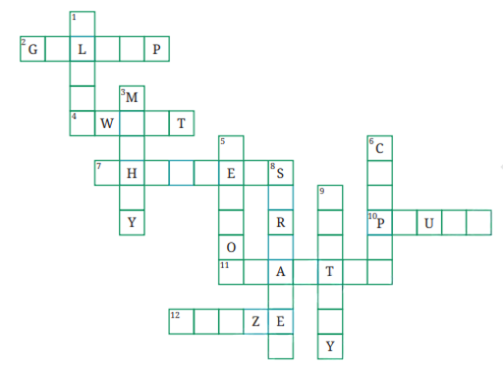
| Across | Down |
| 2. the fastest pace of a horse | 1. runs away from a place |
| 4. happen fast | 3. possessing a great deal of strength or power |
| 7. speaks very softly | 5. a deep loud shout in pain or anger |
| 10. take hold of (something) and quickly remove it from its place | 6. to act according to rules |
| 11. having a lot of money; rich | 8. moved in a continuous flow in a specified direction |
| 12. take hold of something suddenly and forcibly | 9. a win after overcoming an enemy |
Ans.
| Across | Down |
| 2. gallop | 1. flees |
| 4. swift | 3. mighty |
| 7. whispers | 5. bellow |
| 10. pluck | 6. comply |
| 11. wealthy | 8. streamed |
| 12. seize | 9. victory |
III. There are certain expressions that convey a sudden feeling or reaction.
They can be used to express a variety of emotions and thoughts.
Example: … he whispers. “Hush!”
(‘Hush’ denotes the act of silencing someone)
Now, match the expressions in Column 1 with what emotions or reactions they convey, in Column 2.
| Column 1 | Column 2 |
| 1. Phew! | (i) surprise |
| 2. Eek! | (ii) pain |
| 3. Ouch! | (iii) mistake |
| 4. Yippee! | (iv) attract attention |
| 5. Whoa! | (v) relief |
| 6. Oops! | (vi) delight |
| 7. Hey! | (vii) alarm |
Now, create sentences using any five expressions from Column 1.
Ans.
| Column 1 | Column 2 |
| 1. Phew! | (v) relief |
| 2. Eek! | (vii) alarm |
| 3. Ouch! | (ii) pain |
| 4. Yippee! | (vi) delight |
| 5. Whoa! | (i) surprise |
| 6. Oops! | (iii) mistake |
| 7. Hey! | (iv) attract attention |
Let us listen
I. You will listen to five speakers speak about a magical power they wish for. As you listen, match statements 1–7 with speakers (i)–(v). There are two statements you do not need. (Transcript for teacher on page 152 )
| Statements | Speaker No. |
| 1. Power of healing ailments | (iv) |
| 2. Ability to end poverty in the world | X |
| 3. Power to control the weather as per need | (v) |
| 4. Ability to make wise business decisions | X |
| 5. Power to predict one’s own future clearly | (i) |
| 6. Ability to remember information quickly | (ii) |
| 7. Power to move around without using vehicles | (iii) |
Let us write
I. Imaginative essay is a type of creative writing where the writers use their imagination. An imaginative essay can be based on real-life events, observation, or experiences. It is usually a descriptive piece or a personal reflection.
Read the sample of an imaginative essay.
My Life as EcoFlash
Imagine an ordinary 13-year-old student who is also a secret superhero protecting the environment. That’s my life as EcoFlash! By day, I’m Meenu, an ordinary Grade 8 student. By evening, I use my powers to keep my neighbourhood green and clean.
As EcoFlash, I have the ability to grow plants, purify water, and clean polluted air with a wave of my hand. I wear a green suit with a glowing leaf symbol and carry a small seed pouch that holds magic seeds to restore damaged areas. My mission is to fight pollution, save trees, and educate people about taking care of our planet. My friends wonder why I’m always carrying a plant in my bag or why my shoes are muddy, but I can never tell them the truth.
Once, my little brother saw me turning a garbage dump into a beautiful garden and almost spilled my secret to our parents. I had to convince him it was a magic trick!
Being EcoFlash is not just about powers but also responsibility. Every time I see clean streets, blooming flowers, and children playing in green parks, I feel proud. I know that even small changes can make a big difference, and that’s what keeps me going.
II. Complete the given checklist based on your observations and understanding of what an imaginative essay includes. Share the answers with your classmates and teacher.
1. Title — A relevant title
2. Introduction
• Captivating opening sentence to catch the reader’s attention
• Clear statement of the setting, situation, or mai
• Establishes the tone (e.g., playful, serious, and adventurous)
• Introduces the narrator briefly (if applicable)
3. Setting and Context
• Description of the setting to create a mental picture
• Clear time frame (past, present, or future)
• Brief explanation of any unique or imaginative elements (e.g., powers, fantasy world)
4. Characters
• Main character introduced with unique traits
• Supporting characters briefly described (if relevant)
5. Central Idea
• Clear focus on a single powerful idea or narrative
• Logical flow of events, even if the story involves imagination or fantasy
6. Language and Style
• Use of sensory details (sight, sound, touch, smell, and taste) to enhance the narrative
• Creative metaphors or similes to enrich descriptions
7. Resolution
• Key turning point or moment of realisation
• Resolution of the main idea
• Clear takeaway message
8. Conclusion
• Ends on a reflective or thought-provoking note
• Summarises the main message or leaves the reader with a strong final impression
III. Write an imaginative essay on any one of the following.
1. Imagine you were a scarf that flew away from a clothesline. Describe the places you travelled to and how you came back. Also write about what you thought was the most valuable experience.
2. Imagine you stumbled upon a magical book in the library. The book transported you to a different time period. Describe your experience and an important learning.
Ans.
1. The Wandering Scarf
Lina had a warm, soft scarf. It was maroon and cream, with little frays at the edges. Her grandmother, Nani, had made it just for her. One windy afternoon, Lina washed the scarf and hung it on the clothesline to dry. But the wind had other plans. Whoosh! The scarf flew into the sky!
The scarf landed on a rooftop. A big orange cat named Tobble sniffed it. “You’re not a bird,” Tobble said, curling up on the scarf. “But you’re soft.” The scarf stayed with Tobble for a day. Then, the wind blew again. Whoosh! The scarf flew into the sky!
Next, the scarf landed in a tall pine tree. Down below, a little fox named Ivo looked up. “A sky-snake?” he wondered. Ivo tugged the scarf down and hung it at the entrance of his den.
“It makes my home feel cozy,” he said. Then, the wind blew again. Whoosh! The scarf flew into the sky!
The scarf caught onto a hiker’s backpack. It travelled far and ended up in a big city. There, a street musician named Miles found it in a puddle. “Nice colours,” he said. He tied the scarf to his guitar. The scarf danced as Miles played music in the square. People clapped and smiled. Then, the wind blew again. Whoosh! The scarf flew into the sky!
Now the scarf was at the beach. The sea almost took it! But a little girl named Sofi grabbed it just in time. “Treasure!” she shouted, wrapping it around her shoulders. As she draped it around her small body, she felt something in the scarf’s soft fabric. She inspected it closely and saw a sign: “Lost Scarf – Very Special. Please return.” She was a bit sad that the scarf belonged to someone else, but she was a responsible girl and knew that she couldn’t take what was not hers.
Sofi smiled. “Let’s take it back.”
She gave the scarf to her parents. Sofia’s family knew Lina and her grandmother very well. They recognised the handwriting and smiled in relief that they could find the owners easily.
Lina was looking out the window, missing her scarf. Then, she heard the doorbell. Nina opened the door and saw her scarf and gasped. Thanking Sofia and her family, she took the scarf which she had made with her own aged fingers. She went to Lina and draped it carefully around her small body. “Surprise!”
Lina smiled brightly and hugged it tight. “Scarf! It came back!”
Nani smiled too. “Looks like it had quite the adventure, too.”
2. Library’s Secret
Seema opened the door to the place of comfort and escape. The library was an ordinary place for reading and knowledge for most people. But for her, it was a place where she could escape her mundane lifestyle. Little did she know that she would actually escape her life that evening.
She walked down the endless corridors, her eyes searching for the perfect book. Her eyes then spotted a book, which widened her eyes in wonder. It was a book which had a plant’s roots on the outer cover. She curiously opened the book and saw a flower in the middle of it. Before she could react, the flower glowed brightly. A second later, she felt herself get sucked into the book.
It was a strange and slightly uncomfortable sensation. Right when she thought she could not bear it any longer, the sensation stopped, and her feet felt the ground. It took some time for her to get her senses adjusted, but when they did, she saw that she was no longer in the library.
She was in a vast garden full of beautiful flowers. She gasped in awe and wonder as she took in the breathtaking sight of it all. Then, she heard a deep commanding voice.
“Who are you?”
She turned around to see an older man wearing robes and jewels and a crown. He looked like a king.
And he was.
However, the king was not a kind or selfless ruler whom Seema liked to read about. He seized the book and called the guards to hold Seema. As the guards took her inside the castle, Seema observed the furnished and beautiful halls of the king’s castle. The paintings, chandeliers, servants, and tiled floor. All of it displayed the king’s riches and the artistry of the Monarch period.
Her tour soon ended and now she had to face the wrath of the king, who saw her as an intruder. Seema explained her innocence, but how would anyone believe that she had come from the future, or that she came from a book?
Seema then thought of a plan. “Your Majesty, the book can fulfil any dream, any wish or demand. However, only I can harness that power. Please give me the book, and in return, I will give you anything you need. You will be the most powerful king in the world.”
The king, amazed by the power and blinded by his greed, ordered his guards to hand Seema the mysterious book. When Seema got the book back, she opened it. As soon as she opened it, the flower glowed, and she was sucked back, leaving the old world and not fulfilling any of the king’s wishes.
She was grateful to be back in her own timeline. For once, she thought that escaping the world was not always a good thing.
CBSE Class 8 English Unit 3 Chapter 2 The Magic Brush of Dreams Extract-Based Questions
A. “Go and gather wild beans, Gopi,
Go and fetch some rice.
Go and pluck the mangoes
And bring home something nice.”
Gopi sits beneath the banyan,
A twig is in her hand.
She sits there drawing pictures,
Pictures in the sand.
Q1. What is the rhyme scheme used?
Ans. abcb
Q2. What is ‘banyan’?
Ans. It is a type of a tree.
Q3. Twig means ______
Ans. small branch of a tree
Q4. What is Gopi doing?
Ans. She is drawing pictures in the sand
Q5. What is Gopi supposed to do?
Ans. Gopi is supposed to gather wild beans, fetch rice and pluck mangoes.
B. The winds blow by and sweeps away
The pictures in the sand.
But on a stone there sits a man,
A brush is in his hand.
He looks around. He calls to Gopi.
“Come here!” he whispers. “Hush!
We mustn’t let the village know
About this magic brush.”
Q1. What sweeps the pictures drawn by Gopi?
Ans. The wind
Q2. Who is sitting on a stone?
Ans. A Man.
Q3. What is the man holding?
Ans. He is holding a brush.
Q4. What does he tell Gopi?
Ans. He calls her and says that he has a magic brush.
Q5. What secret does the man want Gopi to keep?
Ans. He wants her not to tell the villagers about the magic brush.
C. He slips the brush into her hand
And tells her to be sure,
“Paint not for the wealthy ones,
But only for the poor.”
“Did you gather wild beans, Gopi?
Did you fetch some rice?
Did you pluck the mangoes
And bring home something nice?”
Q1. What condition does the man lay while giving the brush to Gopi?
Ans. He asks her to paint for the poor and not for the wealthy.
Q2. Did Gopi do the work?
Ans. No, she did not fetch the rice, pluck mangoes or gather the wild beans.
Q3. Where was Gopi supposed to take the rice, mangoes and beans?
Ans. She was supposed to take them home.
Q4. What is Gopi supposed to do with the brush?
Ans. She is supposed to paint with it.
Q5. Identify the figure of speech used-
‘He slips the brush into her hand’
Ans. Alliteration
D. “The bowl is full of khichdi, Gopi!”
Into the house the villagers streamed
The young and old all wish to see
The magic brush of dreams.
She paints a muffler for a farmer,
A plough for another man,
A shawl for a grandmother,
And for a girl, a fan.
Q1. What was full with Khichdi?
Ans. The bowl was full with khichdi.
Q2. Why did the villagers visit the house?
Ans. They wanted to see the magic brush of dreams.
Q3. What did Gopi do with the brush?
Ans. She painted several things for the villagers – a muffler for a farmer, a plough, a shawl and a fan.
Q4. Identify the figure of speech used-
‘The young and old all wish to see’
Ans. Antithesis
Q5. Why does the poet use inversion in the last line – And for a girl, a fan.?
Ans. Inversion is used as a poetic license because the poet wants to create rhyme with the word ‘man’.
Class 8 The Magic Brush of Dreams Multiple Choice Questions
Q1. Why does Gopi refuse to paint for the zamindar?
A. He forces her
B. He is rich
C. He is a law-breaker
D. She doesn’t like him
Ans. B. He is rich
Q2. What is the first thing that Gopi paints with the magic brush?
A. mango
B. rice
C. khichdi
D. beans
Ans. C. khichdi
Q3. Who gives Gopi the magic brush?
A. her grandma
B. her grandfather
C. a man sitting on a stone
D. she buys it
Ans. C. a man sitting on a stone
Q4. What was Gopi sent to get?
A. rice
B. wild beans
C. mangoes
D. all of these
Ans. D. all of these
Q5. What was Gopi doing when she met the man?
A. singing
B. collecting mangoes
C. drawing in the sand
D. swinging on the banyan tree
Ans. C. drawing in the sand
Q6. After painting the bowl of khichdi, Gopi waits for ______
A. the villagers to come
B. the paint to dry
C. the man to see it
D. none of these
Ans. B. the paint to dry
Q7. What magic happens when the paint dries?
A. The villagers arrive to see the magic brush
B. the bowl gets full of khichdi
C. the magic brush vanishes
D. the man appears
Ans. B. the bowl gets full of khichdi
Q8. What does Gopi paint for a grandmother?
A. shawl
B. stick
C. saree
D. spectacles
Ans. A. shawl
Q9. She paints a muffler for a ____
A. teacher
B. girl
C. man
D. farmer
Ans. D. farmer
Q10. What does the zamindar order Gopi?
A. to paint for him
B. to sing for him
C. to give him the magic brush
D. to pray for him
Ans. A. to paint for him
Q11. Gopi paints for _____
A. everyone
B. kids
C. the needy
D. the villagers
Ans. C. the needy
Q12. What does Gopi address the zamindar as?
A. Uncle
B. Sir
C. My Lord
D. My dear
Ans. C. My Lord
Q13. Which of the following options gives the correct meaning of ‘swore’?
A. sang a song
B. took an oath
C. doze off to sleep
D. took bath
Ans. B. took an oath
Q14. How did the zamindar react to Gopi’s refusal?
A. went away quietly
B. roared and stomped his foot
C. tbroke the brush
D. begged her
Ans. B. roared and stomped his foot
Q15. What did the zamindar do to Gopi?
A. locked her in a cell
B. killed her
C. kidnapped her
D. left her
Ans. A. locked her in a cell
Q16. Why were the villagers happy to see her back?
A. she used the magic brush to help them
B. she taught them how to paint
C. she gave them wild beans, mangoes and rice
D. none of these
Ans. A. she used the magic brush to help them
Q17. How did Gopi escape the cell where the zamindar had locked her?
A. the villagers broke the cell and helped her escape
B. she painted a horse and escaped on it
C. she was rescued by an army plane
D. she meditated and the cell door opened magically
Ans. B. she painted a horse and escaped on it
Q18. Who followed Gopi as she galloped out of the prison?
A. zamindar
B. villagers
C. old man
D. zamindar’s men
Ans. D. zamindar’s men
Q19. How did Gopi get rid of the zamindar and his men?
A. she painted a dead zamindar
B. she threatened to paint a beast that would chase them
C. she threw the magic brush in the river
D. the magic of the brush ended
Ans. B. she threatened to paint a beast that would chase them
Q20. What does Gopi paint in the last stanza of the poem?
A. a muffler
B. a river
C. tea and sweets
D. horse
Ans. C. tea and sweets
CBSE Class 8 English Poorvi Book Unit 3 Mystery And Magic Chapter 2- The Magic Brush of Dreams Extra Question and Answers
Answer the following questions-
Q1. What is Gopi supposed to fetch?
Ans. She is supposed to fetch some wild beans, mangoes and rice.
Q2. What was Gopi doing when she met the old man? What did he give her?
Ans. Gopi was sitting under the banyan tree, drawing in the mud using a twig. At that time, she met the old man. The old man gave her a brush which he claimed was magical.
Q3. What precaution did the old man ask Gopi to use?
Ans. The old man cautioned Gopi to use the magic brush only to help the poor and not for the rich people.
Q4. What did the zamindar do when Gopi refused to fulfil his demand?
Ans. The zamindar ordered his men to lock Gopi in a prison cell till she obeyed his order.
Q5. The zamindar ordered Gopi to paint several things. What does it show about him?
Ans. The zamindar was greedy and so he ordered Gopi to paint a big fortress, treasures and jewels for him.
Very helpful for me