
The Winner Summary and Explanation
CBSE Class 6 English Unit 4- Sports and Wellness Chapter 2- The Winner Summary, Explanation along with Difficult Word Meanings from Poorvi Book
The Winner Summary – Are you looking for the summary, theme and lesson explanation for CBSE Class 6 English Unit 4- Sports and Wellness Chapter 2 – The Winner from English Poorvi Book. Get Lesson summary, theme, explanation along with difficult word meanings
- The Winner Introduction
- The Winner Summary
- The Winner Summary in Hindi
- The Winner Theme
- The Winner Explanation
Related:
CBSE Class 6 English Poorvi Book Unit 4 – Sports and Wellness Chapter 2 – The Winner
The Winner Introduction
Georgia Heard is a popular poetess and an educator. Her poetry profoundly captures the emotions and experiences of humans. She has used vivid imagery and thought-evoking ideas in her poems to resonate with readers of all age groups. Her poem ‘The Winner’ explores the themes of nature, fleeting childhood, and the race against time. This three-stanza poem is about the poetess playing a game with her friends that leaves them breathless. Eventually, night wins at the end, as with its arrival the game ends.
The Winner Summary
As evening came, the poetess and her friends met by a small river in her neighbor’s field. They played with a colorful ball, running on the grass. Each time the poetess ran, she felt excited and breathless, enjoying the game.
When the sun set, the surroundings changed; shadows became longer and darker, covering everything. The grass, which was warm before, now felt cool and prickly under their bare feet, making them shiver. Tall trees stood nearby, their shapes more visible in the dark, reminding them of the darkness and changes around them.
Eventually, they had to face the night, and the joy of the game started to fade. With a heavy heart, the poetess said that the night had taken over their play, wrapping them in its calm yet eerie presence.
Summary of the Lesson The Winner in Hindi
जैसे ही शाम हुई, कवयित्री और उसकी सहेलियाँ उसके पड़ोसी के खेत में एक छोटी नदी के किनारे मिलीं। वे घास पर दौड़ते हुए रंगीन गेंद से खेलते थे। हर बार जब कवयित्री दौड़ती थी, तो वह उत्साहित और बेदम महसूस करती थी और खेल का आनंद लेती थी।
जब सूरज डूबा तो परिवेश बदल गया; परछाइयाँ लंबी और गहरी हो गईं, जिससे सब कुछ ढक गया। घास, जो पहले गर्म थी, अब उनके नंगे पैरों के नीचे ठंडी और कांटेदार महसूस हो रही थी, जिससे वे कांप रहे थे। पास में ऊँचे-ऊँचे पेड़ खड़े थे, अँधेरे में उनकी आकृतियाँ अधिक दिखाई दे रही थीं, जो उन्हें अँधेरे और अपने आस-पास के बदलावों की याद दिला रही थीं।
अंततः उन्हें रात का सामना करना पड़ा और खेल का आनंद फीका पड़ने लगा। कवयित्री ने भारी मन से कहा कि रात ने उनके खेल पर कब्ज़ा कर लिया है, उन्हें अपनी शांत लेकिन भयानक उपस्थिति में लपेट लिया है।
Theme of the Lesson The Winner
The Race Against Time
The poetess and her friends wanted to continue their game, but the night ended their game. When the poetess quoted ‘Night wins!’, she implied the race of time against humans, in which time always emerges as a winner. The night ended their game, which they didn’t want to stop.
Fleeting Childhood Days
The poetess and her friends were happy to play with the ball in their neighbour’s field in the evening. In the last stanza, when it’s night, the poetess shifts to an eerie tone to depict that her childhood ended as she embarks on her adulthood. With the game, the excitement and fun of her childhood days ended. Moreover, the pain of their feet depicts the trial and tribulation of adulthood.
Childhood Joys and Fears
The poetess vividly portrayed the child’s joys and fears in the poem ‘The Winner’. She described the fun she and her friends had while playing and the sadness after their game ended. The fear of darkness in the childhood days, too, has been implied in the poem.
The Winner: Lesson Explanation
Poem:
Evenings,
we play ball
next to the creek
in our neighbour’s field.
Word meanings
creek: a small river
Explanation of the above stanza—In the evening, the poetess with her friends used to play with the ball, next to the small river that passed through her neighbour’s field. Through this stanza, she wants to highlight the joy and fun of childhood days.
Poem: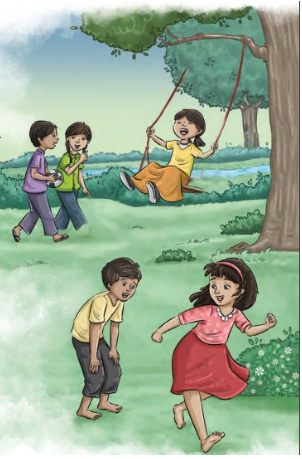
We run so fast
I
can’t
even
catch
my
breath.
Word meanings
catch my breath: breathless
Explanation of the above stanza—The poetess, with her friends, used to run so fast after the ball that they would be left breathless. George Heard uses short phrases to imply the breathlessness after running.
Poem:
When blue dark turns to black,
cold grass aches our feet,
trees creep close—
game’s over.
Night wins!
Word meanings
creep: move forward slowly
aches: pain
Explanation of the above stanza—The poetess has used imagery in the line ‘when the blue dark turns to black’ to show the transition from evening to night. At night, the temperature dropped, leaving the cold grass to pain the poetess and her friends’ bare feet. The ‘trees creep close’ depicts the approaching darkness. The game was over and the night won against them.
The Winner: Poetic Devices
Imagery
Imagery is the vivid description through words to create mental images in the minds of the readers. The imagery of nature enhances the reader’s experience through the setting. The poetess in the poem ‘The Winner’ has used imagery like ‘next to the creek’, ‘cold grass aches our feet’, ‘When blue dark turns to black’ and ‘trees creep close’ to vividly describe the beauty of nature and the transition from the evening to night.
Personification
Personification is a literary device used by the poet to give human aspects to an object. The poetess used ‘trees creep close’ and ‘Night win!’ to give human-like aspects to nature.
Alliteration
Alliteration is the repetition of an identical consonant sound at the beginning of nearby words. In ‘The Winner’, the poetess used alliteration in the line ‘creep close’.
Symbolism
Symbolism means the use of symbols to represent an idea. The poetess has used many symbols in the poem ‘The Winner’. The symbol of ‘ball’ and ‘evening’ represents the innocence of childhood, while the symbol of ‘night’ emphasises adulthood. She had used ‘Blue dark’ to symbolise the evening, while ‘black’ to symbolise the night. The ‘Cold grass’ also symbolises the drop in temperature, implying the transition from evening to night.
Enjambment
Enjambment means the continuation of a sentence without a pause across the line break. The poetess has used enjambment to add a sense of urgency and movement in the second stanza of the poem.
Conclusion
The poem The Winner by George Heard gives a vivid description of fleeting childhood and the race of humans against time. Students can take help from the post to understand the poem and also learn the difficult word meanings to get a better grasp over the poem. This lesson includes the summary of the poem ‘The Winner’ which will help students of class 6 to get a quick recap of the poetry.