
CBSE Class 6 English Unit 3 – Nurturing Nature Chapter 3 – Spices That Heal Us Important Question Answers from Poorvi Book
Class 6 English Spices That Heal Us Question Answers – Looking for questions and answers for CBSE Class 6 English Unit 3 – Nurturing Nature Chapter 3 – Spices That Heal Us? Look no further! Our comprehensive compilation of important questions will help you brush up on your subject knowledge. Practising Class 6 English question answers can significantly improve your performance in the exam. Improve your chances of scoring high marks by exploring Unit 3 – Nurturing Nature Chapter 3 – Spices That Heal Us now. The questions listed below are based on the latest CBSE exam pattern, wherein we have given NCERT solutions to the chapter’s extract-based questions, multiple choice questions and Extra Question Answers
Also, practising with different kinds of questions can help students learn new ways to solve problems that they may not have seen before. This can ultimately lead to a deeper understanding of the subject matter and better performance on exams.
- Spices That Heal Us NCERT Solutions
- Spices That Heal Us Extra Question Answers
- Spices That Heal Us Multiple Choice Questions
- Spices That Heal Us Extract Based Questions
- Spices That Heal Us Grammar Exercise
Related:
Spices That Heal Us Textbook Questions (NCERT Solutions)
Let us do these activities before we read.
1. A spice is any seed, fruit, root, bark, leaf or any other part of a plant used to give taste and colour to our food. Try to recall the names of three spices that are used for cooking in your home. Write them below and share your answers with your teacher.
(a) _______________ (b) _______________ (c) _______________
Ans.
(a) Star anise
(b) Ginger
(c) Bay leaf
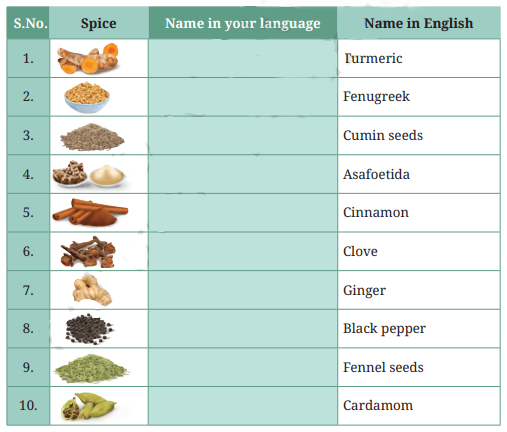
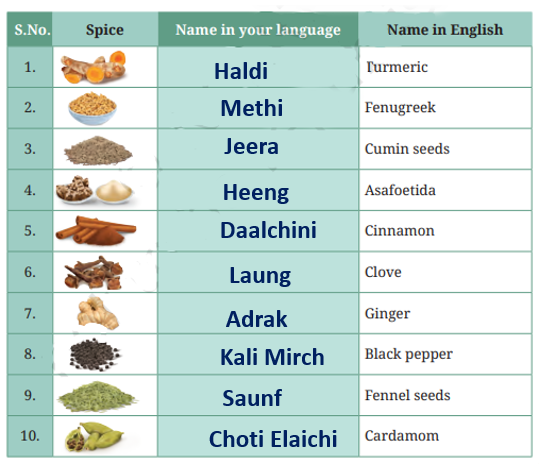
2. Given below are pictures of some spices. Work in pairs and write what you call them in your language. Their names in English are given in the last column. Share your answers with your teacher.
Ans.
Let us think and reflect
1. Read the given lines and answer the following questions.
‘When I was a child, I learnt them from my grandmother. She used to find cures for most of the weather-related common illnesses in the kitchen.’
(a) Where exactly in the kitchen did her grandmother find the cures?
(b) Give one example of weather-related common illnesses.
(c) What kind of relationship did the speaker have with her grandmother?
Ans.
(a) In the cooking area where spices were stored.
(b) cold
(c) Her grandmother had taught her various home remedies for different treatments and the benefits of different spices.
2. Fill in the blanks to complete the sentence.
Daadi soaked methi seeds overnight and drank the water in the morning to manage _____________________ and _____________________.
Ans. blood sugar level and fat level
3. Circle the spice that is not useful for body pain according to Daadi’s letter.
(a) Turmeric
(b) Ginger
(c) Fennel seeds
(d) Black pepper
Ans. (c) Fennel seeds
4. Why did Daadi ask Vikram and Vaibhavi to share the natural cures with their friends?
Ans. She wanted them to share the cures with their friends so that more people could benefit from these cures.
5. What was Daadi’s final advice to Vikram and Vaibhavi?
Ans. Her final advice was to use the spice under the guidance of an elder.
6. How do we know that natural cures are passed from one generation to another?
Ans. The grandmother got the knowledge of these home remedies from her grandmother. Now she was passing it on to her grandchildren. So, we know that the cures were passed on from one generation to another.
7. Why do you think we should know about the healing properties of spices?
Ans. We should know about the healing properties of spices so that we can use them and get better health in time of illness.
Let us learn
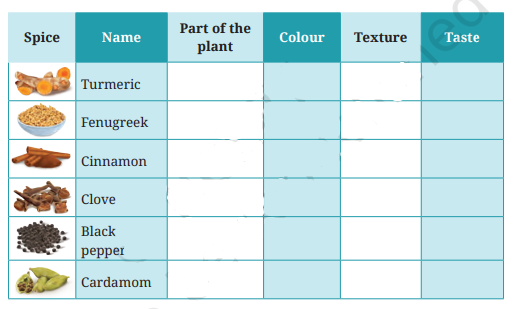
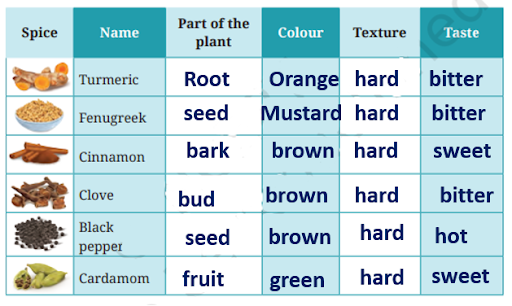
1. You have read the uses of spices in the letter. Complete the following table with the help of your teacher. You may use the words from the box given below.
Part of the plant: root/bark/leaves/flower buds/fruit/seeds
Texture: rough/soft/silky
Taste: bitter/sweet/sour/salty/spicy
Ans.
CBSE Class 6 English Poorvi Book Unit 3 – Nurturing Nature Chapter 3 – Spices that Heal Us Extra Question and Answers
Answer the following questions
Q1. What precaution did the grandmother give to Vikram and Vaibhavi?
Ans. She cautioned them to take the herbal remedies after consulting an elder.
Q2. Mention the names of all the spices which grandmother mentions in the letter.
Ans. The grandmother mentions various spices like ginger, turmeric, carom seeds, fenugreek seeds, black pepper, asafoetida, cinnamon, cardamom and clove.
Q3. What is the aim of grandmother’s letter?
Ans. Through the letter, the grandmother shows her happiness that the natural remedies have helped cure Vikram and Vaibhavi. Then she informs them about other spices and their benefits. She also asks them to spread this awareness among their friends. However, she warns the siblings that they should use these remedies only after consulting an elder.
Q4. Which are the various methods of using the herbs as mentioned in the lesson?
Ans. A few seeds like fenugreek and cumin are soaked overnight and the water is consumed the next morning. Certain herbs like asafoetida are mixed in water and the solution is rubbed on the stomach. Some of the seeds of herbs are chewed as it is. While some spices are added to food or brewed in herbal tea.
Q5. Grandmother tells about the spice called Adrak that is used in Indian cooking. Do you know any other spice that is a popular ingredient in Indian cooking?
Ans. Yes, a few spices like Cumin seeds and turmeric are very popular in Indian cooking.
Class 6 Spices that Heal Us Multiple Choice Questions
Q1. Which of the following spice is NOT mentioned in the lesson?
A. Ajwain
B. Heeng
C. Bay leaf
D. saunf
Ans. C. Bay leaf
Q2. Which of the following spice DOES NOT help in body pains?
A. Haldi
B. Saunf
C. Black pepper
D. Adrak
Ans. B. Saunf
Q3. Which spice is helpful in toothache?
A. Clove
B. Ginger
C. Turmeric
D. Heeng
Ans. A. Clove
Q4. Which spice cures cough?
A. Ajwain
B. Heeng
C. saunf
D. Adrak
Ans. D. Adrak
Q5. Who is a character in the story?
A. Vaibhavi
B. Vishakha
C. Vishali
D. All of them
Ans. A. Vaibhavi
Q6. Who suggests home remedies to Vaibhavi and Vikram?
A. teacher
B. mother
C. doctor
D. grandmother
Ans. D. grandmother
Q7. Who suggested the home remedies to the grandmother?
A. Her friend
B. Her neighbour
C. her grandmother
D. her mother
Ans. C. her grandmother
Q8. The grandmother asks the sibling to share the cures with their ______
A. parents
B. friends
C. neighbours
D. teachers
Ans. B. friends
Q9. What is the grandmother’s name?
A. Vaijanti
B. Vimla
C. Vindhya
D. None of these
Ans. D. None of these
Q10. Did the remedies help the siblings?
A. yes
B. no
C. not mentioned
D. only partially
Ans. A. yes
Q11. Which spice helped the grandmother to control her sugar level?
A. jeera
B. methi
C. saunf
D. heeng
Ans. B. methi
Q12. Which spice has been used in Indian cooking for more than 4000 years?
A. ajwain
B. haldi
C. jeera
D. adrak
Ans. D. adrak
Q13. Which spice is helpful in curing bad breath?
A. Jeera
B. Tulsi
C. cardamom
D. dalchini
Ans. C. cardamom
Q14. Ajwain is also called ______
A. cumin
B. carom
C. coriander
D. basil
Ans. B. carom
Q15. Which spice is called the ‘Queen of herbs’?
A. Cumin
B. turmeric
C. basil
D. ginger
Ans. C. basil
Q16. Tulsi leaves can either be eaten raw or added to _____
A. milk
B. soup
C. juice
D. tea
Ans. D. tea
Q17. Which of the following is NOT a property of tulsi?
A. anti-bacterial
B. improves blood pressure
C. protects us from pollutants
D. cures toothache
Ans. D. cures toothache
Q18. What is added to ginger to make a remedy for cough and cold?
A. sugar
B. honey
C. tea leaves
D. jaggery
Ans. B. honey
Q19. Which herb helps cure respiratory troubles?
A. adrak
B. heeng
C. ajwain
D. elaichi
Ans. D. elaichi
Q20. Basil is also known as _______
A. adrak
B. Tulsi
C. mulethi
D. manaksha
Ans. B. Tulsi
CBSE Class 6 English Chapter Spices That Heal Us Extract-Based Questions
A. I am happy that the natural cures that I had shared, helped you. You should try to remember these cures and may share them with your friends. When I was a child, I learnt them from my grandmother. She used to find home remedies for most of the weather-related common illnesses. Let me share some of the benefits of the spices that most of us have in our kitchen.
1. Who is ‘I’ here?
Ans. Vikram and Vaibhavi’s grandmother
2. Why is she writing to them?
Ans. She is expressing her happiness that the home remedies suggested by her have helped the grandchidren.
3. How are Vikram and Vaibhavi related?
Ans. They are siblings
4. How big was the grandmother when she learnt the home remedies?
Ans. She was a child.
5. From whom did she learn about the home remedies?
Ans. She learned about the home remedies from her grandmother.
B. Let me start with haldi, which is called turmeric in English. It helps in improving our energy level and digestion. It helps in reducing body pain too. Next, let us take methi, which is called fenugreek in English. You will be surprised to know that it helps me in keeping my sugar level and my body weight in control. I need to soak the methi seeds overnight and drink the water in the morning.
1. What is haldi called in English?
Ans. Turmeric
2. What is methi called in English?
Ans. Fenugreek
3. What are the benefits of haldi?
Ans. It improves energy level and digestion. It also helps reduce body pains.
4. What two benefits does grandmother get from methi?
Ans. It helps control her sugar level and body weight.
5. How does she consume methi seeds?
Ans. She soaks the overnight and consumes the water the next morning.
C. • Jeera (cumin) seeds soaked in water overnight can also improve digestion and help cure sleeplessness.
• You know, when you were babies and had gas in your tummy, I used to put heeng (asafoetida) water on your tummy to give you some relief. Heeng can also help in controlling cough and cold.
• Dalchini (cinnamon) and laung (clove) give relief when we have toothache till we can consult a dentist.
1. What is another name for cumin seeds?
Ans. Jeera
2. What are the benefits of Jeera?
Ans. It improves digestions and cures sleeplessness.
3. Heeng is also known as ________
Ans. Asafoetida
4. Heeng relieves ____, _____ and _______
Ans. gas, cold and cough
5. Which two spices can help in toothache?
Ans. Daalchini and laung
D. • Adrak (ginger) is another herb that can help us when we have cough and cold. It also gives relief from pain. Do you know, ginger has been used for cooking for more than 4000 years? Even today, it is extensively used in cooking Indian food.
• Kali mirch (black pepper) is also helpful in digestion and can give us relief from body pain. You may have seen that at the end of a meal, saunf (fennel seeds) and ajwain (carom seeds) are served. It is because they help in the digestion of food.
• Elaichi (cardamom) also helps us with digestion and respiratory troubles in addition to curing bad breath.
1.What is another name of adrak?
Ans. Ginger
2. For how many years has ginger been used in indian cooking?
Ans. For more than 4000 years, ginger has been known to have been used in Indian cooking.
3. Kali mirch is also called ___
Ans. black pepper
4. Black pepper helps in ____ and _______
Ans. digestion, body pains
5. Which two spices are known for their help in digestion and are served after meals?
Ans. Saunf and ajwain are served after meals because the help in digesting food.
Spices That Heal Us Grammar Exercises
1. Read the sentences given below.
You may share them with your friends.
You should try to remember these cures.
It can help to control cough and cold.
You must consult an elder before you use them.
I need to soak the methi seeds overnight.
I used to put heeng water on your tummy.
(a) The words given in Column A are helping verbs. Match the helping verbs in Column A with their functions in Column B.
| Column A Helping verbs |
Column B Functions |
| 1. may | a. past habit |
| 2. should | b. suggestion |
| 3. can | c. compulsion |
| 4. must | d. advice |
| 5. need to | e. ability |
| 6. used to | f. necessity |
Ans.
| Column A Helping verbs |
Column B Functions |
| 1. may | a. past habit |
| 2. should | b. suggestion |
| 3. can | c. compulsion |
| 4. must | d. advice |
| 5. need to | e. ability |
| 6. used to | f. necessity |
| The helping verbs in Column A are called modal verbs or modals. Each modal verb has a different function. |
(b) Complete the following dialogues with any four modals from the table given above.
(Use a modal only once.)
Ajay: Anand had fever last week. He (i) _____________ take good rest.
Suman: Yes, he (ii) _____________ or he will fall ill again.
Ajay: He (iii) _____________ take grandmother’s natural cures.
Suman: Yes, we (iv) _____________ remember how effective they are.
Ans.
Ajay: Anand had fever last week. He (i) should take good rest.
Suman: Yes, he (ii) ought to or he will fall ill again.
Ajay: He (iii) needs to take grandmother’s natural cures.
Suman: Yes, we (iv) should remember how effective they are.
Let us listen
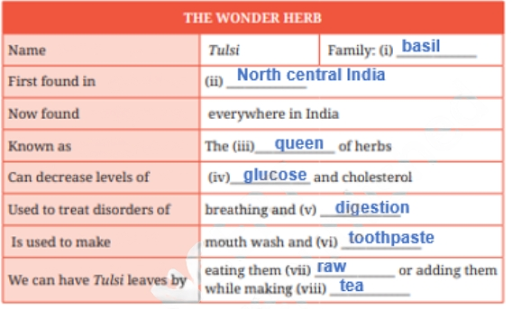
You will listen to the benefits of Tulsi (Holy Basil), a common herb. As you listen, complete the factsheet given below. (refer to page 102 for transcript)
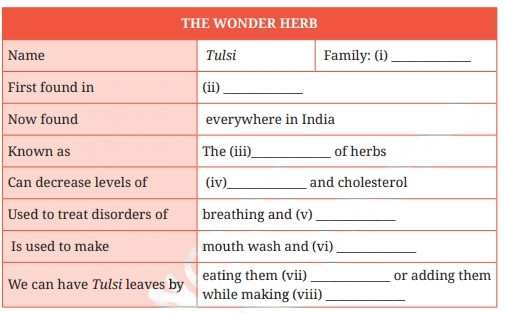
Ans.
Let us write
1. Vikram’s grandmother shared two natural cures to cure his cough in her earlier letter. It was kept outside and a few drops of rain fell on it. Some of the words got washed away by the rain. Help Vikram complete the natural cures. Use the phrases given in the box below. There are two phrases that you do not need.
| Some leaves of basil | For cough | Amount of honey |
| The mixture | For high fever | A piece of fresh ginger |
| You can have it | Grind to get | Home remedy |
Natural Cures for Cough
(a) To prepare this home remedy, you just need ginger and honey. First, take ____________________, grate it and take the juice from it. Take about two teaspoons of this juice and add about two and half teaspoons of honey to it. Mix it properly. Warm ____________________ slightly on very low heat for a minute. Then ____________________ about three to four times a day to get relief from cough. Have patience to see the effect as natural cures ____________________ with ginger and honey might take some time to show results.
(b) To prepare the second ____________________ for cough, take about 10 grams of each long pepper, dried ginger and basil leaves. Add four to six small cardamoms and ____________________ a fine powder. If you take this powder with an equal ____________________, it will give you relief from cough.
Ans.
Natural Cures for Cough
(a) To prepare this home remedy, you just need ginger and honey. First, take a piece of fresh ginger, grate it and take the juice from it. Take about two teaspoons of this juice and add about two and half teaspoons of honey to it. Mix it properly. Warm the mixture slightly on very low heat for a minute. Then you can have it about three to four times a day to get relief from cough. Have patience to see the effect as natural cures for cough with ginger and honey might take some time to show results.
(b) To prepare the second home remedy for cough, take about 10 grams of each long pepper, dried ginger and basil leaves. Add four to six small cardamoms and grind to get a fine powder. If you take this powder with an equalamount of honey, it will give you relief from cough.
2. Now, write a short paragraph on Tulsi based on the completed factsheet in ‘Let us listen’.
Ans. Tulsi is considered a holy plant and had religious significance in India. Tulsi is known as the queen of herbs due to its various benefits. It was first grown in north central India and now, it is found all over the country. Tulsi leaves help regulate blood pressure and calm our mind. They help in curing fever and digestive disorders. It has anti-bacterial properties which make it indeal for herbal hand sanitizers. It also protects us from pollution and cleans the air. Tulsi leaves can be eaten raw or they can be added to herbal tea.
Okay good 💯