
CBSE Class 6 English Unit 1 – Fables and Folk Tales Chapter 2 The Raven and the Fox Important Question Answers from Poorvi Book
Class 6 English The Raven and the Fox Question Answers – Looking for questions and answers for CBSE Class 6 English Unit 1 – Fables and Folk Tales Chapter 2 The Raven and the Fox? Look no further! Our comprehensive compilation of important questions will help you brush up on your subject knowledge. Practising Class 6 English question answers can significantly improve your performance in the exam. Improve your chances of scoring high marks by exploring Unit 1 – Fables and Folk Tales Chapter 2 The Raven and the Fox now. The questions listed below are based on the latest CBSE exam pattern, wherein we have given NCERT solutions to the chapter’s extract-based questions, multiple choice questions and Extra Question Answers
Also, practising with different kinds of questions can help students learn new ways to solve problems that they may not have seen before. This can ultimately lead to a deeper understanding of the subject matter and better performance on exams.
- The Raven and the Fox NCERT Solutions
- The Raven and the Fox Extra Question Answers
- The Raven and the Fox Multiple Choice Questions
- The Raven and the Fox Extract Based Questions
Related:
The Raven and the Fox Textbook Questions (NCERT Solutions)
Let us do these activities before we read.
1. We know that frogs croak. Did you know that ravens also croak?
Ans. Yes, animals like frogs and ravens croak. A croak is a deep harsh sound produced by these two animals.
2. Which animal is shown to be cunning in stories? Circle the correct answer.
(a) tiger (b) fox (c) bear
Ans. (b) fox
Let us discuss
1. Fill in the blanks by choosing the correct option.
(a) Stanza 1
(i) Mr Raven is a __________. (bird/frog)
(ii) The name of the fox is __________. (Raven/Reynard)
(iii) Mr Raven had __________ in his beak. (a piece of food/ a bunch of leaves)
Ans.
(i) Bird
(ii) Reynard
(iii) a piece of food
(b) Stanza 2
(i) The Fox calls the Raven a __________ bird. (foolish/good-looking)
(ii) The Fox asks the Raven to __________. (dance/sing)
(iii) The Raven and the Fox live in the __________. (trees/woods)
Ans.
(i) Foolish
(ii) Sing
(iii) woods
(c) Stanza 3
(i) The Raven ___________ that he croaked. (remembered/forgot)
(ii) The Raven opened its beak to ___________. (eat/sing)
(iii) The ___________ fell down. (food/Raven)
Ans.
(i) Forgot
(ii) Sing
(iii) Food
(d) Stanza 4
(i) The Fox ___________ at the Raven. (laughed/looked)
(ii) It is not ___________ to be too proud of oneself. (wise/unwise)
(iii) The Raven learnt a ______________. (lesson/teaching)
Ans.
(i) laughed
(ii) wise
(iii) lesson
2. Read the poem again and match the words in Column A with their meanings in Column B. Check your answers with your teacher and your classmates.
| Column A | Column B |
| 1. perched | (a) a small piece of food |
| 2. morsel | (b) looked with interest at something |
| 3. seek | (c) feeling that you are better than others |
| 4. pride | (d) sat on a branch |
| 5. eyed | (e) to look for something |
| 6. limb | (f) a smaller area of forest with similar kind of trees |
| 7. woods | (g) branch of a tree |
Ans. 1-d, 2-a, 3-e, 4-c, 5-b, 6-g, 7-f
Let us think and reflect
1. Look at the pictures and number them in the order that they happen in the poem.
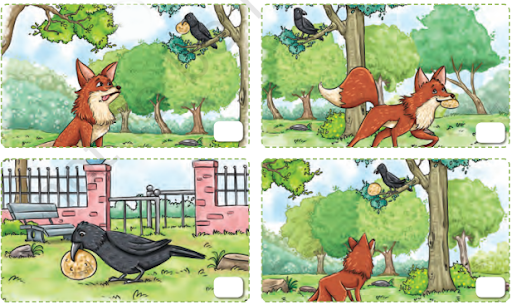
Ans.
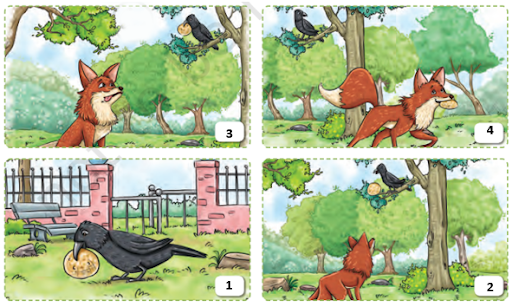
2. Read the following lines and answer the questions that follow.
(a) Sir Raven, you are a handsome bird.
Such feathers! If you would only sing,
The birds of these woods would call you King.
(i) ‘Such feathers’ refer to __________________ feathers.
a. shiny and beautiful
b. black and dull
c. grey and long
d. short and unattractive
(ii) Why would the birds of the woods call the Raven ‘King’?
(iii) Why does the Fox address the Raven as ‘Sir’?
Ans.
(i) a. shiny and beautiful
(ii) They would call the raven ‘King’ because it would sing.
(iii) It addresses the raven as ‘Sir’ to make it feel proud of itself.
(b) The Raven, who did not see the joke,
Forgot that his voice was just a croak.
He opened his beak, in his foolish pride–
(i) Why did the Raven open his beak?
(ii) Complete the following with one word from the given lines.
Fox : clever : : Raven : ______________
Ans.
(i) He wanted to fufil the fox’s desire and so, opened its beak to sing.
(ii) foolish
3. Why does the Raven forget that his voice is just a croak?
Ans. On being falsely praised by the fox, the raven loses his wisdom and forgets the reality.
4. How does Reynard make the Raven sing?
Ans. Reynard praises Raven as being handsome, with attractive feathers and adds that if it sings, the other animals would call him ‘king’.
5. Why does Reynard say that pride is not wise?
Ans. He says this because when the raven was filled with pride, it lost its wisdom, opened its beak to sing and as a result, the food fell from its beak. So, it ended up losing the food because of its pride.
6. Give one reason why the teaching is quite a surprise.
Ans. The teaching is a surprise because the teacher is the same being who has cheated the raven.
7. Imagine someone praises you too much. How would you react?
Ans. I would feel delighted but at the same time, I would think rationally, if the praise was true or not.
Let us learn
1. Write the rhyming words from the poem. One has been done for you.
| Stanza 1 | Stanza 2 | Stanza 3 | Stanza 4 |
| (a) limb-him (b)______ ______ |
(a) word-______
(b)______ ______ |
(a) joke-______ (b)______ ______ |
(a) know-______ (b)______ ______ |
Ans.
| Stanza 1 | Stanza 2 | Stanza 3 | Stanza 4 |
| (a) limb-him (b) beak seek |
(a) word- bird
(b) sing king |
(a) joke- croak (b) pride eyed |
(a) know- glow (b) unwise surprise |
2. Study the underlined words in the poem.
(a) For the Raven held in his great big beak.
The words ‘big’ and ‘beak’ begin with the same /b/ sound.
(b) The song of sweet birds.
Alliteration is a repetition of consonant sounds at the beginning of words. When two or more words together, begin with the same sound, it is called alliteration.
Now, pick another example of alliteration from Stanza 2.
Ans. woods would
3. Choose the correct opposites from the box given below and complete the table. There are two extra words that you will not need.
| wise | happy | humility | flew | remembered |
| notice | dim | cried | silly |
| Words | Opposites |
| 1. perched | |
| 2. forgot | |
| 3. foolish | |
| 4. pride | |
| 5. laughed | |
| 6. ignore | |
| 7. glow |
Ans.
| Words | Opposites |
| 1. perched | flew |
| 2. forgot | remembered |
| 3. foolish | wise |
| 4. pride | humility |
| 5. laughed | cried |
| 6. ignore | notice |
| 7. glow | dim |
Use any four words from the table given above to make sentences of your own.
Ans.
- The sparrow perched on the branch near her nest.
- I forgot to carry my spectacles.
- She has lost all her friends due to her pride.
- Please ignore the nagging beggars.
Let us write
Now, write the story you narrated in the form of a conversation.
(Remember to write only the actions for the Raven as he has food in his mouth and does not speak.)
You may begin like this.
Reynard: Good morning, Mr Raven! You seem to be awake so early!
(Mr Raven just nods his head)
Reynard: Oh, Mr Raven, you look …
Ans.
Reynard: Oh, Mr Raven, you look so handsome and attractive with those feathers.
Mr Raven feels happy and smiles.
Reynard: Only if you would sing, all the creatures would accept you as their king.
Mr Raven feels so proud of himself. He wants to be called the king and so, he opens his beak.
Mr Raven: croak! Croak!
The croaking sound erupts from Mr Raven’s beak and the piece of food falls to the ground.
Reynard laughs
Reynard: You should not be proud, rather be wise. Now you lost the food.
CBSE Class 6 English Poorvi Book Unit 1 – Fables and Folk Tales Chapter 2 The Raven and the Fox Extra Question and Answers
Q1. Who are the two characters in the poem?
Ans. Mr Raven, the raven and Reynard, the fox are the two characters.
Q2. Who is fooled in the poem?
Ans. The Raven is fooled and loses his food.
Q3. Who is the clever animal?
Ans. Reynard the fox is the clever animal.
Q4. Why does the fox indulge in admiring the raven?
Ans. The fox wants to take the food from the raven. He is ready to go to any length to seek it and so, he indulges in false praise.
Q5. The fox is successful in fooling the raven. What should the raven have done?
Ans. The raven should have been wise. It should have remembered that it cannot sing because it could only croak. It should have been aware and not get trapped in the fox’s honey-coated words.
CBSE Class 6 English Chapter The Raven and the Fox Extract-Based Questions
A. Mr Raven was perched upon a limb,
And Reynard the Fox looked up at him;
For the Raven held in his great big beak,
A morsel the Fox would go far to seek.
1. Who was Mr Raven?
Ans. Mr Raven was a raven whose name was also Raven.
2. What does ‘limb’ mean here?
Ans. Limb means a branch.
3. What was the name of the fox?
Ans. Reynard.
4. What was Mr Raven holding in its beak?
Ans. It was holding a morsel of food.
5. What does ‘the Fox would go far to seek’ mean?
Ans. It means that the fox could do anything and do any mean act to get that morsel fo food.
B. Said the Fox, in admiring tones: “My word!
Sir Raven, you are a handsome bird.
Such feathers! If you would only sing,
The birds of these woods would call you King.”
1. Whom did the fox admire?
Ans. It admired the raven.
2. What adjective/s did the fox use for the raven?
Ans. handsome
3. According to the fox, Mr Raven had attractive _______
Ans. feathers
4. Who would call the raven a king?
Ans. The birds who lived in the woods would call the raven as king.
5. What does ‘woods’ here mean?
Ans. It means the forest area.
C. The Raven, who did not see the joke,
Forgot that his voice was just a croak.
He opened his beak, in his foolish pride–
And down fell the morsel the Fox had eyed.
1. What does ‘The Raven, who did not see the joke’ mean?
Ans. It means that the raven failed to recognize that the fox was merely flattering him.
2. How does the raven prove his foolishness?
Ans. The raven opens its beak to sing and forgets that he can merely croak. This proved his foolishness.
3. Why was the fox flattering the raven?
Ans. The fox wanted the morsel of food and so, by flattering the raven, it would make it open its beak and drop the morsel.
4. Was the fox successful?
Ans. Yes, it was successful in getting the morsel of food from the raven’s beak.
5. Which character in the poem is cunning?
Ans. Reynard, the fox is cunning.
D. “Ha-ha!” laughed the Fox. “And now you know,
Ignore sweet words that make you glow.
Pride, my friend, is rather unwise;
I’m sure this teaching is quite a surprise.”
1. Why did the fox laugh?
Ans. The fox had fooled the raven and looted his food. Thus, it laughed.
2. Who is teaching the raven?
Ans. The fox who had cheated the raven also teaches him to be wise instead of being proud.
3. Why was this teaching a surprise?
Ans. It was a surprise because it was coming from the same being who had cheated.
4. Which of these words rhymes with ‘glow’?
A. Duet
B. Blow
C. Got
D, Hot
Ans. B. Blow
5. Who is the teacher?
Ans. The fox
Class 6 The Raven and the Fox Multiple Choice Questions
Q1. Which of these is the correct pair of characters in the poem?
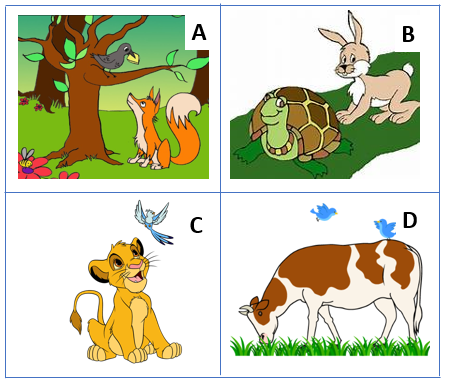
Ans. A
Q2. _______ was sitting on a branch.
A. fox
B. crow
C. camel
D. All of these
Ans. B. crow
Q3. How much food was the raven carrying?
A. a morsel
B. a handful
C. a bowl
D. a plate
Ans. A. a morsel
Q4. What did the fox want?
A. It wanted to rest
B. It wanted the food
C. It wanted to sit on the tree
D. It wanted to kill the raven
Ans. B. It wanted the food
Q5. What did the fox call the raven, when it admired it?
A. beautiful
B. smart
C. beast
D. handsome
Ans. D. handsome
Q6. What is the fox named?
A. Raven
B. Rayon
C. Reynard
D. Robin
Ans. C. Reynard
Q7. The fox could go ________ the morsel.
A. to the cafe to buy
B. far to seek
C. to the canteen to search for
D. home to cook
Ans. B. far to seek
Q8. Who was the foolish animal?
A. Reynard
B. Mr Raven
C. Both A and B
D. None of these
Ans. B. Mr Raven
Q9. Who was the clever animal?
A. Reynard
B. Mr Raven
C. Both A and B
D. None of these
Ans. A. Reynard
Q10. The Raven ______ with pride.
A. glowed
B. bloomed
C. burned
D. danced
Ans. A. glowed
Q11. What would the birds call the raven?
A. foolish
B. king
C. Minister
D. smarty
Ans. B. king
Q12. What happened when the raven opened the beak to sing?
A. it croaked
B. the morsel fell
C. Both A and B
D. None of these
Ans. C. Both A and B
Q13. Which if the following is alliteration from the poem?
A. admiring tones
B. handsome bird
C. Such feathers
D. big beak
Ans. D. big beak
Q14. What is the rhyme scheme of the poem?
A. abab
B. aabb
C. abcb
D. abcd
Ans. B. aabb
Q15. What did the raven have to do to be called a king?
A. dance
B. sing
C. act
D. cook
Ans. B. sing
Q16. Identify the use of ‘Onomatopoeia’ in the poem.
A. handsome
B. tones
C. croak
D. morsel
Ans. C. croak
Q17. Which word does NOT rhyme with ‘surprise’?
A. Price
B. Unwise
C. disguise
D. moist
Ans. D. moist
Q18. The raven could not see the joke cracked by the ____
A. cat
B. dog
C. fox
D. cow
Ans. C. fox
Q19. Who says ‘Pride, my friend, is rather unwise;’
A. Raven
B. Reynard
C. Both A and B
D. None of these
Ans. B. Reynard
Q20. Who is the friend in ‘Pride, my friend, is rather unwise;’
A. Raven
B. Reynard
C. Both A and B
D. None of these
Ans. A. Raven
Also See:
It was helpful