

CBSE Class 9 English Poem 5 Nine Gold Medals Question Answers (Important) from Kaveri Book
Class 9 English Nine Gold Medals Question Answers – Looking for Nine Gold Medals question answers (NCERT solutions) for CBSE Class 9 English Kaveri Book Poem 5? Look no further! Our comprehensive compilation of important questions will help you brush up on your subject knowledge. Practising Class 9 English question answers can significantly improve your performance in the exam. Our solutions provide a clear idea of how to write the answers effectively. Improve your chances of scoring high marks by exploring Poem 5: Nine Gold Medals now. The questions listed below are based on the latest CBSE exam pattern, wherein we have given NCERT solutions (Textbook Questions) to the chapter’s, Extract Based Questions, Multiple Choice Questions, and Extra Question Answers
Also, practising with different kinds of questions can help students learn new ways to solve problems that they may not have seen before. This can ultimately lead to a deeper understanding of the subject matter and better performance on exams.
- Nine Gold Medals Textbook Questions (NCERT Solution)
- Nine Gold Medals Grammar Exercises
- Nine Gold Medals Extract-Based Questions
- Nine Gold Medals Multiple Choice Questions
- Nine Gold Medals Extra Questions
Related:
Nine Gold Medals Textbook Questions (NCERT Solution)
Check Your Understanding
I. Work in pairs. Match the words and phrases in Column 1 with their meanings in Column 2. You may read the poem again and infer the contextual meaning. Check your answers with the teacher.
| Column 1 | Column 2 |
| 1. dashed in the dirt | (i) walk or move with difficulty |
| 2. stumbled | (ii) destroyed |
| 3. staggered | (iii) a hard black substance used to make roads and paths |
| 4. anguish | (iv) step awkwardly, lose balance and almost fall |
| 5. asphalt | (v) extreme pain or suffering |
Ans.
| Column 1 | Column 2 |
| 1. dashed in the dirt | (ii) destroyed |
| 2. stumbled | (iv) step awkwardly, lose balance and almost fall |
| 3. staggered | (i) walk or move with difficulty |
| 4. anguish | (v) extreme pain or suffering |
| 5. asphalt | (iii) a hard black substance used to make roads and paths |
II. Identify the gist of each stanza. Write the number of the stanza in the boxes given.
1. Spectators cheered participants of different events and waited enthusiastically for the final event to start.
2. All runners dashed ahead as soon as they heard the gun shot; suddenly, one of the athletes tripped and fell on the ground.
3. The race finished with nine athletes holding hands and winning the well-deserved gold medals; their smiles, and spectators standing up to applaud, conveyed everything.
4. Participants got ready at the starting line and nine determined athletes waited for the sound of the gun.
5. Athletes from various parts of the country had gone through months of training; had big dreams of winning a medal.
6. The eight athletes stopped to help the young fallen athlete stand up, forgetting that they were competing.
7. Nine athletes held the banner and walked hand in hand; this gesture represented the ethos of Special Olympics.
8. The young athlete felt his dreams were shattered and cried in pain and disappointment, but something unique happened.
Ans.
1. Spectators cheered participants of different events and waited enthusiastically for the final event to start. Stanza 2
2. All runners dashed ahead as soon as they heard the gun shot; suddenly, one of the athletes tripped and fell on the ground. Stanza 4
3. The race finished with nine athletes holding hands and winning the well-deserved gold medals; their smiles, and spectators standing up to applaud, conveyed everything. Stanza 8
4. Participants got ready at the starting line and nine determined athletes waited for the sound of the gun. Stanza 3
5. Athletes from various parts of the country had gone through months of training; had big dreams of winning a medal. Stanza 1
6. The eight athletes stopped to help the young fallen athlete stand up, forgetting that they were competing. Stanza 6
7. Nine athletes held the banner and walked hand in hand; this gesture represented the ethos of Special Olympics. Stanza 7
8. The young athlete felt his dreams were shattered and cried in pain and disappointment, but something unique happened. Stanza 5
III. Let us appreciate the poem.
1. Two examples of alliteration from the poem are (i) ______________ and (ii) ____________.
Ans.
(i) standing still
(ii) beaming faces
2. Give three examples of visual imagery from the poem.
(i) ______________
(ii) _______________
(iii) _______________
Ans.
(i) nine runners at the starting line
(ii) the boy falling on the asphalt
(iii) athletes holding hands at the finish line
3. Give an example of auditory imagery from the poem. (i) _________________
Ans.
(i) the pistol exploded
4. How does the use of imagery make the poem more appealing?
Ans. Imagery creates a clear and vivid picture in the reader’s mind, making the events more real and engaging.
5. How does the poet’s tone change from the beginning to the end of the poem?
Ans. The tone changes from competitive and tense at the beginning to emotional, caring, and inspirational at the end.
6. What is the overall mood created by the poem?
Ans. The mood is inspiring, emotional, and uplifting.
7. What is the message being conveyed by the poem?
Ans. The poem conveys that humanity, compassion, and teamwork are more important
than winning or competition.
Critical Reflection
I. Read the extracts given below and answer the questions that follow.
1. The eight other runners pulled up on their heels
The ones who had trained for so long to compete
One by one they all turned round and went back to help him
And brought the young boy to his feet.
(i) Select the correct option to complete the sentence.
The phrase ‘pulled up on their heels’ means that the runners _______.
A. moved aside
B. stopped running
C. tried to run faster
D. jumped ahead
Ans. B. stopped running
(ii) Mention one character trait common to all the eight other runners.
Ans. Compassion / kindness
(iii) What is the tone of the poet in these lines?
Ans. Empathetic and caring tone
(iv) How might the young athlete have felt on being helped by the others?
Ans. grateful, relieved, and supported
(v) Would you consider this incident as a turning point in the poem? If yes, why? If no, why not?
Ans. Yes, this is a turning point because the race changes from competition to cooperation and humanity
2. That’s how the race ended, with nine gold medals
They came to the finish line holding hands still
And a standing ovation and nine beaming faces
Said more than these words ever will.
(i) How did the nine contestants feel when they reached the finishing line together?
Ans. They felt happy, proud, and united
(ii) Why do you think all the nine contestants were given gold medals?
Ans. Because they showed sportsmanship, teamwork, and compassion instead of selfish competition
(iii) Complete the sentence appropriately.
The holding of hands signifies a feeling of _____________________.
Ans. The holding of hands signifies a feeling of unity and togetherness
(iv) Choose the correct option to complete the sentence. The spectators giving a ‘standing ovation’ indicates that they were ______.
A. amazed
B. speechless
C. distracted
D. thoughtful
Ans. A. amazed
(v) Explain the last line of the extract.
Ans. The last line means that their actions of kindness and unity expressed more powerful emotions than words could ever explain.
Answer the following questions.
1. Describe how the setting established in the first two stanzas of the poem create a vivid atmosphere for the events that follow.
Ans. The first two stanzas create a lively and exciting atmosphere by describing athletes, their preparation, and cheering spectators, building anticipation for the race.
2. How do you think the youngest athlete might have felt when he fell?
Ans. The youngest athlete might have felt sad, disappointed, and helpless when he fell.
3. Why were the athletes eager to begin the race?
Ans. The athletes were eager because they had trained for months and wanted to win medals.
4. What does the transformation of the hundred-yard dash to a walk symbolise?
Ans. It symbolises unity, compassion, and humanity over competition
5. How might the poem be different if the focus was solely on individual achievement rather than collective support?
Ans. The poem would become selfish and less meaningful, losing its message of kindness and teamwork.
6. How does the poet’s use of language and tone enhance the reader’s engagement with the poem?
Ans. The poet uses simple language and emotional tone, making the poem easy to understand and deeply engaging.
7. What might be the poet’s purpose of writing this poem?
Ans. The poet’s purpose is to promote empathy, teamwork, and true sportsmanship.
Top
Nine Gold Medals Grammar Exercises
Vocabulary in Context
I. The phrase ‘standing ovation’ is an example of an adjective–noun collocation. Identify two other similar examples from the poem.
Collocation is a pair or group of words that habitually appear together.
Ans.
young athletes
final event
II. Complete the table given below by writing four nouns in Column 2 that collocate with the adjectives in Column 1. One example has been done for you. You may take the help of a dictionary.
| Column 1 | Column 2 |
| 1. big | disappointment, failure, surprise, decision |
| 2. heavy | |
| 3. strong | |
| 4. large | |
| 5. great |
Ans.
| Column 1 | Column 2 |
| 1. big | disappointment, failure, surprise, decision |
| 2. heavy | rain, traffic, load, loss |
| 3. strong | coffee, wind, argument, support |
| 4. large | number, amount, crowd, area |
| 5. great | effort, success, achievement, importance |
III. Choose the correct adjectives from those given in the box for the underlined words given in the sentences below. Ensure you do not use the same adjective twice.
| positive | significant | youngest |
| noisy | loud |
1. The littlest athlete was moving at a steady pace. _____________________
2. The eight athletes had a smiling attitude. _____________________
3. When the athlete fell, he gave a huge cry of pain. _____________________
4. The spectators saw a terrible difference in the athletes who had only come to compete. _____________________
5. The gaudy crowd cheered the runners enthusiastically. _____________________
Ans.
1. youngest
2. positive
3. loud
4. significant
5. noisy
I. You will listen to a radio-talk about Patrick Gomes, a coach of special athletes. As you listen, write true or false for the statements given. (Transcript for teacher on page 268)
1. Patrick Gomes began his career in sports with track events.
Ans. True
2. Patrick Gomes has been coaching special athletes for 10 years.
Ans. False
3. Patrick Gomes does all the household work himself.
Ans. True
II. You will listen to the radio-talk once again. As you listen, choose the correct option for each question.
1. When the speaker uses the phrase ‘push your boundaries’, he wants listeners to _________.
(i) challenge themselves
(ii) meet new people
(iii) be open-minded
Ans. (i) challenge themselves
2. Patrick Gomes is a ___________ at present.
(i) special athlete
(ii) coach of special athletes
(iii) value education teacher
Ans. (ii) coach of special athletes
3. Special Olympic Games held at Connecticut was a __________ for Patrick Gomes.
(i) motivational year
(ii) turning point
(iii) gradual change
Ans. (ii) turning point
4. As a special athlete, Patrick Gomes mostly participated in ___________.
(i) track events
(ii) jogging
(iii) football
Ans. (i) track events
5. Patrick Gomes believes that sports is essential because it encourages ___________ along with fitness.
(i) a positive outlook
(ii) a peaceful mind
(iii) an active life
Ans. (i) a positive outlook
Writing Task
I. Work in pairs to write three creative slogans on Special Olympics.
One example of a slogan on Special Olympics has been given below.
Special Olympics: Igniting a Universe of Potential
Present your slogans in a creative manner and share with your classmates and teacher.

Steps to write a slogan
Understand the theme on which you want to write a slogan.
Brainstorm ideas and use them to create the slogan.
Keep it brief and simple.
It should not be more than eight to ten words.
Make the slogan catchy
Ans.
1. “Play with heart, win with unity and pride.”
2. “Inclusion in sports builds strength, courage, and confidence.”
3 “Different abilities, same dreams, one powerful team.”
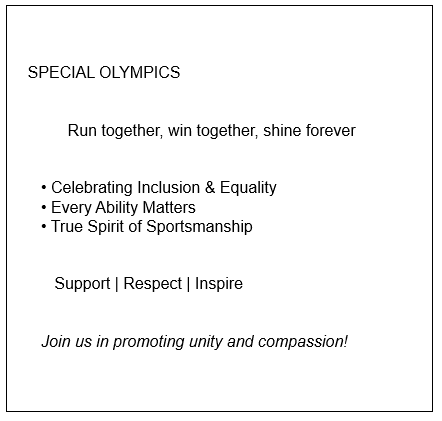
Now, create a poster based on the inspiration you have drawn from the poem. Present your poster to the class and display it on the classroom board.
Steps to design a poster
- Include all vital information.
- Write down the ideas.
- Remember to place the slogan you created.
- Use top, bottom, and sides of the poster for other important information.
- Include some illustrations, a call for action, if needed.
- Colour and decorate your poster.
- Present your poster as a box item.
Ans.
CBSE Class 9 English Poem 5 Nine Gold Medals Extract-Based Questions
A.
“The athletes had come from all over the country
To run for the gold, for the silver, and bronze
Many weeks and months of training
All coming down to these games.”
Q1. Where had the athletes come from?
Ans. The athletes had come from all over the country to participate in the Special Olympics. They had gathered at one place to compete in the hundred-yard dash for gold, silver and bronze medals.
Q2. What had the athletes been doing for many weeks and months?
Ans. The athletes had been training hard for many weeks and months before the Special Olympics. All their dedication and hard work had come down to this one final and most important event of the games.
Q3. What does the phrase “all coming down to these games” suggest?
Ans. The phrase suggests that months of hard work, sacrifice and preparation had finally led to this one crucial moment. It shows how important and significant this event was for every single athlete participating in it.
Q4. What medals were the athletes competing for?
Ans. The athletes were competing for gold, silver and bronze medals. These three medals represent the first, second and third positions in any Olympic or sporting competition held around the world.
Q5. What does this stanza tell us about the athletes’ dedication?
Ans. This stanza tells us that the athletes were deeply dedicated and hardworking. Despite their special needs they trained for months with full determination showing that passion and commitment know no physical or mental boundaries.
B.
“The signal was given, the pistol exploded
And so did the runners all charging ahead
But the smallest among them, he stumbled and staggered
And fell to the asphalt instead.”
Q1. How did the race begin?
Ans. The race began with a signal and the sound of an exploding pistol. All nine runners charged ahead with full energy and determination as soon as they heard the starting signal.
Q2. What happened to the smallest runner?
Ans. The smallest runner among the nine athletes suddenly stumbled and staggered and fell hard on the asphalt track. This unexpected fall happened just as the race had begun and all runners were charging ahead.
Q3. What does the word “exploded” suggest about the pistol sound?
Ans. The word “exploded” suggests that the pistol sound was sudden, sharp and very loud. It also creates a sense of excitement and energy as all nine runners burst forward with full power and determination.
Q4. What does the word “stumbled” tell us about the fall?
Ans. The word “stumbled” tells us that the fall was sudden and unexpected. The smallest runner lost his balance and coordination while running at full speed and fell helplessly onto the hard asphalt track below him.
Q5. How does this stanza create a dramatic effect in the poem?
Ans. This stanza creates a dramatic effect by suddenly shifting from the excitement of the race beginning to the shocking moment of the smallest runner falling. This unexpected turn makes the reader feel both surprised and deeply concerned for the fallen boy.
C.
“He gave out a cry of frustration and anguish
His dreams and his efforts dashed in the dirt
But as sure as I’m standing here telling this story
The same goes for what next occurred.”
Q1. Why did the fallen runner cry out?
Ans. The fallen runner cried out in frustration and anguish because he felt that all his months of hard training and his dreams of winning a medal had been destroyed in that one terrible moment of falling.
Q2. What does the phrase “dreams and efforts dashed in the dirt” mean?
Ans. This phrase means that all the hopes, dreams and months of hard work of the fallen runner seemed to have been completely destroyed in one moment. It powerfully captures his deep pain, disappointment and sense of helplessness.
Q3. What does the narrator mean by “as sure as I’m standing here telling this story”?
Ans. This phrase means that the narrator is personally vouching for the truth of what happened next. It makes the poem feel like a real eyewitness account and adds a sense of genuineness and credibility to the extraordinary event that followed.
Q4. What emotion does the word “anguish” convey in this stanza?
Ans. The word “anguish” conveys a feeling of deep and overwhelming pain both physical and emotional. It shows that the fallen runner was not just hurt physically by his fall but was also devastated emotionally by the thought of losing the race.
Q5. How does this stanza build suspense in the poem?
Ans. This stanza builds suspense by describing the fallen runner’s pain and then hinting that something extraordinary is about to happen next. The phrase “what next occurred” makes the reader deeply curious and eager to find out what happened after the fall.
D.
“Then all the nine runners joined hands and continued
The hundred-yard dash now reduced to a walk
And a banner above that said Special Olympics
Could not have been more on the mark.”
Q1. What did all nine runners do after helping the fallen boy?
Ans. After helping the fallen boy to his feet all nine runners joined hands together and walked slowly toward the finish line completing the hundred-yard dash not as a competitive race but as a beautiful act of unity.
Q2. What does the phrase “reduced to a walk” suggest?
Ans. The phrase suggests that the competitive race had been transformed into something far more beautiful and meaningful. The runners chose togetherness and compassion over speed and competition making the walk far more powerful than any fast race could ever be.
Q3. What is the significance of the Special Olympics banner in this stanza?
Ans. The Special Olympics banner is deeply significant because it represents the true spirit of the games, celebrating every human being’s dignity and ability. The poet says it “could not have been more on the mark” meaning this act perfectly represented what Special Olympics truly stands for.
Q4. What does “could not have been more on the mark” mean?
Ans. This phrase means that the banner reading “Special Olympics” was perfectly and completely appropriate for what had just happened. The runners’ extraordinary act of compassion and unity was the perfect and most beautiful representation of the Special Olympics spirit.
Q5. How does joining hands symbolize the central message of the poem?
Ans. Joining hands symbolizes unity, compassion and togetherness, the central message of the entire poem. It shows that when human beings choose to support each other rather than compete against each other the result is something far more beautiful and meaningful than any individual victory.
Top
Class 9 Nine Gold Medals Multiple Choice Questions
Q1. Where had the athletes come from?
A. One city
B. All over the country
C. One school
D. One state
Ans. B. All over the country
Q2. What were the athletes competing for?
A. Money
B. Fame
C. Gold, silver and bronze medals
D. Certificates
Ans. C. Gold, silver and bronze medals
Q3. How long had the athletes trained?
A. Few days
B. Few weeks and months
C. One year
D. One day
Ans. B. Few weeks and months
Q4. What was the final event?
A. Marathon
B. Relay race
C. Hundred-yard dash
D. Long jump
Ans. C. Hundred-yard dash
Q5. How many athletes were at the starting line?
A. Seven
B. Eight
C. Nine
D. Ten
Ans. C. Nine
Q6. What signalled the start of the race?
A. Whistle
B. Bell
C. Gun shot
D. Clap
Ans. C. Gun shot
Q7. What happened to the smallest athlete?
A. Won the race
B. Got tired
C. Stumbled and fell
D. Ran fast
Ans. C. Stumbled and fell
Q8. How did the fallen athlete feel?
A. Happy
B. Excited
C. Angry and joyful
D. Frustrated and anguished
Ans. D. Frustrated and anguished
Q9. What did the other runners do?
A. Continued running
B. Ignored him
C. Stopped and helped him
D. Left the race
Ans. C. Stopped and helped him
Q10. How did they help the boy?
A. Gave water
B. Lifted him up
C. Called teacher
D. Left him
Ans. B. Lifted him up
Q11. What did the runners do after helping him?
A. Started running again
B. Quit the race
C. Walked together holding hands
D. Sat down
Ans. C. Walked together holding hands
Q12. What was written on the banner?
A. Olympics
B. Sports Day
C. Special Olympics
D. National Games
Ans. C. Special Olympics
Q13. How did the race end?
A. One winner
B. No winner
C. Nine winners
D. Disqualified
Ans. C. Nine winners
Q14. What did the spectators do?
A. Left early
B. Booed
C. Gave a standing ovation
D. Stayed silent
Ans. C. Gave a standing ovation
Q15. What does the poem mainly highlight?
A. Speed
B. Competition
C. Unity and compassion
D. Winning medals
Ans. C. Unity and compassion
Q16. What does ‘pulled up on their heels’ mean?
A. Ran faster
B. Jumped
C. Stopped running
D. Fell down
Ans. C. Stopped running
Q17. What is the tone of the poem?
A. Sad
B. Angry
C. Inspiring and emotional
D. Funny
Ans. C. Inspiring and emotional
Q18. What message does the poem convey?
A. Winning is everything
B. Help others and show humanity
C. Run fast
D. Practice daily
Ans. B. Help others and show humanity
Q19. Why were all given gold medals?
A. No competition
B. Judge’s mistake
C. For teamwork and kindness
D. Luck
Ans. C. For teamwork and kindness
Q20. What does holding hands symbolise?
A. Weakness
B. Friendship only
C. Unity and support
D. Fear
Ans. C. Unity and support
Top
CBSE Class 9 English Kaveri Book Poem 5 – Nine Gold Medals Extra Question and Answers
Answer the following questions:
Q1. Why had the athletes gathered at the field?
Ans. The athletes had gathered at the field to participate in the Special Olympics hundred-yard dash. They had come from all over the country to compete for gold, silver and bronze medals after months of hard training.
Q2. What was the mood of the spectators before the race began?
Ans. The spectators were very excited and enthusiastic before the race began. They had gathered around the old field to cheer on all the young women and men and excitement was at its highest point as the final event of the day approached.
Q3. How many athletes participated in the hundred-yard dash?
Ans. Nine athletes participated in the hundred-yard dash. They were all lined up at the starting line, fully prepared and determined to give their best performance in this final and most important event of the Special Olympics.
Q4. What happened to the smallest runner as soon as the race began?
Ans. As soon as the race began the smallest runner stumbled and staggered and fell hard on the asphalt track. He cried out in frustration and anguish feeling that all his dreams and months of hard work had been destroyed in that one moment.
Q5. How did the eight runners respond when the smallest runner fell?
Ans. The eight runners immediately stopped running and pulled up on their heels. They turned around one by one and went back to help the fallen boy. Together they lifted him to his feet showing extraordinary compassion and selflessness.
Q6. What did all nine runners do after the fallen boy was helped to his feet?
Ans. After helping the fallen boy to his feet all nine runners joined hands together and walked slowly toward the finish line. The competitive hundred-yard dash was now transformed into a beautiful and powerful walk of unity and togetherness.
Q7. How did the race end?
Ans. The race ended with all nine runners crossing the finish line together holding hands. They all received gold medals and the crowd gave them a standing ovation. Their nine beaming and joyful faces expressed more than any words could ever describe.
Q8. What is the significance of the title “Nine Gold Medals”?
Ans. The title is deeply significant because normally only one person wins a gold medal. Here all nine athletes received gold medals not for their speed but for their selfless compassion and humanity. Their gold medals symbolize nine golden hearts full of kindness and unity.
Q9. What does the poem teach us about true sportsmanship?
Ans. The poem teaches us that true sportsmanship is not just about winning races or collecting medals. It is about respecting fellow competitors, showing compassion when someone is in need and valuing human dignity over personal glory and individual achievement.
Q10. Why is this poem considered an inspiring and motivational poem?
Ans. This poem is considered inspiring because it shows that ordinary people can do extraordinary things when they choose compassion over competition. The eight runners gave up their personal victory to help a fallen teammate proving that humanity and kindness are always the greatest and most valuable achievements in life.