

CBSE Class 9 English Poem 3 Canvas of Soil Question Answers (Important) from Kaveri Book
Class 9 English Canvas of Soil Question Answers – Looking for Canvas of Soil question answers (NCERT solutions) for CBSE Class 9 English Kaveri Book Poem 3? Look no further! Our comprehensive compilation of important questions will help you brush up on your subject knowledge. Practising Class 9 English question answers can significantly improve your performance in the exam. Our solutions provide a clear idea of how to write the answers effectively. Improve your chances of scoring high marks by exploring Poem 3: Canvas of Soil now. The questions listed below are based on the latest CBSE exam pattern, wherein we have given NCERT solutions (Textbook Questions) to the chapter’s, Extract Based Questions, Multiple Choice Questions, and Extra Question Answers
Also, practising with different kinds of questions can help students learn new ways to solve problems that they may not have seen before. This can ultimately lead to a deeper understanding of the subject matter and better performance on exams.
- Canvas of Soil Textbook Questions (NCERT Solution)
- Canvas of Soil Grammar Exercises
- Canvas of Soil Extract-Based Questions
- Canvas of Soil Multiple Choice Questions
- Canvas of Soil Extra Questions
Related:
Canvas of Soil Textbook Questions (NCERT Solution)
Check Your Understanding
I. Read the poem again and complete the summary of each stanza by filling in the blanks.
1. The _______ is portrayed as a rich palette where gardeners’ __ __ __ a __ s flourish in the form of ________ , awaiting spring.
2. The garden flowers _________ into a beautiful display of different b __ __ __ __ __ m s, resembling a ________ by Mother Nature, in the light of morning.
3. Each garden is likened to a wide __ __ n __ __ s, integrating art and __________. Through the efforts of gardeners, gardens transform into still-life __________.
Ans.
1. Earth, dreams, seeds
2. Blossom, blooms, painting
3. canvas, life, paintings
II. Select the appropriate title for each stanza from those given below. There are two extra titles.
1. Nature’s Work of Art
2. Sweet-smelling Blossoms
3. Gardens as Living Canvases
4. Earth and Possibilities
5. The Painter’s Canvas
Ans.
Titles of each stanza
1. Stanza 1 Earth and Possibilities
2. Stanza 2 Nature’s Work of Art
3. Stanza 3 Gardens as Living Canvases
III. Match the poetic devices in Column 1 to the examples in Column 2. Discuss your responses in pairs. Then share the responses with your classmates and teacher.
| Column 1 | Column 2 |
| 1. Imagery [mind pictures] | (i) appreciative |
| 2. Metaphor [comparison without use of ‘like’ or ‘as’] | (ii) AABB |
| 3. Rhyme Scheme | (iii) ‘Blossoms bloom’ |
| 4. Tone [what the poet feels] | (iv) colours, brushstrokes, blossoms, shades of green |
| 5. Mood [what the reader feels] | (v) a gardener |
| 6. Speaker | (vi) garden as a painting, plot as canvas, seeds as brushstrokes |
| 7. Alliteration [same consonant sound] | (vii) joyful |
The poem may be interpreted as an allegory.
An allegory is a literary device used to express larger ideas than those presented without explicitly stating them. Allegory operates on two levels, the surface meaning and the deeper meaning.
Upon considering this poem as an allegory, the garden could symbolise various aspects of life or nature.
- Life’s journey and growth, The garden, with its changing seasons and blooming flowers, could represent the journey of life, growth, and the cyclical nature of existence.
- Harmony and diversity, The interaction of different colours in the garden could symbolise the beauty and importance of diversity and harmony in our world.
Ans.
| Column 1 (Poetic Device) | Column 2 (Answer) |
| 1. Imagery | (iv) colours, brushstrokes, blossoms, shades of green |
| 2. Metaphor | (vi) garden as a painting, plot as canvas, seeds as brushstrokes |
| 3. Rhyme Scheme | (ii) AABB |
| 4. Tone | (i) appreciative |
| 5. Mood | (vii) joyful |
| 6. Speaker | (v) a gardener |
| 7. Alliteration | (iii) ‘Blossoms bloom’ |
Critical Reflection
I. Read the given extracts from the poem and answer the questions that follow.
1. Brushstrokes of seeds, planted true,
Awaiting spring’s vibrant hue.
(i) The poet has used a metaphor in ‘Brushstrokes of seeds’. Which option from those given below uses a metaphor?
A. Her mother’s heart heard her heartfelt request with kindness.
B. She has a heart of gold.
C. Her heart did a dance of joy on seeing the new doll.
D. She has a very kind heart.
Ans. B. She has a heart of gold.
(ii) Complete the sentence appropriately.
The phrase ‘planted true’ is significant because it implies __________.
Ans. seeds are planted carefully and properly.
(iii) Why has the poet used the word ‘hue’ instead of ‘colours’ in the extract?
Ans. The poet used ‘hue’ because it sounds more poetic and shows different shades of colour, not just simple colours.
(iv) Complete the following analogy correctly with a word from the extract.
Summer: hot :: Spring : _________
Ans. vibrant
(v) Read the Assertion (A) and the Reason (R) and select the option that is correctly suited.
(A): Gardeners wait for Spring.
(R): Gardens are worth painting in Spring.
A. Both (A) and (R) are true and (R) is the correct explanation of (A).
B. Both (A) and (R) are true but (R) is not the correct explanation of (A).
C. (A) is true but (R) is false.
D. (A) is false but (R) is true.
Ans. A (Both are true and R explains A)
2. Each plot, a canvas wide,
Where art and life coincide.
(i) What does ‘Each plot’ refer to in this extract?
Ans. Each plot’ refers to each piece of garden land.
(ii) Select which option imitates the rhyme scheme of the extract.
A. beautiful and clear
laughter and cheer
B. beautiful and clear
laughter and tears
Ans. A . beautiful and clear
laughter and cheer
(iii) Select the line from the extract that conveys that gardening blends aesthetic beauty with natural growth.
Ans. “Where art and life coincide.”
(iv) Complete the following sentence appropriately.
The plot is likened to a canvas suggesting that_____________.
Ans. a garden is like a place where creativity is expressed like painting.
‘
(v) Why has the poet most likely used the word ‘wide’ instead of ‘long’ in ‘canvas wide’?
Ans. ‘Wide’ shows openness and large creative space, better than ‘long’.
II. Give reasons for the comparisons made by the poet in the poem.
1. A painter is compared to a gardener because______________.
2. A palette is like earth as __________________.
3. The brushstrokes are like seeds because_________________.
4. A canvas is similar to a garden plot as __________________.
Ans.
1. both create beauty using their skills.
2. both hold and mix different colours/elements.
3. both start the creation process.
4. both are spaces where creation happens.
III. Answer the following questions.
1. How does the metaphor ‘Brushstrokes of seeds’, enhance the understanding of gardening as an art form?
Ans. It shows gardening is like art because seeds are like brushstrokes that create beauty.
2. What can you infer about the poet’s perspective on the relationship between nature and creativity from the following lines?
‘Each plot, a canvas wide,/Where art and life coincide.’
Ans. The poet believes nature and creativity are closely connected and work together.
3. Do you think the imagery in the poem successfully paints a vivid picture in the reader’s mind? If yes, why? If no, why not?
Ans. Yes, because the poem uses colourful and clear imagery that helps us imagine the garden.
4. Support the view that the poet’s mention of the colour yellow, besides red, blue and green, would have lent effectively to the imagery.
Ans. Yellow would add more brightness and variety, making imagery richer.
5. Considering the line ‘Gardens become paintings still’, what can you interpret about the poet’s view on the timelessness of nature’s beauty?
Ans. It means nature’s beauty is timeless and everlasting.
6. Justify the title of the poem, ‘Canvas of Soil’.
Ans. The title is justified because soil acts like a canvas where nature creates art.
Top
Canvas of Soil Grammar Exercise
Vocabulary in Context
I. The poet refers to the shades of green, red, and blue in the poem. Let us read some of the names of different shades of these colours.
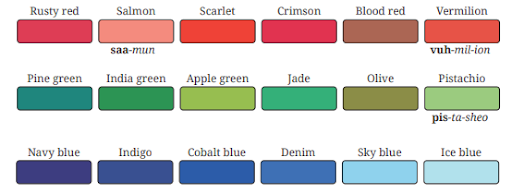
Now, Discuss in pairs, any two things that you can associate with these colours.
Ans.
Red (shades of red)
Roses
Apples
Green (shades of green)
Leaves
Grass
Blue (shades of blue)
Sky
Ocean
II. You have studied painting-related words like palette, brushstrokes, shades, hue, colours, and canvas. Now, read the following paragraph and discuss in pairs what the underlined painting-related words might mean. Discuss this way:
I think ____________ means ____________ because the passage talks about ____________.
Example: I think portrait means a picture of someone’s face because the passage talks about capturing a friend’s features.
In the art studio, young painters eagerly approached their easels, each framing a canvas that they had to work on. The teacher encouraged them to experiment with a diverse tonal range, playing with shades and hues to bring their paintings to life. One student focused on a detailed portrait, capturing his friend’s features, first with careful underpainting and then filling the final colours. Another student worked on a mural, depicting a Spring Day on the right wall of the classroom. The room continued to buzz with artistic energy.
Ans.
I think easels means a stand to hold a canvas because the passage talks about painters working on their canvas.
I think tonal range means variety of light and dark shades because the passage talks about experimenting with shades and hues.
I think underpainting means the first base layer of paint because the passage talks about painting before adding final colours.
I think mural means a large painting on a wall because the passage talks about painting on the classroom wall.
Listen and Respond
I. You will listen to a young girl describe her school garden. As you listen identify which of the following 1–3, she does not talk about. (Transcript for teacher on page 264)
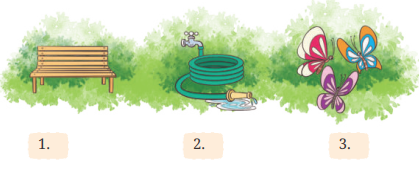
Ans. 1. bench
II. You will once again listen to the young girl. As you listen, circle the correct answer from the options given below.
| Statements | Options | ||
| 1. The colour of flowers in the first row | white | red | pink |
| 2. The type of flowers in the second row | marigold | jasmine | rose |
| 3. Position of the type of the useful plants | left corners | right corners | left and right corners |
| 4. The number of potted evergreen plants | 15 | 20 | 25 |
| 5. The paint colour on the bricks bordering the garden | black and white | red and black | white and red |
| 6. Type of tree in the centre of the garden | neem | peepal | banyan |
| 7. Things created with waste material | dustbins | plant name boards | bird houses |
Ans.
1. white
2. marigold
3. left and right corners
4. 20
5. white and red
6. neem
7. bird houses
Writing Task
I. Write a descriptive piece of two to three paragraphs describing the details and colours in the garden you have visited.
- Focus on how different shades of blue, red, and green interact, create contrast, and bring the garden to life.
- Pay attention to details like the texture of petals, the varying greens of leaves, and the way light affects the colours.
Ans.
I recently visited a beautiful garden filled with vibrant colours and natural beauty. The garden had a refreshing mix of shades of green, from light green new leaves to dark green old trees. The plants were neatly arranged, and the grass looked soft and fresh, like a green carpet. The sunlight falling on the leaves made them shine and added a glowing effect to the entire garden.
Bright red flowers stood out among the greenery, creating a striking contrast. Some flowers were deep red while others were light pink, adding variety and charm. The petals were soft and smooth, and their delicate texture made them look even more attractive. Blue flowers added a calm and cool touch, balancing the bright reds and greens beautifully.
The combination of colours, textures, and light made the garden come alive like a painting. The gentle breeze made the leaves and flowers move softly, creating a peaceful and pleasant atmosphere. It felt like nature had carefully painted every detail to create a perfect and lively scene.
Top
CBSE Class 9 English Poem 3 Canvas of Soil Extract-Based Questions
A
Palette of earth, rich and deep,
Where dreams of gardeners seep.
Brushstrokes of seeds, planted true,
Awaiting spring’s vibrant hue.
Q1. What does the poet mean by comparing soil to a palette?
Ans. The poet compares soil to a palette to show that just like a painter uses a palette to create a masterpiece, a gardener uses rich and deep soil to plant dreams and create a living work of art.
Q2. Why does the poet say “dreams of gardeners seep” into the earth?
Ans. The poet says this because every seed a gardener plants carries their hopes, aspirations, and creative vision. The dreams seep into the earth just like water, suggesting gardening is a deeply personal and emotional creative act.
Q3. What does “brushstrokes of seeds” suggest about gardening?
Ans. The metaphor suggests that planting seeds is as deliberate, purposeful, and artistic as making brushstrokes on a canvas. It elevates gardening to the level of a noble and beautiful art form requiring skill and creativity.
Q4. What does “planted true” suggest about the gardener?
Ans. The phrase “planted true” suggests that the gardener plants seeds with honesty, dedication, sincerity, and deep commitment to their craft. It shows that great gardening, like great art, requires truthfulness and wholehearted devotion.
Q5. What is the effect of the gardener awaiting spring’s vibrant hue?
Ans. It shows that great art and great gardening both require patience and faith. The gardener waits with hope and anticipation for spring to bring vibrant colours, blooming flowers, and the beautiful fulfillment of all planted dreams.
B
Blossoms bloom, a painted sight,
Dancing in the morning light.
Shades of green, red, and blue,
Nature’s artwork, ever new.
Q1. What does “blossoms bloom, a painted sight” suggest?
Ans. The phrase suggests that blooming flowers in a garden look exactly like a beautiful painting come to life. The garden transforms into a magnificent visual masterpiece when flowers bloom, showing nature’s extraordinary artistic genius and beauty.
Q2. Why does the poet describe blossoms as “dancing in the morning light”?
Ans. The poet uses personification to describe blossoms dancing to show how flowers sway gracefully in the morning breeze and light. This creates a joyful, lively, and visually stunning image of the garden full of movement and beauty.
Q3. What do the shades of green, red, and blue represent in the poem?
Ans. These shades represent the extraordinary diversity and richness of colours found in a blooming garden. They also symbolize the variety and harmony of nature’s artistic palette, showing that nature creates artwork of breathtaking colour and beauty.
Q4. What does “nature’s artwork, ever new” suggest?
Ans. It suggests that unlike a painted canvas which remains fixed and unchanged, a garden is a living and constantly evolving masterpiece. Nature’s creativity is endless and always surprising, creating fresh and new beauty with every passing season.
Q5. How does this stanza celebrate nature as an artist?
Ans. This stanza celebrates nature as the greatest artist by showing how it creates breathtaking artwork through blooming blossoms, dancing light, and shades of colour that are always fresh, always new, and always more beautiful than any human painting.
C
Each plot, a canvas wide,
Where art and life coincide.
In the hands of those who till,
Gardens become paintings still.
Q1. What does “each plot, a canvas wide” suggest?
Ans. It suggests that every section of a garden is as wide and full of creative possibility as a blank canvas. Each plot offers the gardener an opportunity to express their artistic vision and create something of extraordinary natural beauty.
Q2. What does “where art and life coincide” mean?
Ans. It means that in a garden, artistic creation and natural life are not separate but come together beautifully. The garden is the perfect place where human creativity and nature’s own life force meet and collaborate to create extraordinary beauty.
Q3. What is meant by “in the hands of those who till”?
Ans. This phrase refers to the gardeners who work the soil with their hands. It suggests that the gardener’s skilled and loving hands are the instruments through which nature’s raw material is transformed into something of extraordinary artistic beauty and significance.
Q4. What does “gardens become paintings still” suggest about nature’s beauty?
Ans. The word “still” has a beautiful double meaning. Gardens become still-life paintings frozen in perfect beauty, and gardens remain paintings still meaning their beauty is timeless and enduring across all seasons and all the passing years.
Q5. How does this stanza bring together the poem’s central message?
Ans. This stanza powerfully brings together the poem’s central message by declaring that human creativity and nature’s beauty together create something truly timeless. Every gardener is an artist and every garden is a magnificent living canvas of extraordinary soil.
Top
Class 9 Canvas of Soil Multiple Choice Questions
1. Who wrote the poem “Canvas of Soil”?
A. Subramania Bharati
B. Maya Anthony
C. Rabindranath Tagore
D. Kamala Das
Ans. B. Maya Anthony
2. In which book does the poem “Canvas of Soil” appear?
A. Beehive
B. Moments
C. Honeydew
D. Kaveri
Ans. D. Kaveri
3. What is the soil compared to in the poem?
A. A garden bed
B. A painter’s palette
C. A blank canvas
D. A field of flowers
Ans. B. A painter’s palette
4. What are seeds compared to in the poem?
A. Colours
B. Dreams
C. Brushstrokes
D. Paintings
Ans. C. Brushstrokes
5. What does the gardener await in the first stanza?
A. Summer’s warm days
B. Autumn’s falling leaves
C. Winter’s cold nights
D. Spring’s vibrant hue
Ans. D. Spring’s vibrant hue
6. What does the poet describe as “a painted sight”?
A. Morning light
B. Garden soil
C. Blooming blossoms
D. Shades of colour
Ans. C. Blooming blossoms
7. What are the shades mentioned in the poem?
A. Yellow, orange, and purple
B. Green, red, and blue
C. White, pink, and violet
D. Brown, grey, and black
Ans. B. Green, red, and blue
8. What does the poet call nature’s creation in the poem?
A. Nature’s garden
B. Nature’s blessing
C. Nature’s artwork
D. Nature’s canvas
Ans. C. Nature’s artwork
9. What is each garden plot compared to in the poem?
A. A palette
B. A painting
C. A canvas
D. A brushstroke
Ans.C. A canvas
10. What does the poet say coincides in the garden?
A. Dreams and reality
B. Art and life
C. Nature and culture
D. Seeds and flowers
Ans. B. Art and life
11. What do gardens become in the hands of those who till?
A. Palettes
B. Canvases
C. Paintings
D. Masterpieces
Ans. C. Paintings
12. What is the rhyme scheme of the poem?
A. ABAB
B. ABBA
C. AABB
D. ABCD
Ans. C. AABB
13. What type of poem is “Canvas of Soil”?
A. Elegy
B. Sonnet
C. Ballad
D. Lyric
Ans. D. Lyric
14. What is the tone of the poem?
A. Sad and mournful
B. Angry and critical
C. Joyful and celebratory
D. Confused and uncertain
Ans. C. Joyful and celebratory
15. What literary device is used in “blossoms dancing in the morning light”?
A. Simile
B. Metaphor
C. Personification
D. Alliteration
Ans. C. Personification
16. What does “planted true” suggest about the gardener?
A. Planting in straight rows
B. Dedication and sincerity
C. Using correct seeds
D. Following instructions
Ans. B. Dedication and sincerity
17. What is the central metaphor of the poem?
A. Garden as a forest
B. Garden as a painting
C. Garden as a palace
D. Garden as a temple
Ans. B. Garden as a painting
18. What does “ever new” suggest about nature’s artwork?
A. Nature is always changing colours
B. Nature plants new seeds daily
C. Nature’s beauty is always fresh and surprising
D. Nature creates new gardens every season
Ans. C. Nature’s beauty is always fresh and surprising
19. What is the mood of the poem?
A. Dark and gloomy
B. Warm and uplifting
C. Tense and anxious
D. Cold and distant
Ans. B. Warm and uplifting
20. What is the main message of the poem?
A. Gardening is hard work
B. Nature is more powerful than art
C. Every garden is a living canvas and every gardener is an artist
D. Spring is the most beautiful season of the year
Ans. C. Every garden is a living canvas and every gardener is an artist
CBSE Class 9 English Kaveri Book Poem 3 – Canvas of Soil Extra Question and Answers
Q1. What is the poem Canvas of Soil about?
Ans. The poem is a beautiful tribute to gardening and nature celebrating the deep connection between art and life. The poet compares a garden to a painting showing that every gardener is an artist and every garden is a living masterpiece.
Q2. Why does the poet compare soil to a palette?
Ans. The poet compares soil to a palette because just like a painter uses a palette to mix colours and create art, a gardener uses soil to plant seeds and create a living work of extraordinary natural beauty.
Q3. What is the significance of seeds being called brushstrokes?
Ans. Calling seeds brushstrokes elevates gardening to a noble art form. It suggests every seed is planted deliberately and purposefully, just like an artist makes careful brushstrokes, showing deep creativity and artistic intention in every act of gardening.
Q4. How does the poet show that art and life coincide in a garden?
Ans. The poet shows this by declaring each garden plot a wide canvas where artistic creation and natural life meet beautifully. The garden is the perfect place where human creativity and nature’s own life force collaborate to create extraordinary beauty.
Q5. What is the effect of the AABB rhyme scheme in the poem?
Ans. The AABB rhyme scheme gives the poem a musical, flowing, and joyful quality. It creates a pleasant and harmonious rhythm that perfectly matches the poem’s celebratory tone and its message about the beauty and artistry of nature.
Q6. What does “nature’s artwork ever new” tell us about nature?
Ans. It tells us that nature’s creativity is endless, always surprising, and continuously renewed. Unlike a fixed painting, a garden creates fresh beauty with every passing season showing that nature is the greatest and most inexhaustible artist in the world.
Q7. How does the poem justify its title Canvas of Soil?
Ans. The title perfectly captures the poem’s central metaphor. Soil is the canvas on which nature and gardeners collaborate to create living masterpieces. The poem justifies this title by treating every aspect of a garden as a magnificent work of art.
Q8. What does the final line “gardens become paintings still” mean?
Ans. The word “still” has a double meaning, gardens become still-life paintings frozen in beauty, and gardens remain paintings still meaning their beauty is timeless and enduring across all seasons and all the passing years of time.
Q9. Why is the poem considered an allegory?
Ans. The poem is an allegory because the garden represents deeper aspects of life beyond its surface meaning. The garden symbolizes life’s journey and growth, diversity and harmony, and the beautiful collaboration between human creativity and the natural world.
Q10. What message does the poet want to give through Canvas of Soil?
Ans. The poet wants to inspire deep appreciation for nature and human creativity. She shows that gardening is a noble art form and every garden is a living masterpiece, urging readers to see extraordinary beauty in the simple and everyday natural world.