
CBSE Class 9 English Chapter 2 The Pot Maker Question Answers (Important) from Kaveri Book
Updated for the CBSE 2026-27 session as per the rationalised syllabus.
The poem is about a little boy who loses his ball in the water and feels sad and helpless. Through this simple incident, the poet shows that growing up means learning to accept loss and move on, even when we lose things or people we love.
Are you looking for The Pot Maker question answers (NCERT solutions) for CBSE Class 9 English Kaveri Book Chapter 2? Look no further! Our comprehensive compilation of important questions will help you brush up on your subject knowledge. Practising Class 9 English question answers can significantly improve your performance in the exam. Our solutions provide a clear idea of how to write the answers effectively. Improve your chances of scoring high marks by exploring Chapter 2: The Pot Maker now. The questions listed below are based on the latest CBSE exam pattern, wherein we have given NCERT solutions (Textbook Questions) to the chapter’s, Extract Based Questions, Multiple Choice Questions, and Extra Question Answers
Also, practising with different kinds of questions can help students learn new ways to solve problems that they may not have seen before. This can ultimately lead to a deeper understanding of the subject matter and better performance on exams.
- The Pot Maker Textbook Questions (NCERT Solution)
- The Pot Maker Grammar Exercises
- The Pot Maker Extract-Based Questions
- The Pot Maker Multiple Choice Questions
- The Pot Maker Extra Questions
Related:

The Pot Maker Textbook Questions (NCERT Solutions)
Check Your Understanding
I. Do you think pot making is easy? If yes, why? If no, why not?
Ans. No, pot making is not easy at all. It involves fetching heavy clay from a riverbank sixteen kilometres away, pounding it in bamboo cylinders, carefully shaping it with a spatula and tending a kiln precisely to avoid over or under firing. Each batch takes months of labour. Even experienced potters face exhaustion and failure. Sentila’s struggle to learn the craft for almost two years further confirms that pot making requires extraordinary skill, patience and physical endurance.
II. Would Sentila be able to fulfil her dream of becoming a pot maker? Explain.
Ans. Yes, Sentila ultimately fulfils her dream through extraordinary perseverance and Onula’s compassionate guidance. Despite almost two years of failed attempts, she achieves mastery on the final day when left alone in the work shed. She makes an entire row of pots matching her mother’s quality and quantity, proving that passionate dreams combined with determined practice ultimately triumph over all obstacles and opposition. The story’s concluding line “A new pot maker was born” beautifully confirms her complete achievement.
III. Do you think Mesoba and Arenla would support Sentila? Give a reason.
Ans. Initially Arenla strongly opposed Sentila learning pot making, preferring weaving for practical economic reasons. However after the village council’s firm intervention, Mesoba convinced Arenla to teach Sentila. Though Arenla’s teaching appeared passive and detached, her final deliberate act of leaving Sentila alone in the work shed suggests she eventually supported her daughter’s dream quietly, giving her the independence needed to discover her own natural mastery of the craft.
IV. Do you think Onula’s support helped Sentila? If yes, why? If no, why not?
Ans. Yes, Onula’s support was absolutely crucial and transformative for Sentila. Without her timely intervention, Sentila might have abandoned her dream entirely after repeated failures. Onula correctly identified the root cause of Sentila’s failure , excessive tension rather than lack of ability. Her patient encouragement and specific technical guidance gave Sentila both the emotional confidence and practical insight she needed. Her advice to observe her mother shaping the pot’s mouth ultimately unlocked Sentila’s natural ability completely.
V. Sentila observes her mother making pots. What does this tell us about her?
Ans. Sentila’s careful observation of her mother’s hands while making pots reveals several important qualities , her sharp intelligence, keen observational skills, deep determination and genuine willingness to learn from every available opportunity. Even after Onula’s guidance, she understands that patient observation of an expert is essential for mastering the finer details of any traditional craft. This quality of learning through careful, focused observation ultimately proves to be the key that finally unlocks her mastery of pot making.

VI. Arrange the following events of the story in the correct sequence. Share your answer with your classmates and teacher.
| 1. | The village council called Mesoba to know about Arenla’s unwillingness to teach pottery to Sentila. | |
| 2. | Arenla made a new batch of pots and asked Sentila to continue the work as she was unwell. | |
| 3. | Sentila observed how other expert potters crafted beautiful pots. | |
| 4. | Sentila was passionate about pottery but did not share it with her mother. | |
| 5. | Onula guided Sentila in the art of pot making. | |
| 6. | Sentila overheard her mother saying that pot making was a tiring job and that she earned very little from it. | |
| 7. | Onula observed two rows of pots inside the work shed, which she felt was the work of two people. | |
| 8. | Sentila learnt the art of pot making for a year from her mother, but was unsuccessful. | |
| 9. | Sentila was able to make pots quickly and skillfully, just one less than her mother’s. |
Ans.
| Order | Event |
| 1st | Sentila was passionate about pottery but did not share it with her mother. |
| 2nd | Sentila overheard her mother saying that pot making was a tiring job and that she earned very little from it. |
| 3rd | Sentila observed how other expert potters crafted beautiful pots. |
| 4th | The village council called Mesoba to know about Arenla’s unwillingness to teach pottery to Sentila. |
| 5th | Sentila learnt the art of pot making for a year from her mother, but was unsuccessful. |
| 6th | Onula guided Sentila in the art of pot making. |
| 7th | Arenla made a new batch of pots and asked Sentila to continue the work as she was unwell. |
| 8th | Sentila was able to make pots quickly and skillfully, just one less than her mother’s. |
| 9th | Onula observed two rows of pots inside the work shed, which she felt was the work of two people. |
Critical Reflection.
I. Read the extracts given below and answer the questions that follow.
1. Pounding the stubborn clay inside bamboo cylinders to soften it, is also tedious. So many times I’ve dropped the mould out of sheer exhaustion and have had to start all over again. It takes months to bring out a batch of pots after so much labour. And the reward? A few rupees. But if Sentila learns weaving, she can make much more money besides providing enough cloth for the family. Weaving is not messy like pot making and can be done indoors in all seasons. Also, the time spent on weaving one shawl is much less and the return is handsome.
(i) Choose the correct reason for the given assertion.
(A): The effort in making pots is far greater than the returns.
A. The process of pot making is quite tiresome and long, and one hardly earns much.
B. The process of pot making is exhausting, takes a long time, yet gives a sense of satisfaction.
Ans. A. The process of pot making is quite tiresome and long, and one hardly earns much.
(ii) Why does Arenla want Sentila to learn weaving?
Ans. Arenla wants Sentila to learn weaving because it is far more practical and profitable than pot making. Weaving can be done indoors in all seasons, takes significantly less time than making a batch of pots and earns considerably more money. It also provides enough cloth for the family’s needs. Compared to the exhausting and poorly rewarded work of pot making, weaving offers Sentila a cleaner, more comfortable and financially secure livelihood for her future.
(iii) State one advantage that weaving has over pot making, as per the extract.
Ans. One clear advantage of weaving over pot making is that weaving can be done indoors in all seasons without any mess. Unlike pot making which requires travelling to distant riverbanks, pounding heavy clay and carefully tending a kiln outdoors, weaving is a clean indoor activity that can be practiced comfortably throughout the year regardless of weather conditions, making it a far more convenient and practical skill for daily living and earning a livelihood.
(iv) Choose the sentence that uses the word ‘handsome’ in the same way as in the extract.
A. My father is a handsome man.
B. They will make a handsome profit selling this property.
Ans. B. They will make a handsome profit selling this property.
The word “handsome” in the extract means large or considerable in amount, referring to good financial returns. Option B uses “handsome” in the same sense of substantial profit, while Option A uses “handsome” to describe physical appearance which is a completely different meaning.
(v) ‘And the reward?’ What is the author’s purpose of using a question mark here?
Ans. The author uses a question mark after “And the reward?” to create a powerful rhetorical effect. The question invites the reader to pause and anticipate the answer, making the contrast between enormous effort and minimal reward far more striking. It reflects Arenla’s deep frustration, bitterness and irony about the economic reality of pot making. The dramatic pause created by the question mark makes the answer “A few rupees” hit with maximum emotional impact and painful irony.
2. Onula saw her taking out some clay and the implements from her basket quietly. She watched Sentila’s clumsy efforts to make a pot and noticed that Sentila was too tense. As a result, the clay seemed unable or unwilling to yield the right shape. When Sentila wearily let the misshapen lump fall flat on the ground, Onula went to her and said, “Don’t worry, little one, I shall teach you how to make a perfect pot.” Sentila watched in amazement as Onula fashioned a beautiful pot and asked her to try again.
(i) Complete the sentence with an appropriate reason.
Onula feels Sentila’s effort at making a pot is clumsy because ______________.
Ans. she is too tense and anxious while working, which prevents her hands from moving with the natural sensitivity, confidence and relaxed coordination required to successfully shape the clay into a proper pot.
(ii) Choose the correct option to complete the following sentence.
‘Don’t worry, little one, I shall teach you how to make a perfect pot.’
This shows that Onula was _____________.
A. sincere and generous
B. forgiving and thoughtful
C. thoughtful and generous
D. forgiving and sincere
Ans. C. Thoughtful and generous
(iii) Which among the following is the effect of a cause?
A. As a result, the clay seemed unable or unwilling to yield the right shape.
B. Onula saw her taking out some clay and the implements from her basket quietly.
Ans. A. “As a result, the clay seemed unable or unwilling to yield the right shape.”
(iv) ‘Onula fashioned a beautiful pot.’ Here, the word ‘fashioned’ means ______________. (created/styled)
Ans. Created
(v) How might Sentila have felt when she saw ‘the misshapen lump fall flat on the ground’?
Ans. Sentila must have felt deeply frustrated, ashamed and discouraged when the misshapen lump fell flat on the ground. After months of determined practice and desperate desire to succeed, this repeated failure would have filled her with self-doubt and hopelessness. The extract describes her as “wearily” letting the lump fall, suggesting physical and emotional exhaustion. She must have felt that her dream of becoming a pot maker was slipping permanently beyond her reach despite all her passionate efforts.
II. Answer the following questions.
1. Describe the process of pot making followed by expert pot makers, as observed by Sentila.
Ans. Sentila carefully observes the entire pot making process during her secret visits to expert potters. First the clay is mixed with water and pounded thoroughly until soft and malleable. The potter then pushes the left hand carefully into a lump of softened clay while deftly rotating it. A spatula held in the right hand shapes the rotating clay with regular tapping sounds. After two or three days the pots receive a final touch-up to retain shape and test consistency. The pots are then dried in the sun before being loaded onto a kiln on a bed of hay and dried bamboo, covered with the same materials and carefully fired. The fire must be tended precisely as both over-firing and under-firing would ruin the entire batch.
2. What warning was given to Mesoba by the village council?
Ans. The village council warned Mesoba that Arenla was obligated to teach pot making to Sentila and to anyone who wished to learn the craft. The elders firmly reminded him that traditional skills like pot making do not belong to any individual person but to the entire community. They emphasized that such skills symbolize the tradition and history of the people and must be passed down from generation to generation. They cautioned Mesoba to remind Arenla that teaching her daughter this traditional craft was her cultural duty and community responsibility.
3. How did Sentila feel when she failed at pot making even after a year of training with her mother?
Ans. Sentila felt deeply ashamed, frustrated and discouraged when she failed to master pot making despite almost a year of training with her mother. The text describes her hanging her head in shame and frustration when she could not even hold the lump of dough properly while her mother effortlessly transformed the same lump into a beautiful pot. These repeated failures must have been particularly painful because of her intense, lifelong passion for the craft and her desperate desire to succeed in fulfilling her deepest dream.
4. ‘Onula stood there for a long time as if trying to absorb a new phenomenon’. Explain.
Ans. When Onula discovered the work shed after Arenla’s death, she found two identical rows of freshly made pots standing side by side. She intuitively understood that one row had been made by Arenla and the other by Sentila , and that both rows were of equal quality and skill. This was a profound and extraordinary moment , she was witnessing the perfect transmission of a traditional craft from mother to daughter at the exact moment of the mother’s death. She stood for a long time trying to absorb the deep spiritual and cultural significance of what she was witnessing.
5. ‘The tradition and history of the people did not belong to any individual,’ what does this symbolise?
Ans. This powerful statement by the village council symbolizes the deeply collective and communal nature of traditional knowledge and cultural heritage. It represents the idea that traditional skills like pot making are not private property to be guarded or withheld but living expressions of a community’s shared identity, history and values. Every skilled practitioner is merely a temporary custodian of knowledge that belongs to the entire people across generations. This philosophy ensures that cultural traditions survive beyond any individual’s lifetime, continuously renewed through willing transmission to new generations.
6. What is the signicance of the concluding line of the story, ‘A new pot maker was born’?
Ans. The concluding line carries profound literal and symbolic significance. Literally it announces that Sentila has successfully achieved mastery of pot making, fulfilling her lifelong passionate dream. Symbolically it affirms that the ancient tradition of pot making will continue beyond Arenla’s death through her daughter’s skilled hands. The word “born” suggests not merely skill acquisition but a deeper transformation , Sentila has been reborn as a cultural guardian of her community’s heritage. The line also suggests a spiritual continuity , as one pot maker dies, another is born, ensuring the tradition lives forever.
7. What is the role of perseverance in pursuing one’s dreams? Elaborate with reference to Sentila.
Ans. Perseverance plays an absolutely essential role in pursuing one’s dreams as powerfully demonstrated through Sentila’s journey. Her dream of becoming a pot maker faces multiple serious obstacles , her mother’s strong opposition, almost two years of repeated failure and deep personal frustration. Yet she never abandons her dream. She secretly visits expert potters, continues practicing despite humiliating failures and even practices alone in the dormitory. When she finally makes an entire row of pots matching her mother’s skill, it is through accumulated years of determined practice. Sentila teaches us that genuine dreams require not just passion but unwavering perseverance despite repeated failure and discouragement.
The Pot Maker Grammar Exercises
Vocabulary and Structures in Context
I. Read the highlighted words in the following sentences from the text.
1. She taught Sentila how to dig the clay with dao, load it on to her carrying basket…
2. Sentila was a quick learner and turned the clay into malleable dough. Pounding the stubborn clay inside bamboo cylinders to soften it …
The highlighted words describe the tools and materials required in the process of pot making.
Now, classify the words/phrases given in the box as shown in the table below. One example for each category has been done for you.
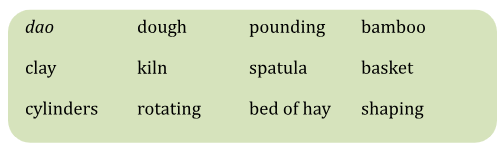
| Tools/Implements | Raw Materials | Process |
| dao | dough | pounding |
Ans.
| Tools/Implements | Raw Materials | Process |
| Dao | Dough | Pounding |
| Spatula | Grey clay | Rotating |
| Bamboo cylinders | Red clay | Shaping |
| Carrying basket | Water | Drying |
| Kiln | Hay | Firing |
| Mould | Dried bamboo | Loading |
| Trough | Soaking |
II. Notice the use of the following words in the text.
| pittance | rupees | reward | return |
These words relate to livelihood and economic aspects that are crucial for any enterprise/business/vocation.
Work in pairs and find the meanings of the following words related to economy. You may refer to a dictionary.

Now, frame sentences using each word.
Ans.
| Word | Meaning |
| Bankrupt | completely without money; unable to pay debts |
| Credit | money borrowed that must be paid back later |
| Currency | money used in a country (notes/coins) |
| Debt | money that is owed |
| Fiscal | related to government money/taxes |
| Inflation | rise in prices of goods over time |
| Investment | putting money to earn profit |
| Interest | extra money paid on borrowed money |


1. Complete the following sentences with suitable noun clauses.
(i) The elders emphasised that ___________________ ____________________
(ii) Mesoba explained why _______________________ __________________
(iii) Onula’s promise was that _____________________ ___________________
(iv) Sentila observed her mother carefully when she was shaping the mouth of the pot, which ______________
(v) The kiln, where _____________________, required careful attention to prevent over-or-under firing.
Ans.
i. traditional skills like pot making belonged to the entire community and must be passed down to anyone who wished to learn them.
ii. Arenla had not yet taught Sentila pot making, saying she had been waiting for her daughter to grow stronger after her illness.
iii. she would teach Sentila how to make a perfect pot and help her overcome her difficulties with the craft.
iv. helped her finally understand the specific hand movements and technique needed to complete the pot successfully.
v. the pots were carefully fired on a bed of hay and dried bamboo,
2. Read the following sentences from the text. Underline the main clause and circle the subordinate clause.
(i) Arenla took Sentila to the riverbank where the grey and red clay was found.
(ii) She started on the next one, and like a sprinter (who had suddenly found momentum)…
(iii) … skills such as pot making, (which not only catered to the needs of the people)…
Ans.
(i) Arenla took Sentila to the riverbank (where the grey and red clay was found.)
(ii) She started on the next one, and like a sprinter (who had suddenly found momentum)…
(iii) … skills such as pot making, (which not only catered to the needs of the people)…

3. Complete the following sentences with suitable relative clauses.
i. Sentila, whose ______________, practised the craft diligently.
ii. The village council, where ____________, sought an explanation for Arenla’s reluctance.
iii. The potter’s hands, which _____________, shaped the clay into beautiful creations.
iv. Arenla, her mother, wanted her to learn weaving, which ______________________.
v. Mesoba went home and discussed the matter with Arenla, who _____________.
Ans.
i. passion for pot making had begun in childhood,
ii. the elders gathered to discuss community matters,
iii. moved with practiced skill and dexterity,
iv. was more profitable, less messy and could be done indoors in all seasons.
v. eventually agreed to teach Sentila the art of pot making.
4. Read the highlighted words in the following lines from the text.
- Onula saw her taking out some clay…
- … make as many pots as they could.
- … did not belong to any individual.
- Slowly she walked away from this place of wonder.
- … they would not have enough days of sunshine …

Here is a list of the most frequently used determiners:
- a, an, the (Articles)
- this, that, these, those (Demonstratives)
- my, our, your, his, her, its, their, one’s (Possessives)
- one, two, three, etc. (Definite numerals)
- some, any, no, all, both, much, many, few, less, several, little (Indefinite numerals)
- each, every, either, neither (Distributives)
(i) Find out some more determiners from the text.
Ans. Some more determiners from the text are: some, many, any, this, that, her, their, each, every.
(ii) Fill in the banks with suitable determiners. The first two blanks have been done for you.
A. The florist arranged five bouquets for her clients, that were displayed in ____________ elegant floral shop.
B. The carpenter crafted ____________ unique tables, and _____________________ became the centrepiece in ____________________ furniture collection.
C. ___________ of ____________ apprentices in ____________ culinary class demonstrated ____________ knife skills during the intense cooking session.
D. ___________ of ____________ sculptures were displayed at _______________ art exhibition, showcasing ___________ diverse artistic skills.
Ans.
A. her
B. some, these, his
C. each, the, the, their,
D. several, the, an, their
Listen and Respond
I. You will listen to a man speak about stone statues. As you listen, complete the given paragraph by filling in the blanks with the exact words you listen to. Transcript for teacher on page 261)
A statue is carved to create a shape that is 1. _________. Among the many things stone is used for making stone 2. _____________ is one of them. India has some of the most 3. _____________ stone sculptures, as is obvious from its many stone monuments across the country.
Ans.
1. three-dimensional.
2. statues
3. beautiful
II. You will now listen to the man speaking about some steps involved in making stone statues. As you listen, select the six correct steps out of the nine given. (Transcript for teacher on page 261)
1. carve to remove large unwanted portions of the stone
2. set up the different tools
3. measure the weight and dimensions of the statue
4. leave the statue in water to firm up overnight
5. refine the creation within the stone
6. choose the stone
7. begin carving from the centre
8. detach the creation from the stone as the final statue
9. work to bring out the imagined shape
Ans.
Correct
1. carve to remove large unwanted portions of the stone
2. set up the different tools
5. refine the creation within the stone
6. choose the stone
8. detach the creation from the stone as the final statue
9. work to bring out the imagined shape
Incorrect steps:
3. measure the weight and dimensions of the statue
4. leave the statue in water to firm up overnight
7. begin carving from the centre
Writing Task
Reflective Writing – Identifying Skills and Passion
Reflective writing encourages introspection and thoughtful exploration of personal experiences, skills, and aspirations. It helps individuals gain deeper insights into themselves and their goals through structured reflection.
I. Follow the steps given below to create a write-up about your skills and passions.
- Step 1: Introduction
Reflect on your passions and the skills you currently possess or are developing. Consider why these activities or interests are meaningful and enjoyable to you.
- Step 2: Describing skills
Describe specific activities or practices you engage in to nurture your skills. This could include hobbies, classes (art, music, coding, etc.), workshops, or personal projects.
- Step 3: Passion into profession
Identify which of these skills you believe have the potential to turn your passion into a profession. Explain why you think these skills are crucial or advantageous in your chosen field.
- Step 4: Examples and reflection
Provide examples or anecdotes that illustrate how your skills and passions complement each other. Reflect on how these experiences have shaped your career aspirations and personal growth.
- Step 5: Conclusion
Summarise your reflections. Discuss any insights gained about yourself, your skills, and your career ambitions through this exercise.
My Skills and Passions
By Diksha
Everyone has certain skills and passions that make them unique. I enjoy activities that allow me to express myself and learn new things. My interests make me happy and help me grow as a person.
I like engaging in activities such as reading, writing, and learning new concepts. I practise these skills regularly by doing school assignments, reading books, and sometimes writing my own thoughts. These activities help me improve my knowledge and creativity.
Among my skills, writing and learning are the ones I would like to turn into a profession. These skills can help me succeed in fields like teaching or content writing. I believe these skills are important because they help in expressing ideas clearly and understanding the world better.
For example, whenever I write essays or complete projects, I feel confident and satisfied. These experiences motivate me to improve further and explore more opportunities. They have helped me become more disciplined and focused on my goals.
In conclusion, reflecting on my skills and passions has helped me understand myself better. I have realised the importance of developing my abilities and following my interests. This will guide me in choosing the right career in the future.
CBSE Class 9 English Chapter 2 The Pot Maker Extract-Based Questions
A
“Ever since Sentila became old enough to accompany her mother to the fields and forests, she began to dream of becoming a pot maker like her mother and grandmother. However Arenla, her mother, wanted her to become a weaver. On days when she managed to stay at home while her parents went to the fields, Sentila approached expert potters to learn the skill.”
Q1. What was Sentila’s dream from childhood?
Ans. Sentila dreamed of becoming a pot maker like her mother and grandmother. Despite her mother’s strong preference for weaving, she secretly visited expert potters to watch and learn the craft, showing that her dream was a deep and genuine calling that grew stronger with every passing year.
Q2. How did the expert potters initially react to Sentila’s visits?
Ans. The expert potters were initially amused by Sentila’s insistence on learning pot making. They thought she would soon outgrow what they assumed was merely a childish passion. They did not take her seriously at first, expecting her enthusiasm to fade quickly with time.
Q3. Why did Sentila visit the potters secretly?
Ans. Sentila visited the potters secretly because she had overheard her mother Arenla strongly opposing pot making during a private conversation. Rather than confronting her parents or abandoning her dream, she quietly pursued her passion while avoiding family conflict.
Q4. What does the word “outgrow” suggest about the potters’ attitude?
Ans. The word “outgrow” suggests that the expert potters viewed Sentila’s passion as a temporary childish phase she would naturally leave behind as she grew older. They underestimated her genuine calling, reflecting a broader tendency to dismiss children’s passions as insignificant and fleeting.
Q5. What does this extract reveal about Sentila’s character?
Ans. This extract reveals that Sentila is a passionate, determined and emotionally mature young girl. Despite her mother’s opposition and the potters’ amusement, she continues pursuing her dream quietly without giving up, showing remarkable courage, sensitivity and unwavering commitment to her deepest calling.
B
“Sentila did not disclose her fascination with pot making at home as she had overheard a conversation between her parents one night. Her mother was complaining about Sentila’s indifference to weaving. She said, ‘I shall not teach her pot making as it has brought no joy to me and only a pittance for my troubles. The riverbank, where the grey and red clay required for making pots is found, is sixteen kilometres from here.'”
Q1. Why did Sentila not disclose her passion for pot making at home?
Ans. Sentila did not disclose her passion because she had overheard her mother strongly opposing pot making during a private conversation. She understood that revealing her dream would cause family conflict, so she chose to pursue it secretly while protecting her family’s feelings and avoiding unnecessary confrontation at home.
Q2. What reasons did Arenla give for refusing to teach Sentila pot making?
Ans. Arenla said pot making brought no joy and only a pittance despite enormous effort. Clay had to be fetched from a riverbank sixteen kilometres away, pounding was tedious, batches took months and financial reward was minimal. She believed weaving would give Sentila far better income and a more comfortable livelihood.
Q3. What does the word “pittance” reveal about the economic reality of pot making?
Ans. The word “pittance” powerfully reveals the harsh economic reality of traditional craftswomen who dedicate enormous physical effort for extremely minimal financial reward. It suggests that the tremendous labor of fetching clay, shaping pots and firing the kiln is rewarded with barely enough money to justify the effort, threatening the survival of traditional crafts.
Q4. How does this extract highlight the conflict between tradition and practicality?
Ans. This extract highlights the universal conflict between honoring cultural traditions and meeting practical economic needs. Arenla herself is a skilled pot maker yet discourages her daughter from learning it because of poor financial returns, representing the difficult position of traditional craftspeople who must choose between cultural heritage and their children’s economic security.
Q5. What does Arenla’s complaint about Sentila’s indifference to weaving suggest?
Ans. Arenla’s complaint suggests she had already been actively trying to interest Sentila in weaving but consistently failed. It reveals her genuine frustration and maternal concern for Sentila’s financial future. It also ironically shows that Sentila’s passion for pot making was already so deep that she could not genuinely engage with weaving despite her mother’s encouragement.
C
“Mesoba was summoned by the village council and asked to explain why Arenla was refusing to pass on the skill to her daughter. The elders decided to let him go, cautioning him to remind Arenla that it was her duty to teach her daughter the skill that was handed down from generation to generation. Skills such as pot making did not belong to any individual.”
Q1. Why was Mesoba summoned by the village council?
Ans. Mesoba was summoned because Arenla’s refusal to teach Sentila pot making had become village gossip. The elders were worried that if expert pot makers refused to pass on their skills, there would be no skilled potters left to continue the ancient tradition, threatening the community’s cultural heritage.
Q2. How did Mesoba respond to the village council’s summons?
Ans. Mesoba responded humbly and diplomatically, cleverly explaining that they had only been waiting for Sentila to grow stronger after her illness before beginning her training. He promised the elders they would soon see Sentila making the best pots in the village, successfully satisfying their concerns while preserving his family’s dignity.
Q3. What did the village elders emphasize about traditional skills?
Ans. The village elders powerfully emphasized that traditional skills like pot making belong to the entire community and not to any individual. They reminded Mesoba that expert craftspeople are obligated to teach their skills not only to their own children but to anyone who genuinely wishes to learn, as these skills symbolize the community’s tradition and history.
Q4. What does the phrase “handed down from generation to generation” suggest?
Ans. The phrase suggests that traditional skills are living cultural inheritances connecting each generation to its ancestors. It implies a sacred responsibility , each generation must pass the tradition forward intact to those who follow. Breaking this chain would sever an entire community’s connection to its ancient heritage, identity and cultural roots.
Q5. What does this extract reveal about the social structure of the Naga community?
Ans. This extract reveals a strong community governance system where village elders exercise real authority over individual family decisions affecting collective interests. It shows a society where traditional knowledge is communal property rather than individual privilege, demonstrating a deeply collective social structure that prioritizes shared cultural heritage over personal family preferences and choices.
D
“Before long, she realised that the pot was ready. She started on the next one, and like a sprinter who had suddenly found momentum, she continued making pot after pot with the same speed and dexterity that she had noticed in her mother’s hands. Finally, when she looked at her row of pots, she saw that she had made just one short of her mother’s tally.”
Q1. What does the sprinter metaphor suggest about Sentila’s experience of mastery?
Ans. The sprinter metaphor suggests that Sentila’s mastery was a sudden, liberating breakthrough after years of struggle. Just as a sprinter suddenly finds natural rhythm and momentum, Sentila discovered the natural flow of pot making once her technical and psychological barriers were finally overcome through years of persistent, determined practice.
Q2. What does the word “dexterity” mean and why is it significant here?
Ans. Dexterity means skillful and nimble use of the hands. Its significance is profound because dexterity is the quality Sentila had desperately struggled to develop for almost two years. She now works with the same dexterity as her expert mother, confirming that the skill has genuinely become her own through determined perseverance.
Q3. How is Sentila making just one pot short of her mother’s tally significant?
Ans. Making just one pot short of her mother’s tally shows Sentila has essentially reached her highly experienced mother’s level on her very first successful session. The one pot difference is not failure but triumph , a complete beginner has achieved near-expert mastery through determination, beautifully confirming that Sentila was born to be a pot maker.
Q4. What does this extract reveal about the relationship between observation and mastery?
Ans. This extract reveals that careful observation of an expert is essential for achieving genuine mastery. Sentila’s breakthrough comes directly from Onula’s advice to observe her mother’s specific hand movements. It shows that observation and practice must work together , observation without practice remains theoretical while practice without careful observation of expert technique remains ineffective.
Q5. How does this extract serve as the emotional climax of the story?
Ans. This extract is the emotional climax because it represents the triumphant fulfillment of Sentila’s lifelong dream after years of opposition, failure and perseverance. Every obstacle she faced makes this moment of sudden confident mastery extraordinarily powerful. Looking at her completed row of pots captures the deepest human joy of achieving something passionately pursued against all odds.
Class 9 The Pot Maker Multiple Choice Questions
Q1. What is common among the pictures of vocations?
A. All are machines
B. All are skill-based work
C. All are office jobs
D. All are farming
Ans. B. All are skill-based work
Q2. Skill-based work is called:
A. Business
B. Vocations
C. Jobs
D. Services
Ans. B. Vocations
Q3. What did Sentila dream of becoming?
A. Weaver
B. Potter
C. Teacher
D. Farmer
Ans. B. Potter
Q4. Who wanted Sentila to become a weaver?
A. Mesoba
B. Onula
C. Arenla
D. Villagers
Ans. C. Arenla
Q5. Why did potters laugh at Sentila initially?
A. She was weak
B. She was poor
C. They thought her interest was childish
D. She was lazy
Ans. C. They thought her interest was childish
Q6. Where was the clay found?
A. Forest
B. Riverbank
C. Market
D. Hill
Ans. B. Riverbank
Q7. How far was the riverbank?
A. 10 km
B. 12 km
C. 16 km
D. 20 km
Ans. C. 16 km
Q8. What is ‘pittance’?
A. Big amount
B. Small amount
C. Reward
D. Salary
Ans. B. Small amount
Q9. What tool is used to shape pots?
A. Knife
B. Spatula
C. Hammer
D. Stick
Ans. B. Spatula
Q10. Why is pot making difficult?
A. It is fast
B. It is cheap
C. It is tiring and time-consuming
D. It is easy
Ans. C. It is tiring and time-consuming
Q11. What happens if pots are overfired?
A. Become strong
B. Become beautiful
C. Get ruined
D. Shine more
Ans. C. Get ruined
Q12. Who was Sentila’s father?
A. Mesoba
B. Arenla
C. Onula
D. Elder
Ans. A. Mesoba
Q13. What did the village council advise?
A. Stop work
B. Teach the skill
C. Sell pots
D. Leave village
Ans. B. Teach the skill
Q14. What is ‘malleable’?
A. Hard
B. Soft and shapeable
C. Rough
D. Sticky
Ans. B. Soft and shapeable
Q15. Where was Sentila sent after maturity?
A. School
B. Market
C. Dormitory
D. Forest
Ans. C. Dormitory
Q16. Who was Onula?
A. Teacher
B. Widow caretaker
C. Farmer
D. Potter
Ans. B. Widow caretaker
Q17. Why did Sentila fail at first?
A. No tools
B. Laziness
C. Nervousness
D. No guidance
Ans. C. Nervousness
Q18. What helped Sentila improve?
A. Magic
B. Practice and guidance
C. Luck
D. Money
Ans. B. Practice and guidance
Q19. What happened to Arenla?
A. Fell sick
B. Left village
C. Died
D. Slept
Ans. C. Died
Q20. What did Onula see in the shed?
A. Broken pots
B. Two rows of pots
C. Empty shed
D. Tools
Ans. B. Two rows of pots
CBSE Class 9 English Kaveri Book Chapter 2 – The Pot Maker Extra Question and Answers
Answer the following questions-
Q1. Why did Sentila keep her passion for pot making a secret from her parents?
Ans. Sentila kept her passion secret because she had overheard her mother Arenla strongly opposing pot making during a private conversation. She knew revealing her dream would cause family conflict. Rather than confronting her parents she wisely chose to pursue her passion secretly by visiting expert potters while avoiding unnecessary trouble at home.
Q2. Why did Arenla not want Sentila to learn pot making?
Ans. Arenla did not want Sentila to learn pot making because it was extremely exhausting and poorly rewarded. Clay had to be fetched from sixteen kilometres away and all the hard work earned only a pittance. She believed weaving was far more practical as it could be done indoors in all seasons and earned considerably more money for the family.
Q3. What was the warning given by the village council to Mesoba?
Ans. The village council warned Mesoba that traditional skills like pot making belong to the entire community and not to any individual. The elders firmly reminded him that Arenla was obligated to teach Sentila and anyone who wished to learn, as such skills symbolize the tradition and history of the people and must be passed down from generation to generation responsibly.
Q4. Describe the process of pot making as observed by Sentila.
Ans. Sentila observed that clay was first mixed with water and pounded until soft and malleable. The potter pushed the left hand into the clay while rotating it and shaped it with a spatula held in the right hand. After two or three days pots received a final touch-up, were dried in the sun and then carefully fired in a kiln. Both over-firing and under-firing would ruin the entire batch.
Q5. Why did Sentila fail to learn pot making despite almost a year of training?
Ans. Sentila failed because she could not master the delicate shaping technique despite almost a year of training. She could not even hold the lump of dough properly while her mother effortlessly made beautiful pots. Arenla’s passive and detached teaching style also contributed as she simply sat watching without providing encouraging guidance or addressing the root cause of her daughter’s difficulties.
Q6. How did Onula help Sentila overcome her difficulties?
Ans. Onula correctly identified that excessive tension rather than lack of ability was causing Sentila’s failure. She patiently demonstrated the correct technique and encouraged her with kind words. She also advised Sentila to carefully observe her mother’s hand movements while shaping the pot’s mouth. This compassionate guidance gave Sentila both the technical insight and emotional confidence she needed to finally achieve mastery.
Q7. What does the sprinter metaphor suggest about Sentila’s achievement?
Ans. The sprinter metaphor suggests that Sentila’s mastery was a sudden liberating breakthrough after years of persistent struggle. Just as a sprinter suddenly finds natural rhythm and momentum, Sentila discovered the natural flow of pot making once her technical and psychological barriers were finally overcome through years of determined practice and repeated failure.
Q8. What did Onula discover in the work shed after Arenla’s death?
Ans. Onula discovered two identical rows of newly made pots standing side by side in the work shed. She intuitively understood that one row was made by Arenla and the other by Sentila , both of equal quality. She stood for a long time absorbing the profound significance of witnessing the perfect transmission of an ancient craft from mother to daughter.
Q9. What is the significance of the concluding line “A new pot maker was born”?
Ans. The concluding line literally announces Sentila’s successful mastery of pot making fulfilling her lifelong dream. Symbolically it affirms that the ancient tradition will continue beyond Arenla’s death through Sentila’s skilled hands. The word “born” suggests a deeper transformation, Sentila has become a cultural guardian ensuring that as one pot maker dies another is born keeping the tradition alive forever.
Q10. What message does the story “The Pot Maker” convey?
Ans. The story conveys that genuine passion combined with determined perseverance can overcome all obstacles including family opposition and repeated failure. It emphasizes that traditional skills belong to the entire community and must be preserved responsibly. It also teaches that compassionate guidance at the right moment can completely transform a struggling learner’s journey toward achieving their deepest dream.
More Questions Updated (July 2026)
Question (extract-based): “Mother, I did not wish it to happen this way; it simply came to me. Please forgive me.” What does Sentila mean by these words, and why does only Onula understand them?
Ans. Sentila is referring to the day her mother pretended to be unwell and left her alone in the work shed, where her skill suddenly flowed and she made almost as many pots as her mother — the same day Arenla died. Sentila feels guilty, as if her long-hidden wish to become a pot maker was fulfilled only at the cost of her mother’s life. Only Onula understands, because she alone knew of Sentila’s secret practice sessions and had told her to watch her mother’s technique closely. When Onula later sees the two identical rows of pots in the shed, she realises what Sentila’s words truly meant — a new pot maker was born.
Question (long answer): Why did Arenla initially refuse to teach pot making to Sentila, and what changed her mind?
Ans. Arenla refused because pot making had brought her only hardship and a pittance. The clay had to be carried from a riverbank sixteen kilometres away, pounding it in bamboo cylinders was exhausting, and a batch of pots took months of labour for a reward of just a few rupees. She wanted Sentila to learn weaving instead, which earned more, could be done indoors in all seasons, and provided cloth for the family. Her mind changed after the village council summoned her husband Mesoba and reminded him that skills like pot making symbolised the tradition and history of the people, did not belong to any individual, and that experts were duty-bound to pass them on. The following year, Arenla began teaching Sentila herself.