
CBSE Class 7 English Unit 4 – Travel and Adventure Chapter 2 Travel Important Question Answers from Poorvi Book
Class 7 English Travel Question Answers – Looking for questions and answers for CBSE Class 7 English Unit 4 – Travel and Adventure Chapter 2 Travel? Look no further! Our comprehensive compilation of important questions will help you brush up on your subject knowledge. Practising Class 7 English question answers can significantly improve your performance in the exam. Improve your chances of scoring high marks by exploring Unit 4 – Travel and Adventure Chapter 2 Travel now. The questions listed below are based on the latest CBSE exam pattern, wherein we have given NCERT solutions to the chapter’s extract-based questions, multiple choice questions and Extra Question Answers
Also, practising with different kinds of questions can help students learn new ways to solve problems that they may not have seen before. This can ultimately lead to a deeper understanding of the subject matter and better performance on exams.
- Travel NCERT Solutions
- Travel Extract Based Questions
- Travel Multiple Choice Questions
- Travel Extra Question Answers
Related:
Travel Textbook Questions (NCERT Solutions)
Let us do these activities before we read.
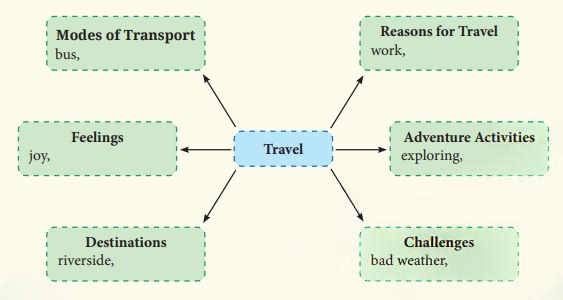
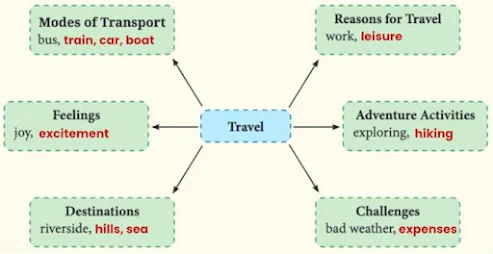
I Complete the following word web on travel.
Ans.
II You are going on a trip to an adventure camp with your classmates and teacher.
1. How will you travel to the adventure camp?
2. What things will you take along?
3. Why would you like to go there?
4. What are the activities you would like to do with your friends?
5. How much time will it take to complete your adventure trip?
Ans.
1. I will travel to the adventure camp by bus with my classmates and teacher.
2. I will take a water bottle, snacks, a backpack, comfortable clothes, and a camera.
3. I would like to go there to have fun, try new activities, and spend time with my friends.
4. I would like to do trekking, rope climbing, and campfire storytelling with my friends.
5. The adventure trip will take about 3 days to complete.
III Discuss in pairs. What might be the reasons that people enjoy train journeys?
Ans. People enjoy train journeys because:
They can see beautiful views like mountains and rivers.
It’s relaxing to sit and watch the scenery.
They can talk and play with friends or family.
Trains are comfortable and have space to move around.
Let us discuss
I The main ideas of each stanza of the poem are given below. Write the number of the stanza against the matching main idea.
1. At night, the speaker imagines the train and hears its engine in the quiet.
2. The speaker feels a strong desire to take any train, no matter where it goes.
3. The speaker hears the train whistle during the day, even though the train is far away.
Ans. Stanza 1 – The speaker hears the train whistle during the day, even though the train is far away.
Stanza 2 – At night, the speaker imagines the train and hears its engine in the quiet.
Stanza 3 – The speaker hears the train whistle during the day, even though the train is far away.
II Read the poem and underline the rhyming words in each stanza.
Write the rhyming words from each stanza. An example has been done for you.
1. Stanza (i): away-day;
2. Stanza (ii):
3. Stanza (iii):
Ans. Stanza I: away – day, speaking-shrieking
Stanza II: by-sky, dreaming-steaming
Stanza III: make – take, knowing – going
III Identify the rhyme scheme of the poem from the options given below.
1. AABB
2. ABCA
3. ABAB
4. ABBC
Ans. 3. ABAB
IV Identify the word in the poem that personifies the whistle of the train.
Ans. “shrieking” – it gives the whistle a human-like scream.
V Tone refers to the attitude the poet has about the poem. Which of these words can be used to describe the poet’s tone in this poem?
| serious | excited | curious | worried | thoughtful |
| content | enthusiastic | critical | joyful |
Ans. thoughtful, enthusiastic, content, joyful
The poem has a thoughtful and enthusiastic tone about travel and imagination.
VI Select the words that tell us what the train symbolises for the poet.
1. education
2. adventure
3. comfort
4. Opportunities
Ans. 2. adventure
4. opportunities
VII Complete the following by choosing the correct option from those given in brackets.
The poet repeats the line, ‘…there isn’t a train goes by,’ in all three stanzas to _______. (highlight the speaker’s fascination with the train/suggest that the area has many trains passing through)
Ans. The poet repeats the line, ‘…there isn’t a train goes by,’ to highlight the speaker’s fascination with the train.
VIII The poem contrasts the busy day with the stillness of the night. What is the common factor in these?
Ans. Even though the day is busy and night is still, the train remains in the speaker’s thoughts and imagination at both times.
IX Imagery is a literary device that uses descriptive language to create mental pictures and appeal to the reader’s senses (sight, sound, smell, taste and touch). It makes the descriptions more relatable.
Select the phrases from the poem that are examples of imagery. One example is given: day is loud.
Ans. Phrases from the poem that are examples of imagery:-
“day is loud” (sound)
“hear its whistle shrieking” (sound)
“cinders red on the sky” (sight)
“hear its engine steaming” (sound)
Let us think and reflect
I Read the extract given below and answer the questions that follow.
1. My heart is warm with the friends I make,
And better friends I’ll not be knowing…
(i) Choose the suitable option to complete the following.
The line ‘My heart is warm’ refers to a heart that is ___.
A. filled with worries
B. full of love
C. feeling upset
D. experiencing anger
(ii) What does the speaker say about her current friends?
(iii) What does the line ‘better friends I’ll not be knowing’ suggest about the speaker’s feelings toward their current friends?
(iv) Complete the following suitably.
The tone of the speaker in these lines is ______. (grateful/content)
Ans. (i) B. full of love
(ii) The speaker treasures them and feels that she won’t find better friends than them.
(iii) The speaker is deeply content and grateful for her current friendships.
(iv) The tone of the speaker in these lines is content.
II Answer the following questions.
1. What does the phrase ‘cinders red on the sky’ tell us about the train at night?
Ans. The phrase ‘cinders red on the sky’ tells us about the train at night and that the glowing sparks from the train light up the night sky.
2. What is the significance of the repeated references to the train’s whistle?
Ans. The significance of the repeated references to the train’s whistle shows how strongly the speaker feels about trains, it is always on her mind.
3. What does the line ‘no matter where it’s going’ reveal about the speaker’s attitude towards travel?
Ans. The line ‘no matter where it’s going’ reveals that the speaker is open to exploring new places and opportunities without fear or hesitation.
4. Do you think the poet actually sees and hears the train? Why or why not?
Ans. The poet does not necessarily actually see and hears the train. The poet may be imagining it, showing how deep her thoughts and longing for travel are.
Let us learn
I Read the expressions from the poem given in Column 1 and match them with what they indicate in Column 2.
| Column 1 | Column 2 |
| 1. miles away | (i) The speaker’s affection for their friends |
| 2. cinders red | (ii) The fast and powerful movement of the train |
| 3. heart is warm | (iii) The busy and noisy atmosphere during the day |
| 4. day is loud | (iv) The glow of the train’s sparks lighting up the night sky |
| 5. engine steaming | (v) The distance of the train from the speaker |
Ans.
| Column 1 | Column 2 |
| 1. miles away | (v) The distance of the train from the speaker |
| 2. cinders red | (iv) The glow of the train’s sparks lighting up the night sky |
| 3. heart is warm | (i) The speaker’s affection for their friends |
| 4. day is loud | (iii) The busy and noisy atmosphere during the day |
| 5. engine steaming | (ii) The fast and powerful movement of the train |
Now, use the expressions in Column 1 to fill in the following blanks correctly.
1. After meeting her old friend, her ______ with the joy of rekindled memories.
2. As I arrived at the railway station I could hear the ______.
3. The marketplace is bustling, and the ______ with the chatter of shoppers and vendors.
4. The bonfire glowed brightly, throwing ______ into the dark night sky.
5. The sound of a train could still be heard _____ as the evening grew quiet.
Ans.
1. After meeting her old friend, her heart was warm with the joy of rekindled memories.
2. As I arrived at the railway station I could hear the engine steaming.
3. The marketplace is bustling, and the day is loud with the chatter of shoppers and vendors.
4. The bonfire glowed brightly, throwing cinders red into the dark night sky.
5. The sound of a train could still be heard miles away as the evening grew quiet.
II The poet uses the word ‘shrieking’ to tell us about the sound of the train’s whistle. There are other words that tell us about different types of related sounds.
Read the meanings of such words in Column 1 and match them with the words in Column 2. You may use a dictionary. Share your answers with your classmates and the teacher.
| Column 1 | Column 2 |
| 1. shouting loudly, often in anger or excitement | (i) wailing |
| 2. crying out in fear or excitement | (ii) hollering |
| 3. crying loudly with grief or sorrow | (iii) screeching |
| 4. making a high-pitched, piercing sound | (iv) yelling |
| 5. calling out loudly, often in a casual or informal way | (v) whimpering |
| 6. crying softly in a low, broken voice | (vi) bawling |
| 7. crying loudly and uncontrollably | (vii) screaming |
Ans.
| Column 1 | Column 2 |
| 1. shouting loudly, often in anger or excitement | (iv) yelling |
| 2. crying out in fear or excitement | (vii) screaming |
| 3. crying loudly with grief or sorrow | (vi) bawling |
| 4. making a high-pitched, piercing sound | (iii) screeching |
| 5. calling out loudly, often in a casual or informal way | (ii) hollering |
| 6. crying softly in a low, broken voice | (v) whimpering |
| 7. crying loudly and uncontrollably | (i) wailing |
Now, complete the following paragraph by using suitable words from Column 2.
The street was filled with a variety of sounds. A shopkeeper was 1. ______ to attract customers, while a child nearby was 2. _______ at his friend to wait for him. From the other side of the road, a toddler was 3. ________ uncontrollably after dropping his ice cream, and his mother tried to calm him as he began 4. _________ softly. In the background, someone’s loud 5. _________ voice added to the bustling noise of the busy evening.
Ans. The street was filled with a variety of sounds. A shopkeeper was 1. hollering to attract customers, while a child nearby was 2. yelling at his friend to wait for him. From the other side of the road, a toddler was 3. bawling uncontrollably after dropping his ice cream, and his mother tried to calm him as he began 4. whimpering softly. In the background, someone’s loud 5. screeching voice added to the bustling noise of the busy evening.
Let us listen
I Listen to this announcement made in the morning assembly about a school trip to the National Science Centre. As you listen, circle the information that is not correct. (Transcript for the teacher on pg. 177)
1. The trip to the National Science Centre is organised on 15 September.
2. Students will start from school at 8.00 in the morning and return by 5.00 in the evening.
3. Refreshment will not be provided during the trip.
4. Students are permitted to carry a phone, a notebook, and a pen.
5. The permission slip is to be signed by the class teacher.
6. The permission slip is to be submitted to your class teacher by 10 September.
7. Mr. Mukherjee is the Adventure Club in-charge.
Ans. Statements 1, 3, 4, 5, and 7 are incorrect.
II Now, listen to the announcement again and rectify the sentences.
Ans. The following are the corrected statements:
1.The trip to the National Science Centre is organised on 14 September.
2. Refreshments will be provided during the trip.
3. Students are not permitted to carry a phone. They are only allowed to bring a notebook and a pen.
4. The permission slip is to be signed by the parent or guardian
5. Mr. Mukherjee is not the Adventure Club in-charge.
Let us write
I A diamante poem is a poem that is shaped like a diamond, which uses specific types of words like adjectives and–ing words. Let us read an example.
Day
Bright, sunny
Dancing, playing, running
Out comes the sun, down goes the sun
Resting, listening, dreaming
Quiet, peaceful
Night
In this example we see how two different ideas—day and night are connected through the poem.
Let us now write a diamante poem that connects ‘reading’ and ‘adventure’.
| Reading | the first topic |
| two adjectives about reading | |
| three -ing words about reading | |
| four nouns or a short phrase linking your topics | |
| three -ing words about adventure | |
| two adjectives about adventure | |
| Adventure | the second topic |
Ans.
| Reading | the first topic |
| quiet, imaginative | two adjectives about reading |
| exploring, learning, dreaming | three -ing words about reading |
| books, pages, thoughts, worlds | four nouns or a short phrase linking your topics |
| climbing, discovering, daring | three -ing words about adventure |
| thrilling, exciting | two adjectives about adventure |
| Adventure | the second topic |
Share your poem with your classmates and the teacher.
II We come across many interesting characters while travelling. They become interesting because of their actions, their behaviour, and manner of speaking. Describe one such character that you met. Follow these steps.
1. Choose the character.
2. Create a first draft of your description including the following details.
(i) What is the name of the character?
(ii) What does the character look like?
(iii) What does the character do?
(iv) What kind of person is she or he?
(v) Include any line or incident from the text that you like the most.
3. Check your description for any spelling mistakes or errors.
4. Show your classmates your work and ask for suggestions.
5. Rewrite your description including all the changes and suggestions for improvement.
Ans. Name: Mr. Sharma
Appearance: A tall man with a white beard, wearing a bright yellow turban
What does he do?: He runs a small tea stall near the railway station
What kind of person is he?: Friendly, talkative, and always smiling.
Favourite incident: He gave free tea to a group of tired travelers and said, “Kindness is the best refreshment.”
CBSE Class 7 English Chapter 2 Travel Extract-Based Questions and Answers
A.
“The railroad track is miles away,
And the day is loud with voices speaking,
Yet there isn’t a train goes by all day
But I hear its whistle shrieking.”
1. How far is the railroad track according to the speaker?
Ans. The railroad track is miles away from the speaker.
2. What does the speaker say about the atmosphere during the day?
Ans. The speaker says that the day is filled with the sound of voices speaking, suggesting it is noisy and busy.
3. Despite the distance, what sound does the speaker still hear?
Ans. The speaker hears the whistle of the train shrieking, even though the track is far away.
4. What might the train whistle symbolize for the speaker?
Ans. The train whistle could symbolize a longing for travel, escape, or the excitement of distant places.
5. What contrast is being made in this stanza?
Ans. The contrast is between the physical distance of the train and its strong presence in the speaker’s mind or imagination.
B.
“All night there isn’t a train goes by,
Though the night is still for sleep and dreaming,
But I see its cinders red on the sky,
And hear its engine steaming.”
1. What does the speaker observe about trains at night?
Ans. The speaker notes that no train goes by during the night.
2. What is the night typically associated with in the poem?
Ans. The night is associated with sleep and dreaming.
3. Despite no trains running, what does the speaker claim to see and hear?
Ans. The speaker claims to see red cinders in the sky and hear the train’s engine steaming.
4. What does this suggest about the speaker’s thoughts or dreams?
Ans. This suggests that the speaker is preoccupied with thoughts of trains, possibly dreaming of travel or escape.
5. What literary device is used in “I see its cinders red on the sky”?
Ans. The line uses imagery and possibly personification, as it creates a vivid picture of the train’s impact on the night sky.
C.
“My heart is warm with the friends I make,
And better friends I’ll not be knowing;
Yet there isn’t a train I wouldn’t take,
No matter where it’s going.”
1. How does the speaker feel about their friends?
Ans. The speaker feels affection and warmth for the friends they have made.
2. What does the speaker say about the quality of these friendships?
Ans. The speaker believes they will not know better friends than the ones they already have.
3. Despite this, what is the speaker still willing to do?
Ans. The speaker is still willing to take any train, regardless of its destination.
4. What does the willingness to take any train imply about the speaker?
Ans. It implies a deep yearning for travel, adventure, or change, even at the cost of leaving behind valued relationships.
5. What theme is most evident in this stanza?
Ans. The theme of wanderlust or restless longing for travel and exploration is most evident here.
Class 7 Travel Multiple-Choice Questions
1. Where is the railroad track located, according to the speaker?
(a) Nearby
(b) Under her window
(c) Miles away
(d) Across the sea
Ans. (c) Miles away
2. What does the speaker hear during the day despite no train passing?
(a) Birds chirping
(b) The train’s whistle
(c) Car horns
(d) Children playing
Ans. (b) The train’s whistle
3. What mood is created by the line “The day is loud with voices speaking”?
(a) Silence
(b) Loneliness
(c) Busyness
(d) Peacefulness
Ans. (c) Busyness
4. What sensory detail is used in “I hear its whistle shrieking”?
(a) Taste
(b) Sight
(c) Smell
(d) Sound
Ans. (d) Sound
5. What time of day does the second stanza describe?
(a) Morning
(b) Afternoon
(c) Evening
(d) Night
Ans. (d) Night
6. What is the night usually associated with in the poem?
(a) Work and chores
(b) Dreams and sleep
(c) Adventure and travel
(d) Sound and noise
Ans. (b) Dreams and sleep
7. Despite no trains passing at night, what does the speaker imagine?
(a) Fireworks in the sky
(b) Friends waving goodbye
(c) Cinders and steam from a train
(d) The silence of the woods
Ans. (c) Cinders and steam from a train
8. What is the speaker’s heart filled with?
(a) Sorrow
(b) Dreams
(c) Friends
(d) Regret
Ans. (c) Friends
9. What is ironic about the speaker’s attitude towards their friends?
(a) They dislike their friends
(b) They value them but still want to leave
(c) They plan to replace them
(d) They are unaware of their friends
Ans. (b) They value them but still want to leave
10. What does the train symbolize in the poem?
(a) Wealth and power
(b) Danger and fear
(c) Change, escape, and desire
(d) Sleep and comfort
Ans. (c) Change, escape, and desire
11. What poetic device is most prominent in “I see its cinders red on the sky”?
(a) Simile
(b) Personification
(c) Imagery
(d) Alliteration
Ans. (c) Imagery
12. What does the speaker say about taking a train?
(a) They will only travel for work
(b) They avoid trains due to danger
(c) They would take any train, anywhere
(d) They only take trains with friends
Ans. (c) They would take any train, anywhere
13. What emotion is conveyed by the phrase “My heart is warm”?
(a) Indifference
(b) Anger
(c) Affection
(d) Confusion
Ans. (c) Affection
14. What is the main theme of the poem?
(a) Isolation and fear
(b) Joy of staying home
(c) Longing for travel and new experiences
(d) Hatred of routine
Ans. (c) Longing for travel and new experiences
15. How does the speaker relate to the passing trains emotionally?
(a) With irritation
(b) With indifference
(c) With yearning and connection
(d) With fear and anxiety
Ans. (c) With yearning and connection
16. What kind of rhyme scheme is used in the poem?
(a) ABAB
(b) AABB
(c) ABCD
(d) None
Ans. (a) ABAB
17. Which line suggests that the speaker dreams of travel even when no trains run?
(a) “And the day is loud with voices speaking”
(b) “Though the night is still for sleep and dreaming”
(c) “Yet there isn’t a train goes by all day”
(d) “And better friends I’ll not be knowing”
Ans. (b) “Though the night is still for sleep and dreaming”
18. Which stanza focuses on the speaker’s friendships?
(a) First
(b) Second
(c) Third
(d) None
Ans. (c) Third
19. What contradiction is evident in the speaker’s feelings?
(a) She hates trains but boards them
(b) She wants to leave despite loving her friends
(c) She likes silence but complains about it
(d) She finds the trains boring but watches them
Ans. (b) She wants to leave despite loving her friends
20. What is the overall tone of the poem?
(a) Humorous
(b) Angry
(c) Nostalgic and wistful
(d) Harsh and critical
Ans. (c) Nostalgic and wistful
CBSE Class 7 English Poorvi Book Unit 4 – Travel and Adventure Chapter 2 Travel Extra Question Answers
1. What emotions does the speaker experience in the poem, and how are they conveyed?
Ans. The speaker experiences a deep sense of longing, curiosity, and restlessness. Although surrounded by the warmth of friendships and a seemingly ordinary life, she yearns for something beyond, symbolized by the distant railroad track and trains. This longing is conveyed through her sensory experiences, such as hearing the whistle during the day and imagining the cinders at night. Even though the trains never pass, she perceives them vividly, showing her inner desire to escape or explore. The line “Yet there isn’t a train I wouldn’t take” emphasizes her readiness to embrace the unknown, despite the comfort of her current life.
2. Discuss the use of imagery in the poem and its impact on the reader.
Ans. Imagery plays a crucial role in the poem, bringing the speaker’s emotions to life and making the abstract feeling of wanderlust tangible. Visual and auditory imagery, such as “the whistle shrieking” and “cinders red on the sky,” help readers hear and see the trains that are only imagined. These images create a strong contrast between the stillness of the night and the dynamic presence of a train that never actually appears. This powerful use of imagery pulls readers into the speaker’s inner world, where imagination overcomes reality, and the longing for adventure becomes more vivid than her actual surroundings.
3. How does the poem portray the conflict between contentment and desire for change?
Ans. The poem beautifully captures the tension between being content with life and desiring change. The speaker expresses warmth and love for the friends she has, acknowledging that they are “better friends I’ll not be knowing.” Yet, in the very next breath, she admits she would take any train, regardless of its destination. This contradiction highlights the universal human conflict between appreciating what one has and seeking what lies beyond. The metaphor of the train, a symbol of departure and possibility, represents her suppressed desire for freedom and new experiences, even if it means leaving behind the comfort of home.
4. What role does the train play symbolically in the poem?
Ans. The train in the poem is a powerful symbol of escape, freedom, and the allure of the unknown. Even though the speaker never physically sees the train, she constantly hears or imagines it. This recurring motif symbolizes her deep yearning for adventure and change. The railroad, miles away, represents opportunities that are distant but persistently calling. The fact that she would take “any train, no matter where it’s going” shows that the journey itself, the act of leaving or moving forward, is more important to her than the destination. The train thus becomes a metaphor for hope, transformation, and exploration.
5. How does the poet use contrast between day and night in the poem?
Ans. The poet cleverly uses the contrast between day and night to reflect the speaker’s emotional state and inner conflict. During the day, which is “loud with voices,” no train passes, yet the speaker hears its whistle, symbolizing her desire breaking through the noise of everyday life. At night, when everything is still and meant for dreaming, she imagines the train’s cinders lighting up the sky. The day represents external reality, filled with routine and social obligations, while the night symbolizes the inner world of dreams and longing. Through this contrast, the poet emphasizes how the speaker’s yearning persists across all times.