
CBSE Class 7 English Unit 2 – Wit and Humour Chapter 1 Animals, Birds, and Dr. Dolittle Important Question Answers from Poorvi Book
Class 7 English Animals, Birds, and Dr. Dolittle Question Answers – Looking for questions and answers for CBSE Class 7 English Unit 2 – Wit and Humour Chapter 1 Animals, Birds, and Dr. Dolittle? Look no further! Our comprehensive compilation of important questions will help you brush up on your subject knowledge. Practising Class 7 English question answers can significantly improve your performance in the exam. Improve your chances of scoring high marks by exploring Unit 2 – Wit and Humour Chapter 1 Animals, Birds, and Dr. Dolittle now. The questions listed below are based on the latest CBSE exam pattern, wherein we have given NCERT solutions to the chapter’s extract-based questions, multiple choice questions and Extra Question Answers
Also, practising with different kinds of questions can help students learn new ways to solve problems that they may not have seen before. This can ultimately lead to a deeper understanding of the subject matter and better performance on exams.
- Animals, Birds, and Dr. Dolittle NCERT Solutions
- Animals, Birds, and Dr. Dolittle Grammar Exercises
- Animals, Birds, and Dr. Dolittle Extract Based Questions
- Animals, Birds, and Dr. Dolittle Multiple Choice Questions
- Animals, Birds, and Dr. Dolittle Extra Question Answers
Related:
- Animals, Birds, and Dr. Dolittle Summary, Explanation
- Animals, Birds, and Dr. Dolittle Character Sketch
- Class 7 English Summary and Lesson Notes
Animals, Birds, and Dr. Dolittle Textbook Questions (NCERT Solutions)
Let us discuss
I Complete the following sentence by selecting a suitable reason.
The Cat’s-food-Man suggests to Doctor Dolittle that he should become an animal doctor because he believes that Dolittle ________________________.
1. earns less fee by treating human patients
2. enjoys the company of animals as they speak less
3. dislikes spending time with human patients
4. knows more about animals than the local veterinarians
Ans. 4. knows more about animals than the local veterinarians.
II Fill in the blanks by choosing the suitable option given in the brackets.
Doctor Dolittle reacts to Polynesia’s information about animal languages with both excitement and ____________ (certainty/curiosity). He rushes to ____________ (write/memorise) the bird words she provides and is interested in learning more.
Ans. Doctor Dolittle reacts to Polynesia’s information about animal languages with both excitement and curiosity. He rushes to write the bird words she provides and is interested in learning more.
III Do you think Doctor Dolittle would be famous as an animal doctor? If yes, why? If not, why not?
Ans.Yes, it is highly likely that Doctor Dolittle would become famous as an animal doctor. His unique ability to understand and speak the languages of various animals sets him apart from any ordinary veterinarian. This extraordinary skill allows him to directly communicate with his patients, understand their ailments precisely, and gain insights into their feelings and needs in a way no other doctor can. This direct line of communication would undoubtedly lead to more accurate diagnoses and effective treatments, earning him the trust and gratitude of the animal kingdom. Furthermore, as the story suggests, the animals themselves would spread the word about this remarkable doctor who truly understands them, leading to a growing number of patients seeking his help from far and wide. This reputation, built on genuine understanding and successful treatment, would undoubtedly solidify his fame within the animal world.
IV What became a common sight in Puddleby after Doctor Dolittle started treating animals?
1. Humans talking to farm animals
2. Farm animals wearing glasses
3. Farm animals learning bird language
4. Birds riding atop farm animals
Ans. 2. Farm animals wearing glasses
V What challenges do you think Doctor Dolittle might face if more and more animals come to him for help?
Ans. If lots and lots of animals come to Doctor Dolittle for help, he might have some problems. First, his house and garden could get super crowded with all the different animals needing care. It might be hard to find space for everyone! Also, taking care of so many animals with different sicknesses would take a lot of time and energy. He might get very tired. Plus, he’d need a lot of different kinds of medicines and food for all the different creatures, which could cost a lot of money. Keeping everything clean and healthy with so many animals around could also be a big job. So, while it’s great that the animals trust him, having too many patients could make things really difficult for Doctor Dolittle.
1. How might he overcome these challenges to ensure that he provides good treatment?
Ans. To handle lots of animal patients and still give good care, Doctor Dolittle could try a few things. First, he might need to get more space, maybe a bigger house or use more of his garden as a proper animal hospital with different areas for different animals. He could also ask some of the smarter animals, like Polynesia or Chee-Chee, to help him with simple tasks like keeping records or helping the smaller animals. To save time, he could learn to quickly tell what’s wrong with common animal problems. Getting help from other people who also love animals and can learn to assist him with feeding and cleaning could make a big difference too. Finally, he might need to find ways to get more supplies and medicines, maybe by asking for donations or finding special ways to get what he needs for all his different patients. By organizing his work and getting help, he could manage the large number of animals and still be a good doctor to them all.
VI Arrange the following events in correct order according to the story. Two have been done for you. Share your answers with your classmates and the teacher.
| 1. Doctor Dolittle decides to stop being a doctor for people and becomes a doctor for animals. | |
| 2. Animals from near and far come to Doctor Dolittle for help, crowding his garden. | |
| 3. A man with a stomach-ache visits Doctor Dolittle and suggests he should treat animals instead of people. | (i) |
| 4. Polynesia teaches Doctor Dolittle animal languages, and he starts understanding and communicating with animals. | |
| 5. A plough horse with vision problems visits Doctor Dolittle, who prescribes green spectacles, to improve the horse’s eyesight. | |
| 6. The parrot, Polynesia, encourages Doctor Dolittle to become an animal doctor, revealing that animals can talk. | (ii) |
| 7. Doctor Dolittle installs special doors for different animals to enter his house for treatment. | |
| 8. Doctor Dolittle’s ability to communicate with animals helps him diagnose and treat their illnesses effectively. | |
| 9. Doctor Dolittle gains fame among animals worldwide, and they come to him from various places for his help. | |
| 10. Word spreads, and people start bringing their sick pets and farm animals to Doctor Dolittle for treatment. |
Ans.
| 1. Doctor Dolittle decides to stop being a doctor for people and becomes a doctor for animals. | (iv) |
| 2. Animals from near and far come to Doctor Dolittle for help, crowding his garden. | (viii) |
| 3. A man with a stomach-ache visits Doctor Dolittle and suggests he should treat animals instead of people. | (i) |
| 4. Polynesia teaches Doctor Dolittle animal languages, and he starts understanding and communicating with animals. | (iii) |
| 5. A plough horse with vision problems visits Doctor Dolittle, who prescribes green spectacles, to improve the horse’s eyesight. | (vi) |
| 6. The parrot, Polynesia, encourages Doctor Dolittle to become an animal doctor, revealing that animals can talk. | (ii) |
| 7. Doctor Dolittle installs special doors for different animals to enter his house for treatment. | (ix) |
| 8. Doctor Dolittle’s ability to communicate with animals helps him diagnose and treat their illnesses effectively. | (vii) |
| 9. Doctor Dolittle gains fame among animals worldwide, and they come to him from various places for his help. | (x) |
| 10. Word spreads, and people start bringing their sick pets and farm animals to Doctor Dolittle for treatment. | (v) |
Let us think and reflect
I Read the extracts given below and answer the questions that follow.
1. “If I say, ‘Polly wants a cracker’, you understand me. But hear this: Ka-ka oi-ee, fee-fee?”
“Good Gracious!” cried the Doctor. “What does that mean?”
“That means, ‘Is the porridge hot yet?’—in bird language.”
“My! You don’t say so!” said the Doctor. “You never talked that way to me before.”
“What would have been the good?” said Polynesia, dusting some cracker crumbs off her left wing. “You wouldn’t have understood me if I had.”
(i) Complete the sentence by choosing the correct option.
In the line, “Good Gracious!” cried the Doctor, the expression ‘Good Gracious’ can be replaced by ______________!
A. bravo
B. gosh
C. alas
D. hurray
(ii) Why had Polynesia never used bird language with the Doctor earlier?
(iii) Identify whether the following statement is true or false.
Polynesia had been munching on a food item while talking to Doctor Dolittle.
(iv) How did Doctor Dolittle feel according to the extract?
A. anxious
B. surprised
C. angry
D. relaxed
Ans. (i) B. gosh
(ii) Polynesia had never used bird language with the Doctor earlier because he wouldn’t have understood her. She states, “You wouldn’t have understood me if I had.”
(iii) True. The line “Polynesia, dusting some cracker crumbs off her left wing” indicates that she had been eating crackers while talking to Doctor Dolittle.
(iv) B. surprised The Doctor’s exclamation, “Good Gracious!” and his subsequent statement, “My! You don’t say so! You never talked that way to me before,” clearly show his astonishment and surprise at learning that Polynesia could speak another language.
2. “I would like a pair like yours,” said the horse—“only green. They’ll keep the Sun out of my eyes while I’m ploughing the field.”
“Certainly,” said the Doctor. “Green ones you shall have.”
“You know, the trouble is, Sir,” said the plough horse as the Doctor opened the front door to let him out—“the trouble is that anybody thinks he can doctor animals—just because the animals don’t complain. As a matter of fact, it takes a much cleverer man to be a really good animal doctor than it does to be a good people’s doctor.”
(i) Choose a word from the extract to complete the analogy. digging: flower bed:: ______________: field
(ii) Choose the correct word to complete the sentence.
Doctor Dolittle’s attitude in the extract is ______________.
A. respectful
B. sentimental
C. understanding
D. careful
(iii) Complete the sentence with an appropriate reason.
Based on the extract, we can conclude that doctors take animals for granted because ______________.
(iv) Do you agree with the concluding sentence of the extract? Why/why not?
Ans. (i) digging: flower bed:: ploughing: field
(ii) C. Respectful. He listens attentively to the horse’s request and agrees to provide the green spectacles without any condescension.
(iii) Based on the extract, we can conclude that doctors take animals for granted because the plough horse states that people think they can doctor animals just because the animals don’t complain.
(iv) Yes, I agree with the concluding sentence of the extract. The plough horse makes a valid point. Animals cannot articulate their ailments in human language, making diagnosis and treatment more challenging. A good animal doctor needs to be more observant, understand non-verbal cues, and possess a deeper understanding of different species’ physiology and behavior than a doctor who relies on verbal communication from their patients. Therefore, it likely requires a “much cleverer man” to be truly effective in animal medicine
II Answer the following questions.
1. How can we say that Polynesia was a good trainer of animal language?
Ans. We can say Polynesia was a good trainer of animal language because she was patient and clear with Doctor Dolittle. She started with bird language, which she knew very well, and helped him understand the different sounds and what they meant, like “Ka-ka oiee, fee-fee” meaning “Is the porridge hot yet?”. She didn’t get annoyed when the Doctor didn’t understand at first. Instead, she explained things simply and even showed him how animals use other parts of their bodies, like their noses for asking questions, to talk. Because of her teaching, the Doctor learned so well that he could talk to all sorts of animals and understand everything they said. This shows she was a very effective and good trainer.
2. Explain how Doctor Dolittle gave equal and individual attention to each animal who came to him for treatment.
Ans. Doctor Dolittle made sure every animal who came to him felt seen and cared for individually. Because he could speak their languages, he could have a proper conversation with each one, asking them directly where it hurt and how they were feeling. This personal talk helped him understand their specific problem much better than just looking at them. To handle the crowd of animals, he even made special doors for different types, like a big door for horses and a tiny tunnel for mice. This way, each animal had their own way to come in and didn’t get lost or scared in the crowd. He made sure to go around to each group, even the little mice waiting patiently in the cellar, showing that no animal was too small or unimportant for his attention. This careful and personal way of listening and treating each animal showed that he gave equal and individual attention to everyone.
3. How does Doctor Dolittle’s readiness to follow the parrot’s advice highlight the importance of listening to different viewpoints?
Ans. Doctor Dolittle’s willingness to listen to Polynesia’s advice, even though she was a parrot and he was a human doctor, shows how important it is to listen to different ways of seeing things. At first, he was a doctor for people, but he wasn’t very successful. It was the Cat’s-food-Man, an ordinary person, and then Polynesia, an animal, who suggested he become an animal doctor. Doctor Dolittle didn’t dismiss their ideas just because they weren’t other human doctors. Instead, he listened and realized they had a point because he loved animals and understood them well. Following Polynesia’s advice to learn animal languages opened up a whole new world for him and made him a very successful and happy doctor. This shows that good ideas and the right path can come from anyone, not just from people who seem important or who have the same background as you. Being open to different viewpoints can lead to unexpected and positive changes.
4. Which qualities of Doctor Dolittle made him famous among the animals? Explain with evidence from the text.
Ans. Doctor Dolittle became famous among the animals because of several special qualities. First and most importantly, he could understand and speak their languages. The text says, “Doctor got to learn the language of the animals so well that he could talk to them himself and understand everything they said.” This meant animals could tell him exactly what was wrong, as the plough horse said, “As soon as they found that he could talk their language, they told him where the pain was and how they felt.” Second, Doctor Dolittle was genuinely helpful and kind to all creatures. The text mentions how farmers came “many miles to show him sick cows and sheep,” and old ladies brought their pets. This shows he was willing to care for any animal in need. He even got green spectacles for the plough horse, showing he listened to their specific needs. Finally, the animals spread the word about him. “Now all these animals went back and told their brothers and friends that there was a doctor… who really was a doctor.” And the birds flying to other countries told animals there about him. This shows his reputation grew because the animals themselves trusted and valued his abilities. His fame wasn’t from human advertisements, but from the positive experiences of the animals he helped.
5. What changes do you think would happen in the world if people suddenly gained the ability like Doctor Dolittle, to understand and communicate with animals?
Ans. If everyone could suddenly understand and talk to animals like Doctor Dolittle, the world would change in some pretty big ways. First, how we treat animals might become much kinder. If we could hear their worries, their pain, and what makes them happy, we might think twice about things like factory farming or keeping pets in small cages. We might also learn a lot more about the world around us. Animals could tell us secrets about nature, like where to find certain plants or how different ecosystems work. Our understanding of science and the environment could grow a lot. However, it might not all be easy. Imagine the noise if every animal had something to say all the time! We might get overwhelmed by all the different voices and needs. Also, there could be disagreements and maybe even conflicts between what humans want and what animals need. For example, if we understand that a certain animal is suffering because its habitat is being destroyed, it might be hard to balance that with human development. So, while it could lead to more understanding and kindness, it might also bring new challenges in how we live together on this planet.
Animals, Birds, and Dr. Dolittle Grammar Exercises
Let us learn
I Read the following words from the text.
Cat’s-food-Man, bird language, flowerpots
Are all the words that are combined to form another word written the same way?
Compound words are formed by combining two words of different parts of speech to create a new word that has an entirely new meaning. They are of three types─hyphenated (Cat’s-food-Man), open compound words (bird language) and closed compound words (flowerpots).
Complete the following table correctly by choosing words from the box given below. An example has been done for you.
| sailor song | teatime | check-in | plough horse |
| harvest mice | windowsill | well-bred |
| Hyphenated Words | Open Compound Words | Closed Compound Words |
| check-in |
Ans.
| Hyphenated Words | Open Compound Words | Closed Compound Words |
| check-in
well-bred |
plough horse
sailor song harvest mice |
teatime
windowsill |
II Create compound words from the table given below.
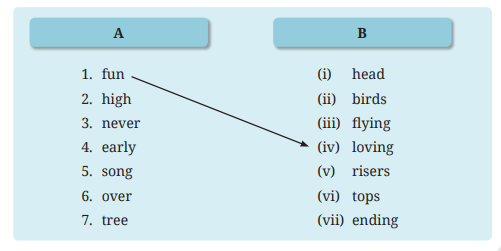
Now, complete the paragraph with suitable compound words from the table. An example has been done for you.
After being treated by Doctor Dolittle, the A. fun-loving dolphins danced playfully in his sanctuary. The B. _______________ chatter of monkeys echoed through the C. _______________, their ailments cured. D. ______________ eagles soared gracefully E. _______________ their health restored. F. _______________ among the G. _______________ chirped joyfully from the branches. All creatures were happy with Doctor Dolittle’s care.
Ans.
1. fun-loving
2. high flying
3. never-ending
4. early riser
5. song birds
6. overhead
7. Treetops
After being treated by Doctor Dolittle, the A. fun-loving dolphins danced playfully in his sanctuary. The B. song birds chatter of monkeys echoed through the C. tree-tops, their ailments cured. D. high flying eagles soared gracefully E. never-ending, their health restored. F. Early risers among the G. overhead chirped joyfully from the branches. All creatures were happy with Doctor Dolittle’s care.
III Underline the names of animals that are hidden in the sentences given below. Clues are given within the brackets. An example has been done for you.
1. Dr. Dolittle was eating oatmeal for his breakfast. (a farm animal)
2. Old ladies began to bring him their pets. (an insect)
3. The author sees the connection between humans and animals. (a farm animal)
4. The three baby dinosaurs are from ice age. (field animal)
5. The patients who came late didn’t know where to go. (ship of the desert)
Ans.
2. Old ladies began to bring him their pets. (an insect): ant
3. The author sees the connection between humans and animals. (a farm animal): horse
4. The three baby dinosaurs are from ice age. (field animal): mice
5. The patients who came late didn’t know where to go. (ship of the desert): camel
IV Read the following sentence from the text. Study the highlighted words.
But that stupid man over the hill never even looked at my eyes.
The highlighted words spell and read the same backwards too.
A word, phrase, or sequence that reads the same backwards as forwards is a palindrome.
Some of the common palindromes include ‘Was it a car or a cat I saw?’, ‘Madam, I’m Adam’ and ‘A man, a plan, a canal—Panama’
Some of the common palindromes include ‘Was it a car or a cat I saw?’, ‘Madam, I’m Adam’ and ‘A man, a plan, a canal—Panama’.
Read the sentences below and identify the palindrome words and sentences.
- Step on no pets.
- Naman saw a race car at the show.
- Nitin speaks in Malayalam.
- The engineer used a rotator to check the surface level.
- The pilot relied on the radar to navigate safely.
- Eva can I see bees in a cave?
Now, create your own palindrome and share it with your classmates and the teacher.
Ans.
- Step on no pets: This entire sentence is a palindrome
- Naman saw a race car at the show: Naman, racecar is a palindrome.
- Nitin speaks in Malayalam: This entire sentence is a palindrome
- The engineer used a rotator to check the surface level: rotator is a palindrome
- The pilot relied on the radar to navigate safely: radar is a palindrome
- Eva can I see bees in a cave?: This entire sentence is a palindrome
Palindrome Example
a nut for a jar of tuna
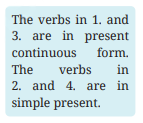
V Underline the verbs and identify the tense form in the following sentences from the text.
1. He is asking you a question.
2. Oh, there are plenty of animal doctors.
3. I am going blind in one eye.
4. … the trouble is that anybody thinks he can doctor animals.
Ans.
1. He is asking you a question. Present Continuous Tense
2. Oh, there are plenty of animal doctors. Simple Present Tense
3. I am going blind in one eye. Present Continuous Tense
4. … the trouble is that anybody thinks he can doctor animals. Simple Present Tense
VI Read the following sentences from the text.
- That man’s (man has) got sense.
- Can’t you see that it has stopped raining?
In the first sentence the verbs, ‘has got’ denote an action that is relevant at the time of speaking.
In the second sentence, the verbs ‘has stopped’ denote an action that is recently completed.
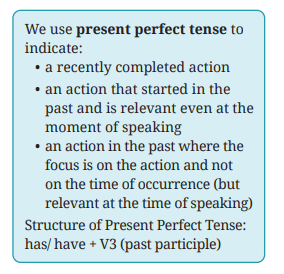
Fill in the blanks using the correct form of verbs (present perfect) given within brackets.
Since becoming an animal doctor, Doctor Dolittle 1. _________ (learn) to communicate with all animals and birds. He 2. _________ (treat) countless farm animals and pets with care. The parrot, Polynesia, 3. _________ (teach) him bird-language, and he 4. _________ (write) books about his adventures. Many people 5. _________ (bring) their sick animals to his door. Over the years, Dolittle 6. _________ (become) renowned worldwide for his unique abilities.
Ans. Since becoming an animal doctor, Doctor Dolittle 1. has learnt to communicate with all animals and birds. He 2. has treated countless farm animals and pets with care. The parrot, Polynesia, 3. has taught him bird-language, and he 4. has written books about his adventures. Many people 5. have brought their sick animals to his door. Over the years, Dolittle 6. has become renowned worldwide for his unique abilities.
Let us listen
I You will listen to an announcement. As you listen, state whether the following statement is true or false. (Transcript for the teacher on pg. 88)
Dr. Dolittle’s new clinic presents an offer of free medicines.
Ans. False
II You will listen to the announcement again. As you listen, complete the details given below with one or two exact words you hear.
1. The new clinic is located in the town of ______________.
2. The address is 12, ______________ Lane.
3. The clinic is open Monday to Friday from ______________ a.m. to 5 p.m.
4. Special timings for ______________ are on Saturdays from 11 a.m. to 2 p.m.
5. Dr. Dolittle will ensure that animals get the ______________.
6. All animals—horses, cows, ______________, wild animals, and others are welcome.
Ans.
1. The new clinic is located in the town of Woodstock.
2. The address is 12, Rose Lane.
3. The clinic is open Monday to Friday from 9 a.m. to 5 p.m.
4. Special timings for birds are on Saturdays from 11 a.m. to 2 p.m.
5. Dr. Dolittle will ensure that animals get the best care.
6. All animals—horses, cows, pets, wild animals, and others are welcome.
Let us write
A notice is a means of formal communication for a particular group of persons. It informs them about some important event, such as an invitation to a meeting, an announcement, to give instructions, make appeals, etc.
Write a notice in about 50 words about the Annual Health Check-up for students of Grades 6–8. Remind students to collect their health check-up cards from the class teacher. Include all other necessary details about date, time, and venue.
Complete the draft of the notice by using the words and phrases given in the box below
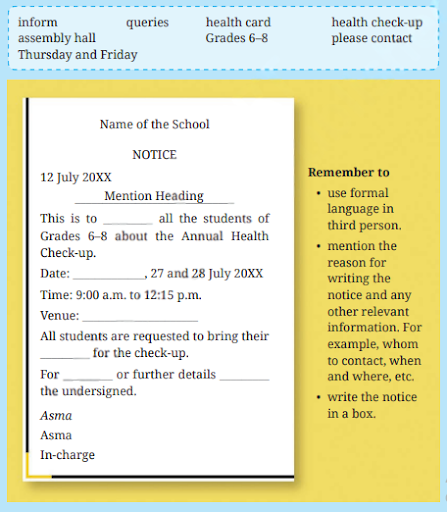
Ans.
Symbosise High School
NOTICE
20 May 2025
Health Check-up
This is to inform all the students of Grades 6-8 about the Annual Health Check-up.
Date: Sunday and Monday, 27 and 28 July 2025
Time: 9:00 a.m. to 12:15 p.m
Venue: Assembly Hall
All students are requested to bring their health card for the check-up.
For queries or further details Please contact the undersigned
Asma
Asmara
In-charge
CBSE Class 7 English Chapter 1 Animals, Birds, and Dr. Dolittle Extract-Based Questions
Answer the following extract-based questions..
A.
“You see, Doctor,” the Cat’s-food-Man went on, “you know all about animals—much more than what these vets here do. That book you wrote—about cats, why, it’s wonderful! I can’t read or write myself—my wife, Theodosia, is a scholar, and she read your book to me. You might have been a cat yourself. You know the way they think.”
Q1. According to the Cat’s-food-Man, what is Doctor Dolittle’s level of knowledge about animals compared to other veterinarians in the area?
Ans. The Cat’s-food-Man believes that Doctor Dolittle knows much more about animals than the local veterinarians.
Q2. What specific work of Doctor Dolittle does the Cat’s-food-Man praise?
Ans. The Cat’s-food-Man praises the book that Doctor Dolittle wrote about cats, calling it wonderful.
Q3. What is the Cat’s-food-Man’s personal experience with Doctor Dolittle’s book?
Ans. The Cat’s-food-Man cannot read or write himself, so his wife, Theodosia, who is a scholar, read Doctor Dolittle’s book to him.
Q4. What comparison does the Cat’s-food-Man make regarding Doctor Dolittle’s understanding of cats?
Ans. The Cat’s-food-Man suggests that Doctor Dolittle understands cats so well that he might have been a cat himself.
Q5. What does the Cat’s-food-Man attribute Doctor Dolittle’s deep understanding of cats to?
Ans. The Cat’s-food-Man implies that Doctor Dolittle’s deep understanding comes from knowing the way cats think.
B.
When the Cat’s-food-Man had gone the parrot flew off the window on to the Doctor’s table and said, “That man’s got sense. That’s what you ought to do. Be an animal doctor. Give the silly people up—if they haven’t brains enough to see you’re the best doctor in the world. Take care of animals instead— they’ll soon find it out. Be an animal doctor.”
“Oh, there are plenty of animal doctors,” said John Dolittle, putting the flowerpots outside on the windowsill to get the rain.
“Yes, there are plenty,” said Polynesia. “But none of them are any good at all. Now listen, Doctor, and I’ll tell you something. Did you know that animals can talk?”
Q1. Who suggests that Doctor Dolittle should become an animal doctor in this passage?
Ans. The parrot, Polynesia, suggests that Doctor Dolittle should become an animal doctor.
Q2. What reason does Polynesia give for Doctor Dolittle to stop treating people?
Ans. Polynesia believes that silly people do not have enough intelligence to recognize that Doctor Dolittle is the best doctor in the world.
Q3. What was Doctor Dolittle doing when he replies that there are plenty of animal doctors?
Ans. Doctor Dolittle is putting the flowerpots outside on the windowsill to get the rain when he makes that statement.
Q4. What claim does Polynesia make about the existing animal doctors?
Ans. Polynesia claims that although there are many animal doctors, none of them are any good at all.
Q5. What question does Polynesia ask Doctor Dolittle?
Ans. Polynesia asks Doctor Dolittle if he knew that animals can talk.
C.
“Looks to me as though he were scratching his ear,” said the Doctor.
“But animals don’t always speak with their mouths,” said the parrot in a high voice, raising her eyebrows. “They talk with their ears, with their feet, with their tails—with everything. Sometimes they don’t want to make a noise. Do you see now the way he’s twitching up one side of his nose?”
“What’s that mean?” asked the Doctor.
“That means, ‘Can’t you see that it has stopped raining?’” Polynesia answered. “He is asking you a question. Dogs nearly always use their noses for asking questions.”
After a while, with the parrot’s help, the Doctor got to learn the language of the animals so well that he could talk to them himself and understand everything they said. Then he gave up being a people’s doctor altogether.
Q1. What action of an animal does the Doctor initially interpret as scratching its ear? What does it actually mean?
Ans. The Doctor interprets the animal’s action as scratching its ear as mere scratching, which according to him is insignificant, but in reality he was asking the Doctor if he couldn’t see that it had stopped raining.
Q2. According to Polynesia, what are some of the ways that animals communicate besides using their mouths?
Ans. Polynesia states that animals talk with their ears, their feet, their tails, and with everything.
Q3. What specific non-verbal cue does Polynesia point out that the dog is making?
Ans. Polynesia points out that the dog is twitching up one side of its nose.
Q4. What is the meaning of the dog twitching one side of its nose, according to Polynesia?
Ans. According to Polynesia, the dog twitching one side of its nose means, “Can’t you see that it has stopped raining?” Dogs nearly always use their noses for asking questions.
Q5. What was the eventual outcome of the Doctor learning the language of the animals with Polynesia’s help?
Ans. Eventually, with the parrot’s help, the Doctor learned the language of the animals so well that he could talk to them himself and understand everything they said, leading him to give up being a people’s doctor altogether.
D.
“Of course—of course,” said the Doctor. “I’ll get you some at once.”
“I would like a pair like yours,” said the horse—“only green. They’ll keep the Sun out of my eyes while I’m ploughing the field.” “Certainly,” said the Doctor. “Green ones you shall have.”
“You know, the trouble is, Sir,” said the plough horse as the Doctor opened the front door to let him out—“the trouble is that anybody thinks he can doctor animals—just because the animals don’t complain. As a matter of fact, it takes a much cleverer man to be a really good animal doctor than it does to be a good people’s doctor.”
“Well, well!” said the Doctor.
“When will my glasses be ready?”
“I’ll have them for you next week,” said the Doctor.
“Come in again Tuesday—Good morning!”
Q1. What does the Doctor immediately offer to get for the horse?
Ans. The Doctor immediately offers to get the horse some glasses.
Q2. What specific request does the horse make regarding the type and color of glasses it wants?
Ans. The horse wants a pair of glasses like the Doctor’s, but green in color.
Q3. What reason does the horse give for wanting green glasses?
Ans. The horse explains that the green glasses will keep the sun out of its eyes while it is ploughing the field.
Q4. According to the plough horse, what is a common misconception about treating animals?
Ans. According to the plough horse, the trouble is that anybody thinks they can doctor animals just because the animals don’t complain.
Q5. When does the Doctor tell the horse to come back to collect its glasses?
Ans. The Doctor tells the horse to come back again on Tuesday of the next week.
Class 7 Animals, Birds, and Dr. Dolittle Multiple Choice Questions
Q1. What kind of doctor did John Dolittle initially practice as?
A. A human doctor
B. An animal doctor
C. A bird doctor
D. A plant doctor
Ans. A. A human doctor
Q2. Who was the first one to suggest that Dr. Dolittle become an animal doctor?
A. Polynesia, the parrot
B. The cat’s-food-man
C. Jip the dog
D. The plough horse
Ans. B. The cat’s-food-man
Q3. What special ability did Dr. Dolittle eventually learn?
A. How to fly like a bird
B. How to swim underwater for long periods
C. How to understand and speak the language of animals
D. How to make plants grow very quickly
Ans. C. How to understand and speak the language of animals
Q4. Who was Polynesia?
A. A cat
B. A dog
C. A horse
D. A parrot
Ans. D. A parrot
Q5. What reason did the plough horse give for needing glasses?
A. To look more intelligent
B. To keep the rain out of its eyes
C. To keep the sun out of its eyes while ploughing
D. Because the doctor had them
Ans. C. To keep the sun out of its eyes while ploughing
Q6. According to Polynesia, how do animals communicate besides using their mouths?
A. Only with their eyes
B. Only with their tails
C. With their ears, feet, tails, and everything
D. They don’t communicate without their mouths
Ans. C. With their ears, feet, tails, and everything
Q7. What did the cat’s-food-man’s wife, Theodosia, do for him regarding Dr. Dolittle’s book?
A. She bought him a copy
B. She translated it into another language
C. She read it aloud to him
D. She wrote a review of it
Ans. C. She read it aloud to him
Q8. What was the name of Dr. Dolittle’s dog?
A. Jip
B. Theodosia
C. Polly
D. Polynesia
Ans. A. Jip
Q9. What did the old ladies bring to Dr. Dolittle after he became known as an animal doctor?
A. Sick cats and canaries
B. Pet pugs and poodles who had overeaten cake
C. Injured squirrels and rabbits
D. Wild foxes and badgers
Ans. B. Pet pugs and poodles who had overeaten cake
Q10. Where did Polynesia often sit while Dr. Dolittle was talking to visitors in the kitchen?
A. On the floor by the fire
B. On the doctor’s lap
C. In the window looking outside
D. On top of the bookshelf
Ans. C. In the window looking outside
Q11. What did the twitching of the dog’s nose mean, according to Polynesia?
A. It was angry
B. It wanted food
C. It had an itchy nose
D. “Can’t you see that it has stopped raining?”
Ans. D. “Can’t you see that it has stopped raining?”
Q12. How did the animals in foreign lands learn about Dr. Dolittle?
A. Through letters written by other animals
B. Through messages carried by the wind
C. Through birds who flew to other countries in the winter
D. Through stories told by sailors
Ans. C. Through birds who flew to other countries in the winter
Q13. What was Dr. Dolittle doing when Polynesia first directly suggested he become an animal doctor?
A. Examining a human patient
B. Reading a book about animals
C. Putting the flowerpots outside on the windowsill
D. Feeding his pets
Ans. C. Putting the flower pots outside on the windowsill to get the rain
Q14. Why did Dr. Dolittle put the flower pots outside the windowsill?
A. To watered them
B. To get them rainwater
C. It was sunny
D. To give them to a patient
Ans. B. To get them rainwater
Q15. What was Polynesia proud of being able to speak?
A. Only bird language
B. Only people’s language
C. Two languages – people’s language and bird language
D. Many different animal languages
Ans. C. Two languages – people’s language and bird language
Q16. What did the cat’s-food-man say Dr. Dolittle seemed like he might have been in a past life?
A. A dog
B. A horse
C. A parrot
D. A cat
Ans. D. A cat
Q17. What was the general opinion of the other animal doctors, according to Polynesia?
A. They were all very helpful
B. There were few of them
C. None of them were any good at all
D. They mostly treated farm animals
Ans. C. None of them were any good at all
Q18. What was the eventual result of Dr. Dolittle learning to speak animal languages?
A. He became the richest doctor in town
B. He wrote more books about animals
C. He gave up being a people’s doctor altogether
D. he traveled the world teaching animals to speak human languages
Ans. C. He gave up being a people’s doctor altogether
Q19. How did Dr. Dolittle feel about his life after becoming an animal doctor?
A. He was lonely and missed treating people
B. He was constantly worried about money
C. He wished he had learned animal languages sooner
D. He was happy and liked his life very much
Ans. D. He was happy and liked his life very much
Q20. What did the plough horse think it took to be a ‘really” good animal doctor compared to a people’s doctor?
A. Less patience
B. More common sense
C. A clever man
D. Better medical tools
Ans. C. A clever man
CBSE Class 7 English Poorvi Book Unit 2 – Wit and Humour Chapter 1 Animals, Birds, and Dr. Dolittle Extra Question and Answers
Answer the following questions and answers.
Q1. What was the pivotal event or realization that led John Dolittle to shift his medical practice from humans to animals?
Ans. The pivotal realization was the suggestion made by the Cat’s-food-Man, which was then strongly seconded by Polynesia the parrot, that Doctor Dolittle possessed a unique understanding of animals that surpassed that of other veterinarians and that he should dedicate his skills to treating them instead of “silly people.”
Q2. What was the significance of Polynesia the parrot in Doctor Dolittle’s journey into the animal world?
Ans. Polynesia was crucial because she revealed to Doctor Dolittle that animals could talk in their own languages, beyond just mimicking human speech. She also became his primary teacher, helping him to learn these languages, which was the foundation for his ability to understand and treat animals effectively.
Q3. How did the animal community become aware of Doctor Dolittle’s unique abilities, and what was the impact of this awareness?
Ans. The animal community became aware through word-of-mouth, with local animals spreading the news and migratory birds carrying tales of Doctor Dolittle’s understanding and helpfulness to animals in foreign lands. This led to animals from far and wide seeking his assistance, establishing his reputation as a world-renowned animal doctor.
Q4. What underlying message or theme about the human-animal relationship is conveyed through Doctor Dolittle’s transformation?
Ans. The story conveys a message of the potential for deeper understanding and communication between humans and animals. It suggests that animals possess intelligence and complex ways of communicating that humans often overlook. Doctor Dolittle’s success highlights the value of empathy, listening, and respecting the unique perspectives and needs of the animal kingdom.
Q5. What ultimately brought Doctor Dolittle satisfaction and happiness in his life?
Ans. Doctor Dolittle found satisfaction and happiness in dedicating his life to understanding and helping animals. By embracing his unique ability to communicate with them and addressing their ailments, he discovered a fulfilling purpose that was more rewarding than his previous practice as a human doctor. His happiness underscores the importance of finding one’s true calling and living in harmony with one’s passions.