
Character Sketch of Saheb e Alam and Mukesh from Class 12 English Flamingo Book Chapter 2 The Lost Spring: Stories of Stolen Childhood
To understand the Class 12 Board Exam Pattern and Marking Scheme, Click here
Saheb e Alam
Questions related to the Character of Saheb e Alam
- How does the full name of Saheb-e-Alam contrast sharply with his actual socio-economic reality in Seemapuri?
- In what way does Saheb view the act of ragpicking differently from how an adult might view it?
- Analyze the transition of Saheb from a ragpicker to a tea stall worker. Why does the author suggest that he is no longer his own boss?
Mukesh
Questions related to the Character of Mukesh
- Describe the physical environment of Mukesh’s home and neighborhood as depicted in the character sketch.
- Mukesh dreams of becoming a motor mechanic but grows quiet when asked about becoming a pilot. What does this reveal about the scope of his dreams and his surroundings?
- How does Mukesh’s attitude toward his future differ from the karam or destiny mindset held by his family and the people of Firozabad?
- What specific qualities make Mukesh stand out as a ‘courageous’ character in the context of the glass-blowing industry?
Related:
- The Lost Spring: Stories of Stolen Childhood Question Answers
- The Lost Spring Summary Class 12 English Explanation Notes
- The Lost Spring: Stories of Stolen Childhood MCQs
- Lost Spring Stories of Stolen Childhood Previous Years Question with Answers
Character Sketch of Saheb e Alam
Finish your entire Class 12 English prep in 24 hrs & ace your CBSE Boards 2026! – Concise chapter summaries (key events & ideas), lesson themes, Visual character sketches using mind maps Click here
Questions related to the character of Saheb-e-Alam
Question: How does the full name of Saheb-e-Alam contrast sharply with his actual socio-economic reality in Seemapuri?
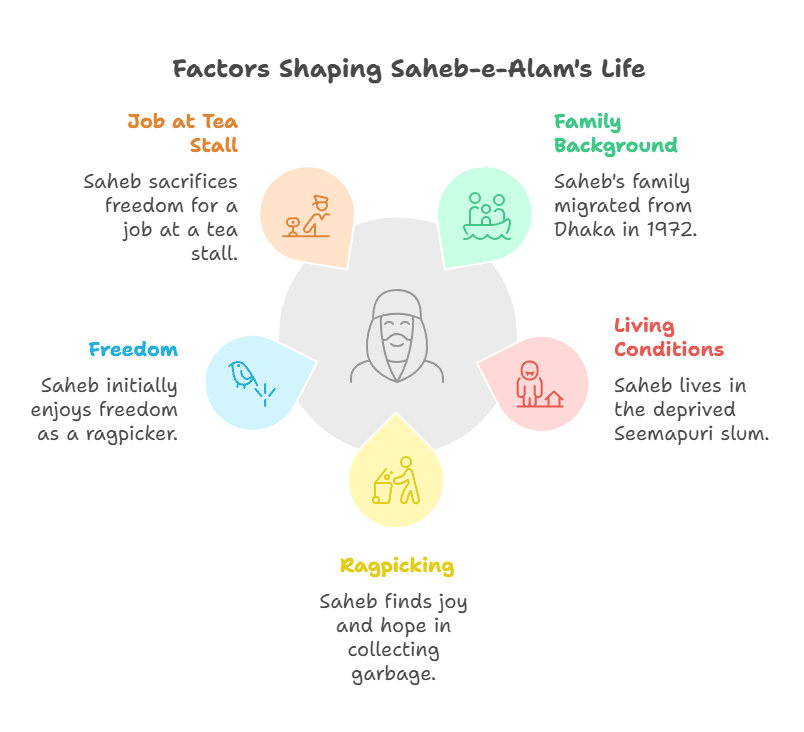
Answer. The name Saheb-e-Alam translates to ‘Lord of the Universe’, implying supreme power, wealth, and status.
This creates a stinging irony when contrasted with his life as a destitute ragpicker in the slums of Seemapuri. Instead of ruling the world, Saheb is a refugee who lives on the fringes of society, roaming the streets barefoot and scrounging through garbage dumps for survival. His reality is defined by grinding poverty, lack of education, and a search for “gold” in the form of discarded coins, making him a victim of his circumstances rather than a master of the universe.
He is unaware of the name’s grand meaning, which serves as a cruel mockery of his sub-human living conditions and his struggle for his daily bread.

Question: In what way does Saheb view the act of ragpicking differently from how an adult might view it?
Answer. To the elders, garbage is a grim necessity. It represents ‘daily bread’ and a means of survival. Their view is functional and rooted in the struggle to stay alive.
To Saheb, garbage is ‘wrapped in wonder’. It is a treasure hunt where a found coin provides ‘joy and mystery’. The difference lies in hardship versus hope. For adults, it is a chore; for Saheb, it is an adventure.
Question. Analyze the transition of Saheb from a ragpicker to a tea stall worker. Why does the author suggest that he is no longer his own boss?
Answer. Saheb’s move to the tea stall represents a shift from destitute independence to stifling security. Though he earns 800 rupees and meals, he loses his carefree look. The author suggests he is no longer his own boss because his autonomy has been traded for servitude. Previously, he carried a light plastic bag that belonged to him; now, he carries a heavy steel canister belonging to his master. This canister symbolizes the weight of responsibility and loss of liberty. While the job provides bread, it robs him of the freedom to be his own master.
Character Sketch of Mukesh
Questions related to the character of Saheb-e-Alam
Question. Describe the physical environment of Mukesh’s home and neighborhood as depicted in the character sketch.
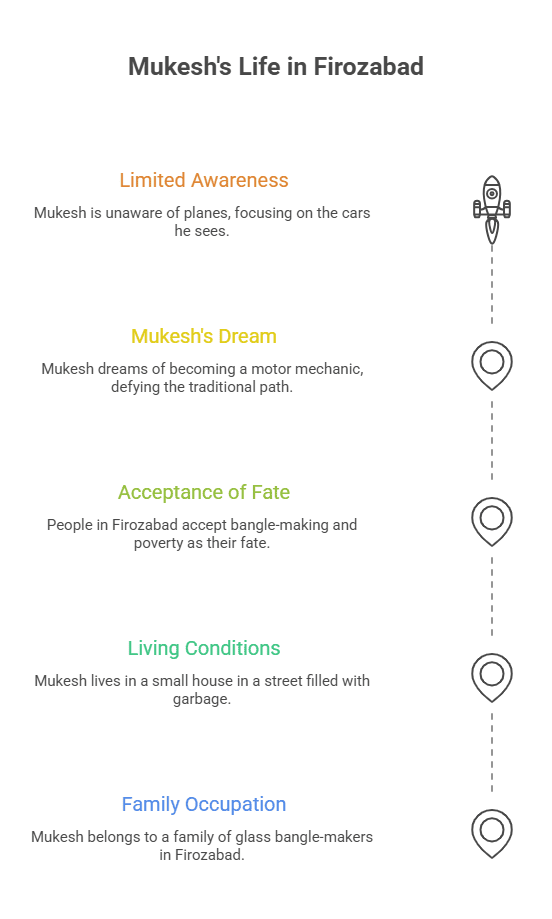
Answer. Mukesh lives in a dilapidated section of Firozabad, characterized by extreme squalor and decay. The neighborhood consists of stinking lanes choked with garbage and overcrowded hovels with crumbling walls and wobbly doors. These dwellings often lack windows, creating dark, unhygienic living spaces shared by humans and animals alike. Mukesh’s own home is a half-built shack in a state of slow renovation. The interior is primitive, featuring a dead-grass thatched roof and a firewood stove where a frail young woman cooks meager meals. This environment reflects the grinding poverty and sub-human conditions typical of the bangle-making community.
Question. Mukesh dreams of becoming a motor mechanic but grows quiet when asked about becoming a pilot. What does this reveal about the scope of his dreams and his surroundings?
Answer. Mukesh’s silence when asked about becoming a pilot reveals the grounded and realistic nature of his ambitions, shaped by his limited surroundings. Unlike the mirage of unreachable goals, his dream of being a motor mechanic is inspired by the cars he sees daily on the streets of Firozabad. It is a tangible escape from the vicious circle of bangle-making. However, a pilot represents a world entirely beyond his reach. Since few planes fly over Firozabad, he cannot relate to or visualize such a future. His embarrassment stems from the realization of his socio-economic boundaries; he is brave enough to break tradition, but his imagination remains tethered to the physical reality of his impoverished environment.
Question. How does Mukesh’s attitude toward his future differ from the karam or destiny mindset held by his family and the people of Firozabad?
Answer. Mukesh’s attitude is marked by resilience and agency, contrasting sharply with the fatalism of Firozabad. His family views bangle-making as a God-given lineage and karam, believing they are born to suffer in dark furnaces. This mindset breeds stagnation and a mind-numbing toil that kills all initiative. Conversely, Mukesh refuses to let his circumstances define his future. He insists on being his own master by dreaming of becoming a motor mechanic. While his community has succumbed to a vicious circle of exploitation, Mukesh’s willingness to dare represents a break from the psychological shackles of tradition.
Question. What specific qualities make Mukesh stand out as a ‘courageous’ character in the context of the glass-blowing industry?
Answer. In the oppressive environment of Firozabad, Mukesh stands out for his determination and independence. Unlike his peers who have surrendered to karam and the vicious circle of exploitation, Mukesh insists on being his own master. His courage is evident in his willingness to break a centuries-old tradition of bangle-making. Despite the mental pressure from his family and the physical threat of the sahukars and police, he dares to pursue a different path as a motor mechanic. By choosing to walk to a distant garage to learn a new trade, Mukesh demonstrates a pioneer spirit that refuses to let his stolen childhood dictate a future of certain blindness and poverty.
The Lost Spring: Stories of Stolen Childhood Overview – The sad position of poor children who are forced to have a wretched life and forgo the fun times of childhood due to their social circumstances is the subject of the story “Lost Spring.” These children are compelled to labour from an early age and are not given the opportunity to pursue an education. Anees Jung, the writer, makes a concerted effort to end child labour. She advocates for government enforcement of strict laws prohibiting child work as well as enforce the education of children. She talks about her encounter with a slum dweller kid named Saheb-e-Alam who is a ragpicker and wishes to play tennis and go to a school. However, these wishes remain unfulfilled. Another boy named Mukesh hails from a family of bangle makers from Firozabad. Their lives are miserable because the profession does not provide a good livelihood and harms them physically too. The boy dreams to do something different but his dreams are restricted to the life that he has seen in his hometown. He aspires to become a car mechanic.
Class 12 Important Videos Links
| Class 12 English Important Questions Videos |
| Class 12 English Flamingo and Vistas book MCQs Videos |
| Class 12 Flamingo Book Chapter wise Video Explanation |
Also See:
- CBSE Class 12 English Notes, Lesson Explanation
- CBSE Class 12 English MCQ Question Answers
- Class 12 English Flamingo Book Chapter wise word meaning
- Class 12 English Flamingo Poems Word meaning
- Class 12 English Vistas Book Word meanings
- CBSE Class 12 English Important Question Answers
- Character Sketch of Class 12 English
- Class 12 English Core Previous Year Question Answers (2019-2024) Chapterwise
- Class 12 English Core Previous Year Question Paper with Solutions 2019-2024