
CBSE Class 12 English Lesson 6 Memories of Childhood Part 2 –We too are Human Beings Summary, Line by Line Explanation along with Difficult Word Meanings from Vistas Book
In the class 12 chapter 6 Memories of Childhood- We too are Human Beings, Bama discusses caste distinction and the course that she took to come above this prejudice prevalent in the society. From a cheerful, innocent young girl who finds joy in everyday street observations, Bama transforms into an angry, determined young woman who fights against caste discrimination through education and hard work.
To understand the Class 12 Board Exam Pattern and Marking Scheme, Click here
Question: What are the important keywords / value points of Memories of Childhood – We Too Are Human Beings for class 12 English?
Ans. Here is a list of the keywords of We Too Are Human Beings-
- Childhood Innocence and Street Observations: Bama is a cheerful, curious young girl who loves observing things taking place in her street. Though her school is only ten minutes away from home, she takes thirty minutes to reach because she stops to watch various entertaining street activities, a monkey performing, a snake charmer, a cyclist, a famous temple with a big bell, tribal men selling clay beads, various snack stalls and political party lectures. Her innocent, joyful observations represent the natural curiosity and wonder of childhood before the harsh realities of social discrimination intrude upon innocence.
- The Incident of the Snack Pack – Discovery of Caste Discrimination: The turning point of the story comes when Bama sees an elderly man from her community carrying a snack pack in a very strange manner and offering it to the landlord. She finds this so amusing that she bursts out laughing. However, when she narrates this incident to her elder brother, he reveals the shocking truth, the old man was carrying the snack pack carefully to avoid touching it with his hands because as a low caste person, his touch would make the food impure for the upper caste landlord. This revelation shatters Bama’s innocent worldview and introduces her to the cruel reality of caste discrimination.
- Caste Discrimination and Social Inequality: Bama’s elder brother explains the harsh reality that they belong to a low caste community and that upper caste people do not like their presence or touch because it would make them impure. This revelation fills Bama with deep disgust and anger toward the upper caste people who practice such dehumanizing discrimination. The incident powerfully exposes how caste discrimination operates in everyday life, reducing lower caste individuals to the status of untouchables who cannot even hand food directly without polluting it through their touch.
- Anger and Determination Against Injustice: Bama’s reaction to learning about caste discrimination is not passive acceptance but active anger and determination. She finds the discrimination disgusting and grows intensely angry over upper caste people’s behavior. This anger becomes a powerful motivating force that drives her to seek a way out of social oppression. Her emotional response represents the natural human reaction against injustice and serves as the foundation for her subsequent determination to fight discrimination through education and achievement.
- Role of Education in Fighting Discrimination: Bama’s elder brother plays a crucial role by channeling her anger productively. When he is questioned about his whereabouts to determine his caste, he suggests that Bama study hard as only education could earn her genuine respect in society. He understands that knowledge and academic achievement are powerful weapons against caste discrimination. His wise advice transforms Bama’s anger into focused determination, showing that education is the most effective tool for marginalized communities to break free from social oppression and discrimination.
- Transformation Through Education and Achievement: Bama follows her brother’s advice and works extremely hard, eventually becoming the topper of her class. This academic achievement not only earns her tremendous respect but also brings her many genuine friends. Her success demonstrates that education has the power to transcend caste barriers and earn recognition based on merit rather than birth. Her transformation from an angry, humiliated young girl to a respected class topper powerfully shows that determination, hard work and education can overcome even the most deeply entrenched social discrimination and inequality.
Memories of Childhood Part 2- We too are Human beings Quick Overview
| Detail | Information |
| Chapter Title | Memories of Childhood – We too are Human beings |
| Author | Bama |
| Book | Vistas (CBSE Class 12 English) |
| Chapter No. | 6 |
| Narrator | Writer |
| Setting | Writer’s native village |
| Theme | Caste discrimination, human dignity, importance of education |
- Memories of childhood Part 2 We too are human Beings Summary Mind Map
- Theme based Questions of Memories of Childhood Part 2 – We Too Are Human Beings
- Memories of Childhood Summary Previous Year Questions with Model Answers PDF
- Memories of childhood Part 2 We too are human Beings Explanation
- Memories of childhood Part 2 We too are human Beings Video Explanation
- Memories of childhood Part 2 We too are human Beings Summary in Hindi
Related:
- Memories of Childhood Class 12 English Explanation Notes Part 1
- Memories of Childhood Part 1 Important Question Answers
- Memories of Childhood Part 2 Important Question Answers
- Memories of Childhood Part 1 Character Sketch
- Memories of Childhood Part 2 Character Sketch
- Memories of Childhood MCQs
- Memories of Childhood Previous Years Question with Answers
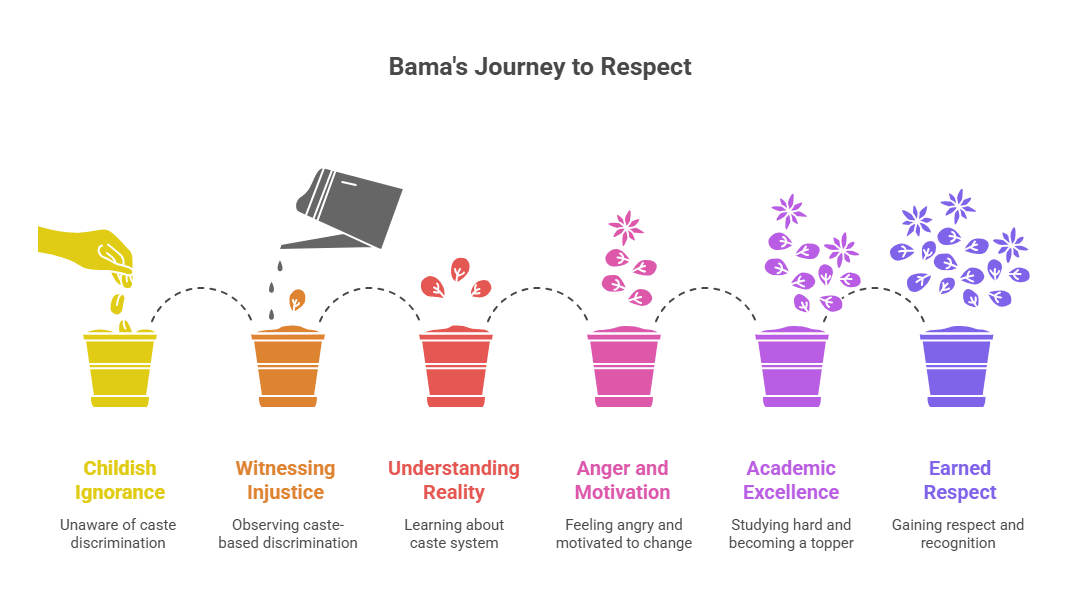
Memories of Childhood Part 2 We Too Are Human Beings Summary Mind Map
Finish your entire Class 12 English prep in 24 hrs & ace your CBSE Boards 2026! – Concise chapter summaries (key events & ideas), lesson themes, Visual character sketches using mind maps Click here
Question. Describe the transformation in Bama as the story ‘Memories of Childhood – We Too Are Human Beings’ proceeds, as asked in CBSE class 12 board exam.
Ans. In the story “We Too Are Human Beings,” we see that the character of Bama undergoes a remarkable transformation from a cheerful, innocent young girl to an angry, determined individual who fights caste discrimination through education and hard work. The story opens with Bama as a joyful, curious child who takes thirty minutes to walk home from school because she stops to observe fascinating street activities, monkey performers, snake charmers, cyclists, temples, and snack stalls. Her innocent observations reveal a child full of wonder and joy, completely unaware of the harsh social realities surrounding her.
The turning point comes when Bama witnesses an elderly man from her community carrying a snack pack in a strange manner and offering it to the landlord. Initially she finds this amusing and laughs. However, when her elder brother reveals the shocking truth, that the old man was avoiding touching the food to prevent polluting it for the upper caste landlord, Bama’s innocent worldview is completely shattered. This revelation introduces her to the cruel, dehumanizing reality of caste discrimination that has surrounded her all along without her awareness.
Her immediate reaction is not passive acceptance but intense anger and disgust. She grows furious at upper caste people who practice such humiliating discrimination against her community. This anger represents a crucial stage in her transformation, the loss of innocent ignorance and the birth of social consciousness and awareness of injustice.
The most significant transformation occurs when her elder brother channels her anger productively by advising her to study hard. He explains that only education can earn genuine respect in a society deeply divided by caste. Bama takes this advice to heart and dedicates herself completely to academic achievement, working tirelessly to excel in her studies.
Bama’s transformation reaches its peak when she becomes the topper of her class. This achievement not only earns her tremendous respect from teachers and peers but also brings her many genuine friends who value her for her merit and character rather than her caste identity.
Thus, the story shows a complete and inspiring transformation in Bama from a cheerful but socially unaware young girl to a determined, successful individual who overcomes caste discrimination through education and hard work. Her journey teaches us that anger against injustice, when channeled productively through education and determination, can become a powerful force for personal liberation and social change.
Theme based Questions of Memories of Childhood – We Too Are Human Beings
Question. How does Bama show resistance to the theme of caste discrimination in the story?
Ans. Bama resists caste discrimination by channeling her anger into academic determination. When she discovers the humiliating reality of untouchability through the snack pack incident, she grows furious but productively uses that anger to study hard and become class topper. She does not want discrimination to define her life because human dignity and respect are her fundamental rights as expressed powerfully in the title “We Too Are Human Beings.”
Question. How does We Too Are Human Beings show a connection between education and dignity?
Ans. The story highlights that education is the most powerful tool for earning dignity and respect in a caste-divided society. Bama’s elder brother advises her that only hard work and academic achievement can earn genuine respect regardless of caste. When Bama becomes class topper, she earns both respect and friendship based on merit. Thus, education becomes the bridge between caste-based humiliation and genuine human dignity and social recognition.
Question. Bama displays anger and determination against social injustice in class 12 lesson Memories of Childhood – We too are Human beings. Discuss.
Ans. Bama demonstrates intense anger when her brother reveals the humiliating truth about caste discrimination. She finds the practice of untouchability disgusting and grows furious at upper caste people’s dehumanizing behavior. However, she channels this anger productively through determined academic effort. She works hard and becomes class topper, showing that righteous anger against injustice when directed purposefully becomes a powerful force for personal transformation and social change.

Question. The character of Bama undergoes realization and transformation. Discuss.
Ans. Bama’s transformation begins with her innocent amusement at the snack pack incident. Her brother’s revelation shatters her innocent worldview and fills her with anger and disgust at caste discrimination. Through her brother’s wise advice, she realizes that education is the path to dignity and respect. This realization transforms her from an angry, humiliated girl to a determined student who becomes class topper, earning genuine respect and friendship through merit.
Question. How does the story justify the title “We Too Are Human Beings”?
Ans. The title powerfully asserts the fundamental humanity and equal dignity of lower caste people who are treated as untouchables by upper caste society. The snack pack incident shows how lower caste people are dehumanized and treated as sources of pollution. Bama’s anger and her subsequent academic achievement both challenge this dehumanization. The title declares that regardless of caste, all human beings deserve equal dignity, respect and recognition as full human beings.
Question. What is the background of “We Too Are Human Beings”? Describe the setting.
Ans. “We Too Are Human Beings” is written by Bama, a Tamil Dalit woman writer. The story is set in a small Indian village where caste discrimination is deeply entrenched in everyday social life. The setting includes Bama’s familiar street with its various entertainers, the landlord’s field where caste hierarchy is visibly enacted, and her school where education eventually transcends caste barriers. The village setting powerfully reveals how caste discrimination operates openly and systematically in ordinary daily life.
Question. Describe the writing style used by Bama in class 12 lesson Memories of Childhood – We Too Are Human Beings.
Ans. “We Too Are Human Beings” uses first-person autobiographical narrative making the account deeply personal, authentic and emotionally powerful. The tone moves from cheerful and innocent to angry and determined. Bama uses vivid, simple descriptions of everyday street life to establish her innocent childhood perspective before introducing the harsh reality of caste discrimination. Her writing style is direct and honest, moving from childhood wonder to social consciousness, concluding powerfully with her academic triumph as a symbol of resistance against caste oppression.
Memories of Childhood Previous Year Questions with Model Answers PDF
Download the previous year questions of the Poem Memories of Childhood of class 12 English for free. With the help of this, you can prepare for the exam.
To Download Memories of Childhood Previous Year Questions with Model Answers- Click Here
Memories of Childhood Part 2- We too are human Beings Lesson Explanation
Question: In the class 12 chapter, We too are human beings, what does Bama mean when she says that she had already ‘seen, felt, experienced and been humiliated by’ untouchability even though she had not heard it spoken about openly?
Passage: When I was studying in the third class, I hadn’t yet heard people speak openly of untouchability. But I had already seen, felt, experienced and been humiliated by what it is.
Word Meanings:
Humiliated: insulted
Explanation / Answer: The writer says that when she was a student in the third class she had never heard anyone speaking openly about untouchability. But she by then had already seen and felt it. For her it was very embarrassing to experience the concept of untouchability.
Question: In the class 12 chapter, Memories of Childhood – We too are human beings, how does Bama describe her habit of dawdling on the way back from school?
Passage: I was walking home from school one day, an old bag hanging from my shoulder. It was actually possible to walk the distance in ten minutes. But usually it would take me thirty minutes at the very least to reach home. It would take me from half an hour to an hour to dawdle along, watching all the fun and games that were going on, all the entertaining novelties and oddities is the streets, the shops and the bazaar.
Word Meanings:
Dawdle: waste time, idle
Novelties: newness, freshness
Oddities: strange things
Explanation / Answer: The writer says that one day she was coming back home from her school. She was carrying an old bag with her. The distance between her school and home was only ten minutes. But she would take thirty minutes to reach her home. It was so because she used to waste her time in the street watching all the fun and games happening there. She used to see new or sometimes strange things happening there, and then there were the shops and the bazaar that she loved to see.
Question: What did Bama see and enjoy while dawdling on the way back from school?
Passage: The performing monkey; the snake which the snake charmer kept in its box and displayed from time to time; the cyclist who had not got off his bike for three days, and who kept pedalling as hard as he could from break of day; the rupee notes that were pinned on to his shirt to spur him on; the spinning wheels; the Maariyaata temple, the huge bell hanging there; the pongal offerings being cooked in front of the temple; the dried fish stall by the statue of Gandhi; the sweet stall, the stall selling fried snacks, and all the other shops next to each other; the street light always demonstrating how it could change from blue to violet; the narikkuravan hunter gypsy with his wild lemur in cages, selling needles, clay beads and instruments for cleaning out the ears — Oh, I could go on and on. Each thing would pull me to a stand-still and not allow me to go any further.
At times, people from various political parties would arrive, put up a stage and harangue us through their mikes. Then there might be a street play, or a puppet show, or a “no magic, no miracle” stunt performance. All these would happen from time to time. But almost certainly there would be some entertainment or other going on.
Even otherwise, there were the coffee clubs in the bazaar: the way each waiter cooled the coffee, lifting a tumbler high up and pouring its contents into a tumbler held in his other hand. Or the way some people sat in front of the shops chopping up onions, their eyes turned elsewhere so that they would not smart. Or the almond tree growing there and its fruit which was occasionally blown down by the wind. All these sights taken together would tether my legs and stop me from going home.
Word Meanings:
Snake Charmer: an entertainer who appears to make snakes move by playing music.
Spur: encouragement
Offerings: donation, gift
Demonstrate: to show
Lemur: an animal
Instrument: tool
Harangue: to give lecture
Miracle: wonder
Tumbler: Jug
Tether: tie up
Explanation / Answer: The writer describes those things she watched in the street or the bazaar. There was a performing monkey, a snake charmer who could make snakes move by playing music. He would keep the snake in a box and display it from time to time. There was a cyclist also who had been riding his bike from past three days. He pedaled hard to continue his riding as he was into some kind of contest. Somebody had pinned the rupee notes on his shirt so as to encourage him and keep him going on his cycle. Then there was spinning wheel and the Maariyaata temple, there was a huge bell hanging inside the temple. The pongal offering that is a particular dish cooked during pongal was cooked outside this temple. There were dried fish also that were sold by the statue of Gandhi. Next she describes that there were stalls of sweet and fried snacks and other shops next to each other. There were street lights that turned violet from blue and then the narikkuravan, a tribe in south India. He had a lemur an animal that looks like a monkey in a cage. He was a seller of needles, clay beads and some instrument used for cleaning ears. These sights of various things were so entertaining for her that it prevented her from going further.
The writer says that sometimes, the people from various political parties would come in their street and put up a stage to deliver lectures for all of us. Sometimes street plays, puppet show and no magic no wonder acts were also staged in the street. So basically there was a regular display of such entertaining acts in the street.
She further says that even if no such act was staged in the street then also there were the coffee clubs in the bazaar. She liked the way waiters cooled the coffee by pouring it from one jug to another. There were some other people who used to sit in front of their shops and chop onions. They always turned their eyes on the other side so as to save them from getting teary. Other interesting thing for the writer was an almond tree that was still growing and whose fruit was blown away by the wind. All these sights were so very interesting for the writer that she couldn’t help her from stopping there and watching them. She feels like her legs been tied up so that she could not reach her home.
Question: What kinds of seasonal fruits and snacks did Bama notice in the bazaar, and how does this show her keen observation?
Passage: And then, according to the season, there would be mango, cucumber, sugar-cane, sweet-potato, palm-shoots, gram, palm-syrup and palm-fruit, guavas and jack-fruit. Every day I would see people selling sweet and savoury fried snacks, payasam, halva, boiled tamarind seeds and iced lollies.
Word Meanings:
Savoury: a salty or spicy dish
Payasam: sweet dish made with rice and milk
Iced lollies: piece of flavored ice on stick
Explanation / Answer: There were sellers of various things in the bazaar. They used to sell items as per the season so there were mango, cucumber, sugarcane, sweet potato, palm-shoots, gram, palm- syrup, guavas and jack-fruit for sale. Even the writer saw many other sellers selling sweet and spicy snacks, payasam, halva, boiled tamarind seeds and iced lollies. So the writer was quite a good observer and she used to notice every bit of thing happening in the market street.
Question: In the story Memories of Childhood part 2, how does Bama describe the threshing‑floor scene with the landlord and the workers from her community?
Passage: Gazing at all this, one day, I came to my street, my bag slung over my shoulder. At the opposite corner, though, a threshing floor had been set up, and the landlord watched the proceedings, seated on a piece of sacking spread over a stone ledge. Our people were hard at work, driving cattle in pairs, round and round, to tread out the grain from the straw. The animals were muzzled so that they wouldn’t help themselves to the straw. I stood for a while there, watching the fun.
Word Meanings:
Gaze: look
Threshing floor: A specially flattened outdoor surface to separate the grain from straw.
Proceedings: events, activities
Sack: bag
Ledge: shelf
Tread: walk
Muzzled: a covering used to cover the mouth of an animal
Explanation / Answer: The writer says that looking at all those skits and beautiful things all day she then entered her own street. On the opposite side of the street there was a newly made threshing floor, a flattened outdoor surface made to separate grain from straw. The landlord was sitting on a stone shelf and was watching people work in his field. She then describes the laborers who are working in the field. They belonged to the writer’s community. She says that they are very hardworking and they were driving the cattle in pairs in the field. They were doing so to separate the grain from the straw. Further, she says that the mouth of the animals was covered so as to stop them from eating grains. All this was such a fun to watch for her.
Also, see – Tips to score 95% in English paper of CBSE Board Exams
Question: In the class 12 lesson Memories of Childhood, why did Bama feel like laughing at the strange way of holding the packet?
Passage: Just then, an elder of our street came along from the direction of the bazaar. The manner in which he was walking along made me want to double up. I wanted to shriek with laughter at the sight of such a big man carrying a small packet in that fashion. I guessed there was something like vadai or green banana bhajji in the packet, because the wrapping paper was stained with oil. He came along, holding out the packet by its string, without touching it. I stood there thinking to myself, if he holds it like that, won’t the package come undone, and the vadais fall out?
The elder went straight up to the landlord, bowed low and extended the packet towards him, cupping the hand that held the string with his other hand. The landlord opened the parcel and began to eat the vadais.
Word Meanings:
Double up: laugh out loud
Shriek: burst out
Wrap: cover
Stain: Spot
Strings: thread
Extend: hold out
Cupping: holding hands together to catch something
Explanation / Answer: Then she saw an elder person, who was her neighbor coming from bazaar. He was carrying a packet of some snack with him. The manner in which the old man was walking made her burst in laugh. He was handling it at some distance from his body. She says that she came to know that the packet contained vadai or green banana bhaji. She guessed it because of the oily spots on the packet. The man was carrying it by the threads. This made the writer think that this way of handling a packet could lead to fall of its contents.
The old man went up to the landlord. He bends down to show respect to the landlord and holding his hand out he offered the carry bag to the landlord. The landlord took the parcel and started eating vadais out of it.
Question: Explain the difference between Bama’s and her brother Annan’s reactions to the old man carrying the packet by its string?
Passage: After I had watched all this, at last I went home. My elder brother was there. I told him the story in all its comic detail. I fell about with laughter at the memory of a big man, and an elder at that, making such a game out of carrying the parcel. But Annan was not amused. Annan told me the man wasn’t being funny when he carried the package like that. He said everybody believed that they were upper caste and therefore must not touch us. If they did, they would be polluted. That’s why he had to carry the package by its string.
Word Meanings:
Amused: finding something funny
Polluted: impure, harmful
Explanation / Answer: After watching all this she went back to her home. She narrated the whole incident of the old man to her elder brother. She was laughing out by recalling the way that big man was handling the packet. But her brother Annan didn’t found it funny. He told her that the man wasn’t being funny, He did it because we belong to a lower caste. People from upper caste do not touch us as this would make them impure. Even the food should be handled by the strings if it is for the upper caste, that is why the old man was carrying it like this.
Question: In the class 12 chapter, We too are human beings, explain how Bama’s reaction changes from amusement to anger and how she begins to realize the injustice of untouchability.
Passage: When I heard this, I didn’t want to laugh any more, and I felt terribly sad. How could they believe that it was disgusting if one of us held that package in his hands, even though the vadai had been wrapped first in a banana leaf, and then parceled in paper? I felt so provoked and angry that I wanted to touch those wretched vadais myself straightaway. Why should we have to fetch and carry for these people, I wondered. Such an important elder of ours goes meekly to the shops to fetch snacks and hands them over reverently, bowing and shrinking, to this fellow who just sits there and stuffs them into his mouth. The thought of it infuriated me.
How was it that these fellows thought so much of themselves? Because they had scraped four coins together, did that mean they must lose all human feelings? But we too are human beings. Our people should never run these petty errands for these fellows. We should work in their fields, take home our wages, and leave it at that.
Word Meanings:
Terrible: horrible
Disgusting: unpleasant
Provoked: evoke, arouse
Wretched: miserable, sad
Fetch: bring, carry
Meekly: quietly, submissively
Reverently: with deep respect
Infuriate: anger
Scraped: here, saved
Errands: task, job
Explanation / Answer: When she heard all this from her brother, the writer became very sad. She wanted to know how the people of upper caste could have such a belief about their community. She knew that vadais are first packed in banana leaves and then in a parcel so how could they get polluted with their touch. She felt so angry at this that she decided to go and touch those vadais herself. She then questioned herself again as to why we have to go and bring things for these upper caste people. She also felt bad for that elder person who was one of the important people of her tribe. She said he even had to go to bring things for them. He had to hand all that with great respect to such a person who just sits there and pops the things into his mouth. This very thought filled her with anger.
Bama says that what if the upper caste people have some money with them. Does that mean that they will not treat others nicely? She says that we are also human beings and should be treated like a human. She also thinks that people from her community should not do such small tasks of bringing food for them. We should work in their fields, take our wages and then leave out. We should never do any extra work for them.
Question. In the lesson Memories of Childhood, how did the landlord’s man try to find out Annan’s caste while walking along the banks of the irrigation tank?
Passage: My elder brother, who was studying at a university, had come home for the holidays. He would often go to the library in our neighboring village in order to borrow books. He was on his way home one day, walking along the banks of the irrigation tank. One of the landlord’s men came up behind him. He thought my Annan looked unfamiliar, and so he asked, “Who are you, appa, what’s your name?” Annan told him his name. Immediately the other man asked, “Thambi, on which street do you live?” The point of this was that if he knew on which street we lived, he would know our caste too.
Word Meanings:
Irrigation Tank: water pond made for watering fields
Thambi: brother
Explanation / Answer: The writer’s elder brother had come home for the holidays. He was a student in a University. He was on the way to his home from a neighboring village, where he had gone to borrow books from the library. He was walking along an irrigation pond when he was stopped by one of the men of the landlord. He was asked his name. Annan told his name. He then queried about the street where he lived so that he could know his caste.
Question: How did Annan explain the importance of education to Bama, and how did she respond to his advice?
Passage: Annan told me all these things. And he added, “Because we are born into this community, we are never given any honour or dignity or respect; we are stripped of all that. But if we study and make progress, we can throw away these indignities. So study with care, learn all you can. If you are always ahead in your lessons, people will come to you of their own accord and attach themselves to you. Work hard and learn.” The words that Annan spoke to me that day made a very deep impression on me. And I studied hard, with all my breath and being, in a frenzy almost. As Annan had urged, I stood first in my class. And because of that, many people became my friends.
Word Meanings:
Community: group
Dignity: nobility
Indignities: humiliate, disrespect
Frenzy: madness, mania
Explanation / Answer: Annan told the whole incident to the writer. He also told her that as they were born into a low caste they will never get any respect from the upper caste. They are deprived of all this. But if they study hard and make progress in their life they can throw away this disrespect. He suggested his sister to study hard and stay ahead over others as this would earn her respect and company from others. The words of the elder brother touched her so deeply that she started working hard almost like a mad person. As Annan had asked she stood first in her class and because of this she made so many friends.
Memories of Childhood Part 2 We too are human Beings by Bama Class 12 Video Explanation
Memories of Childhood Part 2 – We too are Human beings FAQs
Question: Who is the writer of Memories of Childhood- We too are Human beings?
Ans. The class 12 story We too are Human beings is written by Bama.
Question: What is the theme of the class 12 lesson Memories of Childhood- We too are Human beings?
Ans. The story, Memories of Childhood – We too are Human beings gives a powerful message about caste discrimination, human dignity, the importance of education, and the power of determination to overcome social injustice and inequality.
Question: Who is Annan in the lesson Memories of Childhood- We too are Human beings?
Ans. In the class 12 English story Memories of Childhood – We too are human beings, Annan is Bama’s elder brother. Annan tells Bama the reason why the old man was holding the packet of Vadais in a peculiar manner so that he would not ‘pollute’ them. Annan guides Bama that education is the way to respect in the society.
Question: What does the title “We too are Human beings” denote?
Ans. The title of the lesson denotes the feelings of those who face caste discrimination. As they are also human beings, they demand equal status and respect in the society.
Question: What is the lesson Memories of Childhood- We too are Human beings about?
Ans. The lesson is about caste discrimination. The writer narrates an incident where she saw an old man carrying a food packet in a peculiar manner and offering it to his boss. Later, she was told by her elder brother, Annan that the old man was from a lower caste and so, he held the packet so that he would not touch the snack inside, else they would get ‘polluted’ by his touch. This revelation impacted Bama and she aimed at getting higher education so that she could grow above the barrier of caste and gain respect in the society.
Memories of Childhood Part 2 We Too Are Human Beings Summary in Hindi
यह कहानी बामा द्वारा लिखी गई है जो इस कहानी के पात्रों में से एक है। वह एक खुशमिजाज लड़की है जो अपनी गली में हो रही चीजों को देखना पसंद करती है।
वह कहती हैं कि हालांकि उनके स्कूल से घर पहुंचने में केवल दस मिनट लगते हैं लेकिन उन्हें लगभग तीस मिनट लगते हैं। इसके बाद वह इसके पीछे की वजह बताती हैं। वह कहती है कि जब वह घर जा रही थी तो उन्होने देखा कि एक बंदर और एक सपेरा अपने सांप के साथ कुछ ऐसा कर रहे थे जो उनके लिए बहुत दिलचस्प था।
फिर एक साइकिल सवार भी देखा जो पिछले तीन दिनों से साइकिल चला रहा था और एक प्रसिद्ध मंदिर जिसमें एक बड़ी घंटी थी और एक आदिवासी व्यक्ति जो मिट्टी के मोती, सुई आदि बेच रहा था। उन्होने विभिन्न स्नैक स्टालों और स्ट्रीट एक्ट्स में भी देखे। फिर वह बताती हैं कि कैसे विभिन्न राजनीतिक दल व्याख्यान देने के लिए उनकी गली में आते हैं। जैसे ही वह आगे बढ़ी, उन्होने देखा कि एक जमींदार बैठा है और अपने मजदूरों को खेत में काम करते देख रहा है | फिर उन्होने देखा कि उनके समुदाय के एक बूढ़े आदमी ने एक बहुत ही अजीब तरीके से एक स्नैक पैक को संभाला और फिर उसे जमींदार को दे दिया | उन्हें यह इतना मनोरंजक लगा कि वह ज़ोर से हंस पड़ी।
घर पहुंचकर वह अपने बड़े भाई को यह बात सुनाती है और हंसने लगती है। फिर वह उन्हें एक निचली जाति से होने की वास्तविक सच्चाई बताते हैं और केसे उच्च जाति के लोग उनकी उपस्थिति को नपसंद करते हैं या नीची जाति के स्पर्श से वे अपने आप को अशुद्ध मानते है|
उन्हें यह इतना घृणित लगता है कि वह उच्च जाति के लोगों पर क्रोधित हो जाती है।
कुछ दिनों बाद उनके बड़े भाई से उसकी जाति जानने के लिए उनके ठिकाने के बारे में पूछताछ की जाती है। फिर वह उन्हें कड़ी मेहनत से अध्ययन करने का सुझाव देते है क्योंकि इससे ही उन्हें सम्मान मिल सकता था।
वह उनके सुझावों के अनुसार काम करती है और अपनी कक्षा की टॉपर बन जाती है। इससे न सिर्फ उन्हें इज्जत मिली बल्कि कई दोस्तों की भी मिले।
Class 12 English Important Links
Class 12 English Vistas Book Lesson Explanation
- The Third Level Summary, Explanation, Word meanings Class 12
- The Tiger King Summary, Explanation, Word meanings Class 12
- Journey to the end of the Earth Summary, Explanation, Word meanings Class 12
- The Enemy Summary, Explanation, Word meanings Class 12
- On the face of it Summary, Explanation, Word meanings Class 12
- Memories of childhood Part 1 Summary, Explanation, Word meanings Class 12
- Memories of childhood Part 2 Summary, Explanation, Word meanings Class 12
Also See :
- CBSE Class 12 English Notes, Lesson Explanation
- CBSE Class 12 English MCQ Question Answers
- Class 12 English Flamingo Book Chapter wise word meaning
- Class 12 English Flamingo Poems Word meaning
- Class 12 English Vistas Book Word meanings
- CBSE Class 12 English Important Question Answers
- Character Sketch of Class 12 English
- Class 12 English Core Previous Year Question Answers (2019-2024) Chapterwise
- Class 12 English Core Previous Year Question Paper with Solutions 2019-2024
The summary before was perfect now it’s too long and repeated ideas makes me irritated during study totally disappointed