
CBSE Class 12 English Lesson 3 Journey to the end of the Earth Summary, Line by Line Explanation along with Difficult Word Meanings from Vistas Book
Updated for the CBSE 2026-27 session as per the rationalised syllabus.
In the class 12 chapter 3 Journey to the End of the Earth, Tishani Joshi narrates her remarkable expedition to Antarctica with a group called “Students on Ice.” The chapter vividly describes Antarctica’s unique geography, its ancient history, and its significance as an indicator of climate change. The story gives a message about environmental awareness, the fragility of our planet, the importance of understanding Earth’s past to protect its future, and the urgent need to address global warming.
Updated for the CBSE 2026-27 session as per the rationalised syllabus.
To understand the Class 12 Board Exam Pattern and Marking Scheme, Click here
Question: What are the important keywords / value points of Journey to the End of the Earth for class 12 English?
Ans. Here is a list of the keywords of Journey to the End of the Earth-
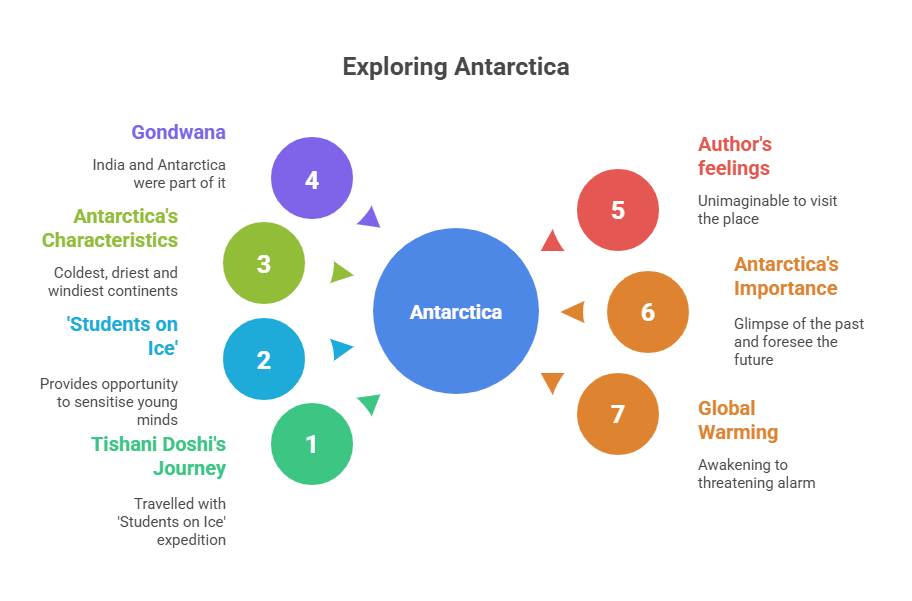
- Antarctica – The Last Pristine Wilderness: Antarctica is described as one of the coldest, driest and windiest continents in the world. Despite human civilization spreading across the globe, Antarctica still remains in its pure, untouched form. Its completely white landscape and uninterrupted blue horizon give immense relief and a sense of wonder. This pristine wilderness represents what Earth looked like before human interference, making it an extraordinarily valuable natural treasure worth protecting for future generations.
- Students on Ice – Sensitizing Young Minds: Tishani Doshi travelled to Antarctica with an expedition group named “Students on Ice” that provides opportunities to young minds to sensitize themselves toward realistic versions of climatic changes happening in the world. According to the founder of the organization, young students are future versions of policy makers who can turn the situation around. This initiative demonstrates the importance of educating and inspiring youth to take responsibility for protecting our planet’s fragile environment.
- Gondwana – Earth’s Ancient History: It is shocking to believe that India and Antarctica were once part of the same supercontinent called Gondwana. This supercontinent eventually segregated into different countries giving rise to the globe we know today. Antarctica had a warmer climate during that ancient period. Understanding this geological history helps us realize how dramatically Earth’s climate can change over millions of years and gives us perspective on the current climate crisis threatening our planet today.
- Antarctica as a Climate Change Indicator: Antarctica is home to enormous evidence that gives us a glimpse of Earth’s past while simultaneously helping us foresee its future. The place gives a powerful awakening to the threatening reality that global warming is actually real and happening. Antarctica constitutes 90 percent of the world’s ice and its melting threatens to raise sea levels catastrophically. This makes Antarctica the most important natural laboratory for studying climate change and understanding the urgent environmental challenges facing humanity.
- Human Civilization versus Natural Wilderness: The chapter creates a powerful contrast between the spread of human civilization and the untouched wilderness of Antarctica. While humans have altered almost every corner of Earth, Antarctica remains pure and unaffected. Being a south Indian sun-worshipping individual, Tishani finds it unimaginable to visit a place so quiet that silence is only interrupted by snow avalanches. This contrast makes us reflect on how human activities are destroying natural environments while Antarctica stands as a reminder of Earth’s original beauty.
- Urgency of Environmental Awareness: The chapter concludes with a haunting question — who knows if Antarctica will become warm again and even if it does, will we be alive to see it? This powerful thought captures the urgency of addressing climate change immediately. The entire journey serves as a wake-up call for humanity to recognize the devastating consequences of global warming. The chapter urges readers, especially young people, to take environmental responsibility seriously before it becomes too late to reverse the damage.
Journey to the end of the Earth Quick Overview
| Detail | Information |
| Chapter Title | Journey to the end of the Earth |
| Author | Tishani Doshi |
| Book | Vistas (CBSE Class 12 English) |
| Chapter No. | 3 |
| Narrator | Writer |
| Setting | Antarctica |
| Theme | Environmental awareness, Antarctica’s history and present, Students on Ice programme |
- Journey to the end of the Earth Summary Mind Map
- Describe the transformation in Tishani Doshi as the chapter ‘Journey to the End of the Earth’ proceeds, as asked in CBSE class 12 board exam.
- How does Tishani Doshi show resistance to the theme of environmental indifference in the story?
- How does Journey to the End of the Earth show a connection between Earth’s past and its future?
- The class 12 chapter “Journey to the end of the Earth” displays the importance of environmental awareness. Discuss.
- The chapter “Journey to the end of the Earth” undergoes a shift from wonder to urgent concern. Discuss.
- How does the story justify the title “Journey to the End of the Earth”?
- What is the background of class 12 story “Journey to the End of the Earth”? Describe the setting.
- Describe the writing style used by Tishani Doshi in Journey to the End of the Earth.
- Journey to the end of the Earth Previous Year Questions with Model Answers PDF
- Journey to the end of the Earth Explanation
- In the class 12 chapter, Journey to the end of the Earth, Why is Antarctica the best place to study “evolution and extinction”?
- In the class 12 chapter, Journey to the end of the Earth, How do geological phenomena help us to know about the history of humankind?
- In the class 12 chapter, Journey to the end of the Earth, Why does the author feel she has lost “all earthly sense of perspective and time” in Antarctica?
- In the class 12 chapter, Journey to the end of the Earth, What are the two primary causes of the increase in average global temperature mentioned in this extract?
- In the class 12 chapter, Journey to the end of the Earth, Why is Antarctica the place to go to, to understand the earth’s present, past, and future?
- What are Geoff Green’s reasons for including high school students in the Students on Ice expedition? Answer with respect to the class 12 chapter, Journey to the end of the Earth.
- What are the reasons for the success of the Students on Ice programme?
- In the class 12 chapter, Journey to the end of the Earth, ‘Take care of the small things and the big things will take care of themselves.’ What is the relevance of this statement in the context of the Antarctic environment?
- In the class 12 chapter, Journey to the end of the Earth, the author states that her Antarctic experience was full of epiphanies, but the best occurred just short of the Antarctic Circle of 65–55 degrees south? Explain.
- Journey to the end of the Earth Video Explanation
- Journey to the end of the Earth Summary in Hindi
Related:
- Journey to the end of the Earth MCQ Question Answers
- Journey to the End of the Earth Question Answers
- Journey to the end of the Earth Character Sketch
- Journey to the End of the Earth Previous Years Question with Answers
Journey to the end of the Earth Summary Mind Map
Finish your entire Class 12 English prep in 24 hrs & ace your CBSE Boards 2026! – Concise chapter summaries (key events & ideas), lesson themes, Visual character sketches using mind maps Click here
Question. Describe the transformation in Tishani Doshi as the chapter ‘Journey to the End of the Earth’ proceeds, as asked in CBSE class 12 board exam.
Answer. In the chapter “Journey to the End of the Earth,” we see that the character of Tishani Doshi undergoes a remarkable transformation from a curious traveller to a deeply committed environmental advocate. The chapter opens with Tishani embarking on an extraordinary journey to Antarctica, travelling through nine time zones, six checkpoints, three water bodies and as many ecospheres to reach the Southern end of the Earth. As a south Indian sun-worshipping individual, visiting the world’s coldest, driest and windiest continent was an experience completely alien to her familiar world.
The turning point comes when Tishani arrives in Antarctica and witnesses its breathtaking, pristine beauty for the first time. The completely white landscape, uninterrupted blue horizon, and profound silence broken only by snow avalanches create an overwhelming sense of wonder and reverence. She begins to understand why this continent, despite human civilization spreading everywhere, has remained in its pure, untouched form.

Her understanding deepens when she learns about Antarctica’s ancient geological history — that India and Antarctica were once part of the same supercontinent Gondwana. This revelation transforms her perspective on Earth’s history and makes her realize how dramatically our planet’s climate can change over millions of years. She begins connecting Antarctica’s past to its present condition and to the future it predicts for humanity.
The most significant transformation occurs when Tishani fully grasps Antarctica’s role as a powerful indicator of climate change. Witnessing the 90 percent of world’s ice concentrated in this continent and understanding the catastrophic consequences of its melting awakens a deep sense of environmental responsibility within her. The visit transforms her from a curious traveller into a passionate environmental advocate.
Tishani’s words reveal her philosophical transformation when she realizes the haunting uncertainty of Earth’s future “Who knows if Antarctica will be warm again and even if it does, will we be alive to see it?” This thought marks the peak of her transformation from personal observer to global environmental voice.
Thus, the chapter shows a complete transformation in Tishani from a sun-worshipping south Indian traveller to a deeply committed environmental advocate who uses her poetry and writing to spread awareness about climate change. Her journey demonstrates that witnessing Earth’s most fragile wilderness firsthand can transform individuals into passionate protectors of our planet’s future.
Questions based on the themes / central idea of Journey to the End of the Earth
Question. How does Tishani Doshi show resistance to the theme of environmental indifference in the story?
Ans. Tishani resists environmental indifference by travelling to Antarctica and witnessing climate change’s reality firsthand. She joins “Students on Ice” to understand and spread awareness about environmental threats. She uses her poetry and writing to highlight how human actions damage fragile ecosystems. Tishani does not want indifference to destroy our planet because preserving Earth’s natural wilderness is essential to humanity’s survival and future.
Question. How does Journey to the End of the Earth show a connection between Earth’s past and its future?
Ans. The story highlights that understanding Earth’s geological past is essential for protecting its future. Antarctica’s ancient connection to Gondwana shows how dramatically climate can change over millions of years. The continent contains evidence of Earth’s past climate while simultaneously predicting its future. Thus, studying Antarctica connects our understanding of prehistoric Earth to the urgent environmental challenges threatening humanity’s survival today.
Question. The class 12 chapter “Journey to the end of the Earth” displays the importance of environmental awareness. Discuss.
Ans. The chapter powerfully demonstrates environmental awareness through Tishani’s Antarctic expedition. Antarctica constitutes 90 percent of world’s ice and its melting due to global warming threatens catastrophic consequences. The “Students on Ice” program sensitizes young future policymakers toward climate change realities. The chapter shows that environmental awareness is not optional but urgently necessary for humanity to take immediate action before irreversible damage destroys our planet completely.
Question. The chapter “Journey to the end of the Earth” undergoes a shift from wonder to urgent concern. Discuss.
Ans. The chapter begins with wonder at Antarctica’s breathtaking pristine beauty, its white landscape, blue horizon, and profound silence. Gradually this wonder transforms into urgent environmental concern as Tishani understands the devastating reality of global warming and melting ice. The haunting concluding question about Antarctica’s future marks the complete shift from personal admiration to global environmental urgency, showing how direct experience transforms passive observers into committed advocates.
Question. How does the story justify the title “Journey to the End of the Earth”?
Ans. The title works both literally and symbolically. Literally, Antarctica is geographically the southernmost end of Earth requiring travel through nine time zones and six checkpoints. Symbolically, it represents journeying to the end of Earth’s natural wilderness, the last pristine place untouched by human civilization. The title also suggests a warning, if we ignore climate change, we may be journeying toward Earth’s end through our own destructive actions.
Question. What is the background of class 12 story “Journey to the End of the Earth”? Describe the setting.
Ans. “Journey to the End of the Earth” is written by Tishani Doshi, an Indian poet and dancer. The story is set across the extraordinary journey from Madras, India to Antarctica — travelling through nine time zones, six checkpoints, three water bodies and multiple ecospheres. The primary setting is Antarctica, one of the coldest, driest and windiest continents, home to 90 percent of world’s ice, where pristine wilderness serves as Earth’s most powerful climate change laboratory.
Question. Describe the writing style used by Tishani Doshi in Journey to the End of the Earth.
Ans. “Journey to the End of the Earth” uses first-person narrative making the account deeply personal and authentic. The tone is reflective, wonder-filled and urgently concerned. Tishani uses vivid descriptive language to bring Antarctica’s breathtaking beauty alive for readers. She combines personal observations with scientific facts about climate change effectively. Her writing style moves from personal wonder to philosophical urgency, concluding powerfully with a haunting question about Earth’s future that leaves readers deeply concerned and motivated to act.
Journey to the end of the Earth Previous Year Questions with Model Answers PDF
Download the previous year questions of the Poem Journey to the end of the Earth of class 12 English for free. With the help of this, you can prepare for the exam.
To Download Journey to the end of the Earth Previous Year Questions with Model Answers- Click Here
Journey to the end of the Earth Lesson Explanation
Question. In the class 12 chapter, Journey to the end of the Earth, Why is Antarctica the best place to study “evolution and extinction”?
Passage: EARLY this year, I found myself aboard a Russian research vessel — the Akademik Shokalskiy — heading towards the coldest, driest, windiest continent in the world: Antarctica. My journey began 13.09 degrees north of the Equator in Madras, and involved crossing nine time zones, six checkpoints, three bodies of water, and at least as many ecospheres.
By the time I actually set foot on the Antarctic continent I had been travelling over 100 hours in a combination of a car, an aeroplane and a ship; so, my first emotion on facing Antarctica’s expansive white landscape and the uninterrupted blue horizon was a relief, followed up with an immediate and profound wonder. Wonder at its immensity, its isolation, but mainly at how there could ever have been a time when India and Antarctica were part of the same landmass.
Word Meanings:
Ecospheres– parts of the universe habitable by living organisms
Expansive- covering a wide area in terms of space or scope; extensive
Profound- very great or intense
Isolation- separation
Landmass- a continent or other large body of land
Explanation / Answer: In the beginning, the author talks about her journey to one of the coldest, driest and windiest continents on Earth; Antarctica. She went there on a Russian research vessel known as the Akademik Shokalskiy. The author is a South Indian woman who began her journey from Madras. On her voyage, she crossed nine time zones, six checkpoints, three water bodies and just as many ecospheres.
It took her about 100 hours of combined travelling by car, aeroplane and then a ship to reach the continent. So, when she first set her feet on the continent, she felt utmost relief for it was all white as far as the eyes could see. The sight of the blue horizon was also very comforting. Next emotion that followed was that of wonderment. She was astonished by the fact that there was once a time when India and Antarctica were geographically connected.
Top
Question. In the class 12 chapter, Journey to the end of the Earth, How do geological phenomena help us to know about the history of humankind?
Passage: Six hundred and fifty million years ago, a giant amalgamated southern supercontinent — Gondwana — did indeed exist, centred roughly around the present-day Antarctica. Things were quite different then: humans hadn’t arrived on the global scene, and the climate was much warmer, hosting a huge variety of flora and fauna. For 500 million years.
Gondwana thrived, but around the time when the dinosaurs were wiped out and the age of the mammals got under way, the landmass was forced to separate into countries, shaping the globe much as we know it today.
To visit Antarctica now is to be a part of that history; to get a grasp of where we’ve come from and where we could possibly be heading. It’s to understand the significance of Cordilleran folds and pre-Cambrian granite shields; ozone and carbon; evolution and extinction. When you think about all that can happen in a million years, it can get pretty mind-boggling. Imagine: India pushing northwards, jamming against Asia to buckle its crust and form the Himalayas; South America drifting off to join North America, opening up the Drake Passage to create a cold circumpolar current, keeping Antarctica frigid, desolate, and at the bottom of the world.
Word Meanings:
Amalgamated- combine or unite to form one structure
Supercontinent- a former large continent from which other continents are held to have broken off and drifted away
Thrived- prosper; flourish
Cordilleran folds- an extensive chain of mountains or mountain ranges
Precambrian granite shields- large areas of relatively low elevation that forms part of continental masses
Mind-boggling- overwhelming; startling
Frigid- very cold in temperature
Desolate- (of a place) uninhabited and giving an impression of bleak emptiness
Explanation / Answer: Millions of years ago, there was a supercontinent known as Gondwana, from which Antarctica and India are supposed to have been parted off. The situation however, was completely different from how it is right now. There were no humans and the climate was warmer which gave rise to huge varieties of flora and fauna. Gondwana flourished for 500 million years until dinosaurs got extinct and human beings came into existence. The huge continent was then forced into segregation to form countries and the world as we know of it today.
According to the author, if one wants to have a glimpse of history and from where we have originated along with where we are headed, Antarctica is the right place. It is the best place to research and understand about mountain ranges and low elevation continents, ozone and carbon, evolution and extinction. It is capable of giving an insight of the future and that can be really startling.
Question. In the class 12 chapter, Journey to the end of the Earth, Why does the author feel she has lost “all earthly sense of perspective and time” in Antarctica?
Passage: For a sun-worshipping South Indian like myself, two weeks in a place where 90 percent of the Earth’s total ice volumes are stored is a chilling prospect (not just for circulatory and metabolic functions, but also for the imagination). It’s like walking into a giant ping-pong ball devoid of any human markers — no trees, billboards, buildings. You lose all earthly sense of perspective and time here. The visual scale ranges from the microscopic to the mighty: midges and mites to blue whales and icebergs as big as countries (the largest recorded was the size of Belgium). Days go on and on and on in surreal 24-hour austral summer light, and a ubiquitous silence, interrupted only by the occasional avalanche or calving ice sheet, consecrates the place. It’s an immersion that will force you to place yourself in the context of the earth’s geological history. And for humans, the prognosis isn’t good.
Word Meanings:
Surreal- unusual; bizzare
Austral- relating to the Southern Hemisphere
Ubiquitous- everywhere; pervasive
Avalanche- snowslide
Calving- split and shed
Consecrates- make or declare sacred
Immersion- submerge
Prognosis- a forecast of the likely outcome of a situation
Explanation / Answer: It was a very different experience for the narrator as being a South Inidan sun-worshipping woman, it was hard for her or anyone else to imagine living in a place where 90 percent of the Earth’s total ice volumes are stored. Not only biologically or physically difficult, but also for imagination. A place untouched by humans and their inventions, it gives an experience that makes you forget about all the other things. From small creatures like midges and mites to huge creatures like blue whales and icebergs as big as countries, everything can be found in Antarctica. Days are never ending with sun light all the time falling on the Southern Hemisphere. It is such a quiet place interrupted only by falling mass of snow rapidly down a mountain. It is a setting that forces you to ponder upon earth’s geological history and helps you foresee future which for humans, doesn’t seem very pleasant.
Top
Human Impact
Question. In the class 12 chapter, Journey to the end of the Earth, What are the two primary causes of the increase in average global temperature mentioned in this extract?
Passage: Human civilisations have been around for a paltry 12,000 years — barely a few seconds on the geological clock. In that short amount of time, we’ve managed to create quite a ruckus, etching our dominance over Nature with our villages, towns, cities, megacities. The rapid increase of human populations has left us battling with other species for limited resources, and the unmitigated burning of fossil fuels has now created a blanket of carbon dioxide around the world, which is slowly but surely increasing the average global temperature.
Word Meanings:
Paltry- petty; insignificant
Ruckus- a row or commotion
Etching- engraved
Unmitigated- unconditional
Explanation / Answer: Human life on earth has been since 12,000 years which converts into a few seconds on the geological clock. In merely this less time, humans have managed to exploit each and every resource, thereby creating a chaos in the nature. The ever increasing human population is robbing other species of the necessities for survival. Not to forget about the unlimited exploitation of fossil fuels that have created a blanket of carbon dioxide around our planet which is further increasing the average global temperature, thus leading to global warming.
Why is Antarctica the place to go to, to understand the earth’s present, past, and future?
Passage: Climate change is one of the most hotly contested environmental debates of our time. Will the West Antarctic ice sheet melt entirely? Will the Gulf Stream ocean current be disrupted? Will it be the end of the world as we know it? Maybe. Maybe not. Either way, Antarctica is a crucial element in this debate — not just because it’s the only place in the world, which has never sustained a human population and therefore remains relatively ‘pristine’ in this respect; but more importantly, because it holds in its ice-cores half-million-year-old carbon records trapped in its layers of ice. If we want to study and examine the Earth’s past, present and future, Antarctica is the place to go.
Word Meanings:
Pristine- in its original condition; unspoilt
Explanation / Answer: Global Warming and climate change are high priority concern these days. Questions like melting of Antarctic sheet, disruption of Gulf Stream ocean and how the world will end still remains unanswered. Regardless, Antarctica remains an important part, not only because it is untouched by humans, but also because of the ice-cores half-million-year-old carbon records trapped in its layers of ice. According to the author, if one wishes to study and analyse Earth’s past, present and future, Antarctica is the place to go.
Question. What are Geoff Green’s reasons for including high school students in the Students on Ice expedition? Answer with respect to the class 12 chapter, Journey to the end of the Earth.
Passage: Students on Ice, the programme I was working with on the Shokaskiy, aims to do exactly this by taking high school students to the ends of the world and providing them with inspiring educational opportunities which will help them foster a new understanding and respect for our planet. It’s been in operation for six years now, headed by Canadian Geoff Green, who got tired of carting celebrities and retired, rich, curiosity-seekers who could only ‘give’ back in a limited way. With Students on Ice, he offers the future generation of policy-makers a life-changing experience at an age when they’re ready to absorb, learn, and most importantly, act.
Word Meanings:
Carting- taking
Explanation / Answer: The author has been in Antarctica on an expedition with ‘Students on Ice’, a programme that takes young minds to the ends of the world which helps in inspiring them to work towards our planet. It was started with the vision of providing life-changing experiences to ‘the future generation of policy-makers’ to learn about the planet at a very early age. The initiative was introduced by Geoff Green who got tired of his regular job once he got rich and wanted to give it back in some way.
Question: What are the reasons for the success of the Students on Ice programme?
Passage: The reason the programme has been so successful is because it’s impossible to go anywhere near the South Pole and not be affected by it. It’s easy to be blasé about polar ice-caps melting while sitting in the comfort zone of our respective latitude and longitude, but when you can visibly see glaciers retreating and ice shelves collapsing, you begin to realise that the threat of global warming is very real.
Word Meanings:
Blasé- unimpressed with or indifferent to something because one has experienced or seen it so often before
Explanation / Answer: The programme has been immensely successful in implementing its vision by the way people get affected by seeing the real scenario because it is very easy to sit at home and talk about real issues, but actually seeing glaciers retreating and ice shelves collapsing, it gives you a glimpse into the future. It tells you that the very threat of global warming is real.
Question. In the class 12 chapter, Journey to the end of the Earth, ‘Take care of the small things and the big things will take care of themselves.’ What is the relevance of this statement in the context of the Antarctic environment?
Passage: Antarctica, because of her simple ecosystem and lack of biodiversity, is the perfect place to study how little changes in the environment can have big repercussions. Take the microscopic phytoplankton — those grasses of the sea that nourish and sustain the entire Southern Ocean’s food chain. These single-celled plants use the sun’s energy to assimilate carbon and synthesise organic compounds in that wondrous and most important of processes called photosynthesis. Scientists warn that a further depletion in the ozone layer will affect the activities of phytoplankton, which in turn will affect the lives of all the marine animals and birds of the region, and the global carbon cycle. In the parable of the phytoplankton, there is a great metaphor for existence: take care of the small things and the big things will fall into place.
Explanation / Answer: It is one of those places with limited biodiversity and thus, has a less complicated ecosystem. As a result, little changes in its environment can have drastic effects. For instance, the microscopic phytoplankton are grasses of the sea that sustains the entire Southern Ocean’s food chain. Now, it has been recently concluded by scientists that a further depletion in the ozone layer can affect the activities of these single-celled plants and affect the marine life altogether. Thus, in this case, the saying comes true, “Take care of the small things and the big things will fall into place.”
Top
Question. In the class 12 chapter, Journey to the end of the Earth, the author states that her Antarctic experience was full of epiphanies, but the best occurred just short of the Antarctic Circle of 65–55 degrees south? Explain.
Passage: My Antarctic experience was full of such epiphanies, but the best occurred just short of the Antarctic Circle at 65.55 degrees south. The Shokalskiy had managed to wedge herself into a thick white stretch of ice between the peninsula and Tadpole Island which was preventing us from going any further. The Captain decided we were going to turn around and head back north, but before we did, we were all instructed to climb down the gangplank and walk on the ocean. So there we were, all 52 of us, kitted out in Gore-Tex and glares, walking on a stark whiteness that seemed to spread out forever. Underneath our feet was a metre-thick ice pack, and underneath that, 180 metres of living, breathing, salt water. In the periphery Crabeater seals were stretching and sunning themselves on ice floes much like stray dogs will do under the shade of a banyan tree. It was nothing short of a revelation: everything does indeed connect.
Nine time zones, six checkpoints, three bodies of water and many ecospheres later, I was still wondering about the beauty of balance in play on our planet. How would it be if Antarctica were to become the warm place that it once used to be? Will we be around to see it, or would we have gone the way of the dinosaurs, mammoths and woolly rhinos? Who’s to say? But after spending two weeks with a bunch of teenagers who still have the idealism to save the world, all I can say is that a lot can happen in a million years, but what a difference a day makes!
Word Meanings:
Epiphanies: a striking realization
Wedge: to force into a narrow space
Gangplanck: a board or plank used to board or disembark from a ship or boat
Kitted out: to give the clothing or equipment required for a particular activity
Goretex: a waterproof breathable fabric
Glares: sunglasses
Ice floe: a large pack of floating ice at least 20×10mts
Revelation: an interesting fact made known
Explanation / Answer: The writer’s journey to Antarctica was full of sudden happenings and here she describes the best one. They were just nearing the Antarctic Circle , at a latitude of 65.55 degree south when the ship entered a thick mass of ice which was between the peninsula and the Tadpole island. It got stuck there. The captain of the ship decided to turn back north but before that all the passengers were asked to get down the ship on the frozen ocean. All the 52 members wore all protective clothing and walked on the huge expanse of the frozen ocean which was absolutely white in colour. Under the thick layer of ice was 180 metre deep ocean which contained salty water and marine life. At some distance, they saw Crabeater seals, playing in the Sun like we see stray dogs do under the shady Banyan trees. She realized that the seals in Antractica reminded her of the stray dogs in her hometown, thus, all creations of nature were similar and interrelated.
For all it took for her to travel from Madras to Antarctica, the nine time zones, checkpoints and various bodies of water, the author pondered upon the capability of nature to maintain its balance. She wondered what it would be like if Antarctica, the place that houses over 90 percent of world’s ice, becomes warm again. She wonders if we will be there to see it if it ever happens but who knows! Thus, by seeing the spirit of teenagers who still are left with the courage to save the world, she talks about the uncertainty of events that can happen over a million years.
Are you looking for a Video Explanation of Journey to the end of the Earth Class 12
Watch the Video-
Journey to the end of the Earth FAQs
Question: Who is the writer of Journey to the end of the Earth?
Ans. The class 12 story Journey to the end of the Earth is written by Tishani Joshi.
Question: What is the theme of the class 12 lesson Journey to the end of the Earth?
Ans. The central message of the lesson Journey to the end of the Earth is the connection between the Earth’s present, past and future; as can be observed from the ecosystem of Antarctica. The lesson highlights the importance of environmental awareness and the Students on Ice programme aims to create this sensitization among the young minds. It also throws light on the history and formation of Antarctica.
Question: What is Students on Ice in the story Journey to the end of the Earth?
Ans. Students on Ice is a learning expedition to Antarctica. Students go aboard a Russian research vessel — the Akademik Shokalskiy, to the coldest, driest, windiest continent in the world: Antarctica. The aim is to sensitize the young minds towards the changes in Earth’s climate by studying the ecosystem of Antarctica.
Question: What does the title Journey to the end of the Earth denote?
Ans. The title of the lesson signals at Antarctica which is the Southern tip of the Earth and so, the title is apt – ‘Journey to the end of the Earth’.
Question: What is the lesson Journey to the end of the Earth about?
Ans. The lesson is about Antarctica’s delicate ecosystem and how the changes in it indicate the future of the Earth’s climate.
Question: What role does the phytoplankton example play in the lesson Journey to the end of the Earth?
Ans. The phytoplankton example shows how a tiny, single-celled organism sustains the entire food chain of the Southern Ocean through photosynthesis. Since Antarctica has a simple ecosystem with limited biodiversity, even a small disturbance like ozone depletion can disrupt phytoplankton activity and set off major consequences for marine life and the global carbon cycle. It illustrates the chapter’s larger message: take care of the small things and the big things will take care of themselves.
Journey to the end of the Earth Summary in Hindi
मद्रास से अंटार्कटिका की यात्रा करने वाले एक दक्षिण भारतीय व्यक्ति के लिए, वहां तक पहुंचने के लिए नौ समय क्षेत्र, छह चौकियां, तीन जल निकाय और उतने ही पारिस्थितिक क्षेत्र लगते हैं। तिशानी दोशी ने ‘स्टूडेंट्स ऑन आइस’ नामक एक अभियान समूह के साथ पृथ्वी के दक्षिणी छोर की यात्रा की, जो युवा दिमागों को दुनिया में हो रहे जलवायु परिवर्तन के यथार्थवादी संस्करण के प्रति संवेदनशील बनाने का अवसर प्रदान करता है। संगठन के संस्थापक के अनुसार, हम भविष्य के नीति निर्माताओं के युवा संस्करण हैं जो स्थिति को बदल सकते हैं। अंटार्कटिका दुनिया के सबसे ठंडे, सबसे शुष्क और हवा वाले महाद्वीपों में से एक है।
जहां तक आंखें देख सकती हैं, यह पूरी तरह से सफेद है और इसका निर्बाध नीला क्षितिज बेहद राहत देता है। यह विश्वास करना चौंकाने वाला है कि भारत और अंटार्कटिका उसी सुपरकॉन्टिनेंट गोंडवाना का हिस्सा थे, जो आज हम जिस विश्व को जानते हैं, उसे जन्म देने वाले देशों में विभाजित हो गए हैं। उस समय तक अंटार्कटिका की जलवायु गर्म थी। दुनिया भर में मानव सभ्यता के बदलाव के बावजूद यह अभी भी अपने शुद्ध रूप में बनी हुई है। दक्षिण भारतीय सूर्य-पूजा करने वाले व्यक्ति होने के नाते, लेखक के लिए उस स्थान का दौरा करना अकल्पनीय था, जो दुनिया की 90 प्रतिशत बर्फ का निर्माण करता है, एक ऐसा स्थान जो इतना शांत है कि यह केवल हिमस्खलन से बाधित है। यह बहुत सारे सबूतों का घर है जो हमें अतीत की एक झलक दे सकता है और साथ ही, अंटार्कटिका हमें भविष्य की भविष्यवाणी करने में मदद करता है। यह जगह खतरनाक अलार्म को जागृत करती है कि ग्लोबल वार्मिंग वास्तव में वास्तविक है। कौन जानता है कि अंटार्कटिका फिर से गर्म होगा और अगर ऐसा होता भी है, तो क्या हम इसे देखने के लिए जीवित रहेंगे?
Class 12 English Important Links
Class 12 Important Videos Links
Class 12 English Vistas Book Lesson Explanation
- The Third Level Summary, Explanation, Word meanings Class 12
- The Tiger King Summary, Explanation, Word meanings Class 12
- Journey to the end of the Earth Summary, Explanation, Word meanings Class 12
- The Enemy Summary, Explanation, Word meanings Class 12
- On the face of it Summary, Explanation, Word meanings Class 12
- Memories of childhood Part 1 Summary, Explanation, Word meanings Class 12
- Memories of childhood Part 2 Summary, Explanation, Word meanings Class 12
Also See :
- CBSE Class 12 English Notes, Lesson Explanation, Question Answers
- CBSE Class 12 English MCQ Question Answers
- Class 12 English Flamingo Book Chapter wise word meaning
- Class 12 English Flamingo Poems Word meaning
- Class 12 English Vistas Book Word meanings
- CBSE Class 12 English Important Question Answers
- Character Sketch of Class 12 English
- Class 12 English Core Previous Year Question Answers (2019-2024) Chapterwise
- Class 12 English Core Previous Year Question Paper with Solutions 2019-2024