
CBSE Class 9 English Chapter 5 The World of Limitless Possibilities Question Answers (Important) from Kaveri Book
Class 9 English The World of Limitless Possibilities Question Answers – Looking for The World of Limitless Possibilities question answers (NCERT solutions) for CBSE Class 9 English Kaveri Book Chapter 5? Look no further! Our comprehensive compilation of important questions will help you brush up on your subject knowledge. Practising Class 9 English question answers can significantly improve your performance in the exam. Our solutions provide a clear idea of how to write the answers effectively. Improve your chances of scoring high marks by exploring Chapter 5: The World of Limitless Possibilities now. The questions listed below are based on the latest CBSE exam pattern, wherein we have given NCERT solutions (Textbook Questions) to the chapter’s, Extract Based Questions, Multiple Choice Questions, and Extra Question Answers
Also, practising with different kinds of questions can help students learn new ways to solve problems that they may not have seen before. This can ultimately lead to a deeper understanding of the subject matter and better performance on exams.
- The World of Limitless Possibilities Textbook Questions (NCERT Solution)
- The World of Limitless Possibilities Grammar Exercises
- The World of Limitless Possibilities Extract-Based Questions
- The World of Limitless Possibilities Multiple Choice Questions
- The World of Limitless Possibilities Extra Questions
Related:
- The World of Limitless Possibilities Summary, Explanation
- The World of Limitless Possibilities Character Sketch
The World of Limitless Possibilities Textbook Questions (NCERT Solution)
Reflect and Respond
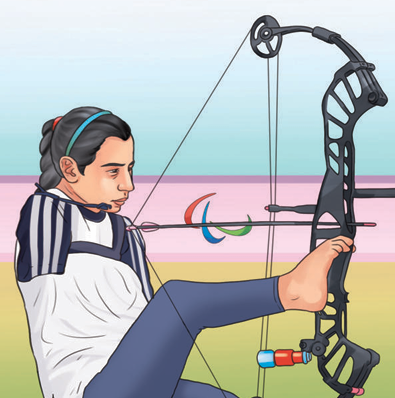
I. This is a picture of Sheetal Devi, a para-archer who was honoured with the Arjuna Award in January 2024.
1. Look at the picture carefully and share your observations with your classmates and teacher.
2. Does this personality inspire you? Explain how.
3. Give a caption for this picture.
Ans.
1. The picture shows Sheetal Devi, a world-class para-archer. Despite having no arms, she uses her legs and shoulder to operate the bow with incredible precision. She looks focused, calm, and determined.
2. Yes, she is deeply inspiring. She proves that disability is a state of mind. By inventing her own technique to compete at the highest level, she shows that with adaptation and grit, one can overcome any physical barrier.
3. The Unstoppable Sheetal Devi
II. Complete the table given below about Paralympics. Share your responses with your classmates and teacher.
| What I know | What I want to know |
Ans.
| What I know | What I want to know |
| It is an international multi-sport event for athletes with disabilities. | How are athletes classified into different categories? |
| India won several medals at the Tokyo and Paris Paralympics. | What kind of specialized technology is used in their equipment? |
| The games originated as a way to help war veterans with spinal injuries recover. | What are the specific requirements for a new sport to be included in the Paralympics? |
Check Your Understanding
I. Fill in the fact table given below based on the interview with Dr. Deepa Malik. Discuss your answers with your classmates and teacher.
|
Fact Table |
|
| 1. diagnosed with spinal tumour at the age of | |
| 2. result of the surgery | |
| 3. named as one of the 10 most effective para-athletes by | |
| 4. first successful Paralympic event | |
| 5. list of ‘firsts’ | (i) (ii) |
| 6. awards won | (i) (ii) (iii) |
| 7. two things supported by her | (i) (ii) |
Ans.
|
Fact Table |
|
| 1. diagnosed with spinal tumour at the age of | 29 |
| 2. result of the surgery | Paralyzed waist down; bound to a wheelchair. |
| 3. named as one of the 10 most effective para-athletes by | International Paralympic Committee |
| 4. first successful Paralympic event | 2016 Rio Paralympic Games |
| 5. list of ‘firsts’ | (i) First Indian female para-athlete to win an Asian Games medal. (ii) First Indian female Paralympics medalist across any sport. |
| 6. awards won | (i) Khel Ratna (ii) Arjuna Award (iii) Padma Shri |
| 7. two things supported by her | (i) Empowering women through outdoor sports (ii) Providing equipment to para-sportspersons from lower socio-economic strata |
II. Read the two sets of sentences given below.
Choose whether the given statements display: fact-opinion or cause-effect.
(1)
(i) In the 2016 Rio Paralympic Games, I secured the silver medal in the shot-put event.
(ii) I feel it was a moment of personal victory and a step forward in changing perceptions.
(2)
(i) I was diagnosed with a tumour in my spine.
(ii) I had a surgery and was told that I would be bound to a wheelchair for the rest of my life.
| Knowing the difference between fact (evidence/factual information that can be proved to be true) and opinion (writer’s beliefs/perception) helps us understand the text better. Understanding the relationship between cause (actions/ events) and effect (outcomes) is also helpful in deeper analysis of the text. |
Ans.
1. Fact-Opinion: The first sentence is a verifiable fact; the second is an opinion about her contribution.
2. Cause-Effect: The talent shown in Paralympics is a cause that leads to a shift in global perception.
III. Work in pairs to identify which of these pairs of sentences show:
1. cause-effect
2. fact-opinion
Write 1 or 2 in the boxes given.
(i) Dr. Deepa Malik was a member of the Working Group for the Formulation of the Twelfth Five Year Plan (2012–17).
It is believed that she contributed greatly to create better sports policies for the persons with disabilities.
(ii) Paralympics showcases incredible talent and determination of para-athletes.
The global perception on disabilities shifts, inspiring para-athletes to pursue their dreams.
Ans.
(i) Fact-Opinion: The first sentence is a historical fact regarding Dr. Malik’s professional role. The second sentence starts with ‘It is believed that’, which marks it as an opinion or a perception of her contribution.
(ii) Cause-Effect: The Paralympics showcasing talent acts as the cause. The effect is the shift in global perception and the inspiration felt by other athletes to pursue their dreams.
Critical Reflection
I. Read the extracts given below and answer the questions that follow.
1. I had two choices—squander my life in remorse or transform it to a world of limitless possibilities.
I love sports and had been a swimmer too, so I decided to switch to para-athletics. This is how my Paralympics journey began. My breakthrough moment came in the 2016 Rio Paralympic Games, when I secured the silver medal in the shot-put event. In hindsight, I feel it was a moment of personal victory and a step forward in changing perceptions.
(i) Give a reason for the following statement.
The speaker’s decision to transform her life can be likened to the concept of a caterpillar transforming into a butterfly.
Ans. Both involve a complete structural and functional change from a state of restriction to a state of beauty and freedom.
(ii) Why could the speaker switch to para-athletics quite comfortably?
Ans. The speaker switched to para-athletics quite comfortably because she was already a lover of sports and had been a swimmer previously.
(iii) Complete the sentence with an appropriate reason.
The speaker calls the 2016 Rio Paralympic Games a ‘breakthrough moment’ because _______.
Ans. The speaker calls the 2016 Rio Paralympic Games a ‘breakthrough moment’ because it was her first Olympic-level medal and a moment that changed how society perceived her.
(iv) Select the correct option to complete the sentence.
The phrase ‘in hindsight’ indicates the speaker is __________.
A. curious
B. reflective
C. determined
D. courageous
Ans. B. reflective
(v) The speaker uses the phrase ‘changing perceptions’. List one likely perception the speaker might have changed.
Ans.The likely perception the speaker has changed is that a person in a wheelchair cannot be a world-class athlete or contribute to the economy
2. Honestly, I feel sports, especially Paralympics, have the extraordinary ability to challenge stereotypes and change attitudes towards disability. When people witness the strength, skill, and competitive spirit of para-athletes, it breaks down preconceived notions. Paralympics has given me a new lease of life and helped me push boundaries.
(i) Choose the option that lists the words to describe the tone of the speaker.
A. appreciative
B. moralistic
C. sentimental
D. optimistic
E. defensive
(a) A and D
(b) B, D, and E
(c) B and C
(d) A, C, and E
Ans. (a) A and D
(ii) Complete the analogy given below with a word from the extract.
ability : potential :: preconceived notions: __________
Ans. stereotypes
(iii) State whether the following sentence is true or false.
Paralympics is a platform that not only showcases the remarkable abilities of para-athletes but also questions stereotypes.
Ans. True
(iv) What does ‘helped me push boundaries’ tell us about the speaker?
Ans. It shows she is constantly seeking growth and refuses to be confined by her physical state.
(v) Which phrase from the extract suggests that the speaker was able to transform her life?
Ans. New lease of life
II. Answer the following questions.
1. Explain how Dr. Malik’s achievements challenge societal perceptions.
Ans. Dr. Malik’s achievements challenge the stereotype that individuals with physical disabilities are incapable. By winning international medals in physically demanding sports like shot-put and swimming, she proved that physical limitations do not define a person’s potential. Her success forces society to shift its focus from what a person cannot do to what they can achieve with grit and determination.
2. What can be the long-term impact of involving youth in schools and colleges in advocacy with respect to disability?
Ans. Involving the youth creates a more empathetic and inclusive future society. Since the youth are the voice of tomorrow, educating them helps dismantle preconceived notions early on. Long-term, this leads to better infrastructure, fairer hiring practices, and a culture where people with disabilities are treated with dignity rather than pity.
3. Rationalise the appropriateness of the title of this text with reference to Dr. Deepa Malik’s attitude and achievements.
Ans. The title ‘The World of Limitless Possibilities’ perfectly reflects Dr. Malik’s refusal to be defined by her paralysis. Instead of seeing her wheelchair as a boundary, she viewed her life as a blank canvas for new achievements. Her transition from a swimmer to a shot-put medalist and an advocate shows that limits are often mental rather than physical; her attitude transformed a personal tragedy into a journey without a ceiling.
4. “Every setback is an opportunity to prove your strength”. How might this be a life lesson for every individual, and not just sportspersons?
Ans. This is a universal lesson in resilience. For any individual, a setback whether it is academic, professional, or personal can either lead to despair or serve as a test of character. By viewing obstacles as chances to grow, people can develop emotional fortitude. It teaches us that while we cannot always control what happens to us, we can control our reaction to it, using the experience to become stronger and more capable.
5. Examine how Dr. Deepa Malik’s recognition as one of the 10 most inspirational para-athletes globally contributes to the larger discourse on gender equality in sports.
Ans. Her recognition highlights the double hurdle that female para-athletes often face: overcoming both disability-related stereotypes and gender-based biases in the sporting world. As a global icon, she proves that women are equally capable of performing at the highest levels of intensity and discipline. This encourages more investment, media coverage, and respect for women’s sports, helping to level the playing field for future female athletes.
6. How might Dr. Deepa Malik’s thought, ‘ability beyond disability’, serve as a guideline for success for all future para-athletes?
Ans. This mantra serves as a mental framework for success by shifting the focus from what an athlete cannot do to what they can master. It encourages future para-athletes to stop comparing themselves to able-bodied standards and instead strive for excellence within their own unique physical context. It suggests that specialized talent and hard work are more defining than any physical impairment.
7. What have you learnt from this interview, and how can you implement these learnings in your life?
Ans. The interview teaches the importance of choosing a positive perspective over regret. I have learned that fortitude is built through challenges. I can implement this by not giving up when faced with difficult school subjects or personal failures. Instead of making excuses for my limitations, I can focus on my unique strengths and work toward my goals with consistency and a limitless mindset.
The World of Limitless Possibilities Grammar Exercises
Vocabulary and Structures in Context
I. Work in pairs. Match the given phrases in Column 1 with their meanings in Column 2. Use the phrases in sentences of your own.
| Column 1 | Column 2 |
| 1. defy the odds | (i) a time of significant development or discovery |
| 2. a new lease of life | (ii) overcome challenges and achieve goals |
| 3. in hindsight | (iii) succeed in doing something when most people think it would result in failure |
| 4. breakthrough moment | (iv) ability to understand something after it has happened |
| 5. turn obstacles into stepping stones | (v) an occasion when you become more energetic and active than earlier |
Ans.
| Column 1 | Column 2 |
| 1. defy the odds | (iii) succeed in doing something when most people think it would result in failure |
| 2. a new lease of life | (v) an occasion when you become more energetic and active than earlier |
| 3. in hindsight | (iv) ability to understand something after it has happened |
| 4. breakthrough moment | (i) a time of significant development or discovery |
| 5. turn obstacles into stepping stones | (ii) overcome challenges and achieve goals |
II. A common word used in athletics is ‘sprinting’ which relates to movement. Read the words related to movement given in the box below.
Arrange them on the word cline in increasing order of pace from the slowest to the fastest. Some examples have been done for you.
| crawl | amble | walk | jog |
| saunter | dart | sprint | stroll |
| run | plod | creep |
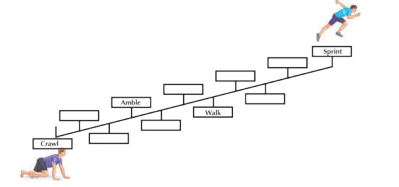
Ans. Creep→Crawl→Plod→Amble→Saunter→Stroll→Walk→Jog→Run→Dart→Sprint
III. Match the highlighted verbs in Column 1 with their functions in Column 2. There are two extra functions that you do not need.
| Column 1 | Column 2 |
| 1. I could hear the audience clapping. | (i) promise |
| 2. It couldn’t be helped. | (ii) possibility |
| 3. I should give it my best shot. | (iii) prediction |
| 4. I knew if I tried, I would win. | (iv) obligation |
| (v) past ability | |
| (vi) impossibility |
The verbs in bold are called modal auxiliaries. Each of these modal verbs can perform various functions based on the situation in which they are used.
Ans.
| Column 1 | Column 2 |
| 1. I could hear the audience clapping. | (v) past ability |
| 2. It couldn’t be helped. | (vi) impossibility |
| 3. I should give it my best shot. | (iv) obligation |
| 4. I knew if I tried, I would win. | (ii) possibility |
IV. Read the table which shows other functions of the modal auxiliaries.
| Modal Verbs | Functions |
| 1. could | (i) possibility (ii) unreal ability (iii) request (iv) suggestion |
| 2. couldn’t | (i) inability |
| 3. should | (i) probability (ii) advice |
| 4. would | (i) request (ii) past habit |
Now, make sentences with the modal verbs given in the table above with each function of the modal verbs. Mention the function in brackets.
| Modal Verbs |
Functions |
| 1. could | (i) possibility: It could rain later this evening, so take an umbrella. (ii) unreal ability: If I had wings, I could fly across the ocean. (iii) request: Could you please pass the salt? (iv) suggestion: We could try that new Italian restaurant for dinner. |
| 2. couldn’t | (i) inability: I couldn’t finish the marathon because of a leg injury. |
| 3. should | (i) probability: The bus should be here any minute now. (ii) advice: You should include more leafy greens in your diet. |
| 4. would | (i) request: Would you mind closing the window? (ii) past habit: When I was a child, I would spend hours playing in the garden. |
V. Read the following sentences.
- Interviewer: You’ve been listed as one of the 10 most inspirational women para-athletes globally by the International Paralympic Committee.
- Dr. Malik: I love sports and had been a swimmer too, so I decided to switch to para-athletics.
The sentences given above are in ______________________. (Direct Speech/Reported Speech)
The sentences given above are ___________ sentences. (declarative/interrogative/exclamatory/imperative)
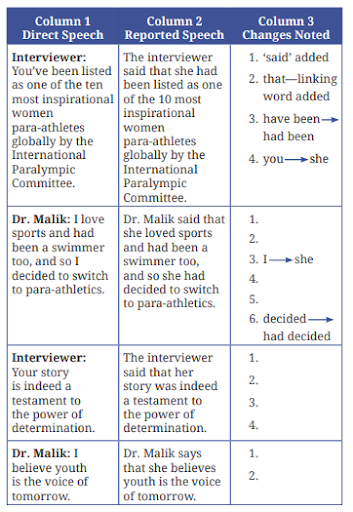
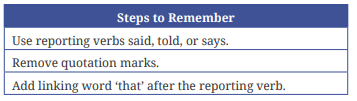
Now, work in pairs. Observe the changes from Column 1 to Column 2. Note these changes in Column 3. One example has been done for you.
Ans.
1. The sentences given above are in Direct Speech. Since they are the exact words spoken by the Interviewer and Dr. Malik.
2. The sentences given above are declarative sentences. Since they are making statements or sharing information.
(i) Dr. Malik: I love sports…
- ‘said’ added
- ‘that’ added (linking word)
- I → she
- love → loved
- had been → had been (no change)
- decided → had decided
(ii) Interviewer sentence:
- ‘said’ added
- ‘that’ added
- your → her
- is → was
(iii) Dr. Malik (last sentence):
- I → she
- believe → believes since reporting verb is ‘says’
VI. Read the conversation given below.
SIYA: I watched a documentary on the para equestrian event on television last night.
TARUN: I didn’t know paralympics has equestrian events.
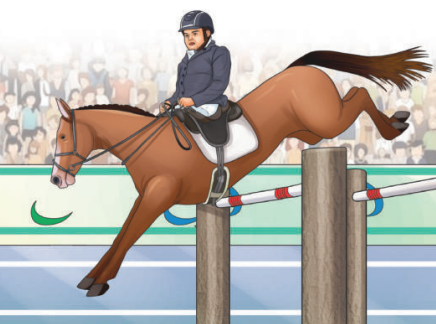
SIYA: It does. It was so interesting to watch.
TARUN: That’s wonderful. So, para equestrians must be training for months for this.
SIYA: They also have to find and develop their own style of communication with their horse.
TARUN: I will watch this documentary the next weekend.
Change the conversation given above to reported speech.
Siya said that she 1. ________________________________. Tarun replied that he hadn’t known that Paralympics had equestrian events. Siya added that 2. __________________. Tarun remarked that it was wonderful and that para equestrians must be training for months for that. Siya replied that 3. ________________________________. Tarun said that 4. ____________________________________.
Ans.
Siya said that she 1. had watched a documentary on the para equestrian event on television the previous night. Tarun replied that he hadn’t known that Paralympics had equestrian events. Siya added that 2. it did and added that it had been very interesting to watch. Tarun remarked that it was wonderful and that para equestrians must be training for months for that. Siya replied that 3. they also had to find and develop their own style of communication with their horse. Tarun said that 4. he would watch that documentary the following weekend.
Listen and Respond
I. You will listen to an announcement for special assembly in school. As you listen, fill in the blanks with one or two exact words. (Transcript for teacher on page 268)
1. The venue for the special assembly is the ______________.
2. A presentation on inclusion will be made by the ________________.
3. The dance performance will focus on the themes of ___________ and ____________.
4. A _______________ will be conducted by experts who support inclusion.
5. The celebration will end with a _______________ to encourage team work.
Ans.
1. The venue for the special assembly is the school auditorium.
2. A presentation on inclusion will be made by the Interact Club.
3. The dance performance will focus on the themes of diversity and acceptance.
4. A panel discussion will be conducted by experts who support inclusion.
5. The celebration will end with a song to encourage team work.
Writing Task
I. Read the details about a notice in the table given below.
| What is a notice? | A notice is generally written to convey some information to students, or a specific group of people. |
| A notice tells us about… | An event, a celebration, a competition, important information, lost/found article |
| Format of a notice |
Name of Organisation Date Heading Signature |
II. The Sports Club of your school is organising an Inter-school Athletic Meet. As the Sports Captain, draft a notice in not more than 50 words asking interested students to register themselves for selection in different events. Add all necessary details. Do not forget to design your notice within a box.
Ans.
Lancer’s Convent School
NOTICE
7 April 2026
Inter-school Athletic Meet
The Sports Club invites students to register for selection in various athletic events. Interested students must give their names to the Sports Captain by 12 April 2026.
Signature
Riya Sharma
Sports Captain
Learning Beyond the Text
I. Did you know?
The origin of Paralympics can be traced back to the year 1948, when Sir Ludwig Guttmann, organised a sports competition for war veterans with spinal cord-related injuries in England. The Stoke Mandeville Games was the Olympic-style games for differentlyabled athletes. It was organised for the first time in Rome in 1960 and since then the game has evolved. The Paralympics are split into Winter Games and Summer Games, which alternately occur every two years. Since the late twentieth century, the Paralympics have been held in the same city, which hosts the corresponding Olympic Games; the Paralympics follow shortly after the Olympics.
II. Work in groups of four. Choose any one of the topics given below and make a presentation.
- Two lesser-known Paralympic sports (examples: para equestrian, para rowing, etc.)
- Two Paralympians from India
Steps to be followed:
- Do research on the topic of your choice. Refer to magazines, newspapers, and the internet.
- Prepare the presentation based on the following guidelines:
- One introductory slide (mentioning topic chosen)
- Two slides on origin and brief history of Paralympics
- Four to five slides about lesser-known Paralympic sports or Indian Paralympians
- One concluding slide
- Choose appropriate slide design, colour schemes, and images.
- Ensure there is a good balance between text and images.
- Share your presentation in class.
- Each member of the group to take turns to present.
Ans.
Indian Paralympians
Slide 1: Introduction
Title: Champions of Spirit: A Tribute to Indian Paralympians
Sub-title: Exploring the Journey and Impact of India’s Finest Para-Athletes
Slide 2: Origin of the Paralympics
The Stoke Mandeville Games (1948): It all began in England when Sir Ludwig Guttmann organized a sports competition for World War II veterans with spinal injuries.
The First Official Games: The movement evolved into the first official Paralympic Games held in Rome in 1960.
Slide 3: Modern Evolution
Growth: What started with 400 athletes from 23 countries has grown into a global phenomenon with thousands of participants.
The Olympic Connection: Since the late 20th century, the Paralympics have been held in the same host city as the Olympics, usually starting shortly after the Olympic closing ceremony.
Slide 4: Sumit Antil (Javelin Throw)
Background: A former wrestler who lost his leg in a motorbike accident in 2015.
Achievement: Won the Gold Medal at the Tokyo 2020 Paralympics.
The Record: He broke the world record multiple times during the same final event, showing incredible dominance in the F64 category.
Slide 5: Avani Lekhara (Shooting)
Background: Paralyzed from the waist down following a car accident at age 11. She found her passion in shooting after reading Abhinav Bindra’s autobiography.
Achievement: The first Indian woman to win two Paralympic medals in a single edition (Gold and Bronze at Tokyo 2020).
Impact: She has become a symbol of precision and mental focus for young girls across India.
Slide 6: Conclusion
The Lesson: Paralympians teach us that the human spirit has no limits.
Final Thought: ‘Disability is a matter of perception. If you can do one thing well, you are needed by someone.’—Martina Navratilova.
Call to Action: Let’s support and celebrate para-sports with the same enthusiasm as mainstream sports!
CBSE Class 9 English Chapter 5 The World of Limitless Possibilities Extract-Based Questions
A.
Enter the world of Paralympic Games, a thrilling celebration of resilience, and extraordinary talent of athletes with locomotor, sensory, or intellectual disabilities. Paralympics go beyond competition, to quell stereotypes and redefine possibilities. Bharat’s debut in the Paralympics dates back to 1968, and the first medal was clinched in swimming in 1972. Since then, many Indian Paralympians have brought incredible honour to our country.
Q1. What does the passage describe as the core nature of the Paralympic Games?
Ans. The Games are described as a thrilling celebration of resilience and the extraordinary talent of athletes with various disabilities.
Q2. According to the text, what is the purpose of the Paralympics beyond sports competition?
Ans. The purpose is to overcome societal stereotypes and redefine what is possible for people with disabilities.
Q3. When did India participate in the Paralympics for the first time?
Ans. India made its debut in the Paralympic Games in the year 1968.
Q4. In which sports discipline did India win its first-ever Paralympic medal?
Ans. India won its first medal in the sport of swimming in 1972.
Q5. What has been the contribution of Indian Paralympians since their first medal?
Ans. Many Indian para-athletes have brought immense honor and pride to the country through their achievements.
B.
I was 29, an awful tragedy struck me when I was diagnosed with spine tumour. I underwent a surgery, but misfortune raised its ugly head again. The doctors declared that I would be bound to a wheelchair for the rest of my life, as I was paralysed waist down. I had two choices—squander my life in remorse or transform it to a world of limitless possibilities. I love sports and had been a swimmer too, so I decided to switch to para-athletics.
Q1. How old was the speaker when she faced a major life-altering tragedy?
Ans. The speaker was twenty-nine years old when she was diagnosed with a spinal tumor.
Q2. What was the medical outcome of the surgery the speaker underwent?
Ans. The speaker remained paralyzed from the waist down and was told she would be confined to a wheelchair for life.
Q3. What were the two conflicting paths the speaker identified for her future?
Ans. She could either waste her life in regret and sadness or change her life into one filled with endless opportunities.
Q4. Why did the speaker decide to pursue para-athletics specifically?
Ans. She already had a deep love for sports and had experience as a swimmer, making athletics a natural choice for her transformation.
Q5. What does the phrase raising its ugly head suggest in this context?
Ans. It suggests that a new and unpleasant problem appeared just when she was trying to recover from her initial surgery.
C.
One of the significant challenges for me was societal perceptions. People often underestimated my abilities. Overcoming this required not only physical strength but also mental resilience. I embraced challenges as opportunities to prove my capabilities. The support of my family, coupled with my fortitude, allowed me to turn obstacles into stepping stones. Physical limitations don’t define one’s potential.
Q1. What was the primary non-physical challenge the speaker faced in her journey?
Ans. The primary challenge was societal perceptions and the fact that people frequently doubted her capabilities.
Q2. What two types of strength did the speaker need to overcome the doubts of others?
Ans. She required a combination of physical strength and mental resilience to prove her worth.
Q3. How did the speaker view the difficulties that came her way?
Ans. She looked at challenges as chances to demonstrate what she was truly capable of achieving.
Q4. What external and internal factors helped the speaker turn obstacles into progress?
Ans. The unwavering support of her family and her own inner courage and strength helped her move forward.
Q5. What is the central message the speaker conveys regarding physical disability?
Ans. The speaker believes that a person’s physical condition does not set a limit on their true potential or talent.
D.
Advocacy is integral to my mission. I strongly believe in working for the cause of strengthening the emotional health of persons with challenges and empowering women through outdoor sports and adventure activities. I also support persons from lower socio–economic strata and provide equipment to para sportspersons. I believe youth is the voice of tomorrow. So, we organise disability sports awareness and advocacy sessions at various schools and colleges.
Q1. What does the speaker consider to be a vital part of her life’s mission?
Ans. The speaker considers advocacy for the rights and empowerment of people with disabilities to be essential to her work.
Q2. Which specific groups does the speaker aim to empower through outdoor activities?
Ans. She focuses on empowering women and improving the emotional well-being of individuals facing physical or mental challenges.
Q3. How does the speaker assist athletes who face financial difficulties?
Ans. She supports people from lower-income backgrounds by providing necessary equipment to para-sportspersons.
Q4. Why does the speaker choose to conduct awareness sessions in educational institutions?
Ans. She believes that young people are the leaders of the future, so she targets schools and colleges to build a more inclusive society.
Q5. What is the ultimate goal of the speaker’s advocacy work?
Ans. Her goal is to create a society where everyone is treated with respect and given an equal opportunity to succeed, regardless of their physical abilities.
Class 9 The World of Limitless Possibilities Multiple Choice Questions
Q1. The Paralympic Games are a celebration of resilience for athletes with which types of disabilities?
A. Locomotor and sensory
B. Intellectual
C. Both A and B
D. Only physical
Ans. C. Both A and B
Q2. When did India make its debut in the Paralympic Games?
A. 1972
B. 1968
C. 2016
D. 1948
Ans. B. 1968
Q3. In which year and sport did India win its first ever Paralympic medal?
A. 1968, Shot-put
B. 1972, Swimming
C. 1972, Javelin throw
D. 2016, Swimming
Ans. B. 1972, Swimming
Q4. At what age was Dr. Deepa Malik diagnosed with a spine tumour?
A. 18
B. 25
C. 29
D. 32
Ans. C. 29
Q5. What medical condition did Dr. Malik face following her surgery?
A. Loss of vision
B. Paralysis from the waist down
C. Loss of hearing
D. Complete memory loss
Ans. B. Paralysis from the waist down
Q6. From what Dr. Deepa Malik decided to switch to para-athletics?
A. Professional dancer
B. Swimmer
C. Mountaineer
D. Cricketer
Ans. B. Swimmer
Q7. In which year and event did Dr. Malik win her historic Paralympic silver medal?
A. 2012 London, Javelin
B. 2016 Rio, Shot-put
C. 2020 Tokyo, Shot-put
D. 2016 Rio, Swimming
Ans. B. 2016 Rio, Shot-put
Q8. Which award has NOT been bestowed upon Dr. Deepa Malik?
A. Khel Ratna
B. Arjuna Award
C. Padma Shri
D. Bharat Ratna
Ans. D. Bharat Ratna
Q9. What does Dr. Malik mean by the phrase ability beyond disability?
A. Only able-bodied people can play sports
B. Physical limitations do not define a person’s potential
C. Disability is a limitation that cannot be overcome
D. Para-athletes should not compete globally
Ans. B. Physical limitations do not define a person’s potential
Q10. According to the text, what is a significant non-physical challenge faced by para-athletes?
A. Lack of equipment
B. Societal perceptions and being underestimated
C. Traveling to different countries
D. Learning the rules of the game
Ans. B. Societal perceptions and being underestimated
Q11. What helped Dr. Malik turn obstacles into stepping stones?
A. Financial wealth
B. Luck and chance
C. Family support and personal fortitude
D. Constant media attention
Ans. C. Family support and personal fortitude
Q12. How do the Paralympics contribute to changing societal attitudes?
A. By providing free tickets to matches
B. By showcasing the strength and competitive spirit of para-athletes
C. By showing only the struggles of athletes
D. By limiting the number of sports
Ans. B. By showcasing the strength and competitive spirit of para-athletes
Q13. What does Dr. Malik believes that individuals with disabilities can be?
A. Less capable than able-bodied people
B. As capable as their able-bodied counterparts
C. Only involved in indoor activities
D. Dependent on others for life
Ans. B. As capable as their able-bodied counterparts
Q14. What is the main goal of Dr. Malik’s advocacy work?
A. To win more medals
B. To create a society where everyone is treated with dignity
C. To become a famous politician
D. To travel the world for adventure
Ans. B. To create a society where everyone is treated with dignity
Q15. Dr. Malik empowers women specifically through which activities?
A. Weaving and sewing
B. Outdoor sports and adventure activities
C. Cooking classes
D. Academic lectures
Ans. B. Outdoor sports and adventure activities
Q16. Why does Dr. Malik target schools and colleges for awareness sessions?
A. To find new coaches
B. Because youth is the voice of tomorrow
C. To sell sporting equipment
D. To recruit volunteers for her games
Ans. B. Because youth is the voice of tomorrow
Q17. For whom does Dr. Malik provide equipment?
A. Only professional Olympic athletes
B. Para-sportspersons from lower socio-economic strata
C. School teachers
D. International sports commentators
Ans. B. Para-sportspersons from lower socio-economic strata
Q18. According to Dr. Malik, every setback is an opportunity to?
A. Give up on dreams
B. Complain about misfortune
C. Prove your strength
D. Wait for someone to help
Ans. C. Prove your strength
Q19. What does the word squander mean in the context of the interview?
A. To save carefully
B. To waste recklessly
C. To improve significantly
D. To ignore completely
Ans. B. To waste recklessly
Q20. How does Dr. Malik describes disability?
A. Burden to carry
B. Misfortune to hide
C. Unique strength waiting to be unleashed
D. Barrier to success
Ans. C. Unique strength waiting to be unleashed
CBSE Class 9 English Kaveri Book Chapter 5 – The World of Limitless Possibilities Extra Question and Answers
Q1. What defines the world of Paralympic Games according to the introductory text?
Ans. The Paralympic Games are defined as a thrilling celebration of resilience and extraordinary talent for athletes with locomotor, sensory, or intellectual disabilities. They serve to quell stereotypes and redefine what is possible.
Q2. When did India win its first Paralympic medal and in which sport?
Ans. India won its first Paralympic medal in 1972 in the sport of swimming.
Q3. What life-altering tragedy did Dr. Deepa Malik face at the age of 29?
Ans. At the age of 29, Dr. Malik was diagnosed with a spine tumour. Following surgery, she was paralyzed from the waist down and told she would be bound to a wheelchair for the rest of her life.
Q4. What were the two choices Dr. Malik felt she had after her diagnosis?
Ans. She felt she could either squander her life in remorse or transform it into a world of limitless possibilities.
Q5. What does Dr. Malik consider to be her breakthrough moment in her sporting career?
Ans. Her breakthrough moment was during the 2016 Rio Paralympic Games, where she secured a silver medal in the shot-put event.
Q6. How does Dr. Malik interpret the phrase ability beyond disability?
Ans. She believes that physical limitations do not define a person’s potential. To her, it means focusing on the unique strengths and skills an individual possesses regardless of their physical challenges.
Q7. According to Dr. Malik, what is the most significant social challenge she faced?
Ans. The most significant challenge was societal perceptions, as people often underestimated her abilities based on her physical condition.
Q8. How do the Paralympics help in changing global attitudes toward disability?
Ans. When people witness the strength, skill, and competitive spirit of para-athletes, it breaks down preconceived notions and proves that individuals with disabilities are highly capable.
Q9. What specific advocacy work does Dr. Malik engage in outside of active sports?
Ans. She works on strengthening the emotional health of persons with challenges, empowering women through adventure sports, and providing equipment to para-sportspersons from lower socio-economic backgrounds.
Q10. What advice does Dr. Malik give to individuals currently facing setbacks?
Ans. She advises that every setback is an opportunity to prove one’s strength. She encourages people to surround themselves with a support system, believe in themselves, and view disability as a unique strength to be unleashed.