
CBSE Class 8 English Unit 4 Environment Chapter 1 The Cherry Tree Important Question Answers from Poorvi Book
Class 8 English The Cherry Tree Question Answers – Looking for questions and answers for CBSE Class 8 English Unit 4 Environment Chapter 1 The Cherry Tree? Look no further! Our comprehensive compilation of important questions will help you brush up on your subject knowledge. Practising Class 8 English question answers can significantly improve your performance in the exam. Improve your chances of scoring high marks by exploring Unit 4 Environment Chapter 1 The Cherry Tree now. The questions listed below are based on the latest CBSE exam pattern, wherein we have given NCERT solutions to the chapter’s extract-based questions, multiple choice questions and Extra Question Answers
Also, practising with different kinds of questions can help students learn new ways to solve problems that they may not have seen before. This can ultimately lead to a deeper understanding of the subject matter and better performance on exams.
- The Cherry Tree NCERT Solutions
- The Cherry Tree Grammar Exercises
- The Cherry Tree Extract Based Questions
- The Cherry Tree Multiple Choice Questions
- The Cherry Tree Extra Question Answers
Related:
- The Cherry Tree Summary, Explanation
- The Cherry Tree Character Sketch
- Class 8 English Poorvi Book Lesson Notes
The Cherry Tree Textbook Questions (NCERT Solutions)
Exercises
Let us do these activities before we read.
II. What kind of trees do people plant in their homes? Why is it important to plant trees?
Ans. People plant a variety of trees in their homes. Some examples are: mango, lychee, apple, cherry, deodar, oak, mahogany. Planting trees is not only good for learning responsibility, but also to adopt environmentally friendly practices and lifestyle.
III. Name some fruit trees that grow in your region. What type of conditions help these fruit trees to grow?
Ans. The fruit trees that grow in my region are mangoes, figs, lychees, chikoos, papayas, guavas, and lemons. The dry and warm climate of the region contributes to the growth of these fruit trees.
Let us discuss
I. Arrange the events in order of occurrence in the story.
Two have been done for you. Share your answers with your classmates and the teacher.
1. Rakesh discovered that the small, well-rooted twig had grown into a cherry tree.
2. Rakesh was sent to live with his grandfather in Mussoorie.
3. Rakesh pressed the cherry seed into the soft soil with his thumb.
4. The cherry tree grew quickly after the rains arrived early.
5. Rakesh bought a bunch of cherries and ate most of them.
6. A goat entered the garden and ate all the leaves of the young cherry tree.
7. Rakesh’s parents grew maize, rice, and barley in a village.
8. Rakesh sprinkled water on the cherry tree and surrounded it with pebbles.
9. Grandfather told Rakesh that cherry trees were tough.
10. Rakesh kept rolling the last cherry seed in his mouth.
Ans.
7. Rakesh’s parents grew maize, rice, and barley in a village.
2. Rakesh was sent to live with his grandfather in Mussoorie.
5. Rakesh bought a bunch of cherries and ate most of them.
10. Rakesh kept rolling the last cherry seed in his mouth.
3. Rakesh pressed the cherry seed into the soft soil with his thumb.
1. Rakesh discovered that the small, well-rooted twig, had grown into a cherry tree.
8. Rakesh sprinkled water on the cherry tree and surrounded it with pebbles.
6. A goat entered the garden and ate all the leaves of the young cherry tree.
9. Grandfather told Rakesh that cherry trees were tough.
4. The cherry tree grew quickly after the rains arrived early.
II. Do you think the cherry tree would survive? Why do you think so?
Ans. Yes, the cherry tree would survive. The cherry tree survived an attack from a goat, getting chopped away, as well as harsh weather conditions. Rakesh and his grandfather took good care of it. Therefore, the cherry tree is cared for and resilient.
Let us discuss
I. Complete the table given below based on your understanding of Part II of the story. One example has been done for you. Share your answers with your classmates and teacher.
| Cause | Effect |
| 1. A woman cut the cherry tree while cutting grass. | (i) Grandfather scolded the woman. |
| 2. | (ii) Rakesh was thinner but stronger when he came back. |
| 3. A hairy caterpillar started eating the leaves of the cherry tree. | |
| (iii) | 4. (iv) Rakesh and Grandfather gazed at the tree as though it was a miracle. |
| 5. Rakesh tasted one of the small cherries during summer. | (v) |
Ans.
| Cause | Effect |
| 1. A woman cut the cherry tree while cutting grass. | (i) Grandfather scolded the woman. |
| 2. Rakesh went back to the village to help his parents. | (ii) Rakesh was thinner but stronger when he came back. |
| 3. A hairy caterpillar started eating the leaves of the cherry tree. | Rakesh removed the caterpillar and put it on dry leaves. |
| (iii) There was a blossom on the cherry tree. | 4. (iv) Rakesh and Grandfather gazed at the tree as though it was a miracle. |
| 5. Rakesh tasted one of the small cherries during summer. | (v) It was sour and he spat it out. |
Let us think and reflect
I. Read the given extracts and answer the questions that follow.
1. “Have a cherry, Grandfather,” he said, as soon as he saw his grandfather in the garden.
Grandfather took one cherry and Rakesh promptly ate the other two. He kept the last seed in his mouth for some time, rolling it round and round on his tongue until all the tang had gone. Then
“Of course.” he placed the seed on the palm of his hand and studied it.
“Are cherry seeds lucky?” asked Rakesh.
“Then I’ll keep it.”
“Nothing is lucky if you put it away. If you want luck, you must put it to some use.”
(i) Substitute the underlined phrase with a correct word from the extract.
The Kho-kho captain changed her strategy quickly and without delay when a new player came in from the opposing team.
Ans. The Kho-kho captain changed her strategy promptly when a new player came in from the opposing team.
(ii) What does Rakesh’s action of rolling the cherry seed in his mouth most likely suggest about his mood at that moment?
A. He is feeling impatient and restless.
B. He is enjoying the taste and the moment.
C. He is bored and has nothing better to do.
D. He is thoughtful and feeling playful.
Ans. B. He is enjoying the taste and the moment.
(iii) Complete the following sentence suitably with reference to Rakesh and his grandfather.
Rakesh’s decision to plant the seed shows that ______________.
(he respects and values his grandfather’s advice/he has a close bond with his grandfather and a willingness to learn from him)
Ans. Rakesh’s decision to plant the seed shows that he has a close bond with his grandfather and a willingness to learn from him.
(iv) How does the grandfather’s advice reflect his view about luck and effort?
Ans. Grandfather’s advice shows that luck and effort are intertwined. According to his experience, nothing can give luck unless it is used properly.
2. Winter came early. The cherry tree bent low with the weight of snow. Field-mice sought shelter in the roof of the cottage. The road from the valley was blocked, and for several days there was no newspaper, and this made Grandfather quite grumpy. His stories began to have unhappy endings.
In February it was Rakesh’s birthday. He was nine—and the tree was four, but almost as tall as Rakesh.
(i) Complete the following sentence suitably.
The phrase ‘field-mice sought shelter in the roof of the cottage’ suggests that _____________.
Ans. the weather was cold and creatures sought out warmth.
(ii) What can be inferred about the cherry tree’s toughness from the line, ‘The cherry tree bent low with the weight of snow’?
A. The weight of the tree was more than the snow.
B. The tree could withstand harsh weather.
C. The tree was growing close to the ground.
D. The snow gave support to the tree.
Ans. The tree could withstand harsh weather.
(iii) How did the early winter affect Grandfather’s mood and storytelling?
Ans. Because of the snowfall in the early winter, roads were blocked by snow. This resulted in a temporary stop in transportation, including the delivery of newspapers. Newspapers were a pleasant pastime for Grandfather. When he did not get to listen to the news articles, he became irritable and grumpy. Due to his bad mood, his stories went from being imaginative and creative to having bad endings. His stories were no longer happy and adventurous.
(iv) Complete the sentence by choosing the correct option.
The comparison of Rakesh’s age to the cherry tree’s age symbolises _______________. (the tree’s growth paralleling Rakesh’s own development/the tree standing as a dear one on Rakesh’s birthday)
Ans. the tree’s growth paralleling Rakesh’s own development
II. Answer the following questions.
1. Why did Rakesh’s parents send him to Mussoorie?
Ans. Rakesh’s parents lived in the village and worked in the fields. They wanted their son to go to school and get his education. So, his parents sent him to Mussoorie to live with his grandfather, from where he could easily travel to the nearby school.
2. Why did Rakesh let the praying-mantis remain on the branch of the cherry tree?
Ans. It was the first guest on the cherry tree and did not harm it. So Rakesh allowed it to stay there.
3. How is life in the Himalayan foothills described in the story?
Ans. Life is close to nature and events like snowfall can hamper smooth functioning of life. Rakesh wears chappals and raincoat when he walks to and from school during the monsoons. In winters, they sit in front of charcoal fire, sit in the warm Sun to get heat and have to bear with no supplies of essentials like newspapers.
4. What might Rakesh mean when he says, “Is this what it feels to be God?” at the end of the story?
Ans. Rakesh had experienced the joy and relief of seeing something he was taking care of grow and flourish. He watered the cherry tree and protected it from hairy caterpillars and celebrated every flower and every milestone. Therefore, he wondered if God felt the same sense of accomplishment when he sees his creations develop and become the best versions of themselves.
5. How does the writer describe the relationship between Rakesh and his grandfather?
Ans. The writer describes the relationship between Rakesh and his grandfather to be positive, warm, and comfortable. Rakesh would help his grandfather by cutting wood for the fire and reading the newspaper for him. His grandfather would give him useful advice, support, and entertain him with vivid stories.
6. What can you infer about the connection between humans and nature based on the story?
Ans. According to the story, the humans and nature have a codependent connection. Humans and nature can impact one another in different ways. Nature can impact humans negatively, like when the snowfall blocked the roads; Rakesh and his grandfather did not get newspapers and his grandfather became grumpy. Humans can impact nature negatively, like when the woman chopped the cherry tree in half. Nature can also impact humans positively, like when the cherry tree grew even under harsh conditions and it made Rakesh happy. Humans can also impact nature positively, like when Rakesh watered the cherry tree and kept it company and the cherry tree grew stronger due to it.
7. Imagine Rakesh reflects on his wonderful experience of watching a seed being transformed into a full-grown cherry tree. Write how he must have felt.
Ans. Rakesh looks at the grown and developed cherry tree and thinks back to how the cherry tree was once just a seed. The seed went through various obstacles and challenges. Rakesh and his grandfather forgot about the sown seed, and the weather was harsh. Yet, the seed grew out of the soil into a two-foot twig-like tree. The next obstacle was the goat eating most of the tiny tree. Rakesh was sad, but his grandfather encouraged him to continue nurturing the cherry tree. The tree was growing but then a woman chopped it down to half. Rakesh and his grandfather lost all hope, but nature helped them by giving a lot of rainfall, which healed the broken cherry tree. Rakesh watered it and kept it company to support the growth of the tree. Rakesh allowed insects like the mantis to stay, celebrating the tree’s first visitor. Rakesh protected the tree by removing harmful insects like the hairy caterpillar. Rakesh celebrated the first flower and the arrival of bees and birds in its foliage. And now that it was full-grown into a beautiful and resilient cherry tree, Rakesh felt like he was proud and that he had accomplish something monumental. He planted, grew, nurtured and protected something and it resulted into a strong and radiant being.
The Cherry Tree Grammar Exercises
Let us learn
I. Each word list has one word that does not match with the other words. Identify the odd word. One example has been done for you.
1. chop, trim, slice, mince
(‘chop’, ‘slice’ and ‘mince’ are words used for cutting with a knife; whereas ‘trim’ is to cut a part with a pair of scissors)
2. plodded, galloped, scrambled, trudged
3. tender, delicate, soft, smooth
4. stared, peered, pecked, gazed
5. growing, blossoming, progressing, planting
Ans.
1. trim
2. galloped
3. smooth
4. pecked
5. planting
II. Choose the most suitable taste words given in the box below and write against the food items that follow.
| sweet | sour | tangy | bitter |
| spicy | salty | bland (tasteless) |
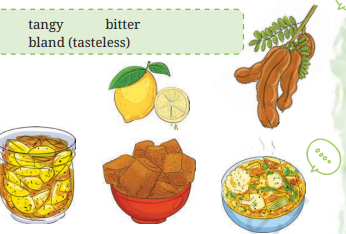
1. tamarind
2. jaggery
3. neem leaves
4. paneer (cottage cheese)
5. lemon
6. pickle
7. a dish of vegetables
Now, use any five taste words and make sentences of your own.
Ans.
1. tamarind – tangy
2. jaggery – sweet
3. neem leaves – bitter
4. paneer (cottage cheese) – bland
5. lemon – sour
6. pickle – spicy
7. a dish of vegetables – salty
Sentences –
1. The tea was too sweet for me.
2. I dislike bitter gourd.
3. The doctor advised me to avoid sour foods.
4. Kanika enjoyed the salty peanuts.
5. The sandwich tasted bland so I added some sauce to it.
III. Choose the correct antonyms for the textual words given below from the box. There are two extra words that you will not need.
| growing | ordinary | unprotected | cheerful | hard |
| wide | fasting | shaky | fussing | coldness |
| 1. tender | 5. feasting | ||
| 2. sturdy | 6. grumpy | ||
| 3. narrow | 7. sheltered | ||
| 4. warmth | 8. special |
Ans.
| 1. tender | hard | 5. feasting | fasting |
| 2. sturdy | shaky | 6. grumpy | cheerful |
| 3. narrow | wide | 7. sheltered | unprotected |
| 4. warmth | coldness | 8. special | ordinary |
IV Read the following lines from the text and underline all the verbs and identify the form of tense.
1. Rakesh was on his way home from school when he bought the cherries.
2. Rakesh was looking for Grandfather without finding him in any of his favourite places around the house.
3. Rakesh and Grandfather gazed at the tree as though it had performed a miracle.
Ans.
1. Rakesh was on his way home from school when he bought the cherries. Simple past tense
2. Rakesh was looking for Grandfather without finding him in any of his favourite places around the house. Past continuous tense
3. Rakesh and Grandfather gazed at the tree as though it had performed a miracle. Simple past tense, past perfect tense
Now, fill in the blanks with the correct form of Simple Past, Past Progressive, or Past Perfect Tenses of the verbs given in brackets. One example has been done for you.
(i) I was sitting (sit) with my grandparents in the garden, sharing the wonderful memories from my childhood. As we (ii) ______________ (talk), I (iii) ______________ (realise) how much wisdom they (iv) ______________ (impart) to me over the years. While I (v) ______________ (listen) to their stories for hours together, I (vi) ______________ (remember) the times we (vii) ______________ (spend) together planting flowers and learning about life. By the time I left, the sun (viii) ______________ (set), and I (ix) ______________ (feel) a deep sense of gratitude for the bond we (x) ______________ (nurture) through love, care, and countless memories.
Ans. (i) I was sitting (sit) with my grandparents in the garden, sharing the wonderful memories from my childhood. As we (ii) talked, I (iii) realized how much wisdom they (iv) were imparting (impart) to me over the years. While I (v) listened to their stories for hours together, I (vi) was remembering the times we (vii) had spent together planting flowers and learning about life. By the time I left, the sun (viii) had set, and I (ix) felt a deep sense of gratitude for the bond we (x) were nurturing through love, care, and countless memories.
V Study the punctuation marks in the following sentences from the text.
- “Hey, not there,” said Grandfather, “I’ve sown mustard in that bed. Plant it in that shady corner, where it won’t be disturbed.”
- When Grandfather saw what had happened, he went after the woman and scolded her; but the damage could not be repaired.
- She did not try to avoid the tree: one sweep, and the cherry tree was cut in two.
| Punctuation refers to the symbols used in writing to clarify meaning and separate sentences and their components. Proper punctuation ensures the clarity and flow of a text, guiding readers through its structure. |
Here are some of the most common punctuation marks:
- Full stop (.)—ends a declarative sentence
For example: She went to the store.
- Comma (,)—separates components in a list, clauses, or phrases within a sentence
For example: We bought apples, oranges, and bananas.
- Question Mark (?)—ends a direct question
For example: Where are you going?
- Exclamation Mark (!)—indicates strong emotion or emphasis
For example: Watch out!
- Colon (:)—introduces a list, explanation or elaboration
For example: He had one goal: win the race.
- Semicolon (;)—connects closely related independent clauses or separates complex list items
For example: She likes reading; he prefers writing.
- Apostrophe ( ’)
-
- In contractions—He’s (He is), they’ll (they will), I’m (I am)
- To show possession—Jagan’s book, the girls’ toys
- If the noun ends in -s, add only the apostrophe—Manas’ car
- Quotation Marks (“ ”)—enclose direct speech or quotations
For example: She said, “I’m happy.”
- Dash (– or —)—adds emphasis or separates related thoughts
For example: He was late—again.
- Capitalisation Rules
- Names of people and places—Priya, India
- Days, months, festivals—Monday, December, Diwali
- Titles with names—Dr. Sneha, Mr. Patel
- Deities and holy books—God, the Quran, the Bhagawad Gita
- First person pronoun—I
- Adjectives from proper nouns—Indian, American
- Geographical features, races, religions, languages—the Himalayas, Hindu, French
- Titles of books, poems, or plays—Malgudi Days, The Road Not Taken, Good Heavens, etc.
Now, punctuate the following paragraph appropriately.
every sunday roshni would visit her grandparents house on their farm come sit grandpa would say patting the bench on their porch
roshni loved these moments where the world slowed down and stories flowed like magic grandma would bring tea her eyes twinkling with joy im excited to hear about your younger days the adventures the lessons and the memories roshni said eagerly
grandpa smiled softly his wrinkled hands resting on the cane ah the old days… when everything was simple and happiness was all we had
roshni could feel the warmth of those memories he sat in silence bound not by words but by a timeless bond
Ans. Every Sunday, Roshni would visit her grandparents’ house on their farm. “Come sit,” Grandpa would say, patting the bench on their porch.
Roshni loved these moments where the world slowed down and stories flowed like magic. Grandma would bring tea, her eyes twinkling with joy. “I’m excited to hear about your younger days, the adventures, the lessons, and the memories,” Roshni said eagerly.
Grandpa smiled softly, his wrinkled hands resting on the cane. “Ah, the old days… when everything was simple and happiness was all we had.”
Roshni could feel the warmth of those memories he sat in silence, bound not by words but by a timeless bond.
Let us listen
I. You will listen to a conversation between a son and his mother. As you listen, select four true statements from 1–7 given below. (Transcript for teacher on page 201)
1. The mother encouraged her son to deliver a presentation on the Chipko Movement.
2. The son was surprised to know about the Appiko Movement.
3. The son agreed that the Chipko Movement was about people uniting to make an impact.
4. The mother expressed a desire to share more details about Saalumarada Thimakka.
5. The mother was curious to hear about Saalumarada Thimakka.
6. The mother and son were in disagreement about the work of Jadav Payeng.
7. The son found the information on Jadav Payeng wonderful.
Ans.
1. True
2. True
3. True
4. False
5. True
6. False.
7. True
Let us write
An article is a piece of writing on a specific topic. It showcases independent opinions expressed by a writer. Articles are published in newspapers, newsletters, magazines, journals, and online portals.
Let us understand how to draft an article for a school magazine.
Remember to
- write the heading or title at the top,
- write the name of the writer below it as a byline, and
- follow the correct layout.
-
- Paragraph 1: Give a brief introduction of the topic or issue.
- Focus on the main idea of the paragraph.
- Paragraph 2: Elaborate by giving facts and advantages.
- Paragraph 3: Include consequences and disadvantages.
- Paragraph 4: Provide suggestions. End with a word of hope, a word of caution or a call for action.
Now, complete the article for a magazine on ‘Trees–Our Lifeline’. Use the words and phrases given in the box below.
| absorb carbon dioxide | Moreover, our planet | reduces pollution |
| Additionally | would stop existing | ensures a better future |
| climate control | Trees–Our Lifeline | To conclude |
| If trees were not there |
(i) ________________ -by ________________ (write your name and class) Trees are essential for life on Earth. Without them, life as we know (ii) ________________. This is the reason why trees are our lifeline. Trees provide us with food, shelter, and even medicine. Trees (iii) ________________ and release oxygen, helping us breathe. This process also (iv) ________________ and keeps the environment clean. (v) ________________, trees give us fruits, nuts, and other foods. Trees also help in (vi) ________________ and prevention of soil erosion. (vii) ________________, the air would be polluted, and we would struggle to breathe. (viii) ________________ would be barren, lacking food, shelter, and life-giving greenery. (ix) ________________, trees are true friends. Protecting and planting trees (x) ________________ for everyone on Earth. Therefore, we must act now to protect and plant more trees, preserving Earth’s green lifeline for future generations.
Ans.
(i) Trees–Our Lifeline
-by ________________ (write your name and class)
Trees are essential for life on Earth. Without them, life as we know (ii) would stop existing. This is the reason why trees are our lifeline.
Trees provide us with food, shelter, and even medicine. Trees (iii) absorb carbon dioxide and release oxygen, helping us breathe. This process also (iv) reduces pollution and keeps the environment clean. (v) Additionally, trees give us fruits, nuts, and other foods. Trees also help in (vi) climate control and prevention of soil erosion. (vii) If trees were not there, the air would be polluted, and we would struggle to breathe. (viii) Moreover, our planet would be barren, lacking food, shelter, and life-giving greenery.
(ix) To conclude, trees are true friends. Protecting and planting trees (x) ensures a better future for everyone on Earth. Therefore, we must act now to protect and plant more trees, preserving Earth’s green lifeline for future generations.
CBSE Class 8 English Unit 4 Environment Chapter 1 The Cherry Tree Extract-Based Questions
A. Rakesh lived with his grandfather on the outskirts of Mussoorie, just where the forest began. His father and mother lived in a small village fifty miles away, where they grew maize and rice and barley in narrow terraced fields on the lower slopes of the mountain.
But there were no schools in the village, and Rakesh’s parents were keen that he should go to school. As soon as he was of school-going age, they sent him to stay with his grandfather in Mussoorie.
He had a little cottage outside the town.
Rakesh was on his way home from school when he bought the cherries. He paid fifty paise for the bunch. It took him about half-an-hour to walk home, and by the time he reached the cottage there were only three cherries left.
‘Have a cherry, Grandfather,’ he said, as soon as he saw his grandfather in the garden.
Q1. Where did Rakesh live?
Ans. Rakesh lived in Mussorie, on the outskirts of the forest, with his grandfather.
Q2. What did Rakesh’s parents do?
Ans. They were farmers. They practised terrace farming on hill slopes and grew maize, rice and barley.
Q3. Why did Rakesh live with his grandfather instead of his parents?
Ans. There were no schools in the village where Rakesh’s parents lived. They wanted him to get education and so, sent him to Mussorie to live with his grandfather.
Q4. What did Rakesh buy on his way to school?
Ans. He bought cherries.
Q5. How much time did Rakesh take to reach home?
Ans. He reached home in thirty minutes.
B. ‘What are the pebbles for?’ asked Grandfather.
‘For privacy,’ said Rakesh.
He looked at the tree every morning but it did not seem to be growing very fast, so he stopped looking at it except quickly, out of the corner of his eye. And, after a week or two, when he allowed himself to look at it properly, he found that it had grown—at least an inch!
That year the monsoon rains came early and Rakesh plodded to and from school in raincoat and chappals. Ferns sprang from the trunks of trees, strange-looking lilies came up in the long grass, and even when it wasn’t raining the trees dripped and mist came curling up the valley. The cherry tree grew quickly in this season.
It was about two feet high when a goat entered the garden and ate all the leaves. Only the main stem and two thin branches remained.
‘Never mind,’ said Grandfather, seeing that Rakesh was upset. ‘It will grow again, cherry trees are tough.’
Q1. Where was Rakesh placing the pebbles?
Ans. He was placing the pebbles around the cherry sapling.
Q2. What happened to the cherry tree in the monsoon season?
Ans. It grew quickly in the monsoon season.
Q3. What did the goat do?
Ans. It entered the garden and ate all the leaves of the cherry plant.
Q4. What did the grandfather comment about the cherry tree?
Ans. He commented that the tree is tough and will grow again.
Q5. How did Rakesh commute to school in the rainy season?
Ans. He wore a raincoat and chappals and walked slowly to and from school.
C. When Grandfather saw what had happened, he went after the woman and scolded her; but the damage could not be repaired.
‘Maybe it will die now,’ said Rakesh.
‘Maybe,’ said Grandfather.
But the cherry tree had no intention of dying.
By the time summer came round again, it had sent out several new shoots with tender green leaves.
Rakesh had grown taller too. He was eight now, a sturdy boy with curly black hair and deep black eyes. Blackberry eyes, Grandfather called them.
That monsoon Rakesh went home to his village, to help his father and mother with the planting and ploughing and sowing. He was thinner but stronger when he came back to Grandfather’s house at the end of the rains to find that the cherry tree had grown another foot. It was now up to his chest.
Even when there was rain, Rakesh would sometimes water the tree. He wanted it to know that he was there.
One day he found a bright green praying-mantis perched on a branch, peering at him with bulging eyes. Rakesh let it remain there; it was the cherry tree’s first visitor.
The next visitor was a hairy caterpillar, who started making a meal of the leaves. Rakesh removed it quickly and dropped it on a heap of dry leaves.
‘Come back when you’re a butterfly,’ he said.
Q1. Why did grandfather scold the woman?
Ans. He scolded her because while chopping the grass with her scythe, she also chopped the cherry plant.
Q2. Describe Rakesh.
Ans. Rakesh was tall, sturdy with curly black hair and deep black eyes. His grandfather called them blackberry eyes.
Q3. Who was the first visitor on the cherry tree?
Ans. The first visitor was a bright green praying-mantis.
Q4. Why did Rakesh water the tree despite the rain?
Ans. He wanted the tree to know that he was there for it.
Q5. What was the caterpillar doing?
Ans. It was eating the leaves of the cherry tree.
D. Winter came early. The cherry tree bent low with the weight of snow. Field-mice sought shelter in the roof of the cottage. The road from the valley was blocked, and for several days there was no newspaper, and this made Grandfather quite grumpy. His stories began to have unhappy endings.
In February it was Rakesh’s birthday. He was nine—and the tree was four, but almost as tall as Rakesh.
One morning, when the sun came out, Grandfather came into the garden to let some warmth ‘get into my bones,’ as he put it. He stopped in front of the cherry tree, stared at it for a few moments, and then called out, ‘Rakesh! Come and look! Come quickly before it falls!’
Rakesh and Grandfather gazed at the tree as though it had performed a miracle. There was a pale pink blossom at the end of a branch.
The following year there were more blossoms.
And suddenly the tree was taller than Rakesh, even though it was less than half his age. And then it was taller than Grandfather, who was older than some of the oak trees.
But Rakesh had grown too. He could run and jump and climb trees as well as most boys, and he read a lot of books, although he still liked listening to Grandfather’s tales.
In the cherry tree, bees came to feed on the nectar in the blossoms, and tiny birds pecked at the blossoms and broke them off. But the tree kept blossoming right through the spring, and there were always more blossoms than birds.
That summer there were small cherries on the tree. Rakesh tasted one and spat it out.
Q1. Why did the tree bend low?
Ans. As it had snowed, the tree bent low due to the weight of the snow that had fallen on it.
Q2. Why was grandfather grumpy?
Ans. As it had snowed heavily, the road from the valley was blocked and hence, closed. There was no newspaper delivery which made him grumpy.
Q3. Which of the following is a suitable synonym for ‘blossom’?
A. Bird
B. Flower
C. Fruit
D. Insect
Ans. B. Flower
Q4. What all did Rakesh do?
Ans. He could run and jump and climb trees as well as most boys, and he read a lot of books, although he still liked listening to Grandfather’s tales.
Q5. What did Rakesh do when he tasted a cherry?
Ans. He disliked the taste and spat it out.
Class 8 The Cherry Tree Multiple Choice Questions
Q1. Rakesh lived in _______
A. a small village
B. Dehradun
C. Nainital
D. Mussoorie
Ans. D. Mussoorie
Q2. Who lived with Rakesh?
A. mother
B. father
C. grandfather
D. no one
Ans. C. grandfather
Q3. Why did Rakesh not live with his parents?
A. they were dead
B. there were no schools in the village
C. they were too poor to educate him
D. they disliked him
Ans. B. there were no schools in the village
Q4. Which of these is talked about in the story?
A. a cherry blossom tree
B. a mango tree
C. a cherry tree
D. lilies
Ans. C. a cherry tree
Q5. What does Rakesh do with the cherry seed?
A. He break it open
B. He swallows it
C. He plants it
D. He throws it
Ans. C. He plants it
Q6. How does Rakesh commute to and from school?
A. on a car pool
B. he walks
C. he cycles
D. grandfather drop him on a cycle
Ans. B. he walks
Q7. What do the parents do?
A. nothing
B. farming
C. rear animals
D. work as sweepers
Ans. B. farming
Q8. What kind of terrain is there?
A. plains
B. hilly
C. valley
D. all of them
Ans. B. hilly
Q9. What kind of trees grow in Mussoorie?
A. oak and deodar
B. pine
C. palm
D. all of these
Ans. A. oak and deodar
Q10. The cherries were from ______
A. Mussoorie
B. USA
C. Dubai
D. Kashmir
Ans. D. Kashmir
Q11. How much money did the cherries cost?
A. 10 rupees
B. 50 paise
C. 1 rupee
D. 25 paisa
Ans. B. 50 paise
Q12. Usually, how much time did Rakesh take to walk hom from school?
A. 30 minutes
B. 1 hour
C. 45 minutes
D. not known
Ans. D. not known
Q13. According to the grandfather, for anything to be lucky it had to _________
A. be rare
B. be expensive
C. be put to use
D. be lost
Ans. C. be put to use
Q14. Grandfather had sown ________ seeds in the flower bed.
A. mustard
B. spinach
C. cumin
D. mix
Ans. A. mustard
Q15. Where did Grandfather suggest to plant the cherry seed?
A. in a sunny corner
B. in a windy area
C. in a shady corner
D. nowhere
Ans. C. in a shady corner
Q16. What sport did Rakesh play with his friends?
A. football
B. basketball
C. cricket
D. hide and seek
Ans. C. cricket
Q17. In the winters, Rakesh and his grandfather _________
A. sat around charcoal fire
B. narrated tales
C. read newspapers
D. all of these
Ans. D. all of these
Q18. What indicated the onset of spring season?
A. the wild ducks flying away to Siberia
B. the new flowers blossoming in the garden
C. the arrival of the Sun
D. the disappearance of snow
Ans. A. the wild ducks flying away to Siberia
Q19. Which of these words does Rakesh use to call his grandfather?
A. grandpa
B. Dada
C. Nana
D. Dadoo
Ans. B. Dada
Q20. Why did Rakesh place pebbles around the tiny cherry sapling?
A. he wanted to make a boundary for it
B. he wanted to decorate it
C. he wanted to use the pebbles
D. he had read that pebbles are good for cherry plant’s growth
Ans. A. he wanted to make a boundary for it
CBSE Class 8 English Poorvi Book Unit 4 Environment Chapter 1 The Cherry Tree Extra Question and Answers
Answer the following questions-
Q1. Who is Rakesh?
Ans. Rakesh is a young boy of six years of age. He lives in the hilly town Mussoorie with his grandfather, in a cottage at the edge of the forest. His parents are farmers who live in a nearby village.
Q2. From where does Rakesh get the cherries? How did they taste?
Ans. On his way home from school, he buys a bunch of cherries from the bazaar, for fifty paisa and eats them on the way. The cherries tasted a mix of sweet ans sour.
Q3. Where is Mussoorie located?
Ans. Mussoorie is a hilly town in the foothills of the Himalayas.
Q4. What similarity can be seen between the cherry plant and Rakesh?
Ans. We see that both the cherry plant and Rakesh grow big as the story proceeds.
Q5. Discuss the various agencies that damaged the cherry plant.
Ans. Once a goat nibbled away all the leaves of the cherry plant. Then during monsoon rains, a woman chopped the plant along with the long grass. Then a hairy caterpillar arrived and chewed a few leaves.