
Rani Abbakka Summary and Explanation
CBSE Class 7 English Unit 5 Bravehearts Chapter 3- Rani Abbakka Summary, Explanation along with Difficult Word Meanings from Poorvi Book
Rani Abbakka Summary – Are you looking for the summary, theme and Lesson explanation for CBSE Class 7 English Unit 5 Bravehearts Chapter 3 – Rani Abbakka from English Poorvi Book. Get Lesson summary, theme, explanation along with difficult word meanings
CBSE Class 7 English Unit 5 Bravehearts Chapter 3 – Rani Abbakka
The play tells the inspiring story of Rani Abbakka, a brave queen who ruled the small kingdom of Ullal on India’s western coast. Set in a time when the powerful Portuguese were colonizing parts of India, the story highlights Abbakka’s fierce determination to protect her homeland and people from foreign rule. Facing immense challenges, including the fear of other local rulers and the might of the Portuguese army, Rani Abbakka stands as a symbol of courage and resistance, fighting tirelessly to ensure Ullal’s freedom and independence.
Related:
- Rani Abbakka Question Answers
- Rani Abbakka Character Sketch
- Class 7 English Summary and Lesson Notes
Rani Abbakka Summary
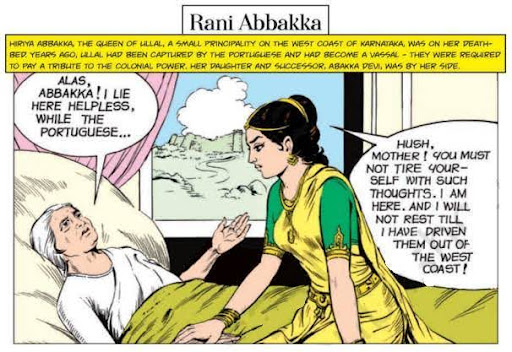
Rani Abbakka was the queen of Ullal, a small kingdom located on the western coast of Karnataka, a state in India. Many years before Abbakka became queen, while her mother was dying, the powerful Portuguese had taken control of Ullal. This meant Ullal became a “vassal” state, forced to pay taxes or tribute to the Portuguese, who were the foreign rulers of the region.
Abbakka, who was her mother’s daughter and next in line to be queen, was with her mother during her last moments. Her mother, feeling weak and unable to fight, expressed her distress about being helpless while the Portuguese controlled their land, but she couldn’t finish her sentence. Rani Abbakka comforted her, telling her not to worry. Abbakka promised that she would not rest until she had forced the Portuguese out of the west coast.
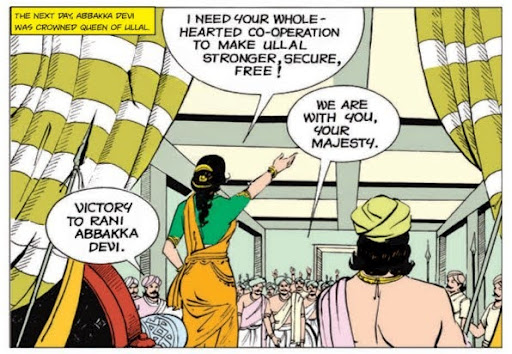
The very next day, Abbakka Devi was crowned the Queen of Ullal. She spoke to the people, asking for their full and honest cooperation to make Ullal strong, safe, and free. The crowd responded with great loyalty and support, cheering “Victory to Rani Abbakka Devi!”
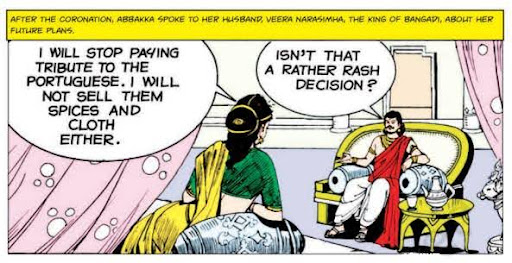
After being crowned, Rani Abbakka discussed her future plans with her husband, Veera Narasimha, who was the king of another place called Bangadi. She bravely declared that she would stop paying taxes to the Portuguese and would also refuse to sell them spices and cloth. Her husband questioned this decision, thinking it might be too quick and risky.
Veera Narasimha was worried that Rani Abbakka’s bold decision would put him in danger. He feared the Portuguese might suspect he was working with her, which could lead to his own kingdom, Bangadi, suffering the Portuguese’s anger. Because of this fear, he felt he had to convince Rani Abbakka to change her mind. However, Rani Abbakka responded by saying that he might be afraid of the Portuguese, but she refused to be intimidated by them, showing her great courage and determination.
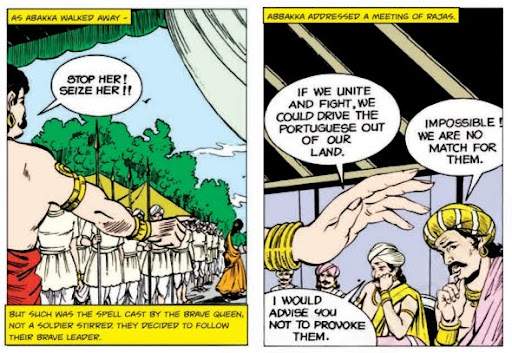
As Rani Abbakka walked away, her husband called out to his soldiers to stop and capture her. Yet, Queen Abbakka had such a strong and powerful presence that none of the soldiers moved. Instead, they chose to follow their brave leader. Rani Abbakka then held a meeting with other Rajas (rulers). She suggested that if they united and fought together, they could drive the Portuguese out of their land. One of the Rajas replied that it would be impossible, as they were no match for the Portuguese. Another ruler advised her not to provoke them, showing a lack of confidence and fear among some of the rulers.
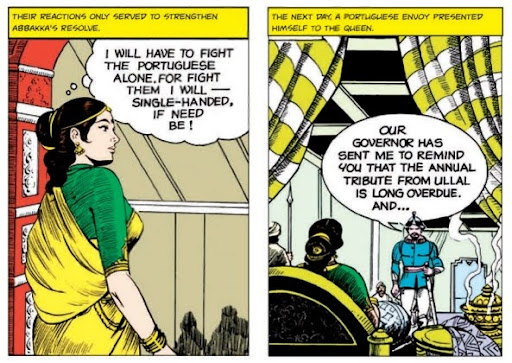
Hearing their fearful reactions only strengthened Rani Abbakka’s resolve. She declared that she would fight the Portuguese alone, even if she was the only one fighting. This demonstrated her extraordinary bravery and determination.
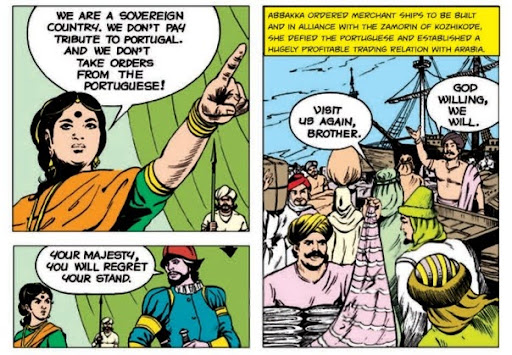
The very next day, a Portuguese officer arrived to meet the Queen. He announced that their Governor had sent him to remind her that Ullal’s annual tribute was long overdue, clearly demanding the payment. Rani Abbakka firmly asserted that Ullal was a sovereign country, meaning it was independent. She declared that they would not pay tribute to Portugal and would not take orders from them. This clearly showed Ullal’s independence and strong stand against Portuguese demands. The Portuguese envoy threatened her, saying she would regret her decision.
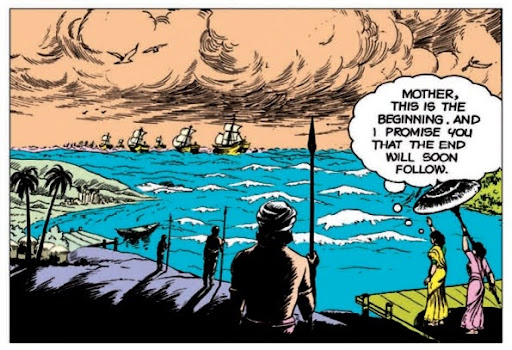
Ignoring the threat, Abbakka ordered merchant ships to be built. She also formed an alliance with the Zamorin of Kozhikode. She worked to hinder the Portuguese’s activities and successfully built a very profitable trading relationship with Arab merchants. The merchants of Ullal and the Arabs were on good terms, with Arab merchants inviting the Ullal merchants to visit again, and the Ullal merchants appreciating the connection. These actions highlighted her smart strategies to control trade and oppose Portuguese influence. Rani Abbakka thought about her mother and said that the growing trade between Arabs and Ullal was just the beginning, and the end of the Portuguese rule would soon follow.
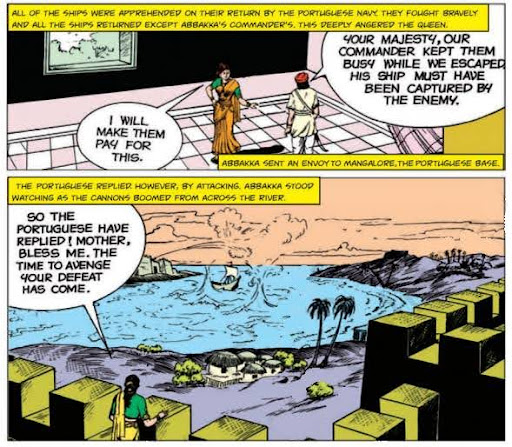
However, Queen Abbakka’s ships, despite fighting bravely, were stopped and captured by the Portuguese Navy when they were returning. All the ships returned except for her commander’s ship, suggesting that the commander was either captured or killed, and his ship was lost. Her soldier informed her that the commander kept the Portuguese busy so the other ships could escape, but his ship must have been captured. This loss greatly angered the Queen, who vowed to make the Portuguese pay.
Rani Abbakka sent her messenger to Mangalore, a Portuguese base. However, the Portuguese did not respond peacefully; instead, they reacted aggressively. They launched an attack, firing cannons from across a river, leading to a direct military confrontation. Queen Abbakka stood on her side of the river, observing the attack. She viewed the Portuguese attack as their challenge, which strengthened her resolve to fight back. Rani Abbakka sought a blessing for her mother, emphasizing how serious the situation was and how important it was to fight to avenge the previous defeat that her mother had faced.
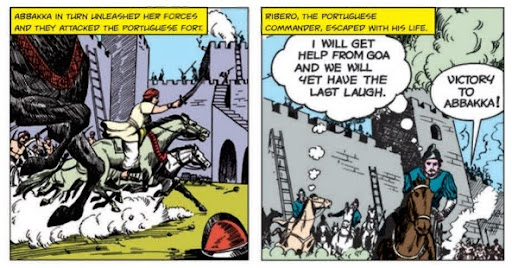
Abbakka then retaliated by launching an attack on a Portuguese fort. Her forces, including cavalry (soldiers on horseback) and infantry, bravely assaulted the fort. There was intense fighting, with soldiers clashing, arrows or spears flying, and fallen bodies on the ground. Ribeiro, the Portuguese commander, was shown on horseback, leading his troops. He appeared determined despite the difficult situation, with other Portuguese soldiers behind him, some fighting, some fallen. Ribeiro confidently believed that reinforcements from Goa, a major Portuguese stronghold, would arrive and bring them ultimate victory. This added a strategic element to the battle. However, Abbakka’s forces remained confident, shouting “Victory to Abbakka!”, showing their continued, direct, and strong will to fight. This part of the story clearly demonstrates Abbakka’s active and aggressive leadership against the Portuguese threat.
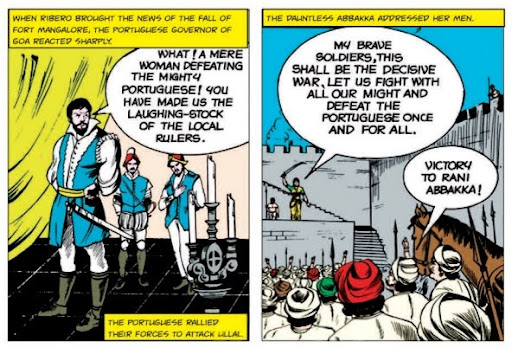
When Ribeiro brought the news that the fort had fallen to the Portuguese Governor in Goa, the Governor was very shocked and angry. He could not believe that “just a woman” had defeated the powerful Portuguese, making them look foolish to other local rulers. Following this, the Portuguese forces then gathered to attack Ullal.
After her important victory, the fearless Queen Abbakka spoke to her soldiers. She told them that this would be the final and most important battle. She encouraged them to fight with all their strength to completely defeat the Portuguese. Her soldiers cheered for her, ready to fight for their queen.
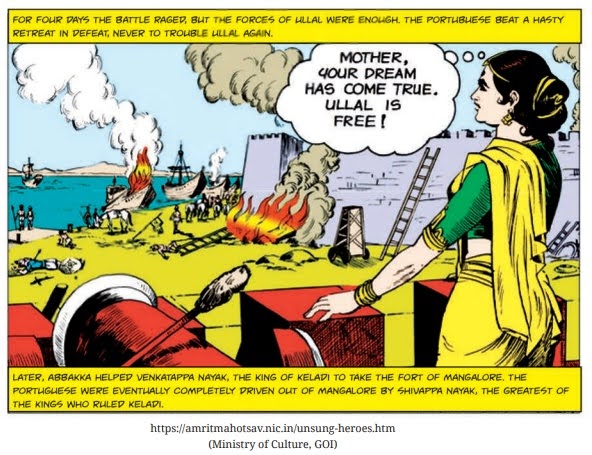
The fierce battle lasted for four days, but Ullal’s forces proved to be strong enough. The Portuguese were defeated and had to make a swift withdrawal, never to bother Ullal again. Queen Abbakka proudly announced that her mother’s dream had come true, and Ullal was now completely free.
Later, Queen Abbakka assisted Venkatappa Nayak, the King of Keladi, in taking over the fort of Mangalore from the Portuguese. Eventually, the Portuguese were completely driven out of Mangalore by Shivappa Nayak, who was known as the greatest among the kings who ruled Keladi.
Summary of the Lesson Rani Abbakka in Hindi
रानी अब्बक्का भारत के कर्नाटक राज्य के पश्चिमी तट पर स्थित एक छोटे से राज्य उल्लाल की रानी थीं। अब्बक्का के रानी बनने से कई साल पहले, जब उसकी माँ मर रही थी, शक्तिशाली पुर्तगालियों ने उल्लाल पर कब्जा कर लिया था। इसका मतलब था कि उल्लाल एक “जागीरदार” राज्य बन गया, जो पुर्तगालियों को कर या कर देने के लिए मजबूर था, जो इस क्षेत्र के विदेशी शासक थे।
अब्बक्का, जो उनकी माँ की बेटी थी और रानी बनने वाली अगली पंक्ति में थी, अपनी माँ के अंतिम क्षणों के दौरान उनके साथ थी। उसकी माँ, जो कमजोर महसूस कर रही थी और लड़ने में असमर्थ थी, ने असहाय होने के बारे में अपना दुख व्यक्त किया, जबकि पुर्तगालियों ने उनकी भूमि को नियंत्रित किया, लेकिन वह अपनी सजा पूरी नहीं कर सकी। रानी अब्बक्का ने उसे सांत्वना देते हुए कहा कि चिंता मत करो। अब्बक्का ने वादा किया कि जब तक वह पुर्तगालियों को पश्चिमी तट से बाहर नहीं निकालती, तब तक वह आराम नहीं करेगी।
अगले ही दिन अब्बक्का देवी को उल्लाल की रानी का ताज पहनाया गया। उन्होंने उल्लाल को मजबूत, सुरक्षित और स्वतंत्र बनाने के लिए लोगों से उनका पूरा और ईमानदार सहयोग मांगा। भीड़ ने बड़ी निष्ठा और समर्थन के साथ जवाब दिया, “रानी अब्बक्का देवी की जीत!”
ताज पहनने के बाद, रानी अब्बक्का ने अपने पति वीरा नरसिम्हा के साथ अपनी भविष्य की योजनाओं पर चर्चा की, जो बंगड़ी नामक एक अन्य स्थान के राजा थे। उसने बहादुरी से घोषणा की कि वह पुर्तगालियों को कर देना बंद कर देगी और उन्हें मसाले और कपड़े बेचने से भी इनकार कर देगी। उसके पति ने इस निर्णय पर सवाल उठाया, यह सोचकर कि यह बहुत जल्दी और जोखिम भरा हो सकता है।
वीरा नरसिम्हा को चिंता थी कि रानी अब्बक्का का साहसिक निर्णय उन्हें खतरे में डाल देगा। उसे डर था कि पुर्तगालियों को संदेह हो सकता है कि वह उसके साथ काम कर रहा था, जिससे उसका अपना राज्य, बंगादी, पुर्तगालियों के गुस्से का शिकार हो सकता है। इस डर के कारण, उन्हें लगा कि उन्हें रानी अब्बक्का को अपना मन बदलने के लिए राजी करना होगा। हालाँकि, रानी अब्बक्का ने यह कहकर जवाब दिया कि वह पुर्तगालियों से डर सकते हैं, लेकिन उन्होंने अपने महान साहस और दृढ़ संकल्प को दिखाते हुए उनसे डरने से इनकार कर दिया।
जैसे ही रानी अब्बक्का चली गईं, उनके पति ने अपने सैनिकों को रुकने और उन्हें पकड़ने के लिए कहा। फिर भी, रानी अब्बक्का की इतनी मजबूत और शक्तिशाली उपस्थिति थी कि कोई भी सैनिक नहीं हिलता था। इसके बजाय, उन्होंने अपने बहादुर नेता का अनुसरण करना चुना। रानी अब्बक्का ने तब अन्य राजाओं (शासकों) के साथ एक बैठक की उन्होंने सुझाव दिया कि अगर वे एकजुट हो जाते हैं और एक साथ लड़ते हैं, तो वे पुर्तगालियों को उनकी भूमि से बाहर निकाल सकते हैं। राजाओं में से एक ने जवाब दिया कि यह असंभव होगा, क्योंकि वे पुर्तगालियों के लिए कोई मुकाबला नहीं थे। एक अन्य शासक ने कुछ शासकों के बीच आत्मविश्वास और भय की कमी को दर्शाते हुए उन्हें उकसाने की सलाह नहीं दी।
उनकी भयावह प्रतिक्रियाओं को सुनकर रानी अब्बक्का का संकल्प और मजबूत हुआ। उसने घोषणा की कि वह अकेले पुर्तगालियों से लड़ेगी, भले ही वह अकेले ही लड़ रही हो। यह उनकी असाधारण बहादुरी और दृढ़ संकल्प को दर्शाता है।
अगले ही दिन एक पुर्तगाली अधिकारी रानी से मिलने आया। उन्होंने घोषणा की कि उनके राज्यपाल ने उन्हें यह याद दिलाने के लिए भेजा था कि उल्लाल की वार्षिक श्रद्धांजलि लंबे समय से लंबित थी, स्पष्ट रूप से भुगतान की मांग कर रहे थे। रानी अब्बक्का ने दृढ़ता से कहा कि उल्लाल एक संप्रभु देश था, जिसका अर्थ है कि यह स्वतंत्र था। उन्होंने घोषणा की कि वे पुर्तगाल को श्रद्धांजलि नहीं देंगे और उनसे आदेश नहीं लेंगे। यह स्पष्ट रूप से उल्लाल की स्वतंत्रता और पुर्तगाली मांगों के खिलाफ मजबूत रुख को दर्शाता है। पुर्तगाली राजदूत ने उसे धमकी देते हुए कहा कि उसे अपने फैसले पर पछतावा होगा।
खतरे को नजरअंदाज करते हुए, अब्बक्का ने व्यापारिक जहाजों के निर्माण का आदेश दिया। उन्होंने कोझिकोड के ज़मोरिन के साथ भी गठबंधन किया। उन्होंने पुर्तगालियों की गतिविधियों में बाधा डालने का काम किया और अरब व्यापारियों के साथ सफलतापूर्वक एक बहुत ही लाभदायक व्यापारिक संबंध बनाया। उल्लाल के व्यापारियों और अरबों के बीच अच्छे संबंध थे, अरब व्यापारियों ने उल्लाल व्यापारियों को फिर से आने के लिए आमंत्रित किया, और उल्लाल व्यापारियों ने इस संबंध की सराहना की। इन कार्यों ने व्यापार को नियंत्रित करने और पुर्तगाली प्रभाव का विरोध करने के लिए उनकी चतुर रणनीतियों को उजागर किया। रानी अब्बक्का ने अपनी माँ के बारे में सोचा और कहा कि अरबों और उल्लाल के बीच बढ़ता व्यापार सिर्फ शुरुआत थी, और पुर्तगाली शासन का अंत जल्द ही होगा।
हालाँकि, रानी अब्बक्का के जहाजों को बहादुरी से लड़ने के बावजूद, पुर्तगाली नौसेना ने रोक दिया और जब वे लौट रहे थे तो उन्हें पकड़ लिया। उसके कमांडर के जहाज को छोड़कर सभी जहाज लौट आए, यह सुझाव देते हुए कि कमांडर को या तो पकड़ लिया गया था या मार दिया गया था, और उसका जहाज खो गया था। उसके सैनिक ने उसे सूचित किया कि कमांडर ने पुर्तगालियों को व्यस्त रखा ताकि अन्य जहाज भाग सकें, लेकिन उसके जहाज पर कब्जा कर लिया गया होगा। इस नुकसान ने रानी को बहुत क्रोधित कर दिया, जिन्होंने पुर्तगालियों को भुगतान करने की कसम खाई।
रानी अब्बक्का ने अपने दूत को एक पुर्तगाली अड्डे मैंगलोर भेजा। हालाँकि, पुर्तगालियों ने शांतिपूर्वक प्रतिक्रिया नहीं दी; इसके बजाय, उन्होंने आक्रामक प्रतिक्रिया व्यक्त की। उन्होंने एक हमला किया, एक नदी के पार से तोपें दागीं, जिससे सीधा सैन्य टकराव हुआ। रानी अब्बक्का नदी के किनारे खड़ी होकर हमले को देख रही थी। उन्होंने पुर्तगाली हमले को अपनी चुनौती के रूप में देखा, जिसने वापस लड़ने के उनके संकल्प को मजबूत किया। रानी अब्बक्का ने अपनी माँ के लिए आशीर्वाद मांगा, इस बात पर जोर देते हुए कि स्थिति कितनी गंभीर थी और पिछली हार का बदला लेने के लिए लड़ना कितना महत्वपूर्ण था जिसका सामना उनकी माँ ने किया था।
अब्बक्का ने तब एक पुर्तगाली किले पर हमला करके जवाबी कार्रवाई की। घुड़सवार सेना (घोड़े पर सवार सैनिक) और पैदल सेना सहित उनकी सेना ने किले पर बहादुरी से हमला किया। तीव्र लड़ाई होती थी, जिसमें सैनिकों की झड़प होती थी, तीर या भाले उड़ते थे, और जमीन पर शव गिरते थे। पुर्तगाली सेनापति रिबेरो को घोड़े पर सवार होकर अपने सैनिकों का नेतृत्व करते हुए दिखाया गया था। कठिन परिस्थिति के बावजूद वह दृढ़ प्रतीत हुआ, उसके पीछे अन्य पुर्तगाली सैनिक थे, जिनमें से कुछ लड़ रहे थे, कुछ मारे गए थे। रिबेरो को विश्वास था कि पुर्तगालियों के एक प्रमुख गढ़ गोवा से अतिरिक्त बल आएंगे और उन्हें अंतिम जीत दिलाएंगे। इसने लड़ाई में एक रणनीतिक तत्व जोड़ा। हालाँकि, अब्बक्का की सेना आत्मविश्वास से भरी रही, “अब्बक्का की जीत! “, लड़ने के लिए उनकी निरंतर, प्रत्यक्ष और मजबूत इच्छाशक्ति को दर्शाते हुए। कहानी का यह हिस्सा स्पष्ट रूप से पुर्तगाली खतरे के खिलाफ अब्बक्का के सक्रिय और आक्रामक नेतृत्व को दर्शाता है।
जब रिबेरो ने यह खबर गोवा में पुर्तगाली राज्यपाल को दी कि किला गिर गया है, तो राज्यपाल बहुत हैरान और गुस्से में थे। उन्हें विश्वास नहीं हो रहा था कि “सिर्फ एक महिला” ने शक्तिशाली पुर्तगालियों को हरा दिया था, जिससे वे अन्य स्थानीय शासकों को मूर्ख लग रहे थे। इसके बाद, पुर्तगाली सेना उल्लाल पर हमला करने के लिए इकट्ठा हुई।
अपनी महत्वपूर्ण जीत के बाद, निडर रानी अब्बक्का ने अपने सैनिकों से बात की। उसने उनसे कहा कि यह अंतिम और सबसे महत्वपूर्ण लड़ाई होगी। उन्होंने पुर्तगालियों को पूरी तरह से हराने के लिए उन्हें अपनी पूरी ताकत से लड़ने के लिए प्रोत्साहित किया। उसके सैनिक उसकी जय-जयकार करने लगे, अपनी रानी के लिए लड़ने के लिए तैयार थे।
भयंकर लड़ाई चार दिनों तक चली, लेकिन उल्लाल की सेना काफी मजबूत साबित हुई। पुर्तगालियों को हार का सामना करना पड़ा और उन्हें तेजी से पीछे हटना पड़ा, जिससे उल्लाल को फिर कभी परेशान नहीं करना पड़ा। रानी अब्बक्का ने गर्व से घोषणा की कि उनकी माँ का सपना सच हो गया है, और उल्लाल अब पूरी तरह से मुक्त हो गया था।
बाद में, रानी अब्बक्का ने पुर्तगालियों से मैंगलोर के किले पर कब्जा करने में केलाडी के राजा वेंकटप्पा नायक की सहायता की। आखिरकार, पुर्तगालियों को शिवप्पा नायक द्वारा मैंगलोर से पूरी तरह से बाहर निकाल दिया गया, जिन्हें केलाडी पर शासन करने वाले राजाओं में सबसे महान के रूप में जाना जाता था।
Rani Abbakka Themes
Resistance Against Colonialism/Foreign Domination
This is the most central theme. The entire narrative revolves around Ullal’s struggle against the Portuguese, who are presented as an oppressive foreign power demanding tribute and control. Rani Abbakka’s unwavering refusal to submit, her strategic actions to counter Portuguese influence, and her direct military confrontations all exemplify active resistance against colonial rule. The story highlights the fight for independence and self-determination against a powerful invading force.
Leadership and Courage
Rani Abbakka embodies exceptional leadership and courage. From her deathbed promise to her mother to her defiant stance against the Portuguese envoy, and her rallying of her troops, she consistently displays fearlessness and determination. Even when other Rajas are hesitant or fearful, she declares her willingness to fight alone. Her ability to inspire loyalty in her soldiers, even against her husband’s orders, further underscores her powerful leadership qualities.
Patriotism and Love for Homeland
Abbakka’s actions are deeply rooted in her love for Ullal and her desire to see it free. Her final declaration, “Ullal is free!” and her mother’s dying wish, demonstrate a profound connection to their land and a commitment to its sovereignty. The unwavering support of her people also reflects a shared sense of patriotism and the collective desire to protect their homeland from foreign control.
Gender Equality and Challenging Stereotypes
A significant theme is the defiance of gender stereotypes, particularly evident in the Portuguese Governor’s reaction. He is utterly shocked and insulted that a “mere woman” could defeat the mighty Portuguese, calling them “the laughing-stock of the local rulers.” This highlights the prevalent sexism of the time. However, Rani Abbakka’s military prowess, strategic thinking, and fearless leadership directly challenge these patriarchal views, proving that a woman can be an incredibly effective and powerful ruler and warrior, even in a male-dominated world.
Strategic Thinking and Diplomacy
Beyond just direct confrontation, Abbakka demonstrates astute strategic thinking. She builds merchant ships, forms alliances with the Zamorin of Kozhikode, and establishes profitable trade relations with Arabs. She also initially sends an envoy to Mangalore, indicating an attempt at diplomatic engagement before resorting to war. These actions show a holistic approach to governance and defense, not just brute force.
Unity and Disunity
The theme of unity is explored through the mixed reactions of the other Rajas. While some are fearful and advise caution, Abbakka advocates for collective action, believing that “if they unite and fight, they could drive the Portuguese out.” Her eventual success, even when seemingly fighting alone or with limited support, highlights the power of conviction, but the later detail about her helping Venkatappa Nayak and Shivappa Nayak driving out the Portuguese from Mangalore reinforces the ultimate effectiveness of broader regional unity in achieving colonial expulsion.
Legacy and Inspiration
The story concludes with Abbakka continuing to aid other rulers in their fight against the Portuguese, and Shivappa Nayak ultimately driving them out of Mangalore. This suggests that Abbakka’s bravery and successes not only freed Ullal but also served as an inspiration and catalyst for a broader movement against the Portuguese in the region, leaving a lasting legacy of resistance and contributing to the eventual expulsion of the colonial power from the area.
Rani Abbakka Lesson Explanation
Word meanings
Rani Abbakka: “Rani” means Queen. So, Queen Abbakka.
Ullal: The name of a small kingdom or territory.
Small Principality: A small kingdom or state ruled by a prince or, in this case, a queen.
West Coast of Karnataka: The western part of the state of Karnataka in India, which borders the Arabian Sea.
Portuguese: People from Portugal, a European country, who were colonial invaders in India.
Vassal: A state or country that is dependent on a more powerful one, often forced to pay tribute or taxes to it.
Tribute: A payment made by one ruler or state to another as a sign of dependence or for protection.
Colonial Power: A foreign country that has control over another country or territory, often for economic or strategic reasons.
Successor: Her child (daughter) who will take over the throne (become queen) after her.
By her side: Next to her.
Helpless: Unable to defend oneself or do anything to change a situation.
Hush: An exclamation used to tell someone to be quiet or to calm down.
Tire yourself: Make yourself feel weary or exhausted.
Thoughts: Ideas or worries.
Rest: Stop working or fighting; take a break.
Driven them out: Forced them to leave.
Explanation of the above passage—Rani Abbakka was the queen of Ullal, which was a small kingdom on the western coast of Karnataka (a state in India). Many years ago, when her mother was dying, Ullal had been taken over by the Portuguese. Ullal had become a “vassal,” meaning it was forced to pay taxes or tribute to the Portuguese, who were the colonial power (foreign rulers). Rani Abbakka, who was her mother’s daughter and the next in line to be queen, was by her mother’s side. Her mother, feeling weak and unable to fight, said to Abbakka that she had been lying here helpless while the Portuguese…She couldn’t finish her sentence, indicating her distress. Rani Abbakka comforted her mother, saying that she must not make herself tired with such thoughts. She was there and she will not rest until she has forced them out of the west coast!
Passage:
Word meanings
Crowned: To place a crown on someone’s head as a symbol of becoming a king, queen, or ruler.
Whole-hearted: Complete and sincere; with full effort and feeling.
Co-operation: Working together with others to achieve a common goal.
Majesty: A title used when addressing or referring to a king, queen, or emperor.
Victory: The act of winning a battle, game, or competition; triumph.
Explanation of the above passage—The next day, Abbakka Devi (Rani Abbakka) was crowned the Queen of Ullal. Rani Abbakka speaks to the crowd that she needs their complete and honest cooperation to make Ullal strong, safe and free. The crowd responded that they were with her. This shows their loyalty and support. Someone from the crowd exclaimed victory to Rani Abbakka Devi!
Passage:
Word meanings
Coronation: The ceremony where a king or queen is officially crowned and begins their rule.
Veera Narasimha: The name of her husband.
Bangadi: The name of another kingdom or place where her husband is king.
Future plans: What she intends to do next or in the time to come.
Spices: Aromatic substances from plants (like pepper, cardamom, etc.) used to flavor food. India was famous for its spices, which were highly valuable in trade.
Rash decision: A decision made too quickly, without careful thought, and possibly leading to bad consequences.
Explanation of the above passage—After Rani Abbakka was crowned queen, she spoke to her husband, Veera Narasimha, who was the king of another place called Bangadi. She told him about her future plans. Rani Abbakka said that she will stop paying taxes (tribute) to the Portuguese. Also, she will not sell them spices and cloth. Her husband questioned if it wasn’t a rather hasty decision. This shows he might be worried or thinks she is acting too quickly.
Passage:

Word meanings
Dangerous: Likely to cause harm or problems.
In league with her: Working together or secretly allied with her.
Bangadi: The name of the kingdom ruled by Rani Abbakka’s husband.
Wrath: Intense anger; fury.
Make her change her mind: Convince her to alter her decision.
Afraid: Scared; feeling fear.
Refuse: To say no; to not agree to do something.
Cowed by them: Intimidated or frightened into submission by them; made to feel afraid and give in.
Explanation of the above passage—Veera Narasimha is worried that Rani Abbakka’s decision (to stop paying tribute and trading with the Portuguese) is dangerous for him. He fears that the Portuguese might think he is working together with her. If they think this, his kingdom, Bangadi, might also have to suffer the anger of the Portuguese. Because of this fear, he feels he must convince Rani Abbakka to change her decision. Rani Abbakka responds by saying that he might be scared of the Portuguese. But she refuses to be intimidated by them. This shows her bravery and determination.
Passage:
Word meanings
Walked away: Moved away from a place.
Seize: To take hold of suddenly and forcibly.
Spell cast by the brave queen: The powerful effect or influence that the queen had on the soldiers, making them do what she wanted.
Stirred: Moved even slightly.
Decided to follow: Chose to go with or obey.
Brave leader: A courageous person who guides others.|
Addressed a meeting of Rajas: Spoke to a gathering of kings or rulers.
Unite: To come together for a common purpose; to join forces.
Drive out: To force someone to leave a place.
Impossible: Not able to be done or to happen.
No match for them: Not strong or skilled enough to compete with them successfully.
Explanation of the above passage—As Rani Abbakka was walking away, her husband shouted to Stop and catch her. However, the brave queen had such a powerful effect on the soldiers that none of them moved. Instead, they decided to follow their courageous leader. Rani Abbakka then addressed a meeting of Rajas. She said that if they unite and fight, they could drive the Portuguese out of their land. One of the Rajas replied that it would be impossible. They are no match for them. Another ruler advised her not to provoke Portuguese. This shows a lack of confidence or fear among some of the rulers.
Passage:
Word meanings
Reactions: Responses or ways of acting in response to something.
Strengthen: To make something stronger or more determined.
Abbakka’s resolve: Rani Abbakka’s strong determination or firmness of purpose.
Fight alone: To battle by oneself, without help from others.
Provoke: To intentionally make someone angry or cause a reaction.
Portuguese Envoy: A representative or messenger sent by the Portuguese (in this case, an officer).
Presented himself to the queen: Introduced himself or appeared before the queen.
Governor: A person who is the official head of a state or region, often a colonial power’s representative.
Remind: To cause someone to remember something.
Annual: Happening once every year.
Ullal: The name of Rani Abbakka’s kingdom.
Long overdue: Something that should have been done or paid a long time ago.
Explanation of the above passage—Rani Abbakka’s determination only grew stronger after hearing the fearful reactions of the Rajas. She declared that she will fight the Portuguese alone! If needed, she will fight them even if she was the only one. This shows her extreme bravery and resolve. The very next day, a Portuguese officer came to meet the Queen. He announced that their Governor has sent him to remind her that the annual tribute for Ullal is long overdue, and…” (he left the sentence incomplete but it’s clear he’s demanding the payment).
Passage:
Word meanings
Sovereign Country: a political unit that is independent and self-governing, with its own government and territory, and is not under the authority of any other country or entity.
Alliance: a union or association formed for mutual benefit, especially between countries or organizations.
Defied: openly resist or refuse to obey.
Explanation of the above passage—She asserts that Ullal is a sovereign country. She firmly states that they would not pay tribute to Portugal and won’t take orders from the Portuguese. This highlights Ullal’s independence and its strong stance against Portuguese demands. The Portuguese envoy threatened the consequences for her refusal, by saying that she will regret her stand. Abbakka ordered merchant ships to be built and in alliance with the Zamorin of Kozhikode. She hindered the Portuguese and established a highly profitable trading relation with Arabs. The merchants of Ullal and Arabs are on good terms, as the Arab merchants invite the Ullu merchants to visit them again, while the Ullu merchant appreciated. It shows her strategic actions to control trade and counter Portuguese influence.
Passage:
Word meanings
The end will soon follow: a conclusion, resolution, or final outcome is imminent or expected to happen in a short period of time.
Explanation of the above passage—Rani Abbakka reminisces about her mother and says that the trade between Arabs and Ullal is just the beginning and the Portuguese’s end will follow.
Passage:
Word meanings
Apprehended: Caught or taken into custody.
Canon: a large gun, usually on wheels, which used to be used in battles
Avenge: To harm or punish someone in return for an injury or wrong done to oneself or to someone one cares about.
Explanation of the above passage—Queen Abbakka’s ships, despite fighting bravely, were intercepted and captured by the Portuguese Navy on their return journey. All returned except for her commander’s ship, implying the commander was either captured or killed, and their ship was lost. Her soldier told her that the commander kept the Portuguese busy, while the other ships escaped. Commander’s ship must have been captured by the Portuguese. This loss has greatly angered the Queen as she says she will make them pay. Rani Abbakka sends her envoy to Mangalore, the Portuguese base. The Portuguese response to Abbakka’s envoy was not diplomatic but aggressive. They launched an attack, with cannon fire coming from across a river, indicating a direct military confrontation. On Abbakka’s side of the river, there are some huts or small buildings under palm trees. Queen Abbakka stands on her side of the river, observing the attack. Portuguese attack is viewed as their response, and it fuels the resolve to fight back. Rani Abbakka seeks blessing for her mother emphasizing the gravity of the situation and the impending battle to avenge the previous defeat her mother has faced.
Passage:
Word meanings
Unleashed: To release from a leash or restraint; to allow or cause to operate at full force. In this context, it means Abbakka released her forces to attack with full intensity.
Goa: A state on the southwestern coast of India, which was historically the capital of Portuguese India and a major Portuguese stronghold. Ribeiro expects help from this key Portuguese base.
The Last Laugh: To finally triumph after being defeated or scorned, especially after a long period of adversity or difficulty. Ribeiro means he believes the Portuguese will ultimately be victorious despite the current situation.
Explanation of the above passage—Abbakka is now retaliating by launching an offensive against a Portuguese fort. Abbakka’s forces, including cavalry (soldiers on horseback) and infantry attacked the Portuguese fort. There’s intense action on the Portuguese Fort with soldiers clashing, arrows or spears flying, and bodies on the ground. Ribeiro, the Portuguese commander, is shown on horseback, leading his troops. He appears determined despite the dire situation. Behind him, there are more Portuguese soldiers, some on the ground, some still fighting. He is confident that reinforcements from Goa (a major Portuguese stronghold in India) will arrive, and they will ultimately be victorious. This adds a layer of strategic expectation to the battle. However, Abbakka’s forces remain confident, shouting “Victory to Abbakka!”, signifying the ongoing, direct, and determined military conflict. It shows Abbakka’s active and aggressive leadership in response to the Portuguese threat.
Passage:
Word meanings
Boomed: Made a deep, resonant sound, like thunder or a cannon.
Mighty: Having great power or strength.
Laughing-stock: A person or thing that is the object of ridicule; someone or something that is made fun of.
Dauntless: Fearless and determined.
Once and for all: Completely and finally.
Explanation of the above passage—When Ribeiro brought the news of the fort’s fall to the Portuguese Governor in Goa, the Governor was very shocked and angry. He could not believe that “just a woman” had defeated the mighty Portuguese, which made them look foolish to other local rulers. The Portuguese forces then came together to attack Ullal. After her victory, the fearless Queen Abbakka spoke to her soldiers. She told them that this was going to be the final and important battle. She encouraged them to fight with all their strength to defeat the Portuguese completely. Her soldiers cheered for her, ready to fight for their queen.
Passage:
Word meanings
Raged: Continued with great violence or intensity. In this context, it means the battle was very fierce and active.
Hasty retreat: A quick and hurried withdrawal, usually from a dangerous situation or a battle. “Hasty” means done quickly and with little thought.
Dream has come true: A long-held wish or ambition has been realized.
Eventually: In the end, especially after a long delay or much difficulty.
Driven out: Forced to leave a place or position.
Explanation of the above passage—For four days, a fierce battle took place, but the forces of Ullal proved to be strong enough. The Portuguese were defeated and had to make a swift withdrawal, never to bother Ullal again. Queen Abbakka proudly announced that her mother’s dream had come true, and Ullal was now free. Later, Queen Abbakka assisted Venkatappa Nayak, the King of Keladi, in capturing the fort of Mangalore. Eventually, the Portuguese were entirely driven out of Mangalore by Shivappa Nayak, who was considered the greatest among the kings who ruled Keladi.
Conclusion
Rani Abbakka is a play about Abbakka’s fierce determination to protect her homeland and people from foreign rule. Facing immense challenges, Rani Abbakka stands as a symbol of courage and resistance, fighting tirelessly to ensure Ullal’s freedom and independence. Students can take help from this post to understand the play and also learn the difficult word meanings to get a better grasp of Rani Abbakka. This lesson includes a summary of Rani Abbakka, which will help students in class 7 to get a quick recap of the play.