
My Brother’s Great Invention Summary and Explanation
CBSE Class 7 English Unit 3 Dreams and Discoveries Chapter 1- My Brother’s Great Invention Summary, Explanation along with Difficult Word Meanings from Poorvi Book
My Brother’s Great Invention Summary – Are you looking for the summary, theme and Lesson explanation for CBSE Class 7 English Unit 3 Dreams and Discoveries Chapter 1 – My Brother’s Great Invention from English Poorvi Book. Get Lesson summary, theme, explanation along with difficult word meanings
CBSE Class 7 English Unit 3 Dreams and Discoveries Chapter 1 – My Brother’s Great Invention
Anita Rau Badami
The lesson “My Brother’s Great Invention” by Anita Rau Badami is a funny and interesting story about two siblings, Anand and the narrator. Anand is a clever and curious boy who loves to invent new things, even if it means using parts from household gadgets. His family is always worried about what he might take apart next. One day, he decides to make a time machine, and things quickly get exciting and strange. The story shows how Anand’s wild ideas often lead to unexpected situations.
- My Brother’s Great Invention Summary
- My Brother’s Great Invention Summary in Hindi
- My Brother’s Great Invention Theme
- My Brother’s Great Invention Explanation
Related:
- My Brother’s Great Invention Question Answers
- My Brother’s Great Invention Character Sketch
- Class 7 English Summary and Lesson Notes
My Brother’s Great Invention Summary
The lesson “My Brother’s Great Invention” by Anita Rau Badami tells us about a boy named Anand who loves inventing new things. Anand is very creative and curious. Due to an increase in thefts in their neighborhood, Anand decides to build a burglar alarm to keep their house safe. His sister helps him, even though she would rather finish reading her book. Anand carefully plans and builds the alarm using wires, bells, and switches. Later, Anand wants to build something even bigger, a time machine. He takes apart many things in the house to collect parts, which makes a lot of noise and worries their parents. Anand’s room becomes full of wires, springs, and bulbs, and he looks messy because he spends so much time working. One night, Anand and his sister hear strange noises at the door. A man with a green scarf appears and enters the house. They discover that the man has somehow gone into the time machine. Everyone wonders where the man went and what will happen next. The story shows how Anand’s imagination and inventions lead to exciting and surprising events.
Summary of the Lesson My Brother’s Great Invention in Hindi
अनीता राऊ बादामी द्वारा लिखित पाठ “मेरे भाई का महान आविष्कार” हमें आनंद नाम के एक लड़के के बारे में बताता है जिसे नई चीजों का आविष्कार करना बहुत पसंद है। आनंद बहुत रचनात्मक और जिज्ञासु है। अपने पड़ोस में चोरी की घटनाओं में वृद्धि के कारण, आनंद अपने घर को सुरक्षित रखने के लिए एक चोर अलार्म बनाने का फैसला करता है। उसकी बहन उसकी मदद करती है, भले ही वह अपनी किताब पढ़ना खत्म करना चाहती हो। आनंद सावधानी से योजना बनाता है और तारों, घंटियों और स्विच का उपयोग करके अलार्म बनाता है। बाद में, आनंद कुछ और भी बड़ा बनाना चाहता है, एक टाइम मशीन। वह घर में कई चीजों को अलग करके पुर्जे इकट्ठा करता है, जिससे बहुत शोर होता है और उनके माता-पिता चिंतित हो जाते हैं। आनंद का कमरा तारों, स्प्रिंग और बल्बों से भर जाता है, और वह गन्दा दिखता है क्योंकि वह बहुत समय काम में बिताता है। एक रात, आनंद और उसकी बहन को दरवाजे पर अजीब सी आवाज़ें सुनाई देती हैं। हरे रंग का दुपट्टा पहने एक आदमी दिखाई देता है और घर में प्रवेश करता है। उन्हें पता चलता है कि वह आदमी किसी तरह टाइम मशीन में चला गया है। हर कोई हैरान है कि वह आदमी कहाँ गया और आगे क्या होगा। कहानी दिखाती है कि कैसे आनंद की कल्पना और आविष्कार रोमांचक और आश्चर्यजनक घटनाओं को जन्म देते हैं।
Theme of the Lesson My Brother’s Great Invention
The lesson “My Brother’s Great Invention” by Anita Rau Badami revolves around the following themes:-
Creativity and Imagination
The story highlights Anand’s creative thinking. He is always full of new ideas and wants to invent something useful, like a burglar alarm or even a time machine. His imagination turns his room into a workshop filled with wires, switches, and strange machines. This theme shows how creativity can make even an ordinary day feel exciting and full of possibilities. Anand’s love for inventing teaches us that using our imagination can help us dream big and think differently.
Family Support
Even though Anand’s inventions can be noisy and messy, his family doesn’t stop him. His sister, who tells the story, helps him even when she’d rather read her novel. Their parents, though sometimes worried, allow Anand to experiment. This shows how important it is for families to support each other’s passions. When someone in the family is trying something new, others play a big role by being patient, helpful, and encouraging.
Curiosity and Experimentation
Anand’s inventions are born from his deep curiosity about how things work. He takes apart gadgets, draws blueprints, and keeps testing different ideas. He learns through trying and making mistakes. This theme tells us that being curious and experimenting helps us learn and grow. It also reminds us that learning doesn’t always come from books, it can come from doing things with our hands and thinking through problems on our own.
Teamwork and Cooperation
Anand doesn’t work alone. His sister helps him set up wires, test ideas, and even deal with emergencies. Though she complains at times, she’s always there when needed. They solve problems together, especially when things get scary with the burglar. This theme shows that teamwork makes a big difference. Sharing ideas, dividing tasks, and helping each other are key to achieving success, especially when working on something big.
My Brother’s Great Invention Passage Explanation
Passage:
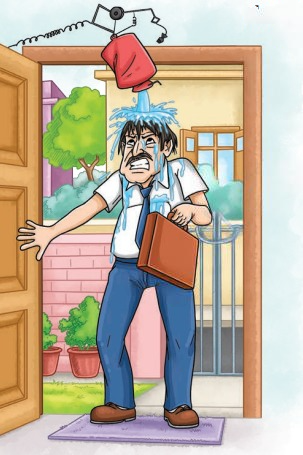
“Who put that water bag here?” roared my father from the front doorstep. “Your burglar alarm,” I hissed to my brother Anand, who was getting ready to disappear from the house. Ma rushed in to see what the racket was all about and found Papa standing there, sopping wet and scowling.
Word Meanings:
racket (n): a loud and disturbing noise
sopping (adj.): soaking
scowling (adj.): having an angry or frowning expression
Explanation of the above passage: The story begins with a funny moment. The narrator’s father steps inside the house and gets soaked by a water bag. He becomes angry and shouts, “Who put that water bag here?” The narrator quickly tells her brother Anand that it was his burglar alarm. Anand had created the alarm to stop burglars, but it accidentally soaked their father instead. Anand starts getting ready to run away so he doesn’t get scolded. Their mother hears the noise and rushes in. She sees her husband standing at the door, completely wet and very angry.
Passage:
“I want to know who is behind this nonsense,” Papa said grimly.
“I think it’s supposed to be a burglar alarm,” Ma said, in a soothing voice.
“I don’t care what it’s supposed to be,” Papa said.
“Where’s that boy? I’m sure he rigged this up.”
Word Meanings:
grimly (adv): in a worried, serious, or sad way
burglar (n): a person who illegally enters buildings and steals things
soothing (adj.): having a gently calming effect
rigged up (v): assembled something temporarily
Explanation of the above passage: Papa becomes very serious and says he wants to find out who is responsible for the mess. Ma tries to calm him down and explains that it is probably meant to be a burglar alarm. But Papa is too angry to care about what it’s supposed to be. He just wants to know who did it. He guesses that Anand is the one who made the alarm and demands to know where he is. He is sure that Anand is behind this whole situation.
Passage:
Anand had vanished by this time and reappeared only after dinner when Papa had cooled down.
Before this story, let me put you in the picture. I am Anita, fourteen years old. My brother Anand, one year younger than me, caused all that hoo-ha with his burglar alarm. And this is not the first time he’s got on Papa’s nerves or frightened someone half to death in the house. The trouble with him is that he thinks he is a scientist. He loves tinkering with all sorts of electrical gadgets, tools, dynamos, planks of wood, and things like that. And he keeps creating ‘inventions’ that never work out as they are supposed to.
Word Meanings:
hoo-ha (n): an occasion when there is too much interest in or discussion about something that is not important
nerves (phrase): worry or anxiety about something that is going to happen
frightened (adj.): feeling fear or worry
tinkering (v): experimenting or fiddling
dynamos (n): electric generator
Explanation of the above passage: In this passage, the narrator tells us about her younger brother Anand and his habit of making strange inventions. After their father became angry because of a failed invention, Anand disappeared for a while and only came back after their father had calmed down. The narrator then gives some background information. She is a 14-year-old girl, and Anand is one year younger to her. Anand is always trying to invent something using wires, wood, tools, and other household items. He calls himself a scientist, but most of his inventions never work properly. These failed experiments often create trouble at home, annoy their father, and sometimes even scare the family.
Passage:
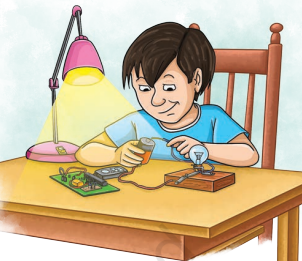
Recently there had been a rush of thefts in the colony and Anand had got it into his head that what was needed was a burglar alarm. So, the minute Papa left for the office and Ma for the market, he started on his latest scheme. As usual I had to be involved, though I’d have preferred to finish my novel. “If you get a shelling, don’t bring me in,” I warned Anand.
“Nothing will go wrong this time. I’ve planned it out carefully. See the blueprint.”
Anand loves words like blueprint—it makes him feel professional! Anyway, I looked at the elaborate drawing of doors, wires, and bells and asked, “How does this thing work?”
Word Meanings:
shelling (n): here, a scolding or getting shouted at
blueprint (n): a photographic copy of an early plan for a building or machine
elaborate (adj.): detailed
Explanation of the above passage: Anand got the idea to make a burglar alarm because there had been many thefts in their colony. As soon as their father left for work and their mother went to the market, Anand began working on his new invention. Like always, he involved his sister, the narrator, even though she wanted to relax and read her novel. She warned him not to blame her if anything went wrong. Anand confidently said that nothing would go wrong because he had planned everything carefully. He even showed her a “blueprint”—a detailed drawing of how the alarm system would work using doors, wires, and bells. The narrator adds that Anand likes using technical words like “blueprint” because it makes him feel like a real scientist.
Passage:
“It’s quite simple. The moment the door opens, this alarm is tripped off and makes a clanging sound. Then this water bag here is loosened and falls on the thief’s head. By then we call the police—simple!”
Word Meanings:
clanging (v): a loud ringing sound like that of a metal being hit
Explanation of the above passage: Anand explains how his burglar alarm works. He says it’s very simple. When someone opens the door, the alarm will be triggered and make a loud, clanging noise to alert everyone. At the same time, a water bag will be released and fall on the thief’s head to scare them away. While all this happens, they plan to call the police for help. Anand thinks this plan is easy and effective for catching thieves.
Passage:
“But how does the alarm know that a burglar is opening the door?”
I’ve taken care of that,” Anand said loftily. I had my own doubts about the alarm’s guessing powers, but kept them to myself because when Anand is in one of his inventive moods, nothing stops him.
“You see,” Anand explained smugly, “A thief tries to open the door stealthily. I’ve rigged it up so that the alarm works only when the door is opened gently.”
Word Meanings:
loftily (adv): in a way that shows you think you are better than other people
smugly (adv): proudly
stealthily (adv): quietly or carefully so that one is not seen or heard
rigged (v): set up
Explanation of the above passage: In this passage, the narrator asks Anand how the alarm can identify if the one opening the door is a thief. Anand proudly says that he has thought of everything. Although the narrator is doubtful, she doesn’t say anything because Anand gets very serious when he’s inventing. Anand then explains that his alarm is designed to work only when the door is opened gently, like a thief would try to do quietly. This way, the alarm will catch the burglar but not go off for normal door openings.
Passage:
I was sceptical. “Remember, if Papa asks, I’m not involved,” I warned. “Now clean up this mess before anyone gets home.”
As you already know, my doubts about the alarm were quite justified. Papa, who always opens the door softly, was thoroughly soaked and angry as angry could be. Anyway, for a week after this, Anand did not dare try out anything new. Then we saw this film ‘Back to the Future’. I don’t know if you have seen it, but it’s all about a time machine. Well, that was the end of peace and quiet in the house.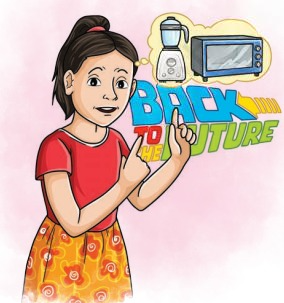
Word Meanings:
sceptical (adj.): doubtful
justified (adj.): having a good reason for something
soaked (adj.): extremely wet
Explanation of the above passage: Anita did not really believe Anand’s alarm would work properly. She even told him that if their father asked, she would not admit that she had helped him. She also told Anand to clean up the mess before anyone came home. As expected, the alarm didn’t work as planned. Their father, who always opens the door gently, got soaked by the water bag and became very angry. After this, Anand didn’t try any new inventions for a week. But then they watched a movie called Back to the Future, about a time machine, and from that moment, the house became noisy and chaotic again because Anand started inventing something new.
Passage:
My brother decided that he had to make a time machine too. Papa locked up his tool box and hid the key while Ma kept a wary eye on her oven and mixer. Because, as I told you, when Anand is on one of his inventing binges, he takes apart all the gadgets in the house to collect parts. You can’t imagine the noise that was going on—hammering and sawing and clattering. Anand’s room, next to our room, was transformed into a network of wires, springs, levers, and bulbs. There was an enormous panel which was to be control switchboard. As for Anand, he went around looking like a savage. When Ma didn’t notice, the fellow didn’t even comb his hair.
Anand just wouldn’t let anyone into his room. Finally, after a fortnight of frantic activity, the time machine was ready. “We can try it out tonight,” Anand announced to everyone at home at lunch time.
Word Meanings:
wary (adj.): not completely trusting or certain about something or someone
hammering (v): the sound or activity of someone or something loudly and repeatedly hitting or knocking something
sawing (v): to cut something using a saw
clattering (v): to make continuous loud noises by hitting hard objects against each other, or to cause objects to do this
springs (n): a tool used in construction
levers (n): a bar or handle which moves around a fixed point
enormous (adj.): very large in size
switchboard (n): an apparatus for connections between electric circuits in other applications
savage (adj.): uncontrolled and wild
frantic (adj.): hurried and disorganised
Explanation of the above passage: Anand decided to build a time machine just like the one in the movie. Their father was so worried about Anand breaking things that he locked up his toolbox and hid the key. Their mother also kept a close watch on her kitchen appliances because Anand usually took apart gadgets around the house to use their parts for his inventions. The house was full of loud noises like hammering and sawing because Anand was busy working. His room was full of wires, springs, levers, and bulbs, and there was a big control panel that was supposed to operate the time machine. Anand looked wild and messy since he didn’t even comb his hair. He wouldn’t let anyone enter his room while he was working. After two weeks of hard work, Anand finally finished the time machine and announced at lunch that they could try it out that very night.
Passage:
“I don’t know what you’ve been up to in that room, but you’re not trying out anything new,” Papa said firmly.
“But it’s a time machine! I’ve invented it,” Anand protested.
“When I say NO, I mean NO,” Papa said, glaring.
“Poor boy,” Ma said noticing Anand’s crestfallen look.
Word Meanings:
crestfallen look (adj.): sad and disappointed appearance
Explanation of the above passage: Anand excitedly tells his family that he has finished building a time machine and wants to try it out. However, his father firmly refuses. His father doesn’t trust Anand’s inventions because they often go wrong, and he’s worried something else might get broken. Even though Anand tries to explain that it’s a time machine he has invented, Papa doesn’t change his mind. He says “No” very strictly and glares at Anand. Seeing how disappointed and sad Anand looks, Ma feels sorry for him and softly says, “Poor boy,” showing sympathy for his efforts.
Passage:
“At least let’s take a look at it.”
Papa sighed. “All right, but if the house falls, it’s your fault.”
As it turned out, we could not try out the time machine that day at all. The next day, Papa and Ma were going to Kharagpur, a few hours away from Calcutta (now Kolkata), for a wedding. Ma was worried about leaving us alone, but we reassured her. “We’re old enough to look after ourselves, Ma,” I said. “And we can go next door to Sharma Aunty if we need anything.”
“And it’s only one night,” Anand added.
“All right. But promise me you won’t do anything with that time machine till we come back,” Ma said sternly, looking at Anand. He promised half-heartedly, offended at this lack of respect for his creation. I breathed a sigh of relief.
Word Meanings:
reassured (v): say or do something to remove the doubts or fears
sternly (adv): in a serious and severe manner
half-heartedly (adv): without energy
offended (adj.): felt upset or hurt
Explanation of the above passage: Anand wants his parents to at least look at the time machine he made. Papa finally agrees, though he jokes that if anything bad happens to the house, it’ll be the kid’s fault. However, they don’t get to test the machine that day because Papa and Ma had to go to a wedding in Kharagpur the next day. Ma feels nervous about leaving the children home alone, but they convince her they can manage. Anita says she can go to the neighbour, Sharma Aunty, if needed. Ma agrees but makes Anand promise not to use the time machine while they are away. Anand gives a weak promise, clearly upset that Ma doesn’t take his invention seriously. The narrator feels relieved that the machine won’t be tested yet.
Passage:
They left by the afternoon train and were coming back the following evening. Anand fell asleep immediately, but I stayed up to finish a novel. At about eleven thirty I thought I heard a scratching at the front door. Telling myself it was only my imagination, I went back to the book. A little later there was a rattle and a click. I was really scared, I can tell you, what with a murder story before me and then strange noises in the middle of the night! I shook Anand and whispered, “Listen, there’s someone at the door.”
“Go and open it then,” he muttered groggily.
Word Meanings:
scratching (v): mark the surface with a sharp or pointed object
groggily (adv): sleepily
Explanation of the above passage: After Papa and Ma leave for the wedding, they plan to return the next evening. Anand quickly falls asleep, but the narrator stays up late to finish reading a novel. Around 11:30 at night, the narrator hears a scratching sound at the front door. She tries to ignore it, thinking it’s just her imagination. But then she hears more noises, which make her feel really scared, especially because she’s reading a murder story. She becomes more nervous and wakes up Anand by shaking him. She whispers that someone might be at the door. Anand, still half asleep, tells her to go open it herself.
Passage:
“You silly! Someone’s trying to get in,” I said.
Anand sat up. “Who? What?”
“I don’t know,” I said. “What shall we do?”
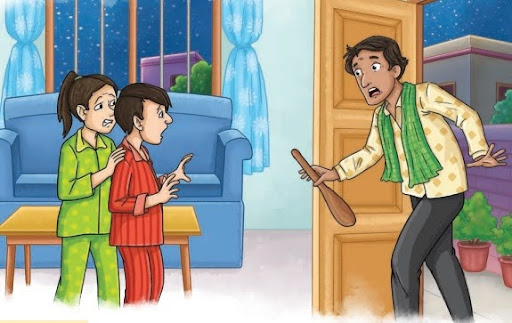
“Let’s holler for help,” he said. Before we could do anything, the door swung open and we found ourselves looking at a ruffianly fellow with a green scarf around his neck. Anand gasped.
Word Meanings:
holler (v): give a loud shout or cry.
ruffianly (adj.): rough or violent looking
gasped (adv): took a short, deep breath in surprise
Explanation of the above passage: The narrator scolds Anand and says that someone is really trying to break in. Anand sits up suddenly, confused and asking what’s happening. The narrator replies that she doesn’t know who it is and nervously asks what they should do. Anand suggests they shout for help. But before they can do anything, the front door opens wide on its own. Standing there is a rough and scary-looking man wearing a green scarf around his neck. Anand is shocked and gasps when he sees the stranger.
Passage:
“Hey, it’s Boppa!” I whispered. It was indeed the fellow who had recently begun sweeping out the compounds in our row of houses. So, he was the thief, and no wonder. He knew exactly when the occupants were out, leaving the coast clear.
The fellow gave an evil grin. “One squeak out of you and see what happens,” he said, brandishing his cudgel and backing out of the room. We heard him slide the latch in.
Word Meanings:
sweeping (adj.): cleansing or carrying away dirt with a broom
compounds (n): an outdoor space attached along the sides or front of a house
occupants (n): a person who resides or is present in a house
brandishing (v): waving
cudgel (n): a short, thick stick used as a weapon
latch (n): a device for keeping a door or gate closed
Explanation of the above passage: Anita whispers to Anand that the man is Boppa, the person who had recently started sweeping the compounds in their row of houses. It turns out that Boppa is the thief! This makes sense now because he knows exactly when each house is empty, making it easy for him to steal without getting caught. Boppa gives them a scary, evil grin. He threatens them and says they’ll regret it if they make any noise. He waves a thick stick in front of them and steps out of the room. Then, they hear him slide the latch and lock them in.
Passage:
“What do we do now?” I asked in a low voice.
“Let’s shout anyway,” Anand suggested.
The door opened suddenly again in the middle of our discussion.
“No noise from you! Now, where is your father’s room?”
I was about to direct him upstairs when Anand said quickly,
“The one next to this one.”
“You silly goose!” I said angrily as soon as the man had gone.
“That’s your room. He’ll come back as mad as mad can be.”
“At least it will give us some time to think of something,” Anand said. “He’ll take a while to locate the light switch. Let’s shout.” All of a sudden there was a crash followed by a loud scream. More strange noises emerged from the next room—a few muffled thumps, an eerie whine, and a low, humming sound.
Word Meanings:
muffled (adj.): not a very clear and loud sound
thumps (v): hit something heavily
eerie (adj.): strange
whine (n): a long, high-pitched cry
humming (v): to make a continuous, low sound, or to sing a tune with closed lips
Explanation of the above passage: Anita asks Anand what they should do now. Anand suggests that they should shout for help anyway. But before they can act, the thief suddenly opens the door again and threatens them to stay quiet. He asks where their father’s room is. Just as the narrator is about to point upstairs, Anand quickly lies and says it’s the room next to theirs, actually his own room. The narrator gets angry, saying the thief will return even angrier when he realizes he was tricked. But Anand explains that this lie will buy them some time because the thief will take a while to find the light switch. Just then, they hear a loud crash, a scream, and strange noises coming from the next room.
Passage:
“My time machine, he’s started it!” Anand gasped. “I wish we could get out of this room and see what is happening out there.”
There was another howl, much fainter this time, and a great deal of clattering. We shouted for all we were worth. In a few minutes, we heard footsteps running up our drive. Thankfully we recognised Mrs. Sharma’s voice, along with her husband and Dr. Mohan—also a neighbour.
Word Meanings:
howl (n): to make a loud sound, usually to show pain, sadness, or another emotion
clattering (n): continuous loud noises
Explanation of the above passage: Anand gets shocked and says the thief has switched on his time machine by accident. He wishes they could get out of the room to see what’s happening. Then, they hear another scream, but this time it’s not very loud. There are also loud crashing and banging sounds coming from the next room. Anand and his sister start shouting for help. After some time, they hear people running towards their house. They feel very happy and safe when they hear the voices of their neighbours, Mrs. Sharma, her husband, and Dr. Mohan, coming to help them.
Passage:
“Anand! Anita! Children, what’s the matter? Where are you?”
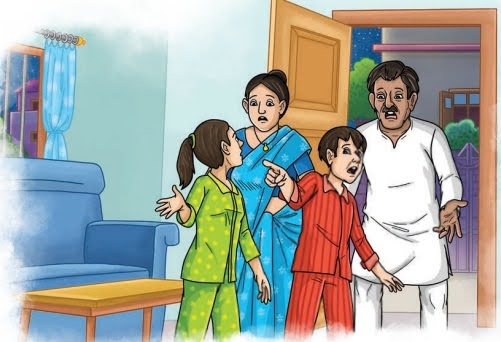
“Here!” we shouted in unison. In a minute the door was unlocked.
“What on earth has been happening here, children?” Sharma Uncle asked. Both Anand and I fell over ourselves trying to explain. “Where is the fellow now?”
“The last we heard, he was in the time machine,” I explained hastily, seeing everyone looking rather puzzled.
Word Meanings:
unison (n): together
hastily (adv): quickly
puzzled (adj.): unable to understand
Explanation of the above passage: Mrs. Sharma calls out asking where Anand and Anita are. Both of them shout together to let her know they are locked in the room. Very soon, someone opens the door and lets them out. Sharma Uncle asks what is going on. Both children get excited and try to explain everything quickly. When Uncle asks where the thief is, Anita tells them that the last time they saw him, he was stuck inside the time machine. Everyone looks confused hearing this.
Passage:
We entered the room cautiously and turned on the lights. The time machine was still humming softly but otherwise there was no other sound from the room.
“Well, where is he?” Dr. Mohan asked, peering behind the door. “Did you imagine this?”
“Oh no,” I protested. “How could both of us have imagined the same thing?”
“Maybe he ran out,” Anand suggested.
“I’m sure we’d have seen him. There’s only one way out of this house and we came the same way as soon as we heard you,” Sharma Uncle sounded very sure.
“Look!” Anand said, pointing to the floor. “He was wearing that.” Near the panel of switches was the green scarf.
“Let’s search the house—perhaps he’s still around,” Dr. Mohan said, going upstairs.
Word Meanings:
peering (v): looking carefully
protested (v): to say something forcefully or complain about something
Explanation of the above passage: Everyone walked into the room and switched on the lights. The time machine was still making a low noise, but the room was otherwise quiet. Dr. Mohan asked where the thief was and wondered if the children had imagined everything. Anita quickly said they could not have imagined the same thing together. Anand thought maybe the thief had escaped. But Sharma Uncle did not agree, he said they would have seen the thief if he had run out because they entered through the only exit. Then Anand pointed to the green scarf on the floor near the machine and said the thief was wearing it. Dr. Mohan decided to search the rest of the house to make sure the thief wasn’t hiding somewhere.
Passage:
Boppa was nowhere to be seen. “Well maybe he did run out and we missed him,” Mrs. Sharma said at last, “I can’t imagine what else could have happened.”
“My time machine! He’s gone through that!” Anand burst out, his eyes shining.
“What an imagination this boy has!” Mr. Sharma said, smiling indulgently. “Now off to bed, both of you. I’ll spend the night here so you needn’t worry about any more intruders now.”
Word Meanings:
indulgently (adv): fondly
intruders (n): people who enter a place without permission
Explanation of the above passage: Boppa, the thief, was not found anywhere in the house. Mrs. Sharma said maybe he did run away, and they just missed seeing him. She couldn’t think of any other explanation for what happened. Anand excitedly said that the thief must have gone through his time machine. Mr. Sharma smiled and said Anand had a very good imagination. Then he told the children to go to bed and said he would stay at their house all night to keep them safe from any more trouble.
Passage:
Needless to say, Boppa was never seen again. Anand insists that his time machine worked and he disappeared into the past. The machine itself was dismantled because Papa thought it wasn’t safe (maybe he also had a niggling suspicion that it worked), so we couldn’t try it out.
As for Anand, he is convinced that he is a genius and has launched a new project—something about a telephone to contact creatures in outer space. Tell you all about it next time.
Word Meanings:
dismantled (v): taken apart
niggling (adv): slight feeling (of)
suspicion (n): the act or an instance of suspecting something wrong without proof or on slight evidence
Explanation of the above passage: After that night, Boppa the thief was never seen again. Anand strongly believes that his time machine really worked and that Boppa disappeared into the past. However, their father took apart the time machine because he thought it was dangerous. Maybe he secretly believed it worked too, but he didn’t say anything. Anand still thinks he is very clever and has already started working on a new invention, a telephone to talk to creatures from outer space. The narrator ends by promising to tell more about this new project another time.
Conclusion
This post provides the students with a comprehensive understanding of the Unit 3 Dreams and Discoveries Chapter 1 – My Brother’s Great Invention By Anita Rau Badami from the CBSE Class 7 English Poorvi Book. It provides the students with the summary, lesson explanation with word meanings, ensuring that the students comprehend the chapter effectively.