
CBSE Class 7 English Unit 3 – Dreams and Discoveries Chapter 1 My Brother’s Great Invention Important Question Answers from Poorvi Book
Class 7 English My Brother’s Great Invention Question Answers – Looking for questions and answers for CBSE Class 7 English Unit 3 – Dreams and Discoveries Chapter 1 My Brother’s Great Invention? Look no further! Our comprehensive compilation of important questions will help you brush up on your subject knowledge. Practising Class 7 English question answers can significantly improve your performance in the exam. Improve your chances of scoring high marks by exploring Unit 3 – Dreams and Discoveries Chapter 1 My Brother’s Great Invention now. The questions listed below are based on the latest CBSE exam pattern, wherein we have given NCERT solutions to the chapter’s extract-based questions, multiple choice questions and Extra Question Answers
Also, practising with different kinds of questions can help students learn new ways to solve problems that they may not have seen before. This can ultimately lead to a deeper understanding of the subject matter and better performance on exams.
- My Brother’s Great Invention NCERT Solutions
- My Brother’s Great Invention Grammar Exercises
- My Brother’s Great Invention Extract Based Questions
- My Brother’s Great Invention Multiple Choice Questions
- My Brother’s Great Invention Extra Question Answers
Related:
- My Brother’s Great Invention Summary, Explanation
- My Brother’s Great Invention Character Sketch
- Class 7 English Summary and Lesson Notes
My Brother’s Great Invention Textbook Questions (NCERT Solutions)
Let us do these activities before we read.
I Work in pairs and guess the invention.
1. I am a concept invented by ancient Indian mathematicians. I add value to numbers. Without me, calculations in the modern digital world would be impossible. Who am I?
2. I am an ancient Indian practice, now popular globally. I focus on physical and mental well-being. What am I?
II Discuss in groups of four what you think the world today would have been like without inventions and discoveries.
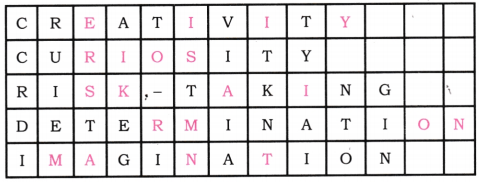
III Fill the grid given below with missing letters to complete the words. These words display qualities of an inventor.
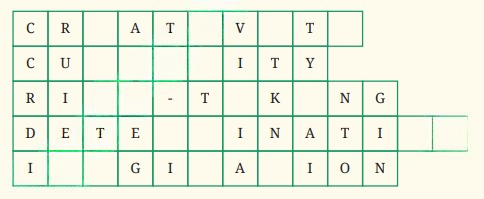
Ans.
1. I. Zero
2. I. Yoga
II. Students should form groups of 4 and lead a discussion on the given topic.
III.
Let us discuss
I Complete the cause-and-effect table given below.
| Causes | Effects |
| 1. Anand set up his burglar alarm and rigged it to work when the door was opened softly. | |
| 2. | Anita was able to avoid any responsibility as Anand faced the consequences alone. |
| 3. We watched the movie ‘Back to the Future’. | |
| 4. Papa firmly said ‘NO’ to trying out the time machine. |
Ans.
| Causes | Effects |
| 1. Anand set up his burglar alarm and rigged it to work when the door was opened softly. | Papa got wet when he opened the door |
| 2. Anand’s father knew he was the culprit | Anita was able to avoid any responsibility as Anand faced the consequences alone. |
| 3. We watched the movie ‘Back to the Future’. | Anand decided to invent the time machine |
| 4. Papa firmly said ‘NO’ to trying out the time machine. | Mother sympathised with Anand |
II Do you think Anand was able to keep his promise regarding the time machine? If yes, why? If no, why not?
Ans. Yes, Anand was able to keep his promise regarding not doing anything with the time machine. The burglar alarm had already caused great anger to Anand’s father, so he was warned against committing such pranks again.
Let us discuss
Arrange the following events in the correct order of occurrence.
1. The door swings open, and they see Boppa, standing there with an evil grin.
2. Boppa is nowhere to be found, but his green scarf is lying near the time machine.
3. Mrs. Sharma, her husband, and Dr. Mohan unlock the door and enter the house to help the children.
4. Anita wakes Anand up, informing him that someone is trying to get into the house.
5. Anand misleads Boppa into entering his room instead of his father’s room.
Ans. 1.4. Anita wakes Anand up, informing him that someone is trying to get into the house.
2. 5. Anand misleads Boppa into entering his room instead of his father’s room.
3. 1. The door swings open, and they see Boppa, standing there with an evil grin.
4. 3. Mrs. Sharma, her husband, and Dr. Mohan unlock the door and enter the house to help the children.
5. 2. Boppa is nowhere to be found, but his green scarf is lying near the time machine.
Let us think and reflect I
Read the extracts given below and answer the questions that follow.
1. Before beginning this story, let me put you in the picture. I am Anita, fourteen years old. My brother Anand, one year younger than me, caused all that hoo-ha with his burglar alarm. The trouble with him is that he thinks he is a scientist. He loves tinkering with all sorts of electrical gadgets, tools, dynamos, planks of wood, and things like that. And he keeps creating ‘inventions’ that never work out as they are supposed to.
(i) Complete the following sentence suitably by choosing the correct option from those given in the brackets.
When Anita says, “…let me put you in the picture”, she wants to _________ (introduce/summarise) the situation for the benefit of the readers.
(ii) Anand loves ‘tinkering’ with all sorts of electrical gadgets. This means that he enjoys _________ gadgets.
A. dismantling and creating
B. labelling or naming
C. repairing or improving
D. collecting and displaying
(iii) Which of the following options most suitably describes Anand’s personality?
A. methodical and cautious
B. creative and experimental
C. energetic and hasty
D. shy and reserved
(iv) Based on the extract, compare what Anita thinks of her brother Anand with what he thinks of himself.
Ans. (i) Introduce
(ii) C. repairing or improving
(iii) B. creative and experimental
(iv) Anita finds Anand annoying and impractical, thinking his inventions always cause trouble. On the other hand, Anand sees himself as a scientist and believes in his creativity and inventions.
2. I was about to direct him upstairs, when Anand said quickly, “The one next to this one.”
“You silly goose!” I said angrily as soon as the man had gone.
“That’s your room. He’ll come back as mad as mad can be.”
“At least it will give us some time to think of something,” Anand said. “He’ll take a while to locate the light switch. Let’s shout.” All of a sudden there was a crash followed by a loud scream. More strange noises emerged from the next room—a few muffled thumps, an eerie whine, and a low, humming sound.
(i) Complete the sentence given below with a suitable reason. Anita was angry with Anand because ____________.
(ii) Which action of Anand shows his presence of mind?
(iii) What might be the cause of the strange noises emerging from the next room?
A. The intruder moving furniture around
B. Anand’s time machine getting activated
C. The intruder locating the light switch
D. Anand’s invention malfunctioning
(iv) Which of the following best describes the atmosphere in this extract?
A. relaxing
B. peaceful
C. tense
D. sad
E. suspenseful
F. joyful
(a) A, D and E (b) B and F (c) C and E (d) Only D
Ans. (i) Anita was angry with Anand because he misled the intruder into going into his room instead of their father’s.
(ii) Anand showed presence of mind by directing the intruder into a different room to buy them time to think of a solution.
(iii) B. Anand’s time machine getting activated
(iv) (c) C and E
II Complete the table with the suitable traits of the characters based on evidence from the text. Choose the traits given in the box below. An example has been done for you.
| creative | curious | careful | responsible | bothersome | confident |
| Character | Traits | Evidence from the Text |
| Anand | 1. bothersome | And this is not the first time he’s got on Papa’s nerves or frightened someone half to death in the house. |
| 2. __________ | He loves tinkering with all sorts of electrical gadgets, tools, dynamos, planks of wood, and things like that. And he keeps creating ‘inventions’ that never work out as they are supposed to. | |
| 3.___________ | “Nothing will go wrong this time. I’ve planned it out carefully. See the blueprint.” | |
| Anita | 1._________ | “We’re old enough to look after ourselves, Ma…” |
| 2. __________ | “But how does the alarm know that a burglar is opening the door?” | |
| 3.___________ | “Now clean up this mess before anyone gets home.” |
Ans.
| Character | Traits | Evidence from the Text |
| Anand | 1. bothersome | And this is not the first time he’s got on Papa’s nerves or frightened someone half to death in the house. |
| 2. creative | He loves tinkering with all sorts of electrical gadgets, tools, dynamos, planks of wood, and things like that. And he keeps creating ‘inventions’ that never work out as they are supposed to. | |
| 3. confident | “Nothing will go wrong this time. I’ve planned it out carefully. See the blueprint.” | |
| Anita | 1. responsible | “We’re old enough to look after ourselves, Ma…” |
| 2. curious | “But how does the alarm know that a burglar is opening the door?” | |
| 3. careful | “Now clean up this mess before anyone gets home.” |
III Answer the following questions.
1. What prompted Anand to create the burglar alarm?
Ans. Anand created the burglar alarm to protect his home from robbers after hearing news about burglaries in the neighborhood.
2. How did Anand’s father become the target of the burglar alarm?
Ans. Anand’s father became the target of the burglar alarm when he entered the house without knowing that Anand had installed the alarm, which then went off and startled him.
3. How did Anand’s parents and sister react to his ideas?
Ans. Anand’s parents and sister often found his ideas amusing and sometimes annoying, but deep down they were proud of his creativity and intelligence.
4. How did Anand behave when he was on his ‘inventing binges’?
Ans. When Anand was on his ‘inventing binges,’ he would become completely absorbed in his work, forget about food or sleep, and scatter tools and wires all around the house.
5. Why did Mr. Sharma not believe Anand when he spoke about his time machine?
Ans. Mr. Sharma did not believe Anand because he thought it was impossible for a young boy to build something as complex as a time machine, and assumed it was just part of his imagination.
6. Give an ending to this story, explaining what might have happened to Boppa.
Ans. In the end, Boppa was found in the garden, safe and sound. It turned out that he had wandered off during one of Anand’s experiments and had fallen asleep under a tree. The family realized Boppa was fine, and Anand promised to test his inventions more carefully in the future.
My Brother’s Great Invention Grammar Exercises
Let us learn
I Read the highlighted word in the following sentence.
It’s quite simple. The moment the door opens, this alarm is tripped off and makes a clanging sound.
Such sound words are called onomatopoeic words.
| Onomatopoeia is the use of words that imitate actual sounds of the thing they describe. The ‘boom’ of a firework exploding, the ‘ding-dong’ of a bell, the ‘pitter-patter’ of rain drops, the ‘tick-tock’ of a clock are all examples of onomatopoeia. |
1. Read the sound words used in the story in Column 1. Complete Column 2 by matching expressions from the box given below. An example has been done for you.
| whispered angrily
constant and loud construction noises sudden loud sound of breaking a continuous low and soothing sound |
| Column 1 | Column 2 |
| (i) Crash | sudden loud sound of breaking |
| (ii) Humming | a continuous low and soothing sound |
| (iii) Hissed | whispered angrily |
| (iv) Hammering, sawing, clattering | constant and loud construction noises |
I Read the highlighted phrase in the following sentence from the text.
Well, that was the end of peace and quiet in the house.
The highlighted phrase displays a combination of two words generally used together in a fixed order. Such phrases are called binomials.
| Binomials are expressions consisting of two words, usually linked by a conjunction such as ‘and’ or ‘or’ that are commonly used together in a fixed order. The two words convey a single meaning or an opposite. |
1. Match the words in Column 1 with the correct pairs in Column 2 to make binomials
| Column 1 | Conjunction | Column 2 |
| (i) safe | and
or |
A. break |
| (ii) odds | B. cons | |
| (iii) make | C. never | |
| (iv) pros | D. take | |
| (v) now | E. sound | |
| (vi) give | F. ends |
Ans.
| Column 1 | Conjunction | Column 2 |
| (i) safe | and
or |
E. sound |
| (ii) odds | F. ends | |
| (iii) make | A. break | |
| (iv) pros | B. cons | |
| (v) now | C. never | |
| (vi) give | D. take |
2. Complete the following sentences with suitable binomials from 1.
(i) This project will be a ______________ moment for our team’s success.
(ii) After a long journey, we were relieved to arrive home ______________.
(iii) Every friendship works well when there is a balance of ______________.
(iv) She organised all the ______________ in the cupboard, to make space for new clothes.
(v) Before making a decision, it is important to weigh the ______________ carefully.
(vi) This is our final chance to perform on stage, it is ______________.
Ans. (i) This project will be a make or break moment for our team’s success.
(ii) After a long journey, we were relieved to arrive home safe and sound.
(iii) Every friendship works well when there is a balance of give and take.
(iv) She organised all the odds and ends in the cupboard, to make space for new clothes.
(v) Before making a decision, it is important to weigh the pros and cons carefully.
(vi) This is our final chance to perform on stage, it is now or never.
3. Complete the paragraph by using the phrasal verbs given in the box below.
| tripped off | let up | turned out | ran out of | rigged up |
It had been raining and we (i) ___________ time to set up for the function, so we quickly (ii) ______ some decorations using whatever materials we had. We accidentally (iii) ___________ the fire alarm because of the smoke from the bonfire. Thankfully, the rain (iv) ___________ just as the guests were arriving, and despite all the chaos, the function (v) ___________ to be a huge success.
Ans. (i) ran out of
(ii) rigged up
(iii) tripped off
(iv) let up
(v) turned out
III Read the highlighted expressions in the following sentence from the text.
And this is not the first time he’s got on Papa’s nerves or frightened someone half to death in the house.
The highlighted expressions are called idioms.
| An idiom is a phrase or expression that has a meaning different from the literal meaning of the individual words. It is like a special saying that people understand in a specific way. For example, ‘It is raining cats and dogs’ means it’s raining very heavily. |
Complete the following sentences by filling in the blanks with suitable idioms from the text given in the box below.
| leaving the coast clear | get on our nerves | fell over ourselves |
| frighten me half to death | get a shelling |
1. Shekhar knew he would _______________________ for breaking his mother’s favourite flower vase.
2. We _______________________ trying to help the injured dog and get it to the vet as quickly as possible.
3. Faizy distracted Kanchan, _______________________ for us to get inside the room to prepare the birthday surprise.
4. The constant power fluctuations during meetings can _______________________.
5. When I am alone at home, any unexpected loud noise in the night can _______________________.
Ans. 1. Shekhar knew he would get a shelling for breaking his mother’s favourite flower vase.
2. We fell over ourselves trying to help the injured dog and get it to the vet as quickly as possible.
3. Faizy distracted Kanchan, leaving the coast clear for us to get inside the room to prepare the birthday surprise.
4. The constant power fluctuations during meetings can get on our nerves.
5. When I am alone at home, any unexpected loud noise in the night can frighten me half to death.
IV Read the highlighted words in the given sentence.
It was indeed the fellow who had recently begun sweeping out the compounds in our row of houses.
Here we refer to two completed actions─the recent past (new action) and the later past (old action).
1. Underline the verbs in simple past and past perfect tense for the following sentences from the text.
(i) Ma had rushed in to see what the racket was all about and found Papa standing there, sopping wet and scowling.
(ii) Anand had vanished by this time and reappeared only after dinner when Papa had cooled down.
Ans.(i) Past perfect-had rushed, had found
Simple past- was, found, was, scowling
(ii) Past perfect- had vanished, had cooled down
Simple past- reappeared
2. Fill in the blanks with the simple past or past perfect form of the verbs given in brackets.
(i) After Rohan A. __________ (finish) his homework, he B. __________ (decide) to go for a walk. He C. __________ (leave) the house and D. __________ (realise) he E. __________ (forget) his keys inside.
(ii) By the time we A. __________ (reach) the station, the train B. __________ (already/leave). We C. __________ (wait) for the next one to arrive.
Ans. (i) A. had finished
B. decided
C. left
D. realised
E. had forgotten
(ii) A. reached
B. had already left
C. waited
3. Combine the pairs of sentences using the time expressions in the boxes given below and rewrite them using the past perfect tenses.
An example has been done for you.
Example: Rohan had packed his suitcase before he left for the airport.
| Old Actions | Time Expressions | New Actions |
| (i) Rohan packed his suitcase. | before, after, by the time, when | He left for the airport. |
| (ii) We started work. | He arrived in the morning. | |
| (iii) They set up the tents. | The others brought food and medicine. | |
| (iv) The students became quiet. | They heard the teacher coming. | |
| (v) The villagers left the village. | The flood submerged the entire area. |
Ans. (i) Rohan had packed his suitcase before he left for the airport.
(ii) We had started work before he arrived in the morning.
(iii) They had set up the tents before the others brought food and medicine.
(iv) The students had become quiet when they heard the teacher coming.
(v) The villagers had left the village by the time the flood submerged the entire area.
Let us listen
I You will listen to a conversation between Anita and Toby. Toby is a Martian and is stranded on Earth. He has become Anita’s friend. As you listen, choose the true statements from 1–5 given below. (Transcript for the teacher on pg. 136)
1. Toby misses his school.
2. Anita accepts Toby as her friend.
3. Anita asks Toby about one of his facial features.
4. Toby tells Anita that she had a banana for breakfast.
5. Toby shares that he can see much clearer with a closed eye.
Ans. 1. False
2. True
3. True
4. False
5. True
II Listen to the conversation again and fill in the blanks with the exact words you hear.
1. Toby: I miss my _________________ and home.
2. Toby: Well, we _________________ don’t need to eat anything. We get our _________________ from the Sun.
3. Anita: Oh! Don’t you ever feel like having ice creams and _________________?
4. Anita: Okay, tell me one thing. How are you able to see with only_________________ eye?
5. Toby: I can see beyond mountains and _________________, woods and even _________________.
Ans. 1. Toby: I miss my people and home.
2. Toby: Well, we Martians don’t need to eat anything. We get our energy from the Sun.
3. Anita: Oh! Don’t you ever feel like having ice creams and chocolates?
4. Anita: Okay, tell me one thing. How are you able to see with only one eye?
5. Toby: I can see beyond mountains and clouds, woods and even metals.
Let us speak
I Read the following sentences from the text.
As usual, I had to be involved, though I’d have preferred to finish my novel.
“We’re old enough to look after ourselves, Ma,” I said.
The word ‘though’ is pronounced to rhyme with the word ‘low’. The word ‘enough’ is pronounced to rhyme with the word ‘puff’.
In English there are many words ending with –ough, which are pronounced very differently. Listen to the teacher say these words aloud and notice how they are pronounced.
| bough | cough |
| dough | thought |
| through | plough |
Now, work in pairs. Pronounce these words out loud and put them in the correct boxes given below.
| Sounds like ‘oo’ | Sounds like ‘off’ | Sounds like ‘o’ | Sounds like ‘ow’ | Sounds like ‘aw’ |
Share more words that sound similar to the words in the table.
Ans.
| Sounds like ‘oo’ | Sounds like ‘off’ | Sounds like ‘o’ | Sounds like ‘ow’ | Sounds like ‘aw’ |
| through | cough | dough | bough,plough | thought |
More words that sound similar to the words in the table:-
- Throughout
- trough
- Although
- Plough
- bought
II Read the story given below aloud. Check the correct pronunciation with the teacher.
In spite of a nagging cough, the woman continued working in her farm, right through the rough weather. She filled up the trough with water for her cows and ploughed the fields to plant the seeds. She then plucked some raw mangoes from a low bough of a mango tree to make a spicy chutney. Though the day had been tough, she smiled peacefully as she had already prepared dough to make enough rotis for dinner.
III Now try saying this tongue twister fast as many times as you can clearly.
The boy with the tough dough on the rose bough fell in the trough and caught a cough.
Let us write
Think about different vocations that you see around or you are currently studying.
For example: electrician, mechanic, chef, nurse, graphic designer. You may add more vocations to the list given here.
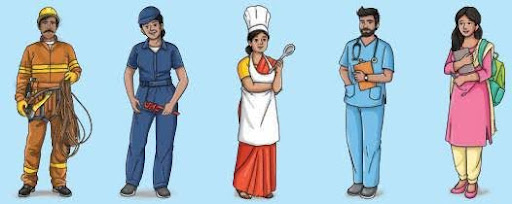
Now, choose a vocation and write a paragraph. You may use the hints given below.
- why you like this vocation
- what training is needed
- what tools and equipment are required
- who would your co-workers be
- highlight the importance of team work
- how you would deal with the customers
- how you plan to pursue it with a sense of pride
Ans. Chef
I want to become a chef because I enjoy cooking and creating new dishes that bring joy to people. To become a chef, I would need professional training at a culinary school where I can learn cooking techniques, food safety, and presentation skills. A chef uses many tools like knives, blenders, ovens, and other kitchen equipment. My co-workers would include other chefs, sous chefs, kitchen assistants, and waiters. Teamwork is very important in a kitchen because everyone must coordinate to make sure food is prepared and served on time. I would treat customers politely and always be open to feedback to improve their experience. I would pursue this career with pride, always learning and growing, because food connects people and makes special moments even better.
CBSE Class 7 English Chapter 1 My Brother’s Great Invention Extract- Based Questions
A
“Recently there had been a rush of thefts in the colony and Anand had got it into his head that what was needed was a burglar alarm. So, the minute Papa left for the office and Ma for the market, he started on his latest scheme. As usual I had to be involved, though I’d have preferred to finish my novel. “If you get a shelling, don’t bring me in,” I warned Anand.
“Nothing will go wrong this time. I’ve planned it out carefully. See the blueprint.”
Anand loves words like blueprint—it makes him feel professional! Anyway, I looked at the
elaborate drawing of doors, wires, and bells and asked, “How does this thing work?””
1. What recent event made Anand want to create a burglar alarm?
Ans. A recent rush of thefts in the colony made Anand want to create a burglar alarm.
2. When did Anand begin working on his new invention?
Ans. Anand started working on it as soon as Papa left for the office and Ma went to the market.
3. What was the narrator’s initial reaction to Anand’s plan?
Ans. The narrator was reluctant and warned Anand not to involve him if things went wrong.
4. What word did Anand use to feel professional?
Ans. Anand used the word “blueprint” to feel professional.
5. What did the blueprint show?
Ans. The blueprint was an elaborate drawing showing doors, wires, and bells.
B
“My brother decided that he had to make a time machine too. Papa locked up his tool box and hid the key while Ma kept a wary eye on her oven and mixer. Because, as I told you, when Anand is on one of his inventing binges, he takes apart all the gadgets in the house to collect parts. You can’t imagine the noise that was going on—hammering and sawing and clattering. Anand’s room, next to our room, was transformed into a network of wires, springs, levers, and bulbs. There was an enormous panel which was to be control switchboard. As for Anand, he went around looking like a savage. When Ma didn’t notice, the fellow didn’t even comb his hair.”
1. What did Anand want to invent after the burglar alarm?
Ans. Anand wanted to invent a time machine.
2. How did Papa and Ma react to Anand’s inventing habits?
Ans. Papa locked up his toolbox and hid the key, while Ma kept an eye on her oven and mixer to prevent him from taking parts.
3. What did Anand usually do during his inventing sprees?
Ans. He dismantled household gadgets and made loud noises with hammering, sawing, and clattering.
4. How was Anand’s room transformed during this project?
Ans. It turned into a complex network of wires, springs, levers, bulbs, and a large control switchboard.
5. How did Anand look while working on his invention?
Ans. He looked like a savage and didn’t comb his hair unless Ma reminded him.
C
“They left by the afternoon train and were coming back the following evening. Anand fell asleep immediately, but I stayed up to finish a novel. At about eleven thirty I thought I heard a scratching at the front door. Telling myself it was only my imagination, I went back to the book. A little later there was a rattle and a click. I was really scared, I can tell you, what with a murder story before me and then strange noises in the middle of the night! I shook Anand and whispered, “Listen, there’s someone at the door.”
“Go and open it then,” he muttered groggily.
“You silly! Someone’s trying to get in,” I said.
Anand sat up. “Who? What?”
“I don’t know,” I said. “What shall we do?”
“Let’s holler for help,” he said. Before we could do anything, the door swung open and we found ourselves looking at a ruffianly fellow with a green scarf around his neck. Anand gasped.”
1. Why did Anand and the narrator stay home alone?
Ans. Their parents had gone away by the afternoon train and were to return the following evening.
2. What made the narrator frightened at night?
Ans. The narrator heard strange noises at the door while reading a murder story.
3. How did Anand react when the narrator told him about the noises?
Ans. Anand, half-asleep, told the narrator to open the door, but later sat up when he realized someone was trying to get in.
4. What happened before the door opened?
Ans. There was a rattle and a click, followed by the door swinging open.
5. Who was at the door?
Ans. A ruffianly man with a green scarf around his neck was at the door, causing Anand to gasp.
D
““What on earth has been happening here, children?” Sharma Uncle asked. Both Anand and I fell over ourselves trying to explain. “Where is the fellow now?”
“The last we heard, he was in the time machine,” I explained hastily, seeing everyone looking rather puzzled.
We entered the room cautiously and turned on the lights. The time machine was still humming softly but otherwise there was no other sound from the room.
“Well, where is he?” Dr. Mohan asked, peering behind the door. “Did you imagine this?”
“Oh no,” I protested. “How could both of us have imagined the same thing?”
“Maybe he ran out,” Anand suggested. ”
1. Who asked the children what had happened?
Ans. Sharma Uncle asked the children what had happened.
2. What did the narrator say about the intruder’s last known location?
Ans. The narrator said the intruder had last been seen in the time machine.
3. What was the condition of the time machine when they entered the room?
Ans. The time machine was still humming softly, but the room was silent and empty.
4. What did Dr. Mohan suggest might have happened?
Ans. He suggested that the children might have imagined the whole incident.
5. How did the children defend their claim?
Ans. The narrator insisted that both of them couldn’t have imagined the same thing, and Anand suggested the man might have run out.
Class 7 My Brother’s Great Invention Multiple-Choice Questions
1. What inspired Anand to build a burglar alarm?
(a) A movie he watched
(b) A dream he had
(c) A recent string of thefts in the colony
(d) A suggestion from his teacher
Ans. (c) A recent string of thefts in the colony
2. What does Anand love using to sound professional?
(a) Technical words like “blueprint”
(b) Expensive gadgets
(c) Scientific books
(d) Long speeches
Ans. (a) Technical words like “blueprint”
3. How did the narrator feel about helping Anand with his invention?
(a) Excited
(b) Uninterested and reluctant
(c) Eager to assist
(d) Nervous but hopeful
Ans. (b) Uninterested and reluctant
4. What did Anand usually do during his inventing sprees?
(a) Read books
(b) Cook food
(c) Dismantle household gadgets
(d) Watch television
Ans. (c) Dismantle household gadgets
5. Why did Papa lock up his toolbox?
(a) To keep it clean
(b) To prevent Anand from taking tools
(c) To organize it
(d) Because it was broken
Ans. (b) To prevent Anand from taking tools
6. What precaution did Ma take when Anand was inventing?
(a) She encouraged him
(b) She left the house
(c) She watched over her oven and mixer
(d) She helped him collect parts
Ans. (c) She watched over her oven and mixer
7. How was Anand’s room described during his invention phase?
(a) Spotless and quiet
(b) Neatly arranged
(c) A noisy mess full of wires and bulbs
(d) Closed for repairs
Ans. (c) A noisy mess full of wires and bulbs
8. What unusual device did Anand try to build?
(a) Rocket
(b) Robot
(c) Time machine
(d) Submarine
Ans. (c) Time machine
9. What did the narrator prefer doing instead of helping Anand?
(a) Playing games
(b) Sleeping
(c) Finishing a novel
(d) Going to school
Ans. (c) Finishing a novel
10. What did Anand look like during his invention craze?
(a) Like a scientist
(b) Very neat
(c) Like a savage
(d) Like a movie star
Ans. (c) Like a savage
11. What sound did the narrator first hear at night while reading?
(a) A whistle
(b) A knock
(c) A scratching at the door
(d) A scream
Ans. (c) A scratching at the door
12. What type of story was the narrator reading when the noises began?
(a) Romance
(b) Adventure
(c) Comedy
(d) Murder mystery
Ans. (d) Murder mystery
13. How did Anand react when told someone was at the door?
(a) He ran to open it
(b) He said to holler for help
(c) He ignored it
(d) He called the police
Ans. (b) He said to holler for help
14. What did the intruder wear around his neck?
(a) A tie
(b) A red ribbon
(c) A green scarf
(d) A black mask
Ans. (c) A green scarf
15. Who came to check what was going on after the incident?
(a) Ma and Papa
(b) The police
(c) Sharma Uncle and Dr. Mohan
(d) The neighbours
Ans. (c) Sharma Uncle and Dr. Mohan
16. What was the time machine doing when they entered the room?
(a) Blinking
(b) Glowing brightly
(c) Humming softly
(d) Making loud noises
Ans. (c) Humming softly
17. What did the adults suggest when they couldn’t find the man?
(a) He was hiding
(b) The children imagined it
(c) He stole something
(d) He turned invisible
Ans. (b) The children imagined it
18. What argument did the narrator use to prove it wasn’t imagination?
(a) The time machine was broken
(b) The door was open
(c) Both he and Anand saw the man
(d) There were footprints
Ans. (c) Both he and Anand saw the man
19. What did Anand suggest might have happened to the man?
(a) He turned into a ghost
(b) He disappeared into the past
(c) He ran out
(d) He hid in the kitchen
Ans. (c) He ran out
20. What was the narrator’s warning to Anand at the beginning?
(a) Don’t damage the house
(b) Don’t ask for help
(c) Don’t bring me in if you get a shelling
(d) Don’t tell Ma
Ans. (c) Don’t bring me in if you get a shelling
CBSE Class 7 English Poorvi Book Unit 3 – Dreams and Discoveries Chapter 1 My Brother’s Great Invention Extra Question and Answers
1. Why was Anand so determined to create a time machine, and what does this reveal about his personality?
Ans. Anand was determined to create a time machine because he was fascinated by science and had an active imagination. His previous invention, a burglar alarm, had been a success, which boosted his confidence. His passion for building things and his desire to be taken seriously as an inventor drove him to take on more ambitious projects. This determination reveals that Anand is curious, inventive, and highly motivated. He does not give up easily and enjoys experimenting with new ideas, even if they seem unrealistic. His ambition sometimes leads to chaos, but it shows his creativity and commitment to learning.
2. Describe the relationship between the narrator and Anand. How does it evolve throughout the story?
Ans. The relationship between the narrator and Anand is a mix of irritation, admiration, and reluctant cooperation. At the beginning, the narrator finds Anand’s experiments annoying and messy, especially since Anand often ropes him in as an assistant without asking. However, as the story progresses and they face a mysterious situation together, the narrator begins to take Anand more seriously. The shared experience of the night incident brings them closer, and the narrator starts to appreciate Anand’s creativity and courage. Their bond evolves from simple sibling annoyance to mutual respect, showing how shared challenges can strengthen relationships.
3. What role do the parents and neighbours play in the story, and what do their reactions tell us?
Ans. The parents and neighbours play a background but significant role in the story. Papa locks his toolbox to prevent Anand from misusing it, and Ma keeps an eye on her kitchen appliances, both showing concern for Anand’s curiosity. When the children report the mysterious intruder, Sharma Uncle and Dr. Mohan respond with disbelief, assuming it was the children’s imagination. Their reactions highlight how adults sometimes dismiss children’s experiences as fantasy. This skepticism creates a gap between adult and child perspectives. Their role emphasizes the challenges children face in being taken seriously, especially when involved in unusual or imaginative activities.
4. What is the significance of the ‘green scarf’ in the story?
Ans. The green scarf worn by the strange man at the door becomes a key symbol of mystery and disbelief in the story. It is one of the few concrete details the narrator remembers, making the experience feel real and not imagined. The scarf sets the man apart, suggesting he doesn’t belong in the current time or setting. When the adults refuse to believe the children’s story, the green scarf remains a vivid memory that supports the idea that something strange truly happened. It represents the fine line between reality and imagination, and the children’s attempt to prove they weren’t imagining things.
5. How does the story blend elements of humor and suspense, and why is this effective?
Ans. My Brother’s Great Invention skillfully blends humor and suspense, making the story both engaging and entertaining. The humor comes from Anand’s quirky behavior, like dismantling household gadgets and declaring big ideas with exaggerated seriousness. The narrator’s sarcastic tone and reluctant involvement also add to the comic effect. At the same time, the suspense builds when strange noises are heard, and a mysterious man appears at the door. This sudden shift keeps readers intrigued. The mix of humor and suspense is effective because it mirrors real sibling dynamics while drawing readers into an unpredictable and imaginative adventure.
Very nice solutions 🙂🙂🙂🙂🙂🙂🙂🙂🙂