
CBSE Class 7 English Unit 2 – Wit and Humour Chapter 3 Say The Right Thing Important Question Answers from Poorvi Book
Class 7 English Say The Right Thing Question Answers – Looking for questions and answers for CBSE Class 7 English Unit 2 – Wit and Humour Chapter 3 Say The Right Thing? Look no further! Our comprehensive compilation of important questions will help you brush up on your subject knowledge. Practising Class 7 English question answers can significantly improve your performance in the exam. Improve your chances of scoring high marks by exploring Unit 2 – Wit and Humour Chapter 3 Say The Right Thing now. The questions listed below are based on the latest CBSE exam pattern, wherein we have given NCERT solutions to the chapter’s extract-based questions, multiple choice questions and Extra Question Answers
Also, practising with different kinds of questions can help students learn new ways to solve problems that they may not have seen before. This can ultimately lead to a deeper understanding of the subject matter and better performance on exams.
- Say The Right Thing NCERT Solutions
- Say The Right Thing Grammar Exercises
- Say The Right Thing Extract Based Questions
- Say The Right Thing Multiple Choice Questions
- Say The Right Thing Extra Question Answers
Related:
- Say The Right Thing Summary, Explanation
- Say The Right Thing Character Sketch
- Class 7 English Summary and Lesson Notes
Say The Right Thing Textbook Questions (NCERT Solutions)
Let us do these activities before we read.
I Work in pairs and discuss.

1. What does ‘Athithi Devo Bhava’ mean?
Ans. ‘Athithi Devo Bhava’ is a Sanskrit phrase that means “Guest is God” or “Treat the guest as God.” It signifies a highly respectful and hospitable attitude towards guests.
2. Why is it important to be polite to guests?
Ans. It is important to be polite to guests because it makes them feel welcome, respected, and comfortable. Politeness fosters good relationships, creates a pleasant atmosphere, and reflects well on the host and their family. It aligns with the principle of showing kindness and consideration, as seen in Mrs. Shaw’s advice.
II Choose the statements that display polite behaviour when you have guests at home.
1. Offer the guests a glass of water.
2. Enquire about the well-being of the guests.
3. Ask the guests when they would leave.
4. Comment critically about the habits of guests.
5. Accompany the guests to the door when they leave.
Ans. 1. Offer the guests a glass of water.
2. Enquire about the well-being of the guests.
5. Accompany the guests to the door when they leave.
III Sometimes you find that a few friends in class are rude while disagreeing with each other on certain issues. Work in groups. How would you deal with such a situation? Share at least three ways in which you can do this.
Ans. Three ways in which you can deal with a few friends in class who are rude while disagreeing with each other on certain issues.
1. Intervene calmly and suggest ground rules for discussion: You could step in and say something like, “Hey guys, I know we all feel strongly about this, but let’s try to keep our voices down and focus on the ideas, not on attacking each other. We can disagree respectfully.” This helps remind everyone of basic etiquette.
2. Model polite disagreement yourself: When it’s your turn to speak, demonstrate how to express a differing opinion politely. Use “I statements” (e.g., “I see your point, but I respectfully disagree because…”) and focus on the issue rather than personal attacks. Your example might encourage others to follow suit.
3. Talk to them privately later: If the rude behavior persists, consider pulling one or both friends aside after class. Explain calmly how their rudeness affects the discussion and makes others uncomfortable. For example, “When you interrupt or raise your voice, it makes it hard for me to focus on the argument and for others to share their ideas.” This direct, private feedback can be very effective.
Let us discuss
I Complete the table given below based on Scene I of the play. An example has been done for you. Share your answers with your classmates and the teacher.
| Speaker | Words of the Speaker | Reason |
| Mrs. Shaw | The room looks cleaner now. Put that coat away in your bedroom. | To instruct Mary to keep the room tidy |
| Mary | You’re always telling me to put things away. | |
| I’m not a child! | ||
| Mrs. Shaw | To highlight the importance of being kind as a way to ensure Mary says the appropriate things when guests arrive |
Ans.
| Speaker | Words of the Speaker | Reason |
| Mrs. Shaw | The room looks cleaner now. Put that coat away in your bedroom. | To instruct Mary to keep the room tidy |
| Mary | You’re always telling me to put things away. | To express frustration at her mother’s frequent instructions. |
| I’m not a child! | To assert her independence and maturity. | |
| Mrs. Shaw | Say things that will please them. | To highlight the importance of being kind as a way to ensure Mary says the appropriate things when guests arrive |
II Do you think Mary will be able to follow her mother’s advice successfully when Mrs. Harding and Mrs. Lee visit? Why or why not?
Ans. No, I do not think Mary will be able to follow her mother’s advice successfully when Mrs. Harding and Mrs. Lee visit. Throughout the play, Mary consistently demonstrates a lack of social understanding and discretion, despite her mother’s well-intentioned guidance. She tends to interpret instructions literally or speaks her mind without considering the impact of her words on others’ feelings. Her eagerness to talk often overrides any politeness filters, leading her to make awkward and unintentionally offensive comments about Mr. Best, Mrs. Cotter, and even the guests’ personal lives. The central conflict of the play revolves around her inability to “say the right thing”, culminating in her final blunder of asking the guests to leave instead of stay. Her track record clearly indicates that she struggles to apply the nuanced rules of polite conversation, making it highly probable she will fail to follow her mother’s advice successfully during the visit.
Let us discuss
I Rectify the false statements given below from Scene II of the play. An example has been done for you. Share your answers with your classmates and the teacher.
1. Mrs. Harding states that they do not like London as it is not the same as Lanfield.
Rectification: Mrs. Harding states that they like Lanfield very much even though it is not the same as London.
2. Mrs. Harding was pleased to know that Mary was familiar with her children.
3. Mrs. Shaw shared that she liked Mrs. Best as she read a lot of newspapers.
4. Mrs. Harding and Mrs. Shaw agree that wearing a blue dress with a red coat is unfashionable.
5. Mary shares that she finds the dog outside the window cute.
Ans. 1. Mrs. Harding states that they do not like London as it is not the same as Lanfield.
Rectification: Mrs. Harding states that they like Lanfield very much even though it is not the same as London.
2. Mrs. Harding was pleased to know that Mary was familiar with her children.
Rectification: Mrs. Harding was not pleased to know that Mary was familiar with her children, as she had no children and Mary’s comment was a mistake.
3. Mrs. Shaw shared that she liked Mrs. Best as she read a lot of newspapers.
Rectification: Mrs. Shaw shared that she liked Mrs. Best as she was a nice woman, not specifically because she read a lot of newspapers. (This was a conversational shift after Mary’s offensive comments about bankers who read newspapers).
4. Mrs. Harding and Mrs. Shaw agree that wearing a blue dress with a red coat is unfashionable.
Rectification: The play does not mention Mrs. Harding and Mrs. Shaw discussing or agreeing on the fashionability of a blue dress with a red coat.
5. Mary shares that she finds the dog outside the window cute.
Rectification: Mary shares that she sees Mr. Pomeroy on his horse outside the window and criticizes his habits, not that she finds a dog cute.
Let us think and reflect
I Read the extracts given below and answer the questions that follow.
1. Mary : What are you going to talk about?
Mrs. Shaw : I don’t know. All kinds of things. One day you’ll have to go to some of these houses yourself and talk to the people there.
Mary : I can talk now. I’ve been able to talk for a long time.
Mrs. Shaw : Yes, that’s true. You always talk too much. But does anyone want to hear the things that you say?
Mary : I can talk very well when I like. I’ll stay with you today and talk to them when they come.
Mrs. Shaw : Oh, I don’t think so. You can go out for a walk. It will be better if you do that.
(i) What does Mrs. Shaw imply when she says, “One day you’ll have to go to some of these houses yourself and talk to the people there”?
A. She believes Mary should start learning about hosting guests then.
B. She thinks Mary is ready to visit these houses independently.
C. She wants Mary to develop social skills for the future.
D. She hopes Mary will avoid these social interactions entirely.
(ii) Complete the following sentence with the correct option from the brackets.
Mrs. Shaw and Mary are discussing how to _____________________. (have a polite conversation/ get to know people better)
(iii) Why did Mary insist on staying with her mother when the guests arrived?
(iv) Match the following character traits to the characters in the extract:
| A. eager | B. inexperienced | C. cautious |
| Mary | Mrs. Shaw |
Ans. (i) C. She wants Mary to develop social skills for the future.
(ii) Mrs. Shaw and Mary are discussing how to have a polite conversation.
(iii) Mary insisted on staying because she believed she could “talk very well” and wanted to prove her ability to communicate with the guests.
(iv) Mary: eager, inexperienced
Mrs Shaw: caution
2. Mary : I saw Mrs. Cotter this afternoon. I met her in the street. No one sees her in the morning because she always stays in bed then. And she’s always asking the doctor to go to see her. I can’t understand women who stay in bed in the morning. And why must she always ask for the doctor? I’ve never been to a doctor in my life.
Mrs. Harding : I stay in bed in the morning myself.
(i) Complete the following sentence suitably.
Mary could spot Mrs. Cotter in the street because _________.
(ii) What does Mary’s comment about Mrs. Cotter staying in bed and calling the doctor suggest about her understanding?
A. She is worried about why Mrs. Cotter stays in bed all morning.
B. She is unable to understand why people need medical help.
C. She thinks Mrs. Cotter is scared and lonely for staying in bed.
D. She believes Mrs. Cotter is right to rest and take care of herself.
(iii) How can we say that Mary enjoyed good health?
(iv) Identify whether the following statement is true or false.
Mary might have unintentionally offended Mrs. Harding.
Ans. (i) Mary could spot Mrs. Cotter in the street because she met her in the afternoon, as Mrs. Cotter typically stays in bed during the mornings.
(ii) B. She is unable to understand why people need medical help.
(iii) We can say that Mary enjoyed good health because she states, “I’ve never been to a doctor in my life.”
(iv) True. (Mary’s comment about not understanding “women who stay in bed in the morning” directly follows Mrs. Harding’s revelation that she herself stays in bed in the morning, making it an unintentional offense.)
II Answer the following questions.
1. What does Mary’s comment about Mr. Best’s routine and profession reveal about her viewpoint on bankers and their way of life?
Ans. Mary’s comments reveal her very simplistic and critical viewpoint. She sees Mr. Best’s routine of commuting and reading newspapers as a miserable, illogical existence (“What kind of life is that? Why do people do things like that? They do not know how to live.”). Furthermore, she generalizes this criticism to his profession, concluding that “bankers can’t think,” showing a judgmental and narrow understanding of people’s lives and occupations.
2. What can we infer about Mary’s understanding of polite conversation based on her interactions with the guests?
Ans. We can infer that Mary has a very superficial and literal understanding of polite conversation. She tries to follow her mother’s instructions, but she lacks the empathy, discretion, and social awareness to apply them appropriately. She speaks her mind without considering the feelings of others or the context, leading to repeated awkward and insulting remarks despite her intentions to “say the right thing.”
3. What do you think the repeated stage direction ‘no one speaks’ indicates about the atmosphere in the room when Mary speaks?
Ans. The repeated stage direction ‘no one speaks’ indicates an atmosphere of extreme awkwardness, discomfort, and shock. It shows that Mary’s comments are so inappropriate or embarrassing that they cause the conversation to a halt. It highlights the tension and the guests’ increasing discomfort, contrasting sharply with Mrs. Shaw’s desire for a pleasant and flowing conversation.
4. How does Mary’s attitude towards the guests change throughout the play?
Ans. Mary’s attitude towards the guests doesn’t necessarily change in terms of malice; she seems to genuinely believe she’s being helpful or conversational. However, her initial eagerness to participate and show she “can talk very well” gradually gives way to moments of realization (like “Oh, I’m sorry. I didn’t know!”) after she inadvertently offends them. Despite these brief moments of recognition, her core struggle to grasp true social etiquette persists, leading to her final, most significant blunder.
5. What do Mrs. Harding’s and Mrs. Lee’s responses to Mary’s blunders during their visit reveal about their characters?
Ans. Mrs. Harding’s and Mrs. Lee’s responses reveal their politeness, patience, and increasing discomfort. They mostly react with quiet surprise (“Oh!”) or direct, but still restrained, corrections (“I have no children; believe me.”). Their decision to cut their visit short and their final glances at Mary suggest a polite but firm desire to escape the awkward situation, indicating they are well-mannered individuals who are simply overwhelmed by Mary’s gaffes rather than becoming confrontational.
6. In what way does the play show the importance of knowing how to engage in polite conversation?
Ans. The play dramatically highlights the importance of knowing how to engage in polite conversation by showcasing the negative consequences when one lacks this skill. Mary’s blunders lead to discomfort, embarrassment, and ultimately, the premature departure of the guests, despite her mother’s best efforts. It demonstrates that effective communication goes beyond just speaking; it requires empathy, discretion, active listening, and an understanding of social cues to build positive relationships and maintain a pleasant social atmosphere. The play serves as a humorous cautionary tale about the pitfalls of speaking without thinking.
Say The Right Thing Grammar Exercises
Let us learn
I Study the following words taken from the text.
humorous, hilariously, coming, beautiful
The given words are made by adding word endings like -ous, -ly, -ing, and -ful to the root words humour, hilarious, come, and beauty. Such word endings are called suffixes.
- humour + -ous
- hilarious + -ly
- come + -ing
- beauty + -ful
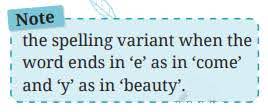
Now, divide the following words from the text as root words and suffixes. Check your answer with the teacher.
| gladly | banker | guidance | quietly | walking |
Ans.
| Word | Root Word | Suffixes |
| Gladly | Glad | ly |
| Banker | Bank | er |
| Guidance | Guide | ance |
| Quietly | Quite | ly |
| Walking | Walk | ing |
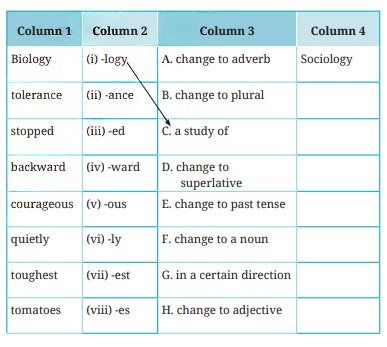
1. Study the words in Column 1. Match the suffixes in Column 2 with their meanings or purpose in Column 3. Write a few examples for each in Column 4. Share your answers with the teacher.
Ans.
| Column 1 | Column 2 | Column 3 | Column 4 |
| Biology | (i) -logy | C. a study of | Sociology |
| Tolerance | (ii) -ance | F. Change to a noun | Guidance |
| Stopped | (iii)-ed | E. change to past tense | Dropped |
| Backward | (iv) -ward | G. in a certain direction | Forward |
| Courageous | (v) -ous | H. Change to adjective | Gorgeous |
| Quietly | (vi) -ly | A. Change to adverb | Softly |
| Toughest | (vii) -est | D. change to Superlative | Fastest |
| Tomatoes | (viii)-es | B. change to plural | Potatoes |
2. Fill in the blanks using words given in the brackets by adding suitable suffixes.
To communicate (i) ___________ (effective), choose your words and topics (ii) ___________ (wise). Avoid (iii) ___________ (discuss) things you don’t know much about or that could upset someone. Remember to be (iv) ___________ (respect) towards others, including yourself, and express your (v) ___________ (appreciate). Finally, always be (vi) ___________ (response) by replying promptly to communicate.
Ans. To communicate (i) effectively, choose your words and topics (ii) wisely. Avoid (iii) discussing things you don’t know much about or that could upset someone. Remember to be (iv) respectful towards others, including yourself, and express your (v) appreciation. Finally, always be (vi) responsive by replying promptly to communicate.
II Read the highlighted words in the following sentences from the text.
• But does anyone want to hear the things that you say?
• I can’t tell you everything.
Select the correct answer.
Is there a difference in the meanings of ‘say’ and ‘tell’? (Yes/ No)
• ‘Say’ focuses on the message and does not always require a listener.
• ‘Tell’ focuses on who receives the message and always needs a listener.
Ans. Yes, there is a difference in the meanings of ‘say’ and ‘tell’.
1. Fill in the blanks with suitable words from the sets of words given in the box below. Make changes in the verb forms (tense), if necessary.
| • fetch : go somewhere to get something and bring it back bring : take something with you to the place you are going• see : something that we view, whether or not we pay attention look : focus your eyes in a certain direction by paying attention• live : permanent place of residence stay : temporary presence in a location as a guest or visitor• study : spend time learning something as part of formal education learn : gain knowledge or skill through study or experience • speak : express thoughts or ideas aloud, often in formal situations • hear : perceive sounds unintentionally through the ears |
(i) I _________ at the photo, but I didn’t _________ anyone familiar.
(ii) I’d better go and _________ my mother from the station, and then _________ her home.
(iii) I need to _________ for my mathematics exam this weekend, so I hope to _________ new concepts along the way.
(iv) I can _________ the music from my neighbour’s house, but I need to _________ to it carefully to understand the lyrics.
(v) “Could I _________ to Mrs. Kalpana, who is going to _________ to us about gardening,” said Ritu.
(vi) I _________ in a small town, but I often _________ with my relatives in the city.
Ans. (i) I looked at the photo, but I didn’t see anyone familiar.
(ii) I’d better go and fetch my mother from the station, and then bring her home.
(iii) I need to study for my mathematics exam this weekend, so I hope to learn new concepts along the way.
(iv) I can hear the music from my neighbour’s house, but I need to listen to it carefully to understand the lyrics.
(v) “Could I speak to Mrs. Kalpana, who is going to talk to us about gardening,” said Ritu.
(vi) I live in a small town, but I often stay with my relatives in the city.
III Read the following sentences from the text and underline the verbs.
- They lived in London before.
- I met her in a shop and asked her to come.
As you know, the verbs you have underlined are in simple past tense. (actions that happened in the past or distant past)
Read the following sentence from the text and underline the verb.
She has been staying with them for a while.
The verb you have underlined is in present perfect continuous tense.
| We use present perfect continuous (has/have + been + verb + -ing) to indicate:
The duration of an action that started in the past and continues up to the present moment. • Mrs. Shaw has been preparing the room since the morning for Mrs. Harding and Mrs. Lee’s visit. An action that was ongoing in the recent past, with its results evident now. The focus is on the ongoing activity rather than its completion. • Mrs. Shaw has been cleaning the room since the morning. (The room looks spotless now.) • The students have been practising a play about the story. (They are rehearsed and ready.) |
Ans.
- They lived in London before.
- I met her in a shop and asked her to come.
She has been staying with them for a while.
1. Fill in the blanks using the verbs given in brackets in present continuous or present perfect continuous tense.
The students (i) ______________ (organise) a play and setting up the stage. They (ii) ______________ (prepare) for weeks to make everything perfect. The performers (iii) ______________ (rehearse) every day, and their excitement (iv) ______________ (grow). The sound in-charge (v) ______________ (test) the microphones to check the sound quality. Everyone (vi) ______________ (work) hard, and now the place (vii) ______________ (buzz) with energy and excitement.
Ans. The students (i) are organising a play and setting up the stage. They (ii) have been preparing for weeks to make everything perfect. The performers (iii) have been rehearsing every day, and their excitement (iv) is growing. The sound in-charge (v) is testing the microphones to check the sound quality. Everyone (vi) is working hard, and now the place (vii) is buzzing with energy and excitement.
IV Read the explanation about the kinds of sentences given in the table below.
| Kinds of Sentences | Function | Punctuation | Examples from the text |
| Declarative sentences | to state or convey information | end with a full stop (.) | There’s always something to say. |
| Interrogative sentences | to ask questions | end with a question mark (?) | What shall I do when they want to go? |
| Exclamatory sentences | to express strong feelings or emotions | end with an exclamatory mark (!) | What beautiful children you have, Mrs. Harding! |
| Imperative sentences | to give order, command or request | end with a full stop (.) | Put that coat away in your bedroom. |
1. Identify the kinds of sentences and punctuate them appropriately.
(i) the meeting starts at 10.00 a.m. in the conference room
(ii) what an exciting adventure it was
(iii) how did you solve the problem so quickly
(iv) what is the weather forecast today
(v) how beautiful is the rainbow
(vi) clean up your room before dinner
(vii) the children are planning a surprise party for their mom
(viii) turn off the music
Ans. (i) the meeting starts at 10.00 a.m. in the conference room
Kind of Sentence: Declarative
Punctuation: The meeting starts at 10.00 a.m. in the conference room.
(ii) what an exciting adventure it was
Kind of Sentence: Exclamatory
Punctuation: What an exciting adventure it was!
(iii) how did you solve the problem so quickly
Kind of Sentence: Interrogative
Punctuation: How did you solve the problem so quickly?
(iv) what is the weather forecast today
Kind of Sentence: Interrogative
Punctuation: What is the weather forecast today?
(v) how beautiful is the rainbow
Kind of Sentence: Exclamatory
Punctuation: How beautiful is the rainbow!
(vi) clean up your room before dinner
Kind of Sentence: Imperative
Punctuation: Clean up your room before dinner.
(vii) the children are planning a surprise party for their mom
Kind of Sentence: Declarative
Punctuation: The children are planning a surprise party for their mom.
(viii) turn off the music
Kind of Sentence: Imperative
Punctuation: Turn off the music.
Let us listen
I Mrs. Shaw wanted Mary to learn to say the right thing. You will listen to a conversation between a mother and her son about basic manners. As you listen, fill in the blanks given below by selecting the correct option. (Transcript for the teacher on pg. 89 )
1. How did the son behave in the grocery queue?
(i) strangely
(ii) impatiently
(iii) politely
Ans. 1. (ii) impatiently
2. The mother finally refers to her son as a __________________.
(i) polite young man
(ii) responsible son
(iii) grateful person
Ans. 2. (i) polite young man
II You will once again listen to the conversation. As you listen, select four true statements from 1– 7 given below.
1. The mother uses the grocery store incident as an opportunity to teach her son about patience and fairness.
2. The son recognises the value of apologising and understands that it shows he notices others.
3. The son is gradually learning the importance of polite words and actions from his mother’s guidance.
4. The mother discourages her son from speaking softly in public, suggesting that people should adjust to his voice level.
5. The son feels that covering his mouth when coughing is only important when he’s at home.
6. The son receives all advice readily while understanding its importance.
7. The mother uses praise to support the polite behaviours she wants her son to continue practising.
Ans. 1. The mother uses the grocery store incident as an opportunity to teach her son about patience and fairness. (True)
2. The son recognises the value of apologising and understands that it shows he notices others. (True)
3. The son is gradually learning the importance of polite words and actions from his mother’s guidance. (True)
4. The mother discourages her son from speaking softly in public, suggesting that people should adjust to his voice level. (False)
5. The son feels that covering his mouth when coughing is only important when he’s at home. (False)
6. The sun receives all advice readily while understanding its importance. (False)
7. The mother uses praise to support the polite behaviours she wants her son to continue practising. (True)
Let us write
Rewrite the play ‘Say the Right Thing’ as a short story, focusing on Mary’s interactions with her mother and the guests.
• Ensure the story captures the main events, character emotions, and humorous moments effectively.
• Use paragraphs to organise your story and include descriptive language to bring the characters and events to life.
You may refer to the following hints:
• Begin with an introduction: describe Mary and Mrs. Shaw, their relationship and the setting of the story.
• Explain Mrs. Shaw’s instructions to Mary before the guests arrive and Mary’s confidence in handling the situation.
• Narrate the events when Mrs. Harding and Mrs. Lee visit, highlighting Mary’s remarks and the guests’ reactions.
• Include key moments of humour and awkwardness to maintain the tone of the play.
• Conclude by commenting on how the visit ended and Mary’s impact on the situation.
Ans.
Mary’s Unintended Mistakes: A Short Story
Mary was a lively girl who loved to talk. She lived with her mother, Mrs. Shaw, in a home that often had guests. Mrs. Shaw, who cared about good manners, worried about Mary’s habit of speaking her mind without thinking. “One day, you’ll have to visit these houses yourself,” she often reminded Mary, hinting that Mary needed to learn more social skills. Mary, however, felt confident. “I can talk now! I’ll stay with you today and talk to them,” she said, not realizing her own conversational blunders. To avoid troubles, Mrs. Shaw suggested a walk, hoping to protect their guests, Mrs. Harding and Mrs. Lee, from Mary’s kind but awkward comments.
Despite Mrs. Shaw’s efforts, Mary was there when the ladies arrived, her mother’s advice ringing in her ears: “Be kind. Say things that will please them.” The visit began with polite greetings, but Mary’s excitement soon took over. When she spotted Mrs. Harding, she tried to compliment her: “What beautiful children you have, Mrs. Harding!” Instead, Mrs. Harding replied flatly, “I have no children; believe me.” An awkward silence followed, which Mrs. Shaw quickly broke by mentioning someone else’s children.
Mary did not give up. She continued to chat, sharing her opinion about Mr. Best, a banker who rode the train and read newspapers. “Bankers can’t think!” she said, not knowing that Mrs. Lee’s brother was a banker with the same routine. Another uncomfortable silence fell, interrupted by Mary’s hurried, “Oh, I’m sorry. I didn’t know.”
With each of Mary’s remarks, the mood grew heavier. She talked about Mrs. Cotter, criticizing her for sleeping in and calling the doctor often. Unbeknownst to Mary, Mrs. Harding enjoyed slow mornings too, and Mrs. Lee visited the doctor regularly. Every innocent comment Mary made caused tension. The situation grew worse when Mary saw Mr. Pomeroy on his horse and said, “Some men like horses more than people, and I wonder why he practices shooting.” Mrs. Lee, whose brother also rode and practiced shooting, could only watch in discomfort.
Mary failed to see the humor in her mistakes, though everyone else did. Each time Mrs. Shaw tried to redirect the conversation, Mary went off track again with another awkward comment. The stage directions often noted “no one speaks,” highlighting the heavy silences after Mary’s words. The atmosphere felt more and more tense, with forced smiles and quiet unease from the guests.
Eventually, Mrs. Harding and Mrs. Lee, looking less happy than when they arrived, said it was “getting a little late.” Mrs. Shaw, always polite, kindly invited them to stay longer: “Please stay a little longer.” However, Mary misheard or reverted to her usual style and said the opposite: “Oh, must you stay? Can’t you go?” With a final forced smile, the guests left promptly, leaving Mrs. Shaw to deal with the fallout from Mary’s earnest but misguided attempts at polite conversation. This brief visit taught Mary a valuable lesson about the delicate art of conversation, a lesson she still needed to learn.
CBSE Class 7 English Chapter 3 Say The Right Thing Extract-Based Questions
Answer the following extract-based questions.
A.
Mary: Why are those two women coming here? Who’s Mrs. Harding?
Mrs. Shaw: She’s the wife of a wealthy man, Mr. Harding. He has just bought a big house in Lanfield. They lived in London before. She’s coming to have a talk. I met her in a shop and asked her to come.
Mary: Oh, I’ve seen her children. They often come along the road. Who’s Mrs. Lee?
Mrs. Shaw: She’s Mr. Harding’s sister. She has been staying with them for a while.
Mary: What are you going to talk about?
Mrs. Shaw: I don’t know. All kinds of things. One day you’ll have to go to some of these houses yourself and talk to the people there.
Q1. Why was Mrs. Harding coming to Mrs. Shaw’s house?
Ans. Mrs. Harding was coming to Mrs. Shaw’s house to have a talk, as Mrs. Shaw had met her in a shop and invited her.
Q2. Where did Mrs. Harding and her husband live before moving to Lanfield?
Ans. Before moving to Lanfield, Mrs. Harding and her husband lived in London.
Q3. Who is Mrs. Lee in relation to Mrs. Harding?
Ans. Mrs. Lee is Mrs. Harding’s sister.
Q4. What does Mary claim to have seen regarding Mrs. Harding?
Ans. Mary claims to have seen Mrs. Harding’s children walking along the road.
Q5. How does Mrs. Shaw respond when Mary asks what they are going to talk about with the guests?
Ans. Mrs. Shaw responds by saying she doesn’t know, just “all kinds of things,” and adds that one day Mary will have to go to such houses herself and talk to people.
B.
Mrs. Shaw: I can’t tell you everything, but you’ll always be right if you’re kind to people. Say things that will please them. Then they’ll like you. Laugh a lot, and try to make them laugh too. And if everyone stops talking, say something to make them talk again. They don’t want to sit here and look at the floor without speaking. Think of something to say.
Mary: I can do that. There’s always something to say. Must I do anything else?
Mrs. Shaw: When they are ready to leave, don’t jump out of your chair and look gladly at the door. You must look sorry when they want to leave.
Mary: What shall I do when they want to go?
Mrs. Shaw: Ask them to stay a little while longer. Just say, “Must you go? Can’t you stay?” or something like that. You like them and you want them to stay, and you must let them understand that.
Mary: That’s not very hard, is it? I’ll remember that. “Must you go? Can’t you stay? Must you go? Can’t you stay?”
Q1. According to Mrs. Shaw, what is the most important rule for Mary to follow to ensure people like her?
Ans. The most important rule is to be kind to people and say things that will please them.
Q2. What advice does Mrs. Shaw give Mary about how to react when conversation stops during the visit?
Ans. Mrs. Shaw advises Mary to say something to make them talk again, so they don’t just sit in silence.
Q3. How should Mary react when guests are ready to leave, according to Mrs. Shaw?
Ans. Mary should look sorry and not jump out of her chair looking gladly at the door.
Q4. What specific phrase does Mrs. Shaw suggest Mary use to encourage guests to stay longer?
Ans. Mrs. Shaw suggests Mary say, “Must you go? Can’t you stay?”
Q5. What is Mary’s initial reaction to the advice about asking guests to stay?
Ans. Mary finds it “not very hard” and repeats the suggested phrase to remember it.
C.
Mrs. Harding: (not very pleased) I have no children; believe me.
Mary: Oh!
Mrs. Shaw: (quietly) They must be someone else’s children. Have you met Mr. Best? He’s a nice man. He lives near you.
Mary: Oh, Mr. Best! He lives here and he works in London. He goes all the way to London by train every morning, and then he comes all the way back by train every night. He lives in trains! (she laughs) What kind of life is that? Why do people do things like that? They do not know how to live. And he reads two newspapers in the train every day. He never reads a book. But he’s only a banker, and bankers can’t think.
Mrs. Lee: My brother’s a banker. He goes to London by train every morning and comes back every night. He reads two newspapers in the train in the morning, and another every night.
Mary: Oh, I’m sorry. I didn’t know.
Mrs. Shaw: Bankers always have to read a lot of newspapers. Do you know Mrs. Best? She’s a nice woman. I like her.
Q1. Why was Mrs. Harding “not very pleased” at the beginning of the extract?
Ans. Mrs. Harding was not pleased because Mary had incorrectly complimented her on her “beautiful children,” implying she had them when she did not.
Q2. What specific details does Mary share about Mr. Best’s daily routine?
Ans. Mary says Mr. Best lives and works in London, commutes by train every morning and night, and reads two newspapers on the train daily.
Q3. What negative judgment does Mary make about bankers based on Mr. Best’s habits?
Ans. Mary judges that “bankers can’t think.”
Q4. How does Mrs. Lee react to Mary’s comments about bankers and train travel?
Ans. Mrs. Lee reveals that her own brother is a banker who follows a very similar routine, reading newspapers on the train, which makes Mary’s previous comments awkward.
Q5. What is Mary’s immediate reaction after realizing she has offended Mrs. Lee?
Ans. Mary immediately apologizes, saying, “Oh, I’m sorry. I didn’t know.”
D.
Mary: (with a red face) Oh, I didn’t know! (No one speaks.)
Mary: (still looking out of the window) There’s Mr. Pomeroy on his horse. He’s always talking about horses. He rides a horse every day, and practises shooting. Why must he do that? What have they done to Mr. Pomeroy? Why do some men like horses more than they like people? It’s hard to understand men.
Mrs. Lee: My brother practises shooting when he has the time, and he rides his horse when he can. He sold his house in London and bought a house here because he wanted to ride and practise shooting.
Mrs. Harding: (looking at Mrs. Lee) It’s getting a little late. We must go now, Mrs. Shaw. It has been very nice to have a little talk. (She looks at Mary.)
Mrs. Lee: Very nice. (She looks at Mary.)
Mrs. Shaw: It was very good of you to come to see us. Please stay a little longer.
Mary: (unable to say the right thing even now) Oh, must you stay? Can’t you go?
Q1. Why does Mary comment about Mr. Pomeroy always talking about horses and practicing shooting?
Ans. Mary is questioning why some men, like Mr. Pomeroy, seem to prefer horses over people and engage in such activities.
Q2. How does Mrs. Lee again become inadvertently offended by Mary’s comments?
Ans. Mrs. Lee’s brother also practices shooting and rides his horse, having moved specifically for these activities, making Mary’s critical remarks about Mr. Pomeroy apply to him as well.
Q3. What do Mrs. Harding’s and Mrs. Lee’s actions suggest about their feelings by the end of their conversation?
Ans. Their actions, such as looking at Mary and stating “It’s getting a little late. We must go now,” suggest they are uncomfortable and eager to leave due to Mary’s repeated awkward comments.
Q4. What is the specific phrase Mrs. Shaw uses to politely ask the guests to stay longer?
Ans. Mrs. Shaw says, “Please stay a little longer.”
Q5. What is Mary’s final, most significant blunder in this extract, contradicting her mother’s earlier teaching?
Ans. Instead of asking the guests to stay, Mary accidentally says, “Oh, must you stay? Can’t you go?”
Class 7 Say The Right Thing Multiple Choice Questions
Q1. Who is the author of the play “Say the Right Thing”?
A. Helen Keller
B. G.C. Thornley
C. Mark Twain
D. William Shakespeare
Ans. B. G.C. Thornley
Q2. Who are the two guests visiting Mrs. Shaw’s home?
A. Mrs. Best and Mrs. Cotter
B. Mrs. Grantley and Mr. Pomeroy
C. Mrs. Harding and Mrs. Lee
D. Mary’s aunts
Ans. C. Mrs. Harding and Mrs. Lee
Q3. What does Mrs. Shaw initially ask Mary to do before the guests arrive?
A. Prepare tea
B. Clean the garden
C. Put her coat away in her bedroom
D. Read a book quietly
Ans. C. Put her coat away in her bedroom
Q4. Why is Mrs. Shaw concerned about Mary talking to the guests?
A. Mary is usually very shy.
B. Mary tends to say the wrong things.
C. Mary complains too much.
D. Mary might fall asleep during the conversation.
Ans. B. Mary tends to say the wrong things.
Q5. What advice does Mrs. Shaw give Mary about making people like her?
A. Show off her intelligence.
B. Be kind and say pleasing things.
C. Remain silent and listen only.
D. Tell many jokes.
Ans. B. Be kind and say pleasing things.
Q6. What was Mary’s first blunder when she spoke to Mrs. Harding?
A. She asked about Mrs. Harding’s age.
B. She complimented Mrs. Harding’s “beautiful children” who didn’t exist.
C. She criticized Mrs. Harding’s dress.
D. She spilled tea on Mrs. Harding.
Ans. B. She complimented Mrs. Harding’s “beautiful children” who didn’t exist.
Q7. What was Mrs. Lee’s relation to Mr. Harding?
A. She was his wife.
B. She was his mother.
C. She was his sister.
D. She was his daughter.
Ans. C. She was his sister.
Q8. What profession did Mary unintentionally insult, unaware that Mrs. Lee’s brother belonged to it?
A. Bankers
B. Teachers
C. Doctors
D. Farmers
Ans. A. Bankers
Q9. What did Mary say about Mrs. Cotter that offended the guests?
A. That Mrs. Cotter was a great cook.
B. That Mrs. Cotter stayed in bed and called the doctor too often.
C. That Mrs. Cotter had a new car.
D. That Mrs. Cotter sang beautifully.
Ans. B. That Mrs. Cotter stayed in bed and called the doctor too often.
Q10. What does Mrs. Shaw tell Mary to do if everyone stops talking?
A. Go to her room.
B. Offer more refreshments.
C. Start singing.
D. Say something to make them talk again.
Ans. D. Say something to make them talk again.
Q11. What was Mary’s comment about Mrs. Grantley?
A. She called her an excellent storyteller.
B. She called her “too talkative” and not interesting.
C. She admired her sense of fashion.
D. She praised her gardening skills.
Ans. B. She called her “too talkative” and not interesting.
Q12. What was the impact of Mary’s continuous blunders on the guests?
A. They found her very amusing.
B. They became more comfortable and relaxed.
C. They felt embarrassed and uncomfortable.
D. They ignored her completely.
Ans. C. They felt embarrassed and uncomfortable
Q13. What advice did Mrs. Shaw give Mary regarding guests leaving?
A. Ask them to stay longer, like “Must you go? Can’t you stay?”
B. “Must you stay? Can’t you go?”
C. Thank them for coming.
D. Offer them a gift as they depart.
Ans. A. Ask them to stay longer, like “Must you go? Can’t you stay?”
Q14. What was Mary’s final blunder as the guests were about to leave?
A. She accidentally locked the door.
B. She told them they should visit more often.
C. She said, “Oh, must you stay? Can’t you go?”
D. She offered them outdated magazines.
Ans. C. She said, “Oh, must you stay? Can’t you go?”
Q15. What is the main moral lesson of the play “Say the Right Thing”?
A. Always tell jokes to make people laugh.
B. Silence is always golden.
C. Guests should never be allowed to talk much.
D. The importance of thinking before you speak and choosing your words carefully.
Ans. D. The importance of thinking before you speak and choosing your words carefully.
Q16. What kind of story is “Say the Right Thing”?
A. A fairy tale
B. A detective story
C. A humorous play
D. A historical account
Ans. C. A humorous play
Q17. Which quality does Mary lack when interacting with the guests?
A. Politeness
B. Punctuality
C. Intelligence
D. Cooking skills
Ans. A. Politeness
Q18. How did Mrs. Shaw try to manage Mary’s interruptions and inappropriate comments?
A. By sending Mary out of the room.
B. By loudly scolding Mary.
C. By trying to change the topic quickly.
D. By laughing along with Mary.
Ans. C. By trying to change the topic quickly.
Q19. What does the play suggest about listening?
A. It’s not as important as speaking.
B. It is crucial to listen carefully before speaking.
C. Listening is only for adults.
D. Listening can be done while multitasking.
Ans. B. It is crucial to listen carefully before speaking.
Q20. What is the central theme highlighted by Mary’s mistakes?
A. The challenges of hosting parties.
B. The difficulty of making new friends.
C. The impact of words and the need for sensitive communication.
D. The importance of children being seen and not heard.
Ans. C. The impact of words and the need for sensitive communication.
CBSE Class 7 English Poorvi Book Unit 2 – Wit and Humour Chapter 3 Say The Right Thing Extra Question and Answers
Answer the following questions.
Q1. Who is the main character in the play, and what is her initial desire regarding the guests?
Ans. The main character is Mary Shaw. Her initial desire is to stay and talk with the guests because she believes she can talk well and wants to practice being social.
Q2. What advice does Mrs. Shaw give Mary about talking to the guests before they arrive?
Ans. Mrs. Shaw advises Mary to be kind, say things that make people happy, laugh to keep the mood light, start conversations if everyone is quiet, and ask guests to stay longer when they want to leave.
Q3. What was Mary’s first major blunder when the guests, Mrs. Harding and Mrs. Lee, arrived?
Ans. Mary’s first major blunder was complimenting Mrs. Harding on her “beautiful children,” only for Mrs. Harding to reveal that she has no children.
Q4. What did Mary say about Mrs. Cotter during the visit that caused awkwardness.
Ans. Mary makes several mistakes. One example is when she criticizes Mrs. Cotter for staying in bed and calling the doctor often, only to find out that Mrs. Harding stays in bed in the morning and Mrs. Lee regularly visits the doctor. Another is when she criticizes dogs, unaware that Mrs. Harding owns one.
Q5. What is the main moral or lesson conveyed by the play “Say the Right Thing”?
Ans. The main moral of the play is the importance of thinking before speaking, being sensitive to others’ feelings, and speaking carefully and kindly. It highlights how good intentions can still lead to awkward or offensive situations if one is not mindful of their words and the context.