
CBSE Class 9 English Chapter 7 Carrier of Words Question Answers (Important) from Kaveri Book
Class 9 English Carrier of Words Question Answers – Looking for Carrier of Words question answers (NCERT solutions) for CBSE Class 9 English Kaveri Book Chapter 7? Look no further! Our comprehensive compilation of important questions will help you brush up on your subject knowledge. Practising Class 9 English question answers can significantly improve your performance in the exam. Our solutions provide a clear idea of how to write the answers effectively. Improve your chances of scoring high marks by exploring Chapter 7: Carrier of Words now. The questions listed below are based on the latest CBSE exam pattern, wherein we have given NCERT solutions (Textbook Questions) to the chapter’s, Extract Based Questions, Multiple Choice Questions, and Extra Question Answers
Also, practising with different kinds of questions can help students learn new ways to solve problems that they may not have seen before. This can ultimately lead to a deeper understanding of the subject matter and better performance on exams.
- Carrier of Words Textbook Questions (NCERT Solution)
- Carrier of Words Grammar Exercises
- Carrier of Words Extract-Based Questions
- Carrier of Words Multiple Choice Questions
- Carrier of Words Extra Questions
Related:
Carrier of Words Textbook Questions (NCERT Solutions)
Reflect and Respond

I. Look at the pictures given below of persons engaged in the same profession.
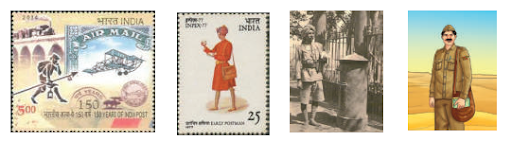
Discuss in pairs and share your answers with your classmates and teacher.
1. Which profession do they belong to?
2. Do they face any difficulties while doing their duty?
3. How does their profession affect the people they meet?
Ans.
1. They belong to the postal profession.
2. Postmen face difficulties environmentally and physically when they travel long distances to deliver mail.
3. Their profession helps maintain human connection in remote areas.
II Discuss in groups.
1. How can ‘words’ be ‘carried’?
Ans. Words can be carried via means of communication like letter, newspaper, magazine, poster, pamphlet, etc.
2. Who could be a carrier of words?
Ans. A vendor, hawker of newspaper or postman can be a carrier of words. Any person who delivers such means of communication can be called a carrier of words.
3. What are the means for people to stay connected?
Ans. Means of communication are the ways for people to stay connected. For example – newspapers, letters, posters, ma
III Read the words given in the box below and place them in their appropriate context in the following passage.

| slumped | dunes | defying |
| hamlets | signals | devoid |
We stepped out of the vehicle at the end of the road. Immediately, our body sent 1. _________ that our decision to visit the sand 2. _________ in the afternoon was insane. We had passed a few 3. _________ on our way to the desert. We could not find even a single soul outdoors, 4. _________ the blazing sun. Even the camels were 5. _________ in the little shade offered by the khejri trees. In this remote place people relied on Bharat Sanchar Nigam Limited (BSNL) to connect to the world as the area was 6. _________ of any other network service.
Ans. We stepped out of the vehicle at the end of the road. Immediately, our body sent signals that our decision to visit the sand dunes in the afternoon was insane. We had passed a few hamlets on our way to the desert. We could not find even a single soul outdoors, defying the blazing sun. Even the camels were slumped in the little shade offered by the khejri trees. In this remote place people relied on Bharat Sanchar Nigam Limited (BSNL) to connect to the world as the area was devoid of any other network service.
Check Your Understanding
I. Khetaram needs to submit information about himself for getting an identity card. While reading the text, fill up the following information sheet for Khetaram.
| Name | Khetaram |
| Position | |
| Employer | |
| Official address | |
| Mode of transport used | |
| Key responsibilities |
|
|
|
|
|
|
Ans.
| Name | Khetaram |
| Position | Gramin Dak Sewak |
| Employer | India Post |
| Official address | Somarad Postal Office |
| Mode of transport used | Foot |
| Key responsibilities |
|
|
|
|
|
|
II Discuss with your teacher.
1. Why do you think Khetaram has taken up this challenging job?
Ans. Khetaram took up this challenging job to provide a more stable and secure income for himself and his family which he could not get from his agriculture work.
2. How do you think Khetaram would feel about taking up this challenging task every day?
Ans. Khetaram was a dedicated and persevering postman who would take up challenge with an optimistic attitude.
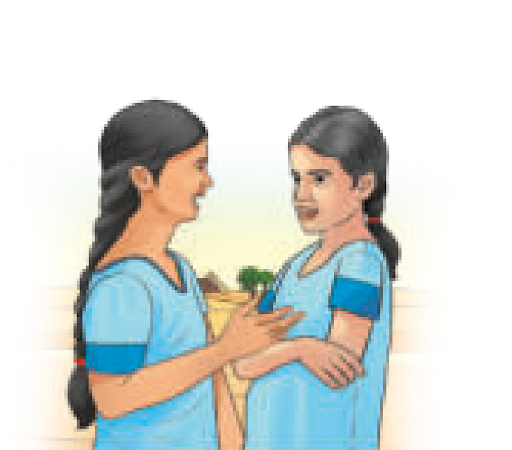
Check Your Understanding
I. Complete the table given below with the situations given in Column 1 and the reasons in Column 2.
| Column 1 | Column 2 |
| Khetaram has a day off. | When the temperature is recorded as 50 degrees celsius and above, a state holiday has to be declared. |
| Khetaram can dwell on any threshold. | The villagers are hospitable |
| BSF always gave Khetaram a lift. | They trusted and appreciated his service |
II. Why was a piece of jaggery offered in the village when he brought news of a birth or weddings?
Ans. The villagers feel grateful for the role he plays in bringing that happy news, so they offer him simple gifts like a piece of jaggery as a token of their happiness and respect.
III. How would phone lines help Khetaram in his job?
Ans. Phone lines would help Khetaram in his job by making communication faster, easier, and more flexible. Instead of walking long distances every day just to carry letters and messages, he could use a phone to pass on news quickly and directly. Family news, job updates, or emergencies could be shared over the phone immediately, reducing the need for frequent long‑distance trips. With phone lines, Khetaram could become a Gramin Dak Sewak who carries a mobile phone along with the post from house to house, helping illiterate or elderly people make calls and stay in touch with relatives in cities.
Critical Reflection
I. Read the extracts given below and answer the questions.
1. “Akaal or famine is a way of life here. In a good year, I get one crop of bajra. That cannot feed my family of five. We would starve without this job,” he says.
And for each family which resides in this arid land, survival is partly dependent on money orders remitted by a relative.
(i) Complete the sentence given below with an appropriate reason.
One crop of bajra makes a little difference for people like Khetaram because __________________________.
Ans. it was not enough to feed his family.
(ii) Why did Khetaram term famine as ‘a way of life’?
Ans. Khetaram saw famine as ‘a way of life’ because it determined how much crop of Bajra he would yield that year.
(iii) Give one reason why Khetaram had to take up a job to help his family to survive.
Ans. Khetaram had to take up a job to help his family to survive because his farming occupation did not yield enough crops for his family’s survival and income.
(iv) Complete the analogy given below with a word from the extract.
Other families: Money orders:: Khetaram: __________________
Ans. postman
(v) What would ‘a good year’ signify?
Ans. A good year means a year when environmental conditions are good enough to yield some crops.
2. There is one letter delivery he dreads. The envelope with the right corner torn off, which signifies that the missive bears news of death. “Ashubh Samachar cannot be carried into the house,” says Khetaram. So, he stands outside, reads out the letter twice, then tears it to bits. “Bad news must be destroyed,” he mutters philosophically.
(i) Choose the correct option for the following question.
Who could have torn the right corner of the envelope?
A. Khetaram
B. Sender of the letter
C. Receiver of the letter
D. The postmaster
Ans. B. Sender of the letter
(ii) Complete the sentence with an appropriate reason.
The most likely reason for Khetaram reading the letter twice is because _____________________ ______________.
Ans. he wanted to convey the message clearly.
(iii) What was Khetaram’s philosophy regarding bad news, and how did he act upon it?
Ans. Khetaram’s philosophy regarding bad news was that bad news needed to be destroyed. So he would tear up the letter carrying bad news into bits.
(iv) State whether the following sentence is true or false.
Khetaram’s action of tearing the letter differed from his beliefs.
Ans. False
(v) Mention any one aspect of Khetaram’s temperament which is revealed through this extract.
Ans. We see that Khetaram cares about the villagers’ feelings and helps deliver bad news in an intuitive way.
II. Answer the following questions.
1. Justify the statement made by Postmaster-General, Rajasthan Western Region stating that the role of GDS is ‘invaluable’.
Ans. The Postmaster General, Rajasthan Western Region, says the role of the Gramin Dak Sevak (GDS) is “invaluable” because GDS are the living link between remote villages and the rest of the country. Without them, a large part of rural India would be cut off from communication, banking, and many government services.
2. How was the purpose of India Post different from that of the British postal system?
Ans. The British postal system and India Post (independent India) had different main purposes. The British postal system’s main purpose is to serve the British administration and colonial interests. It was designed mainly for official communication, military needs, and connecting British officials and traders. Ordinary Indians, especially in remote villages, had limited access as the system was not built primarily for their welfare. The India Post’s main purpose is to serve the people of India, especially common citizens and rural communities. It focuses on universal service: delivering mail, money orders, small savings, and government schemes to even the most remote villages. It also promotes financial inclusion, social welfare, and national integration, not just administrative efficiency. In short, the British postal system is administration-centric and built for the rulers and their control, whereas the India Post is people-centric and built for the citizens, especially the poor, rural, and isolated, to connect them with family, economy, and the state.
3. People trusted Gramin Dak Sewaks. Support this statement with any two instances from the text.
Ans. From the lesson “Carrier of Words”, the statement “People trusted Gramin Dak Sewaks” is supported by the following two instances: Reading letters and writing replies, and accepting him even for painful news. Villagers, many of whom could not read or write, comfortably asked Khetaram to read their letters and even draft replies. This shows that they trusted him with their private and personal messages. When there was bad news like death, villagers allowed Khetaram to read the letter aloud twice at the doorstep and tear it, following their belief that such news should not be carried into the house. Letting him handle such sensitive and emotional moments shows deep trust in his character and respect for his role.
4. Infer the most likely reason that Khetaram was grateful to continue as GDS, even after the age of 60.
Ans. Khetaram was grateful to continue as a Gramin Dak Sevak (GDS) even after the age of 60. The job provided him with financial support, which was important for his livelihood, especially after years of fruitless agriculture. His work gave him a strong sense of purpose. He was deeply respected by the villagers, who trusted him with their letters, money, and even sensitive news. Staying in the role meant he could continue to serve the community and maintain his dignity and social value. In short, Khetaram continued because the job was not just a source of income, but also the source of his identity, respect, and fulfillment in the village.
5. Explain why the author pays tribute to people like Khetaram.
Ans. Khetaram serves remote villagers by delivering letters, money orders, and even painful news like death messages, without expecting anything in return. He helps people stay connected with their families, enables communication, and supports village life. Without such people, many villagers would be isolated and cut off from the world. He works in tough conditions like long walks, difficult terrain, all kinds of weather, and still remains committed to his duty. People like Khetaram are ordinary workers who rarely get noticed or appreciated, but their work is vital for the social and emotional life of the community. The author wants to honour and bring attention to their quiet but important contributions.
Top
Carrier of Words Grammar Exercises
Vocabulary and Structures in Context
I. Study the phrases given in Column 1 and match them with their meanings in Column 2.
| Column 1 | Column 2 |
| 1. crumbles into sand | (i) get a chance to continue living |
| 2. give a new lease of life | (ii) carrying letters to less populated areas |
| 3. turn into a trickle before drying out | (iii) disappears in the desert |
| 4. bearing words across this desolate geography | (iv) lessen gradually and then finally stop |
Ans.
| Column 1 | Column 2 |
| 1. crumbles into sand | (iii) disappears in the desert |
| 2. give a new lease of life | (i) get a chance to continue living |
| 3. turn into a trickle before drying out | (iv) lessen gradually and then finally stop |
| 4. bearing words across this desolate geography | (ii) carrying letters to less populated areas |
Now, use the phrases from Column 1 in sentences of your own.
Ans.
1. crumbles into sand: The old fort wall, weakened by time and weather, slowly crumbles into sand.
2. give a new lease of life: Renovating the village school with fresh paint and new desks will give a new lease of life to the students’ learning environment.
3. turn into a trickle before drying out: After the heavy monsoon rains, the river’s flow began to turn into a trickle before drying out completely by summer.
4. bearing words across this desolate geography: Khetaram, the Gramin Dak Sevak, walks through rugged paths day after day, bearing words across this desolate geography to connect isolated families with their distant loved ones.
II. Identify examples of alliteration and metaphor in the extract given below.
Khetaram’s khaki turban and uniform are his only protection against the desert’s furies, the scorching summer winds and swirling sandstorms which turn him into a walking sandman.
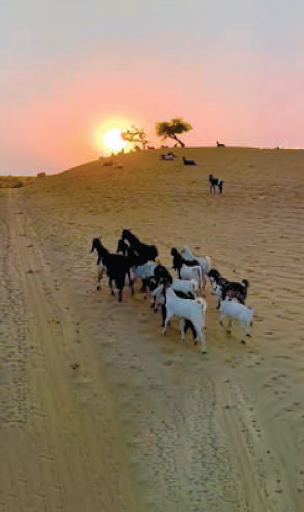
Ans. Alliteration: scorching summer and swirling sandstorms
Metaphor: desert’s furies and walking sandman
III. Match the words in Column 1 to what they suggest in Column 2 in the context of the chapter.
| Column 1 | Column 2 |
| 1. arid | (i) interest rate for the farmers |
| 2. concessional | (ii) corner of the world |
| 3. gaunt | (iii) farmland without much yield |
| 4. remote | (iv) desert stretching far and wide |
| 5. desolate | (v) farmer waiting for the rains |
Ans.
| Column 1 | Column 2 |
| 1. arid | (iii) farmland without much yield |
| 2. concessional | (i) interest rate for the farmers |
| 3. gaunt | (v) farmer waiting for the rains |
| 4. remote | (ii) corner of the world |
| 5. desolate | (iv) desert stretching far and wide |
Now, use the words from Column 1 in sentences of your own.
Ans.
1. arid: The arid desert land receives very little rain and supports only a few hardy plants.
2. concessional: The government provides concessional interest rates on loans for farmers and small businesses.
3. gaunt: After weeks of illness, he looked gaunt, with sharp cheekbones and hollow eyes.
4. remote: The village is so remote that it has no mobile network and depends on the postman for news.
5. desolate: The desolate landscape, with no trees or water, looked empty and lifeless under the fierce sun.
IV. Read the underlined verbs in the sentences given in Column 1 and their functions in Column 2.
| Column 1 | Column 2 |
| 1. She has found her book. | (i) finished actions (past event — present result) |
| 2. I have just eaten a mango. | (ii) recently completed action |
| 3. Have you ever seen a play before? | (iii) life experiences |
| 4. I have finished my project. | (iv) accomplishment |
| 5. Ajay has become a good bowler in five years. | (v) changes over time |
| 6. I have seen this book in the library many times. | (vi) multiple actions at different times |
| 7. I have studied in this school for six years. | (vii) action completed in the past but has its impact in present |
| All the verbs in the sentences in Column 1 are in present perfect tense. The structure is: has/have + past participle (third form of the verb). |
Now, fill in the blanks by using the present perfect form of the verbs given in the brackets to complete the following paragraph.
1. I _________ (has/have) just ________ (get) a collection of postage stamps from my grandfather. He 2. ___________ (collect) these stamps over a period of 20 years. I 3. ___________ (study) most of the stamps in his collection and loved all of them. I 4. _______ (begin) my own collection of postage stamps. Grandfather 5. _________ truly ________ (inspire) me.
Ans.
1. have just got
2. has collected
3. have studied
4. have begun
5. has truly inspired
V. Study the sentences given below.
1. GDS delivers the mail at the border.
When the subject does the action, the sentence is in active voice.
2. The mail is delivered by the GDS at the border.
This implies that the ‘mail’ receives the action ‘deliver’.
This sentence is in passive voice because the subject is receiving the action.
3. Khetaram’s nephew wants to join the GDS. He asks Khetaram how to prepare for it. Khetaram gives him the following advice.
(i) You will need a lot of stamina for this job.
(ii) Practise reading clearly as some of the villagers will expect you to read out the letters.
(iii) Write words neatly as some villagers will ask you to draft replies.
(iv) Wear full-sleeved shirts and trousers to protect yourself from the heat.
Now, complete the following paragraph about the advice given by Khetaram. One example has been done for you.
To begin with, a lot of stamina will be needed for this job. Next, reading clearly A. ________________________, as you B. ________________________ to read out the letters by some of the villagers. Words C. ________________________ neatly as you D. ________________________ to draft replies by some villagers. Full sleeved-shirts and trousers E. ________________________ to protect yourself from the heat.
Ans.
To begin with, a lot of stamina will be needed for this job. Next, reading clearly is important, as you will be expected to read out the letters by some of the villagers. Words should be written neatly as you may be asked to draft replies by some villagers. Full sleeved-shirts and trousers should be worn to protect yourself from the heat.
Listen and Respond
I. You will listen to a girl talking about an event. As you listen, ll in the blank with the suitable word from the brackets. (Transcript for teacher on page 272)
The speaker concluded her talk with a ___________. (suggestion/request/advice)
Ans. suggestion
II You will listen to the girl talking about the event again. As you listen, choose the correct option for the following questions.
1. What was the occasion that the speaker was talking about?
(i) Letter writing carnival
(ii) Philately day
(iii) Indian Postal Day
Ans. (i) Letter writing carnival
2. India Post is famous for having the most extensive network _________.
(i) in India
(ii) in the world
(iii) among design institutes
Ans. (ii) in the world
3. Letter writing is being revived as this art form has been _________.
(i) celebrated
(ii) appreciated
(iii) forgotten
Ans. (iii) forgotten
4. Which of the following will be a part of the letter writing carnival?
(i) calligraphy and graphology
(ii) origami and designing
(iii) letter posting and philately
Ans. (i) calligraphy and graphology
5. What will the postal department add to the event?
(i) interactive demonstrations
(ii) theatre and dance
(iii) workshop for letter writing
Ans. (i) interactive demonstrations
Writing Task
A condolence message communicates your feelings to someone whose relative or a person close to them has just passed away. It mentions how sorry you feel for the loss and your prayers for strength to the family members.
I Khetaram saw a letter with a torn corner. It had news about Bhawar Singh’s uncle passing away. Read the condolence message that Sawant Singh sent to his cousin as a reply to the letter.
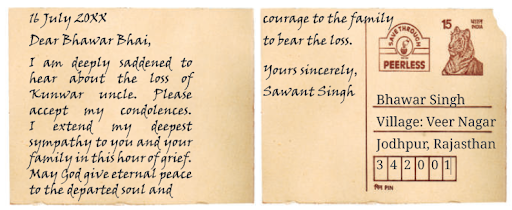
Now, on behalf of your parents draft an imaginary condolence message for your aunt on the recent passing away of her father.
Ans.
Dear Aunt,
We were heartbroken to hear about the sad passing of Kunwar uncle. Please accept our deepest condolences on this terrible loss. He was a kind and loving man, and we will always remember his warmth, his gentle smile, and the stories he used to tell us.
We know how much you loved him and how close you were. This is a very difficult time for you, and we are here for you in any way you need.
May God give you and the whole family the strength to bear this pain.
With love and sympathy,
Bhawant Singh
(On behalf of Mom and Dad)
Top
CBSE Class 9 English Chapter 6 Twin Melodies Extract-Based Questions
A.
Though we are just a click away from sending mail at present, can you imagine how it was before the internet became the way of life? The mail was dropped in the post box, then through the postal system finally it was delivered by the postman in our letter box. The areas beyond the last railhead and after the road crumbles into sand, Gramin Dak Sewaks still serve as the sole link between the oases of humanity in India’s extremes and their faraway families.
Q1. What time is discussed in the lesson?
Ans. The lesson discusses the time before the internet arrived.
Q2. What difference has the internet made in terms of sending letters?
Ans. The internet has brought convenience in sending letters which can now be mailed at the click of the mouse.
Q3. What was the process of delivering mails before the advent of the internet?
Ans. Before the advent of the internet, mails were dropped in the post box, transported by the postal department and delivered by postmen.
Q4. How is Gramin Dak Sewak different from a postman?
Ans. Gramin Dak Sewaks work in remote areas that are not connected by rail or road. In such areas, there are no post offices or postmen. Gramin dak Sewaks are the only ones to connect the people with their faraway families.
Q5. Why is the phrase ‘oases of humanity’ used?
Ans. It is used to highlight that the extreme areas where these people lived were uninhabitable and they had created small patches of livable areas.
B.
Some 120 km beyond the last railhead at Barmer, 50 km beyond the last phone and 10 km beyond where the Barmer–Chohtan road directionlessly crumbles into sand so soft that even bicycles can’t ply, that’s where Khetaram’s footprints appear along sand beds and dunes. It is his bodily effort that ensures that the mail transferred from the mail train onto buses before being hefted onto his shoulders is delivered at the border, within 24 hours of dispatch from Jodhpur, around 330 km away.
Q1. Identify the Indian state that is being talked about.
Ans. Rajasthan
Q2. Khtaram’s footprints could be seen ______ km beyond the point where the Barmer-Chohtan road ended.
Ans. 10 km
Q3. The presence of sand beds suggests that the area is a ________
Ans. desert.
Q4. How does Khetaram carry the mail?
Ans. He carries the big bag on his shoulders.
Q5. From where were the mails sent? How far is the place from Barmer?
Ans. The mails were sent from Jodhpur which is 330 km away.
C.
Till 2001, Khetaram was known as a ‘delivery agent’, operating in rural areas devoid of schools and primary healthcare centres. Since then, India’s three lakh plus delivery agents like Khetaram were accepted as Gramin Dak Sewaks (GDS), who constitute more than 50 per cent of the total workforce.
The frozen desert of Ladakh, the isles of Lakshadweep, and the riverine communities of the northeast are all GDS territories. “The role of GDS is invaluable, since they deliver in interior areas that are often inaccessible by any means besides foot,” explains the Postmaster-General of Rajasthan Western Region.
Q1. Describe the areas where Khetaram operated.
Ans. He operated in rural areas which did not have schools and primary health care centres.
Q2. How many GDS did India have?
Ans. There were more than three lakh Gramin Dak Sewaks.
Q3. Identify the various GDS areas in India.
Ans. In addition to the remote areas of Rajasthan, the frozen desert areas of Ladakh, islands of Lakshdweep and river island areas of the north-east part of the country are GDS areas.
Q4. Why is the role of GDS termed as ‘invaluable’?
Ans. They are invaluable because they deliver letters in areas that can only be accessed by foot.
Q5. The GDSs form ____ percentage of the total workforce of the postal department.
Ans. 50
D.
The essential criterion for GDS selection is access to another means of livelihood. They are required to work only five hours in a day and are also allowed to serve after the age of 60, till the age of 65. All this is so that they can be paid a salary to enable them to have an assured income. The salary of regular postmen gets revised as the other government employees. “Only by applying such different conditions could we retain a large workforce of Gramin Dak Sewaks to serve remote outposts,” explains a postmaster.
Khetaram’s appointment more than a decade ago gave him a new lease of life. “Akaal or famine is a way of life here. In a good year, I get one crop of bajra. That cannot feed my family of five. We would starve without this job,” he says. And for each family which resides in this arid land, survival is partly dependent on money orders remitted by a relative.
Q1. Find a synonym of ‘dry’.
Ans. Arid
Q2. How many hours a day do GDSs work?
Ans. They work 5 hours a day.
Q3. How does the postal department retain the GDS workforce?
Ans. They allow them to work after the age of 60, till 65 and they only work 5 hours a day. This helps retain the workforce.
Q4. What is a decade?
Ans. It is a period of 10 years.
Q5. Akaal is also called _________
Ans. famine.
Top
Class 9 Carrier of Words Multiple Choice Questions
1. Who is the main character in the chapter “Carrier of Words”?
(a) Mulk Raj Anand
(b) Bhawar Singh
(c) Khetaram
(d) The Postmaster-General
Ans. (c) Khetaram
2. What is Khetaram’s profession?
(a) Farmer
(b) Teacher
(c) Gramin Dak Sevak (GDS)
(d) School principal
Ans. (c) Gramin Dak Sevak (GDS)
3. What does the title “Carrier of Words” refer to?
(a) A book
(b) A newspaper
(c) The postman who carries letters
(d) A teacher
Ans. (c) The postman who carries letters
4. Where does Khetaram work?
(a) In a big city
(b) In a branch post office in a remote village area
(c) In a design institute
(d) In a government office in Delhi
Ans. (b) In a branch post office in a remote village area
5. Why is Khetaram called the “carrier of words”?
(a) He writes stories
(b) He carries letters, messages, and news to villagers
(c) He teaches English
(d) He deliver newspapers only
Ans. (b) He carries letters, messages, and news to villagers
6. What do villagers often ask Khetaram to do with their letters?
(a) Tear them
(b) Throw them away
(c) Read them and draft replies
(d) Burn them
Ans. (c) Read them and draft replies
7. How does Khetaram deliver “Ashubh Samachar” (bad news)?
(a) He calls on the phone
(b) He sends an email
(c) He reads it aloud twice at the doorstep and tears the letter
(d) He gives it to the village head
Ans. (c) He reads it aloud twice at the doorstep and tears the letter
8. What does “Ashubh Samachar” mean?
(a) Good news
(b) Happy news
(c) Bad news, often of death
(d) Wedding invitation
Ans. (c) Bad news, often of death
9. Why do people trust Khetaram?
(a) He is rich
(b) He is powerful
(c) He is honest, patient, and treats people with respect
(d) He is a government official
Ans. (c) He is honest, patient, and treats people with respect
10. What does Khetaram wear to protect himself from the heat while delivering mail?
(a) Shorts and T-shirt
(b) Full-sleeved shirts and trousers
(c) Raincoat
(d) Winter coat
Ans. (b) Full-sleeved shirts and trousers
11. What is the main purpose of the Indian postal system after Independence?
(a) To serve only the British officials
(b) To serve the people, especially in remote villages
(c) To serve only urban areas
(d) To serve only the army
Ans. (b) To serve the people, especially in remote villages
12. How does the British postal system differ from India Post?
(a) British system was for common people; India Post was for officials
(b) British system was for administration; India Post is for the people
(c) Both are exactly the same
(d) India Post was for foreigners only
Ans. (b) British system was for administration; India Post is for the people
13. What role does the GDS play in rural areas?
(a) Only delivers newspapers
(b) Acts as a link between villages and the outside world
(c) Teaches at schools
(d) Runs local shops
Ans. (b) Acts as a link between villages and the outside world
14. Why was Khetaram grateful to continue as GDS even after the age of 60?
(a) He wanted to become rich
(b) He wanted fame
(c) For financial support and a sense of purpose and respect
(d) He wanted to travel abroad
Ans. (c) For financial support and a sense of purpose and respect
15. What does Khetaram’s work show about communication in remote villages?
(a) It is not important
(b) It is only for the rich
(c) It is vital for emotional and social connection
(d) It is only for government use
Ans. (c) It is vital for emotional and social connection
16. What would phone lines help Khetaram do?
(a) Stop working
(b) Deliver mail faster and also help villagers make calls
(c) Only send text messages
(d) Only talk to friends
Ans. (b) Deliver mail faster and also help villagers make calls
17. What is the significance of Khetaram reading letters for villagers?
(a) It shows he is a teacher
(b) It shows villagers trust him and many cannot read/write
(c) It shows he is lazy
(d) It shows he wants to show off
Ans. (b) It shows villagers trust him and many cannot read/write
18. What does the Postmaster-General call the role of GDS?
(a) Unimportant
(b) Temporary
(c) Invaluable
(d) Dangerous
Ans. (c) Invaluable
19. What emotion do villagers feel when Khetaram brings good news like a job offer?
(a) Anger
(b) Sadness
(c) Gratitude and happiness
(d) Fear
Ans. (c) Gratitude and happiness
20. Why does the author pay tribute to people like Khetaram?
(a) Because they are famous
(b) Because they are politicians
(c) Because they serve selflessly and keep communities connected
(d) Because they are rich
Ans. (c) Because they serve selflessly and keep communities connected
Top
CBSE Class 9 English Kaveri Book Chapter 7– Carrier of Words Extra Question and Answers
Answer the following questions briefly-
Q1. What was Khetaram’s occupation besides a Gramin Dak Sewak?
Ans. He was a farmer who had a small piece of arid land where they grew some bajra.
Q2. What does Khetaram also do when he delivers letters?
Ans. He even reads the letters and writes replies.
Q3. What type of letters are dreaded by Khetaram?
Ans. He dreads delivering a letter that bears the news of death. Such letters are torn from the right corner.
Q4. The lesson uses various synonyms of ‘letter’. Identify them.
Ans. Mail, missive, post, dak.
Q5. Khetaram wears typical Rajasthani footwear. What is it called?
Ans. Mojri
Q6. When does Rajasthan declare a state holiday?
Ans. When the day temperature touches 50 degrees celsius, the state of Rajasthan declares a state holiday.
Q7. What is the locally used word for settlements?
Ans. Dhaanis.
Q8. Khetaram carries a heavy bag on his shoulder. How can we deduce this?
Ans. The slump on his shoulder indicates that he carries a heavy bag on his shoulders.
Q9. Why does Khetaram not use water to cool himself?
Ans. In the desert, water is very scarce and precious. So he only wipes himself instead of using water to wash and cool.
Q10. What other term is used for Gramin Dak Sewaks?
Ans. Delivery agent.