

CBSE Class 9 English Chapter 3 Winds of Change Question Answers (Important) from Kaveri Book
Updated for the CBSE 2026-27 session as per the rationalised syllabus. Class 9 English Winds of Change Question Answers – Looking for Winds of Change question answers (NCERT solutions) for CBSE Class 9 English Kaveri Book Chapter 3? Look no further! Our comprehensive compilation of important questions will help you brush up on your subject knowledge. Practising Class 9 English question answers can significantly improve your performance in the exam. Our solutions provide a clear idea of how to write the answers effectively. Improve your chances of scoring high marks by exploring Chapter 3: Winds of Change now. The questions listed below are based on the latest CBSE exam pattern, wherein we have given NCERT solutions (Textbook Questions) to the chapter’s, Extract Based Questions, Multiple Choice Questions, and Extra Question Answers
Also, practising with different kinds of questions can help students learn new ways to solve problems that they may not have seen before. This can ultimately lead to a deeper understanding of the subject matter and better performance on exams.
- Winds of Change Questions (NCERT Solution)
- Winds of Change Grammar Exercises
- Winds of Change Extract-Based Questions
- Winds of Change Multiple Choice Questions
- Winds of Change Extra Questions
Related:
Winds of Change Textbook Questions (NCERT Solution)
Reflect and Respond
I. Does anyone in your family use a hand fan? What do you call it in your language? What is it made of?
Ans: Yes, people in my family use a hand fan. We call it pankha. It is made of bamboo and cloth.
II. Work in pairs. Study the pictures given below carefully and complete the information. Discuss your answers with your classmates and teacher.
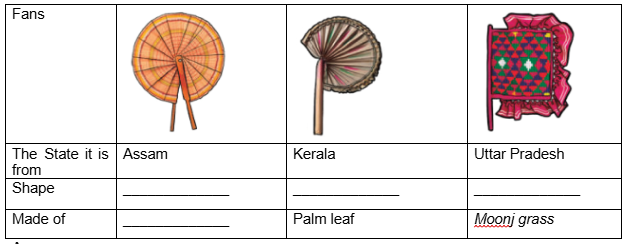
Ans.
| State | Shape | Made of |
| Assam | Round | Bamboo |
| Kerala | Long/oval | Palm leaf |
| Uttar Pradesh | Rectangular | Moonj grass |
III. Work in pairs. Match the underlined words in Column 1 with their meanings in Column 2 given on the next page. Share your answers with your classmates and teacher.
I visited the crafts fair yesterday. It was a wonderful experience. Each indigenous artefact was an innovative creation of industrious craftspersons with its intricate design. It invoked a sense of respect for the initiatives taken by the government to showcase them.
| Column 1 | Column 2 |
| 1. indigenous | (i) hardworking |
| 2. innovative | (ii) actions to improve a situation |
| 3. industrious | (iii) brought out |
| 4. intricate | (iv) local — from where it originated |
| 5. invoked | (v) new and original in approach |
| 6. initiatives | (vi) elaborate/detailed |
Ans.
| Column 1 | Column 2 |
| 1. indigenous | (i) local — from where it originated |
| 2. innovative | (ii) new and original in approach |
| 3. industrious | (iii) hardworking |
| 4. intricate | (iv) elaborate/detailed |
| 5. invoked | (v) brought out |
| 6. initiatives | (vi) actions to improve a situation |
Check Your Understanding
I. Work in pairs to complete the table on pankha. Share your answers with your classmates and teacher
| State | Type of Fan | Material Used |
| Rajasthan | appliqué hand fan | ____________________ |
| temple hand fans | ____________________ | |
| Gujarat | mirror work hand fans | ____________________ |
| ____________________ | beads | |
| ____________________ | leather, decorated with thread and wool | |
| West Bengal | sola hand fans | ____________________ |
| Uttar Pradesh | ____________________ | pure gold, silver zari, silk and satin frills |
| Bihar | ____________________ | bamboo |
Ans.
| State | Type of Fan | Material Used |
| Rajasthan | appliqué hand fan | cloth/fabric |
| temple hand fans | brass | |
| Gujarat | mirror work fans | cotton + mirror |
| beads hand fan | beads | |
| leather hand fan | leather | |
| West Bengal | sola hand fans | sola (plant pith) |
| Uttar Pradesh | phadh hand fans | pure gold, silver zari, silk and satin frills |
| Bihar | bamboo hand fans | bamboo |
Critical Reflection
I. Read the extracts given below and answer the questions that follow.
1. Over time, pankhas became signicant cultural goods distributed through trade routes. They were considered exotic and stylish. Although there was substantial commonality in their use across India, different villages and towns developed their own varieties of traditional pankhas. Each place developed pankhas with distinct materials or a variety of intricate designs, that set them apart from one another.
(i) State whether the following sentence is true or false.
Pankhas were one of the most popular items of commerce.
Ans. true
(ii) Why has the word ‘traditional’ been used to describe pankhas?
Ans: Because pankhas have been used since ancient times and are part of cultural practices.
(iii) Complete the following statement. The sentence ‘They were considered exotic and stylish’ is an opinion and not a fact because ______________________.
Ans: because it expresses a personal view, not a proven fact.
(iv) Infer one reason for commonality in the use of pankhas across India.
Ans: Because of similar climatic conditions (heat) across India.
(v) Select which one of the two statements is the correct assertion for the given reason.
Reason: Pankhas were made of indigenous materials, unique to the region, with elaborate designs.
A. Each kind of pankha could be distinguished from the other.
B. Pankhas were used by many people.
Ans: A. (Each kind of pankha could be distinguished)
2. With time and the advent of technology and innovative creations, the beautiful culture of pankhas runs the risk of slowly losing its presence among Indians. Once made for personal use, over time this handicraft has transformed into a commercial business and now provides some form of livelihood to India’s artisans. The slight increase in popularity and demand is significantly factored by the different versions of the pankha being crafted.
(i) Infer one negative impact of technological advancement on pankha.
Ans: Technology reduced the use of traditional pankhas.
(ii) Complete the statement with an appropriate reason.
The writer refers to ‘pankhas’ not just as an object but as a ‘culture’ because ___________.
Ans: because pankhas represent traditions, art, and heritage of India.
(iii) Select a line from the extract which depicts how the role of the pankha has changed over the years.
Ans: “Once made for personal use, over time this handicraft has transformed into a commercial business.”
(iv) List one way in which the increase in demand of pankhas might benet artisans.
Ans: It provides income and livelihood to artisans.
(v) Select the factor that has contributed to the commercialisation of pankhas.
A. cultural preservation
B. economic demand
C. technological advancements
D. artisan initiative
Ans. B. economic demand
II. Answer the following questions.
1. How does the title ‘Winds of Change’ capture the essence of the chapter?
Ans: The title “Winds of Change” shows how pankhas have evolved from traditional tools to decorative and commercial items over time.
2. Support the following statement with any two relevant examples from the chapter.
‘The structure and design of pankhas are testimony to the cultural identity of the region.’
Ans:
Rajasthan fans use zardozi and fabric work.
Gujarat fans use mirror work and beads.
3. The chapter mentions pankhas running the risk of slowly losing their presence among Indians. Evaluate how the balance between preserving traditional craftsmanship and incorporating innovative designs in the creation of pankhas will help in this regard.
Ans: Combining traditional designs with modern ideas can keep the craft alive and increase demand.
4. How might initiatives such as pankha-making workshops contribute to the preservation of this traditional craft?
Ans: Workshops spread awareness and teach skills, helping preserve the craft.
5. The writer mentions celebrating pankhas in the concluding part of the chapter. Assess how this could be benecial to artisans and the craft.
Ans: It increases demand, provides income, and promotes culture.
6. How does the restriction of the use of pankha for decorative purposes reect the changing cultural role of these traditional fans in modern India?
Ans: It shows that pankhas are no longer daily-use items but symbols of culture and decoration.
Winds of Change Grammar Exercises
Vocabulary and Structures in Context
I. Read the following pairs of words from the text.
| exotic and stylish | villages and towns |
| thread and wool | silk and brass |
| ornate and encrusted | within and outside |
1. Classify the pairs of words given above in the following categories. One example has been done for you.
| Appearance | Place | Material |
| within and outside | ||
Now, Find more such word pairs from the text and share them with your classmates and teacher.
Ans.
| Appearance | Place | Material |
| exotic and stylish | villages and towns | thread and wool |
| ornate and encrusted | within and outside | silk and brass |
II. Find the word pairs for the following fixed expressions. Write the meanings of these expressions by selecting them from the box given below. One example has been done for you.
| Some common expressions with ‘and’ have a fixed order which cannot be changed. The shortest expression comes First. For example bread and butter (*not butter and bread) |
| Word 1 | and | Word 2 | Fixed Expression | Meaning of the Expression |
| 1. high | tear | |||
| 2. cut | fast | |||
| 3. fact | sundry | |||
| 4. all | Thin | all and sundry | (v) everyone, not just a few special people | |
| 5. wear | figures | |||
| 6. time | run | |||
| 7. thick | again | |||
| 8. hard | dry |
Ans.
| Word 1 | and | Word 2 | Fixed Expression | Meaning |
| high | and | dry | high and dry | in a difficult situation |
| cut | and | run | cut and run | to escape quickly |
| fact | and | figures | facts and figures | accurate information |
| all | and | sundry | all and sundry | everyone |
| wear | and | tear | wear and tear | damage due to use |
| time | and | again | time and again | often |
| thick | and | thin | through thick and thin | in all situations |
| hard | and | fast | hard and fast | strict rules |
Now, match the following meanings with the correct word pairs created above.
(i) in a difficult situation, without help or money–
(ii) the damage to object due to normal use –
(iii) accurate and detailed information –
(iv) even when there are problems or difficulties–
(v) everyone, not just a few special people–
(vi) often; on many or all occasions–
(vii) To make a quick or sudden escape –
Ans.
| Meaning | Correct Expression |
| (i) in a difficult situation | high and dry |
| (ii) damage due to normal use | wear and tear |
| (iii) accurate and detailed information | facts and figures |
| (iv) even when there are problems | through thick and thin |
| (v) everyone | all and sundry |
| (vi) often | time and again |
| (vii) quick escape | cut and run |
III. Read the following word combinations from the text.
- sustainable livelihood
- aesthetically pleasing
- appreciating the culture
| The given phrases are conventional combinations just like fixed expressions. Such combinations are called collocations. |
1. Choose the appropriate word collocations for the following sentences.
(i) The students have to (take/give) the English exam tomorrow.
(ii) The interviewer asked the candidate to (take/have) a seat.
(iii) My scooter (dashed against/ran into) a car.
(iv) I must (take/own) responsibility for my success.
(v) I would like to (tone up/improve) my grammar.
Ans.
(i) take
(ii) take
(iii) ran into
(iv) take
(v) improve
IV. Read the following sentences. Underline the verbs.
1. In modern times, pankhas have become traditional craft items in India.
2. Gujarat’s industrious home-based women workers have worked tirelessly in the handicraft of pankha-making.
3. Many tribes in India have adopted this handicraft.
4. Once made for personal use, this handicraft has transformed into a commercial business.
Ans.
1. have become
2. have worked
3. have adopted
4. has transformed
| The underlined verbs refer to the past but have relevance to the current or present time. This form of tense is called the present perfect tense. Recently completed actions also take the present perfect form of tense. |
Now, fill in the blanks with the present perfect form of verbs in the following paragraph. One example has been done for you.
Puppets have long fascinated (fascinate) audiences worldwide. Puppeteers (i) ______ (create) intricate characters and captivating stories with their skillful artistry. They (ii) __________ (master) the delicate movements that bring these lifeless figures to life, entertaining both children and adults. Over the years, puppetry (iii) ___________ (evolve), using modern technology while preserving traditional techniques. Many puppeteers (iv) __________ (pass) down their craft through generations, ensuring its continuity. They (v) ________ (perform) in theatres, on television, and at festivals, conveying important cultural narratives.
Ans.
(i) have created
(ii) have mastered
(iii) has evolved
(iv) have passed
(v) have performed
Listen and Respond
I. You will listen to a dialogue between a boy and a girl discussing which type of pankha they should choose as a gift. As you listen, choose four statements out of seven that are true from 1–7 given below. (Transcript for teacher on page 263)
1. Rohan thinks Grandma prefers heavier items because they feel more substantial.
2. Priya suggests getting a pankha that can be easily moved around.
3. Rohan believes Grandma enjoys sitting in the verandah during the evenings.
4. Priya knows Grandma likes to keep special items close to her.
5. Rohan thinks a pankha with intricate designs would be too delicate for Grandma’s liking.
6. Priya suggests choosing between a bamboo pankha with beadwork or an embroidered pankha with mirror work.
7. Rohan decides they should buy the pankha without consulting their mom.
Ans.
2. Priya suggests getting a pankha that can be easily moved around.
3. Rohan believes Grandma enjoys sitting in the verandah during the evenings.
4. Priya knows Grandma likes to keep special items close to her.
6. Priya suggests choosing between a bamboo pankha with beadwork or an embroidered pankha with mirror work.
Writing Task
I. Describe an artefact you have made in your craft class or learnt from someone.
Begin with collection and organisation of the facts with the help of the pointers given above. Do not include your opinion in the factual description.
Ans. I made a paper balloon and basket in my craft class. It was a different experience as we learnt how to create three dimensional objects. The basket was uniquely designed with alternating boxes of white and black colour that created a checkered pattern. The balloon had eight fins, each of a different colour. I used hand made paper to give it strength and make it firm. The final product looked impressive and even my teacher praised my talent.
CBSE Class 9 English Chapter 3 Winds of Change Extract-Based Questions
A.
The word punkha or pankha originates from the word ‘pankh’, which means feather of a bird. Pankha is used to refer to all fans, whereas the word pankhi denotes a small plumed fan used in ancient India. Evidence of the existence and use of pankhi in India can be found in Buddhist wall paintings at Ajanta. These wall paintings date back to the 2nd century CE. Other representations of the punkha can be found in embroidery work, sculptures, and carvings. In ancient times, pankhas were used in temples to fan deities. They were also used in royal courts to fan kings. Pankhas varied in size from a tiny two inch one to large ones requiring a person’s full arm strength to move them.
Q1. What is the origin of the word Pankha?
Ans. The word origins from Pankh which means the feather of a bird.
Q2. What is a Pankhi?
Ans. It is a smaller version of a pankha.
Q3. What was the use of Pankhas in olden times?
Ans. They were used to fan deities and kings.
Q4. What is the smallest size of a hand fan?
Ans. They can be as small as 2 inches.
Q5. Where can we find evidence of use of hand fans in ancient times?
Ans. Evidence can be found in Buddhist wall paintings at Ajanta caves that are from 2nd century.
B.
In modern times, the use of pankhas has been restricted to decorative purposes, and they have become traditional craft items in India. The structure of each fan reflects the cultural core of the region that crafts it. For instance, the appliqué hand fan of Rajasthan is an antique pankha made of pieces of fabric in different shapes and patterns sewn onto another cloth with the use of ornamental needlework. Furthermore, the zardozi hand fan of Rajasthan differs in its use of glittering ornate and encrusted gold threadwork. In Rajasthan, temple hand fans are popular too. These are made by engraving brass and have a long handle. The painted hand fan, a cardboard pankha featuring various images, is usually offered to gods.
Q1. What is the modern use of hand fans?
Ans. decorative purposes.
Q2. Name the fan that uses pieces of fabric sewn onto another cloth.
Ans. Applique hand fan.
Q3. The zardozi hand fan is a speciality of the state of __________
Ans. Rajasthan.
Q4. ________ hand fans are made of brass.
Ans. Temple
Q5. Which hand fans are offered to gods?
Ans. The painted hand fans made of cardboard are offered to god.
C.
The adjoining state of Gujarat has its own indigenous take on pankhas. These hand fans are elegant pure cotton-based fans embellished with mirror work. The beads hand fan is covered with colourful beads and has a silver handle. Gujarat is the centre for bead craft in India and these dainty pankhas are commonly used as wall decorations. Kutch is recognised for its hand-stitched leather hand fans decorated with thread and wool at its seams. Gujarat’s industrious home-based women workers have worked tirelessly in the handicraft of pankha-making to produce embroidered fans with traditional mirror work and cross-stitch embroidery in different shapes and sizes. Artisans in Bengal make delicate pankhas from the beautiful milky-white spongy centre of the sola. The palm leaf hand fans are locally referred to as Tal Patar Pankha. They are easy to carry and are perpetually kept as an article of possession in Bengali households.
Q1. What material is used to make mirror work hand fans?
Ans. Cotton fabric.
Q2. Bead work hand fans are made in _______
Ans. Gujarat
Q3. Where are leather hand fans made?
Ans. Kutch
Q4. How are the leather hand fans decorated?
Ans. They are decorated with thread and wool seams.
Q5. Artisans of ______ use sola to make hand fans.
Ans. Bengal.
D.
Many tribes in India have adopted this handicraft to make their own versions of the handheld fan. Materials such as grass and metal are embedded into the fans using bamboo sticks and grass. Cane and palm leaves are used, with silk and brass being reserved for antique pieces of these hand fans. The use of geometrical patterns and the white ink and red background combinations have helped the tribes create multiple beautifully designed pankhas.
With time and the advent of technology and innovative creations, the beautiful culture of pankhas runs the risk of slowly losing its presence among Indians. Once made for personal use, over time this handicraft has transformed into a commercial business and now provides some form of livelihood to India’s artisans. The slight increase in popularity and demand is significantly factored by the different versions of the pankha being crafted.
Q1. What kind of patterns are made on hand fans made by tribals?
Ans. Geometric patterns.
Q2. What materials are used to make antique pieces of hand fans?
Ans. Silk and brass.
Q3. _________ of white and red colour is used to create designs on pankhas.
Ans. Ink
Q4. Hand fans were initially made for _________ use.
Ans. personal
Q5. What has caused a reduction in the popularity of hand fans?
Ans. Time and the advent of technology and innovative creations.
Class 9 Winds of Change Multiple Choice Questions
Q1. A hand fan is also called ______
A. Jhumka
B. Pankha
C. Fanka
D. All of these
Ans. B. Pankha
Q2. Which wall painting at Ajanta give evidence of hand fans?
A. Hindu
B. Buddhist
C. Jain
D. Islamic
Ans. B. Buddhist
Q3. In ancient times, pankhas were used in ________
A. battlefields
B. all houses
C. fields
D. temples
Ans. D. temples
Q4. The smallest hand fan measures ________
A. 1 inch
B. 5 inches
C. 2 inches
D. size of the palm
Ans. C. 2 inches
Q5. What is the use of hand fans in modern times?
A. to fan people
B. for heritage
C. as decoration
D. to give on rent
Ans. C. as decoration
Q6. Which of the following hand fans is NOT made in Rajasthan?
A. leather fan
B. Applique fan
C. Zardozi fan
D. brass hand fan
Ans. A. leather fan
Q7. In which state is the leather hand fan made?
A. Rajasthan
B. Uttar Pradesh
C. Odisha
D. Gujarat
Ans. D. Gujarat
Q8. What embroidery patterns are used by the women of Gujarat to decorate the embroidered hand fans?
A. Paisleys
B. cross stitch
C. floral motifs
D. All of these
Ans. B. cross stitch
Q9. Temple hand fans are made by engraving ________
A. silver
B. brass
C. copper
D. gold
Ans. B. brass
Q10. Which hand fans of Rajasthan are encrusted with gold threadwork?
A. applique hand fans
B. Zardozi hand fans
C. cardboard pankha
D. all of these
Ans. B. Zardozi hand fans
Q11. Which of the following is NOT used in hand fans made in Gujarat?
A. bead work
B. mirror work
C. hand painting
D. cross stitch embroidery
Ans. C. hand painting
Q12. Which hand fans are usually offered to Gods?
A. Phadh hand fans
B. temple hand fans
C. Applique hand fans
D. Zardozi hand fans
Ans. B. temple hand fans
Q13. Pieces of fabric of different shapes and sizes are sewn onto another cloth. Which craft work is being described?
A. Zardozi
B. Applique
C. Hand paint
D. embroidery
Ans. B. Applique
Q14. Artisans of ________ use sola to make hand fans.
A. Bengal
B. Bihar
C. Gujarat
D. Rajasthan
Ans. A. Bengal
Q15. Tal Patar pankha is also known as ____________
A. brass hand fan
B. Palm leaf hand fan
C. Banana leaf hand fan
D. none of these
Ans. B. Palm leaf hand fan
Q16. The Phadh hand fans are made in ______
A. Bengal
B. Uttar Pradesh
C. Bihar
D. Rajasthan
Ans. B. Uttar Pradesh
Q17. Which state makes large palm leaf fans?
A. Odisha
B. Uttar Pradesh
C. Bengal
D. Rajasthan
Ans. A. Odisha
Q18. What is used in hand fan making in Bihar?
A. palm leaf
B. Bamboo
C. satin
D. leather
Ans. B. Bamboo
Q19. Tribal fans use _____ and _____ ink on hand fans.
A. white, red
B. white, black
C. red, black
D. none of these
Ans. A. white, red
Q20. Tribal hand fans use ________ patterns.
A. geometrical
B. floral
C. tribal
D. nature-inspired
Ans. A. geometrical
CBSE Class 9 English Kaveri Book Chapter 3 – Winds of Change Extra Question and Answers
Answer the following questions-
Q1. How does the word ‘Pankha’ originate?
Ans. It originates from ‘Pankh’, which means the feather of a bird.
Q2. What craft is discussed in the class 9 lesson ‘Winds of Change’?
Ans. The lesson discusses the traditional craft of making hand fans.
Q3. How old is the origin of hand fans?
Ans. The reference of hand fans is seen in the Buddhist paintings at Ajanta which date back to the 2nd century.
Q4. What types of handiwork are done on hand fans made in Gujarat?
Ans. The women of Gujarat do bead work, mirror work, thread work and even embroider cross stitch patterns to decorate hand fans.
Q5. What materials are used for making handfans in Gujarat?
Ans. Pure cotton fabric and leather are the two materials that are used to make hand fans in Gujarat.
Q6: Why does the chapter suggest that pankhas, once a household necessity, now face the risk of disappearing from Indian life?
Ans. As technology advanced and newer, more convenient cooling options emerged, people had less practical need for hand fans in daily life, so their everyday use gradually declined. What started as an item every household made and used for personal comfort has, over time, shifted into something crafted mainly for commercial and decorative purposes. This shift means the pankha survives today less as a functional tool and more as a traditional handicraft — one that gives artisans a livelihood, but that risks fading from common use unless its cultural and artistic value keeps demand alive.
very useful