

CBSE Class 9 English Poem 2 Gifts of Grace: Honouring Our Vocations Question Answers (Important) from Kaveri Book
Updated for the CBSE 2026-27 session as per the rationalised syllabus.. Class 9 English Gifts of Grace: Honouring Our Vocations Question Answers – Looking for Gifts of Grace: Honouring Our Vocations question answers (NCERT solutions) for CBSE Class 9 English Kaveri Book Poem 2? Look no further! Our comprehensive compilation of important questions will help you brush up on your subject knowledge. Practising Class 9 English question answers can significantly improve your performance in the exam. Our solutions provide a clear idea of how to write the answers effectively. Improve your chances of scoring high marks by exploring Poem 2: Gifts of Grace: Honouring Our Vocations now. The questions listed below are based on the latest CBSE exam pattern, wherein we have given NCERT solutions (Textbook Questions) to the chapter’s, Extract Based Questions, Multiple Choice Questions, and Extra Question Answers
Also, practising with different kinds of questions can help students learn new ways to solve problems that they may not have seen before. This can ultimately lead to a deeper understanding of the subject matter and better performance on exams.
- Gifts of Grace: Honouring Our Vocations Textbook Questions (NCERT Solution)
- Gifts of Grace: Honouring Our Vocations Grammar Exercises
- Gifts of Grace: Honouring Our Vocations Extract-Based Questions
- Gifts of Grace: Honouring Our Vocations Multiple Choice Questions
- Gifts of Grace: Honouring Our Vocations Extra Questions
Related:
Gifts of Grace: Honouring Our Vocations Textbook Questions (NCERT Solution)
Reflect and Respond
I. Given below are four riddles. Read and identify who these people are.
1. In furrows deep, secrets I sow,
As time passes,
I watch them grow.
Who am I? ________________________
2. From wheel to kiln, my skill is born,
Step by step, an art takes form.
Who am I? ________________________
3. I lay foundations, brick by brick,
To build a house, it’s me you pick.
Who am I? ________________________
4. I work with pots, pans, and spice,
Creating dishes that taste so nice.
Who am I? ________________________
Ans.
1. Farmer
2. Potmaker
3. Mason
4. Chef
II. What is the role and relevance of the people you identified in the riddles. How do they contribute to the society? Discuss with your classmates and teacher.
Ans. These people have an immense contribution to the lives of all. They create things like pots, vegetables, grains, houses and food which is essential for sustenance.
Check Your Understanding
I. Based on your understanding of the poem, state whether the following statements are true or false. Also, rectify the false statements.
1. The poem highlights the skilled work of craftsperson.
2. The poet shares that musicians express emotions through their instruments.
3. The carpenters in the poem are admired for their logical work.
4. The electricians in the poem are recognised for their crucial role in lighting up lives.
5. The poem pays homage to shoemakers who manufacture quality footwear.
6. The poem celebrates the patriotism of the people of Bharat.
7. The poet feels that each vocation deserves to be respected.
Ans.
1. True
2. True.
3. True
4. True
5. True
6. False. The poem appreciates the workers of Bharat.
7. True
II. Let us appreciate the poem.
1. Rhyme Scheme and Lineation
(i) Does the poem strictly adhere to a rhyme scheme, or is it in free verse?
(ii) What is the impact of the varying length of lines in the poem?
(iii) What is the pattern in the structure of most lines of the poem?
Ans.
(i) The poem does not follow any rhyme scheme. It is in free verse.
(ii) The variance in the lengths of the lines of the poem aligns with the variance in the different skills and works that are talked about. This prevents monotony, the poem has a conversational tone.
(iii) The pattern in most of the lines is naming a vocation and describing it. The description highlights the uniqueness of that worker.
2. Speaker
(i) Who appears to be the speaker and what is her/his role here?
Ans. The speaker can be the poet or any resident of Bharat who watches and observes the workers closely. The speaker is a voice of collective recognition who watches and celebrates the workers of Bharat.
3. Tone and Mood
(i) Fill in the blanks with suitable options from the box given below.
| serious | celebratory | hostile |
| reverential | joyful | sympathetic |
A. The tone is ______________and _____________ , depicting a sense of admiration and respect for the artisans and crafts persons.
B. There is a _____________mood throughout the poem, capturing the vibrancy and richness of cultural traditions and skills.
Ans.
A. celebratory, reverential
B. Joyful
4. Imagery
(i) Select any two descriptions from the poem that evoke visual images.
(ii) Fill in the blanks with suitable phrases. The poem includes auditory imagery through mentions of artisans with lutes, _______________, and _______________, emphasising the sounds associated with each vocation.
Ans.
(i) The description of boatmen gathering the net and singing as they sail creates a visual image. The poet’s description of the craftsmen who use various colours and hues to weave is also a visual description.
(ii) humming of the electrician, delicious singing of the cook
5. Metaphor
(i) State whether the following sentence is true or false.
The mention of ‘delicious singing’ of the cook is a metaphor because it implies that the quality of the singing is so enjoyable or pleasing that it can be equated to the experience of tasting something delicious.
Ans. True. In this phrase, the poet uses Synesthesia which is a figure of speech where one sense is used to describe another sense. Here, the pleasure of singing (sense of sound) is equated with the happiness derived from cooking (sense of smell and taste).
6. Personification
(i) Select the line that tells us that the poet personifies vocations by attributing humanlike qualities to them.
Ans. In the line ‘The voice of their vocation is the voice of their identity’ the poet personifies the vocations by saying that they have a voice or that they can speak.
7. Repetition
(i) Why might the poet have begun and ended with the same line—‘I hear Bharat celebrating, the varied vocations I hear!’?
Ans. The poet uses repetition and refrain because he wants to lay emphasis on this. He wants to give a structural unity to the poem and so, it starts and ends with the same line. This also gives a musical tone to the poem.
8. Alliteration
(i) Identify two examples of alliteration from the poem.
Ans. varied vocations, sailing and singing.
9. Symbolism
(i) Each vocation in the poem symbolises something more than just a job. What does it symbolise?
Ans. The vocation signifies the identity of the worker. It is a mark of dignity of labour and acknowledges the cultural heritage of Bharat.
Critical Reflection
I. Read the extract given below and answer the questions that follow.
The shoemakers affirming the quality of their work, for the feet that walk, dance, run, jump, return home.
The delicious singing of the cook, or the rhythm of designer, mason, each celebrating what belongs to them and to none else,
1. The poet says that the shoemakers ‘affirm’ the quality of their work. What does ‘affirm’ refer to here?
(i) to make adjustments in
(ii) to declare with confidence
(iii) to label the goods
(iv) to justify the efforts
Ans. (ii) to declare with confidence
2. What do quality shoes help with, according to the poet?
Ans. Good quality shoes support the wearer in various tasks like walking, running, dancing, jumping and returning home.
3. What does ‘return home’ symbolise besides the literal act of returning?
Ans. Returning home is a symbol of-
- Being safe and protected.
- Being connected to one’s roots.
- Being in comfort.
- Being in a space that one identifies with and belongs to
4. Identify the phrase that tells us that every worker’s contribution is distinct.
Ans. The phrase ‘each celebrating what belongs to them and to none else’ shows that each worker has a distinct contribution.
5. Complete the following with suitable words.
…for the feet that walk, dance, run, jump, return home refers to ___________.
Ans. the various activities of daily life.
II. Answer the following questions.
1. Why does the poet say, ‘I hear Bharat celebrating, the varied vocations I hear’?
Ans. According to the poem Gifts of Grace: Honouring our Vocations, Bharat acknowledges the workers and their crafts everyday. The various sounds like the humming of the electrician, the song of the boatman; are the joyous sounds which represent the workers’ identity. The speaker represents the people of Bharat who actively hear and accept the workers of Bharat.
2. What does the electrician ‘humming’ while getting ready for work suggest?
Ans. This suggests that the electrician is joyful in his work and enjoys it. He knows that his work makes his identity.
3. Explain the significance of the line, ‘The voice of their vocation is the voice of their identity.’
Ans. This line in the class 9 poem Gifts of Grace: Honouring our Vocations signifies the connection between the work and the worker’s identity. The artisan’s identity is his work. This connection leads us to accept the maxim – ‘Work is Worship’ because it is the source of inspiration for the worker.
4. Do you think the role of all the people belonging to different vocations is important in our daily lives? Support your answer with a reason.
Ans. Yes, the various roles or tasks performed by workers are important for us. For instance, the houses and other structures constructed by masons are shelters for mankind that are needed by us for making houses, schools and hospitals.
5. Why is the poet celebrating all the vocations in the poem? Explain by giving examples from your context.
Ans. He celebrates the workers because they are the backbone of our society. Several workers who form the basis of our daily life like guards, garbage collectors, gardeners, washermen, plumbers and sweepers are essential for smooth running of daily life.
6. How does the poet use sensory imagery to bring out the beauty of everyday work?
Ans. The poem comprises of various sensory imageries like-
Auditory – the lutes played by the artisans create various emotions and dreams, the humming of electricians and the song of the boatmen show the joy of work. The delicious singing of the cook shows the delight of listening to a good song can be experienced by tasting good food.
Visual – the gathering of net and sails by boatmen, weavers using various colours and hues to create fabrics create images.
Synesthetic imagery – the equation created between singing and cooking in The delicious singing of the cook blends taste with sound.
Kinetic – the various activities carried out by wearing good quality shoes like walking, running, dancing and jumping show motion.
Gifts of Grace: Honouring Our Vocations Grammar Exercises
Vocabulary in Context
I. People of different vocations are being described in the poem. Match the vocations given in the box below with the descriptions that follow.
| ASHA worker | confectioner | sericulturist |
| welder | horticulturist | goldsmith |
1. A person who studies or grows garden plants: ___________
2. A trained female community health worker: ___________
3. A producer of raw silk: ___________
4. A person whose job is making or selling sweets and chocolates: ___________
5. A metalworker who specialises in working with precious metals: ___________
6. A person who fuses materials together: ___________
Ans.
1. Horticulturist
2. ASHA Worker
3. Sericulturist
4. Confectioner
5. goldsmith
6. Welder
Did You Know?
Accredited Social Health Activist (ASHA) is a group of community health workers employed by the Ministry of Health and Family Welfare (MoHFW) as a part of India’s National Rural Health Mission (NRHM).
II. Identify the word from Column 2 that is not the synonym of the words given in Column 1.
| Column 1 | Column 2 |
| 1. myriad | (i) countable, innumerable, numerous, abundant |
| 2. hues | (ii) shades, tints, drawing, colour |
| 3. precision | (iii) exactness, accuracy, correctness, calculation |
| 4. varied | (iv) assorted, diverse, uniform, different |
| 5. delicious | (v) mouth-watering, inedible, tasty, flavourful |
Ans.
| Column 1 | Column 2 |
| 1. myriad | (i) countable |
| 2. hues | (ii) drawing |
| 3. precision | (iii) calculation |
| 4. varied | (iv) uniform |
| 5. delicious | (v) inedible |
Listen and Respond
I. You will listen to two friends, a boy and a girl discussing the occupations of their parents. As you listen, answer the following question in two to three words only. (Transcript for teacher on page 262)
What does the boy use to understand the details of the tools?
Ans. He goes through the tool kit and uses toy cars to discuss and know about the usage of tools in detail.
II. You will listen to the girl and the boy once again. As you listen, answer the questions by selecting the correct option.
1. The girl is __________ about taking food for her mother at the factory.
(i) happy
(ii) boastful
(iii) unsure
Ans. (i) happy
2. The boy thinks that the job of the girl’s mother carries a lot of __________.
(i) luck
(ii) risk
(iii) responsibility
Ans. (iii) responsibility
3. The girl __________why the boy is good at science exhibitions.
(i) wonders
(ii) questions
(iii) realises
Ans. (iii) realises
4. The girl shares her __________ about joining the weekend discussion on tools.
(i) doubts
(ii) wish
(iii) ideas
Ans. (ii) wish
Writing Task
I. Your school will be organising a ‘Career Mela’ in which students are to be made familiar with the different career options. Complete the poster for the event given below.
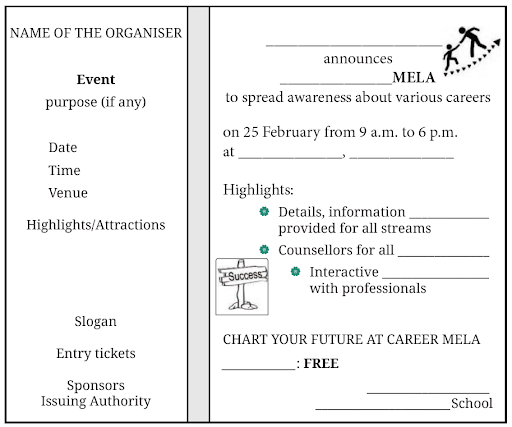
A poster is used to announce an event. It has the following features: placed in a box
|
Ans.

CBSE Class 9 English Poem 2 Gifts of Grace: Honouring Our Vocations Extract-Based Questions
A.
I hear Bharat celebrating, the varied vocations I hear;
Those of craftsperson, each one celebrating their craft, woven with colours and myriad hues.
The artisans with lutes, each hailing varied emotions and celebrating dreams, echoing in the streets.
Q1. What is Bharat?
Ans. Bharat is the name of a country, also known as India.
Q2. What is a ‘vocation’?
Ans. Vocation is any work.
Q3. How can the speaker ‘hear’ vocations?
Ans. He can hear the vocations speak through the creations which the workers make. These creations speak and mark the identity of the worker.
Q4. Identify a synonym of ‘countless’.
Ans. Myriad
Q5. What are ‘lutes’?
Ans. Lutes refers to various stringed musical instruments like guitar, violin, etc.
B.
The carpenters celebrating; they create anything out of wood with mathematical precision,
The electricians humming; they get ready for work, work with cables and wires to brighten our lives,
The boatmen gathering their nets from the shore, sailing, and singing while at work, return to tell the tales of life at sea,
The shoemakers affirming the quality of their work, for the feet that walk, dance, run, jump, return home.
Q1. What are the carpenters working with?
Ans. They work with wood to create various useful objects like tables and chairs.
Q2. What are the carpenters celebrating?
Ans. They are celebrating the articles that they create.
Q3. Who work with cables and wires?
Ans. The electricians work with cables and wires.
Q4. What do the boatmen do as they work?
Ans. They sing at work.
Q5. Who tells tales?
Ans. The boatmen have tales to tell of life at sea.
C.
The delicious singing of the cook, or the rhythm of designer, mason, each celebrating what belongs to them and to none else,
The voice of their vocation is the voice of their identity. I hear Bharat celebrating, the varied voices I hear!
Q1. What is like singing?
Ans. The delicious food cooked by the cook is like singing.
Q2. What does a mason do?
Ans. He builds buildings.
Q3. What do they celebrate?
Ans. They celebrate the thing that they create because it belongs to them.
Q4. What does the vocation do?
Ans. The vocation defines the identity of the worker.
Q5. Which figure of speech is used in the first line?
Ans. Synesthesia. When one sense defines another.
Top
Class 9 Gifts of Grace: Honouring Our Vocations Multiple Choice Questions
Q1. Identify the figure of speech used in the poem’s title.
A. Personification
B. Alliteration
C. Imagery
D. Metaphor
Ans. B. Alliteration
Q2. Who uses mathematical precision?
A. electrician
B. artisans
C. carpenters
D. boatmen
Ans. C. carpenters
Q3. Identify a synonym for ‘vocation’.
A. holiday
B. work
C. celebration
D. pay
Ans. B. work
Q4. What echoes in streets?
A. humming sound of electrician
B. Lutes played by artisans
C. singing of boatmen
D. singing of the cook
Ans. B. Lutes played by artisans
Q5. What is the identity of the worker?
A. Bharat
B. The vocation
C. singing
D. music
Ans. B. The vocation
Q6. Which of the following worker is NOT mentioned in the poem?
A. electrician
B. carpenter
C. pilot
D. boatmen
Ans. C. pilot
Q7. Who has been personified in the poem?
A. artisans
B. electricians
C. vocations
D. Bharat
Ans. C. vocations
Q8. Which figure of speech is used in the line- The delicious singing of the cook, or the rhythm of designer, mason, ?
A. personification
B. Synesthesia
C. metaphor
D. alliteration
Ans. B. Synesthesia
Q9. Who sings at work?
A. boatman
B. artisan
C. electrician
D. carpenter
Ans. A. boatman
Q10. The boatman has tales of ___________ to tell.
A. his work
B. life at sea
C. the hardships of life
D. his team
Ans. B. life at sea
Q11. What does the electrician work with?
A. wires
B. pots
C. net
D. all of these
Ans. A. wires
Q12. The shoemaker checks the _________
A. colour
B. size
C. quality
D. fit
Ans. C. quality
Q13. Which of these activities done by the feet is NOT mentioned?
A. jump
B. dance
C. run
D. stand
Ans. D. stand
Q14. Find a synonym of exact.
A. precision
B. tax
C. inacurate
D. limit
Ans. A. precision
Q15. How do the electricians brighten our lives?
A. They bring us electricity that turns on the light.
B. They charge money which makes them happy.
C. They open curtains which allow sunlight.
D. None of these
Ans. A. They bring us electricity that turns on the light.
Q16. What belongs to the workers?
A. the work or creation
B. the food
C. Bharat
D. all of these
Ans. A. the work or creation
Q17. What is the rhyme scheme?
A. AABB
B. ABAB
C. ABCD
D. Free verse
Ans. D. Free verse
Q18. Which of the following figure of speech is NOT used in the poem?
A. synesthesia
B. repetition
C. alliteration
D. simile
Ans. D. simile
Q19. Why does the shoemaker affirm the quality?
A. his reputation is at stake
B. the feet that wear the shoes have to perform multiple tasks
C. he has to justify the high price
D. none of these
Ans. B. the feet that wear the shoes have to perform multiple tasks
Q20. Why is the cook’s work called singing?
A. by mistake
B. the sense of hearing a good song gives a pleasure which is similar to the sense of smell and taste received from good food.
C. the cook is a singer as well
D. none of these
Ans. B. the sense of hearing a good song gives a pleasure which is similar to the sense of smell and taste received from good food.
CBSE Class 9 English Kaveri Book Poem 2 – Gifts of Grace: Honouring Our Vocations Extra Question and Answers
Answer the following questions-
Q1. List down the various vocations mentioned in the poem.
Ans. The poem mentions vocations like artisans, craftsperson, carpenters, electricians, boatmen, shoemakers, cooks, designers, masons.
Q2. What do the workers celebrate?
Ans. They celebrate the work that they have created or done. It is their only and so it defines their identity.
Q3. What does Bharat celebrate?
Ans. Bharat celebrates the various vocations and the workers who contribute to the lives of the people of Bharat.
Q4. What do the shoemakers do and why?
Ans. The shoemakers affirm the quality of the shoes that they make. The feet that wear the shoes have to do several tasks like walk, run, jump, dance and return home. So the shoemakers considers it to be his responsibility to make good quality shoes.
Q5. What does the poet hear?
Ans. He hears Bharat celebrating. He also hears the various vocations which speak through the works done by the workers and mark their identity.
Q6. Why does the poet choose to structure the poem with varying line lengths instead of a fixed rhyme scheme?
Ans. The poem is written in free verse, and its lines stretch or shrink depending on the vocation being described at that moment. This isn’t accidental — the shifting rhythm mirrors the diversity of the work itself, so a carpenter’s precise, measured task might read differently on the page than a boatman’s flowing song. By avoiding a rigid rhyme scheme, the poet keeps the tone conversational and natural, almost like someone speaking spontaneously as they notice each worker in turn, which suits a poem whose whole purpose is to capture the living, varied texture of everyday labour rather than force it into a neat, uniform pattern.