

CBSE Class 9 English Poem 1 Bharat Our Land Question Answers (Important) from Kaveri Book
“Bharat Our Land” is Subramania Bharati’s patriotic tribute to India, celebrating its natural grandeur (the Himalayas and Ganga), spiritual heritage (the Upanishads, Brahma-knowledge, Buddha’s dhamma), and human legacy of warriors and sages. Through a recurring refrain, the poet declares India peerless and calls on every citizen to praise her.
Are you looking for Bharat Our Land question answers (NCERT solutions) for CBSE Class 9 English Kaveri Book Poem 1? Look no further! Our comprehensive compilation of important questions will help you brush up on your subject knowledge. Practising Class 9 English question answers can significantly improve your performance in the exam. Our solutions provide a clear idea of how to write the answers effectively. Improve your chances of scoring high marks by exploring Poem 1: Bharat Our Land now. The questions listed below are based on the latest CBSE exam pattern, wherein we have given NCERT solutions (Textbook Questions) to the chapter’s, Extract Based Questions, Multiple Choice Questions, and Extra Question Answers
Also, practising with different kinds of questions can help students learn new ways to solve problems that they may not have seen before. This can ultimately lead to a deeper understanding of the subject matter and better performance on exams.
- Bharat Our Land Textbook Questions (NCERT Solution)
- Bharat Our Land Grammar Exercises
- Bharat Our Land Extract-Based Questions
- Bharat Our Land Multiple Choice Questions
- Bharat Our Land Extra Questions
Related:
Bharat Our Land Textbook Questions (NCERT Solution)
Check Your Understanding
I. Fill in the blanks by choosing appropriate words from the box given below to complete the summary of the poem.
| warriors | peerless | Upanishads |
| Ganga | Buddha | Himavant |
| sages | praise | historical greatness |
| Brahma-knowledge |
The poem is a tribute to India, celebrating its natural beauty, spiritual heritage, and 1. _______. The poet praises the 2. _______, describing it as mighty and unparalleled. The 3. _______ is depicted as generous and graceful, while the 4. _______ are honoured as sacred and unmatched. The poem highlights the contributions of 5. _______ and 6. _______ who have enriched the land with their bravery and wisdom. It also acknowledges the presence of 7. _______ and the teachings of 8. _______, highlighting India’s deep-rooted spiritual and philosophical traditions. The poet repeatedly asserts that India is 9. _______, urging everyone to 10. ________ her.
Ans.
1. historical greatness
2. Himavant
3. Ganga
4. Upanishads
5. Warriors
6. Sages
7. Brahma-knowledge
8. Buddha
9. Peerless
10. praise
II Complete the following features about the poem.
1. The impact on the readers (mood): __________
2. The poet’s attitude (tone): __________
3. The rhyme scheme: ___________
4. Examples of personification: _________
Ans.
1. Pride and admiration
2. Patriotic and appreciative
3. AABB (rhyming couplets)
4. The Ganga is described as generous and graceful
India is treated as something that can be praised like a person
III. What is the impact of the refrain, ‘she’s peerless, let’s praise her!’?
Ans. The refrain “she’s peerless, let’s praise her!” creates a strong feeling of pride and admiration in the reader. It emphasises that India is unique and unmatched in its beauty, culture, and heritage. The repetition of this line reinforces the poet’s patriotic and encourages readers to appreciate, respect, and feel proud of their country.
IV. Complete the following sentence appropriately.
India is metaphorically described as ‘this sunny golden land,’ suggesting that it is _________.
Ans. bright, prosperous, rich in culture, and full of warmth and positivity.
V. The poet uses symbolism. Match the symbols in Column 1 to what they suggest in Column 2.
| Column 1 | Column 2 |
| 1. Himavant | (i) knowledge and enlightenment |
| 2. Ganga | (ii) spiritual and philosophical legacy |
| 3. Upanishads | (iii) purity and generosity |
| 4. Gallant warriors and sages | (iv) richness and glory |
| 5. Brahma-knowledge and Buddha’s Dhamma | (v) strength and permanence |
| 6. Sunny golden land | (vi) courage and wisdom |
Ans.
| Column 1 | Column 2 |
| Himavant | (v) strength and permanence |
| Ganga | (iii) purity and generosity |
| Upanishads | (ii) spiritual and philosophical legacy |
| Gallant warriors and sages | (vi) courage and wisdom |
| Brahma-knowledge and Buddha’s Dhamma | (i) knowledge and enlightenment |
| Sunny golden land | (iv) richness and glory |
VI. The poet uses imagery (descriptive language to create vivid mental pictures that appeal to the senses). Give any two examples from the poem.
Ans.
“Sunny golden land” – This creates a vivid picture of a bright, warm, and rich land, appealing to the sense of sight.
“Mighty Himavant” – This gives a strong visual image of tall, powerful mountains, showing strength and grandeur.
VII. What is the impact of the use of hyphens in the first stanza? Select the options that are true.
| 1. Creates deliberate pauses to reinforce the sense of admiration and pride |
| 2. Emphasises the contrast between India’s strengths and weaknesses |
| 3. Lends to the lyrical quality giving it a measured, chant-like rhythm |
| 4. Suggests hesitation or uncertainty in the poet’s claims about India |
| 5. Presents a key element of India’s greatness before the hyphen and makes a strong assertion about its uniqueness after the hyphen |
VIII. The poet uses hyperbole in the poem.
| Hyperbole (hi-puh-buh-lee) is a figure of speech that involves extreme exaggeration to highlight a point or create a dramatic effect. It is not meant to be taken literally but is used to make something sound more impressive or intense. For example:
|
Ans.
Hyperbole in the Poem
An example of hyperbole in the poem is “she’s peerless”. This is an exaggeration because it claims that India has no equal in the entire world. It is not meant to be taken literally but is used to highlight the greatness and uniqueness of India in a powerful and impressive way.
IX. The poem is an ode.
| An ode is a lyrical poem that expresses deep admiration, praise, or reverence for a person, place, object, or idea. It is often written in an elevated and formal style, celebrating the subject with enthusiasm and emotion. An ode’s language is often grand and expressive; and it seeks to highlight the extraordinary qualities of its subject. |
Now, identify examples from the poem that correspond to it being an ode.
Ans.
The poem is an ode because it expresses deep admiration and praise for India. Phrases like “she’s peerless” and “let’s praise her” show strong appreciation and respect. The poet highlights India’s greatness through references to the Himavant, Ganga, Upanishads, warriors, and sages, using grand and expressive language. This enthusiastic celebration of India’s beauty, culture, and heritage clearly shows that the poem is an ode.
X. The poet uses allusion in the poem.
| Allusion is a literary device where a writer makes an indirect reference to a well-known person, place, event, literary work, or cultural element without explicitly mentioning it. The reader is expected to recognise and understand the reference based on prior knowledge. Allusions can come from mythology, religion, literature, history, or popular culture.
For example: He is a real Einstein in the mathematics class. (This alludes to Albert Einstein, meaning the student is very intelligent, especially in mathematics or science.) |
Now, read the explanations and identify the matching allusions from the poem for the following.
- An allusion to the ancient Indian scriptures that form the philosophical core and symbolise deep wisdom and enlightenment.
- An allusion to the concept of spiritual knowledge associated with self-realisation and ultimate truth.
- An allusion to Gautama Buddha’s teachings, which include compassion, non-violence, and enlightenment. This highlights India’s role in shaping major religious and philosophical traditions.
Ans.
1. Ancient Indian scriptures (deep wisdom & philosophy):
Upanishads
2. Spiritual knowledge (self-realisation & ultimate truth):
Brahma-knowledge
3. Teachings of Gautama Buddha:
Buddha’s Dhamma
Critical Reflection
I. Read the extract given below and answer the questions that follow.
The mighty Himavant is ours-
there’s no equal anywhere on earth.
The generous Ganga is ours-
which other river can match her grace?
The sacred Upanishads are ours-
what scriptures else to name with them?
1. Complete the sentence.
The word ‘mighty’ refers to the __________ of the Himavant.
Ans. strength and grandeur
2. Choose the correct option to complete the sentence given below.
The question mark at the end of the fourth and sixth line of the extract is used to __________.
(i) show doubt and uncertainty
(ii) emphasise a point
(iii) highlight confusion and hesitation
(iv) reveal inquiry and curiosity
Ans. (ii) emphasise a point
3. The poet uses the word ‘generous’ to describe the Ganga. Why?
Ans. The poet calls the Ganga “generous” because it provides water, supports life, and nurtures people, showing its giving and selfless nature.
4. Why has the movement of the river been described as graceful?
Ans. The river’s movement is described as graceful because it flows smoothly and beautifully, creating a calm and pleasing visual image.
5. Fill in the blank with the correct option from the words given in the brackets.
The poet is implying that the Upanishads are _________ (unmatched/abundant) in their wisdom and spiritual depth.
Ans. unmatched
II. Answer the following questions.
1. How does the poem reflect a strong connection to cultural identity and heritage?
Ans. The poem reflects a strong connection to cultural identity and heritage by highlighting India’s natural beauty, ancient scriptures like the Upanishads, and spiritual traditions. It celebrates the country’s history, values, and contributions of sages and warriors, showing pride in its rich cultural roots.
2. What can you infer about the poet’s attitude towards India from the repeated phrase ‘she’s peerless, let’s praise her!’?
Ans. The repeated phrase shows that the poet has a deep sense of pride, admiration, and love for India. It reflects a patriotic attitude and emphasises that the poet considers India unique and unmatched, encouraging others to appreciate and honour the nation.
3. What does the line ‘many a sage has sanctified this land’ suggest about India’s spiritual heritage?
Ans. This line suggests that India has a rich spiritual heritage shaped by many wise sages. Their teachings and presence have made the land sacred and spiritually significant, highlighting India’s long tradition of wisdom and enlightenment.
4. How does the poet connect warriors and music to India’s greatness?
Ans. The poet connects warriors and music to India’s greatness by showing both strength and culture. Warriors represent bravery and protection, while music represents creativity and tradition, together highlighting the country’s rich and balanced heritage.
5. How does this poem foster a sense of national pride?
Ans. The poem fosters national pride by praising India’s beauty, culture, and achievements. It reminds readers of the country’s greatness and encourages them to feel proud of their heritage, creating a strong emotional connection with the nation.
Top
Bharat Our Land Grammar Exercises
Vocabulary in Context
I. Complete the table by choosing words from the poem.
| SufÏx | Meaning | Examples |
| -ous | full of, having the qualities of kindness | 1. _______ous |
| -ity | the state of being very old or ancient | 2. _______ity |
| -est | superlative form | 3. ______est |
| -less | without something | 4.______less |
Ans.
| Suffix | Meaning | Examples |
| -ous | full of, having qualities | generous |
| -ity | the state of being very old or ancient | antiquity |
| -est | superlative form | grandest |
| -less | without something | peerless |
II. Complete the following table by adding a different suffix to form new words. Also, create a sentence using the created word. One example has been done for you.
| SufÏx | Meaning | Sentences |
| -tion | the action or process of | Example: indicate, indication The dark clouds were an indication that it would rain soon. 1. |
| -ive | quality or nature of | 2. |
| -ment | the action or result of | 3. |
| -ed | past-tense version of a verb | 4. |
Ans.
| Suffix | Meaning | Sentences |
| -ive | quality or nature of | Create → Creative: She is a very creative student who enjoys drawing and writing. |
| -ment | the action or result of | Develop → Development: The development of the village has improved people’s lives. |
| -ed | past-tense version of a verb | Finish → Finished: I finished my homework before going to play. |
Listen and Respond
I. You will listen to four people talk about the places they like to travel to. As you listen, write the speaker number for the two pictures given. (Transcript for teacher on page 260)
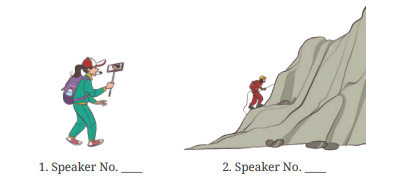
Ans.
1. Speaker No. 2
2. Speaker No. 3
Reason:
Speaker 2 usually talks about exploring places / travelling / recording experiences
Speaker 3 talks about adventure like trekking or mountains
II You will once again listen to the four speakers. As you listen, match the given statements to the speaker. There are two statements that you do not need. (Transcript for teacher on page 260)
| Statement | Speaker |
| 1. The green surroundings look beautiful visually. | |
| 2. The group visits make even the difficult areas seem easy. | |
| 3. The quietness of the environment here leads to a peaceful experience. | |
| 4. The risk and thrill in such an area is what is most appealing. | |
| 5. The dry expanse promises to appeal to the spirit of exploration. | |
| 6. The sight of such beauty is very inviting and has to be captured. |
Ans.
| Statement | Speaker |
| 1. The green surroundings look beautiful visually. | Speaker 1 |
| 2. The group visits make even the difficult areas seem easy. | Speaker 3 |
| 3. The quietness of the environment here leads to a peaceful experience. | Speaker 4 |
| 4. The risk and thrill in such an area is what is most appealing. | Speaker 3 |
| 5. The dry expanse promises to appeal to the spirit of exploration. | Speaker 2 |
| 6. The sight of such beauty is very inviting and has to be captured. | Speaker 2 |
Writing Task
I. Write a paragraph about a place that you have visited which has stayed in your memory. Remember to mention the following:
- Why did you go there?
- Who did you travel with?
- How did you prepare for the travel?
- Where did you stay?
- What activities did you do there?
Ans.
Last year, I visited Varanasi with my family during the summer holidays. We went there to explore its famous temples and experience its spiritual atmosphere. Before the trip, we packed our clothes and made travel arrangements in advance. We stayed at a small hotel near the Ganga River. During our visit, we attended the Ganga Aarti, visited temples, and enjoyed boat rides on the river. The peaceful environment and beautiful surroundings made this trip very special, and it has remained a memorable experience for me.
Top
CBSE Class 9 English Poem 1 Bharat Our Land Extract-Based Questions
A
The mighty Himavant is ours-there’s no equal anywhere on earth.
The generous Ganga is ourswhich other river can match her grace?
The sacred Upanishads are ourswhat scriptures else to name with them?
This sunny golden land is oursshe’s peerless, let’s praise her!
Q1. What does the poet mean by calling Himavant “mighty”?
Ans. The poet calls Himavant mighty to emphasize its enormous size, strength, and grandeur. It symbolizes India’s unparalleled power and permanence that cannot be matched anywhere else on earth.
Q2. Why does the poet describe the Ganga as “generous”?
Ans. The Ganga is called generous because she gives life, water, nourishment, and spiritual purification to millions of people across India without ever expecting anything in return.
Q3. What makes the Upanishads “sacred” according to the poet?
Ans. The Upanishads are sacred because they contain India’s deepest philosophical and spiritual wisdom dealing with self-realisation and ultimate truth, making them unmatched among all world scriptures.
Q4. What does the phrase “sunny golden land” suggest about India?
Ans. The phrase suggests India is a land of warmth, brightness, prosperity, and richness, glowing with the light of ancient wisdom, natural abundance, and cultural and spiritual greatness.
Q5. What is the effect of the repeated use of “is ours” in this extract?
Ans. The repeated use of “is ours” creates a strong sense of pride, ownership, and belonging, instilling a deep feeling of national pride and collective identity among all Indians.
B
Gallant warriors have lived here,
many a sage has sanctified this land.
The divinest music has been heard here,
and here all auspicious things are found.
Q1. What does the word “gallant” tell us about the warriors of India?
Ans. The word “gallant” tells us that India’s warriors were not just brave but also noble, honorable, and chivalrous, representing the heroic tradition that is a proud part of India’s heritage.
Q2. How have sages sanctified India according to the poet?
Ans. Sages sanctified India through deep meditation, spiritual practices, and philosophical teachings. Their wisdom made the land spiritually pure and elevated India to a position of great moral and spiritual glory.
Q3. What does “the divinest music has been heard here” suggest?
Ans. This line suggests India has been home to the most sublime and heavenly music. India’s rich classical music tradition is deeply connected to worship, devotion, and spiritual expression.
Q4. What does the poet mean by “auspicious things”?
Ans. The poet means India is filled with positivity, good fortune, prosperity, and divine blessings, making it a spiritually favored land where conditions for human flourishing have always abundantly existed.
Q5. How does this stanza connect India’s past glory to its present identity?
Ans. This stanza connects past glory to present identity by reminding readers of warriors, sages, music, and blessings that shaped India, giving every Indian deep pride and connection to their magnificent heritage.
C
Here Brahma-knowledge has taken root,
and the Buddha preached his dhamma here.
Of hoary antiquity is Bharat,
she’s peerless, let’s praise her!
Q1. What is meant by “Brahma-knowledge has taken root”?
Ans. It means India’s highest spiritual wisdom of self-realisation and ultimate truth has deeply embedded itself in India’s culture, making India the birthplace of profound spiritual understanding that spread worldwide.
Q2. What is the significance of Buddha preaching his dhamma in India?
Ans. It shows India gave birth to Buddha’s teachings of compassion, non-violence, and enlightenment, making India a cradle of major world religions and philosophical traditions that shaped human civilization globally.
Q3. What does “hoary antiquity” mean and why does the poet use it?
Ans. “Hoary antiquity” means extremely ancient times beyond human memory. The poet uses it to emphasize that India is one of the world’s oldest civilizations with an extraordinarily rich heritage.
Q4. What is the effect of the refrain “she’s peerless, let’s praise her”?
Ans. The refrain creates a powerful cumulative effect of pride and patriotism. Its repetition reinforces India’s incomparable greatness and gives the poem a musical chant-like quality inspiring collective national celebration.
Q5. How does this stanza highlight India’s contribution to world civilization?
Ans. This stanza highlights India’s contribution through Brahma-knowledge and Buddha’s dhamma, two profound traditions that shaped billions of people across centuries, establishing India as a spiritual and intellectual world powerhouse.
Top
Class 9 Bharat Our Land Multiple Choice Questions
1. Who wrote the poem “Bharat Our Land”?
A. Rabindranath Tagore
B. Subramania Bharati
C. Kamala Das
D. R K Narayan
Ans. B. Subramania Bharati
2. In which book does the poem “Bharat Our Land” appear?
A. Beehive
B. Moments
C. Kaveri
D. Honeydew
Ans. C. Kaveri
3. What does the poet call the Himavant?
A. Sacred
B. Generous
C. Golden
D. Mighty
Ans. D. Mighty
4. How does the poet describe the Ganga?
A. Mighty
B. Sacred
C. Generous
D. Ancient
Ans. C. Generous
5. What does the word “peerless” mean in the poem?
A. Very old
B. Very sacred
C. Without equal
D. Very powerful
Ans. C. Without equal
6. What are described as sacred in the poem?
A. The Himalayas
B. The Upanishads
C. The warriors
D. The sages
Ans. B. The Upanishads
7. What kind of warriors does the poet mention?
A. Ancient
B. Powerful
C. Gallant
D. Fearless
Ans. C. Gallant
8. What have sages done to India according to the poem?
A. Glorified it
B. Sanctified it
C. Beautified it
D. Protected it
Ans. B. Sanctified it
9. What type of music does the poet say has been heard in India?
A. Ancient
B. Classical
C. Divinest
D. Sacred
Ans. C. Divinest
10. What does “hoary antiquity” refer to in the poem?
A. Great wisdom
B. Extreme oldness
C. Sacred knowledge
D. Natural beauty
Ans. B. Extreme oldness
11. Who preached his dhamma in India according to the poem?
A. Brahma
B. Mahavira
C. Ashoka
D. Buddha
Ans. D. Buddha
12. What is India metaphorically described as in the poem?
A. Sacred holy land
B. Ancient golden land
C. Sunny golden land
D. Mighty powerful land
Ans. C. Sunny golden land
13. What is the refrain of the poem?
A. The mighty Himavant is ours
B. She’s peerless let’s praise her
C. The generous Ganga is ours
D. Of hoary antiquity is Bharat
Ans. B. She’s peerless let’s praise her
14. What type of poem is “Bharat Our Land”?
A. Sonnet
B. Ballad
C. Elegy
D. Ode
Ans. D. Ode
15. What does Brahma-knowledge refer to in the poem?
A. Ancient warfare
B. Classical music
C. Spiritual wisdom and self realisation
D. Sacred river knowledge
Ans. C. Spiritual wisdom and self realisation
16. What literary device is used in “which other river can match her grace?”
A. Simile
B. Metaphor
C. Rhetorical question
D. Alliteration
Ans. C. Rhetorical question
17. What does the Himavant symbolise in the poem?
A. Purity and generosity
B. Strength and permanence
C. Knowledge and enlightenment
D. Courage and wisdom
Ans. B. Strength and permanence
18. What does the Ganga symbolise in the poem?
A. Strength and permanence
B. Courage and wisdom
C. Purity and generosity
D. Ancient wisdom
Ans. C. Purity and generosity
19. What is the tone of the poem?
A. Sad and mournful
B. Angry and critical
C. Patriotic and celebratory
D. Confused and uncertain
Ans. C. Patriotic and celebratory
20. What does the repeated use of “is ours” create in the poem?
A. Sense of sadness
B. Sense of confusion
C. Sense of pride and belonging
D. Sense of fear and uncertainty
Ans. C. Sense of pride and belonging
Top
CBSE Class 9 English Kaveri Book Poem 1 – Bharat Our Land Extra Question and Answers
Answer the following questions-
Q1. What is the poem “Bharat Our Land” about?
Ans. The poem is a patriotic tribute to India celebrating its natural beauty, spiritual heritage, ancient wisdom, gallant warriors, and sacred sages. The poet repeatedly praises India as peerless and urges everyone to celebrate her greatness.
Q2. Why does the poet call the Ganga generous?
Ans. The poet calls the Ganga generous because she gives life, water, nourishment, and spiritual purification to millions of people across India without expecting anything in return, just like a truly generous person.
Q3. What is the significance of mentioning the Upanishads?
Ans. Mentioning the Upanishads highlights India’s unmatched philosophical and spiritual wisdom. They represent the deepest knowledge of self-realisation and ultimate truth, making India’s intellectual and spiritual heritage incomparable among all world civilizations.
Q4. How does the poet connect warriors and sages to India’s greatness?
Ans. The poet connects warriors and sages by showing that India’s greatness comes from both physical courage and spiritual wisdom. Warriors protected the land while sages enriched it with knowledge, together making India truly great.
Q5. What is the effect of the refrain in the poem?
Ans. The refrain “she’s peerless let’s praise her” creates a powerful cumulative effect of pride and patriotism. It reinforces India’s incomparable greatness and gives the poem a musical chant-like quality inspiring collective celebration.
Q6. What does “hoary antiquity” tell us about India?
Ans. “Hoary antiquity” tells us that India is one of the oldest civilizations in the world. Her history goes beyond human memory, giving her a unique and extraordinary status among all nations of the world.
Q7. How does the poet use nature to express national pride?
Ans. The poet uses the mighty Himavant and generous Ganga as symbols of India’s unmatched greatness. By calling them “ours” he transforms natural wonders into powerful expressions of collective national pride and identity.
Q8. What is the significance of Buddha’s dhamma being preached in India?
Ans. It shows that India gave birth to one of the world’s greatest spiritual traditions. Buddha’s teachings of compassion and non-violence spread across the world making India a cradle of major religious and philosophical civilizations.
Q9. Why is the poem classified as an ode?
Ans. The poem is classified as an ode because it expresses deep admiration and reverence for India using elevated language. It enthusiastically celebrates India’s extraordinary qualities inspiring pride and admiration in every reader.
Q10. What message does the poet want to give through this poem?
Ans. The poet wants to inspire deep love and pride for India among all citizens. He reminds readers of India’s unmatched natural beauty, spiritual wisdom, ancient heritage, and cultural greatness urging everyone to celebrate and protect it.