
CBSE Class 7 English Unit 4 – Travel and Adventure Chapter 1 The Tunnel Important Question Answers from Poorvi Book
Class 7 English The Tunnel Question Answers – Looking for questions and answers for CBSE Class 7 English Unit 4 – Travel and Adventure Chapter 1 The Tunnel? Look no further! Our comprehensive compilation of important questions will help you brush up on your subject knowledge. Practising Class 7 English question answers can significantly improve your performance in the exam. Improve your chances of scoring high marks by exploring Unit 4 – Travel and Adventure Chapter 1 The Tunnel now. The questions listed below are based on the latest CBSE exam pattern, wherein we have given NCERT solutions to the chapter’s extract-based questions, multiple choice questions and Extra Question Answers
Also, practising with different kinds of questions can help students learn new ways to solve problems that they may not have seen before. This can ultimately lead to a deeper understanding of the subject matter and better performance on exams.
- The Tunnel NCERT Solutions
- The Tunnel Grammar Exercises
- The Tunnel Extract Based Questions
- The Tunnel Multiple Choice Questions
- The Tunnel Extra Question Answers
Related:
- The Tunnel Summary, Explanation
- The Tunnel Character Sketch
- Class 7 English Summary and Lesson Notes
The Tunnel Textbook Questions (NCERT Solutions)
Let us do these activities before we read.
I What kind of an adventure activity would you like to be a part of?
Now, choose the option(s) that best applies to you.
1. How would you like to spend your weekends?
(i) Trying new activities
(ii) Reading a book
(iii) Spending time with friends
(iv) Learning something new
Ans. (iv) Learning something new
2. Which of these places would you prefer to explore?
(i) Dense forests and clear streams
(ii) Magical lands with fairies
(iii) Busy cities with interesting people
(iv) Quiet places to think and create
Ans. (iv) Quiet places to think and create
3. Which one of these activities would you prefer to do?
(i) Climbing a mountain or exploring a jungle
(ii) Finding a hidden treasure or discovering a secret world
(iii) Solving puzzles or guessing riddles with friends
(iv) Making something creative or building a model
Ans. (iv) Making something creative or building a model
4. What do you think about teamwork?
(i) I love leading the team.
(ii) I enjoy working with others.
(iii) I prefer sharing ideas with friends.
(iv) I like working alone.
Ans. (ii) I enjoy working with others.
Based on your choices, which of the following do you think applies the best to you? Discuss with your classmates.
• Bold Explorer
• Imaginative Dreamer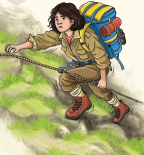
• Energetic Planner
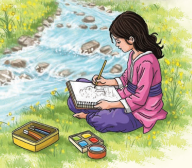
• Thoughtful Creator
You may add to the list as per your choices.
Ans. I am a thoughtful creator, as I read thoroughly before I write. I write to inform others about thoughts and ideas. Writing is a medium that gives voice to my thoughts.
Let us discuss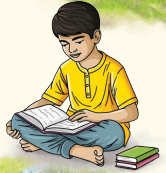
1. Suraj compares the train to a magical creature. Pick the phrases that convey the meaning.
Ans. Suraj compares the train to a magical creature. The phrases that convey this meaning are:
- “snorting and puffing like some green, black, and gold dragon”
- “some beautiful monster out of Suraj’s dreams.”
- “thundering past Suraj like the beautiful dragon of his dreams.”
2. Suraj knew that the train was close by because ____________________.
Ans. Suraj knew that the train was close by because he heard the shrill whistle of the engine, and then a sound like distant thunder issued from the tunnel.
3. What did Suraj see inside the tunnel?
Ans. Inside the tunnel, Suraj saw that the walls were damp and sticky. He also encountered a bat that flew past and a lizard that scuttled between the lines.
4. Select the correct option.
What does Sunder Singh convey about the tunnel?
He says that ____________________ (it is damp and sticky inside/he has lent it to the Government).
Ans. He says that he has lent it to the Government.
5. The watchman has created a system through which he informs the locomotive driver about any danger in the tunnel. The following flow chart shows this system. Refer to the text and complete the flow chart.
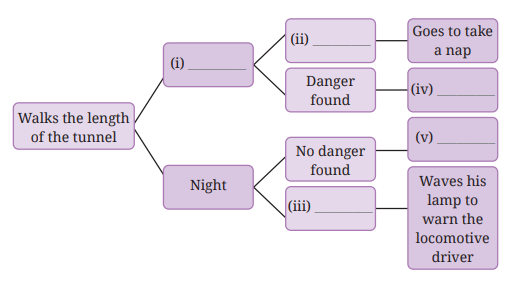
Ans. (i) Day
(ii) No Danger found
(iii) Danger found
(iv) wave a red flag
(v) hang lamp at the door of his hut
Let us discuss
1. Sunder Singh knew that the leopard was in the tunnel because ____________.
Ans. Sunder Singh knew that the leopard was in the tunnel because he heard a distinct rhythmic sawing sound, which he recognized as the leopard.
2. Why do you think Suraj was unable to do any shouting in the tunnel in the beginning?
(i) He was afraid of the leopard.
(ii) He didn’t want to disturb the leopard.
(iii) He was trying to listen for the leopard.
(iv) He didn’t really believe Sunder Singh.
Ans. (i) He was afraid of the leopard.
(This is the most plausible reason, as his throat was “quite dry,” a common physical manifestation of fear.)
3. What made the leopard disappear into the darkness?
Ans. The leopard disappeared into the darkness because Suraj and Sunder Singh both shouted together, and their voices rang through the tunnel. The leopard was uncertain how many “terrifying humans” were with him, so it turned and fled.
4. How did Suraj know Sunder Singh was at the tunnel?
Ans. Suraj knew Sunder Singh was at the tunnel because he saw Sunder Singh’s lamp illuminating the darkness.
5. Why did Suraj’s father take him along to Delhi?
Ans. Suraj’s father took him along to Delhi because he had complained that he doesn’t know where his son gets to, most of the time and thought it’s time he learnt something about his business.
Let us think and reflect
I Read the following lines and answer the questions that follow.
1. Suraj had to turn and look back at the opening to reassure himself that there was still daylight outside. Ahead of him, the tunnel’s other opening was just a small round circle of light.
The tunnel was still full of smoke from the train, but it would be several hours before another train came through. Till then, the cutting belonged to the jungle again.
Suraj didn’t stop, because there was nothing to do in the tunnel and nothing to see. He had simply wanted to walk through, so that he would know what the inside of a tunnel was really like.
(i) Write whether the following statement is true or false.
Suraj looked back at the opening of the tunnel to check if the train was coming.
(ii) Choose the correct option to complete the sentence given below.
Suraj did not stop anywhere in the tunnel because _____________.
A. there was nothing to see in the tunnel
B. the tunnel was damp and sticky
C. he was in a hurry to get out of the tunnel
D. it was time for another train to come
(iii) What does the sentence ‘Till then, the cutting belonged to the jungle again’ mean?
(iv) Suraj wanted to know the inside of the tunnel. What character trait of Suraj is highlighted here?
Ans. (i) False (He looked back to reassure himself there was still daylight outside.)
(ii) A. there was nothing to see in the tunnel
(iii) This sentence means that after the train had passed and before the next one arrived, the railway cutting and tunnel reverted to being a part of the wild, natural environment. It was no longer a human-dominated space for a while; instead, it was reclaimed by the plants and animals of the jungle.
(iv) The character trait of Suraj highlighted here is his curiosity and exploratory nature.
2. “The train will soon be here,” said Suraj.
“Yes, my friend. And if we don’t drive the leopard out of the tunnel, it will be run over and killed. I can’t let that happen.”
“But won’t it attack us if we try to drive it out?” asked Suraj, beginning to share the watchman’s concern.
“Not this leopard. It knows me well. We have seen each other many times. It has a weakness for goats and stray dogs, but it will not harm us. Even so, I’ll take my axe with me. You stay here, Suraj.”
(i) What was the watchman’s concern?
(ii) Complete the sentence with a suitable reason.
Sunder Singh was sure that the leopard in the tunnel would not attack him and Suraj because _____________.
(iii) Select the sentences that are true from those given below.
A. Suraj wants to see the leopards in the jungle.
B. Suraj is concerned about Sunder Singh’s safety.
C. The leopard in the tunnel attacks goats and stray dogs.
D. Sunder Singh wants to protect Suraj.
E. Sunder Singh knows all about the animals in the jungle.
(iv) Choose the correct option to complete the sentence.
Sunder Singh decides to take his axe with him. This tells us that he was _____________.
A. violent
B. cautious
C. bold
D. afraid
Ans. (i) The watchman’s concern was that the leopard, being inside the tunnel, would be run over and killed by the approaching train.
(ii) Sunder Singh was sure that the leopard in the tunnel would not attack him and Suraj because it knew him well and they had seen each other many times.
(iii) C. The leopard in the tunnel attacks goats and stray dogs.
D. Sunder Singh wants to protect Suraj.
E. Sunder Singh knows all about the animals in the jungle.
(iv) B. Cautious
II Answer the following questions.
1. What does Sunder Singh convey by saying that he has lent his tunnel to the Government?
Ans. By saying he has “lent” his tunnel to the Government, Sunder Singh conveys a sense of deep personal ownership and responsibility for the tunnel. It’s a humorous and endearing way of expressing that he is the primary caretaker and guardian of that specific stretch of railway and its surrounding environment, far beyond just fulfilling a job requirement. It shows his profound connection to his work and his territory, suggesting that he feels a more intimate bond with it than a mere employee might.
2. According to Sunder Singh, “It is safer in the forest than in the town”. What example does Sunder Singh give to support his opinion? What does this tell us about him?
Ans. Sunder Singh supports his opinion by stating, “Nothing happens to me out here. But last month, when I went into town, I was almost run over by a bus.” This tells us that Sunder Singh finds peace and security in the wild, natural environment he inhabits. He views the dangers of modern, urban life (like traffic accidents) as more threatening than the dangers posed by wild animals or the solitude of the jungle. It reveals his comfort and deep integration into nature, contrasting it with the perceived chaos and risks of human-made environments.
3. Sunder Singh has become part of the jungle life. Support the view with a suitable reason.
Ans. Sunder Singh has indeed become part of the jungle life. A suitable reason to support this view is his intimate knowledge and harmonious relationship with the wild animals, especially “his” leopard. He not only knows the leopard’s habits (“It comes to this range for a few days every month”) but also understands its temperament (“It knows me well… it will not harm us”). His act of risking his own safety to drive the leopard out of the tunnel, rather than letting it be run over by the train, clearly demonstrates a deep connection and protective instinct towards the wildlife, indicating he sees himself as an integral part of that ecosystem.
4. Sunder Singh and Suraj form an unlikely friendship. What draws them together?
Ans. Sunder Singh and Suraj form a friendship that might seem strange because of their age difference. They are drawn together by their shared interest in the tunnel and the trains. Suraj is very curious about the tunnel and the powerful trains, which matches Sunder Singh’s dedication to his job as the watchman. Suraj is also polite and eager to learn from Sunder Singh, and the watchman, who lives a lonely life, appreciates the boy’s company and willingness to listen. They also share a respect for the jungle and its animals, especially shown when they both worry about the leopard’s safety. This common ground and mutual respect create a strong bond between them.
5. Why is Sunder Singh referred to as a ‘firefly’?
Ans. Sunder Singh is referred to as a “firefly” because, much like a firefly emits a small but noticeable light in the darkness, Sunder Singh’s lamp provides a crucial, albeit tiny, beacon of light in the vast darkness of the jungle for those traveling on the train. He is a solitary figure, a small point of light and vigilance, guiding and safeguarding thousands who pass by unaware. The metaphor highlights his quiet, essential role in illuminating the path and ensuring safety in a remote, otherwise dark environment.
6. Do you think Suraj is an adventure-loving boy? Give reasons.
Ans. Yes, Suraj is an adventure-loving boy. He shows this by leaving the town and cycling deep into the jungle by himself, just to see a train come out of a tunnel. He is not afraid to explore alone. After the train passes, his curiosity leads him to walk through the dark tunnel, even though it’s damp and a bit scary. Later, when Sunder Singh invites him to see the night train, Suraj agrees, showing he likes new experiences. He even bravely goes into the tunnel with Sunder Singh to scare away the leopard, even though he’s a little scared, proving he enjoys thrilling moments.
The Tunnel Grammar Exercises
Let us learn
I Complete the following sentences using the suitable phrases from the text given in the box below.
| drifting smoke | approaching engine | sawing sound | flickering lights |
1. We could hear the ______________________ of the train long before it came into view at the station.
2. The street was completely dark but the little boy walked to his house guided by the ______________________ from the houses.
3. The ______________________ from the carpenter’s workshop grew louder every hour.
4. From the balcony, she watched the ______________________ from her neighbour’s chimney float across the backyard.
Ans.
1. We could hear the approaching engine of the train long before it came into view at the station.
2. The street was completely dark but the little boy walked to his house guided by the flickering lights from the houses.
3. The sawing sound from the carpenter’s workshop grew louder every hour.
4. From the balcony, she watched the drifting smoke from her neighbour’s chimney float across the backyard.
II The text has many ‘sound words’. Some of these words are given in Column 1 and their meanings are given in Column 2. Match the words with their meanings. You can use a dictionary.
| Column 1 | Column 2 |
| 1. creaking | (i) making a noise like a long ‘s’ sound |
| 2. chatter | (ii) making a long low sound when a door or wooden object moves or is moved |
| 3. hissing | (iii) repeated series of short high sounds made by birds or monkeys |
| 4. rustle | (iv) blowing with short, quick blasts, as the wind |
| 5. puffing | (v) a soft low, dry sound made by the movement of things such as leaves, paper, etc. |
Ans.
| Column 1 | Column 2 |
| 1. creaking | (ii) making a long low sound when a door or wooden object moves or is moved |
| 2. chatter | (iii) repeated series of short high sounds made by birds or monkeys |
| 3. hissing | (i) making a noise like a long ‘s’ sound |
| 4. rustle | (v) a soft low, dry sound made by the movement of things such as leaves, paper, etc. |
| 5. puffing | (iv) blowing with short, quick blasts, as the wind |
Now, complete the sentences given below by filling in the blanks with the correct form of the sound words given in Column 1.
1. The steam engine reached the station __________________ black smoke into the sky.
2. Suddenly the snake raised its hood and made a __________________noise.
3. When the wind blew, I heard the __________________ of the wooden roof.
4. He heard a __________________ of leaves behind him when he was walking in the woods.
5. I get disturbed by the continuous __________________ of the monkeys in the neighbourhood.
Ans. 1. The steam engine reached the station puffing black smoke into the sky.
2. Suddenly the snake raised its hood and made a hissing noise.
3. When the wind blew, I heard the creaking of the wooden roof.
4. He heard a rustle of leaves behind him when he was walking in the woods.
5. I get disturbed by the continuous chatter of the monkeys in the neighbourhood.
III Read what the watchman Sunder Singh did regularly at the tunnel as part of his duty. Notice the use of ‘would’.
Every day, before the train came through, he would walk the length of the tunnel. If all was well, he would return to his hut and take a nap. If something was wrong, he would walk back up the line and wave a red flag and the engine driver would slow down. At night, the watchman lit an oil lamp and made a similar inspection of the tunnel.
1. Why is the word ‘would’ used here?
(i) to make a polite request
(ii) to express a desire
(iii) to talk about a habit in the past
In these sentences, the word ‘would’ is used to speak about a past habit.
| ‘Would’ is used in these sentences to describe repeated activities for a period of time in the past. We call them ‘habitual or routine actions in the past’. |
Would and used to both describe something that happened regularly in the past. However, ‘used to’ indicates a past action that doesn’t happen any longer.
• I used to paint when I was in Grade 4.
• Riya used to eat a lot of junk food, but she stopped last year.
Ans. The correct answer is (iii) to talk about a habit in the past as it describes Sunder Singh’s repeated activities (routines/habits) in the past as part of his duty at the tunnel.
2. Complete the sentences using the verb in brackets with the correct form of ‘used to’ or ‘would’. An example has been done for you.
When I was a child we used to live in a village near a forest. Back then, we (i) _____________ (grow) vegetables in our back garden. Every day we (ii) _____________ (get up) early and go for a walk. The weather in summer (iii) _____________ (be) really nice. There was a lake near the house and we (iv) _____________ (go) there every Sunday for a picnic. Winters (v) _____________ (be) rather cold. In the evenings, my father (vi) _____________ (tell) us incredible stories and we (vii) _____________ (listen) with admiration.
Ans. When I was a child we used to live in a village near a forest. Back then, we (i) would grow vegetables in our back garden. Every day we (ii) would get up early and go for a walk. The weather in summer (iii) used to be really nice. There was a lake near the house and we (iv) would go there every Sunday for a picnic. Winters (v) used to be rather cold. In the evenings, my father (vi) would tell us incredible stories and we (vii) would listen with admiration.
IV We use punctuation marks to make our writing clear. You already know how to use full stops and commas. Let us look at three more punctuation marks—brackets, semicolon, and colon.
Colon (:) is used to introduce a list or an explanation.
• You need the following ingredients to make Ela Ada: ghee, coconut, jaggery, and rice flour.
• He has one goal: to win the championship.
Semicolon (;) is used to connect two clauses which are closely related without a conjunction.
• She loves reading; he prefers watching movies.
• Suraj followed close behind; but he found he was unable to do any shouting.
Now, use semicolons and colons to punctuate the following paragraph.
| We explored the busy by-lanes of Charminar, the heart of Hyderabad it was an exciting day. We wanted to do a few things buy bangles, taste biryani, and purchase pearl earrings, which are special to this area. As we walked through the lanes, we saw stalls selling spices, clothes, and jewellery the market was full of colours. We visited some famous spots Charminar, Golconda Fort, Salar Jung Museum, and Chowmahalla Palace each place was beautiful. |
Ans. We explored the busy by-lanes of Charminar, the heart of Hyderabad; it was an exciting day. We wanted to do a few things: buy bangles, taste biryani, and purchase pearl earrings, which are special to this area. As we walked through the lanes, we saw stalls selling spices, clothes, and jewellery; the market was full of colours. We visited some famous spots: Charminar, Golconda Fort, Salar Jung Museum, and Chowmahalla Palace; each place was beautiful.
Let us listen
A famous museum in your town is organising a treasure hunt in the museum premises. You and your friends decide to participate in it. Upon arrival, you find that there are many other teams. Each team is given an audio guide (recorded information) and a map to the museum. (Transcript for the teacher on pg. 176)
Listen to the audio recording and as you listen, mark your map with the route to take to find the treasure. To help you, the names of a few rooms in the museum are given below. Now listen to the audio and mark the various rooms.
| library | auditorium | weapon room | art gallery | musical instruments hall |
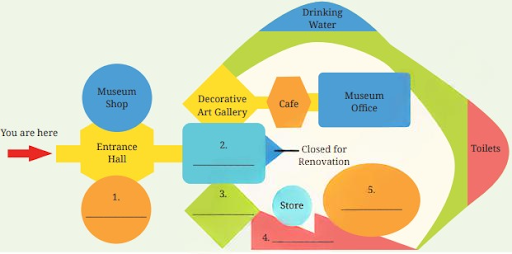
Ans. 1. Library
2. Art Gallery
3. Weapon Room
4. Musical Instruments Hall
5. Auditorium
Let us write
Write a descriptive paragraph about your experience of a train journey. Describe the sights, sounds, and feelings you experienced during the journey. Include details about the people around you, the scenery outside, and the atmosphere inside the train to make your paragraph vivid and engaging.
You may use the following guidelines to help you create the paragraph.
• Start with how the journey began: boarding the train, finding your seat, and the initial impressions.
• Describe the sounds: the whistle of the train, the chatter of passengers, and the rhythmic clatter of wheels on the tracks.
• Mention the sights: the changing scenery outside the window, the hustle and bustle inside the train, and any interesting moments.
• Reflect on your feelings: Were you excited, relaxed, or curious? How did the journey make you feel overall?
Ans. The train journey began with a familiar rush as I boarded, the scent of dust and diesel clinging to the air. Finding my window seat, I settled in just as the guard blew a sharp whistle, and with a gentle lurch, the carriage began to move. Soon, the rhythmic clatter of wheels on the tracks became a comforting heartbeat, a steady drum beneath the cheerful chatter of fellow passengers. Outside, the scenery transformed like a speeded-up film reel: bustling cityscapes gradually gave way to sleepy suburbs, then sprawling green fields dotted with grazing cattle. Tiny villages flashed by, their flickering lights already coming alive as dusk approached, and I felt a profound sense of peace watching the world unfurl beyond my window. Inside, a symphony of sounds filled the air – a baby’s soft cry, the rustle of newspapers, and the occasional laughter from a card game in the aisle. I felt a unique blend of excitement for the destination ahead and a deep relaxation, completely immersed in the journey itself.
CBSE Class 7 English Chapter 1 The Tunnel Extract- Based Questions
Answer the following extract-based questions.
A.
The tunnel was still full of smoke from the train, but it would be several hours before another train came through. Till then, the cutting belonged to the jungle again.
Suraj didn’t stop, because there was nothing to do in the tunnel and nothing to see. He had simply wanted to walk through, so that he would know what the inside of a tunnel was really like. The walls were damp and sticky. A bat flew past. A lizard scuttled between the lines.
Coming straight from the darkness into the light, Suraj was dazzled by the sudden glare and put a hand up to shade his eyes. He looked up at the tree-covered hillside and thought he saw something moving between the trees.
It was just a flash of orange and gold, and a long swishing tail. It was there between the trees for a second or two, and then it was gone.
About fifteen metres from the entrance to the tunnel stood the watchman’s hut. Marigolds grew in front of the hut, and at the back there was a small vegetable patch. It was the watchman’s duty to inspect the tunnel and keep it clear of obstacles.
Q1. Why did Suraj keep walking through the tunnel without stopping?
Ans. Suraj didn’t stop in the tunnel because there was nothing to do or see inside, and he simply wanted to experience what it was truly like to walk through it.
Q2 What two small animals did Suraj encounter inside the tunnel?
Ans. Inside the tunnel, Suraj encountered a bat that flew past and a lizard that scuttled between the lines.
Q3. What effect did coming out of the dark tunnel have on Suraj?
Ans. Coming straight from the darkness into the light, Suraj was dazzled by the sudden glare and had to put a hand up to shade his eyes.
Q4. What did Suraj think he saw moving on the hillside after exiting the tunnel?
Ans. Suraj thought he saw a flash of orange and gold with a long swishing tail moving between the trees.
Q5 What was the watchman’s main duty concerning the tunnel?
Ans. The watchman’s main duty was to inspect the tunnel and keep it clear of obstacles.
B.
Every day, before the train came through, he would walk the length of the tunnel. If all was well, he would return to his hut and take a nap. If something was wrong, he would walk back up the line and wave a red flag, and the engine driver would slow down. At night, the watchman lit an oil lamp and made a similar inspection of the tunnel. Of course, he would not stop the train if there was a porcupine on the line. But if there was any danger to the train, he’d go back up the line and wave his lamp to the approaching engine. If all was well, he’d hang his lamp at the door of his hut and go to sleep.
Q1. What was the watchman’s routine before the train came through during the day?
Ans. Every day, before the train arrived, he would walk the entire length of the tunnel.
Q2. What would the watchman do if he found something wrong in the tunnel during the day?
Ans. If something was wrong, he would walk back up the line and wave a red flag to signal the engine driver to slow down.
Q3. How did the watchman conduct his inspection at night?
Ans. At night, the watchman would light an oil lamp and perform a similar inspection of the tunnel.
Q4. Would the watchman stop a train for a porcupine on the tracks?
Ans. No, he would not stop the train if there was only a porcupine on the line.
Q5. What would the watchman do at night if everything was clear in the tunnel?
Ans. If all was well at night, he would hang his lamp at the door of his hut and go to sleep.
C.
“No. At what time does it come?”
“About nine o’clock, if it isn’t late. You could come and sit here with me, if you like. And after it has gone, instead of going to sleep I will take you home.”
“I’ll ask my parents,” said Suraj. “Will it be safe?”
“Of course. It is safer in the jungle than in the town. Nothing happens to me out here. But last month, when I went into town, I was almost run over by a bus.”
Sunder Singh yawned and stretched himself out on the cot. “And now I am going to take a nap, my friend. It is too hot to be up and about in the afternoon.”
“Everyone goes to sleep in the afternoon,” complained Suraj. “My father lies down as soon as he’s had his lunch.”
“Well, the animals also rest in the heat of the day. It is only the tribe of boys who cannot, or will not, rest.”
Q1. What time does the night train usually arrive?
Ans. The night train usually arrives around nine o’clock, unless it’s running late.
Q2. What did Sunder Singh offer to do for Suraj after the night train had passed?
Ans. Sunder Singh offered to take Suraj home after the night train had gone, instead of going to sleep.
Q3. Why was Suraj hesitant about watching the night train with Sunder Singh?
Ans. Suraj was hesitant because he wanted to ask his parents and he also questioned if it would be safe.
Q4. How did Sunder Singh compare the safety of the jungle to the town?
Ans. Sunder Singh claimed it was safer in the jungle than in the town, giving an example of almost being run over by a bus in town.
Q5. Who, according to Sunder Singh, is the only group that doesn’t rest in the afternoon heat?
Ans. According to Sunder Singh, only the “tribe of boys” cannot, or will not, rest in the afternoon heat.
D.
As Sunder Singh sat down on the cot beside Suraj, a new sound reached both of them quite distinctly—a rhythmic sawing sound, as if someone cutting through the branch of a tree.
“What’s that?” whispered Suraj.
“It’s the leopard,” said Sunder Singh. “I think it’s in the tunnel.”
“The train will soon be here,” said Suraj.
“Yes, my friend. And if we don’t drive the leopard out of the tunnel, it will be run over and killed. I can’t let that happen.”
“But won’t it attack us if we try to drive it out?” asked Suraj, beginning to share the watchman’s concern.
“Not this leopard. It knows me well. We have seen each other many times. It has a weakness for goats and stray dogs, but it will not harm us. Even so, I’ll take my axe with me. You stay here, Suraj.”
“No, I’m coming with you. It will be better than sitting here alone in the dark!”
“All right, but stay close behind me. And remember, there is nothing to fear.”
Raising his lamp, Sunder Singh advanced into the tunnel, shouting at the top of his voice to try and scare away the animal. Suraj followed close behind, but he found he was unable to do any shouting. His throat was quite dry.
Q1. What new sound did Suraj and Sunder Singh hear that was very clear?
Ans. They heard a new, very clear sound described as a “rhythmic sawing sound”, as if someone was cutting through the branch of a tree.
Q2. What animal did Sunder Singh identify as the source of the sound?
Ans. Sunder Singh identified the sound as coming from the leopard.
Q3. Why was Sunder Singh determined to get the leopard out of the tunnel?
Ans. Sunder Singh was determined to get the leopard out of the tunnel because he feared it would be run over and killed by the approaching train, and he couldn’t let that happen.
Q4. How did Sunder Singh try to reassure Suraj about the leopard’s behavior?
Ans. Sunder Singh reassured Suraj by saying that this specific leopard knew him well, they had seen each other many times, and it would not harm them, despite its weakness for goats and stray dogs.
Q5. Why was Suraj unable to shout when they entered the tunnel to scare the leopard?
Ans. Suraj was unable to shout because his throat was “quite dry,” suggesting he was experiencing fear or nervousness.
Class 7 The Tunnel Multiple-Choice Questions
Q1. What time of day was it when Suraj first arrived at the railway cutting?
A. Early morning
B. Mid-afternoon
C. Almost noon
D. Dusk
Ans. C. Almost noon
Q2. How did Suraj travel to the small village before walking to the tunnel?
A. By bus
B. By train
C. By car
D. By cycle
Ans. D. By cycle
Q3. What did the railway lines look like to Suraj as they disappeared into the tunnel?
A. Two shiny ribbons
B. Two straight black serpents
C. Two silver threads
D. Two winding paths
Ans. B. Two straight black serpents
Q4. What sound first indicated to Suraj that the train was approaching?
A. A distant rumble
B. The shrill whistle of the engine
C. The clang of metal
D. A steady chugging
Ans. B. The shrill whistle of the engine
Q5. To what did Suraj compare the steam engine as it shot out of the tunnel?
A. A fierce bull
B. A giant bird
C. A green, black, and gold dragon
D. A galloping horse
Ans. C. A green, black, and gold dragon
Q6. What did Suraj feel when the train emerged from the tunnel?
A. Waves of hot steam struck him
B. A sudden chill
C. A strong gust of wind
D. A tremor in the ground
Ans. A. Waves of hot steam struck him
Q7. What did Suraj decide to do after the train had passed?
A. Return home immediately
B. Explore the jungle
C. Walk through the tunnel
D. Wait for the next train
Ans. C. Walk through the tunnel
Q8. What was the inside of the tunnel like according to Suraj?
A. Dry and dusty
B. Damp and sticky
C. Smooth and cool
D. Rough and rocky
Ans. B. Damp and sticky
Q9. What animal did Suraj see scuttle between the lines inside the tunnel?
A. A snake
B. A bat
C. A lizard
D. A mouse
Ans. C. A lizard
Q10. What color flash and long swishing tail did Suraj see on the hillside after exiting the tunnel?
A. Blue and silver
B. Black and white
C. Orange and gold
D. Green and brown
Ans. C. Orange and gold
Q11. What was the watchman’s name?
A. Suraj Singh
B. Sunder Singh
C. Kamal Singh
D. Raj Singh
Ans. B. Sunder Singh
Q12. What did Sunder Singh say he “owned” besides the tunnel?
A. The railway tracks
B. The surrounding jungle
C. A porcupine
D. A leopard
Ans. D. A leopard
Q13. What was Sunder Singh’s duty regarding the tunnel?
A. To keep it clean
B. To inspect it and keep it clear of obstacles
C. To paint the walls
D. To collect tickets
Ans. B. To inspect it and keep it clear of obstacles
Q14. What time does the night mail train typically come, according to Sunder Singh?
A. Around midnight
B. Around six o’clock
C. Around nine o’clock
D. Around seven o’clock
Ans. C. Around nine o’clock
Q15. What did Sunder Singh place over his face to keep away flies when taking a nap?
A. A towel
B. His cap
C. A large banana leaf
D. A newspaper
Ans. C. A large banana leaf
Q16. What sound did Suraj and Sunder Singh distinctly hear that indicated the leopard’s presence in the tunnel the second time?
A. A growling sound
B. A rhythmic sawing sound
C. A low purr
D. A series of soft thuds
Ans. B. A rhythmic sawing sound
Q17. What did Sunder Singh take with him when he went to drive the leopard out of the tunnel?
A. A stick
B. His lamp
C. His axe
D. A red flag
Ans. C. His axe
Q18. How did the leopard react when Suraj and Sunder Singh shouted at it in the tunnel?
A. It charged at them
B. It snarled and stood its ground
C. It turned swiftly and disappeared
D. It ran towards them
Ans. C. It turned swiftly and disappeared
Q19. What did Suraj feel on the rails that indicated the train was coming after the leopard incident?
A. Its heat
B. Its tremor
C. Its vibration
D. Its dampness
Ans. B. Its tremor
Q20. What did Suraj see from the train window at the end of the story that reminded him of his friend?
A. The watchman’s hut
B. The marigold flowers
C. Sunder Singh’s lamp
D. The tunnel entrance
Ans. C. Sunder Singh’s lamp
CBSE Class 7 English Poorvi Book Unit 4 – Travel and Adventure Chapter 1 The Tunnel Extra Question and Answers
Answer the following questions.
Q1. Why does Suraj go to the railway cutting and the tunnel?
Ans. Suraj goes to the railway cutting and the tunnel primarily out of curiosity. He wants to watch the steam engine come roaring out of the tunnel and later, he wants to walk through the tunnel himself to experience what it’s like inside.
Q2. How does Sunder Singh, the watchman, describe his relationship with the leopard?
Ans. Sunder Singh describes the leopard as “his” leopard, stating that it “minds its own business” and is not dangerous to him or Suraj. He shows a deep understanding and affection for the animal, even risking his safety to drive it out of the tunnel to prevent it from being run over by the train.
Q3. What specific actions does Sunder Singh take to ensure the safety of the trains and the tunnel?
Ans. Sunder Singh has a system for ensuring safety. Before the day train, he walks the length of the tunnel and waves a red flag if there’s any danger. At night, he lights an oil lamp and performs a similar inspection, waving his lamp to signal the approaching engine if there’s an obstacle or danger to the train.
Q4. What unusual sound do Suraj and Sunder Singh hear that alerts them to the leopard’s presence in the tunnel?
Ans. Suraj and Sunder Singh hear a “rhythmic sawing sound, as if someone cutting through the branch of a tree.” This distinctive sound is what Sunder Singh identifies as the leopard in the tunnel.
Q5. How does the story conclude regarding Suraj’s connection to Sunder Singh and the tunnel?
Ans. The story concludes with Suraj traveling on the night mail train with his father almost a week later. As the train approaches the tunnel, Suraj sees Sunder Singh’s lamp, even though he can’t see the watchman himself. This sight reinforces Suraj’s lasting connection to his friend and the lonely watchman who illuminates the darkness for both trains and leopards.