
Paper Boats Summary and Explanation
CBSE Class 7 English Unit 3 Dreams and Discoveries Chapter 2- Paper Boats Summary, Explanation along with Difficult Word Meanings from Poorvi Book
Updated for the CBSE 2026-27 session as per the rationalised syllabus.
Paper Boats Summary – Are you looking for the summary, theme and Lesson explanation for CBSE Class 7 English Unit 3 Dreams and Discoveries Chapter 2 – Paper Boats from English Poorvi Book. Get Lesson summary, theme, explanation along with difficult word meanings
CBSE Class 7 English Unit 3 Dreams and Discoveries Chapter 2 – Paper Boats
by Rabindranath Tagore
Paper Boats is a poem by Rabindranath Tagore. It describes a child playing and dreaming simply and touchingly. The poem highlights a child making and sending paper boats down a stream. This act symbolizes life’s journey, hopes, and the magic of childhood.
- Paper Boats Summary
- Paper Boats Summary in Hindi
- Paper Boats Theme
- Paper Boats Explanation
- Paper Boats Poetic Devices
Related:
Paper Boats Summary
Paper Boats by Rabindranath Tagore is a charming poem from the viewpoint of a young child.
Every day, the child makes little paper boats and sets them free to float down a stream. He writes his name and the name of his village on each boat. His biggest wish is for the boats to travel far away to a new place, where someone will find them and know who he is.
The child adds a special gift to his boats: shiuli flowers, which are lovely flowers that bloom in his garden at dawn. He hopes these flowers will stay safe on their journey and reach another land by night.
As he launches his boats, the child looks up at the sky. He sees small, white, fluffy clouds that remind him of boats with big sails. He imagines that these clouds are also boats, racing alongside his paper boats.
When night comes, the child goes to sleep and dreams. In his dreams, he sees his paper boats floating endlessly under the twinkling stars. In this dream world, the boats carry the “fairies of sleep” and baskets full of dreams, making their journey even more magical.
To sum up, the poem shows a child’s innocent wonder, his desire to connect with the unknown, and how imagination turns simple things into exciting adventures.
Summary of the Lesson Paper Boats in Hindi
रवींद्रनाथ टैगोर की पेपर बोट्स एक छोटे बच्चे के दृष्टिकोण से एक आकर्षक कविता है।
हर दिन, बच्चा छोटी कागजी नावें बनाता है और उन्हें एक धारा में तैरने के लिए मुक्त करता है। वह प्रत्येक नाव पर अपना नाम और अपने गाँव का नाम लिखते हैं। उनकी सबसे बड़ी इच्छा है कि नावें दूर किसी नई जगह पर जाएँ, जहाँ कोई उन्हें ढूंढ लेगा और जान लेगा कि वह कौन है।
बच्चा अपनी नावों में एक विशेष उपहार जोड़ता हैः शिउली फूल, जो सुंदर फूल हैं जो सुबह में उसके बगीचे में खिलते हैं। उन्हें उम्मीद है कि ये फूल अपनी यात्रा में सुरक्षित रहेंगे और रात तक दूसरे देश में पहुंच जाएंगे।
जैसे ही वह अपनी नावों को लॉन्च करता है, बच्चा आकाश की ओर देखता है। वह छोटे, सफेद, रूखे बादलों को देखता है जो उसे बड़ी पाल वाली नौकाओं की याद दिलाते हैं। वह कल्पना करता है कि ये बादल भी नावें हैं, जो अपनी कागजी नावों के साथ दौड़ रही हैं।
जब रात आती है, तो बच्चा सो जाता है और सपने देखता है। अपने सपनों में, वह अपनी कागजी नौकाओं को टिमटिमाते सितारों के नीचे अंतहीन तैरते हुए देखता है। इस सपनों की दुनिया में, नावें “नींद की परियों” और सपनों से भरी टोकरी को ले जाती हैं, जिससे उनकी यात्रा और भी जादुई हो जाती है।
संक्षेप में, कविता एक बच्चे के निर्दोष आश्चर्य, अज्ञात से जुड़ने की उसकी इच्छा और कैसे कल्पना सरल चीजों को रोमांचक रोमांच में बदल देती है, को दर्शाती है।
Theme of the Lesson Paper Boats
Childhood Innocence and Imagination
The poem beautifully captures the pure and boundless imagination of a child. The simple act of floating paper boats transforms into a grand adventure in the child’s mind. The boats are not just paper; they are vessels carrying hopes, dreams, and messages to distant lands. The child imagines clouds as racing playmates and sleep fairies sailing with baskets of dreams, showing how imagination enriches their world and turns ordinary moments into magical experiences.
Desire for Connection and the Unknown
A strong theme is the child’s longing to connect with people in faraway, “strange lands.” By writing their name and village on the boats, the child expresses a fundamental human desire to be known and to reach out beyond their immediate surroundings. It’s a sweet, hopeful yearning for discovery and connection with the vast, unexplored world, even if that connection only happens through a tiny paper boat.
Hope and Optimism
Despite the fragility of paper boats and the vastness of the stream, the child remains hopeful. They “hope that someone in some strange land will find them” and “hope that these blooms of the dawn will be carried safely.” This persistent hope in the face of uncertainty highlights the inherent optimism of childhood, where possibilities seem endless and dreams feel tangible.
The Journey of Life and Dreams
The floating paper boats can be seen as a metaphor for life’s journey. Just as the boats float on “day by day,” people navigate through life, carrying their identity (name), their origins (village), and their hopes and dreams (shiuli flowers, baskets of dreams). The night bringing “fairies of sleep” and dreams suggests the subconscious journey of our aspirations. It implies a continuous, hopeful movement forward, even into the unknown.
Nature’s Companionship
The poem subtly portrays nature as a companion to the child’s play. The “running stream” carries the boats, and the “little clouds setting the white bulging sails” are imagined as fellow travelers or playmates in the sky. This shows a harmonious relationship between the child and their natural surroundings, where elements of nature become active participants in their imaginative world.
Paper Boats Poem Explanation
Stanza
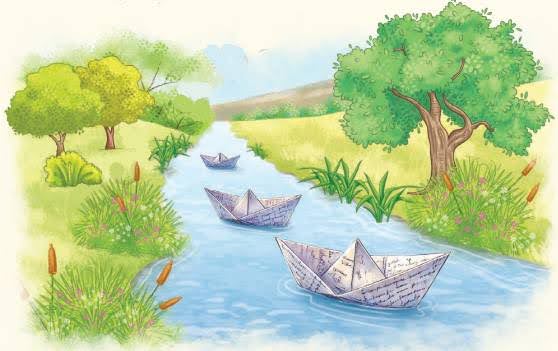
Day by day I float my paper boats one by one down the running stream.
In big black letters I write my name on them and the name of the village where I live.
Word meanings
Day by day: Every single day; consistently.
I float: The child gently places the paper boats on the water so it can move on its own.
my paper boats: Little boats made by the child from paper.
one by one: Each boat individually, sequentially.
down the running stream: Along the small, moving river or brook.
In big black letters: Using large, dark, clearly visible writing.
I write my name: The child put his personal identifier.
Explanation of the above passage—Every day, the child carefully puts their handmade paper boats, one after another, into the flowing stream. On each of these small boats, the child clearly writes his name and the name of his hometown using large, black letters. “Day by day” emphasizes the routine and dedication of the child. This isn’t a one-time activity but a consistent ritual, hinting at the child’s persistent imagination and perhaps a quiet longing. It also suggests the passage of time. The act of floating “paper boats” is inherently symbolic of childhood innocence and simplicity. Paper is fragile and temporary, contrasting with the vast and unknown journey the child imagines for them. The “running stream” represents time, life’s flow, and the path into the unknown. The phrase “one by one” highlights the care and meticulousness the child puts into each boat. It’s not a hasty game but a thoughtful, almost ritualistic act. Writing “my name” and “the name of the village where I live” in “big black letters” acts as a declaration of identity and origin. The child is not just sending a boat; he is sending a piece of himself. The “big black letters” suggest a desire for clarity and certainty that the message will be seen and understood, embodying a child’s directness and longing to be known. This also introduces the theme of connection with the unknown, as the child hopes these identifiers will be discovered by someone far away. The act of labeling the boats also shows a fundamental human desire for legacy or recognition, even at a young age.
Stanza
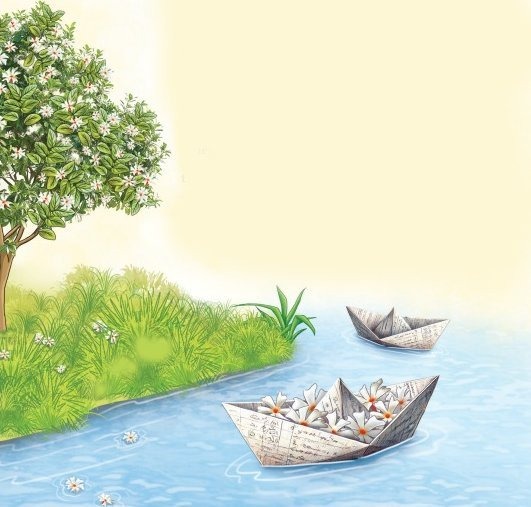
I hope that someone in some strange land will find them and know who I am.
I load my little boats with shiuli flower from our garden, and hope that these blooms of the dawn will be carried safely to land in the night.
Word meanings
Strange land: An unfamiliar or unknown place.
Shiuli flower: A specific type of fragrant white flower (also known as Night-flowering Jasmine) that blooms at dawn and falls during the day.
Blooms of the dawn: A poetic way of referring to the flowers that bloom at night and fall off the branch before sunrise. It’s a metaphor for hope that is beautiful but fleeting in nature.
Carried safely to land in the night: This expresses the wish that the flowers (and metaphorically, the hopes) complete their journey securely before their natural lifespan (blooming period) ends.
Explanation of the above stanza—The child hopes that his paper boats will travel to a far-off, unfamiliar place and that a person living there will discover them. This way, someone unknown will learn about the child who sent them. The child also fills these small boats with shiuli flowers, which are special because they blossom at night and fall off the branches by sunrise, in their garden. The child wishes that these delicate flowers will make it safely across the water and reach land by the time night comes. This stanza reveals the child’s deep desire for connection and recognition beyond his immediate world. It’s an innocent yet universal human longing to make a mark and be acknowledged by others, even those far away. The “strange land” represents the vast, unknown future or distant places. The act of loading the boats with shiuli flowers adds a layer of tenderness and symbolism. Shiuli flowers are known for their fragrance and for blooming at night and falling by the sunrise, making them fragile and fleeting. By placing them on the boats, the child is entrusting something precious and fleeting to the journey, hoping it reaches its destination before its beauty fades. This symbolizes sending out delicate hopes and dreams.
Stanza
I launch my paper boats and look up into the sky and see the little clouds setting the white bulging sails.
I know not what playmate of mine in the sky sends them down the air to race with my boats!
Word meanings
I launch: The child sends his paper boats onto the water.
into the sky: Towards the sky above
setting the white bulging sails: That looks as if they are spreading out their white, puffy sails, like a ship’s sails filled with wind.
what playmate of mine: Which friend of the child.
sends them down the air: Makes those clouds move downwards through the air.
to race with my boats!: So that they can compete or float alongside his paper boats.
Explanation of the above stanza—The child puts his paper boats into the water and then looks up. He sees small, white clouds in the sky that look like ships with their sails puffed out. The child wonders which friend in the sky is sending these clouds down to race with their own little paper boats. The clouds are personified as ships, and their natural movement is transformed into the deliberate act of “setting sails”. The adjective “bulging” emphasises their fullness and readiness for movement, mirroring the child’s own desire for his boats to travel far. This line highlights the child’s ability to see familiar objects (clouds) in a new, fantastical way, revealing their imaginative mind. The clouds aren’t just moving; they are being “sent down” by a “playmate” specifically to “race.” This line conveys a sense of wonder and curiosity, and a deep connection with nature, where natural elements are perceived as animated beings involved in their games. The idea of a “playmate in the sky” adds a touch of loneliness and a longing for companionship, even if it’s an imagined one.
Stanza
When night comes I bury my face in my arms and dream that my paper boats float on and on under the midnight stars.
The fairies of sleep are sailing in them, and the lading is their baskets full of dreams.
Word meanings
Bury my face: To place one’s face down into something, in this case, their arms, often to feel cozy or to hide.
Float on and on: To continue to sail or drift without stopping, endlessly.
Midnight stars: The stars visible in the sky in the middle of the night.
Fairies of sleep: Imaginary, magical creatures associated with bringing sleep or dreams.
Sailing: Traveling on water in a boat.
Lading: The cargo or goods carried by a ship or other vehicle; freight.
Explanation of the above stanza—When night comes, the child goes to sleep and, in his dreams, imagines the paper boats are still floating far away under the stars. The child envisions that these boats are now carrying magical “fairies of sleep,” and the cargo they are transporting is not just flowers, but baskets filled with dreams. The dreamy state becomes an extension of the day’s play, emphasizing the continuous nature of the child’s imaginative life. The boats are not stopped by nightfall; they continue their voyage in the child’s mind, guided by the constant, distant stars. The boats are no longer just inanimate objects; they are vehicles for mythical beings. “Fairies of sleep” personify the very essence of dreams and rest, suggesting that the boats are now part of a grander, more ethereal purpose. This elevates the humble paper boat to a vessel of enchantment. The “Shiuli flowers” of the previous stanza are replaced by “baskets full of dreams.” This transformation of cargo highlights the idea that the boats carry not just tangible hopes, but the very fabric of imagination and future aspirations. It suggests that what begins as a simple act of play eventually nourishes the soul and fuels the subconscious. The image is one of abundance and profound childlike wonder.
Paper Boats Poetic Devices
Alliteration
Alliteration is the repetition of initial consonant sounds in words that are close together. The poem uses this extensively to create a musicality and emphasize certain phrases, contributing to its whimsical tone. Some of the instances of alliteration in the poem Paper Boats are ‘big black’, ‘someone in some strange’, ‘Day by Day’, ‘load my little’, ‘on and on’ and ‘sleep are sailing’.
Consonance
Consonance is the repetition of consonant sounds (not necessarily at the beginning of words) within a short sequence of words. Some of the instances in the poem ‘Day by day’, ‘my name on them’, ‘one by one down the running’, ‘little boats with’, ‘flower from our garden’, ‘setting thee white’, ‘not what playmate’, ‘bury my face in my’, ‘the midnight stars’.
Assonance
Assonance is the repetition of vowel sounds within a short sequence of words. Some of the instances of Assonance in the poem are ‘day by day I float my paper boats’, ‘boats one by one down’, ‘the name of the village where I live’, ‘someone in some strange’, ‘launch my paper boats’, ‘setting thee white’, ‘paper boats float on and on’, ‘The fairies of sleep’ and ‘lading ins their’.
Imagery
Imagery refers to language that appeals to the five senses (sight, sound, smell, touch, taste), creating vivid mental pictures for the reader. The poem is full of strong visual imagery, especially “big black letters”, “running stream”, “Shiuli flower”, “white bulging sails”, “twinkling stars of midnight” and “baskets full of dreams”.
Repetition
In poetry, repetition is a literary device where a word, phrase, line, or even an entire stanza is repeated multiple times. The repetition of the words ‘Day by Day’, ‘on and on’ and ‘one by one’ to emphasize the daily routine and continuity. The phrase “paper boats” itself is repeated throughout the poem, reinforcing the central image.
Metaphor
The Metaphor is a direct comparison between two unlike things without using “like” or “as.” The “little clouds setting the white bulging sails” is a metaphor where the clouds are directly compared to ships with sails. The “blooms of the dawn” (referring to Shiuli flowers) is a metaphorical way of describing the flowers’ connection to dawn due to their falling. The “baskets full of dreams” is a metaphor for the dreams that are presented as a tangible cargo.
Symbolism
Symbolism is the object or idea that represents something else, often more abstract. Paper boats symbolise childhood innocence, dreams, hopes, aspirations, the journey of life, and attempts to connect with the unknown. Running stream symbolizes the flow of life, time, and the journey into the unknown. Shiuli flowers symbolize delicate hopes, fleeting beauty, and the child’s tender offerings to the world. Strange land symbolizes the unknown future, distant places, and the vastness beyond immediate experience. Midnight stars symbolize guidance, distant possibilities, and the continuity of dreams even in darkness. Fairies of sleep and baskets full of dreams symbolize the magical nature of imagination, the subconscious world, and the nurturing aspect of rest.
Paper Boats FAQs
Q1. Who wrote “Paper Boats,” and what is the poem about?
Ans. It was written by Rabindranath Tagore, and it describes a child who makes paper boats and sends them floating down a stream, imagining they carry his identity and dreams to faraway lands.
Q2. What does the child write on each boat, and why?
Ans. He writes his name and the name of his village in big black letters, hoping that whoever finds the boat in a distant land will come to know who he is.
Q3. What special “gift” does the child load onto his boats?
Ans. Shiuli flowers from his garden — delicate blooms that flower at dawn — which he hopes will safely reach another land by nightfall.
Q4. What does the child imagine about the clouds in the sky?
Ans. He sees small white clouds with puffed-out shapes and imagines them as boats with sails, sent by an unseen sky-playmate to race alongside his own paper boats.
Q5. What happens to the boats in the child’s dreams at night?
Ans. He dreams that his paper boats keep floating endlessly under the stars, now carrying the “fairies of sleep” and baskets full of dreams.
Conclusion
Paper Boats is a poem about a child making and sending paper boats down a stream. This act symbolises life’s journey, hopes, and the magic of childhood. Students can take help from this post to understand the poem and also learn the difficult word meanings to get a better grasp of Paper Boats. This lesson includes a summary of Paper Boats, which will help students in class 7 to get a quick recap of the poem.
Very elaborate