
CBSE Class 7 English Unit 1 – Learning Together Chapter 1 The Day the River Spoke Important Question Answers from Poorvi Book
Class 7 English The Day the River Spoke Question Answers – Looking for questions and answers for CBSE Class 7 English Unit 1 – Learning Together Chapter 1 The Day the River Spoke? Look no further! Our comprehensive compilation of important questions will help you brush up on your subject knowledge. Practising Class 7 English question answers can significantly improve your performance in the exam. Improve your chances of scoring high marks by exploring Unit 1 – Learning Together Chapter 1 The Day the River Spoke now. The questions listed below are based on the latest CBSE exam pattern, wherein we have given NCERT solutions to the chapter’s extract-based questions, multiple choice questions and Extra Question Answers
Also, practising with different kinds of questions can help students learn new ways to solve problems that they may not have seen before. This can ultimately lead to a deeper understanding of the subject matter and better performance on exams.
- The Day the River Spoke NCERT Solutions
- The Day the River Spoke Grammar Exercise
- The Day the River Spoke Extract Based Questions
- The Day the River Spoke Multiple Choice Questions
- The Day the River Spoke Extra Question Answers
Related:
- The Day the River Spoke Summary, Explanation
- The Day the River Spoke Character Sketch
- Class 7 English Summary and Lesson Notes
The Day the River Spoke Textbook Questions (NCERT Solutions)
Let us discuss
1. What was Jahnavi’s dream? Was it important to her? Why?
Ans. Jahnavi desires to go to school and learn. Her eagerness to attend school, her disappointment at not being able to, and her joy when she finally gets the chance to listen to the teacher, shows how important her dreams of getting an education are. She defies societal expectations by wanting to go to school when it wasn’t the norm for girls in her community.
2. Do you think the river can help her in fulfilling her dream? How?
Ans. In a literal sense, the river, being a natural entity, cannot directly help Jahnavi in the practical steps of going to school. However, in the story, the river plays a significant role in helping Jahnavi emotionally and perhaps indirectly in pursuing her dream. The river provides Jahnavi with a sense of comfort and reassurance. It tells her not to be scared and listens to her. This emotional support can give her the courage and confidence to pursue her desire for education.
2. Complete the table given below with Jahnavi’s questions in Column 1 and the River’s answers in Column 2. Check your answers with the teacher.
| Column 1 | Column 2 |
| …why the moon always comes from behind the hills…? | |
| … little girls can do as much as little boys. | |
| Big boats, so big that they can take hundreds of people, and they sail along the sea with lights that shine all night. | |
| Will they come here? |
Ans.
| Column 1 | Column 2 |
| …why the moon always comes from behind the hills…? | It goes down towards the sea. I’ve seen it—it always takes the same path, over the mountains and down to the sea, like me! |
| “Can I do something?” | … little girls can do as much as little boys. |
| “What are ships?” | Big boats, so big that they can take hundreds of people, and they sail along the sea with lights that shine all night. |
| Will they come here? | No, they won’t. They’re too big. Chandu’s catamaran is fine for me. He can take you to see a ship someday. |
Let us think and reflect
I Read the extracts given below and answer the questions that follow.
1. “You shouldn’t cry, you know,” the voice went on. “And you really shouldn’t be scared, when you have been coming here to see me every day, well, almost every day.” She was puzzled. It was such a voice, like the river. It couldn’t be the river! “Well, tell me all about it,” said the River, for it was the River. “I’ve got to hurry to reach the sea, you know.”
(i) Complete the sentence with the correct option from those given in the brackets.
The tone of the River in the given extract is __________________. (assuring/sympathising)
(ii) Select a phrase from the extract which shows that Jahnavi was a frequent visitor to the spot.
(iii) Choose the correct option to complete the sentence.
The use of an exclamation mark at the end of the line, ‘It couldn’t be the river!’ expresses __________________.
- excitement
- hesitation
- irritation
- disbelief
(iv) Choose three qualities of the River highlighted in the extract from the words in the box given below.
| affectionate | forgiving | thoughtful | impatient | kind-hearted |
Ans. (i) The tone of the River in the given extract is assuring.
(ii) The phrase from the extract which shows that Jahnavi was a frequent visitor to the spot is “when you have been coming here to see me every day, well, almost every day.”
(iii) The use of an exclamation mark at the end of the line, ‘It couldn’t be the river!’ expresses D. disbelief.
(iv) Three qualities of the River highlighted in the extract are affectionate, thoughtful and kind-hearted.
2. “Can I do something?” asked Jahnavi. “Well, it’s up to you,” said the River. “Seems to me little girls can do as much as little boys—they swim as fast as little boys. You just slip along one morning and sit there in the school and listen to what’s going on, and maybe the teacher will let you stay.”
“I couldn’t,” gasped Jahnavi. “I couldn’t! They’d scare me! They’d chase me out.”

(i) Complete the sentence with an appropriate reason.
According to the River, there was no difference between girls and boys because __________________.
(ii) Identify whether the following statement is true or false.
The River encourages Jahnavi to have faith in herself and fulfill her desire to go to school.
(iii) Choose the correct option to complete the sentence.
When the River suggests that Jahnavi should ‘slip along’, it means that she should move __________________.
- quickly
- casually
- quietly
- confidently
(iv) What does the repetition of the phrase I couldn’t, tell us?
Ans. (i) According to the River, there was no difference between girls and boys because they swim as fast as little boys.
(ii) True
(iii) C. quietly
(iv) The repetition of the phrase “I couldn’t” tells us about Jahnavi’s lack of confidence and her fear of facing opposition or negative reactions from others. It highlights her hesitation and insecurity in taking action to pursue her desire to go to school.
II Answer the following questions.
1. Why does the writer describe different aspects of nature in great detail at the beginning of the story? Why do you think the writer does this?
Ans. The writer describes different aspects of nature in great detail at the beginning of the story to set the scene. The detailed descriptions of the kingfisher, the lizard, and the riverbank create a vivid and immersive setting, allowing the reader to visualize the environment where Jahnavi’s interaction with the river takes place. It is also to establish the river’s character. By describing the natural world, the river is established as a character and almost a living entity. Moreover, it highlights Jahnavi’s connection with nature. The detailed descriptions show that Jahnavi is observant of and connected to her surroundings. The detailed, realistic descriptions of nature contrast with the magical element of the river speaking, making that event stand out and seem even more special.
2. How did the River know so much about Jahnavi?
Ans. The river’s knowledge of Jahnavi is part of the story’s magical realism. The river is personified, meaning it’s given human-like qualities. So, within the story’s context, the river knows about Jahnavi because of it’s a constant presence in her life. The river is a natural entity that Jahnavi visits frequently, so it observes her and her habits. Symbolically, it represents nature’s awareness. The river’s knowledge can be seen as a symbol of nature’s awareness and connection to the people who live alongside it. It enhances the story’s mystical quality. The river’s knowledge adds to the story’s enchanting and fantastical atmosphere.
3. Jahnavi says, “And I’m so old now, they’ll never let me go.” What can you infer about Jahnavi and the school from this line?
Ans. From this line, we can infer several things about Jahnavi. She is older than the typical age for starting school. Her statement suggests that there’s a specific age at which children are expected to begin their education, and she believes she has already passed that age. There might be social or familial restrictions on her going to school. The word “they” implies that there are people in her community or family who have a say in whether she can attend school, and she anticipates their disapproval. It also shows Jahnavi has a strong desire to go to school. Despite the potential obstacles, she clearly wants to attend school, as she expresses concern about missing the opportunity.
4. Why did the River laugh when Jahnavi said she would be scared at school?
Ans. The river laughs when Jahnavi said she would be scared at school because it perceives Jahnavi’s fear of school as ironic. The river has observed Jahnavi’s interactions with other aspects of nature, which some might find intimidating. The river knows Jahnavi is brave as it points out that Jahnavi isn’t afraid of other natural elements. The river sees school as less threatening. In the river’s perspective, the things Jahnavi fears are far less difficult than the social dynamics of a school environment. The river’s laughter is a way to gently tease Jahnavi and encourage her to be brave and overcome her fear.
5. Why should Jahnavi follow the River’s advice?
Ans. Jahnavi should follow the River’s advice because the river offers a practical solution. The river suggests a simple plan to go to the school and listen. The river is a source of reassurance. The river provides emotional support and encourages Jahnavi to have faith in herself. As a constant presence in Jahnavi’s life, the river has observed her and may have a better understanding of her capabilities than Jahnavi herself.
6. How does the conversation between Jahnavi and the River make the story more appealing?
Ans. The conversation between Jahnavi and the river makes the story more appealing as it introduces a magical element. The personification of the river adds a fantastical dimension to the story, making it more engaging and intriguing. It reveals Jahnavi’s inner thoughts and feelings. The river acts as a confidant, allowing Jahnavi to express her fears, desires, and concerns. The interaction between a child and a natural entity is inherently fascinating and creates a special bond between the reader and the characters, also allowing the author to explore themes of nature, imagination, and a child’s perspective in a more creative and engaging way.
7. What is the main message that the writer intends to convey?
Ans. The main message that the writer intends to convey is the importance of imagination and how it can help children navigate their emotions and understand the world. The value of the connection between children and the natural world. The need to overcome societal barriers in the pursuit of knowledge. The idea that nature can be a source of comfort, wisdom, and empowerment.
The Day the River Spoke Grammar Exercises
Let us learn
I You have learnt that naming words are called nouns and only proper nouns begin with a capital letter. Why has the author used a capital letter for the ‘River’ even when it is a common noun? (Clue: Has the River been given qualities of a human being?)
Ans. The River is given human-like qualities, such as the ability to speak, think, and interact with Jahnavi. This is a literary device called personification. By capitalizing “River,” the author emphasizes that it’s not just a geographical feature but a character in the story. Capitalizing “River” also highlights its importance and elevates its status beyond that of an ordinary noun. It becomes a significant entity with a distinct identity and role in the narrative. The River is not just any river; it’s the River in Jahnavi’s experience. Capitalization gives it a unique identity, almost like a proper noun.
II There are a few words related to sound in the text. Pick the words from the text and write them next to the correct definition.
- made a high-pitched piercing sound
- to cause liquid to strike or fall on something
- a low continuous background noise
- cry with loud uncontrollable gasps
- to make a soft dry sound, like paper or leaves moving
- took a short quick breath through the mouth due to surprise, pain or shock
- shaking rapidly to make continuous short, sharp sounds
- making a lot of noise
- made a long, high cry, usually because of pain or sadness
Ans.
- shrieked
- splashed
- murmuring
- sob
- rustled
- gasped
- rattling
- noisy
- wailed
Now, fill in the blanks with suitable sound words from exercise (II).
The classroom grew (i) _______ as the students noticed the teacher carrying the answer papers. As the teacher turned the pages with a (ii) _______, the children (iii) _______, wondering what comments awaited. Someone (iv) _______ in frustration, and the (v) _______of the students steadily increased. Finally, when the teacher praised the students for their excellent performance, the students (vi) _______ with excitement.
Ans.
The classroom grew (i) noisy as the students noticed the teacher carrying the answer papers. As the teacher turned the pages with a (ii) rustled, the children (iii) gasped, wondering what comments awaited. Someone (iv) wailed in frustration, and the (v) murmuring of the students steadily increased. Finally, when the teacher praised the students for their excellent performance, the students (vi) shrieked with excitement.
III The word ‘catamaran’ is used in the text. The word originates from Tamil language ‘kattu maram’ meaning ‘tied wood’.
Find out the meanings of these words. From which Indian language these words were borrowed. An example has been given.
- karma (Sanskrit)
- sahib
- chutney
- guru
- verandah
- jungle
- areca
- palanquin
Ans.
- karma (Sanskrit): This word refers to the concept of action, work, or deed, and its effect on a person’s fate in future existences.
- sahib (Urdu/Hindi): This word is a title of respect, similar to “sir” or “master.”
- chutney (Hindi): This word refers to a spicy condiment made of fruits, vegetables, and spices.
- guru (Sanskrit): This word refers to a teacher or spiritual guide.
- verandah (Hindi): This word refers to a long, open porch, usually with a roof.
- jungle (Sanskrit): This word refers to a thick, tangled forest or wilderness.
- areca (Tamil/Malayalam): This refers to a type of palm, the areca palm, whose nuts are used for chewing.
- palanquin (Sanskrit): This word refers to a covered litter carried by people, used for transporting passengers.
V Solve the crossword puzzle based on words related to water transport.
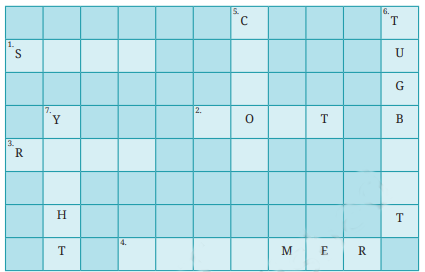
Across
- a large vessel used for transporting goods or passengers by sea
- a small vessel for travelling on water, typically propelled by oars, sails, or an engine
- a flat floating structure for travelling across water
- a boat or ship driven by steam
Down
- a small, light, narrow boat, pointed at both ends and moved using a paddle
- a boat with a powerful engine which can change direction easily and is used to pull large ships into and out of port
- a boat with sails and sometimes an engine, used for either racing or travelling for pleasure, rhymes with ‘cot’
Ans.
- 1. Ship
- Boat
- Raft
- Steamer
- Canoe
- Tugboat
- Yacht
VI Read the highlighted words in the following lines from the text.
“She goes down towards the sea. I’ve seen her; she always takes the same way—over the mountains and down to the sea, like me!”
Prepositions are words that indicate the relationship between nouns or pronouns and other elements in a sentence. They show direction, location, time or logical relationships between ideas.
Now, fill in the blanks with suitable prepositions given within the brackets.
Jahnavi takes the River’s advice and goes to school. On her first day 1. _________ (at/in/on) school, Jahnavi stood nervously 2. _________ (in/ outside/above) the gate, clutching her bag close to her. The bell rang and she hurried 3. _________ (outside/through/inside) the bustling classroom. She found a seat 4. _________ (among/between/from) two friendly classmates. The teacher greeted them warmly and started the lesson 5. _________ (about/in/for) numbers. Jahnavi listened attentively, feeling excited 6. _________ (at/about/for) the new adventure ahead.
Ans. Jahnavi takes the River’s advice and goes to school. On her first day 1. at school, Jahnavi stood nervously 2. outside the gate, clutching her bag close to her. The bell rang and she hurried 3. inside the bustling classroom. She found a seat 4. between two friendly classmates. The teacher greeted them warmly and started the lesson 5. about numbers. Jahnavi listened attentively, feeling excited 6. about the new adventure ahead.
VII Read the highlighted words in the following sentence from the text.
A kingfisher swept down, its wings an arrow of blue in the sunlight.

Words like on, off, up, down can function both as preposition and as adverb.
For example:
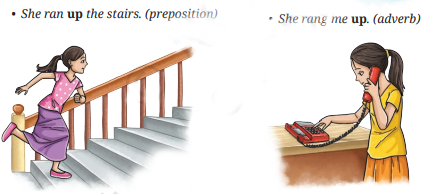
| Remember, a preposition will always be followed by an object (noun) whereas an adverb will tell you more about the action (verb). |
Fill in the blanks with prepositions or adverbs.
- The cat jumped ___________ the table. (preposition)
- The children played ___________ until dark. (adverb)
- She quickly ran ___________ the park. (preposition)
- The helicopter was hovering ___________. (adverb)
- We were just walking ___________, chatting. (adverb)
- After thoroughly wiping his shoes, he stepped ___________. (adverb)
- She drove slowly ___________ the sharp curve. (preposition)
- He placed the keys ___________ the mat before leaving. (preposition)
Ans.
- 1. The cat jumped on the table. (preposition)
- The children played outside until dark. (adverb)
- She quickly ran to the park. (preposition)
- The helicopter was hovering above. (adverb)
- We were just walking along, chatting. (adverb)
- After thoroughly wiping his shoes, he stepped inside. (adverb)
- She drove slowly around the sharp curve. (preposition)
- He placed the keys on the mat before leaving. (preposition)
Let us listen
I Read the words given in the box below. You will listen to five people speak about school life. As you listen, circle the words that are used by the speakers. There are two words you do not need. (Transcript for the teacher on pg. 39 )
| lawyer | desks | homemaker | principal | posters |
| newspapers | marriage | advertisements | careers | books |
Ans. Homemaker
Principal
Careers
Books
II You will once again listen to the five speakers. As you listen, match each statement 1–7 to each speaker (i)–(v). There are two statements that you do not need.
| Statements | Speaker No. |
| 1. Promotes active participation for all in school activities | |
| 2. Comments on how school makes learning Mathematics joyful | |
| 3. Believes in the power of education that leads to freedom of choice | |
| 4. Shares that school also means companionship | |
| 5. Understands that boys and girls have different abilities | |
| 6. Persuades the parent to grant permission to attend school | |
| 7. Believes that learning skills is not gender-based |
Ans.
| Statements | Speaker No. |
| 1. Promotes active participation for all in school activities | (V) |
| 2. Comments on how school makes learning Mathematics joyful | – |
| 3. Believes in the power of education that leads to freedom of choice | (i) |
| 4. Shares that school also means companionship | (iv) |
| 5. Understands that boys and girls have different abilities | – |
| 6. Persuades the parent to grant permission to attend school | (ii) |
| 7. Believes that learning skills is not gender-based | (iii) |
Let us speak
I Read the sentence given below.
“Dear, dear! What’s the matter? … You shouldn’t cry, you know. And you really shouldn’t be scared, when you have been coming here to see me every day, well, almost every day.”
The River spoke to Jahnavi in a ‘sleepy’ voice. Work in pairs and take turns to speak the same sentence in ‘other’ voices. Some hints are given below.
| happy | surprised | angry | scared | sad | worried |
Ans. Happy: “Dear, dear! What’s the matter? … Yay! You shouldn’t cry, you know! And you really shouldn’t be scared! You’ve been coming here to see me every day, well, almost every day!”
Surprised: “Dear, dear! What’s the matter? … Oh my! You shouldn’t cry, you know? And you really shouldn’t be scared? You’ve been coming here to see me every day, well, almost every day!”
Angry: “Dear, dear! What’s the matter?! … Ugh, you shouldn’t cry, you know! And you really shouldn’t be scared, when you have been coming here to see me every day, well, almost every day!”
Scared: “Dear, dear! What’s the matter? … Oh no… You shouldn’t cry, you know. And you really shouldn’t be scared… when you have been coming here to see me every day, well, almost every day…”
Sad: “Dear, dear… What’s the matter? … Alas… You shouldn’t cry, you know… And you really shouldn’t be scared, when you have been coming here to see me every day, well, almost every day…”
Worried: “Dear, dear! What’s the matter? … Phew, you shouldn’t cry, you know. And you really shouldn’t be scared, when you have been coming here to see me every day, well, almost every day.”
II Janhavi asks the River for advice and the River gives advice. Read the given situations and work in pairs to ask for and give advice. Take turns to change your roles. Use the prompts given below.
- Situation (i) : You wish to play football at school but it has an all-boys’ team only.
- Situation (ii) : You have been unable to score well in Mathematics due to nervousness during exams.
- Situation (iii) : You really enjoy music classes but do not get enough time to practise for it.
- Situation (iv) : You cannot see the blackboard clearly from the last bench.

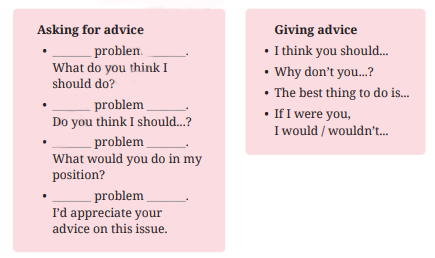
Ans.
Situation (i): You wish to play football at school but it has an all-boys’ team only.
You (Asking for advice): I really want to play football, but the school team is only for boys. What should I do? I feel it’s not fair.
Friend (Giving advice): That’s a tricky situation, but don’t give up! You could start by talking to the sports teacher or the principal. Explain that you and other girls are interested in playing and suggest forming a girls’ team or a mixed team. You could also gather support from other students who feel the same way. If that doesn’t work, maybe look for a football club outside of school.
Situation (ii): You have been unable to score well in Mathematics due to nervousness during exams.
You (Asking for advice): I’m so frustrated! I understand the math concepts, but I always get so nervous during exams that I mess up and don’t score well. What can I do?
Friend (Giving advice): I know how that feels! Try practicing relaxation techniques before the exam, like deep breathing or positive self-talk. Make sure you’re well-prepared, as that can boost your confidence. During the exam, focus on one question at a time, and if you feel overwhelmed, take a few deep breaths. You could also talk to your math teacher about your anxiety; they might have some helpful strategies.
Situation (iii): You really enjoy music classes but do not get enough time to practice for it.
You (Asking for advice): I love music class, but I just don’t have enough time to practice as much as I’d like. I’m not improving as much as I want to. Any ideas?
Friend (Giving advice): That’s a common problem! Try to find small pockets of time in your day, even 15-20 minutes, for focused practice. Maybe you could wake up a little earlier, practice during a study break, or cut down on some non-essential activities. Talk to your music teacher; they might have suggestions for efficient practice techniques or extra practice sessions. Also, try to make practice enjoyable, so it doesn’t feel like a chore.
Situation (iv): You cannot see the blackboard clearly from the last bench.
You (Asking for advice): I’m having trouble in class because I can’t see the blackboard clearly from the last bench. It’s making it hard to follow the lessons. What should I do?
Friend (Giving advice): You should definitely do something about that! The easiest solution is to talk to your teacher and explain the situation. They will most likely allow you to sit in a front row. If the problem persists, you should also tell your parents. You might need to get your eyes checked.
Let us write
Observing Nature

Take some time to observe the world around you. Over the next few days, pay attention to the colours, shapes, patterns, and textures found in nature. Look closely at the plants, trees, flowers, birds, and even the sky. Make detailed notes of what you observe, focusing on textures, movements, and how light plays with these elements. Record your observations in detail and the features that draw your attention the most—whether it’s the soft ripple of water, the vibrant flutter of a butterfly or the colour of the birds or flowers.
Now, write a descriptive paragraph based on what you’ve observed. Highlight the colours, shapes, textures, and unique details that made an impression on you.
Give a title to your paragraph.
| Ideas | Prompts |
| • What do you observe? |
|
| • How do you feel? Why? |
|
| • What is your message to everyone around you? |
|
Ans. Harmony of the Senses
Every day, I see the world waking up beautifully. The first light of day gently colours the sky in soft shades of pink and orange, turning to a bright, hopeful gold. I find it fascinating how the light changes everything it touches. The leaves of the mango tree, a rich green, sparkle with tiny drops of dew, each one reflecting a little bit of the sunrise. A light breeze moves through the leaves, creating a soft, rustling sound, like gentle applause.
Then there are the flowers. They burst with colour—the deep red of hibiscus, the delicate pink of roses, and the bright yellow of sunflowers, all turning towards the sun. A butterfly, with wings like stained glass, dances from flower to flower, adding beauty with its lively movements. The butterfly stands out against the strong, steady banyan tree, whose roots reach down like twisted fingers wrapping around the earth.
Next is the water. The pond nearby is always moving. Its surface ripples like silk, reflecting the sky in changing patterns. Dragonflies, shining like jewels, hover above, their wings sparkling in the light.
I feel a mix of awe and peace in this lively scene. It feels like I am witnessing a masterpiece made by an unseen artist, reminding me of the beauty and connection of all things. My advice is to take a moment each day to really see the world around you. Let its colours, shapes, and textures fill your senses and uplift your spirit. In this symphony of the senses, we connect to something bigger than ourselves.
CBSE Class 7 English Chapter 1 The Day the River Spoke Extract-Based Questions
Answer the following extract-based questions.
A.
“Dear, dear!” said a sleepy, murmuring voice, “What’s the matter?” Jahnavi was startled, because she was sure she had been quite alone.
Q1. Whose voice is heard in this passage?
Ans. The voice heard in this passage is the river’s voice.
Q2. Why is the voice described as “sleepy” and “murmuring”?
Ans. The voice is described as “sleepy” and “murmuring” to suggest its gentle, calm, and soothing quality, like a soft, natural sound.
Q3. Why was Jahnavi startled?
Ans. Jahnavi was startled because she believed she was completely alone and didn’t expect to hear anyone speaking.
Q4. What does the passage reveal about Jahnavi’s state of mind?
Ans. The Passage suggests that Jahnavi might be feeling lonely or in need of comfort, as she is at the river, and the river’s voice seems to respond to her emotional state.
Q5. What literary device is used to describe the river’s voice?
Ans. Personification is used, as the river is given human-like qualities by being able to speak.
B.
It couldn’t have been the lizard. And the kingfisher was up in the thicket of bamboo eating the fish it had caught. It couldn’t be the parrots, because parrots shrieked and this was such a sleepy voice.
Q1. Why does Jahnavi rule out the lizard as the speaker?
Ans. Jahnavi rules out the lizard because lizards do not speak.
Q2. What was the kingfisher doing?
Ans. The kingfisher was in the thicket of bamboo, eating the fish it had caught.
Q3. What word is used to describe the sound made by the parrots, and what does it suggest?
Ans. The word “shrieked” is used, and it suggests that the parrots made a loud, harsh, and high-pitched sound.
Q4. What contrast does Jahnavi notice about the voice she heard?
Ans. Jahnavi notices the contrast between the “sleepy voice” she heard and the loud shrieking of the parrots.
Q5. What does the passage tell us about Jahnavi’s observation skills?
Ans. The Passage shows that Jahnavi is observant of her surroundings and can distinguish between the different sounds and actions of the creatures around her.
C.
“You shouldn’t cry, you know,” the voice went on. “And you really shouldn’t be scared, when you have been coming here to see me every day, well, almost every day.”
Q1. Who is speaking these words?
Ans. The river is speaking these words.
Q2. To whom are these words addressed?
Ans. These words are addressed to Jahnavi.
Q3. What does the speaker imply about Jahnavi’s visits?
Ans. The speaker implies that Jahnavi visits the river frequently, “almost every day.”
Q4. What emotions is the speaker trying to address?
Ans. The speaker is trying to address Jahnavi’s sadness (crying) and fear.
Q5. What kind of relationship does Jahnavi have with the river?
Ans. The passage suggests that Jahnavi has a close and familiar relationship with the river.
D.
The next day she reached the school, panting and out of breath and stood by the door listening while the teacher read out the lesson. It was a story about a prince called As´hoka, who became a great king. Little Appu had fallen asleep on her shoulder.
Q1. Why is Jahnavi “panting and out of breath”?
Ans. Jahnavi is “panting and out of breath” because she rushed to school.
Q2. What story is the teacher reading to the class?
Ans. The teacher is reading a story about a prince named As´hoka, who became a great king.
Q3. Who is Appu, and what is he doing?
Ans. Appu is Jahnavi’s younger brother, and he has fallen asleep on her shoulder.
Q4. What does Appu’s presence indicate about Jahnavi?
Ans. Appu’s presence indicates that Jahnavi is caring and responsible.
Q5. Where is Jahnavi standing?
Ans. Jahnavi is standing by the door of the school.
Class 7 The Day the River Spoke Multiple Choice Questions
Q1. What is the name of the girl to whom the river speaks?
A. Jahnavi
B. Janaki
C. Jayanti
D. Juhi
Ans. A. Jahnavi
Q2. What kind of voice does the river have?
A. Clear
B. Loud
C. Sharp
D. Sleepy
Ans. D. Sleepy
Q3. Which creature’s wings are described as an “arrow of blue”?
A. Crow
B. Kingfisher
C. Parrot
D. Sparrow
Ans. B. Kingfisher
Q4. Where is the kingfisher when Jahnavi hears the voice?
A. At the river’s edge
B. Eating a fish
C. Flying above
D. On a tree branch
Ans. B. Eating a fish
Q5. What is the green creature that slithers to the river’s edge?
A. Frog
B. Lizard
C. Snake
D. Worm
Ans. B. Lizard
Q6. What does Jahnavi feel when she cannot find the source of the voice?
A. Anger
B. Confusion
C. Fear
D. Sadness
Ans. C. Fear
Q7. What does the river say it has seen the moon do?
A. Disappear
B. Float
C. Go down towards the sea
D. Rise into the sky
Ans. C. Go down towards the sea
Q8. What is the floor of the classroom made of?
A. Cement
B. Earthen
C. Stone
D. Wood
Ans. B. Earthen
Q9. Who falls asleep on Jahnavi’s shoulder?
A. A classmate
B. A friend
C. Appu
D. The teacher
Ans. C. Appu
Q10. What is the story that the teacher reads to the class about?
A. A farmer
B. A king
C. A river
D. A ship
Ans. B. A king
Q11. What is the river compared to?
A. A boat
B. A child
C. A road
D. The sea
Ans. C. A road
Q12. What word is used to describe the river’s voice?
A. Shrieking
B. Murmuring
C. Shouting
D. Whispering
Ans. B. Murmuring
Q13. Where does the river say the moon goes?
A. Into the forest
B. Over the mountains
C. To the city
D. Up to the sky
Ans. B. Over the mountains
Q14. What is Jahnavi doing when she hears the voice?
A. Dancing
B. Playing
C. Walking
D. Crying
Ans. D. Crying
Q15. What is Jahnavi’s reaction after she got the opportunity to go school at the end of the story?
A. Anger
B. Curiousity
C. Fear
D. Happiness
Ans. D. Happiness
Q16. What does the river say Jahnavi shouldn’t be?
A. Angry
B. Afraid
C. Sad
D. Tired
Ans. B. Afraid
Q17. What is the color of the lizard?
A. Blue
B. Brown
C. Green
D. Red
Ans. C. Green
Q18. What is the river’s destination?
A. A lake
B. A mountain
C. The sea
D. A town
Ans. C. The sea
Q19. Where is Jahnavi when she listens to the teacher?
A. At home
B. By the door
C. In the field
D. Near the river
Ans. B. By the door
Q20. Who is the central character of the story?
A. Appu
B. Jahnavi
C. The king
D. The teacher
Ans. B. Jahnavi
CBSE Class 7 English Poorvi Book Unit 1 – Learning Together Chapter 1 The Day the River Spoke Extra Question and Answers
Answer the following questions and answers.
Q1. What is the central theme of “The Day the River Spoke”?
Ans. The central theme of the story is the power of a child’s imagination and the connection between children and the natural world. It explores how a child like Jahnavi finds solace, companionship, and wonder through her interaction with the river, which she perceives as a speaking entity. The story also touches upon themes of loneliness, curiosity, and the blurring of lines between reality and fantasy in a child’s mind.
Q2. How is the river personified in the story, and what effect does this have on the narrative?
Ans. The river is personified as a gentle, caring, and communicative being. It speaks in a “sleepy, murmuring voice” and shows concern for Jahnavi’s feelings. This personification makes the river a character in its own right, allowing it to directly interact with Jahnavi and offer her comfort and a sense of connection. It enhances the magical and dreamlike quality of the story, emphasizing the idea that nature can be a source of solace and understanding for children.
Q3. What role does Jahnavi’s journey to school play in the story?
Ans. Jahnavi’s journey to school, and her eagerness to attend despite obstacles, highlights her curiosity and determination. It also provides a contrast to her imaginative interaction with the river. While her time with the river is filled with fantasy and wonder, her journey to school and the classroom setting ground the story in the reality of her daily life and responsibilities. It also subtly touches upon the theme of a child’s desire for knowledge and learning.
Q4. How does the story depict the relationship between Jahnavi and her environment?
Ans. The story depicts a close and intimate relationship between Jahnavi and her environment. She is observant of the natural world around her, noticing the kingfisher, the lizard, and the sounds of the parrots. Her connection with the river goes beyond mere observation, as she perceives it as a communicative and caring presence. The river seems to respond to her emotional state, suggesting a harmonious and empathetic bond between the child and nature.
Q5. What message or lesson can be derived from “The Day the River Spoke”?
Ans. “The Day the River Spoke” conveys the message that nature can be a source of comfort, wonder, and companionship, especially for children. It also highlights the importance of imagination in helping children process their emotions and understand the world around them. The story encourages readers to appreciate the beauty and magic of the natural world and to recognize the value of a child’s unique perspective.
Q6. Which phrase from the extract shows that Jahnavi was a frequent visitor to the spot?
Ans. “And you really shouldn’t be scared, when you have been coming here to see me every day, well, almost every day.” This line spoken by the river shows that Jahnavi was a frequent visitor to the spot.
Q7. How did the river help Jahnavi overcome her fear, in the class 7 lesson The day the river spoke?
Ans. The river was a helpful, encouraging, and observant friend. He noticed that Jahnavi was not scared of the lizards and snakes lurking around in bamboo clusters. She was not nervous about the train rattling past bridges. By pointing all that out, he concluded that she was braver than she thought. So he advised her to simply take the first step and go to school, sit in the class, and listen to what the teacher is teaching. He assured her that she was not too old to go to school. Encouraged and inspired, she finally took the first leap and went to school, overcoming her fear.
Q8. What does the river tell Jahnavi about girls?
Ans. The river was a patient friend who listened to every concern and emotion Jahnavi expressed. When she asked if she could do something about her education and if she could stand up for herself, the river affirmed that she could do anything she wanted to because girls are just as capable as boys. He reaffirmed this by saying that little girls could swim just as fast as little boys, hence having the ability to do as much as boys. So the river told Jahnavi that girls can do as much as boys, motivating her not to feel inferior by gender inequality.
Q9. What advice did the river give to Jahnavi in the class 7 lesson ‘The day the River spoke’?
Ans. The river gave plenty of advice to a distraught and disheartened ten-year-old girl named Jahnavi. The river encouraged Jahnavi to overcome her fear and go to school. He told her that girls are just as capable as boys. He assured that she was not too old to go to school. If she was brave enough to not be scared of lizards, snakes, and the loud train, she was brave enough to start her education at the age of ten. He gave her the imagination and courage to dream about traveling in a ship and then suggested her to get her education before dreaming about sailing through the world.
Q10. What does Jahnavi want to become in the future?
Ans. Jahnavi is an inquisitive and smart young girl who wishes to learn about the world around her. She wants to learn about ships, why spiders are yellow in yellow flowers, why bamboo trees rustle, why the moon always comes from behind the hills and never the other way, and why the baby fish in the field water become frogs. Motivated by the river, she finally goes to school, where the teacher sees her and helps her case. He requests her parents to let her go to school. Seeing the teacher help with her education, Jahnavi tells her mother that when she grows up, she will become a teacher too and she will go house to house to gather girls for their education. She wishes to empower the future generations of girls in the village to prioritise their own education and growth.
Q11. Why was Jahnavi not allowed to go to school in the story ‘The day the River spoke’?
Ans. Jahnavi was not allowed to go to school, in contrast to her brothers. This portrays the gender-based discrimination that girls are still subjected to. Because of her gender, her parents kept her at home and limited her role to someone who assisted in household tasks and cared for the boys of the family. Jahnavi often felt curious about the world around her and therefore, asked her mother if she could go to a school and learn alongside Ettan and Appu. However, her mother kept putting it off and piling more housework on her shoulders. Restrained by her gender, her education was put aside in favour of conventional female chores.
Good answers
But keep it a bit short