
Character Sketch of Tiger King, Durai, Duraisani and Chief Astrologer from Class 12 English Vistas Book Chapter 2 The Tiger King
To understand the Class 12 Board Exam Pattern and Marking Scheme, Click here
Tiger King
Questions related to the Character of Tiger King
- How would you describe the personality of the Maharaja in the story “The Tiger King”, based on his actions and decisions throughout the story?
- In what ways does the Maharaja demonstrate a lack of responsibility toward his kingdom?
- Discuss the Maharaja’s relationship with the truth and how it contributes to his downfall.
- How does the author use the Tiger King’s death to finalize the character’s sketch?
Questions related to the Character of Durai
- Describe the character of the British officer and his significance in the story The Tiger King.
- How does the Durai’s personality contrast with that of the Tiger King?
Questions related to the Character of Duraisani
- How does the character of the Duraisani in the lesson “The Tiger King”, serve as a critique of greed and the influence of the British in India?
- What role does the Duraisani play in the survival of the Tiger King’s kingdom?
- What does the behavior of the Durai’s wife, the Duraisani, reveal about the nature of the British elite in the story The Tiger King?
- Compare the character of the Duraisani with that of the Tiger King in terms of their vanity.
Questions related to the Character of Chief Astrologer
- How does the Chief Astrologer in the chapter ‘The Tiger King’ represent the conflict between traditional wisdom and the arrogance of power in the story?
- In the story The Tiger King, what role does the Chief Astrologer play in highlighting the themes of irony and fate within the narrative?
- To what extent can the Chief Astrologer in “The Tiger King” be considered a successful professional despite the King’s efforts to prove him wrong?
Related:
- The Tiger King Summary, Explanation, Word Meanings
- The Tiger King Question Answers
- The Tiger King MCQs
- The Tiger King Previous Years Question with Answers
Character Sketch of Tiger King
Finish your entire Class 12 English prep in 24 hrs & ace your CBSE Boards 2026! – Concise chapter summaries (key events & ideas), lesson themes, Visual character sketches using mind maps Click here

Questions related to the Character Sketch of Tiger King
Question: How would you describe the personality of the Maharaja in the story “The Tiger King”, based on his actions and decisions throughout the story?
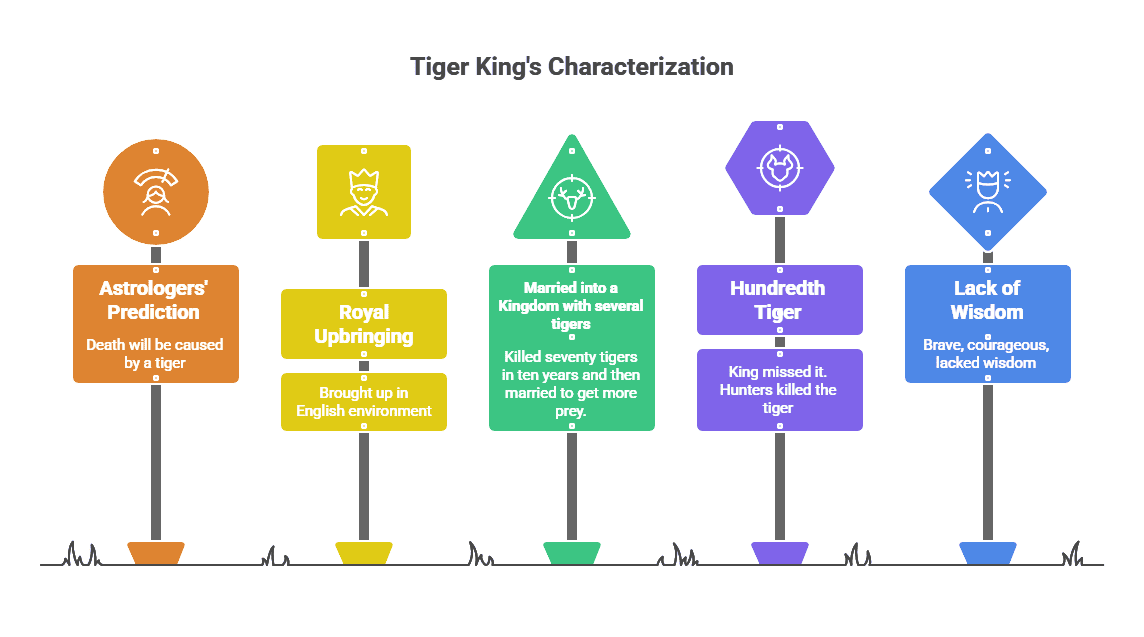
Ans. The Maharaja of Pratibandapuram is portrayed as a highly eccentric, stubborn, and ego-driven ruler. From a young age, his life is defined by a grand sense of self-importance, highlighted by his numerous high-sounding titles and his royal upbringing. He is a man of singular focus, as seen in his unwavering vow to kill one hundred tigers to disprove a prophecy. However, this determination is not a sign of true heroism but rather an indicator of his extreme narcissism. He is completely indifferent to the needs of his subjects or the preservation of nature, choosing instead to prioritize his own survival and pride above all else. His bravery is frequently undermined by his irrationality, making him a figure of ridicule rather than respect.
Question: In what ways does the Maharaja demonstrate a lack of responsibility toward his kingdom?
Ans. The Maharaja is a textbook example of a callous ruler who views his state as a personal playground for his obsessions. He completely neglects his administrative duties, refusing to attend to any matter of the state until his hunting quota is met. His governance is marked by whimsy and tyranny; he doubles land taxes out of spite when he cannot find a tiger and threatens to fire his staff whenever he is frustrated. He even risks the sovereignty of his kingdom by refusing a British officer’s request, only to settle the matter by spending a massive sum of state wealth on a bribe for the officer’s wife. These actions show that he lacks the maturity and wisdom required to lead, as he treats his power as a means to satisfy his own vanity.
Question: Discuss the Maharaja’s relationship with the truth and how it contributes to his downfall.
Ans. The Maharaja lives in a delusional bubble created by his own arrogance and the fear he instills in others. He is so obsessed with his image as a Tiger King that he fails to recognize the reality of the world around him. He believes he has successfully hunted ninety-nine tigers through skill alone, ignoring the times he had to fight them with bare hands due to his own mistakes. His greatest delusion is believing he killed the hundredth tiger, when in reality, his shot missed and his subordinates hid the truth to save their jobs. This disconnection from reality is what eventually kills him; he becomes so complacent in his victory over fate that he ignores a simple physical danger like a splinter from a poorly made toy. His death by a wooden sliver is the ultimate commentary on his inability to see the true nature of things.
Question: How does the author use the Tiger King’s death to finalize the character’s sketch?
Ans. The Maharaja’s death serves as the final piece of satire that defines his character as a tragicomic failure. After years of slaughtering fierce predators and successfully maneuvering through political threats, he dies from a minor infection caused by a low-quality wooden toy. This ending highlights the irony that while he considered himself a warrior of warriors, he was actually vulnerable to the most mundane of accidents. It also emphasizes that his victory over the hundredth tiger was a total illusion. The fact that the surgeons call the operation a success while he is dead suggests that the Maharaja was always more of a symbol or a caricature than a living, breathing person with a soul. His demise is a final mocking salute to a man who thought he could conquer destiny through bloodshed.
Questions related to the Character Sketch of Durai
Question: Describe the character of the British officer and his significance in the story The Tiger King.
Ans. The British officer, referred to as the Durai, represents the colonial authority that held ultimate power over Indian princely states. He is characterized by his vanity and superficiality rather than any genuine hunting skill or bravery. His primary interest in tiger hunting is not the sport itself but the social prestige associated with it. He is more obsessed with the public image of being a hunter, specifically desiring to be photographed with a gun over the carcass of a tiger. This reveals a man who values optics and status over substance. His presence in the story introduces a major conflict for the Maharaja, as his authority is so great that refusing his request puts the King’s entire throne at risk.
Question: How does the Durai’s personality contrast with that of the Tiger King?
Ans. While both the Tiger King and the Durai are driven by ego and a desire for status, the Durai operates from a position of systemic colonial power. The Maharaja is obsessed with the act of killing to outsmart his destiny, whereas the Durai is satisfied with the mere appearance of victory. He is even willing to let the Maharaja do the actual killing as long as he can claim the credit through a photograph. This highlights a different kind of arrogance, one that is lazy and reliant on the labor of others. His character serves to show that during the British Raj, even a powerful Indian King had to resort to expensive bribes and clever manipulation to handle the whims of a single British official.
Questions related to the Character Sketch of Duraisani
Question: How does the character of the Duraisani in the lesson “The Tiger King”, serve as a critique of greed and the influence of the British in India?
Ans. The Duraisani, the wife of a high-ranking British officer, is portrayed as a greedy and materialistic individual who exploits her husband’s position for personal gain. When the Maharaja sends her fifty expensive diamond rings, expecting her to keep one or two and return the rest, she keeps the entire lot without any hesitation. Her brief response of gratitude shows a complete lack of etiquette and a blatant desire for wealth. Through her character, the author satirizes the corruption prevalent among the British elite who often used their influence in India to accumulate riches. She represents a class of people who were more interested in acquiring gifts and maintaining status than in the actual governance or administrative duties of their husbands.
Question: What role does the Duraisani play in the survival of the Tiger King’s kingdom?
Ans. The Duraisani acts as a critical turning point in the story because she is the person who unintentionally saves the Maharaja’s throne. When the King denies her husband permission to hunt tigers, he faces the very real threat of being deposed by the British authorities. To fix this diplomatic crisis, the Maharaja uses the Duraisani as a bridge, knowing that her influence over her husband is significant. By satisfying her greed with diamonds worth three lakh rupees, the King manages to pacify the British officer. Her character highlights the fact that in the political landscape of that time, serious matters of state were often settled through expensive bribes and by pleasing the family members of those in power.
Question: What does the behavior of the Durai’s wife, the Duraisani, reveal about the nature of the British elite in the story The Tiger King?
Ans. The Duraisani, the wife of the British officer, is depicted as a greedy and materialistic woman who exploits the Maharaja’s political vulnerability. When the King sends her fifty expensive diamond rings, expecting her to keep one or two as a polite gesture, she keeps the entire lot without any hesitation. Her brief reply of thanks shows a lack of social grace and a high level of entitlement. Through her, the author satirizes the corruption and avarice of the colonial administrators and their families. She represents the high cost that Indian rulers had to pay to keep the British happy, showing that the stability of a kingdom often depended on satisfying the personal greed of those in power.
Question: Compare the character of the Duraisani with that of the Tiger King in terms of their vanity.
Ans. Both the Duraisani and the Maharaja are driven by intense self-interest, though their vanity manifests in different ways. While the Maharaja is obsessed with his legacy and outsmarting fate through the hunt, the Duraisani is obsessed with the accumulation of material possessions and luxury. Neither character shows any concern for the financial or moral cost of their actions. The Maharaja is willing to spend a fortune from the state treasury just to stay in power, and the Duraisani is happy to accept that fortune without a second thought for the ethics involved. They both represent the superficiality of the ruling classes, where personal pride and greed take precedence over the welfare of the common people or the integrity of their roles.
Questions related to the Character Sketch of Chief Astrologer
Question: How does the Chief Astrologer in the chapter ‘The Tiger King’ represent the conflict between traditional wisdom and the arrogance of power in the story?
Ans. The Chief Astrologer serves as a crucial figure who sets the entire plot in motion through his initial prophecy. He represents a traditional authority that remains unswayed by the Maharaja’s royal status. While the rest of the court is intimidated by the King, the astrologer remains professionally firm, even when challenged by a talking infant. He does not sugarcoat the truth about the King’s eventual demise, which establishes him as a man of conviction. However, his character also reveals a touch of professional pride when he wagers his entire career, including his hair and his vocation, on the accuracy of his prediction regarding the hundredth tiger. This highlights that even the wise are susceptible to the pressures of an ego-driven society.
Question: In the story The Tiger King, what role does the Chief Astrologer play in highlighting the themes of irony and fate within the narrative?
Ans. The Chief Astrologer acts as the mouthpiece of fate, providing the specific details that allow the story’s irony to flourish. By identifying the tiger as the specific source of danger, he inadvertently creates the King’s obsession. The irony lies in the fact that his very warning drives the Maharaja to destroy the tiger population, which eventually leads to the revenge of the hundredth tiger. The astrologer’s presence ensures that the reader is always aware of the inevitable conclusion, making the King’s frantic hunts seem even more futile. He bridges the gap between the supernatural prophecy and the physical reality of the King’s life, proving that the word of a prophet carries more weight than the weapons of a monarch.
Question: To what extent can the Chief Astrologer in “The Tiger King” be considered a successful professional despite the King’s efforts to prove him wrong?
Ans. The Chief Astrologer is ultimately vindicated as a master of his craft, though not in the way the Maharaja expected. His prediction that the hundredth tiger would be the cause of death is proven accurate by the end of the narrative. While the King successfully hunted ninety-nine living tigers, the astrologer’s warning about the hundredth one manifested through a wooden toy. This suggests that the astrologer possessed a deeper understanding of destiny that bypassed physical appearances. His refusal to back down from his claim, even under the threat of royal displeasure, marks him as the only character who successfully stands his ground against the King’s tyranny.
The Tiger King Overview – There is no way to avoid death, which is a truth. Destiny has unlimited power and is unavoidable.
Nobody can alter fate. Men in positions of authority are cruel to animals. They murder defenceless animals under various justifications. The maharaja kills the tigers since the astrologer predicted that a tiger will be the cause of his demise. He kills them in order to avoid dying.
Also See:
- CBSE Class 12 English Notes, Lesson Explanation
- CBSE Class 12 English MCQ Question Answers
- Class 12 English Flamingo Book Chapter wise word meanings
- Class 12 English Flamingo Poems Word meanings
- Class 12 English Vistas Book Word meanings
- CBSE Class 12 English Important Question Answers
- Character Sketch of Class 12 English
- Class 12 English Core Previous Year Question Answers (2019-2024) Chapterwise
- Class 12 English Core Previous Year Question Paper with Solutions 2019-2024