
Character Sketch of Peddler, Ironmaster and Edla from Class 12 English Flamingo Book Chapter 4 The Rattrap
To understand the Class 12 Board Exam Pattern and Marking Scheme, Click here
Peddler
Questions related to the Character of Peddler
- How do you come to know that the peddler was a pessimist?
- How does the peddler’s character evolve throughout the story?
- How does the peddler interpret the acts of kindness shown by the crofter, the ironmaster, and his daughter?
Ironmaster
Questions related to the Character of Ironmaster
- Why was the ironmaster so talkative and friendly?
- How is the ironmaster different from his daughter?
- What made the ironmaster send his daughter to persuade the peddler?
Edla
Questions related to the Character of Edla
- How did Edla change the peddler’s behavior?
- How does the character of Edla in The Rattrap contribute to the theme of empathy?
- How can you say that Edla is the best character in this story?
Related:
- The Rattrap Question Answers
- The Rattrap Summary, Explanation, Word meanings
- The Rattrap MCQs
- The Rattrap Previous Years Question with Answers
Character Sketch of Peddler
Finish your entire Class 12 English prep in 24 hrs & ace your CBSE Boards 2026! – Concise chapter summaries (key events & ideas), lesson themes, Visual character sketches using mind maps Click here
Top
Questions related to the Character Sketch of Peddler
Question: How do you come to know that the peddler was a pessimist?
Answer. The peddler was a pessimist because he had a pessimistic and cynical viewpoint on the world. He compared the world to a giant rattrap, which offered comforts and luxuries as baits to trap people in the rattrap. He was so bitter about his life as a poor vagabond that he enjoyed viewing the world through a pessimistic lens.
Top

Question: How does the peddler’s character evolve throughout the story?
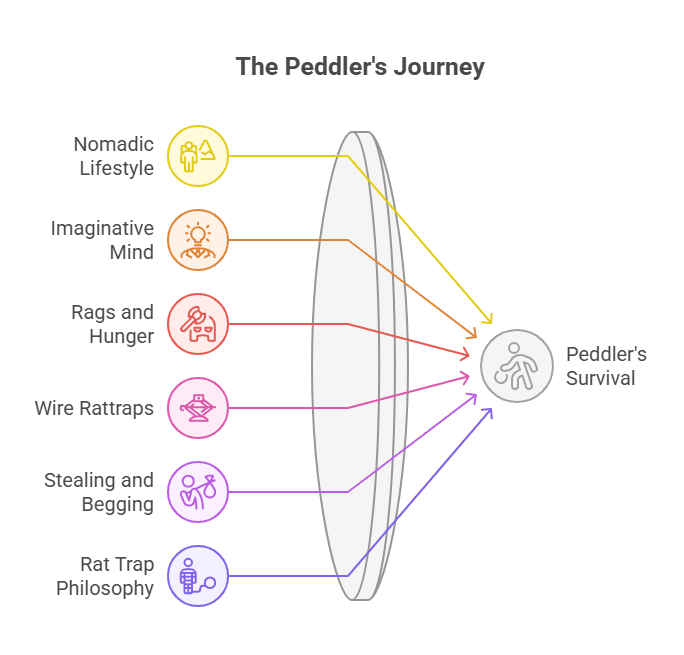
Answer. The peddler was a poor vagabond with a pessimistic and cynical point of view. He saw the world as a giant rattrap, which offered comforts and luxuries as baits to trap people in it. He sold rattraps, begged for money and scraps, and stole money and other resources for survival. He was lonely without a home or someone to go back to after doing lots of hard work. He deceived the crofter by stealing his hard-earned money with no hesitation. However, when he got lost in the woods, he regretted stealing the crofter’s money. He realised that he was lost in the woods because he had been lured by the crofter’s money. He fortunately found the Ramsjo Ironworks and found refuge near the forge’s fire. There he met the ironmaster, who mistook him for Captain von Stahle. His regret and guilt turned into fear because he was getting more and more trapped. He refused the invitation out of fear but was then persuaded by the ironmaster’s daughter, Edla. When he was groomed and cleaned by the valet, the ironmaster realised his mistake and threatened to call the sheriff and get the peddler arrested. He became angry and accused the ironmaster of purposely luring him with a false promise. This shows the distrust and bitterness he had towards people. He was used to living in constant fear of being arrested and being pushed away by people. However, Edla’s compassion and gentle treatment despite his true identity and past actions amazed him. For the first time, he spent a day peacefully and without any fear or fighting for his survival. The unconditional kindness invoked a strong power of gratitude, encouraging him to redeem himself. This led to a positive transformation in his character. Instead of stealing riches and valuables from their manor house, he gave them a Christmas present of a rattrap and a note to Edla signed off as ‘Captain von Stahle’.
Top
Question: How does the peddler interpret the acts of kindness shown by the crofter, the ironmaster, and his daughter?
Answer. The peddler interprets the acts of kindness shown by the crofter, the ironmaster, and his daughter in different ways. The crofter was kind to the peddler because of his own loneliness. The crofter expected him to keep him company in exchange for shelter, food, and water. Therefore, the peddler stole the crofter’s money with no hesitation. The ironmaster, too, showed kindness because he thought the peddler was his old acquaintance. When the ironmaster realised the truth, he became angry and stern, becoming unkind towards the rattrap seller. This shows that the peddler had never been shown unconditional love and saw kindness either as an opportunity for his own benefit, or a transaction in which he has to give something for someone’s help. The ironmaster’s daughter Edla, on the other hand, was the only person who showed him unconditional and genuine compassion, even after knowing the truth about him. This shattered his pessimistic viewpoint on the world, incurring redemption and positive transformation in his character.
Character Sketch of Ironmaster
Questions related to the Character Sketch of Ironmaster
Question: Why was the ironmaster so talkative and friendly?
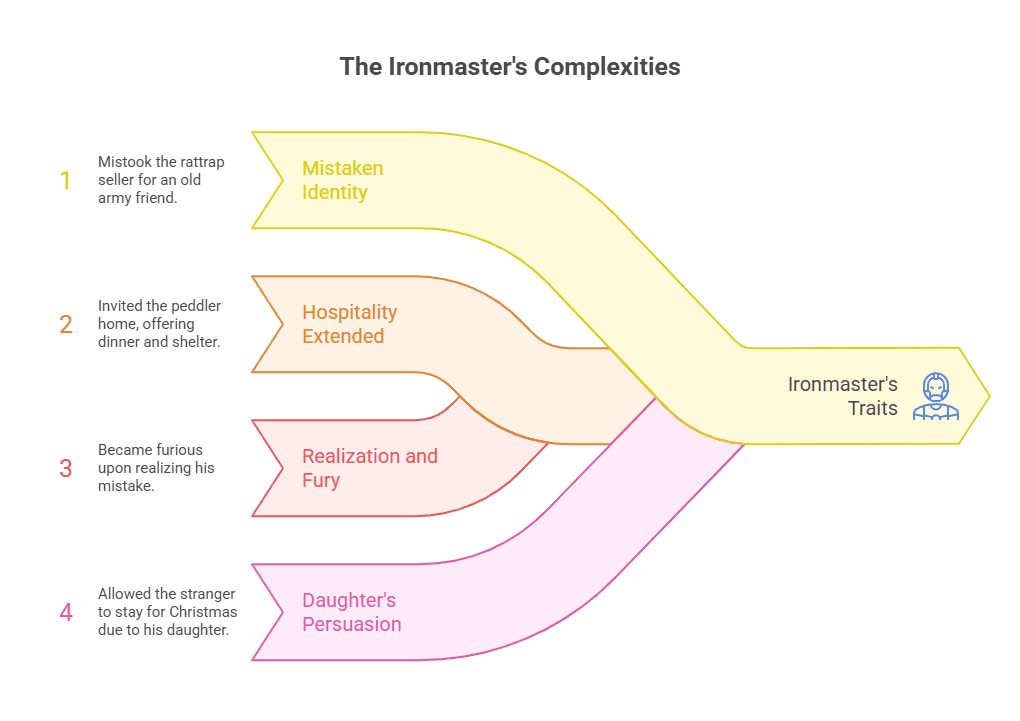
Answer. The ironmaster was first talkative and friendly towards the rattrap seller because he thought that the seller was his old acquaintance. His friendly nature was present only because of his false assumption. This shows that the ironmaster was nice to his friends and family but not to strangers.
Top
Question: How is the ironmaster different from his daughter?
Answer. The ironmaster was different from his daughter Edla. He was a poor judge of character because he could not see that the poor man was declining the invitation because he was afraid of being caught. He assumed that it was because the seller was embarrassed by his shabby and dirty vagabond appearance. When he realised his mistake, he wanted to throw the vagabond out of the manor house, even though he had promised him Christmas cheer. Compared to him, Edla knew from the start that the guest was guilty and afraid of being arrested. She was therefore a good judge of character. When the truth was revealed, she chose to show kindness. She reminded her father that he had promised the man Christmas cheer. She wished to give the man a day of peace, rest, and happiness.
Top
Question: What made the ironmaster send his daughter to persuade the peddler?
Answer. The ironmaster believed that his daughter had a power of persuasion that he did not have. He even says that she can plead better than a parson. Therefore, this shows that he was proud of his daughter and loved her very much. He believed her to be more capable than him in certain matters.
Top
Character Sketch of Edla
Questions related to the Character Sketch of Edla
Question: How did Edla change the peddler’s behavior?
Answer. Edla changed the peddler’s behavior by amazing him with her unconditional compassion and generosity. She gave him the Christmas cheer he had been promised even though he was a vagabond and a thief.
Top
Question: How does the character of Edla in The Rattrap contribute to the theme of empathy?
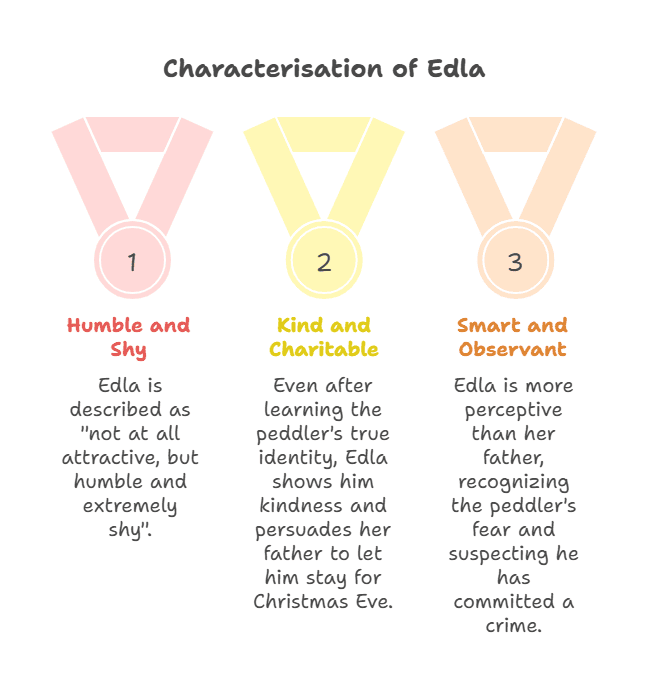
Answer. Edla, despite her doubts about the rattrap seller’s character, wishes to give him a day of rest, peace, and happiness. She is smart and observant, and she can see that the peddler lives in constant fear of being arrested and interrogated. She is an empathetic person and she wants him to be happy for at least one day. She even stands up for the seller against her own father and persuades him to fulfill the promise he made to the peddler. Throughout the day, she takes care of the guest as if he was a dignified man, bringing him delicious food, a comfortable place to sleep, the warmth of a home, and even good, clean clothes. These characteristics invoke a positive change in the peddler, thence contributing to the theme of empathy in The Rattrap.
Top
Question: How can you say that Edla is the best character in this story?
Answer. Edla is the best character in the story “The Rattrap” because of various characteristics. She is described to be not much attractive, but inside, she is humble, shy, smart, observant, a good judge of character, compassionate, generous, and persuasive. She quickly assessed who the guest really was when she first talked to him. She stood up for what she thought, and she used her persuasive powers to convince her father. She is kind and generous without expecting anything back. Her compassionate and helpful nature is so strong that she changed the peddler’s character.
Top
The Rattrap Overview – The potential of kindness and human connection to change even the most hardened and distrustful people is the central topic in Selma Lagerlof’s “The Rattrap.” The narrative chronicles the travels of an elderly vagrant who sells little rattraps. The tramp encounters several individuals along the way who, in spite of their own challenging situations, are kind and generous to him. The tramp reflects on his own life and actions as a result of this encounter, which finally inspires him to make amends and improve himself. The underlying message is that everyone is capable of change and that even the smallest act of kindness can have a big impact on someone else’s life.
Also See :
- CBSE Class 12 English Notes, Lesson Explanation
- CBSE Class 12 English MCQ Question Answers
- Class 12 English Flamingo Book Chapter wise word meanings
- Class 12 English Flamingo Poems Word meanings
- Class 12 English Vistas Book Word meanings
- CBSE Class 12 English Important Question Answers
- Character Sketch of Class 12 English
- Class 12 English Core Previous Year Question Answers (2019-2024) Chapterwise
- Class 12 English Core Previous Year Question Paper with Solutions 2019-2024