
Give a Character Sketch of Gandhi Ji and Rajkumar Shukla from Class 12 English Flamingo Book Chapter 5 Indigo
To understand the Class 12 Board Exam Pattern and Marking Scheme, Click here
Gandhi Ji
Questions related to the Character of Gandhi Ji
- How does the Champaran episode reveal Gandhi’s qualities as a strategist and a fearless leader?
- Beyond the political struggle, how does the lesson highlight Gandhi’s concern for the social and cultural upliftment of the masses?
- Discuss the significance of Gandhi’s refusal to seek help from Charles Freer Andrews in the context of his character.
Rajkumar Shukla
Questions related to the Character of Rajkumar Shukla
Related:
- Indigo Important Question Answers
- Indigo Summary, Explanation, Word meanings
- Indigo MCQs
- Indigo Previous Years Question with Answers
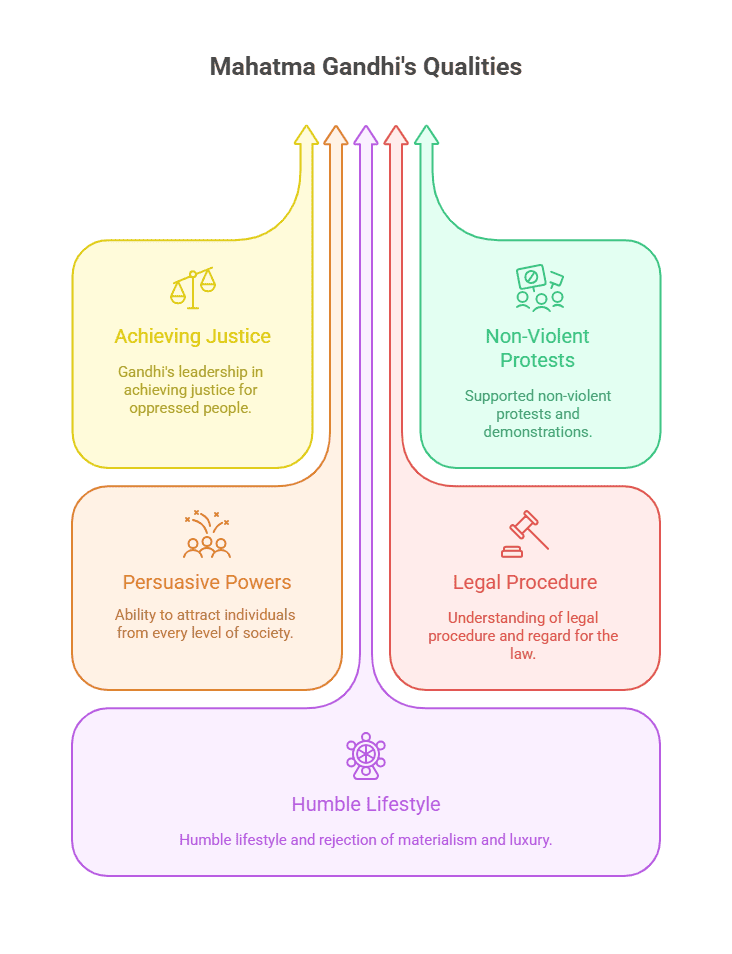
Character Sketch of Gandhi Ji
Finish your entire Class 12 English prep in 24 hrs & ace your CBSE Boards 2026! – Concise chapter summaries (key events & ideas), lesson themes, Visual character sketches using mind maps Click here
Questions related to the character of Mahatma Gandhi
Question: How does the Champaran episode reveal Gandhi’s qualities as a strategist and a fearless leader?
Ans. In Indigo, Gandhi emerges as a leader who combines meticulous fact-finding with unwavering courage.
Initially, he refuses to rely on second-hand information, traveling to Muzaffarpur to brief himself on the ground reality before confronting the British authorities. Throughout the struggle, his fearlessness is evident when he openly disobeys the official order to quit Champaran, choosing to follow the voice of conscience over oppressive laws. He strategically involves local lawyers and organizes the uneducated masses into a disciplined force.
Ultimately, Gandhi proves that leadership is not just about political victory but about the moral strength to challenge an empire through non-violence and truth.

Question. Beyond the political struggle, how does the lesson highlight Gandhi’s concern for the social and cultural upliftment of the masses?
Ans. Gandhi’s character is defined by a holistic vision that looks beyond mere economic settlements to the root of human suffering. While investigating the sharecropping system, he becomes deeply moved by the cultural and social backwardness of the Champaran villages. Instead of leaving after the legal victory, he stays to open primary schools, enlist doctors, and involve his family in teaching personal hygiene and community sanitation. This side of his character shows that he viewed ‘Swaraj’ i.e. Self-rule as an internal evolution of the individual. In conclusion, Gandhi’s humanistic approach proves that true independence is incomplete without dignity, health, and education for the poorest citizen.
Question. Discuss the significance of Gandhi’s refusal to seek help from Charles Freer Andrews in the context of his character.
Ans. The refusal to accept the help of the Englishman Charles Freer Andrews highlights Gandhi’s iron-clad belief in Atmanirbharta or self-reliance. At the beginning of the movement, the lawyers thought having a British ally would be advantageous, but Gandhi viewed this as a sign of psychological weakness. He insisted that the cause was just and that Indians must rely upon their own inner strength to win the battle against inequality. By doing so, he taught his followers that freedom from foreign rule was impossible without first achieving freedom from a dependent mindset. Therefore, his character stands as a beacon of self-sufficiency, ensuring that the victory in Champaran was truly an Indian triumph.
Character Sketch of Rajkumar Shukla
Questions related to the character of Rajkumar Shukla
Question. Give a detailed character sketch of Rajkumar Shukla, highlighting the qualities that led to the Champaran movement.
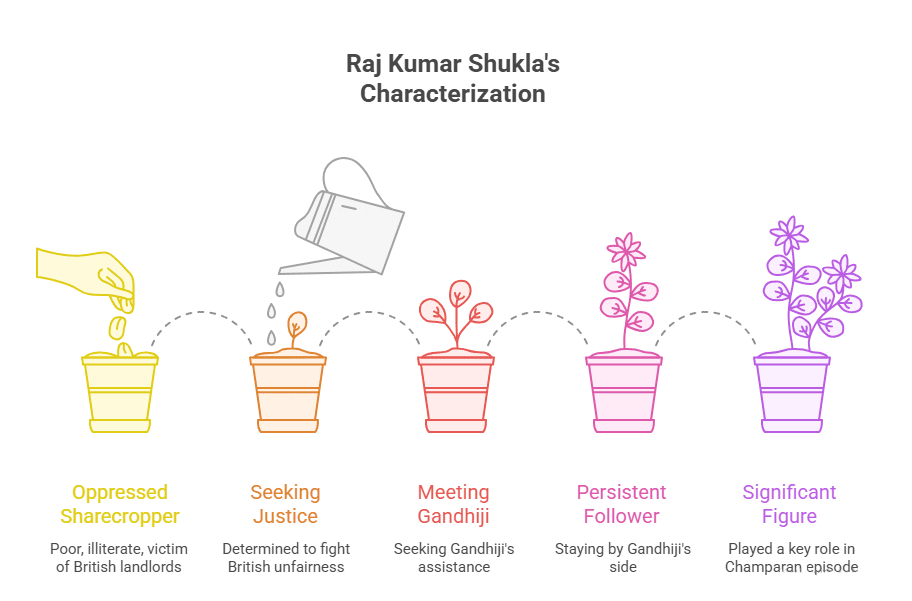
Ans. Rajkumar Shukla was a poor, emaciated, yet resolute sharecropper from Champaran. Though illiterate, he possessed extraordinary tenacity and a strong sense of justice against the oppressive landlord system.
Unlike other peasants who were crushed by fear, Shukla was determined to seek a solution for his people, leading him to the 1916 Congress Convention to seek Gandhi’s help. His persistence was his defining trait; he followed Gandhi from Lucknow to Cawnpore, Ahmedabad, and finally Calcutta, refusing to leave his side for weeks until a date was fixed. His unwavering devotion and patience eventually impressed Gandhi, who agreed to visit Bihar. In conclusion, Rajkumar Shukla was the catalyst of the Champaran movement.
His resolute nature transformed a local agrarian dispute into a national struggle for independence, proving that even an ordinary individual’s determination can change the course of history.
Indigo Overview – The chapter displays the importance of effective leadership in improving the lives of people. The author tells us a few reasons which made Mahatma Gandhiji famous and loved by the masses. He was concerned about the plight of the poor and fought for their rights. He also made efforts to uplift them and taught them self-reliance. The lesson gives us a message that leadership along with empathy are vital for someone to become a people’s person.
Also See :
- CBSE Class 12 English Notes, Lesson Explanation
- CBSE Class 12 English MCQ Question Answers
- Class 12 English Flamingo Book Chapter wise word meaning
- Class 12 English Flamingo Poems Word meaning
- Class 12 English Vistas Book Word meanings
- CBSE Class 12 English Important Question Answers
- Character Sketch of Class 12 English
- Class 12 English Core Previous Year Question Answers (2019-2024) Chapterwise
- Class 12 English Core Previous Year Question Paper with Solutions 2019-2024