

BSEB Class 9 English Chapter 2 Yayati Important Question Answers from English Panorama-I Book
BSEB Class 9 English Yayati Question Answers – Looking for questions and answers for BSEB Class 9 English Panorama-I Book Chapter 2 Yayati? Look no further! Our comprehensive compilation of important questions will help you brush up on your subject knowledge. Practising Class 9 English question answers can significantly improve your performance in the exam. Improve your chances of scoring high marks by exploring Chapter 2 Yayati now. The questions listed below are based on the latest BSEB exam pattern. All the Questions Answers given at the back of the lesson have also been covered.
Related:
BSEB Class 9 English Chapter 2 Yayati Textbook Questions
A. Work in small groups and discuss the following:
1. Which is the golden period of life-childhood, youth or old age? Give reasons for your choice?
Ans. Youth is the golden period of life. This is because youth is the time when beauty, strength, and wisdom are in harmony. It is also the time when a human can have their own money and other resources. It is the time when we can work on our career, develop relationships, and build our future.
2. Why does man want to remain always young?
Ans. People often want to remain young because no one likes to give up their beauty, strength, and mental capacity. Old age means losing beauty, becoming frail and helpless, and always having to rely on others.
B.1.1 Answer the following questions briefly:
1. Who was Emperor Yayati?
Ans. Emperor Yayati was the ancestor of the Pandavas and a powerful ruler. He worshipped the gods and his ancestors. He was famous for being devoted to the welfare of his subjects.
2. How did Yayati become old? Who cursed him?
Ans. Yayati was cursed by Sukracharya for having wronged by his wife, Devayani. The curse made him old prematurely.
3. Was Yayati devoid of sensual desires?
Ans. No, Yayati used to suppress his sensual desires, but he still felt them.
4. What was the reply of his eldest son?
Ans. The eldest son did not want to be mocked by others for being an old man. He asked Yayati to ask his younger sons, who were dearer to him.
5. Why did he become angry?
Ans. Emperor Yayati was angry when four of his five sons refused to take his curse and give him their youth to him.
B. 1.2. Answer the following questions briefly :
1. What are the symptoms of an old man?
Ans. Grey hair, weak body, faltering speech, immobility, and helplessness are the symptoms of an old man.
2. Who was Puru? Did he accept his father’s proposal?
Ans. Puru was Emperor Yayati’s fifth son. Yes, he accepted his father’s proposal because he had been overcome by filial love.
3. Sensual desire is everlasting. Whose thought is this?
Ans. Emperor Yayati was the one who realised that sensual desire is everlasting.
4. Why did Yayati resume his old age?
Ans. Yayati resumed his old age because he realised that sensual desire is everlasting and keeping Puru’s youth will only lead to more indulgence. Indulgence is a ghee to strengthen the fire of sensual desire. Therefore, he decided that he should take back his old age.
5. Do corn, gold, cattle and woman satisfy the desire of a man?
Ans. No amount of corn, gold, cattle and women can satisfy the desire of a man. Indulgence can never quench desire.
B. 1.3. Answer the following questions briefly:
1. What was Yayati famous for?
Ans. Yayati was famous for being a ruler devoted to the welfare of his subjects.
2. Why did Yayati call his sons?
Ans. Yayati called his sons to request them that they take his old age and give him their youth.
3. What did he say to them?
Ans. He begged them to take his old age. He pleaded that he had become old prematurely because of the curse so he could not finish enjoying his youth and fulfilling his sensual desires. He hated being old and having grey hair, a weak body, a faltering speech, immobility, and helplessness.
4. Which son agreed to give Yayati his youth and take his old age?
Ans. Puru, his fifth and youngest son, agreed to give Yayati his youth and take his old age.
5. Why did Yayati go to the garden of Kubera?
Ans. Yayati went to the garden of Kubera to fulfil his sensual desires with an apsara maiden.
C. 1. LONG ANSWER QUESTIONS
1. Why did Yayati become prematurely old? Why did he dislike it?
Ans. Yayati was cursed by Sukracharya because he had wronged Sukracharya’s daughter who happened to be Yayati’s wife, Devayani. Therefore, he became prematurely old. He disliked it because of wrinkles, grey hair, frail body, and low energy. He had suppressed his desires for sensual pleasures when he was young but now his youth had been stolen from him.
2. In order to enjoy the pleasures of youth, Yayati wished to take the youth of one of his sons. Was he right in doing so? Explain with arguments of your own.
Ans. No, he was wrong. Yayati should have accepted the old age that befell him as a curse and should have continued to rule the kingdom properly. Moreover, he should have been a mature father. Asking his sons to give up their youth to him was immature and inconsiderate.
3. Write in your own words the responses of the first three sons to their father’s request.
Ans. The father, Yayati, requested his five sons to give him their youth. The first son refused because he did not want to be mocked by women and servants. The second son was not strong enough to give up his beauty, strength, and wisdom. The third son did not wish to be helpless because old men could not even ride a horse or an elephant.
4. How did the fourth son respond to his father’s appeal? How would you have responded if you were the fourth son?
Ans. The fourth son refused to accept his father’s old age and begged for his forgiveness. The fourth son believed that an old man was pitiful because he had to rely on others to keep his body clean. The fourth son loved his father, but he could not take the curse put on his father.
5. Why did Puru agree to give his youth to his father and take his father’s old age in the bargain? Did he do the right thing?
Ans. Puru could not refuse his father’s demand out of filial love. Therefore, Puru agreed to give his youth to his father and take his father’s old age in the bargain. Yes, he did the right thing because if a parent is begging for something so desperately, a child should go along with a parent’s wishes.
6. Is it right for a father to make such a request to his sons as Yayati did?
Ans. No, it is not right for a father to make such a request to his sons as Yayati did. This is because children should be allowed to enjoy their youth. Parents should be mature and considerate of their children’s youthful energy.
7. Were the four sons justified in refusing their father’s request? If yes, give reasons.
Ans. Yes, the four sons were justified in refusing their father’s request. No child should be expected to give up their own age and youth to their father so that their father can live out their sensual desires and fulfil their own selfish needs.
8. What lesson do you learn from this story?
Ans. The story provides various lessons. The chapter teaches us that the desire for sensual pleasures are always unquenchable. It sheds light on how materialistic and sensual desires can never be fulfilled. A human heart always desires more. Therefore, it is important to control desires and to be satisfied with what you get in life. However, it is also equally necessary to enjoy what you have right now and live in the moment. What one has in the present may or may not be there in the future. Youth should be enjoyed, not always suppressed. The lesson also teaches us to understand the beauty of old age and to accept ageing as a natural process.
C. 2. GROUP DISCUSSION
1. “Elderly people are assets to our nation.” Do you agree? Give reasons.
Ans. Yes, elderly people are valuable assets to our nation. They embody a lifetime of wisdom, experience, and cultural knowledge that guide younger generations through challenges, fostering social cohesion and ethical grounding. Economically, many remain productive, contributing through farming, mentoring, or informal work, while their stories preserve national heritage and inspire innovation. Elderly individuals strengthen family and community bonds by providing childcare, emotional support, and traditional knowledge, reducing societal pressures on working-age populations. In India, their role in the “silver economy” drives opportunities in healthcare, technology, and services tailored for ageing. Nations investing in their integration, such as through digital literacy and community care, unlock long-term growth. Poor health can strain resources by crowding out family labor, yet reforms like accessible healthcare and flexible employment mitigate this, turning potential liabilities into strengths. Prioritizing elderly inclusion ensures sustainable national progress.
C. 3. COMPOSITION
1. Write a paragraph in about 100 words on “Relation between parents and sons”.
Ans. The bond between parents and sons is woven with unconditional love, guidance, and mutual growth. Parents nurture their sons with sacrifices, imparting values, discipline, and life skills to forge resilient and honourable men. Sons, in turn, draw strength from this foundation, navigating challenges with the wisdom inherited from paternal resolve and warmth. Yet, this relation evolves from childhood dependence to adolescent rebellion and finally to adult companionship. Challenges like generational gaps test the bond, but forgiveness and respect sustain it.
Message: Telegram
A telegram is a brief message sent by telegraphy in emergency through Post and Telegraph Department. Since money is charged for each word in the message, only key words are written in such a message. It has lucidity, simplicity and brevity. It is written on a form provided by the Post and Telegraph Department.
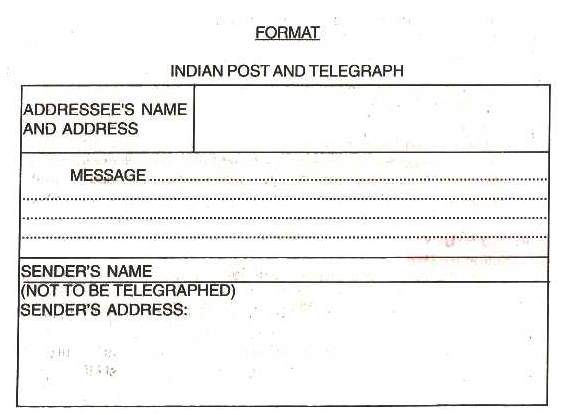
Urgent telegrams are usually delivered in one day while ordinary ones are delivered within two or three days depending on the distance of the addresses.
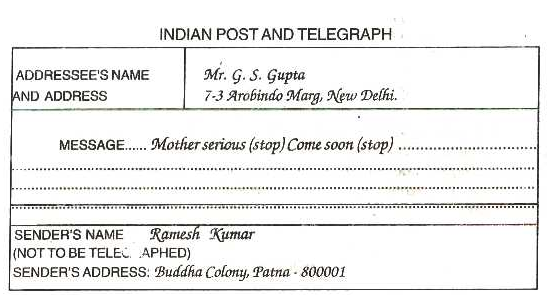
Your mother is seriously ill. Your father is on an official tour. Send a telegram to him in this connection.
Ex. 1. Your friend Amit has passed NTS examination. Send a congratulatory telegram to his parents. Do not use more than 10 words to write the message.
Ans.
Message – Congratulations on Amit’s success in NTS Examination. All the best!
Ex. 2. You were scheduled to reach home from you school hostel on 30th Sept.. But now you will be reaching on 5th October, as you are preoccupied with other businesses. Inform your parents of your programme by telegram.
Ans.
Message – Will get delayed due to work. Reaching by 5 October.
D. WORD STUDY
D.1. Dictionary Use
Ex. 1. Correct the spelling of the following words:
| vigor | pityful | releive | bestouw | induljence |
Ans.
| vigour | pitiful | relieve | bestow | indulgence |
Ex. 2. Look up a dictionary and write two meanings of the following words – the one as used in the lesson and another which is more common.
| defeat | desire | restraint | affection | pleasure |
Ans.
| Word | Meaning (lesson) | Common meaning |
| defeat | An instance of being defeated | To overcome |
| desire | a strong feeling of wanting to have something | A strong wish or want |
| restraint | Something that is under control | The act of imposing control |
| affection | A gentle feeling of fondness | To show a feeling of fondness |
| pleasure | enjoyment | The feeling of being happy or satisfied |
2. Word Formation
Read carefully the following sentences taken from the lesson:
(a) He had five beautiful sons, all virtuous and accomplished.
(b) Yayati, who found himself suddenly an old man, was still haunted by the desire for sensual enjoyment.
In the first sentence the word ‘virtuous‘ is an Adjective which is derived from the word Noun ‘virtue‘. The new word has been made by adding suffix -ous’ to it. Similarly, in the second sentence the word ‘enjoyment‘ is a Noun which is derived from the Verb ‘enjoy’ by adding suffix ‘-ment‘ to it.
Ex. 1. Now, make Adjectives from the following Nouns by using the suffix ‘-ous’, ‘-eous’ or ‘-ious’:
joy, prestige, fame, population, vigour, danger, courage, labour, pity, victory, industry, luxury, merit, spontaneity, continuity, humour
Ans. joyous, prestigious, famous, populous, vigorous, dangerous, courageous, labourious, piteous, victorious, industrious, luxurious, meritorious, spontaneous, continuous, humourous.
Ex. 2. Now make new words from the following Verbs by using the suffix ‘-ment’:
fulfil, attain, enchant, agree, better, settle, retire, require, engage, entertain, adjust, improve.
Ans. fulfilment, attainment, enchantment, agreement, betterment, settlement, retirement, requirement, engagement, entertainment, adjustment, improvement.
3. Word-Meaning
Ex. 1. Find out from the lesson the words the meanings of which have been given in Column A. The last few letters of each word have been given in Column B:
| A | B |
| morally good | ………..uous |
| painful feeling | …………usly |
| people from whom one is descended | …………tors |
| respected deeply | ………….rated |
| command | …………ding |
Ans.
| A | B |
| morally good | virtuous |
| painful feeling | piteously |
| people from whom one is descended | ancestors |
| respected deeply | venerated |
| command | pleading |
Ex. 2. Fill in the blanks with words given below:
| wrinkle | consent | prematurely | curse |
| virtuous | mocked | maiden | bidding |
1. I finally gave my………….to my father’s proposal.
2. I saw a ……………..standing at the gate of my school.
3. We should not ……….. anyone.
4. Hе………. me and I became angry.
5. Your face is covered with…….Are you getting old?
6. The patient died……….
7. ……….men will go to the heaven.
8. Excuse me, I am not at your……. .
Ans.
1. I finally gave my consent to my father’s proposal.
2. I saw a maiden standing at the gate of my school.
3. We should not curse anyone.
4. Hе mocked me and I became angry.
5. Your face is covered with wrinkle. Are you getting old?
6. The patient died prematurely
7. Virtuous men will go to the heaven.
8. Excuse me, I am not at your bidding .
4. Phrases
Ex. 1. Read the lesson carefully and find out the sentences in which the following phrases have been used. Then use these phrases in sentences of your own:
| have had | fill of | by no means | take upon oneself |
| take up | give back | in due course |
Ans.
| phrase | Sentence from lesson | sentence |
| Have had | I have not had my fill of the joys of life | This is enough! I have had a lot of nonsense from you. |
| Fill of | I have not had my fill of the joys of life | I’m done. I have had my fill of snacks. |
| By no means | The fourth son begged to be forgiven, as this was a thing he could by no means consent to. | By no means can I accept such disrespectful behaviour. |
| Take upon oneself | O great king, women and servants will mock at me if I were to take upon myself your old age. | You have to take upon yourself the responsibility to submit the task in time. |
| Take up | Father, you ask me to take up old age which destroys not only strength and beauty but also-as I see-wisdom. | Please wait, I will take up your matter soon. |
| Give back | He even promised to give back their youth after some time and they could rule his kingdom in return. | As responsible citizens, we are bound to give back to the society. |
| In due course | He spent his time there in austerities and in due course attained heaven. | In due course of time, you will understand the working of the organization. |
E. GRAMMAR
Sequence of Tenses
The principle of the Sequence of Tenses is that the tense of the Verb in a Subordinate Clause follows the tense of the verb in the Principal Clause.
There are two main rules with regard to the sequence of tenses.
(1) If the Verb in the Principal Clause is in the Present or Future Tense, the Verb in the Subordinate Clause may be in any tense, according to the sense needed to express.
| I know or I shall know |
what he does. |
| what he is doing. | |
| what he has done. | |
| what he has been doing. | |
| what he did. | |
| what he was doing. | |
| what he had done. | |
| what he had been doing. | |
| what he will do. | |
| what he will be doing. | |
| what he will have done. |
(2) If the Verb in the Principal Clause is in the Past Tense, the Verb in the Subordinate Clause must also be in the Past Tense; e.g.
I knew what he was doing.
He worked hard so that he might succeed.
(3) However, there are some exceptions to this rule:
(i) If the Verb in the Subordinate Clause expresses some universal truth or habitual fact, it is always in the Present Tense, even if the Verb in the Principal Clause is in the Past Tense; e.g.
The teacher said that the earth is round.
He said that man is mortal.
(ii) If the Verb in the Subordinate Clause is introduced by the Conjunction ‘than’ the Verb of the Subordinate Clause may be in any tense, even though there is Past Tense in the Principal Clause; e.g.
He liked her better than he likes you.
They helped us more than they help their own children.
(iii) If the Subordinate Clause is an Adverbial Clause of place or reason, it may be in any tense according to the sense implied; e.g.
He failed because he has poor health.
We must remember that the Conjunction ‘lest’ is always followed by’should’; e.g.
He worked hard lest he should fail.
(4) The conjunction ‘as if’ and ‘as though’ always take ‘were’ or V² (i.e; Past Form of a Verb) in the subordinate clause, whatever the tense of the Principal Clause may be; e.g;
He speaks as if he were mad.
He speaks as if he knew everything.
He fought as though he were a tiger.
G. TRANSLATION
Translate the following sentences into Hindi /your mother tongue.
1. Rajeev was going to market when it started raining.
2. Seema is cooking food now.
3. When the doorbell rang, Abhinav was working on his homework.
4. Sita is trying to go abroad for studies.
5. Does he want to go to market with his mother?
6. Mr. Shah is going out for fishing with his son today.
7. Aashu is a naughty boy, isn’t he?
8. Oh! What a hot day it is!
9. To err is human; to forgive is divine.
10. Were you ready to come and play with me?
11. Sita said, “I am feeling hungry.”
12. Rajeev told Mira that he was going out of town during the summer vacation.
Ans.
1. जब बारिश शुरू हुई , राजिव मार्किट जा रहा था।
2. अब सीमा खाना पका रही है।
3. जब दरवाज़े की घंटी बजी, अभिनव अपने गृहकार्य पे काम कर रहा था।
4. सीता पढ़ाई के लिए विदेश जाने की कोशिश कर रही है।
5. क्या वह अपनी माँ के साथ बाज़ार जाना चाहता है ?
6. आज श्रीमान शाह अपने पुत्र के साथ मछली पकड़ने बहार जा रहे हैं।
7. आशु एक शरती बच्चा है, है न ?
8. ओह ! आज कितनी गर्मी है!
9. गलती करना मानवीय है , माफ़ करना ईश्वरीय है।
10. क्या तुम आके मेरे साथ खेलने के लिए तैयार थे ?
11. सीता ने कहा, “मुझे भूक लग रही है। ”
12. राजीव ने मीरा से कहा कि वह गर्मी की छुटियों में शहर से बाहर जा रहा है।
Bihar Board Class 9 English Chapter 2 Yayati Extra Question and Answers
Extract-Based questions
A. Emperor Yayati was one of the ancestors of the Pandavas. He had never known defeat. He followed the dictates of the sastras, adored the gods and venerated his ancestors with intense devotion. He became famous as a ruler devoted to the welfare of his subjects.
He became prematurely old by the curse of Sukracharya for having wronged his wife Devayani. In the words of the poet of the Mahabharata: “Yayati attained that old age which destroys beauty and brings on miseries.” It is needless to describe the misery of vigorous youth suddenly blighted into age, where the horrors of loss are accentuated by pangs of recollection.
Q1. Who was the ancestor of the Pandavas?
Ans. Emperor Yayati
Q2. Who cursed Yayati?
Ans. Sukracharya
Q3. Why was Yayati cursed?
Ans. He had wronged his wife, Devayani.
Q4. How does the Mahabharata describe the curse?
Ans. It says that the curse was such that it destroyed his beauty and brought misery.
Q5. ‘Blighted’ means __________
Ans. a thing that damages something.
B. Yayati, who found himself suddenly an old man, was still haunted by the desire for sensual enjoyment. He had five beautiful sons, all virtuous and accomplished. Yayati called them and appealed piteously to their affection: “The curse of your grandfather Sukracharya has made me unexpectedly and prematurely old. I have not had my fill of the joys of life; for not knowing what was in store for me. I lived a life of restraint, denying myself even lawful pleasures. One of you ought to bear the burden of my old age and give his youth in return. He who agrees to this and bestows his youth on me will be the ruler of my kingdom. I desire to enjoy life in the full vigour of youth.”
Q1. What haunted Yayati?
Ans. He was haunted by the desire for sensual enjoyment.
Q2. How many sons did Yayati have?
Ans. He had five sons.
Q3. How was Sukracharya related to Yayati’s sons?
Ans. Sukracharya was the grandfather of Yayati’s sons.
Q4. Yayati appealed to his sons to _______________
Ans. exchange Yayati’s old age for his kingdom in return.
Q5. What was Yayati’s desire?
Ans. He wanted to enjoy life in the full vigour of youth.
C. He first asked his eldest son to do his bidding. That son replied: “O great king, women and servants will mock at me if I were to take upon myself your old age. I cannot do so. Ask of my younger brothers who are dearer to you than myself.”
When the second son was asked, he gently refused with the word: “Father, you ask me to take up old age which destroys not only strength and beauty but also-as I see-wisdom. I am not strong enough to do so.”
Q1. What reply did the eldest son give?
Ans. He replied that women and servants would laugh at him if he would take his old age.
Q2. The eldest son felt that the younger brothers were _________ to Yayati than him.
Ans. dearer
Q3. What was the manner of refusal used by the second son?
Ans. He was gentle in his refusal.
Q4. According to the second son, old age destroys ________, ________ and _________.
Ans. strength, beauty and wisdom.
Q5. Did the second son accept the father’s request?
Ans. No, he did not accept it.
D. The king grew angry when he saw that his three sons had declined to do as he wished. He hoped for better from his fourth son, to whom he said, “You should take up my old age. If you exchange your youth with me, I shall give it back to you after some time and take back the old age with which I have been cursed.”
The fourth son begged to be forgiven, as this was a thing he could by no means consent to. An old man has to seek the help of others even to keep his body clean, a most pitiful plight. No, much as he loved his father, could not do it.
Q1. How did the king react to refusal by the sons?
Ans. He grew angry.
Q2. How did the fourth son react to his father’s plea?
Ans. He also refused his request.
Q3. What was the fourth son’s argument?
Ans. He said that an old man has to take help even to keep his body clean which was a pitiful sight.
Q4. Did the fourth son love his father?
Ans. Yes, he loved him.
Q5. What was Yayati’s proposal to his fourth son?
Ans. He proposed to exchange youth for some time after which he would return it back.
Multiple Choice Questions (MCQs)
Q1. Yayati was the ancestor of __________
A. Aryans
B. Pandavas
C. Kauravas
D. None of these
Ans. B. Pandavas
Q2. Who cursed Yayati?
A. Devyani
B. Pandavas
C. Sukracharya
D. All of these
Ans. C. Sukracharya
Q3. How was Devyani related to Yayati?
A. mother
B. sister
C. wife
D. mistress
Ans. C. wife
Q4. How many sons did Yayati have?
A. none
B. 5
C. 4
D. 6
Ans. B. 5
Q5. Yayati had wronged _______
A. his wife
B. his sons
C. Sukracharya
D. his people
Ans. A. his wife
Q6. What did Yayati want?
A. riches
B. sensual enjoyment
C. big kingdom
D. all of these
Ans. B. sensual enjoyment
Q7. Yayati requested ____ to exchange his old age.
A. his people
B. his sons
C. his grandson
D. his father
Ans. B. his sons
Q8. Who was Yayati’s youngest son?
A. Kuru
B. Puru
C. Guru
D. All of these
Ans. B. Puru
Q9. How did Yayati feel when his three sons refused his request?
A. he was sad
B. he was annoyed
C. he was happy
D. none of these
Ans. B. He was annoyed
Q10. After the refusal by four sons, Yayati was struck with _________
A. sorrow
B. hatred
C. anger
D. repentance
Ans. A. sorrow
Q11. Supplicated means-
A. ordered
B. addressed humbly
C. begged
D. none of these
Ans. B. addressed humbly
Q12. Yayati promised to give _______ in return for youth.
A. kingdom
B. wealth
C. family
D. all of these
Ans. A. kingdom
Q13. Yayati was a ________
A. farmer
B. king
C. courtier
D. poor man
Ans. B. king
Q14. Who said that old age destroys strength, beauty and even wisdom?
A. First son
B. second son
C. third son
D. no one
Ans. B. second son
Q15. Who agreed to Yayati’s request?
A. First son
B. fifth son
C. third son
D. second son
Ans. B. fifth son
Q16. What reply did the third son give?
A. begged for forgiveness because he could not accept the father’s wish
B. he was glad to give his youth to his father in return for his old age
C. did not want to be mocked by women and servants
D. An old man cannot ride a horse or an elephant. His speech will falter.
Ans. D. An old man cannot ride a horse or an elephant. His speech will falter.
Q17. Yayati gained fame as a ruler because-
A. increased his territory far and wide
B. ensured the welfare of his subjects
C. held regular free food services
D. distributed sweets and clothes
Ans. B. ensured the welfare of his subjects
Q18. Identify the ancient text that gives information about Yayati.
A. Ramayana
B. Mahabharata
C. Purana
D. Veda
Ans. B. Mahabharata
Q19. Yayati had treated _______ unfairly.
A. sons
B. Devyani
C. Sukracharya
D. subjects
Ans. B. Devyani
Q20. How was Sukracharya related to Yayati’s sons?
A. friend
B. teacher
C. grandfather
D. uncle
Ans. C. grandfather
Extra Questions
Answer the following questions-
Q1. Describe the curse on Yayati.
Ans. Yayati treated his wife Devyani unfairly. In response, her father Sukracharya cursed him into old age. Yayati was then disabled from enjoying sensual pleasures which saddened him.
Q2. What did Yayati do in an attempt to reverse the curse?
Ans. He requested his five sons to exchange his old age for their youth. He was willing to give them his kingdom in return.
Q3. Who accepted Yayati’s offer?
Ans. Yayati’s youngest son, Puru accepted the father’s proposal. Thus, Puru took his father’s old age and became the king.
Q4. What did Yayati realize?
Ans. Yayati got youth and enjoyed with a maiden in the garden of Kubera. He realized that sensual desire can never be satisfied by enjoying it. Human nature always asks for more and the only way to peace was by strengthening his mind.
Q5. What did Yayati do after taking back his old age from Puru?
Ans. He retired to the forests and handed over the kingdom to Puru. In the forest he lived a simple life and attained heaven after his death.