
PSEB Class 10 English Chapter 5 Some Glimpses of Ancient Indian Thought and Practices Important Question Answers from English Main Course Book
PSEB Class 10 English Some Glimpses of Ancient Indian Thought and Practices Question Answers – Looking for questions and answers for PSEB Class 10 English Main Course Book Chapter 5 Some Glimpses of Ancient Indian Thought and Practices? Look no further! Our comprehensive compilation of important questions will help you brush up on your subject knowledge. Practising Class 10 English question answers can significantly improve your performance in the exam. Improve your chances of scoring high marks by exploring Chapter 5 Some Glimpses of Ancient Indian Thought and Practices now. The questions listed below are based on the latest PSEB exam pattern. All the Questions Answers given at the back of the lesson have also been covered.
- Some Glimpses of Ancient Indian Thought and Practices Textbook Questions
- Some Glimpses of Ancient Indian Thought and Practices Extra Question Answers
Related:
PSEB Class 10 English Chapter 5 Some Glimpses of Ancient Indian Thought and Practices Textbook Questions
1. Comprehension Questions
(i) Answer the following questions:
1. What caused desperation to the gods?
Ans. The gods were losing a war against the demons, which could have been devastating for mankind. Therefore, they were desperate to find a way to conquer the demons.

2. Who did the gods go to in desperation?
Ans. The gods went to Lord Vishnu in desperation.
3. What did the Lord advise them?
Ans. Lord Vishnu advised them to use the bones of a great sage to make the invincible weapon, Thunderbolt, or Vajarpatt.
4. What was the sacrifice of Saint Dadhichi?
Ans. Saint Dadhichi sacrificed himself so that the gods could use his bones to create the Vajarpatt to defeat the demons.
5. What is the real spirit behind the yajnas performed in our homes?
Ans. ‘Idam Naa mam’ (This does not belong to me) is the real spirit behind the yajanas performed in our homes.
6. What does the tradition of feeding birds and animals prove?
Ans. The tradition of feeding birds and animals proves that the duty of charity and sharing food with all life forms has been embedded in us since ancient times.
7. Why did some scholars laugh at Ashtavakara?
Ans. Some scholars laughed at Ashtavakara because they did not think someone with a deformed body could engage in a discussion of high philosophy.
8. How did Ashtavakara react?
Ans. Ashtavakara was furious at the humiliation. He went to the King and complained that he could not engage in a discussion with people who judged others’ intelligence and status based on their physical appearance.
9. What did Vivekananda say to the lady who laughed at his simple dress?
Ans. Swami Vivekananda told the lady who laughed at his simple dress that in India, the tailor does not make a person’s worth. A person’s worth is decided by the qualities present inside the person, which constitutes the person’s intrinsic worth.
10. What was the status of women in ancient India?
Ans. Women in ancient India were seen as a devi or goddess, a Kanjak or a young, unmarried girl child fit to be worshipped, the mother of mankind, the ardhangini, the inseparable but equal wheel of the rathá or chariot of life.
11. Why did Shivaji bow his head before the woman who was brought to him as a gift?
Ans. Shivaji bowed his head before the woman who was brought to him as a gift to restore her dignity as a mother and woman.
12. Why, according to you, were the wars fought in the Mahabharata and Ramayana sacred?
Ans. The wars fought in the Mahabharata and Ramayana were sacred because they were fought for matrishakti, or motherhood.
13. What does Lord Rama’s meeting with a Bheel woman and eating the tasted berries show?
Ans. A Bheel woman is a Shudrá woman who used to sprinkle water on the earth with the help of a leather bag. Lord Rama ate the berries from her, showing that ancient India did not differentiate people based on caste and creed.
(ii) Answer the following questions in about 50 words each:
1. Why, according to the author, should those people be ashamed of themselves who believe in female foeticide?
Ans. People who believe in female foeticide should be ashamed of themselves. Indian ancient philosophy does not see females as objects of sex or as a lower gender. Women are auspicious and powerful and need to be respected and worshipped as goddesses.
2. How does the author support the idea of the victory of the good over the evil?
Ans. The author supports the idea of the victory of the good over the evil by displaying examples from the mythological texts of Mahabharata and Guru Gobind Singh. In Mahabharata, Sage Dadhichi sacrifices himself so that the gods can make an invincible weapon out of his bones. Guru Gobind Singh’s sons were willing to be bricked away to uphold their ideals and beliefs. All these sacrifices are made for the victory of the good over the evil.
3. What is the basic difference between the position of women in society in the ancient times and now?
Ans. Women in ancient India were seen as a devi or goddess, a Kanjak or a young, unmarried girl child fit to be worshipped, the mother of mankind, the ardhangini, the inseparable but equal wheel of the rathá or chariot of life. However, now women are seen as objects of lust and sex.
4. What does the practice of ‘langar’ stand for? Explain.
Ans. The practice of ‘langar’ is based on ‘Vasudhev Kutumbukam’ in temples, and ‘Wand chhako’ in gurudwaras. ‘Vasudhev Kutumbukam’ means that the entire Universe is one family. ‘Wand chhako’ means eating only after you have shared your meal with others.
5. Give an example to prove that in ancient India, there was no discrimination on the basis of caste.
Ans. In ancient India, there was no discrimination on the basis of caste. This can be seen from the instance of Lord Rama eating berries from a Bheel woman. A Bheel woman is a Shudrá woman who used to sprinkle water on the earth with the help of a leather bag. A god did not hesitate to take food from someone who was from the lower caste.
B. Vocabulary Exercises
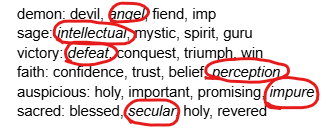
(i) Pick out the odd word which is not a synonym of the word given in italics in each set and put a circle around it.
demon: devil, angel, fiend, imp
sage: intellectual, mystic, spirit, guru
victory: defeat, conquest, triumph, win
faith: confidence, trust, belief, perception
auspicious: holy, important, promising, impure
sacred: blessed, secular, holy, revered
Ans.
(ii) Add prefixes to the given words to form their antonyms:
| easy | available | respect | justice |
| wise | auspicious | proper | separable |
| guide | equal | honour | sufficient |
Ans.
| uneasy | unavailable | disrespect | injustice |
| unwise | inauspicious | improper | inseparable |
| misguide | unequal | dishonour | insufficient |
(iii) Look at the following sentences :
1. This idea of distribution applies not to food only; it extends well up to the entire resources and funds that are available to man.
2. “Madam, in your country, it is the tailor who makes a man; in my country it is the intrinsic worth and character of a person that make him or her great.”
3. This only proves that a woman in this great land was never looked upon as an object of lust or sex; she was always considered a devi.
Do you notice the semicolon (;) in these sentences? When two independent clauses are linked without any conjunction between them; a semicolon is inserted. We use a comma after the first independent clause when we link two independent clauses with one of the following coordinating conjunctions:
and, but, for, or, nor, so, yet. For example:
I am going home, and I intend to stay there. (comma)
I am going home; I intend to stay there. (semi colon)
Each of the following sentences needs either a comma or a semicolon. Choose the correct punctuation mark:
1. Satish has given up smoking about five times ……… but he cannot break the habit.
2. Our dog seems to have a built-in alarm clock …………. he wakes us up at exactly the same time every morning.
3. The passengers on the plane were alarmed ……..… but the pilot and the crew kept their calm.
4. I realized at once that something was wrong ……….. I was not, however, the only person who was concerned.
5. I had to complete the assignment by Sunday……….. otherwise, I would have failed the course.
6. Ram decided to be a doctor ……….. but he changed his mind after he heard of the fees of the medical college.
7. I finished reading Freedom At Midnight …. and then I went to bed.
8. The air was beautifully clear ………… it was a lovely day.
Ans.
1. Satish has given up smoking about five times, but he cannot break the habit.
2. Our dog seems to have a built-in alarm clock; he wakes us up at exactly the same time every morning.
3. The passengers on the plane were alarmed, but the pilot and the crew kept their calm.
4. I realized at once that something was wrong; I was not, however, the only person who was concerned.
5. I had to complete the assignment by Sunday; otherwise, I would have failed the course.
6. Ram decided to be a doctor, but he changed his mind after he heard of the fees of the medical college.
7. I finished reading Freedom at Midnight, and then I went to bed.
8. The air was beautifully clear; it was a lovely day.
C. Grammar Exercises
(i) Fill in the blanks using the modals might, should or must :
1. Your friend said you didn’t need to buy her anything for her birthday, but (insistence) you ………. at least get her some flowers.
2. Anju said she was really busy this week, but I think she …….. show up at the party if she doesn’t have to work overtime.
3. My husband said he would come over right after work, so he ………. be here by 6:00.
4. Don’t move her. She …….. be having some internal injuries because of the accident.
5. You ………. be joking!
6. Your trip to Europe ………. have been absolutely fascinating!
7. You ……… not worry so much. Your father will be all right.
8. The doctor says that you ……… use gloves to avoid skin irritations.
9. Your shopping at The Mall ……… cost you a fortune.
Ans.
1. Your friend said you didn’t need to buy her anything for her birthday, but you must at least get her some flowers.
2. Anju said she was really busy this week, but I think she might show up at the party if she doesn’t have to work overtime.
3. My husband said he would come over right after work, so he should be here by 6:00.
4. Don’t move her. She might be having some internal injuries because of the accident.
5. You must be joking!
6. Your trip to Europe must have been absolutely fascinating!
7. You should not worry so much. Your father will be all right.
8. The doctor says that you should use gloves to avoid skin irritations.
9. Your shopping at the mall might cost you a fortune.
(ii) Choose the correct preposition :
1. He swore ………. God that he was innocent. (by/in)
2. It was a fight …….. the gods and the demons. (in/between)
3. They live ………. the same roof. (below/under)
4. They will do it ……… pleasure. (with/in)
5. Divide the food …… the two boys.(between/among)
6. There is no truth ……. what she just said. (in/about)
7. She stood leaning .. the wall. (on/against)
8. She pushed the letter ………. the door. (under/below)
9. The boys ran …… the road.(across/through)
10. Climb …… the tree to get the mangoes. (on/up)
Ans.
1. He swore by God that he was innocent.
2. It was a fight between the gods and the demons.
3. They live under the same roof.
4. They will do it with pleasure.
5. Divide the food between the two boys.
6. There is no truth in what she just said.
7. She stood leaning against the wall.
8. She pushed the letter under the door.
9. The boys ran across the road.
10. Climb up the tree to get the mangoes.
(iii) Fill in the blanks with the suitable articles:
Once upon …… time there was ……. old woman who lived in …… little house. She had in her garden ……… bed of beautiful striped tulips. One night she was awakened by ….. sounds of sweet singing of birds and the sound of some babies laughing. She looked out of ………. window. The sounds seemed to come from ……. tulip bed, but she could see nothing. …….. next morning. She walked among her flowers, but there were no signs of anyone having been there …….. night before. On ……. following night she was again awakened by the same sounds. She rose and stole softly through her garden. The moon was shining brightly on ……. tulip bed, and …… flowers were swaying to and fro. ……… old woman looked closely and saw, standing by each tulip, ………. little Fair mother who was crooning and rocking the flower like ………. cradle, while in each tulip cup lay ……. Little Fairy baby laughing and playing. …….. good old woman stole quietly back to her house, and from that time on she never picked ……… tulip, nor did she allow her neighbours to touch ……. flowers.
Ans. Once upon a time there was an old woman who lived in a little house. She had in her garden a bed of beautiful striped tulips. One night she was awakened by the sounds of sweet singing of birds and the sound of some babies laughing. She looked out of the window. The sounds seemed to come from the tulip bed, but she could see nothing the next morning. She walked among her flowers, but there were no signs of anyone having been there the night before. On the following night she was again awakened by the same sounds. She rose and stole softly through her garden. The moon was shining brightly on the tulip bed, and the flowers were swaying to and fro. The old woman looked closely and saw, standing by each tulip, the little Fair mother who was crooning and rocking the flower like a cradle, while in each tulip cup lay a little fairy baby laughing and playing. The good old woman stole quietly back to her house, and from that time on she never picked a tulip, nor did she allow her neighbours to touch the flowers.
D. Pronunciation Practice
Check up the pronunciation of the following words in the dictionary and say them aloud:
| sauce | clerk | debris |
| yak | swan | chew |
| butcher | ballet | demon |
| monk | yacht | example |
| canal | balcony | thoroughly |
Don’t you think you should learn some phonetic symbols to be able to read the correct pronunciation of words from the dictionary?
Ans.
| /sɔːs/ | /klɑːk/ | /deɪbriː/ |
| /jak/ | /swɒn/ | /tʃuː/ |
| /ˈbʊtʃə/ | /ˈbaleɪ/ | /ˈdiːmən/ |
| /mʌŋk/ | /jɒt/ | /ɛɡˈzɑːmpl/ |
| /kəˈnal/ | /ˈbalkəni/ | /ˈθʌrəli/ |
E. Creative Writing and Extended Reading
2. Write a paragraph on any one of the following :
i. Importance of Charity in Life.
ii. Status of Women in Ancient India.
iii. The Idea of the World Being a Big Family.
Ans.
i. Charity is important because it helps people who lack food, clothes, or homes. It makes life better for the poor and builds a kinder world. When we give, we show care and reduce suffering from hunger or illness. Charity also teaches us to share and feel happy by helping others. It joins communities together, teaches kids to share, and makes the world fairer for all. Giving makes the giver feel happy and teaches empathy. In ancient India, langars are a form of charity. “Wand chhako” in gurudwaras teaches people to feed others and then feed themselves. Charity helps create a fair and supportive world where everyone has a chance to live well. Small gifts can start big changes that last a long time.
ii. In ancient India, women enjoyed high status during the early Vedic period (2500-1500 BC), with equal rights to education, property, and participation in religious rituals and assemblies like Sabha and Samiti. They were revered as mothers and partners, studying sacred texts and engaging in public life freely. They were given different high status titles like Devi, Kanjak, and Ardhangini. However, from the later Vedic period (1500 BC onward), their position declined sharply due to practices like child marriage, restrictions on movement, loss of inheritance rights, and dependence on male guardians. It led to the present social inferiority, with women and girls being seen simply as objects for sex and lust.
iii. The idea of the world being a big family, known as “Vasudhava Kutumbakam” in Sanskrit, comes from ancient Indian texts like the Maha Upanishad. It means all people, creatures, and the earth form one family, promoting unity beyond borders of nation, religion, or culture. This philosophy teaches compassion, sharing, and mutual care to end divisions caused by narrow thinking. It encourages seeing everyone as relatives, fostering peace, empathy, and global harmony in daily life.
3. India is said to be a country of rich values and noble thoughts. How? Discuss.
Ans. India is said to be a country of rich values and noble thoughts. India values renunciation for victory of good over evil. The nation has long since upheld charity, unconditional kindness, and non-discrimination on any grounds. It has always favoured selflessness. Indian ethos and philosophy prefers intrinsic worth over outer beauty. It gives equal respect and admiration to women, describing them as inseparable and equal partner of man.
5. Relate, in your own words, any 2 stories from your study of the ancient Indian scriptures that convey the ideas of sacrifice, renunciation and charity.
Ans. 1. Gautama Buddha was born as Prince Siddhartha and enjoyed royal life until one day, he saw four sights of pain which led him to renounce the royal life. He went in search of the truth of life and meditated under a Bodhi tree till he got enlightenment. Then he came to be known as Buddha or the enlightened one and went on to spread the truth to his disciples.
2. In the Mahabharata, we come across the character of Bhishma Pitamah who vowed not to marry or have a family so that the queen’s sons could ascend the throne. He maintained his devotion to the throne of Hastinapur all his life.
Punjab Board Class 10 English Chapter 5 Some Glimpses of Ancient Indian Thought and Practices Extra Question and Answers
Extract-Based questions
A. In a fight between the demons and the gods once, the demons were having an upper hand. In desperation and anxiety, the gods went to Lord Vishnu to find out as to how they could vanquish the demons. The Lord advised them to get a mighty sword (a thunderbolt, Vajarpatt) prepared from the bones of some great sage. Accordingly, the gods approached the sage Dadhichi, a great saint. Dadhichi took no time in laying down his life so that his bones could be made into an invincible weapon (amoghastra). This victory of the good over evil is the rarest of the rare examples of great renunciation and sacrifice that this culture teaches. Who can forget the supreme sacrifice of the young sons of Sri Guru Gobind Singh ? They chose to be bricked alive for the sake of their faith and the canons of justice and true liberty. Our philosophy and thought teach us to renounce, to sacrifice, to give away in charity in the real spirit of detachment. ‘Idam Naa mam’ (This does not belong to me) is the real spirit behind yajnas we are called upon to perform frequently in our homes. Should corruption, greed and lust for easy money have any place in a country rich with such noble and lofty traditions?
Q1. Which great saint laid down his life for the gods?
Ans. Saint Dadhichi laid down his life for the gods’ victory over the demons.
Q2. What was the name of the invincible weapon?
Ans. The name of the invincible weapon was thunderbolt or Vajarpatt.
Q3. Which part of sage Dadhichi were used to make amoghastra?
Ans. His bones were used to make amoghastra.
Q4. What does ‘Idam Naa mam’ mean?
Ans. ‘Idam Naa mam’ means that “this does not belong to me”.
Q5. Do we see the thought of renunciation and sacrifice in today’s India?
Ans. No, today’s India is consumed by corruption, greed, and lust.
B. Once, the story goes, king Janaka of Maithil (present Bihar) called a meeting of the scholars to discuss some ticklish issue based on high philosophic thought. A well-known sage named Ashtavakara (so called because of his deformed body) was also invited to this meeting. As Ashtavakara entered the portals of the palace hall and walked up the passage, some scholars already present there burst into a derisive laughter. How could such a deformed and misshapen person discuss high philosophy, they felt. Ashtavakara thundered back to the King.” O King ! I feel ashamed of being invited to this assembly of skinners (a person who deals in animal skins ; charamkar). It is only a skinner who measures intelligence or status of a person from his skin or physical looks or the colour and shape of his skin or body.”
Q1. What was the name of the ruler of Maithil?
Ans. King Janaka was the ruler of Maithil.
Q2. What was the name of the deformed but wise sage who was invited to the discussion?
Ans. The name of the deformed but wise sage who was invited to the discussion was Ashtavakara.
Q3. Who is a skinner?
Ans. A skinner is a person who deals in animal skins.
Q4. Which word in the extract is the opposite of ‘uplifting’?
Ans. ‘Derisive’ is the opposite of ‘uplifting’.
Q5. Why did Ashtavakara thunder back to the King?
Ans. Ashtavakara was angered by the scholars’ unfair judgment of his intelligence. He angrily went to the King to stand up for himself. He was ashamed that the scholars were discriminating him based on his physical appearance.
C. This put the entire assembly to shame and brought them to their knees to beg pardon of this great saint. Colour of the skin or shape of the body has never been a measure of intelligence or status in this country. Lord Rama’s eating of the tasted berries from a Bheel woman (a Shudrá woman who used to sprinkle water on the earth with the help of a leather bag) is a sufficient proof of the fact that there was never any discrimination on the basis of caste, creed or profession of a person in ancient India. One is here also reminded of what the enlightened sage, Swami Vivekananda said to a lady in America who laughed at his ‘simple’ dress : “Madam, in your country, it is the tailor who makes a man; in my country it is the intrinsic worth and character of a person that make him or her great.”
Q1. What does the given extract prove?
Ans. The extract proves that there was no discrimination based on caste, creed, or profession in ancient India.
Q2. What brought the assembly of scholars to shame?
Ans. Sage Ashtavakara’s anger towards the scholar’s discrimination based on his deformed body made the assembly of scholars realize that they wrongly judged the great saint. This made the assembly of scholars ashamed of themselves.
Q3. What kind of discrimination would a Bheel woman normally face?
Ans. A Bheel woman would face discrimination on the basis of caste.
Q4. Why did the lady in America laugh at Swami Vivekananda?
Ans. The lady in America laughed at Swami Vivekananda because of his simple dress.
Q5. What does ‘intrinsic’ mean?
Ans. ‘Intrinsic’ means something that is inside someone or something.
D. The history of this great land is full of examples where no auspicious function was considered to be held properly without the participation of women. So much so, that if no woman could somehow make it to the function, a statue of the woman was created to mark her auspicious presence*. This only proves that a woman in this great land was never looked upon as an object of lust or sex; she was always considered a devi (goddess) , a Kanjak (a young, unmarried girl child fit to be worshipped), the mother of mankind, the ardhangini, the inseparable but equal wheel of the rathá (chariot) of life.
Q1. What was the importance of women in functions in ancient times?
Ans. Women were considered as a symbol of luck and prosperity in functions in ancient India.
Q2. What happened when no women could attend the functions?
Ans. If no woman could attend the function, a statue of the woman was set up to mark her auspicious presence
Q3. How is a woman seen as today?
Ans. Woman is now seen as an object of lust and sex today.
Q4. What is the meaning of ‘ardhangini’?
Ans. Ardhangini is a life partner who is described as the ‘better-half’.
Q5. Who is a Kanjak?
Ans. Kanjak is a young, unmarried girl child fit to be worshipped.
Multiple Choice Questions (MCQs)
Q1. At what occasion was Goddess Sita’s statue set up?
A. Setubandh Puja
B. Durga Puja
C. Lakshmi Puja
D. Ganesh Chaturthi
Ans. A. Setubandh Puja
Q2. What does rathá mean?
A. Goddess
B. Chariot
C. Puja
D. Saint
Ans. B. Chariot
Q3. What does a Bheel woman do in general?
A. sprinkle water on the earth
B. maintain a rose garden
C. clean houses
D. All of these
Ans. A. sprinkle water on the earth
Q4. What does the name Ashtavakara mean?
A. A scholar of philosophy
B. A selfless sage
C. A deformed body
D. All of these
Ans. C. A deformed body
Q5. What does amoghastra mean?
A. Mighty weapon
B. Invincible weapon
C. Small weapon
D. Sharp weapon
Ans. B. Invincible weapon
Q6. Where does Maithil lie now?
A. Chhattisgarh
B. Bihar
C. Odisha
D. Madhya Pradesh
Ans. B. Bihar
Q7. What did the scholars the King want to discuss?
A. Science
B. Psychology
C. Philosophy
D. Politics
Ans. C. Philosophy
Q8. Who brought the woman to Shivaji as a gift?
A. The opposing army
B. His ministers
C. His father
D. His soldiers
Ans. D. His soldiers
Q9. Which thought means ‘the universe is our family’?
A. Wand Chhako
B. Idam Naa mam
C. Vasudhev Kutumbukam
D. None of these
Ans. C. Vasudhev Kutumbukam
Q10. Whose young sons chose to be bricked away rather than give up their beliefs?
A. Guru Gobind Singh
B. Lord Rama
C. Swami Vivekananda
D. Chhatrapati Shivaji
Ans. A. Guru Gobind Singh
Q11. The Vajarpatt was made of ______
A. iron
B. wood
C. bone
D. stone
Ans. C. bone
Q12. ‘Ida naa mam’ means –
A. This is not owned by me
B. This does not belong to me
C. This is not offered by me
D. This belongs to me
Ans. B. This does not belong to me
Q13. Amoghastra was made up of the bones of _____
A. Saint Dadhichi
B. Guru Gobind Singh
C. Lord Vishnu
D. Lord Rama
Ans. A. Saint Dadhichi
Q14. Who ate the berries brought by a Bheel woman?
A. Lord Rama
B. Lord Vishnu
C. Sage Dadhichi
D. None of these
Ans. A. Lord Rama
Q15. Who said – “Madam, in your country, it is the tailor who makes a man; in my country it is the intrinsic worth and character of a person that make him or her great.”?
A. Sage Dadhichi
B. Swami Vivekananda
C. Shivaji
D. None of these
Ans. B. Swami Vivekananda
Q16. Which of the following means ‘a person who deals in animal skins’?
A. Ashtavakara
B. Charamkar
C. Kanjak
D. Ratha
Ans. B. Charamkar
Q17. A lady in America laughed at the simple dress worn by _________
A. Swami Prabhupada
B. Swami Vivekananda
C. Narendra Modi
D. None of these
Ans. B. Swami Vivekananda
Q18. Janaka was the king of ______
A. Maithil
B. Bhaarata
C. Ayodhya
D. All of these
Ans. A. Maithil
Q19. Who was Lord Rama’s Ardhangini?
A. a Bheel woman
B. Sita
C. Both A and B
D. none of these
Ans. B. Sita
Q20. Matrishakti means –
A. Powerful Motherhood
B. Chariot
C. Young girl
D. Thunderstorm
Ans. A. Powerful Motherhood
True or False
State whether the following statements are true or false
1. The moral of “victory of good over evil” is seen when Shivaji bowed in front of the woman brought to him as a gift.
2. Female foeticide was present in ancient India.
3. The scholars were ashamed of themselves after the sage refused to sit with them.
4. Lord Rama did not take the berries from the Shudra woman.
5. Wand chhako is seen in gurudwaras.
6. There is no langar in temples.
7. Corruption was not prevalent in ancient India.
8. Women were considered as equals in ancient India.
9. Charity and kindness is seen in the feeding of pigeons.
10. If no woman could attend a function, some men dressed up as women.
Answers-
1. False
2. False
3. True
4. False
5. True
6. False
7. True
8. True
9. True
10. False
Fill in the blanks
1. ____________ went to America.
2. In ancient India, a woman was not treated as _____________ of lust.
3. The wars in the great epics were caused to uphold the honour of the __________
4. _____________ called a meeting of scholars.
5. _____________ had a deformed body
6. Maithil is in present-day ________
7. ‘Langar’ means ______
8. The Gods consulted Lord _______ for guidance to defeat the demons.
9. The ___ of Guru Gobind Singh chose to be bricked alive.
10. Colour of the ______ can not measure one’s ________
Answers-
1. Swami Vivekananda
2. An object
3. matrishakti
4. King Janaka
5. Sage Ashtavakara
6. Bihar
7. Shared meals
8. Vishnu
9. sons
10. Skin, intelligence
Extra Questions
Answer the following questions-
Q1. What importance did women have in the history of India?
Ans. Women were not considered objects of lust or sex. They were considered matrishakti or powerful motherhood. Any auspicious occasion was not complete without the presence of a woman. Even the great epic battles were fought to uphold the honour of women. A woman was considered a devi, kanjak and ardhangini.
Q2. Who gave the message of Wand Chakho and it applies to what?
Ans. The message of ‘Wand Chakho’ means to eat meals after sharing them with others. It was given by the Gurus. The message extends to the resources and funds available to a man.
Q3. What historical example of supreme sacrifice supports the desire for justice?
Ans. Guru Gobind Singh’s sons chose to be bricked alive for the sake of their faith in justice.
Q4. How did the Gods defeat the deomns in the holy war?
Ans. On the advise of Lord Vishnu, Sage Dadhichi laid his life so that his bones could be used to make an invincible weapon – Vajarpatt or thunderbolt. This weapon was used to defeat the deomns.
Q5. What tradition relates to the dead elders of families?
Ans. It is said that on some fixed days, the elders descend and give divine blessings to the children. It is a duty to feed birds and animals as a mark of respect to these elders.
Q6. Which traditions support Vasudev Kutumbukam?
Ans. The traditions like langar which means to share meals, Wand Chakho which implies to share all of one’s resources and eat only after sharing the meal with others, support the saying of Vasudev Kutumbukam meaning that the entire universe is one family.
Q7. Highlight the views of Swami Vivekananda.
Ans. According to Swami Vivekananda, it is not the clothes that make a man, the intrinsic worth and character make one great.
Q8. Give one historical example which showed that a woman’s presence was essential.
Ans. At the time of Setubandh Puja, a statue of Lord Rama’s ardhangini, or better half was erected to fulfil her presence.