
CBSE Class 12 English Poem 2 Keeping Quiet Summary, Line by Line Explanation along with Difficult Word Meanings and Literary Devices from Flamingo Book
Updated for the CBSE 2026-27 session as per the rationalised syllabus.
In Class 12 Poem 2 “Keeping Quiet,” Pablo Neruda urges humanity to pause—counting to twelve, staying still, and speaking no language—so that the world can experience a rare moment of silence and introspection. He criticises how human beings work single-mindedly like machines, causing harm to themselves, to each other through wars, and to nature through activities like fishing and mining, without ever pausing to consider the consequences. He clarifies that this stillness is not death or total inactivity, but a reflective pause that can help us understand ourselves and rediscover the purpose of life. Using the Earth’s cycle of seasons—where everything appears dead in winter yet returns to life in spring—as a symbol, he suggests that this silence can be a kind of rebirth for the human soul. The poem’s core message is a call for peace, brotherhood, and self-reflection, suggesting that true change begins with quiet introspection rather than ceaseless activity.
To understand the Class 12 Board Exam Pattern and Marking Scheme, Click here
Questions: What are the key points of the poem “Keeping Quiet”?
Ans. The key points of the poem “Keeping Quiet” are as follows:
- Importance of keeping quiet: The poem sheds light on the importance of keeping quiet and being still. Keeping quiet encourages introspection and contemplation, granting us a break from our continuous labour to think about our actions and their consequences. Inactivity and non-verbal communication will foster peace and harmony as it will not allow different languages to be spoken and stop wars and harmful actions.
- Harmful effects of human activities: Human activities are single-minded and goal-oriented. We work like machines and engines, working loudly and continuously until we are burnt out. We do not think about the consequences of our actions, and so we end up harming ourselves with continuous labour, the environment, and brotherhood with our weapons and human-made wars.
- Comparison with death: Keeping quiet is compared with death in the poem. Keeping quiet means stillness and silence for some time and giving ourselves a moment to just think, feel and introspect. On the other hand, death means the permanent ending of all movement and speech.
- Contemplative and encouraging tone: The tone of the poet, Pablo Neruda, is contemplative, serene, and encouraging. The poet calmly encourages us to contemplate our actions and purpose while keeping quiet. The poet is friendly, insistent, but not forceful and stern.
- Understanding ourselves: Stillness will allow us to get out of sadness because we will have the opportunity to understand ourselves and find a purpose in life. The poet recognises how working single-mindedly does not allow us to understand ourselves.
- Role of nature: We can learn the importance of keeping quiet by observing the nature around us. Nature embodies the harmony between stillness and growth. Nature allows growth and life even in complete silence and stillness.
Keeping Quiet Quick overview
| Detail | Information |
| Poem Title | Keeping Quiet |
| Author | Pablo Neruda |
| Book | Flamingo (CBSE Class 12 English) |
| Chapter | 2 |
| Narrator | Poet |
| Setting | The earth |
| Theme | Introspection, world peace, no war |
- Keeping Quiet Summary Mind Map
- Give a summary of the class 12 poem ‘Keeping Quiet’.
- Keeping Quiet Summary in Hindi Video Explanation
- What is the importance of keeping quiet class 12?
- What are the activities that Pablo Neruda speaks out against in his poem Keeping Quiet?
- How does the poet distinguish between stillness and death in Keeping Quiet?
- What is the tone of the poet in Keeping Quiet?
- How can we understand ourselves by keeping quiet?
- What is the role of nature in the poem Keeping Quiet?
- What is the central idea of the poem ‘Keeping Quiet’ for Class 12?
- Why does Pablo Neruda choose stillness rather than a call to action to convey his message of peace?
- Keeping Quiet Previous Year Questions with Model Answers PDF
- Keeping Quiet Lesson Explanation
- What does the poet mean by counting up to 12?
- Why does the poet ask us to count to 12?
- Why does the poet say not to speak any language?
- What does the poet mean by “not move our arms so much”?
- What do you understand by the “face of the Earth” in keeping quiet?
- What is the meaning of the first stanza of “Keeping Quiet”?
- What would be the exotic moment in the poem “Keeping Quiet”?
- What does the poet expect the fisherman to do in the poem Keeping Quiet?
- What does the poet say about the man gathering salt?
- What does sudden strangeness mean in keeping quiet?
- Who are the brothers mentioned in the stanza of the poem Keeping Quiet?
- What is meant by green wars in the poem “Keeping Quiet”?
- What kind of wars does the poet mention in the poem Keeping Quiet?
- What does the poet mean by saying “victory with no survivors” class 12 keeping quiet?
- What is ironic about the line “victory with no survivors”?
- What does the poet want from the lovers of the war?
- Do you think the poet advocates total inactivity and death?
- What does the poet mean by saying “I want no truck with death”?
- What is the ‘sadness’ that the poet refers to in the poem?
- Why does the poet feel that we are threatening ourselves with death?
- What are we single-minded about in keeping quiet?
- What symbol from Nature does the poet invoke to say that there can be life under apparent stillness?
- How can keeping quiet change our attitude to life?
- Why does the poet say “you keep quiet and I will go”?
- Keeping Quiet Video Explanation
- Keeping Quiet Summary in Hindi
Related:
- Keeping Quiet Question Answers
- Keeping Quiet MCQs
- Keeping Quiet Previous Years Question with Answers
Keeping Quiet Summary Mind Map
Finish your entire Class 12 English prep in 24 hrs & ace your CBSE Boards 2026! – Concise chapter summaries (key events & ideas), lesson themes, Visual character sketches using mind maps Click here
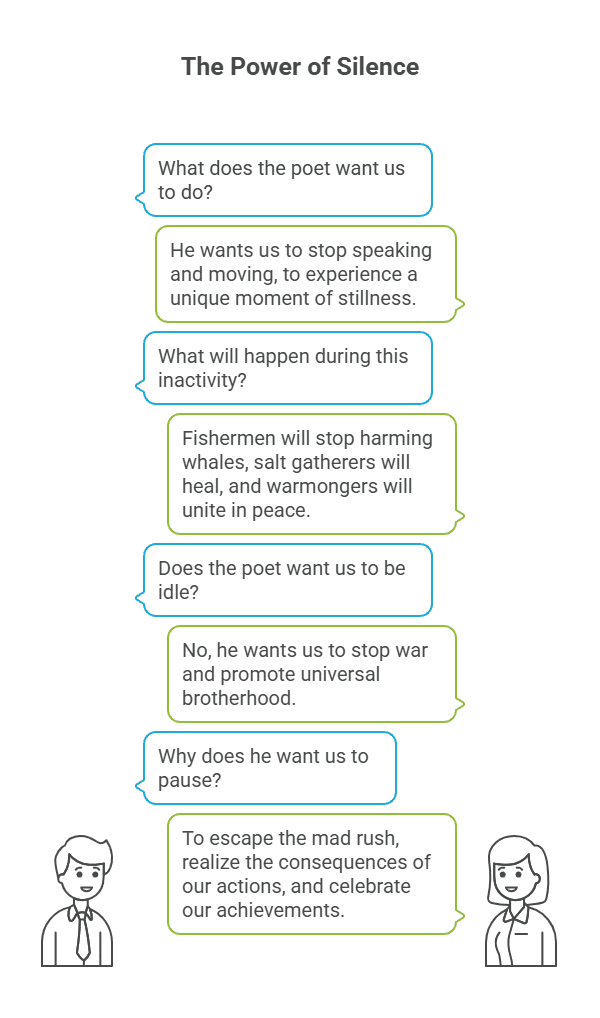
Question: Give a summary of the class 12 poem ‘Keeping Quiet’.
Ans – “Keeping Quiet” is a peace poem written by the Chilean poet Pablo Neruda. The poet asks humanity to count numbers from one to twelve – twelve being the number of hours shown in a clock or the number of zodiac signs. He requests everyone not to speak because languages create barriers between people. The moment when everyone stops moving their body will be very special and different as we have never experienced such a moment before.
The poet says that in this period of inactivity the fishermen would not harm the whales, the salt gatherers will not hurt their hands, those who are busy destroying the nature will adopt a new approach towards life, The men who are preparing for wars and victory based on deaths of innocent people will join their enemy and stand in unity with them, doing nothing. No one will harm himself or any other person. Everyone will unite and ponder upon his acts and realize the results of his deeds.
The poet clarifies his idea and says further that he does not want that people should stand idle. He wants that there should be no war because he does not want to see trucks laden with dead bodies of the soldiers. He is promoting Universal brotherhood and peace.
The poet says that everyone is working continuously, to achieve one’s goals. People are threatened by death and the fear forces them to work endlessly so that they can achieve everything quickly. In this mad rush, they do not realize the repurcutions of their acts. He wants us to pause and come out of the mad rush. He wants us to be happy about our achivements and celebrate them. He wants us to overcome the fear of death and to relax for a while. We should know the results of our deeds and celebrate our achievements.
When the people will remain quiet for a while, they will realize the purpose of their lives. Just like all the creations of nature undergo a rebirth with the change of seasons, similary, keeping quiet will be a rebirth for the human soul. It will give a new meaning to our life. Again, the poet says that he will count till twelve and asks everyone to remain quiet while he leaves.
Keeping Quiet Summary in Hindi Video Explanation

Questions based on the themes of the poem Keeping Quiet
Questions: What is the importance of keeping quiet class 12?
Ans. The poem talks about the importance of keeping quiet. We can keep quiet by counting to twelve and not talk in any language or move our arms and weapons during that time. Those twelve seconds of inactivity and silence will allow us to introspect our actions and decisions and contemplate the consequences. Those who work continuously like an engine will take a break that they deserve. We will put down our tools and weapons and stop our machinery for once. We will not encourage the self-imposed barriers by speaking in different languages. Fishermen will stop hunting fish and hurting whales. The men who gather salt will look at their hurt hands. War will be paused and we will all walk together with the spirit of brotherhood.
Questions: What are the activities that Pablo Neruda speaks out against in his poem Keeping Quiet?
Ans. Pablo Neruda speaks out against harmful human activities in his poem “Keeping Quiet”. The harmful human activities are those actions in which humans destroy the life within them and around them while they work single-mindedly on a goal. These human activities require continuous and arduous labour. These can harm people, such as the men who have to fight in wars and those who gather salt by hand. These human activities can result in mass destruction and loss of life, like wars. These can result in extreme environmental degradation, like green wars, and fishermen hunting and harming aquatic life.
Questions: How does the poet distinguish between stillness and death in Keeping Quiet?
Ans. Stillness and death are distinguished in the poem “Keeping Quiet”. Pablo Neruda explains that he advocates for silence and stillness, not for death. Keeping quiet means being still and silent, and reflecting on your actions and emotions. Stillness is the act of introspection, whereas death is the end of all activity and movement. The poet wants us to stop working and introspect, not to die.
Questions: What is the tone of the poet in Keeping Quiet?
Ans. Pablo Neruda is calm, serene, and encouraging in his poem “Keeping Quiet”. He requests the readers to count to twelve and stop any activity to introspect. He is insistent, but not stern or harsh. He deeply explains the importance of keeping quiet and the adverse consequences of human activities. The poet is friendly and helpful, with the aim of helping us to contemplate our decisions and actions. He wants us to find purpose and gives a solution to our sadness. He is caring as he talks about how mindless, continuous work harms us, people, and the environment.
Questions: How can we understand ourselves by keeping quiet?
Ans. When we keep quiet, we do not move or speak. We are not interacting with anything. This silence and stillness allow us to think more clearly, giving us time and space to introspect. Introspection is the act of thinking about our actions, thoughts, feelings, and the consequences of our actions. We can understand what we want and who we are more deeply when we introspect. The poet highlights how we are constantly sad and depressed because we cannot understand ourselves and figure out our purpose in life. However, by keeping quiet, we can introspect and find out what we want and need in life. Therefore, we can understand ourselves by keeping quiet because through that we will find our purpose in life.
Questions: What is the role of nature in the poem Keeping Quiet?
Ans. Pablo Neruda encourages us to keep quiet by talking about nature. He wants us to observe how nature becomes still and silent during winters but lively and bright during spring season. Therefore, nature shows us that we cannot develop if we keep working single-mindedly all the time. Nature itself is advising us to calm down and introspect, so we can bloom and develop to a stronger and better version of ourselves later on. Therefore, nature shows how keeping quiet is crucial for our development.
Questions: What is the central idea of the poem ‘Keeping Quiet’ for Class 12?
Ans. The poem sheds light on the importance of keeping quiet in a calm, serene, and encouraging tone. The poet wishes to guide us by teaching us the importance of keeping quiet. Inactivity and non-verbal communication will foster peace and harmony as it will not allow different languages to be spoken and stop wars and harmful actions. Human activities are single-minded and goal-oriented. We work like machines and engines, working loudly and continuously until we are burnt out. We do not think about the consequences of our actions, and so we end up harming ourselves with continuous labour, the environment, and brotherhood with our weapons and human-made wars. However, keeping quiet is equivalent to death. Keeping quiet means stillness and silence for some time and giving ourselves a moment to just think, feel and introspect. On the other hand, death means the permanent ending of all movement and speech. Stillness will also allow us to understand ourselves and find a purpose in life. We can learn the importance of keeping quiet by observing the nature around us. Nature embodies the harmony between stillness and growth. Nature shows the importance of keeping quiet for a positive and stronger growth.
Question: Why does Pablo Neruda choose stillness rather than a call to action to convey his message of peace?
Ans. Unlike a protest poem that might demand immediate change, Neruda uses stillness as his tool because he believes real change begins with introspection, not more activity. He suggests that our constant motion — the “single-minded” rush to keep moving — is itself the problem, since it leaves no space to notice the harm we cause. By asking us to simply stop, count to twelve, and observe, he lets people arrive at their own realization about war, environmental destruction, and self-alienation rather than being told what to think. This makes the poem’s method mirror its message: peace cannot be forced or rushed into existence, it has to emerge from a quiet, voluntary pause — much like the Earth’s own stillness in winter that precedes spring’s renewal.
Keeping Quiet Previous Year Questions with Model Answers PDF
Download the previous year questions of the Poem Keeping Quiet of class 12 English for free. With the help of this, you can prepare for the exam.
To Download Keeping Quiet Previous Year Questions with Model Answers- Click Here
Bonus – Tips to Score 95% in English Paper
Keeping Quiet Explanation
POEM
First stanza
Now we will count to twelve
and we will all keep still.
For once on the face of the Earth
let’s not speak in any language,
let’s stop for one second,
and not move our arms so much.
- The poet asks everyone to count up to twelve in their mind. The number twelve represents the hours of the day or the months of a year.
- He wants all of us to be calm and still.
- People across the nations have to unite together, so, they shall not speak their own languages, rather they all shall keep quiet and speak the language of silence.
- This will bring unity among all the humans on the face of the Earth.
- For at least one moment, no one shall move his arms either to signal, or to fight, or argue with each other.
The poet here requests everyone to count till twelve in their own mind and to stop for a while. May be this ‘twelve’ referred by the poet is the twelve hours in the clock or the twelve months in an year. He wants everyone to stop and calm down. The poet urges everyone not to speak any language. As we all know that there are different languages spoken in different parts of the earth which sometimes become a barrier in our way for peace. So, he asks people not to speak. Not only this, he also wants us to stop moving our arms. By using the word ‘arms’ he means the weapons which are used by different countries to raise a war against each other. So basically the poet is demanding peace from all of us.
Literary devices:
Assonance: Use of vowel sound ‘o’ and ‘e’ (Now we will count to twelve, not move our arms so much)
Anaphora: Two consecutive lines starting with the word ‘Let’s’
let’s not speak in any language,
let’s stop for one second,
Alliteration: the repetition of a consonant sound at the start of 2 or more closely placed words.
‘we will’ – ‘w’ sound is repeated
Questions based on the stanza above-
Question: What does the poet mean by counting up to 12?
Ans. The poet of “Keeping Quiet” wants us to count to 12 because 12 is a significant number. There are 12 hours on a clock and 12 months in a year. Therefore, the number represents a complete cycle of time. So keeping quiet for 12 seconds means that we are calm for a complete cycle of time.
Question: Why does the poet ask us to count to 12?
Ans. The poet, Pablo Neruda, asks us to count to 12 so we can stop moving and speaking and simply introspect and contemplate our actions.
Question: Why does the poet say not to speak any language?
Ans. Pablo Neruda requests not to speak any languages because words and varied languages impose boundaries among us. He wants us to keep quiet and enjoy a moment of harmony and brotherhood.
Question: What does the poet mean by “not move our arms so much”?
Ans. The line “not move our arms so much” in stanza one of the poem “Keeping Quiet” has two meanings. One is that the poet is requesting us to keep still and not work for twelve seconds. Second is that the poet wants soldiers to put down their ‘arms’ or weapons and foster brotherhood instead of hostility.
Question: What do you understand by the “face of the Earth” in keeping quiet?
Ans. The phrase “face of the Earth” in “Keeping Quiet” means that the poet is asking the entire Earth not to speak and move while counting up to twelve. It signifies how the face of Earth will be completely calm during those twelve seconds.
Question: What is the meaning of the first stanza of “Keeping Quiet”?
Ans. The poet, Pablo Neruda, of the poem “Keeping Quiet” requests the readers to count to twelve and keep still without moving or speaking. In these twelve seconds, the Earth will finally be calm and quiet. No one will be working, fighting with weapons, and talking in different languages and enforcing the linguistic barriers among humans.
POEM Second stanza
It would be an exotic moment
without rush, without engines,
we would all be together
in a sudden strangeness.
Fishermen in the cold sea
would not harm whales
and the man gathering salt
would look at his hurt hands.
Explanation of the poem passage above:
When everything will come to a standstill, it will be a rare situation.
- No one will be in a rush, there will be no engines running.
- Everyone will be calm and quiet, united with each other in a strange atmosphere.
- It will be strange because it has never happened earlier.
- No person would be harming any other living being either for food or to earn his livelihood.
- All the people who work endlessly will get some time to look at their injuries and the damage they have caused to their body.
Poet says that it would be a rare situation when there will be no engines working. Here he wants to stay that if everything comes to standstill, it will be a very different moment. If all the engines like the vehicles and machines stop, then there will be a sudden, strange situation as the world will experience a sudden calmness. People will not be in a rush to achieve material things one after another. Further the poet says that the fisherman will also stop and not harm whales in the sea. This means that the poet is urging everyone not to harm the animals. Here he gives the example of whales which are being hunted for the purpose of food or trade. He also wants people to calm down so that they can stop and see what they have achieved or lost. For this he gives the example of the man who gathers salt, whose hands are hurt. Here he wants everyone to stop for a while in order to see and feel their achievements and how much they have lost for the sake of attaining such materialistic things.
Literary devices:
Alliteration- ‘we would’ – ‘w’ sound is repeated, ‘sudden strangeness’ – ‘s’ sound is repeated, ‘his hurt hands’ – ‘h’ sound is repeated
Questions based on the stanza above-
Question: What would be the exotic moment in the poem “Keeping Quiet”?
Ans. The ‘exotic moment’ in the poem “Keeping Quiet” means a strange period of time. Here, it references keeping quiet for twelve seconds. When we all stop talking, speaking, and fighting, it will be calm and quiet. Because we are never silent and still, this will be a strange thing to experience for all of us.
Question: What does the poet expect the fisherman to do in the poem Keeping Quiet?
Ans. The poet of “Keeping Quiet” expects the fisherman to stop working when keeping quiet. When he stops working, he will stop harming the whales and think about the consequences of his actions. When the fisherman will think about his actions, he will realise that he is harming the environment.
Question: What does the poet say about the man gathering salt?
Ans. The poem “Keeping Quiet” tells us that counting to twelve and keeping quiet will stop harmful human activities. Human activities harm the person doing it too. The example for this is the man gathering salt with his bare hands. When he stops working and introspects, he will look down at his hands and realise how much pain he is in.
Question: What does sudden strangeness mean in keeping quiet?
Ans. The phrase ‘sudden strangeness’ is important in the poem “Keeping Quiet”. The poet says that if we all keep quiet for twelve seconds, the entire world will be quiet and still, which will be an exotic moment for us. We will all suddenly realise the beauty of silence and not working single-mindedly, which will be a new and strange experience for us. Therefore, we will all come together in the moment of being in a sudden and strange exotic moment.
POEM Third stanza
Those who prepare green wars,
wars with gas, wars with fire,
victory with no survivors,
would put on clean clothes
and walk about with their brothers
in the shade, doing nothing.
What I want should not be confused
with total inactivity.
Life is what it is about;
I want no truck with death.
Explanation of the poem passage above:
- The people who exploit the green wealth of nature by deforestation, or mining, or fishing in the deep seas and the soldiers who use weapons to kill fellow human beings need some time to introspect into the consequences of their actions. They are merely doing their job or following orders.
- He wants them to put on ‘new clothes’ i.e. to adopt a new approach towards life and to realize that killing so many people is not a victory.
- He wants all of us to be united as one, consider our enemy to be our brother.
- He is promoting brotherhood, peace and unity.
- He does not want us to stop our works but to take some time and analyze the results of our deeds.
The poet asks everyone to stop those activities which are damaging the environment. Today all the human beings are making money by damaging the environment with their activities such as mining, deforestation, letting the chemical waste into rivers, etc. The poet asks us not to do so. He also requests people not to involve in wars as there is no benefit of achieving such victory in which no one is left alive. He says so because wars and environmental damage will lead to no life on earth. Rather, he wants people to adopt a new approach towards life and mankind. He says that you should treat your enemy like brothers and promote peace and harmony in the world.
Literary devices:
Alliteration: ‘wars with’ – ‘w’ sound is repeated, ‘clean clothes’ – ‘c’ sound is repeated
Assonance: use of vowel ‘o’ (victory with no survivors, would put on clean clothes and walk about with their brothers)
Repetition: use of ‘war’
Questions based on the stanza above-
Question: Who are the brothers mentioned in the stanza of the poem Keeping Quiet?
Ans. The brothers mentioned in the third stanza of the poem “Keeping Quiet” are the fellow human beings who fight with each other due to man-made distinctions and boundaries. This shows that the poet Pablo Neruda
Question: What is meant by green wars in the poem “Keeping Quiet”?
Ans. In the poem “Keeping Quiet”, different kinds of wars are mentioned. Green wars are the wars that destroy or harm the environment. Therefore, it refers to the large scale destruction of the environment.
Question: What kind of wars does the poet mention in the poem Keeping Quiet?
Ans. The poet mentions three kinds of wars in the poem “Keeping Quiet”. There are green wars, wars with fire, and wars with smoke.
Question: What does the poet mean by saying “victory with no survivors” class 12 keeping quiet?
Ans. “Victory with no survivors” refers to the situation after a war. The war ends with a country or group of people winning, but in both sides, no people are alive to celebrate the victory. It is an impactful line that describes how there are no winners in a war because no one survives to celebrate the victory.
Question: What is ironic about the line “victory with no survivors”?
Ans. The line “victory with no survivors” in the poem “Keeping Quiet” is ironical because victory is something to be celebrated and to be happy about. However, a victory in a war is not something happy because no one is there to celebrate it. People die and the place around is destroyed in a war. When there are no survivors, there will be no celebration, or happiness about the supposed victory.
Question:What does the poet want from the lovers of the war?
Ans. Pablo Neruda wants the lovers of the war to put down their weapons and calm down. He wants them to put on clean clothes and walk around with their fellow human beings under the shade. He wants the lovers of the war to realise the adverse effects of their actions and choose brotherhood and peace over destruction.
Question: Do you think the poet advocates total inactivity and death?
Ans. No, the poet does not advocate total inactivity and death. Pablo Neruda wants the readers to think, introspect, and enjoy the silence. Introspection is not equivalent to total inactivity.
Question: What does the poet mean by saying “I want no truck with death”?
Ans. “I want no truck with death” means that Pablo Neruda does not advocate death in his poem “Keeping Quiet”. He wants the readers to indulge in silence, stillness, and introspection, not total inactivity and death.
POEM Fourth stanza
If we were not so single-minded
about keeping our lives moving,
and for once could perhaps a huge silence
might interrupt this sadness
of never understanding ourselves
and of threatening ourselves with death.
Explanation of the poem passage above:
- All human beings work endlessly with the aim of completing all their tasks.
- They are driven by the target of survival and the threat of death.
- So they are in a mad rush to accomplish all their works.
- He says that perhaps, if they pause for a while, they can appreciate their achievements and their lives would become happier.
- He suggests that by keeping quiet, we will be able to understand the true purpose of our life.
Now the poet wants to clarify to his readers that when he asks them to stop from saying or doing anything, he doesn’t want anyone to become a non active person. Non active is a person who remains idle and doesn’t do anything. Here, he simply means that we should stop and see the consequences of our deeds. The poet doesn’t want to see people being killed due to their greed for money and expansion of territories. Further, he says that people are continuously working to achieve their tasks without even thinking about their results. They are in fear of death and therefore, want to achieve most of the things before their death. Here he urges them to stop for a while and take some moment to relish on what they have achieved till now. Everyone here is living a life in which he wants to achieve various things one after another. But now the poet says it is the time to stop and see what has been achieved and should be enjoyed. This will help us skip the sadness which has become so prominent in our lives. The sadness of not enjoying what we have achieved and the greed to achieve what next is in the list to be achieved.
Literary devices
Alliteration: we were, so single – minded
enjambment: and for once could perhaps a huge silence……..of threatening ourselves with death.
Questions based on the stanza above-
Question: What is the ‘sadness’ that the poet refers to in the poem?
Ans. The ‘sadness’ that the poet refers to in “Keeping Quiet” is the frustration, grief and confusion from not understanding ourselves. When we do not know ourselves or our purpose in life, we are sad and depressed in our lives.
Question: Why does the poet feel that we are threatening ourselves with death?
Ans. The poem “Keeping Quiet” tells us that we threaten ourselves with death due to a sadness that comes from not understanding ourselves. When we don’t take the time to stop moving and speaking, we do not understand our motives and purpose. This makes us overcome with negative emotions and we threaten ourselves with death because it seems like a way to end all sadness.
Question: What are we single-minded about in keeping quiet?
Ans. We are single-minded about keeping our lives moving. We are single-mindedly working and moving just to go from one day to the next without exactly carrying out our purpose and understanding ourselves.
POEM Fifth stanza
Perhaps the Earth can teach us
as when everything seems dead
and later proves to be alive.
Now I’ll count up to twelve
and you keep quiet and I will go.
Explanation of the poem passage above:
The poet suggests us to take a teaching from nature.
- As the Earth undergoes changes, in winter, everything freezes, becomes lifeless but after some time, the season changes again, and everything comes back to life.
- Similarly, taking a pause and introspecting into our lives will give it a new meaning. We will be able to understand the purpose of our life. It will be like a re birth of the soul.
- The poet has conveyed to all the people the purpose of his message and so, he asks them once again to take a pause, count till twelve and walks out of the scene, keeping the scene open for all the people on the Earth to experience this for times to come.
So, now the poet suggests to the human beings that we should learn a lesson from Earth. During the winters everything freezes and becomes lifeless. But when season changes and its the onset of spring season, everything present in the nature such as the trees, birds, rivers, etc gets life. So here, the poet, by giving the example of nature, wants to say that all the human beings should stop and try to judge their deeds. They can try and make their life better with calmness, peace. Finally, he ends up by saying that now he will count upto twelve so that we all may become quiet. Here ‘quiet’ means to calm down ourselves and move towards the path of peace and harmony. After saying this he says ‘I will go’. He says so as he has conveyed his message to the people and wants them to be left alone to think about it and work in the direction of peace.
Questions based on the stanza above-
Question: What symbol from Nature does the poet invoke to say that there can be life under apparent stillness?
Ans. The poet takes the example of the earth to prove that there can be life under apparent stillness. The Earth never gets inactive. In winter, things come to a standstill as the water bodies freeze, the trees shed their leaves, etc. But as soon as the spring season comes, it brings with it the lovely flowers and flowing rivers and a new life is given to nature. So, the poet wants to convey that we should stay calm, but that doesn’t mean that it will bring total inactivity and stillness.
Question: How can keeping quiet change our attitude to life?
Ans. Keeping quiet can change our attitude to life. It is a calming and transformative experience that allows us to introspect and contemplate our actions and thoughts. We can understand ourselves better and experience positive growth and development. By keeping quiet, we can learn the importance of moving and speaking with purpose rather than single-mindedly. We learn that growth can occur when we are still, silent, and understanding our purpose in life.
Question: Why does the poet say “you keep quiet and I will go”?
Ans. Pablo Neruda ends the poem “Keeping Quiet” with the line “you keep quiet and I will go”. This shows the tone of the poet. The poet is friendly, helpful, and patient. He wants us to understand the importance of keeping quiet but he does not want to force it upon us. He says that he would go away because he does not want to irritate the readers by constantly requesting them to keep quiet. This shows the poet’s wisdom and maturity.
Keeping Quiet Class 12 Video Explanation
Rhyme scheme of the poem
The poem is written in free verse. It does not follow any rhyme scheme.
Keeping Quiet FAQs
Question: Who is the narrator of Keeping Quiet?
Ans. The poem Keeping Quiet is narrated by the poet Pablo Neruda.
Question: What is the theme of the class 12 poem Keeping Quiet?
Ans. The central message of the poem Keeping Quiet is World peace. The poet advocates silence and introspection so that we can realize the harms that we are doing and we can improve our actions. This moment of silence and inactivity will be a rare moment which he calls ‘exotic’. Then the people will see the harms that they are doing to themselves. He advocates peace and says that wars are wasteful. We must take the example of the earth where life seems to have finished and then new life begins.
Question: What type of poem is ‘Keeping Quiet’?
Ans. It is a peace poem.
Question: What does the poet wish?
Ans. The poet wishes for peace and happiness in the world.
Question: What is the poem Keeping Quiet about?
Ans. The poem is a ‘peace poem’. The poet advocates world peace and says that we must remove barriers like languages. He asserts that we are all ‘brothers’. He does not support any form of war because they are ‘wasteful’. Pablo requests for a few moments of silence and inactivity wherein we can introspect and assess our actions. He gives the example of the Earth where everything seems to be dead and later, comes back to life. Similarly, humans need to renew their life through renewed actions.
Keeping Quiet Summary in Hindi
“कीपिंग क्वाइट” चिली के कवि पाब्लो नेरुदा द्वारा लिखित एक शांति कविता है।
कवि मानवता से एक से बारह तक की संख्या गिनने के लिए कहता है। बारह एक घड़ी में दिखाए गए घंटों की संख्या या राशियों की संख्या भी हो सकती। वह सभी से न बोलने का अनुरोध करता है क्योंकि भाषाएं लोगों के बीच अवरोध पैदा करती हैं।
जिस क्षण हर कोई अपने शरीर को हिलाना बंद कर देता है वह पल बहुत ही खास और अलग होगा जैसा कि हमने पहले कभी ऐसे क्षण का अनुभव नहीं किया है।
कवि का कहना है कि निष्क्रियता के इस दौर में मछुआरे व्हेल को नुकसान नहीं पहुंचाएंगे, नमक इकट्ठा करने वाले अपने हाथों को चोट नहीं पहुंचाएंगे, जो प्रकृति को नष्ट करने में व्यस्त हैं वे जीवन के प्रति एक नया दृष्टिकोण अपनाएंगे।
जो लोग निर्दोष लोगों की मौत के आधार पर युद्ध और जीत की तैयारी कर रहे हैं, वे अपने दुश्मन में शामिल हो जाएंगे और उनके साथ एकता में खड़े होंगे, कुछ भी नहीं करेंगे।
कोई भी खुद को या किसी अन्य व्यक्ति को नुकसान नहीं पहुंचाएगा। हर कोई एकजुट होगा और उसके कार्यों पर विचार करेगा और उसके कर्मों के परिणामों को महसूस करेगा।
कवि अपने विचार को स्पष्ट करता है और आगे कहता है कि वह नहीं चाहता कि लोग बेकार खड़े रहें। वह चाहता है कि युद्ध न हो क्योंकि वह सैनिकों के शवों से लदे ट्रकों को नहीं देखना चाहता। वह सार्वभौमिक भाईचारे और शांति को बढ़ावा दे रहे हैं।
कवि कहता है कि प्रत्येक व्यक्ति अपने लक्ष्य को प्राप्त करने के लिए निरंतर कार्य कर रहा है। लोगों को मौत की धमकी दी जाती है और डर उन्हें अंतहीन काम करने के लिए मजबूर करता है ताकि वे सब कुछ जल्दी से हासिल कर सकें। इस भागदौड़ में, उन्हें अपने कृत्यों के प्रतिफल का एहसास नहीं होता है।
वह चाहता है कि हम रुकें और पागलों की भीड़ से बाहर आएं। वह चाहता है कि हम अपनी उपलब्धियों के बारे में खुश रहें और उनका जश्न मनाएं। वह चाहता है कि हम मौत के डर पर काबू पाएं और कुछ देर आराम करें। हमें अपने कर्मों के परिणामों को जानना चाहिए और अपनी उपलब्धियों का जश्न मनाना चाहिए।
Also See
Class 12 Important Videos Links
Class 12 English Poem Summary and Explanation
| My Mother at Sixty-Six | Keeping Quiet |
| A Thing of Beauty | A Roadside Stand |
| Aunt Jennifer’s Tigers |
Also See :
- CBSE Class 12 English Notes, Lesson Explanation
- CBSE Class 12 English MCQ Question Answers
- Class 12 English Flamingo Book Chapter wise word meanings
- Class 12 English Flamingo Poems Word meanings
- Class 12 English Vistas Book Word meanings
- CBSE Class 12 English Important Question Answers
- Character Sketch of Class 12 English
- Class 12 English Core Previous Year Question Answers (2019-2025) Chapterwise
- Class 12 English Core Previous Year Question Paper with Solutions 2019-2025